Emotional Intelligence for Traders: A Practical Guide to Trading with EQ
Editor’s note: This article is educational content designed to help traders understand and develop emotional intelligence. It is not a substitute for professional mental health support.
That gap between what you know and what you actually do when real capital is on the line? That’s where emotional intelligence lives.
Emotional intelligence for traders is about building internal skills that help you recognize what’s happening inside you, respond deliberately instead of reactively, and stay aligned with your process when every instinct is screaming at you to deviate. This guide lays out a working framework for understanding trading EQ, along with a concrete daily practice plan you can start using immediately.

What Emotional Intelligence Actually Means for Traders
If you’ve ever closed a winning trade too early because anxiety crept in, or doubled down on a loser because you couldn’t stomach being wrong, you already know what low emotional intelligence feels like. EQ is a measurable, trainable set of skills that directly shapes your trading psychology and, eventually, your account balance.
The concept was popularized by psychologist Daniel Goleman, who identified core competencies that determine how effectively people manage themselves and their relationships. While Goleman’s original framework wasn’t designed with trading in mind, its core ideas adapt naturally to the challenges traders face every session.
The Four Pillars of EQ Applied to Trading
The following pillars are loosely adapted from Goleman’s broader emotional intelligence framework, reframed here for a trading context:
- Self-awareness: Recognizing your emotional state in real time. Noticing when fear, greed, or frustration is shaping your decisions before you click the button.
- Self-regulation: Managing your responses rather than being controlled by them. This is what separates a trader who pauses after a loss from one who fires off a revenge trade.
- Motivation: Internal drive rooted in process and growth, not just profit. Traders with strong intrinsic motivation can weather drawdowns without abandoning their system.
- Social awareness: Reading the emotional climate of markets and trading communities without getting swept into herd behavior.
Each one translates into observable trading behaviors you can track, measure, and improve over time.
Why IQ and Strategy Are Not Enough
You probably know traders who are brilliant analysts but terrible executors. They can dissect a chart with surgical precision, then panic-sell the moment price moves against them by ten pips. Strategy gives you the map. EQ gives you the ability to follow it when the terrain gets rough.
Think of it like driving. Knowing the rules of the road and having a fast car won’t help much if you freeze at every intersection or floor the accelerator when someone honks at you. EQ is the steady hand on the wheel.
So what happens when that steady hand is missing?
How Low Emotional Intelligence Destroys Trading Accounts
A solid week of disciplined trading can unravel in a single afternoon of emotionally charged decisions. Low EQ doesn’t announce itself. It disguises itself as conviction, as “gut instinct,” as justified risk-taking. But the account balance tells the real story.

The Revenge Trade Cycle
You take a well-planned trade. It hits your stop loss. Objectively, it was a clean setup that simply didn’t work out. But something shifts emotionally. Before you’ve even processed the loss, you’re scanning for another entry. Not because the market is offering one, but because you need to “get it back.”
This next trade is larger, less planned, and on a shorter timeframe than your system calls for. If it loses too, the cycle intensifies. Each successive trade becomes less about what the market is doing and more about the emotional wound demanding attention.
The core issue was never the initial loss. It’s the inability to sit with discomfort without trying to fix the feeling through action.
Fear-Based Exits and Missed Opportunities
Fear creates a quieter form of destruction. You enter a trade aligned with your plan. It moves in your favor, then pulls back slightly. You cut it short, feel a brief wave of relief, and then watch it continue to your original target without you.
Over dozens of trades, this habit of cutting winners short while letting losers run to full stop-loss quietly warps your risk-reward profile. Your win rate might look decent on paper, but your average winner ends up as a fraction of your average loser.
Overconfidence After Winning Streaks
Three winners in a row and suddenly the market feels easy. You start sizing up, skipping confirmations, taking setups you’d normally pass on. Then the inevitable losing trade arrives, at inflated size. The emotional whiplash from overconfident high to unexpected loss is deeply destabilizing.
Recognizing these patterns is the first step. But you also need a systematic way to track what’s actually happening inside you.
Self-Awareness: The Foundation of Trading EQ
Every emotional trading mistake starts with a moment you didn’t notice. A tightness in your chest before you oversized. A flash of irritation right before a rule break. Self-awareness is about catching these moments in real time, before they translate into clicks.
Recognizing Your Emotional Triggers
Your triggers are specific conditions that reliably push you toward emotional trading. Common ones include:
- Hitting a daily loss limit
- Watching a skipped trade move without you
- Trading during high-impact news
- Trading after poor sleep or personal conflict
But your triggers are personal, and they won’t be identical to anyone else’s. Start by listing every trade from the past month where you broke your rules, then ask: what was happening internally in the minutes before? Patterns tend to emerge fast.
Using a Trading Journal for Emotional Tracking
A standard trading journal tracks entries, exits, and P&L. An emotionally intelligent journal goes deeper, capturing the internal state that produced those results.
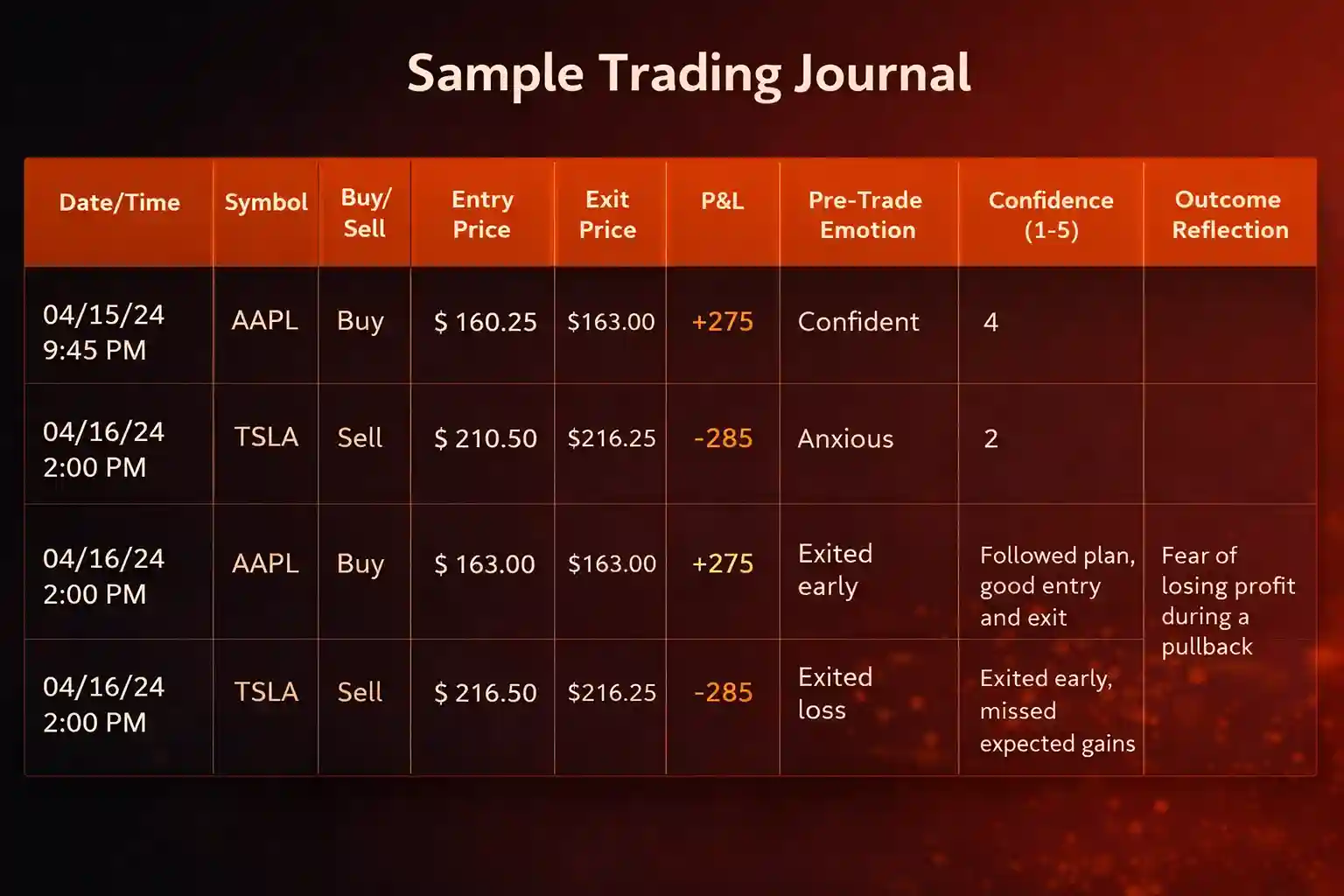
Add these columns to your existing journal:
- Pre-trade emotional state: How are you feeling before entry?
- Confidence level (1-5): How confident are you in this specific setup?
- Post-trade reflection: Did your emotional state shift during the trade?
- Trigger identification: If you deviated from your plan, what triggered it?
After a few weeks, you’ll start seeing correlations between emotional states and specific mistakes. Those correlations become actionable data: the kind that actually changes behavior.
Awareness without action, though, is just observation. The next step is learning to regulate your responses.
Self-Regulation: Controlling Reactions Under Pressure
Knowing you’re angry after a loss is self-awareness. Choosing not to trade until the anger passes is self-regulation.
Think of regulation less like an on/off switch and more like a thermostat. You’re not trying to eliminate the heat entirely, just keeping the temperature in a functional range.
Pre-Trade Routines That Reduce Emotional Noise
The best time to regulate emotions is before they spike. An effective pre-trade routine includes:
- A brief market review (5-10 minutes) focused on what you’re looking for today, not reacting to what’s already happened.
- A personal check-in to honestly assess your current state. Tired? Anxious? Overconfident?
- A rule reminder where you re-read your top three trading rules.
- A commitment statement about what you will and won’t do this session.
Each step pulls you out of autopilot and into deliberate engagement with the session ahead.
The Pause Protocol: Creating Space Between Impulse and Action
When you feel the urge to act, particularly after a loss or a strong emotional reaction, insert a mandatory waiting period.
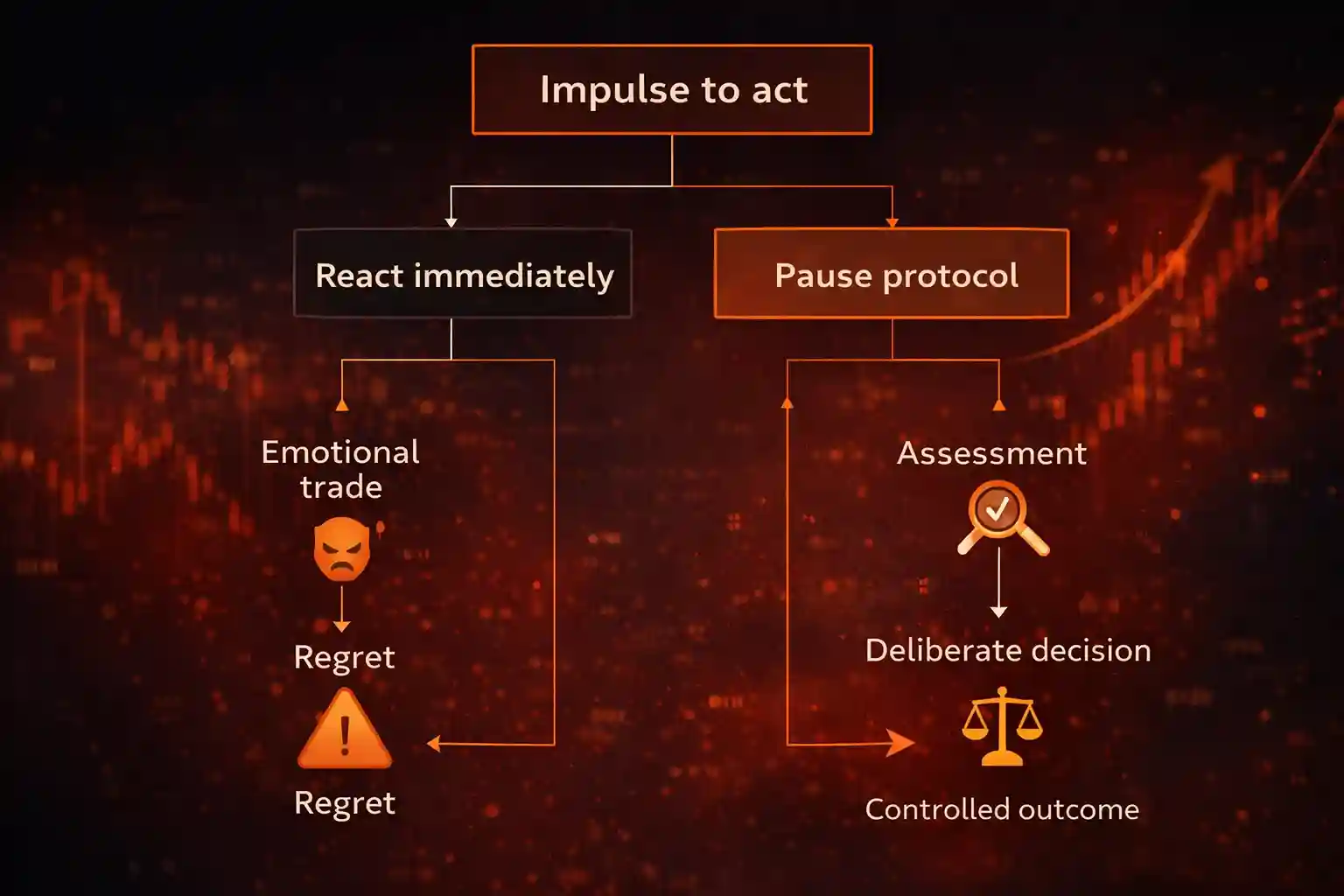
- Notice the impulse to trade.
- Remove your hands from the keyboard.
- Set a timer for 2-5 minutes.
- Ask yourself: Is this in my plan? Am I acting on analysis or feeling? Would I take this trade if I were flat on the day?
- If all three answers support the trade, proceed. If not, walk away.
Most emotional impulses are intense but short-lived. A two-minute gap is often enough for the rational part of your brain to catch up with the reactive one.
Motivation and Discipline Beyond the P&L
If your motivation depends entirely on making money, every drawdown becomes an existential crisis. Traders with strong EQ anchor their motivation to something more durable than the daily P&L column.
Process Goals vs. Outcome Goals
Outcome goals (“make $500 today”) create dependency on results you can’t fully control. Process goals, by contrast, target behaviors that are always within your reach:
- “I will take only A+ setups today”
- “I will honor my stop-loss on every trade”
- “I will complete my journal before closing my platform”
Consistently hitting process goals tends to produce the outcomes anyway, without the emotional rollercoaster that comes from chasing a number.
Staying Consistent During Drawdowns
Drawdowns test everything: your strategy, your risk management, and your emotional resilience. A few practical approaches worth considering:
- Reduce size, not frequency. Stay engaged with the market while lowering the emotional pressure on each trade.
- Review data, not feelings. Check your journal. Is this a stretch of poor execution, or is it normal variance within your system?
- Set circuit breaker rules. Something like: “If I hit X consecutive losses, I stop for the session.” Making this decision in advance removes the emotional component when you need it most.
Empathy and Social Awareness in Trading Communities
Trading communities can be genuinely valuable, but they also become emotional amplifiers if your social awareness isn’t sharp enough to filter the noise.
Reading Market Sentiment Without Getting Swept Into It
Market sentiment is useful data. The danger lies in absorbing it rather than observing it. Crowd sentiment is loudest at exactly the wrong moments: at tops when euphoria is universal, and at bottoms when fear is all-consuming.
Treat sentiment the way a meteorologist treats public weather complaints: interesting, sometimes informative, but never a replacement for your own instruments.
Navigating Social Media and Trading Groups
Social media creates specific EQ challenges worth naming:
- Comparison traps from cherry-picked winner posts
- Urgency bias from rapid-fire channels
- Authority confusion from loud voices with unverified track records
The antidote is deliberate engagement. Set specific times for social consumption, ideally not during active trading hours. And before acting on anything you see, pause and ask: “Is this changing my analysis, or just my emotions?”
Building Your Emotional Intelligence: A Daily Practice Plan
Reading about EQ is useful. Practicing it daily is what actually changes your trading. This framework takes roughly 15-20 minutes total, spread across your session.

Morning Mindset Check
Before opening any charts, take five minutes:
- How did I sleep? Fatigue is a well-known contributor to emotional trading. If the answer is “poorly,” consider reducing your position size for the day.
- What’s my emotional baseline? Anxious, calm, excited? Name it without judging it.
- Is anything outside trading likely to affect me today?
Write one or two sentences for each. This creates a record you can review later for patterns.
Mid-Session Emotional Audit
A 60-second check-in during natural pauses in the session:
- Has my emotional state shifted since this morning?
- Am I still trading my plan, or have I started improvising?
- How reactive am I right now, on a 1-5 scale?
If reactivity hits 4 or 5, activate the Pause Protocol or step away from the screen entirely.
End-of-Day Reflection Framework
After closing your platform, spend five to ten minutes in your trading journal:
- What was my best emotional moment today?
- What was my worst?
- Did my morning assessment predict how the day actually went?
- What’s one specific thing I’ll do differently tomorrow based on today’s emotional data?
The power here is in the pattern recognition that builds over weeks and months of honest reflection.
Frequently Asked Questions