Hope vs Strategy: Why Hopeful Traders Lose and Strategic Traders Survive
In trading, hope might be the most expensive emotion you ever indulge.
This isn’t a motivational speech about discipline. It’s a practical breakdown of how hope infiltrates your trading decisions, why your brain defaults to it under pressure, and exactly how to replace it with a rules-based process that keeps you in the game.
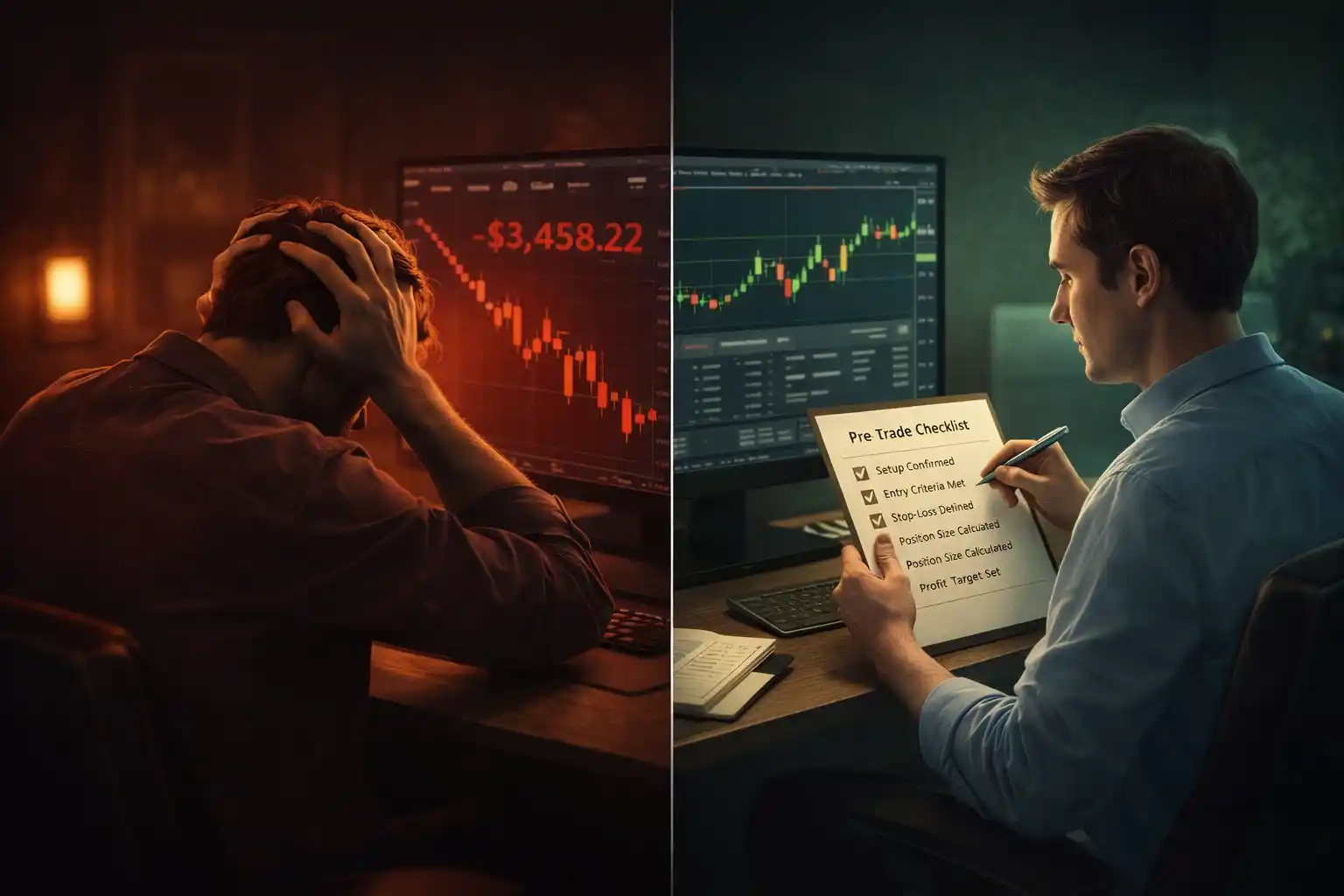
What Hope Actually Looks Like in a Trading Account
Hope in trading disguises itself as patience, as conviction, as “giving the trade room to breathe.” But once you know what to look for, the behavioral fingerprints are unmistakable.
The Anatomy of a Hope-Based Trade
A hope-based trade usually starts like any other. You spot a setup, enter a position, maybe even set a stop-loss. Then the trade moves against you, and something shifts.
The stop-loss gets widened or removed entirely. You drop to a lower timeframe, hunting for evidence that supports your position. You start scanning news articles that confirm your bias. You tell yourself, “It just needs to get back to my entry, and then I’ll close it.”
That internal dialogue is the anatomy of a hope-based trade. The original plan is gone. What’s left is emotional improvisation dressed up as analysis.
Common Scenarios Where Hope Replaces Logic
Hope tends to creep in during predictable moments. Recognizing them is your first line of defense:
- Averaging down without a plan. You didn’t intend to add to a losing position, but the price “looks cheap.” So you double down, not because your strategy called for it, but because lowering your average makes the math feel better.
- Holding through a broken setup. The technical pattern that justified your entry has already invalidated, but you’re still holding because closing now means locking in a loss.
- Ignoring your stop-loss. The price hit your pre-defined exit, but you moved it or simply watched it blow past, telling yourself you’d get out on the next bounce.
- Checking the chart compulsively. If you’re refreshing every thirty seconds, you’re not managing a trade. You’re watching and wishing.
Every one of these behaviors shares a common trait: the original plan has been abandoned, and emotion is running the show.
Why Your Brain Defaults to Hope Under Pressure
Your brain wasn’t built for trading. It was built for survival in environments where cutting losses meant abandoning shelter or food. Understanding this mismatch is key to overcoming it.
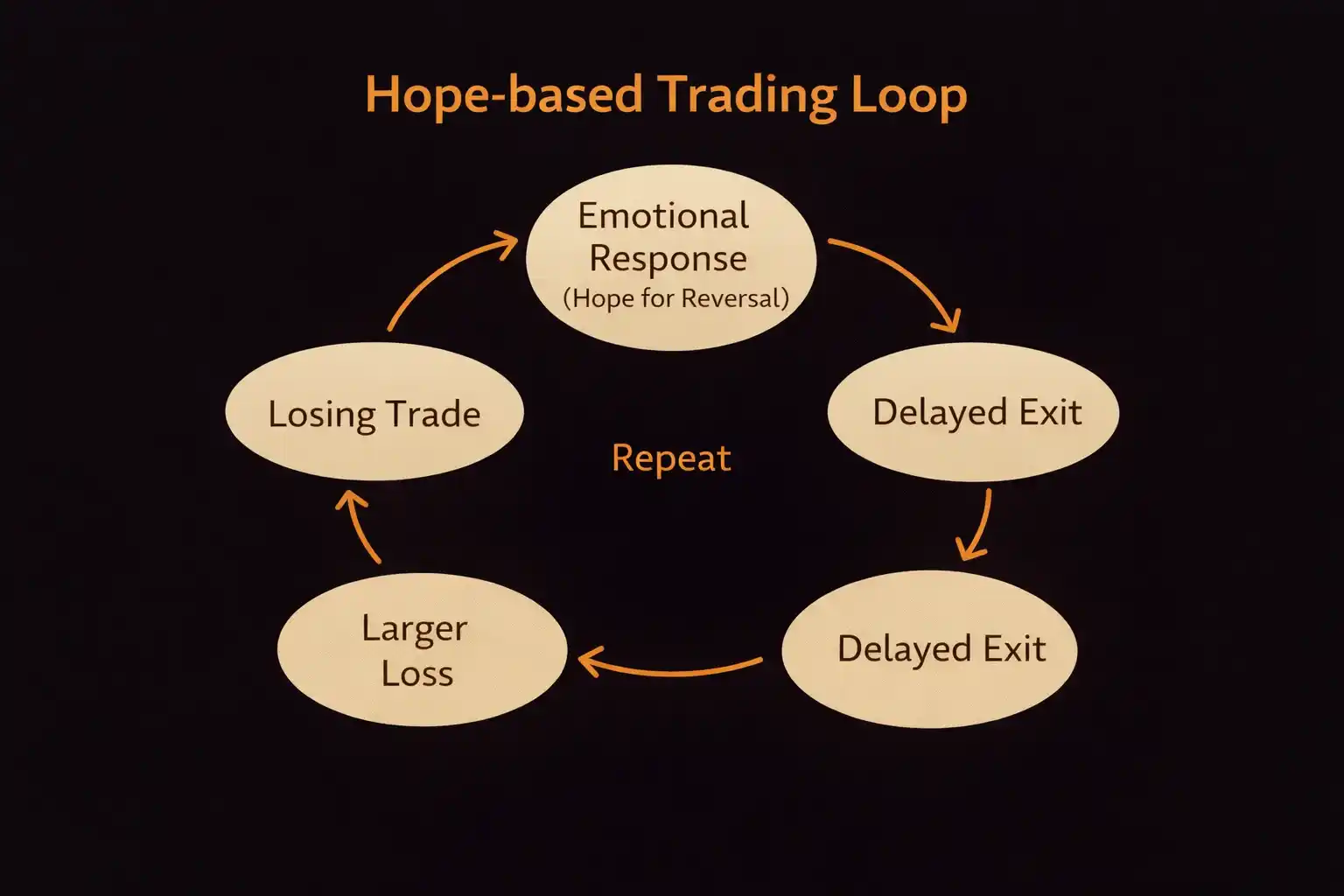
Loss Aversion and the Sunk Cost Trap
Behavioral economists have documented loss aversion extensively: the pain of losing money is roughly twice as intense as the pleasure of gaining the same amount. In trading, this bias makes you hold losing positions far longer than you should. Your brain frames closing a losing trade as “making the loss real,” even though the loss is already real on your screen. As long as the position stays open, uncertainty gives hope somewhere to live.
Layered on top of that is the sunk cost trap. You’ve already invested time, energy, and capital. Walking away feels like wasting all of it. Think of it like sitting through a terrible movie because you paid for the ticket. The rational move is to leave, but it feels wrong. In trading, that feeling costs far more than a movie ticket.
How Wishful Thinking Hijacks Your Trade Management
Wishful thinking doesn’t just affect whether you exit a trade. It warps how you manage it. You start interpreting neutral price action as bullish confirmation. A single green candle carries more weight in your mind than the three red ones before it. You reframe a trading psychology pattern failure as “a shakeout before the real move.”
This is selective perception at work. Your brain, desperate to dodge the pain of a loss, filters information to support the outcome you want. And here’s the uncomfortable truth: intelligence alone doesn’t override millions of years of hardwired emotional circuitry.
Recognizing the pattern is half the battle. The other half is building a system that doesn’t rely on your in-the-moment judgment.
What Strategy-Based Trading Actually Means
Strategy-based trading sounds deceptively simple: have rules, follow them. In practice, it demands structure that locks in decisions before the emotional pressure arrives.
Rules Before Entry, Not Rationalizations After
The core principle is straightforward. Every meaningful decision gets made before you enter the trade. Your entry criteria, position size, stop-loss, and target are all defined while you’re calm and objective.
Once you’re in a live trade with real money at risk, you are biologically compromised. The rational part of your brain that built the plan is no longer fully in charge.
Think of it like a pilot’s pre-flight checklist. Pilots don’t decide mid-turbulence whether they checked the fuel levels. Every critical item gets verified before takeoff, because the consequences of guessing are too high.
The Role of Pre-Defined Exit Criteria
Your exit plan is arguably more important than your entry. Most traders pour 90% of their energy into finding the “perfect entry” and almost none into defining what happens next. That imbalance is exactly where hope fills the vacuum.
Pre-defined exit criteria include a specific stop-loss level based on chart structure, a profit target defined by the same logic that justified your entry, and a time-based exit if the trade hasn’t moved as expected.
When these criteria are locked in before entry, trade management becomes mechanical. The question shifts from “Should I hold or close?” to “Have my pre-defined conditions been met?” That reframing removes hope from the equation entirely.
Hope vs Strategy: A Side-by-Side Decision Framework
Theory is useful. But what does this actually look like when the pressure is on? Let’s compare the hope response and the strategy response to two common situations.
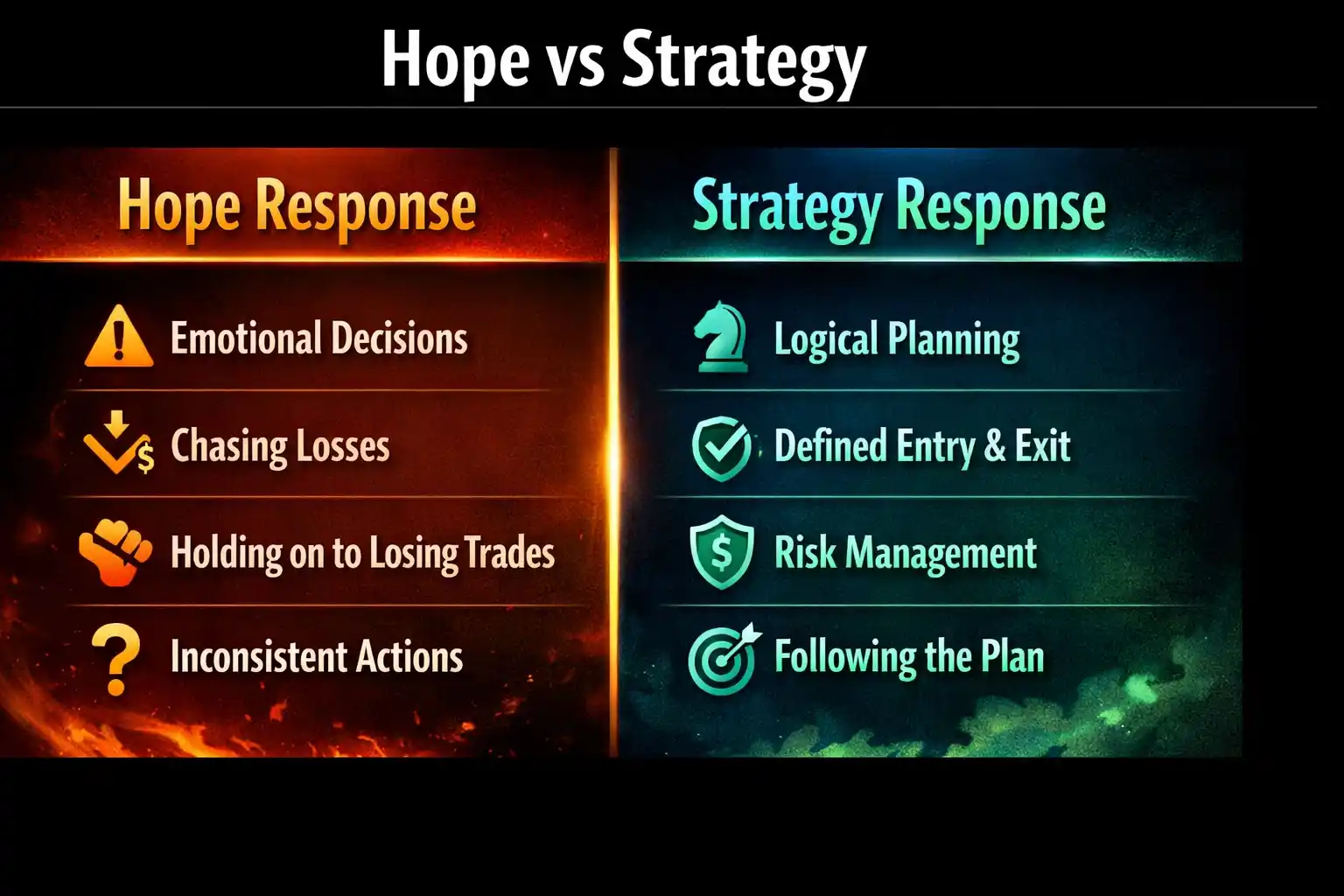
Holding a Losing Position: Hope Response vs Strategy Response
Hope Response | Strategy Response | |
Stop-loss hit | “It’s just a wick.” Moves or removes stop. | Stop triggers automatically. Trade closed. Log the result. |
Position keeps dropping | Adds to the position. Seeks confirmation bias. | No action. Trade was already closed at pre-defined level. |
End of day | Still holding, hoping for a gap-up. | Reviewing the journal, noting what worked and what didn’t. |
The strategic trader might have taken the same loss in dollar terms. The difference is their loss was planned, contained, and informational. The hopeful trader’s loss is open-ended, escalating, and teaches nothing.
Reacting to Unexpected News: Hope Response vs Strategy Response
Hope Response | Strategy Response | |
Negative news hits | “The market is overreacting.” Holds and waits. | Checks if news changes original thesis. If yes, exits per risk management rules. |
Volatility spikes | Freezes. Watches screen. Hopes for reversal. | Evaluates whether volatility hit pre-defined “abort” threshold. Acts accordingly. |
Recovery starts | “See, I knew it!” Reinforces hope behavior. | Re-evaluates whether recovery fits strategy parameters. Doesn’t let relief dictate decisions. |
Notice the pattern: the hope response is reactive and emotional. The strategy response is proactive and systematic. Every single time.
How to Eliminate Hope from Your Trading Process
You can’t eliminate emotion from trading. But you can build systems that make your emotions irrelevant to your outcomes.
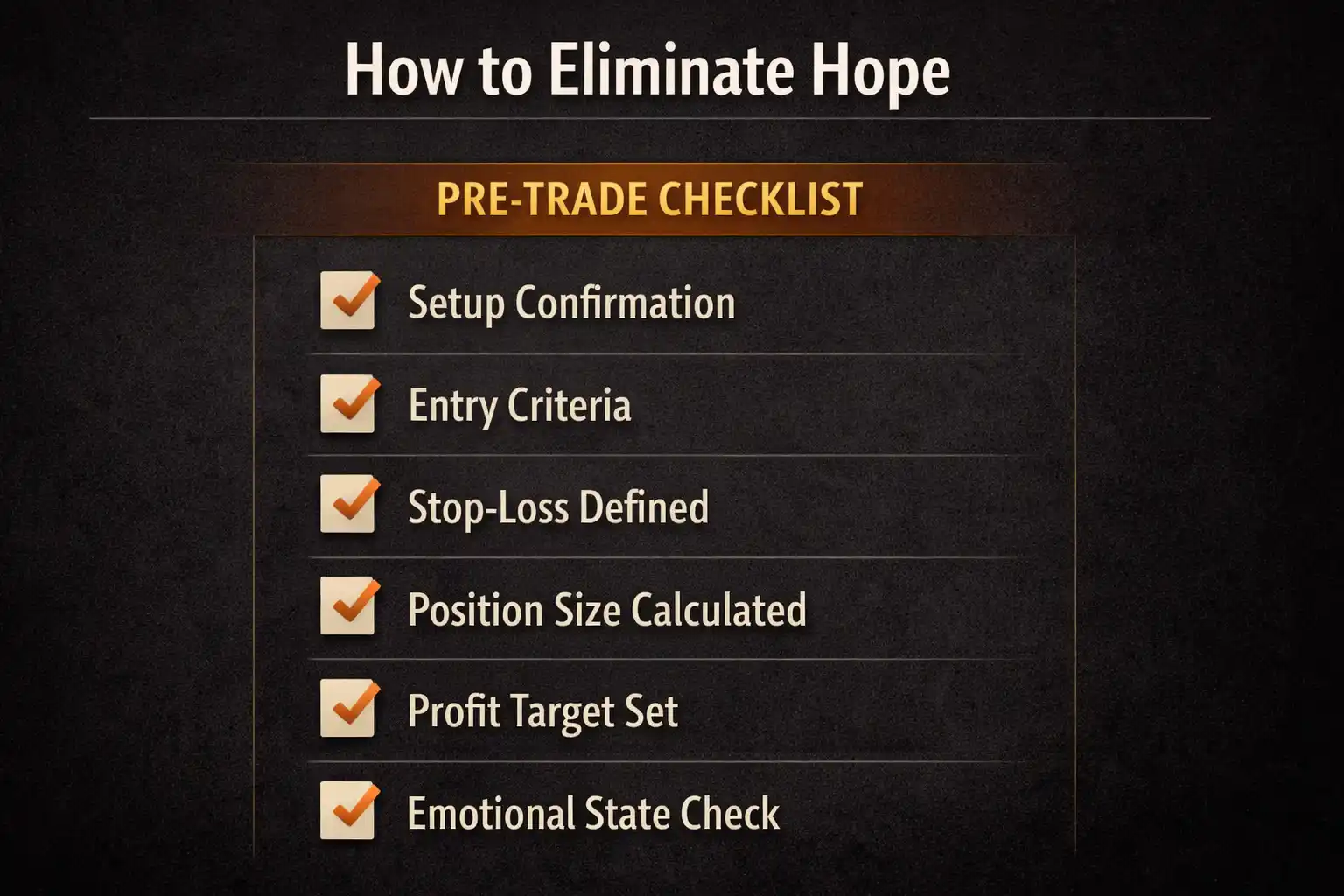
Building a Pre-Trade Checklist
A pre-trade checklist is your most powerful tool against hope-based decisions. It forces you to verify that a trade meets every criterion before you commit capital.
A solid checklist includes:
- Setup confirmation. Does this trade match one of your defined setups? If you can’t name it, you don’t have one.
- Entry criteria. Has the specific trigger fired, or are you anticipating it?
- Stop-loss defined. Where exactly will you exit if wrong? Based on chart structure, not emotional comfort.
- Position size calculated. Is the maximum loss within your risk parameters?
- Profit target set. What needs to happen for you to close as a winner? Is it specific and measurable?
- Emotional state check. Are you entering because the plan says to, or because you’re chasing a previous loss?
If any box goes unchecked, the trade doesn’t happen. No exceptions.
Using a Trading Journal to Catch Hope Patterns
A trading journal is where hope-based habits get exposed. When you log your trades consistently, you create a dataset of your own behavior, and patterns surface fast.
Here’s what to track beyond the basics:
- What you were thinking when you entered. Write it in real time, not after the fact. Memory is unreliable, especially after a loss.
- Any mid-trade adjustments. Did you move your stop? Add to the position? What triggered that decision?
- Your emotional state at key decision points. Calm, anxious, frustrated, or riding a high?
- Whether you followed your plan. A simple yes or no. Over 20 to 30 trades, the correlation between plan adherence and profitability becomes hard to ignore.
The journal isn’t about guilt or self-punishment. It’s a feedback loop that makes the invisible visible.
Accountability Structures That Work
Self-awareness is necessary but often not enough on its own. External accountability adds friction between impulse and action, and that friction can save you real money.
Structures that traders find effective:
- Trading buddy or accountability partner. Someone who reviews your journal weekly and asks the uncomfortable questions you’d rather skip.
- Automated execution. Setting stop-losses and take-profits as actual orders, not mental notes. The system doesn’t hope.
- Daily review routines. Ten minutes at the end of each session reviewing whether your actions matched your plan. This mirrors prop firm-style discipline, where external rules structurally remove the option to hope through a losing trade.
- Cooling-off rules. Two consecutive losses means you stop for the session. No bargaining, no “one more try.”
These aren’t radical ideas. They’re guardrails for a dangerous road.
When Conviction Is Not Hope: Drawing the Line
Here’s an important nuance worth sitting with: not every instance of holding a losing trade is hope-based. Sometimes, genuine conviction is warranted.
The distinction comes down to one question: is your reason for holding based on objective evidence, or on the desire for a different outcome?
Conviction looks like this: the trade is down, but the original thesis remains intact. The setup hasn’t invalidated. The stop-loss hasn’t been hit. You’ve reviewed the position against your criteria, and the plan says “hold.”
Hope looks like this: the trade is down, the setup has broken, and you’re still in because “it might come back.” You’ve stopped referencing your plan because the plan says to exit.
Conviction is evidence-based patience. Hope is fear-based inaction. The line between them isn’t always obvious in the moment, which is exactly why you need the checklist, the journal, and the accountability. These tools don’t just catch hope. They confirm conviction.
Disclaimer: This article is for informational purposes only and does not constitute financial advice. Trading involves significant risk. Always conduct your own research and consider consulting a qualified financial advisor.
Frequently Asked Questions