How to Journal Trades: A Complete System for Any Trader
You already know you should be journaling your trades. Every trading book, every course, every seasoned trader has hammered the same point. But knowing and doing are separate problems, and the real gap is method. Most traders who try journaling quit within a week because they never had a workable system to begin with.
This guide gives you that system. You will walk away with a concrete structure for your trading journal, a clear understanding of what to record for every trade, and a practical routine for reviewing your data so it actually drives improvement.

What a Trading Journal Actually Is (and Is Not)
A trading journal is not a trade log.
A trade log records what happened: entries, exits, profits, losses. Your broker already gives you that. A trading journal captures the why behind every decision, the context surrounding every trade, and the mental state you were in when you pulled the trigger.
Think of it this way: your broker statement is the scoreboard. Your journal is the game film. One tells you the result. The other reveals everything that led to it.
A good trading journal connects your decision-making process to your outcomes. It turns scattered trading experiences into structured data you can actually analyze. Over time, it becomes the most honest mirror you have, surfacing behavioral patterns that are invisible in real time.
This is not about piling on busywork. It is about building the feedback loop that most traders are missing entirely. So what exactly belongs inside that feedback loop?
What to Record for Every Single Trade
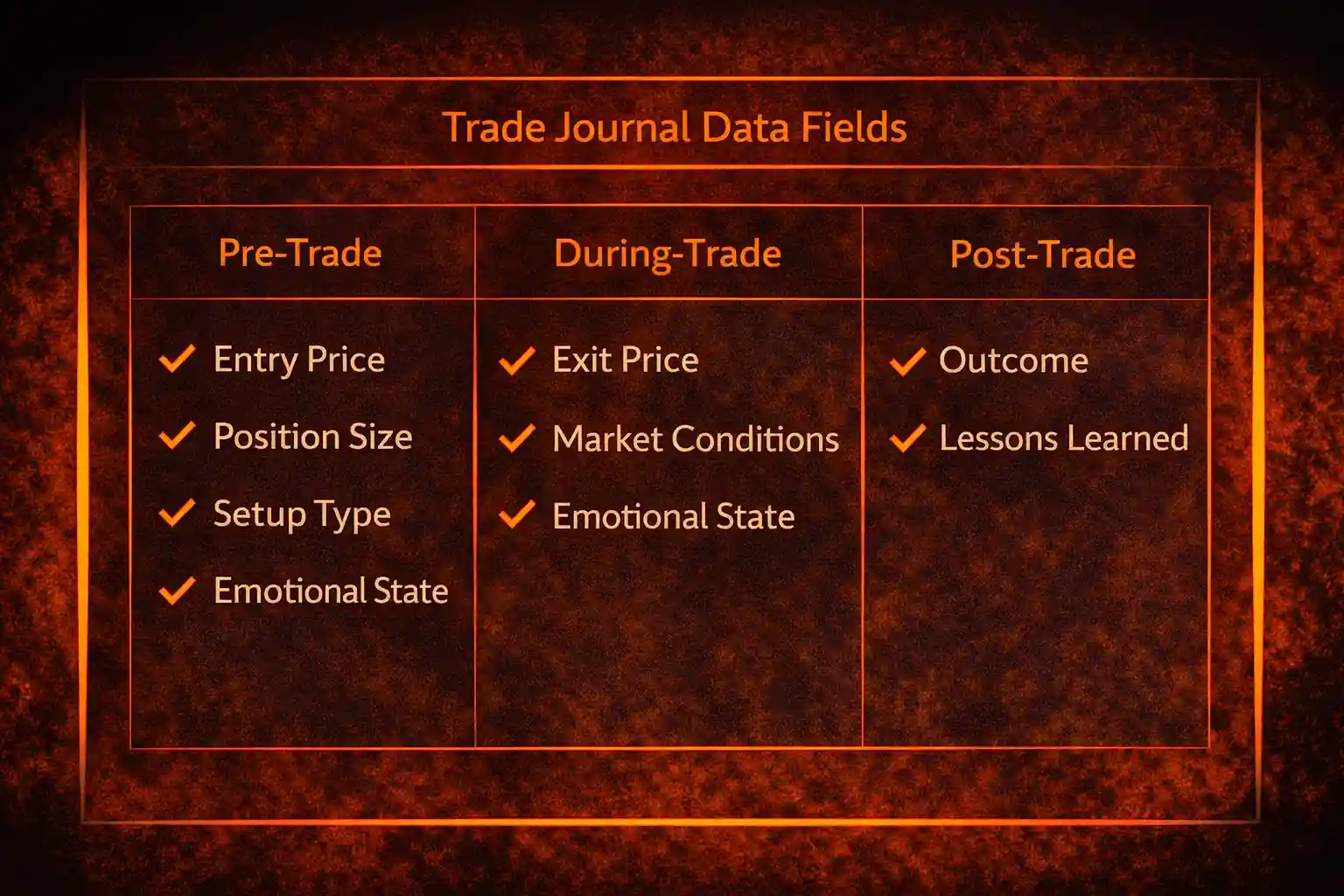
The difference between a useful journal and a wasted effort comes down to what you capture. Record too little and there is nothing to analyze. Record too much and burnout hits before the first week ends. The sweet spot is a focused set of data points organized around three phases of every trade.
Pre-Trade Data Points
Before entering any trade, capture the setup. This is where you document the reasoning that justified the risk. Include:
- Date and time of the planned entry
- Instrument (pair, ticker, contract)
- Setup type (breakout, pullback, reversal, range play, etc.)
- Entry price (planned)
- Stop-loss level and the reasoning behind it
- Target price(s) and the logic for each
- Risk-to-reward ratio (calculated, not estimated)
- Position size and how you determined it
- Market conditions (trending, ranging, volatile, low-volume, pre-news)
- Screenshot of the chart at the moment of entry with key levels marked
That screenshot is more valuable than you think. Memory distorts charts. A week from now, you will remember the trade differently than it actually looked. The screenshot keeps you honest.
During-Trade Notes
This is the layer most traders skip, and it is often the most revealing. While the trade is live, jot down anything you did that was not part of the original plan:
- Did you move your stop? Why?
- Did you add to the position or scale out early?
- Did the market hit a news event that changed conditions?
- Did you feel the urge to close early or hold longer than planned?
These notes do not need to be long. A single sentence is enough to capture the deviation. That deviation data, stacked across dozens of trades, will show you exactly where your discipline fractures.
Post-Trade Review Fields
After the trade closes, record the outcome and your honest assessment:
- Actual exit price versus planned exit
- Profit or loss (in both dollar amount and R-multiples)
- Trade grade (Did you follow your plan? A, B, C, or F, regardless of outcome)
- What worked in your execution
- What did not work or what you would change next time
- One specific lesson from this trade
Grading your trades separately from their outcomes is critical. A trade that followed your plan perfectly but lost money is still a good trade. A trade that ignored your rules but got lucky is still a bad trade. Your journal needs to reflect that distinction, because the market will eventually correct for undisciplined execution.
The Emotional Layer: Tracking Your State of Mind
Most trading journals fall short because traders do not know how to track them in a useful way.
Keep it simple. Before every trade, rate these three things on a scale of 1 to 5:
- Confidence level in the setup
- Overall mood or stress level
- Focus and alertness
After the trade, add one more:
- Emotional reaction to the outcome (calm, frustrated, euphoric, anxious, indifferent)
Over time, correlations will start surfacing. Maybe your worst trades cluster on days when stress sits above a 4. Maybe you overtrade when confidence is running high. This data is not soft or optional. It is raw material for understanding your own behavioral wiring, and it connects directly to how you manage risk.
Knowing what to record is only half the equation, though. Where and how you record it matters just as much.
Choosing Your Journal Format
Your journal format needs to match your workflow, not the other way around. There is no single best option, but there are real tradeoffs worth understanding before you commit.
Spreadsheet Journals
Spreadsheets (Google Sheets, Excel) are the most popular choice for good reason. They are flexible, free, and you can build formulas to automatically calculate win rate, average R, profit factor, and other performance metrics.
The upside is total control. You design the columns, the layout, the calculations. The downside is that spreadsheets require upfront setup time, and they handle screenshots or longer-form notes awkwardly without workarounds.
Spreadsheets work best if you are comfortable with basic formulas and want a journal that doubles as a performance tracker.
Dedicated Journal Software and Apps
Tools like Edgewonk, Tradervue, and TradeZella are built specifically for trade journaling. They typically offer automatic trade importing from your broker, built-in analytics, tagging systems, and chart screenshot storage.
The upside is convenience and ready-made analysis features. The downside is cost (most require a subscription) and the risk of depending on a tool that may change or shut down.
These work best if you want a polished, ready-to-use system and are willing to pay for that convenience.
Handwritten Notebooks
Writing by hand forces you to slow down and process each trade more deliberately. Some traders find that the physical act of writing strengthens both memory and self-awareness.
The downside is obvious: you cannot sort, filter, or run calculations. Review and pattern-finding are entirely manual.
A notebook works best as a supplement, particularly for the emotional and qualitative notes, rather than as your primary data store.
Whichever format you choose, the real priority is starting with something you will actually use consistently. A perfect system you abandon after three days is worth less than a basic one you maintain for three months. With that in mind, let’s build the system.
Building a Trading Journal Template from Scratch
Below is a simple table layout that covers all the essential data points discussed above. You can build this in any spreadsheet application in under 15 minutes.
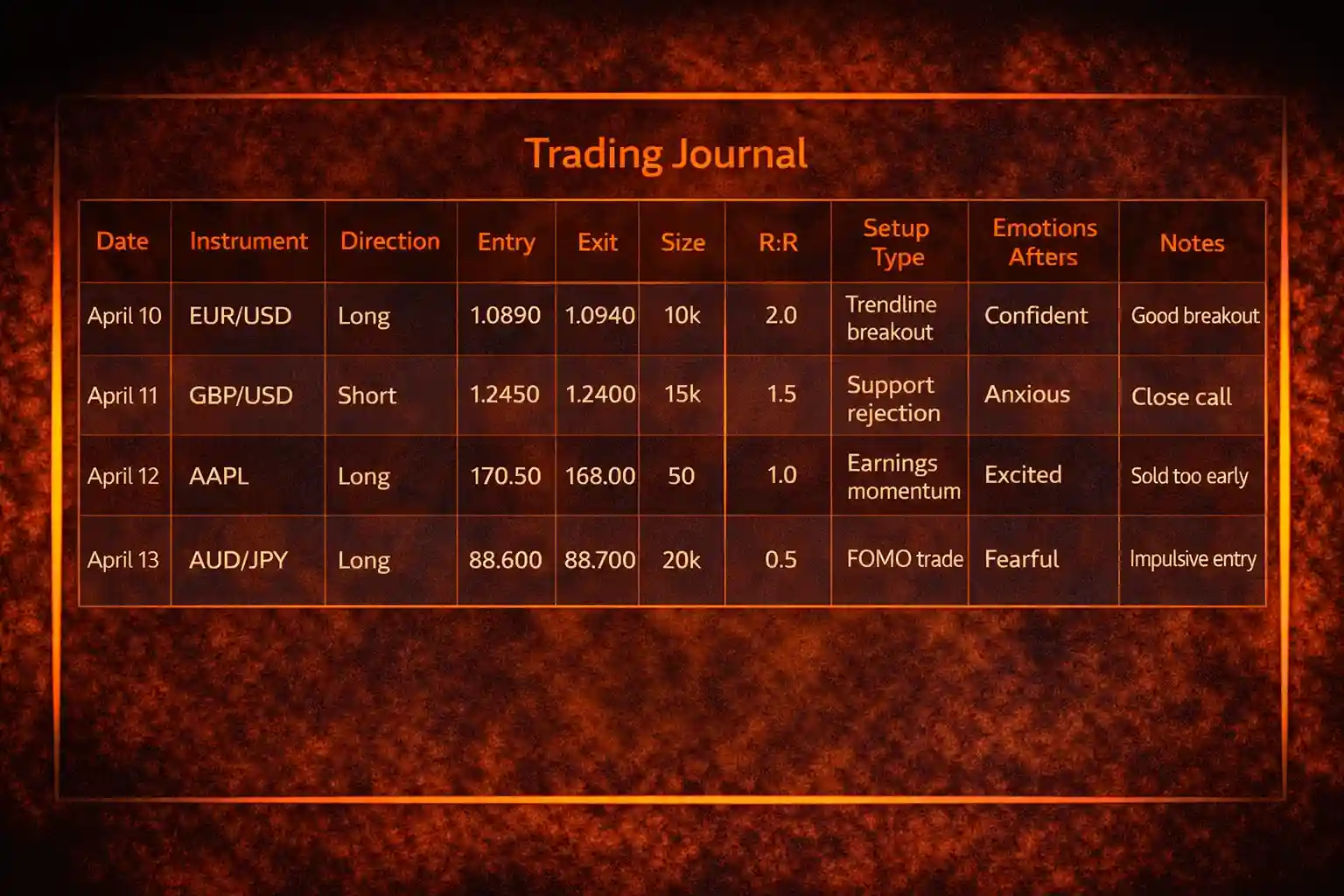
Your core columns should include:
Column | Example Entry |
Date | 2025-03-12 |
Instrument | EUR/USD |
Direction | Long |
Setup Type | Breakout above resistance |
Entry Price | 1.0842 |
Stop-Loss | 1.0810 |
Target | 1.0900 |
Position Size | 0.5 lots |
R:R Ratio | 1:1.8 |
Exit Price | 1.0888 |
P/L (R-multiple) | +1.4R |
Trade Grade | B |
Emotional State (Pre) | Confident, focused |
Notes | Moved stop to breakeven too early, missed full target |
Lesson | Trust the setup, give trades room to breathe |
Start with this. Use it for two weeks. Then adjust based on what you find yourself wanting to track that is not there, or columns you never bother filling in. Your template should evolve alongside your trading, not stay frozen in its first draft.
One tip: add a “Screenshot” column with links to chart images stored in a dedicated folder. Even if you are using a basic spreadsheet, this single habit will transform your review sessions.
With your template ready, the next challenge is building the routine that keeps it alive.
The Daily Journaling Routine That Sticks
The biggest threat to your journal is not the template or the tool. It is the gap between “I should do this” and “I did this today.” A routine closes that gap by removing decision-making from the process entirely.
Pre-Market Entry
Before you take any trades, spend 5 to 10 minutes writing a brief pre-market note. Cover three things:
- Market context – What is the overall environment today? Are there scheduled news events? Is the market trending or choppy?
- Your plan – Which setups are you watching? What are your key levels?
- Your state – How are you feeling? Rate your mood, focus, and stress using the 1-to-5 scale.
This entry takes less time than your morning coffee. Its purpose is to create a baseline, a snapshot of your intentions before the market starts pulling you in unexpected directions.
End-of-Day Review
After your trading session, spend 10 to 15 minutes logging each trade you took. Fill in the template fields while the details are fresh. Do not batch this for the weekend. By Friday, you will have forgotten the nuances that matter most.
For each trade, answer one question with full honesty: “Did I follow my plan?” That single question, answered consistently over weeks, will tell you more about your trading than any indicator or strategy guide ever could.
Weekly Performance Audit
Once a week, set aside 20 to 30 minutes to review the full week. This is no longer about individual trades. It is about the bigger picture:
- What was your overall win rate this week?
- What was your average R-multiple on winners versus losers?
- Did any specific setup type outperform or underperform?
- Were there patterns in your emotional data? Did high-stress days correlate with losses?
- Did you follow your rules more or less consistently than last week?
Write a brief summary paragraph. Three to five sentences covering what went well, what did not, and one specific focus for the week ahead. This weekly summary is the compound interest of journaling. It is where scattered trade data starts becoming genuine self-knowledge.
That self-knowledge only becomes powerful when you know how to extract it. So how do you actually review your journal in a way that produces actionable insights?
How to Review Your Journal and Extract Patterns
Recording trades is the foundation. Reviewing them is the payoff. Without regular, structured review, your journal is just a diary that happens to contain numbers.
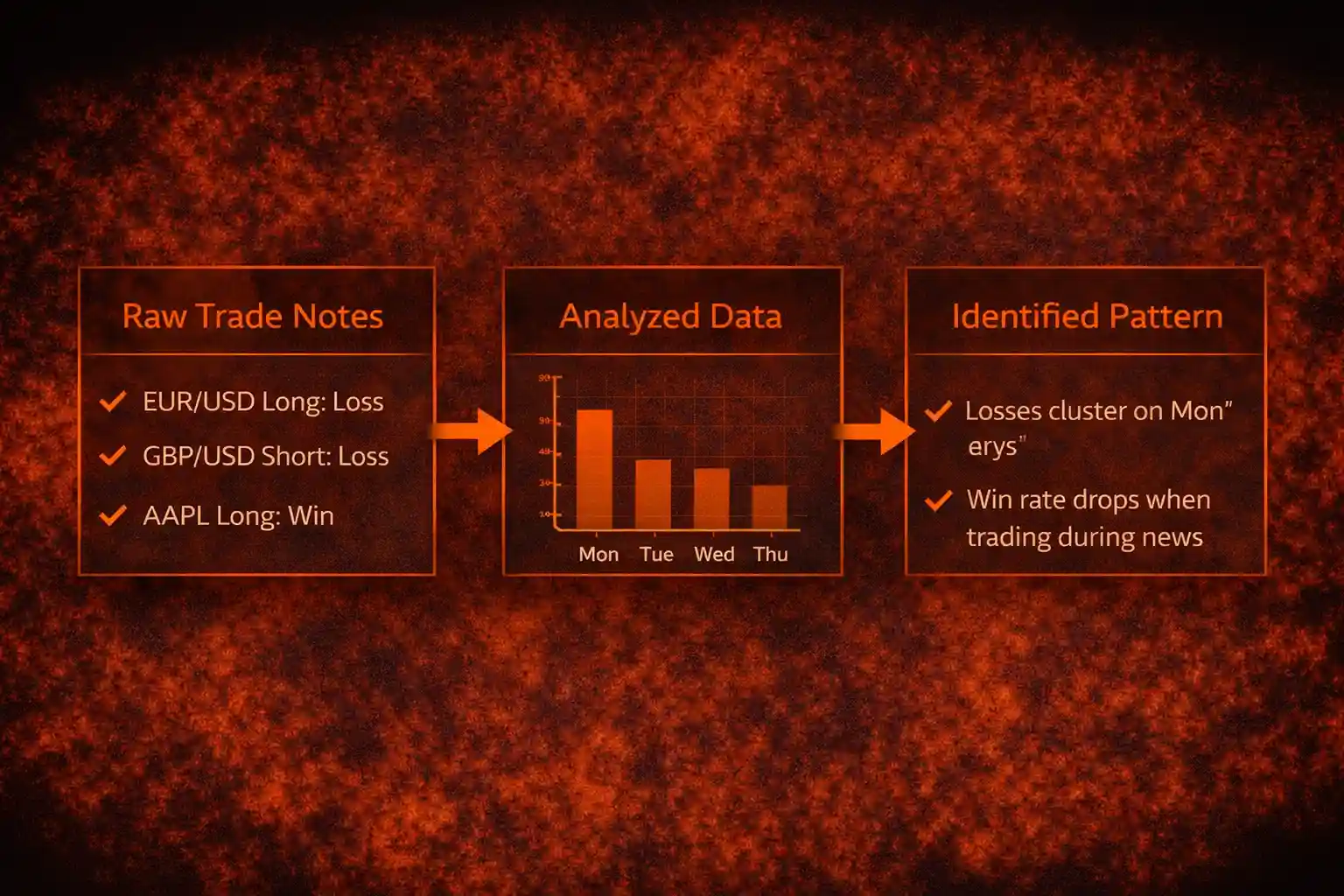
The goal of every review session is to answer one core question: “What is costing me money that I am not yet aware of?”
Start by filtering your journal data by different variables and looking for clusters. Here is a concrete example. Say you filter your last 50 trades by day of the week and discover your win rate on Mondays is 28%, while every other day sits above 50%. That is a pattern worth investigating. Maybe Monday mornings are when you force trades out of weekend anticipation. Maybe the specific market conditions on Mondays simply do not suit your strategy.
Here are some filters worth running during your monthly reviews:
- By setup type – Which setups have the highest expectancy? Which ones are you trading out of boredom?
- By time of day – Are you more profitable during certain sessions?
- By emotional state – Do your pre-trade mood ratings correlate with outcomes?
- By position size – Do you perform differently when sizing up?
- By market conditions – Do you do better in trending or ranging environments?
Each filter can expose a leak in your trading, something quietly eroding your results. Once the pattern is visible, you can build a rule around it. “I do not trade on Monday mornings” is a far more powerful rule when it is backed by 50 trades of your own data, not a tip from a stranger on the internet.
This review process is also where prop firm discipline requirements become tangible. Many funded trading programs expect the kind of self-awareness and rule adherence that only consistent journaling can build.
The system works. But only if you avoid the mistakes that kill the habit before it has time to produce results.
Common Journaling Mistakes That Kill the Habit
Even traders who start with the best intentions fall off track. These are the most common reasons journals get abandoned, and how to sidestep each one.
- Making it too complicated. If your template has 30 columns and takes 20 minutes per trade, you will stop using it. Start with the essentials and layer in complexity only when you genuinely need it.
- Only journaling losing trades. Winners contain just as much information as losers. Skipping them creates a biased dataset and turns your journal into a record of failure rather than a tool for growth.
- Not including the emotional data. Numbers alone do not explain behavior. If you skip the psychological layer, you are working with half the picture.
- Journaling without reviewing. Recording trades without regular review is like collecting gym membership receipts without ever stepping inside. The value lives in the analysis, not the logging.
- Waiting too long to log trades. Memory degrades fast. If you wait until the weekend to journal Monday’s trades, you will fill in the blanks with narratives instead of facts.
- Expecting instant results. Journaling is a long-term discipline. It typically takes several weeks of consistent entries before enough data accumulates to reveal meaningful patterns. Treat it as an investment in future clarity, not a quick fix.
The traders who stick with journaling are the ones who accept that the process is simple but not effortless, and that the real return compounds over months, not days.
Trading involves risk. This content is for educational purposes only and does not constitute financial advice.
Frequently Asked Questions