Winning Streak Psychology: How to Stay Disciplined When You’re on a Roll
The most dangerous moment in your trading career can be the one where you’re winning the most.
Winning streak psychology explores what happens inside your head when things are going right, and why that very success can quietly rewire your decision-making until it hands back every dollar you just earned. The cognitive shifts that take hold during a hot streak are subtle, powerful, and nearly universal among traders. Understanding them isn’t optional if you want to keep what you’ve made.
This article breaks down the neurological and behavioral mechanics behind winning streaks, identifies the warning signs that discipline is slipping, and gives you a repeatable framework for protecting your gains without shutting down the momentum that’s working.
This content is for informational and educational purposes only and does not constitute financial, investment, or trading advice.

What Happens to Your Brain During a Winning Streak
As far as your neurochemistry is concerned, a winning trade triggers the same reward circuitry as any other pleasurable outcome. When those wins stack up, the effects compound in ways you don’t consciously register.
The Dopamine Feedback Loop in Trading
Every time you close a profitable trade, your brain releases dopamine, the neurotransmitter tied to reward, motivation, and reinforcement learning. One win gives you a small hit. Two in a row, and your brain starts anticipating the next reward before it even arrives. Three or four, and you’re caught inside a self-reinforcing feedback loop.
Here’s how it unfolds in practice:
- You execute a trade and it wins.
- Dopamine floods your reward pathways, creating a feeling of satisfaction and competence.
- Your brain encodes the behavior that led to the win as “correct,” reinforcing it.
- Before your next trade, dopamine spikes in anticipation, making you feel confident and eager.
- You take another position, possibly larger or less carefully vetted, because the emotional pull feels like conviction.
This loop is the same mechanism that makes any rewarding behavior habit-forming. The problem is that the feedback loop can’t distinguish between a well-executed trade and a lucky one. Your brain rewards the outcome, not the process. So after a streak, you feel like a sharper trader even if the market simply moved in your favor.

Euphoria Bias and the Illusion of Control
As the streak continues, two closely related biases start running the show behind the scenes.
Euphoria bias is the tendency to overweight positive emotional states when making decisions. When you’re riding high on a string of wins, your emotional baseline shifts upward. You start reading ambiguous setups as strong signals because your emotional filter is skewed toward optimism.
Then there’s the illusion of control: the belief that your actions are influencing outcomes more than they actually are. In trading, this surfaces when you start attributing market moves to your own skill or “read,” even in situations where randomness played a significant role. After five green trades, it’s tempting to believe you’ve developed a sixth sense. You haven’t, but your brain is desperate to build a narrative that says otherwise.
Together, these biases create a dangerous cocktail: you feel great, you think you’re in control, and the market hasn’t punished you yet. That’s a setup for a correction, both in your account and your ego.
So if winning trades flood your brain with chemicals that distort judgment, what makes a winning streak more threatening than the losing streaks most traders obsess over?
Why Winning Streaks Are More Dangerous Than Losing Streaks
Most traders spend hours preparing for drawdowns. They have stop-losses, risk limits, and mental frameworks for handling red days. Yet almost nobody builds a protocol for what happens when everything is working. That gap is where accounts get blown.
Overconfidence and Position Size Creep
Overconfidence bias is one of the most well-documented phenomena in behavioral finance, and winning streaks are its ideal breeding ground. After a series of wins, you start trusting your read on the market more than your rules. The first sign is usually position sizing.
It starts small. You had a great week, so you bump your usual lot size by 20%. Then the next trade wins too, and 20% becomes 40%. Before long, you’re carrying exposure that would have made you uncomfortable two weeks ago, but now it feels “right” because you’ve been winning. This is position size creep, and it’s the mechanical bridge between overconfidence and a blown account.
Think of it like driving. When you first got your license, you were cautious, deliberate, hands at ten and two. After years of incident-free driving, you started checking your phone, rolling through stops, pushing yellow lights. Nothing bad happened, so the risk felt acceptable. Until it didn’t. Trading streaks work the same way: each consequence-free escalation normalizes the next one.
How Recency Bias Rewrites Your Risk Perception
Recency bias is your brain’s tendency to overweight recent events when forming expectations about the future. During a winning streak, your most recent memories are all positive. Your mental model of “what usually happens” shifts to reflect those wins, even if your longer track record tells a more balanced story.
This is especially tricky because it feels like updated information. Recency bias makes it nearly impossible to tell the difference between a genuine hot hand and a favorable stretch of variance.
As a result, your risk perception quietly recalibrates. Setups you would have passed on a month ago suddenly look attractive. Your stop-losses feel unnecessarily tight. Your profit targets feel too conservative. None of these adjustments come from analysis. They come from the emotional residue of recent wins rewriting your internal risk map.
But how do you know when this shift has already started? What does it actually look like in your day-to-day trading behavior?
The Warning Signs You’re Losing Discipline After Wins
The tricky part about overconfidence is that it doesn’t announce itself. You won’t wake up one morning and think, “I’m being reckless today.” It creeps in through small behavioral shifts that feel justified in the moment. The key is learning to spot these patterns before they cost you.
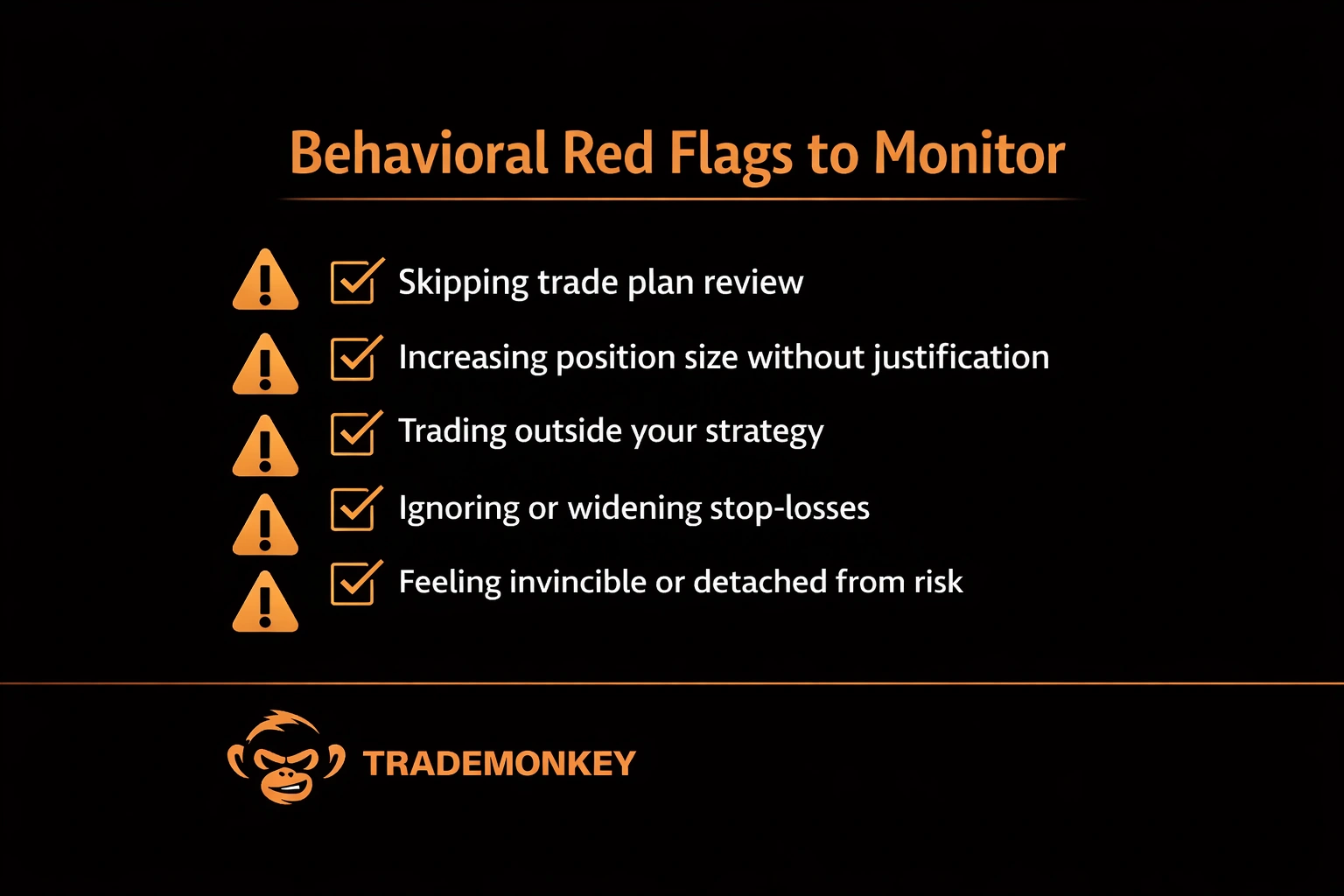
Behavioral Red Flags to Monitor
Watch for these specific warning signs during or after a winning streak:
- Skipping your pre-trade checklist or trade plan review. When you’re winning, preparation starts to feel unnecessary. You tell yourself you’ll “just take a quick look” instead of running your full process. That’s your discipline eroding in real time.
- Increasing position size without a rule-based justification. If your sizing decisions are based on how you feel rather than your risk parameters, you’ve already crossed a line. Some traders set fixed position size caps specifically to prevent this drift.
- Trading outside your defined strategy or setup criteria. You spot something that “looks good” but doesn’t fit your playbook. During a normal stretch, you’d pass. During a streak, you convince yourself it’s a valid adaptation. It usually isn’t.
- Ignoring or widening stop-loss levels. Moving stops to “give the trade room” is one of the most common streak-fueled mistakes. Your original stop was set for a reason. If the reason hasn’t changed, the stop shouldn’t either.
- Feeling a sense of invincibility or detachment from risk. This is the most honest red flag on the list. If you notice that losing feels abstract or unlikely, pay attention. Risk is always real, regardless of your recent results.
When Confidence Crosses Into Recklessness
There’s a fine line between earned confidence and reckless overconfidence, and the distinction matters more than most traders realize. Earned confidence sounds like, “My process is working, and I’m executing well.” Reckless overconfidence sounds like, “I can’t lose right now.”
The difference is where the confidence is rooted. Process-based confidence stays anchored to your system, your rules, your risk management. Outcome-based confidence is tied entirely to recent results, which means it evaporates the moment the streak ends, often taking a chunk of your account with it.
Ask yourself honestly: are you confident in your process, or are you confident because you’ve been winning? If you can’t clearly articulate the difference, it’s worth pausing to examine what’s really driving your decisions.
Once you’ve recognized the pattern, the next question is practical: what do you actually do about it?
How to Protect Your Wins Without Killing Your Momentum
The goal here is to build guardrails that keep you operating within your edge, even when your emotions are pushing you to swing bigger. The best frameworks work precisely because they remove in-the-moment decision-making from the equation.
Pre-Commitment Rules and Trade Plans
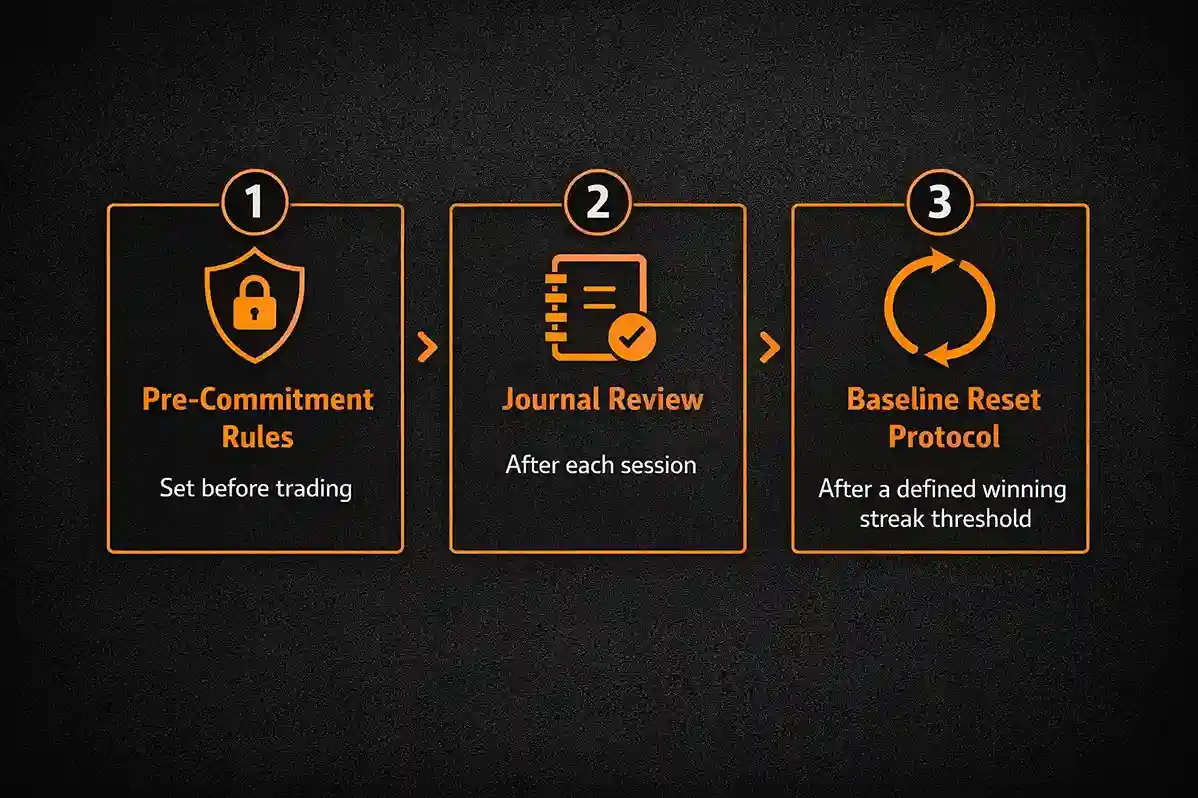
Pre-commitment is the single most effective tool against overconfidence because it shifts your decisions from the emotional present to the rational past. The concept is simple: you set your rules before the streak starts, and you commit to following them regardless of how you feel.
Effective pre-commitment rules might include:
- A maximum position size cap that doesn’t change based on recent performance
- A defined number of trades per day or week, streak or no streak
- A mandatory cooling-off period after a set number of consecutive wins (e.g., taking a half-day away from screens after five winning trades)
- A profit threshold that triggers a step-back review before continuing to trade
The power of these rules is that they’re boring. They don’t require willpower in the moment because the decision was already made. You simply follow the protocol.
The Role of a Trading Journal During Winning Phases
Most traders use journals to analyze losing trades, but journaling during winning streaks is arguably more valuable. Wins are exactly when your blind spots are hardest to see, and a structured journal forces you to look anyway.
During a winning phase, your journal entries should focus on:
- Process adherence: Did you follow your trade plan, or did you deviate and get lucky?
- Sizing rationale: Was your position size consistent with your rules, or did you bump it up?
- Emotional state: How did you feel before, during, and after the trade? Were you calm and deliberate, or excited and impulsive?
- Setup quality: Would you have taken this exact trade on a flat or losing day?
That last question is the most revealing one you can ask yourself. If the honest answer is “probably not,” then the streak is influencing your selection process, and that’s a leak you need to address before it widens.
Resetting Your Baseline After a Streak
After a strong run of wins, your psychological baseline has shifted. You need to actively recalibrate.
A straightforward reset protocol looks like this:
- Acknowledge the streak explicitly. Write down that you’ve had X consecutive wins and that your perception may be skewed.
- Review your last 20-30 trades. Reconnect with the full distribution of your outcomes.
- Revert to your base position size for a defined number of trades, regardless of conviction level.
- Re-read your trade plan from start to finish, as if you’re seeing it for the first time.
This is about resetting the calibration on your internal instruments so your next decisions are based on signal, not emotional noise.
The frameworks and checklists help in the moment. But the traders who consistently protect their gains over years share something deeper than good protocols.
Staying Humble as a Long-Term Trading Edge
Humility in trading gets a bad reputation. It sounds passive, maybe even soft. But in practice, humility is one of the most aggressive competitive advantages you can develop, because it’s the trait that keeps you in the game long enough for your actual edge to compound.
Why Humility Outperforms Conviction Over Time
Markets have a way of humbling everyone eventually. The traders who survive and thrive aren’t the ones who never get overconfident. They’re the ones who built systems to catch themselves when it happens.
Humility in this context means maintaining an accurate relationship with uncertainty. You can be confident in your process while acknowledging that any individual trade’s outcome remains unknown. You can trust your edge while understanding that variance is always part of the equation.
The traders who blow up on winning streaks are almost always the ones who start believing they’ve transcended uncertainty. They stop respecting the market’s capacity to surprise them. Humility is the antidote: not as a personality trait, but as a strategic posture that protects both your capital and your clarity.
Building a Post-Win Routine
Just as you might have a pre-market routine to sharpen focus, a post-win routine helps you decompress and recalibrate after success. Consistency matters far more than complexity.
A practical post-win routine could include:
- A 10-minute journal entry focused on process quality, not profit size
- A brief physical break (walk, stretch, step outside) to interrupt the dopamine loop
- A review of your risk parameters to confirm nothing has drifted
- A single honest question: “Am I still following my plan, or am I freelancing?”
Over time, this routine becomes automatic. It acts as a circuit breaker between the emotional high of a win and the decision-making required for your next trade. The goal is to make sure the good feeling doesn’t make your next decision for you.
Frequently Asked Questions