


How to Trade · Intermediate · 8 min read
Forex Swing Trading Signals: How to Read, Evaluate and Use Them
Forex swing trading signals are actionable trade recommendations that specify an entry price, a stop-loss, and a take-profit for a currency pair held from a few days to a few weeks. They combine technical indicators, price action, and market structure to flag medium-term setups before they fully play out, letting you act on a defined plan rather than a hunch.
What are forex swing trading signals and how do they work
Forex swing trading signals sit between day trading alerts and long-term investment calls. A swing trade (a position held for several days up to a few weeks to capture a single price move) needs a signal that survives overnight gaps, weekend risk, and central bank calendar events.
Signals are generated by analysts, algorithms, or a mix of both, and are typically delivered via app notifications, email, private channels, or platform indicators.
The mechanics are straightforward, even if the analysis is not. A signal tells you which pair to trade, in which direction, at what price to enter, where to place the stop-loss (an automatic exit that closes the trade at a preset loss), and where to book the profit. Good signals also state the timeframe used (usually H4 or D1 charts) and the rationale, so you can decide whether the reasoning matches your own read of the market before you commit capital.
Entry price, stop-loss, and take-profit: the anatomy of a signal
Every forex swing trading signal has three numeric anchors: the entry price where the trade opens, the stop-loss where it exits at a loss, and the take-profit where it exits at a gain.
These three points define your risk-to-reward ratio (the ratio between how much you stand to lose and how much you stand to make) and dictate your position size. Without all three, the signal is not a trade plan; it is an opinion.
A well-formed signal looks like this: 'Long GBP/USD at 1.2650, stop 1.2580, target 1.2790'. Risk is 70 pips (a pip is the standard unit of price movement in most forex pairs, equal to 0.0001), reward is 140 pips, giving a 1:2 risk-to-reward ratio.
| Component | Purpose | Common error |
|---|---|---|
| Entry price | Defines where the setup becomes valid | Chasing price after the level is passed |
| Stop-loss | Caps the downside and defines risk | Widening it mid-trade to avoid a loss |
| Take-profit | Locks in the planned reward | Closing early on emotion |
| Timeframe | Sets the horizon for the move | Managing an H4 trade on a 5-minute chart |
Technical indicators and price action behind swing signals
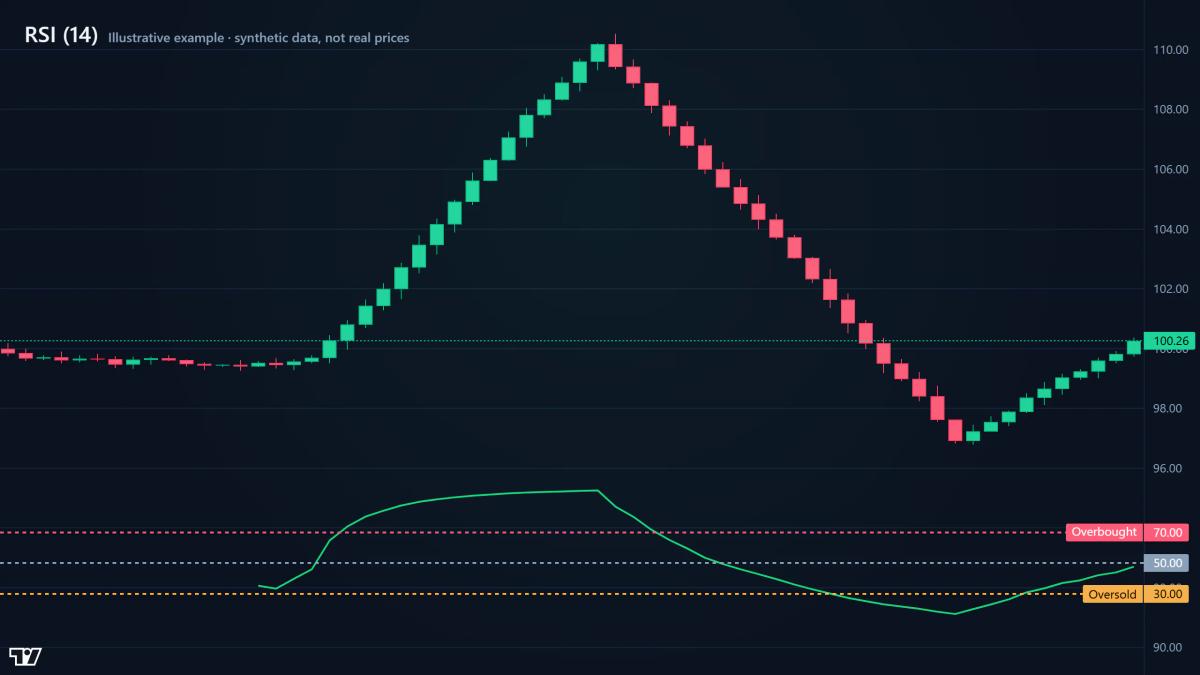
Swing signals rest on a small toolkit of technical indicators combined with raw price behaviour.
- The Relative Strength Index (RSI, a momentum oscillator scaled 0 to 100) flags overbought and oversold conditions.
- The MACD (Moving Average Convergence Divergence) tracks the relationship between two moving averages to identify momentum shifts.
- Moving averages, typically the 20, 50, and 200 period, define the trend context.
- Bollinger Bands (a channel plotted two standard deviations around a moving average) highlight volatility expansion and mean reversion opportunities.
Price action does the heavy lifting alongside these tools. Support and resistance levels, breakout and retest patterns, and Fibonacci retracements identify where price has historically reacted. The strongest swing signals appear at confluence, when several unrelated signals point to the same level. A pullback to the 50-period moving average that also sits on a prior resistance turned support, with RSI curling up from 40, is a higher-quality setup than any single indicator triggering in isolation.
This is why swing signals tend to outperform scalping signals on cost: fewer trades, wider stops, and less exposure to spread and commission drag. The trade-off is patience.
A confluence setup on the daily chart may appear only a few times per month per pair, and you must wait for price to come to your level rather than forcing an entry. Understanding how to identify market trends helps you spot these high-confluence setups more reliably.
Risk management and position sizing for swing signals
Position sizing is what keeps a swing account alive across a losing streak. The industry standard among professional retail traders is to risk no more than 1 to 2% of account equity per trade. On a £5,000 account risking 1%, that is £50 of maximum loss regardless of what the signal provider promises.
Leverage sets the ceiling on how large you can go. According to the FCA (Financial Conduct Authority, the UK regulator for retail investment firms), UK retail clients are capped at 1:30 leverage on major forex pairs, 1:20 on non-major pairs and major indices, and 1:5 on individual equities. CFDs on cryptoassets are prohibited for UK retail. These caps apply to the group entity that onboards you: an FCA-authorised entity is the gold tier; offshore group entities offering higher leverage to UK residents should be flagged and avoided.
Common leverage trading mistakes can wipe an account even when signals are accurate, so position sizing discipline is non-negotiable.
How to evaluate signal accuracy and win rates
Signal quality is measured by two numbers together: win rate and average risk-to-reward. Neither figure alone tells you if a provider is profitable. A 50% win rate with a 1:2 average risk-to-reward is a strong system; a 70% win rate with a 1:0.5 ratio breaks even after costs.
| Win rate | Avg risk-to-reward | Expectancy per £1 risked |
|---|---|---|
| 40% | 1:3 | +£0.60 |
| 50% | 1:2 | +£0.50 |
| 60% | 1:1 | +£0.20 |
| 70% | 1:0.5 | +£0.05 |
Demand a verifiable track record before you subscribe to anything. Screenshots are worthless. Look for a third-party audit trail: a MyFxBook or equivalent verified account, a broker-hosted statement covering at least 12 months, or entry timestamps published live before the outcome was known. Marketing claims of '90% accuracy' with no independent proof should be treated as a red flag, not a selling point.
Paid signal services versus manual analysis: cost and benefit
Paid signal services in the UK range from around £20 per month for basic alerts to £500 or more for institutional-style research. Generally, these services involve someone else doing the screening, and you getting a formatted trade plan. Bear in mind that the cost is not just the subscription: a £100 per month service on a £5,000 account is a 24% annual drag on capital before any trade is placed, which a mediocre signal set will never overcome.
Manual analysis costs nothing but time and study. Many experienced traders end up using signals as a second opinion, filtering them through their own chart read rather than trading every alert blindly.
Common mistakes beginners make when following swing signals
The pattern of losses is remarkably consistent. Beginners ignore or widen the stop-loss, over-leverage relative to account size, chase the entry after price has already moved, and follow providers who publish no verified history.
The deepest error is psychological: treating a signal as a promise rather than a probability. A 60% win rate provider is right on 6 trades out of 10, which means 4 out of 10 lose money, and those 4 often cluster together.
Understanding what triggers a margin call is essential, because over-leveraging on swing signals is one of the fastest ways to hit forced liquidation.
Copying signal size instead of scaling to your own account is another silent account killer. A provider trading 1 standard lot on a £100,000 account is risking 1%; the same lot on your £5,000 account is risking 20% per trade.
Automated versus manual signal delivery: which suits your style
Automated delivery pushes signals through an app, Telegram bot, email, or copy-trading platform in real time, with no interpretation required. It suits traders who cannot watch charts during the day.
Manual delivery, where an analyst posts written analysis in a community and leaves the execution to you, forces you to engage with the reasoning and filter setups against your own view. It suits traders who want to learn as they trade rather than outsource entirely.
[ESMA, 2024]: Between 74% and 89% of retail CFD accounts lose money over the reporting period, according to the ESMA product intervention review.
Frequently Asked Questions
Can I make money following forex swing trading signals without any trading experience?
Following signals blindly rarely produces a durable profit even when the signals themselves are sound. Position sizing, emotional discipline, and knowing when to skip a setup all require experience. Most traders who eventually profit from signals use them as one input alongside their own analysis, not as a substitute for learning the market.
What is a realistic win rate for swing trading signals?
Realistic win rates for verified swing signal services sit between 45% and 60%. Any provider advertising a sustained 80% or 90% win rate should be treated with scepticism unless the record is independently audited over at least 12 months. Win rate alone does not tell you if a system is profitable; you must pair it with the average risk-to-reward ratio.
How do I know if a signal provider is legitimate and not a scam?
Ask for a third-party verified track record covering at least 12 months (MyFxBook, FX Blue, or a broker statement). Check whether entries are timestamped before outcomes are known. Legitimate providers publish losing trades as clearly as winners. Refuse any service that shows only screenshots, redacted account histories, or guarantees of profit.
Should I use leverage when trading swing signals, and what leverage is safe for UK retail traders?
According to the FCA, UK retail clients are capped at 1:30 leverage on major forex pairs, 1:20 on non-majors and major indices, and 1:5 on equities. Using less than the cap is common among professionals. The safer approach is to size positions by risk (1 to 2% of equity per trade) rather than by maximum available leverage.
What is the difference between a swing trading signal and a day trading signal?
A day trading signal targets moves that resolve within a single session and uses tight stops on lower timeframes such as 5 or 15 minutes. A swing signal targets moves lasting days to weeks, uses wider stops on H4 or daily charts, and tolerates overnight and weekend exposure. Swing signals typically incur lower spread and commission costs per unit of profit.
About the authors


Related articles

Cryptocurrency Trading Guide for Beginners: How to Start
A plain-English cryptocurrency trading guide for beginners covering strategies, risk management, platform choice, UK regulation, tax reporting and asset security.
How to Start Trading for Beginners: A Step-by-Step Guide
Learn how to start trading for beginners with this easy guide. Covers account setup, your first trade, risk management, and the key factors that move markets.
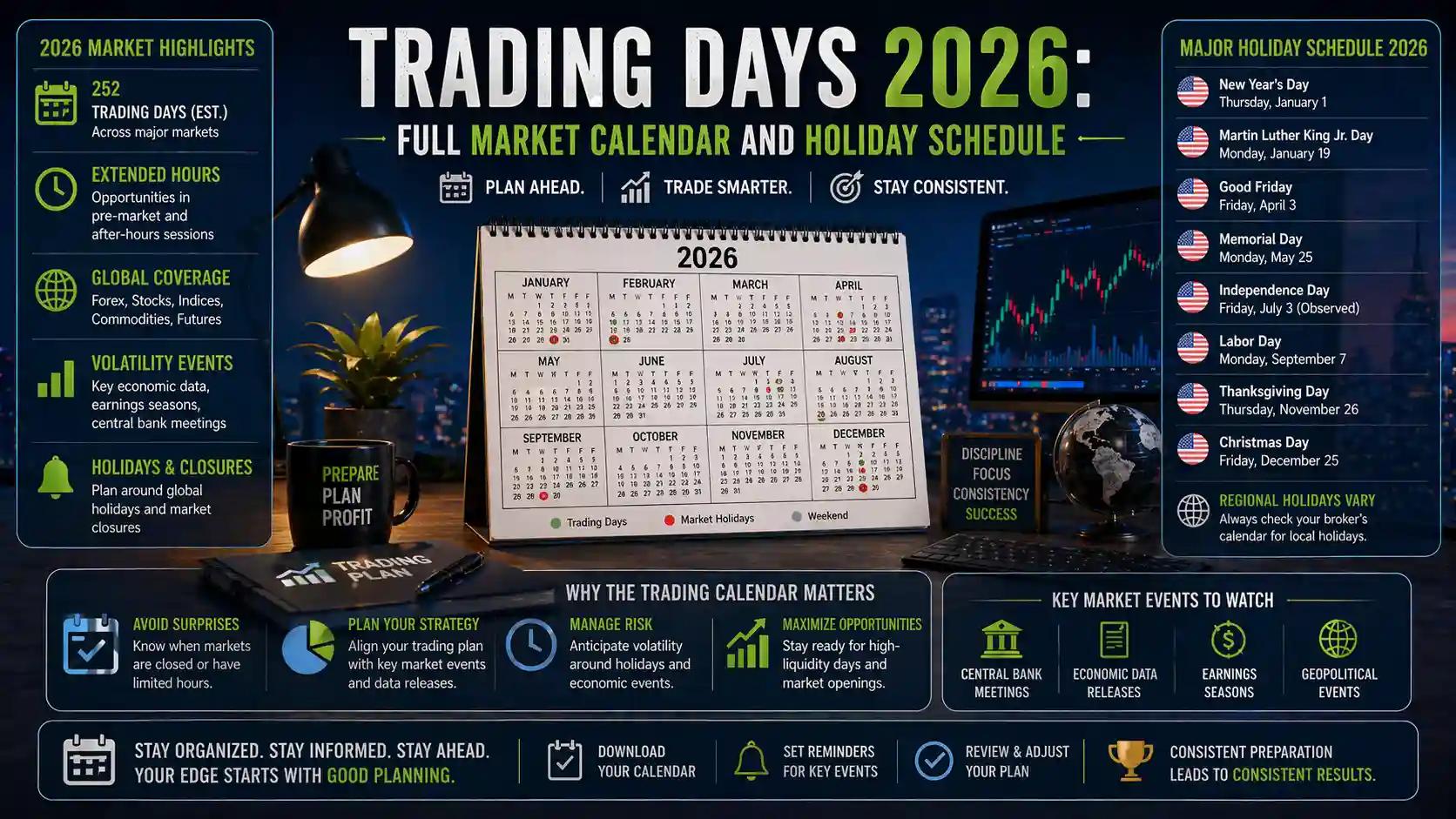
Trading Days 2026: Full Market Calendar and Holiday Schedule
Complete trading days 2026: 251 NYSE/NASDAQ trading days, all market holidays, early-close sessions, and global exchange schedules to plan around.
0 comments