


Forex Broker Fee Structure Explained: How to Read the Numbers Without Getting Misled
This article is for informational purposes only and does not constitute financial or investment advice. Always read a broker’s full terms and conditions before opening an account.
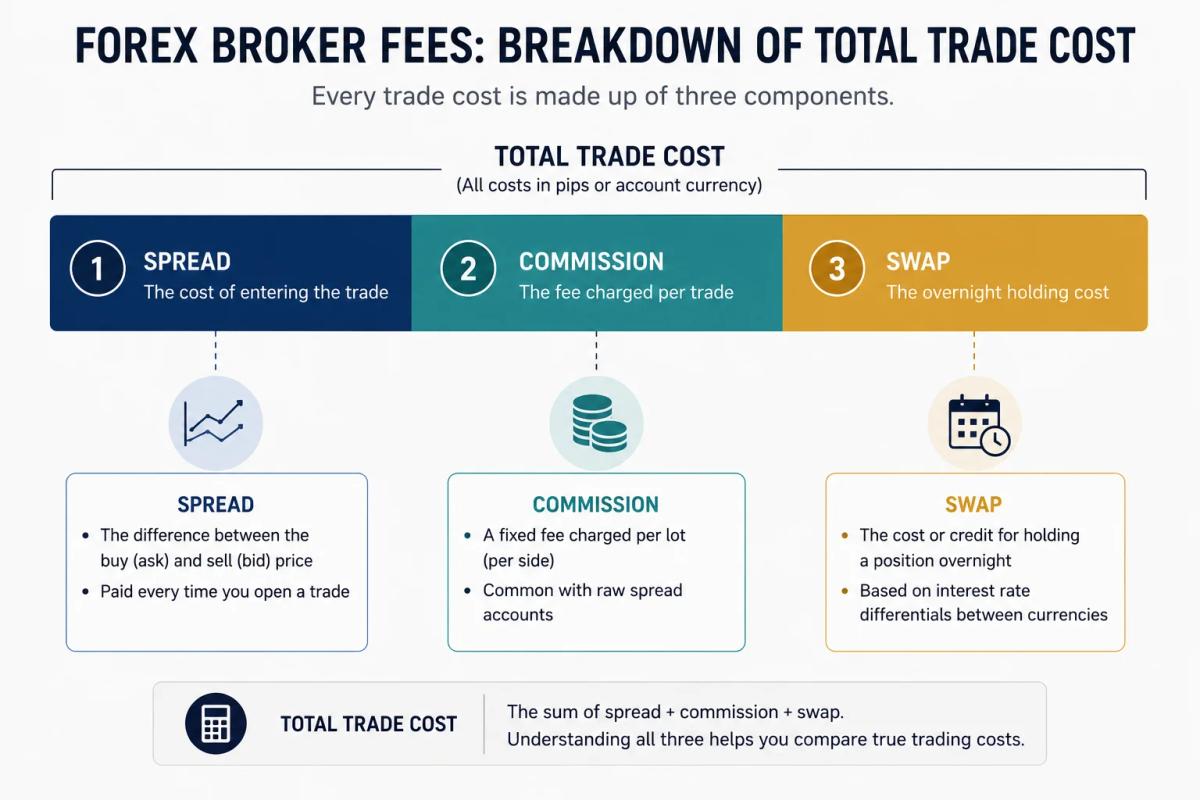
Understanding a forex broker’s fee structure is one of the most practical skills you can build before putting real money to work. This guide covers every major cost type, shows you how to calculate the true cost of a trade, and tells you exactly where to look in a broker’s documentation to find what actually matters.
Why Broker Fees Are Harder to Compare Than They Look
Open two broker websites side by side. One advertises spreads “from 0.0 pips.” The other shows 1.2 pips with no commission. On paper, the first looks cheaper. In practice, you might be paying more. That gap between the advertised number and what you actually pay is where most traders get caught out.
The Advertised Cost vs. the Real Cost
The headline figure a broker shows you is almost always a best-case scenario. Variable spreads are typically quoted at their tightest point, which tends to occur during peak liquidity hours on major pairs. During news events, off-hours trading, or on exotic pairs, that spread can widen considerably.
Commission-based accounts work differently. The raw spread may be genuinely low, but the per-lot commission lands on top of every entry and exit. Trade frequently or in larger sizes, and that commission compounds quickly.
The real cost of a trade is the sum of every fee that applies at the moment you open, while you hold, and when you close. Brokers advertise the most attractive version of their cost structure. The full picture only emerges when you account for all fee types.
Why Brokers Present Fees Differently (And What That Signals)
Brokers use different fee models for legitimate business reasons, and understanding the model tells you something useful about how they operate.
Market makers profit from the spread itself, since they sit on the other side of your trade. Their spread-only accounts are the core product. STP (Straight Through Processing) and ECN (Electronic Communications Network) brokers route your orders to the interbank market or a liquidity pool. Their raw spreads are tighter because they are not the counterparty; they charge a commission instead.
Neither model is inherently better or worse for you. Knowing which one you are dealing with, and calculating costs accordingly, is what matters. Check our [broker comparison hub] if you want to see how specific account types stack up.
The Core Fee Types You Need to Understand
When a broker lists your account costs, the headline number rarely covers everything. Most of the fees that quietly reduce your profitability are scattered across multiple sections of a broker’s documentation. Here are the ones that matter.
Spreads: Fixed vs. Variable
The spread is the difference between the bid price (what you can sell at) and the ask price (what you can buy at). It is built into every trade quote, and you pay it the moment you enter a position.
- Fixed spreads stay constant regardless of market conditions. Useful for predictability, but often wider than variable spreads during calm market hours.
- Variable spreads fluctuate with market liquidity. They can be very tight during active sessions and noticeably wider during low-volume periods or around high-impact news.
Worked example: You open a 1-lot EUR/USD trade with a 1.2 pip variable spread. One standard lot on EUR/USD is 100,000 units, and each pip is worth approximately $10. Your spread cost on entry is 1.2 x $10 = $12.
That $12 is deducted from your position the moment the trade opens. See our [glossary entry on spreads] for a deeper breakdown.
Commission-Based Accounts: How the Per-Lot Model Works
On commission accounts, common with ECN and raw-spread setups, the spread is minimal but the broker charges a flat fee per lot traded, usually applied on both entry and exit.
Worked example: A broker charges $3.50 per lot per side. You open 1 lot EUR/USD and close it later. Your commission cost is $3.50 (entry) + $3.50 (exit) = $7 total. Add whatever spread existed at the time of each fill on top of that.
The round-turn commission (both sides combined) is the figure to use when comparing accounts. Confirm whether the quoted commission is per side or round-turn. It is the kind of detail that is easy to misread.
Swap and Overnight Financing Fees
Hold a forex position past the daily rollover time (typically 5pm New York time) and you will receive or pay a swap fee. This reflects the interest rate differential between the two currencies in the pair.
Key points:
- Swaps can be positive or negative depending on your trade direction and the interest rate relationship between the two currencies.
- On some pairs and directions, you may actually earn a small credit overnight.
- Many brokers triple swap rates on Wednesdays to account for weekend settlement, though rollover schedules vary by broker and instrument.
- Swap rates vary by broker and are listed per instrument; they are not standardised across the industry.
If you are a position trader or swing trader holding trades for days or weeks, swap costs or credits can become a meaningful part of your overall P&L calculation. Check our [glossary entry on swap and rollover] for more detail.
Deposit, Withdrawal, and Currency Conversion Fees
These do not affect your trade costs directly, but they do affect your net returns.
- Deposit fees: Some brokers charge a processing fee on deposits made via certain payment methods. Many do not. Check the payment methods page rather than the main fee schedule; this information is often stored separately.
- Withdrawal fees: Flat fees or percentage charges on withdrawals are common. A $25 wire fee on a $500 withdrawal is 5% gone before you have entered a single trade.
- Currency conversion fees: If your account is denominated in USD and you deposit GBP, the broker applies a conversion. The rate used often includes a markup, and this is rarely disclosed prominently.
Inactivity Fees
Stop trading for a set period (often 3, 6, or 12 months depending on the broker) and many brokers charge a monthly inactivity fee. These are usually small, typically in the $10 to $15 per month range, but they can quietly drain a dormant account.
Check the specific trigger conditions. Some brokers define inactivity as no logins; others require no executed trades. Worth knowing before a holiday turns into an unexpected bill.
How to Calculate the True Cost of a Trade
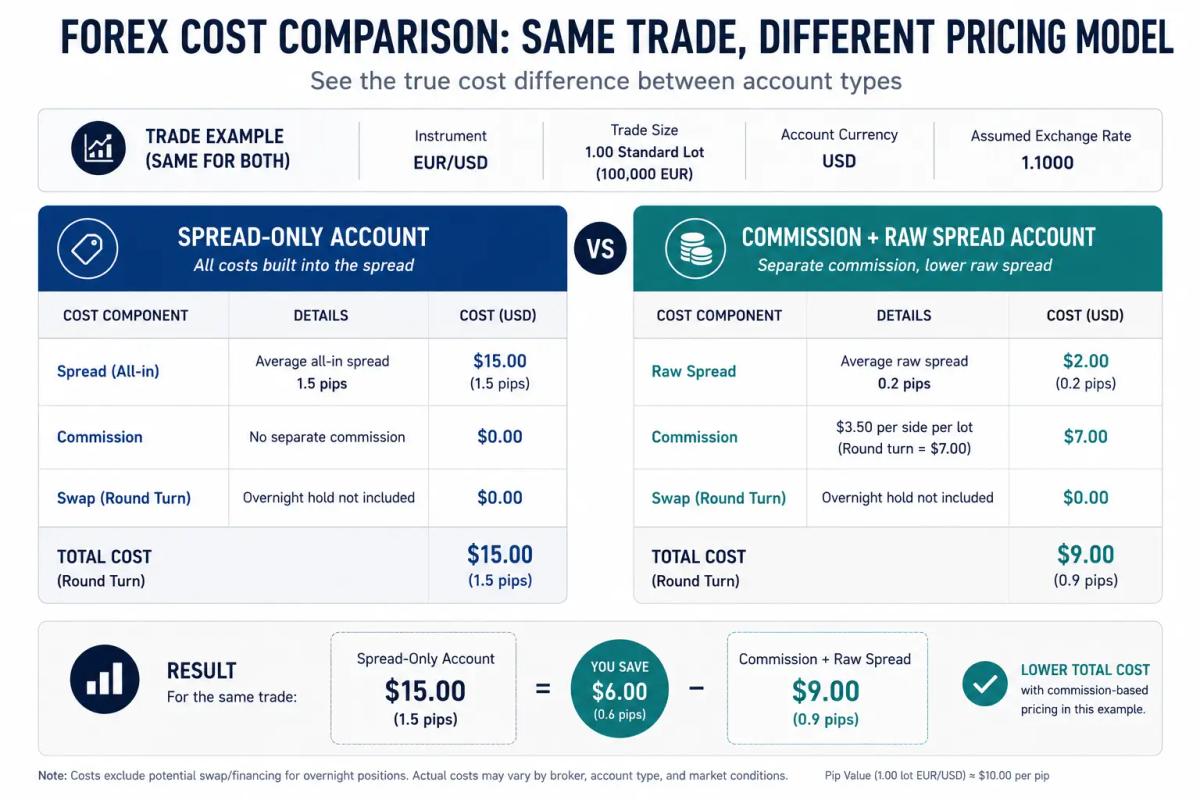
Volume and frequency determine which fee model works in your favour. Work through these five steps with any broker’s fee schedule open in front of you. The aim is to arrive at a single dollar figure for the all-in cost of one complete trade.
Step 1 – Identify Your Account Type and Fee Model
Before calculating anything, confirm:
- Is this a spread-only account or a commission + raw spread account?
- What is the quoted spread for the instrument you are trading?
- Is the spread fixed or variable, and is the quoted figure typical or a best-case minimum?
Step 2 – Calculate Spread Cost in Currency Terms
Use this formula:
Spread cost = Spread in pips x Pip value x Number of lots
For a standard lot on most USD-quoted pairs, pip value is approximately $10.
Example: 1.5 pip spread x $10 pip value x 1 lot = $15 spread cost
For non-USD pairs or cross pairs, pip value varies. Check your broker’s contract specifications for the exact pip value per instrument.
Step 3 – Add Commission If Applicable
If you are on a commission account, add the round-turn commission.
Example (continuing from above): $15 spread cost + $7 commission (round-turn at $3.50 per side) = $22 total entry/exit cost
Step 4 – Factor in Swap if You Hold Overnight
Find the swap rate for your instrument on the broker’s website, usually listed in the trading conditions or contract specifications. Multiply by the number of nights you plan to hold.
Example: Swap rate of -$5.40 per lot per night. Holding 3 nights: -$5.40 x 3 = -$16.20
Add that to your trade cost. For longer holds, this number can start to rival or exceed your spread and commission costs combined.
Step 5 – Check Non-Trading Fees
Ask yourself:
- Will I need to withdraw profit? What does that cost?
- Is my deposit currency the same as my account currency?
- Am I likely to go inactive for an extended period?
These will not affect every trade, but they belong in your total cost picture.
Spread-Only vs. Commission + Raw Spread: Which Is Actually Cheaper?
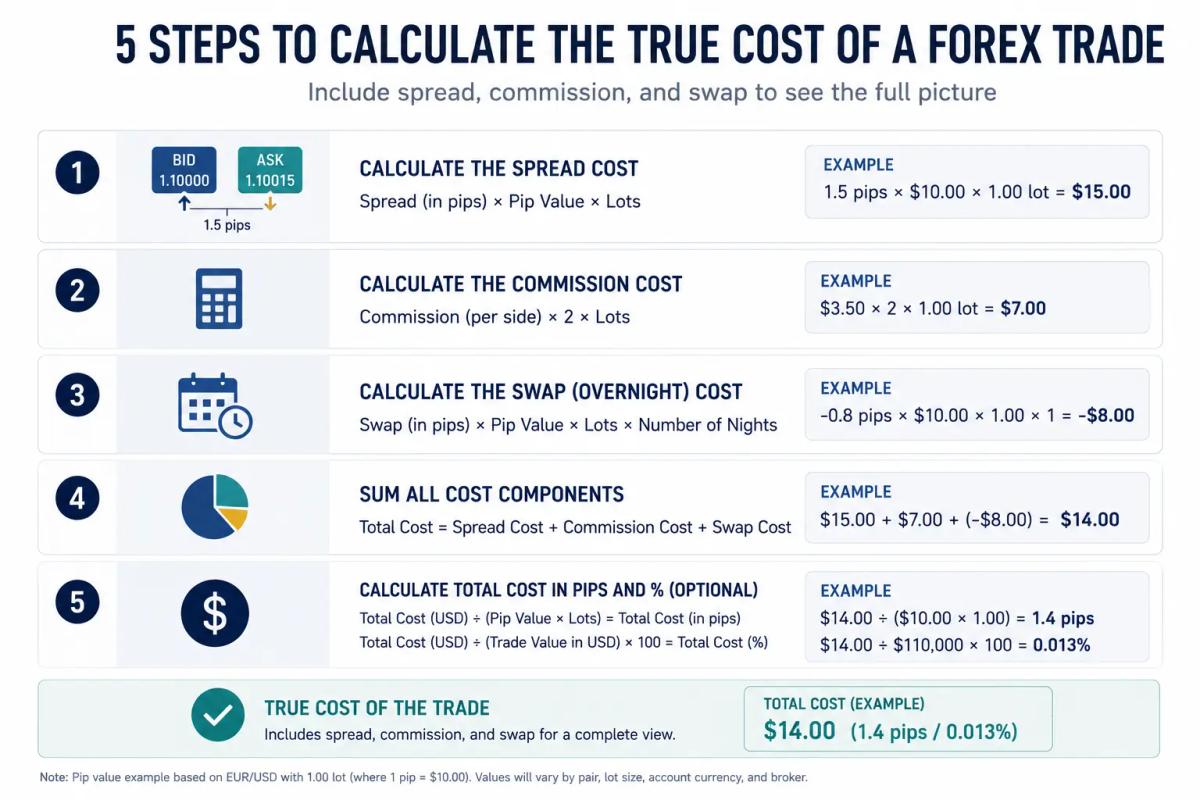
This is the comparison most traders need to make, and the answer depends entirely on your trading volume and frequency.
When Spread-Only Accounts Cost More
Spread-only accounts charge a wider spread to cover the broker’s costs. For traders executing a small number of trades per month or trading smaller sizes, that simplicity has genuine value. As volume increases, the wider spread compounds.
Example: A spread-only account charges 1.4 pips on EUR/USD. A commission account charges 0.2 pips + $7 round-turn commission.
- Spread-only cost at 1 lot: $14
- Commission account cost at 1 lot: $2 + $7 = $9
The commission account is cheaper at that size.
When Commission Accounts Are Worth It
Commission accounts become more cost-efficient at higher volumes and trade sizes. The raw spread is genuinely narrow, sometimes 0.0 to 0.3 pips on major pairs during liquid hours, and the fixed commission per lot does not scale with position size the way a percentage-embedded spread does.
For high-frequency traders, scalpers, and anyone trading multiple lots regularly, the numbers usually favour commission accounts. If you trade through a funded account structure, fee comparison follows similar logic. See our [prop firm and funded trading content] for how these costs apply in that context.
The Break-Even Trade Frequency Threshold
You can calculate the exact point where one account type becomes cheaper than the other.
Formula:
Break-even = Commission cost / (Spread-only pip cost – Raw spread pip cost)
If the commission account costs $7 more per trade in flat fees but saves you $5 in spread per trade, you are paying a net $2 more per trade on the commission account at low volume. At higher volume with larger lots, that dynamic shifts.
Run the numbers for your typical trade size and frequency before choosing an account type. The headline spread is a starting point, not a conclusion.
Where to Find Fee Information (And What Brokers Bury)
Most fee-related surprises are not hidden by design; they are buried by structure. Fee information is spread across multiple pages of a broker’s website, and not all of it is equally easy to find.
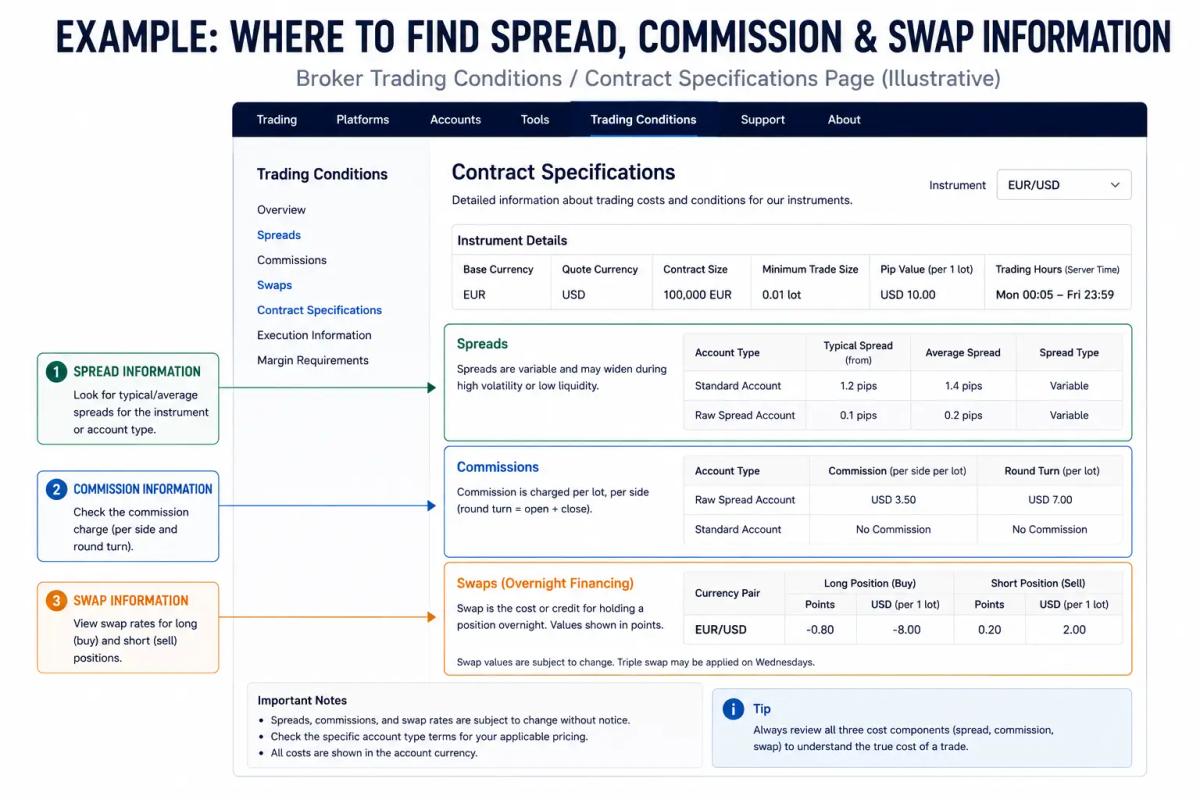
Where to Look in a Broker’s Documentation
Here is where the relevant fee information typically lives:
- Trading conditions or instrument specifications page: Spreads, commissions, swap rates per instrument, and lot sizes.
- Account types comparison page: Differences between standard, ECN, and other account tiers.
- Legal or client agreements section: Inactivity fees, currency conversion markups, and fee change policies.
- Deposit and withdrawal page: Payment method fees, processing times, and minimum withdrawal amounts.
Do not rely on the main homepage or a pricing summary page. Go to the source documents. A broker’s contract specifications page will tell you the exact swap rates for each instrument. That is the number that matters, not a general claim that swaps are “competitive.”
Red Flags in Fee Disclosures
These are evaluation criteria, not accusations. They are details that warrant a closer look before you commit.
- “From X pips” spread language without stating typical spreads: This gives you the floor, not the average. The average is what you will actually trade at.
- Swap rates not listed per instrument: A general statement that swap rates apply, without a table of actual figures, makes it impossible to calculate your holding cost.
- Commission disclosed only in footnotes or appendices: If the commission structure requires significant document-diving to locate, that is a disclosure design choice worth noting.
- Currency conversion fees buried in the legal agreement: A markup on conversion rates is a real cost that is easy to miss if it does not appear on the main fee page.
- Vague inactivity fee terms: Language that lacks specifics about the period, the amount, or the trigger leaves you unable to assess the actual cost.
Questions to Ask Before Depositing
Before funding any account, get clear answers to these:
- What is the typical spread on my primary instrument during my usual trading hours, not the minimum?
- Is the commission quoted per side or round-turn?
- Where can I find the swap rates for each instrument I plan to trade?
- What are the withdrawal fees for my preferred withdrawal method?
- What is the inactivity fee, and what triggers it?
- Does depositing in a currency different from my account currency incur a conversion fee?
If a broker’s documentation cannot answer these questions clearly, that is useful information in itself.
Broker Fee Comparison: What to Look For Beyond the Headline Spread
When comparing two or more brokers, the headline spread is a starting point, not a verdict. Build your comparison around the full picture.
A few additional considerations worth keeping in mind:
- CFD fees on stocks and forex pairs differ considerably. Stock CFDs often carry a percentage-based commission rather than a pip-spread model. Do not assume a broker’s forex fee structure applies to their equity CFDs.
- ECN and STP accounts typically offer tighter spreads but require a commission model. Market maker accounts may offer fixed spreads and no commission, but at a wider baseline cost. Understanding which model a broker uses clarifies both their incentives and your costs.
The aim when comparing brokers is to arrive at a realistic all-in cost per trade for your specific trading style, instrument, and volume. That number is more useful than any ranking table. See our [glossary entries for ECN, commission, and spread] if you need to clarify any of the terms above.
Frequently Asked Questions
What is the practical difference between a spread and a commission?
A spread is a cost built into the price quote itself. You pay it automatically through the difference between the buy and sell price. A commission is a separate, explicit charge applied per lot traded, usually by brokers offering tighter raw spreads. Both are real costs; they are just structured differently. On spread-only accounts you pay one; on commission accounts you pay both, though the spread component is much smaller.
Does a low advertised spread guarantee lower overall trading costs?
No. A low advertised spread is usually the minimum under ideal conditions. Variable spreads widen during low liquidity or high volatility. You also need to account for commissions, swap costs if you hold overnight, and any non-trading fees. The all-in cost across all fee types is the meaningful figure.
How do I find the swap rate for a specific instrument before opening a position?
Go to your broker's trading conditions or contract specifications page and look for the instrument you plan to trade. Swap rates are usually listed separately for long and short positions. Some brokers also publish this within their trading platform under the instrument's contract details. If neither source provides specific figures, contact the broker's support before trading.
What are inactivity fees and when do they typically apply?
An inactivity fee is a periodic charge, usually monthly, applied to accounts where no trading activity has occurred for a defined period. This is commonly 3, 6, or 12 months depending on the broker. The fee is typically small but can drain a dormant account over time. Check the specific trigger: some brokers count inactivity from the last login, others from the last executed trade.
How do I compare two brokers with different fee structures?
Convert all costs to a common unit: the dollar cost per 1 standard lot, round-turn. Calculate the spread cost (pips x pip value), add any round-turn commission, and add or subtract the swap if you plan to hold overnight. Run this calculation for the instrument you trade most and during the session hours you typically trade. That gives you a comparable all-in cost for both brokers.
Are ECN accounts always more cost-efficient than standard accounts?
No. ECN accounts offer tighter raw spreads but charge a per-lot commission. At low trade volumes or small position sizes, the commission can make ECN accounts more expensive than a spread-only standard account. The crossover point depends on your trade frequency and typical lot size. Calculate the break-even threshold using the formula in the comparison section above.
What does "raw spread" mean and how does it differ from the spread shown in a retail account?
The raw spread is the interbank or liquidity-pool spread before any broker markup is applied. Retail spreads include the broker's markup on top of the raw spread; that markup is part of how spread-only brokers generate revenue. On a raw spread or ECN account, you see the underlying market spread, which can be as low as 0.0 pips on major pairs in liquid conditions, and the broker charges a separate commission instead of embedding their margin in the spread.
This article is for informational purposes only and does not constitute financial or investment advice. Always read a broker's full terms and conditions before opening an account.

About the authors

Related articles

Analysis Paralysis in Trading: Why You Freeze and How to Fix It
Learn to recognize analysis paralysis in trading, understand its psychological roots, and build a decision-making framework with confident execution.

Anchoring Bias in Trading: How Mental Price Traps Cost You Money
Learn how anchoring bias distorts your trading decisions. Spot mental price traps, break free from fixation on entry prices, and build systems to protect your returns.

Anger in Trading: Why It Happens and How to Control It
Learn why anger strikes during trading, how it destroys performance through revenge trades and broken rules, and proven techniques to control it.
0 comments