How to Build a Daily Trading Routine That Actually Works
Most traders lose money because they lack structure. A daily trading routine is the invisible scaffolding that separates traders who survive long enough to become profitable from those who burn out chasing random setups.
This guide gives you a complete, phase-by-phase blueprint for building a daily trading routine, from morning preparation through to your evening review. It’s a practical system you can start using tomorrow.

Why Most Traders Fail Without a Daily Trading Routine
The market doesn’t care about your mood, your sleep quality, or whether you remembered to check the economic calendar. It moves regardless. And if you show up without a plan, you’re essentially gambling with extra steps.
The Cost of Reactive Trading
Reactive trading is what happens when you skip preparation and go straight to clicking buttons. You see a candle move, feel the pull, and enter. No context. No predefined levels. No idea where your stop should sit.
Reactive traders carry higher stress, make more emotional decisions, and live with a constant sense of being one step behind. Every loss stings because there was no framework telling them the loss fell within acceptable parameters. Every win feels hollow because no plan validated the entry.
Think of it this way: a surgeon doesn’t walk into the operating room and figure things out on the fly. They review the case, check the instruments, confirm the procedure, and then execute. Trading deserves that same level of respect.
What Consistency Really Means in Practice
Consistency means showing up with the same process, the same preparation, and the same review cycle, regardless of yesterday’s results.
A consistent trader who follows their routine after a losing day is in a far stronger position than a skilled trader who wings it on the back of a winning streak. The routine is what keeps you grounded when emotions try to hijack your decisions.
So what does a structured trading day actually look like from open to close?
The Three Phases of a Structured Trading Day
Every effective daily trading routine breaks down into three distinct phases. Neglect one, and the whole system weakens.
Pre-Market Phase
This is your preparation window. Before the market opens, or before your active trading session begins, you’re doing the mental and analytical groundwork that shapes your entire day. Key tasks include:
- Reviewing overnight price action and key levels
- Checking the economic calendar for scheduled events
- Updating your watchlist based on current market conditions
- Defining your session plan (setups you’re hunting, risk limits)
- Getting yourself mentally and physically dialled in
Active Trading Session Phase
This is execution time, not analysis time. If you’ve done your pre-market work properly, the session should feel calmer and more deliberate. During this phase, you’re:
- Executing only the setups outlined in your plan
- Taking notes in real time on what you’re seeing and feeling
- Managing open positions according to predefined rules
- Monitoring your emotional state and catching yourself when you start to drift
Post-Market Review Phase
This is where the real learning lives, and it’s the phase most traders skip entirely. After the session closes, you’re:
- Logging every trade with entry, exit, and reasoning
- Reviewing what worked, what didn’t, and why
- Identifying behavioural or emotional patterns
- Making small, targeted adjustments for the next session
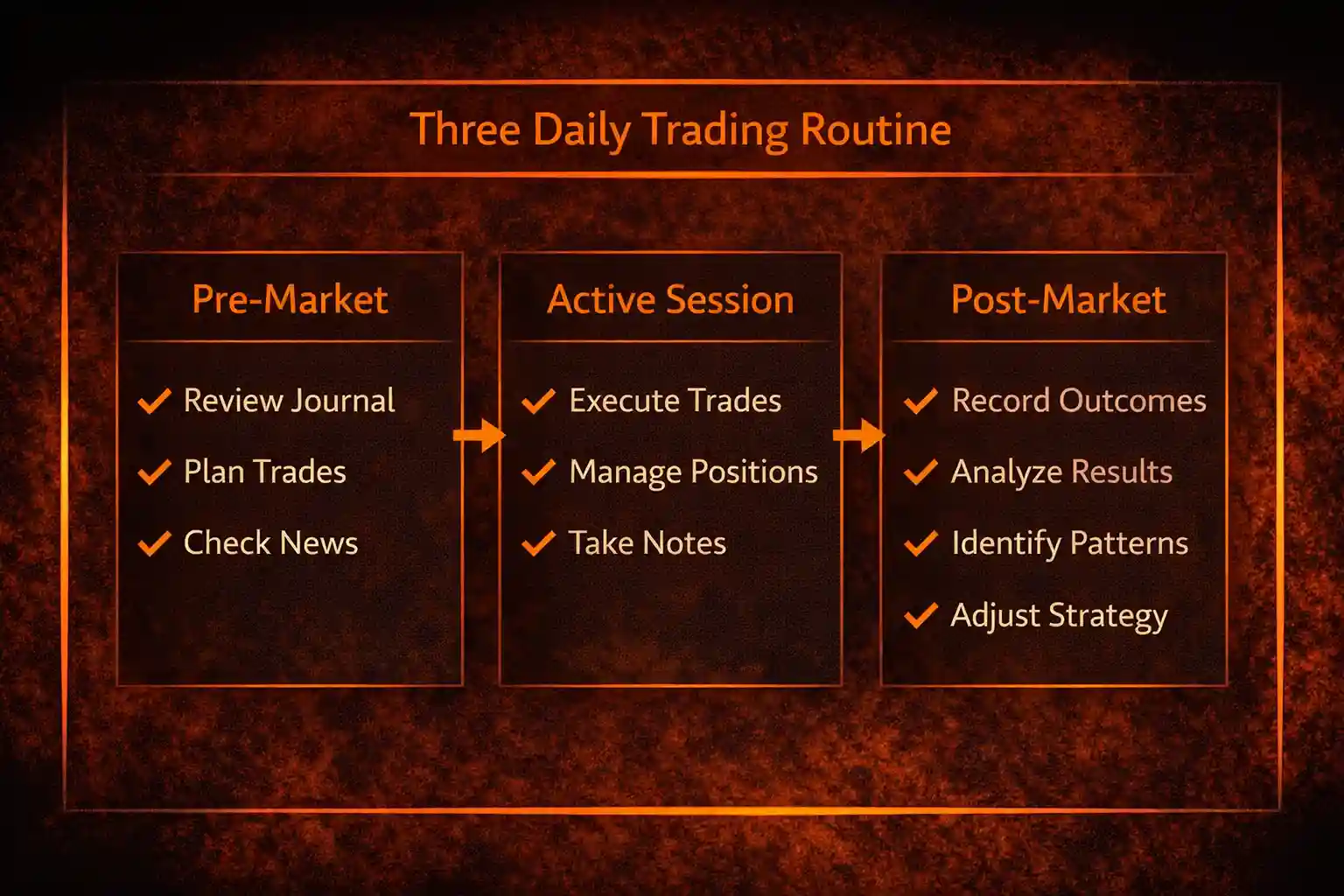
The beauty of this three-phase structure is that each phase feeds the next. Your evening review sharpens tomorrow’s morning prep. Your morning prep tightens your session execution. It’s a cycle, not a checklist.
Knowing the phases is a start. Let’s break down exactly what goes into each one.
Building Your Morning Routine Before the Market Opens
Your morning routine is the foundation everything else rests on. Skip it, and you’re building your trading day on sand. Nail it, and you walk into the session with clarity and quiet confidence.
Market Analysis and Key Level Identification
Start by zooming out. What happened overnight? Where is price sitting relative to the levels you marked yesterday? Have any key support or resistance zones been broken or tested?
For most traders, 15 to 30 minutes of focused chart review is plenty. The goal is to identify:
- Key support and resistance levels for your instruments
- The prevailing trend or range on your primary timeframe
- Any notable overnight moves that shift the context
- Two or three potential scenarios for the day
Write these levels down. Committing them to paper (or a digital note) forces you to lock in a framework before emotions enter the picture.
News and Economic Calendar Review
Nothing derails a structured session faster than getting blindsided by a news event you didn’t know about. Spend five minutes scanning the economic calendar for high-impact releases scheduled during your trading window.
If a major central bank announcement is due at 2:00 PM, you probably don’t want to be holding a tight-stop scalp at 1:55 PM.

Mental and Physical Preparation
This part feels “soft” until you experience the difference it makes firsthand. Your mental state directly impacts your decision-making. If you’re tired, anxious, or distracted, your execution quality drops. Full stop.
A few things that seasoned traders tend to build into their mornings:
- A brief physical activity (even a 10-minute walk) to clear mental fog
- A few minutes of quiet focus or breathing to centre attention
- Reviewing personal trading rules or affirmations about process over outcome
- Eating something and hydrating before the session begins
You wouldn’t expect an athlete to perform at their peak without a warmup. Your brain needs one too.
Can you feel how the pre-market phase sets the tone for everything that follows? Now let’s look at what happens once the action begins.
Structuring Your Active Trading Session
The market is open. Charts are moving. This is where discipline meets opportunity, and where most routines quietly fall apart.
Executing Your Trading Plan
Here’s the uncomfortable truth: the active session is not the time to analyse, strategise, or rethink your plan. It’s the time to execute what you already decided during your morning routine.
If a setup from your watchlist triggers, you take it according to your predefined rules. If nothing triggers, you wait. The waiting is part of the job. One of the most valuable skills you can develop is the ability to sit on your hands when conditions don’t match your criteria.
Keep your trading plan visible during the session. Whether it’s a sticky note on your monitor or a document pinned to your desktop, having your rules in plain sight reduces the temptation to deviate.
Real-Time Journaling and Note-Taking
Most traders think of journaling as something they do after the session ends. But real-time note-taking during the session is remarkably powerful. A quick note like “Felt FOMO on that breakout, almost chased it” or “Stuck to plan, skipped the B-grade setup” gives you raw material for your evening review that you’d otherwise lose completely.
A simple text file, a physical notebook, or a dedicated section in your trading journal works fine. What matters is capturing your thoughts and emotions as they happen, not hours later when memory has already smoothed over the rough edges.
Knowing When to Stop Trading
This might be the most underrated element of any daily trading routine. Having a clear “stop rule” protects you from revenge trading, overtrading, and the slow bleed that comes from forcing trades in dead markets.
Your stop rules might include:
- A maximum number of trades per session
- A daily loss limit (dollar amount or percentage)
- A profit target where you step away and protect gains
- A time cutoff after which you stop entering new positions
- A self-assessed emotional check (if you’re frustrated or euphoric, you’re done)
When you hit a stop rule, you stop. No exceptions. No “just one more.” This is where risk management becomes a daily practice, not just a concept you nod along to.
What happens after you close your charts, though? That’s where the real edge gets built.
The Evening Routine Most Traders Skip
If the morning routine is about preparation and the session is about execution, the evening routine is about growth. It’s the phase that compounds quietly over time, turning average traders into improving ones.
Reviewing Trades and Logging Results
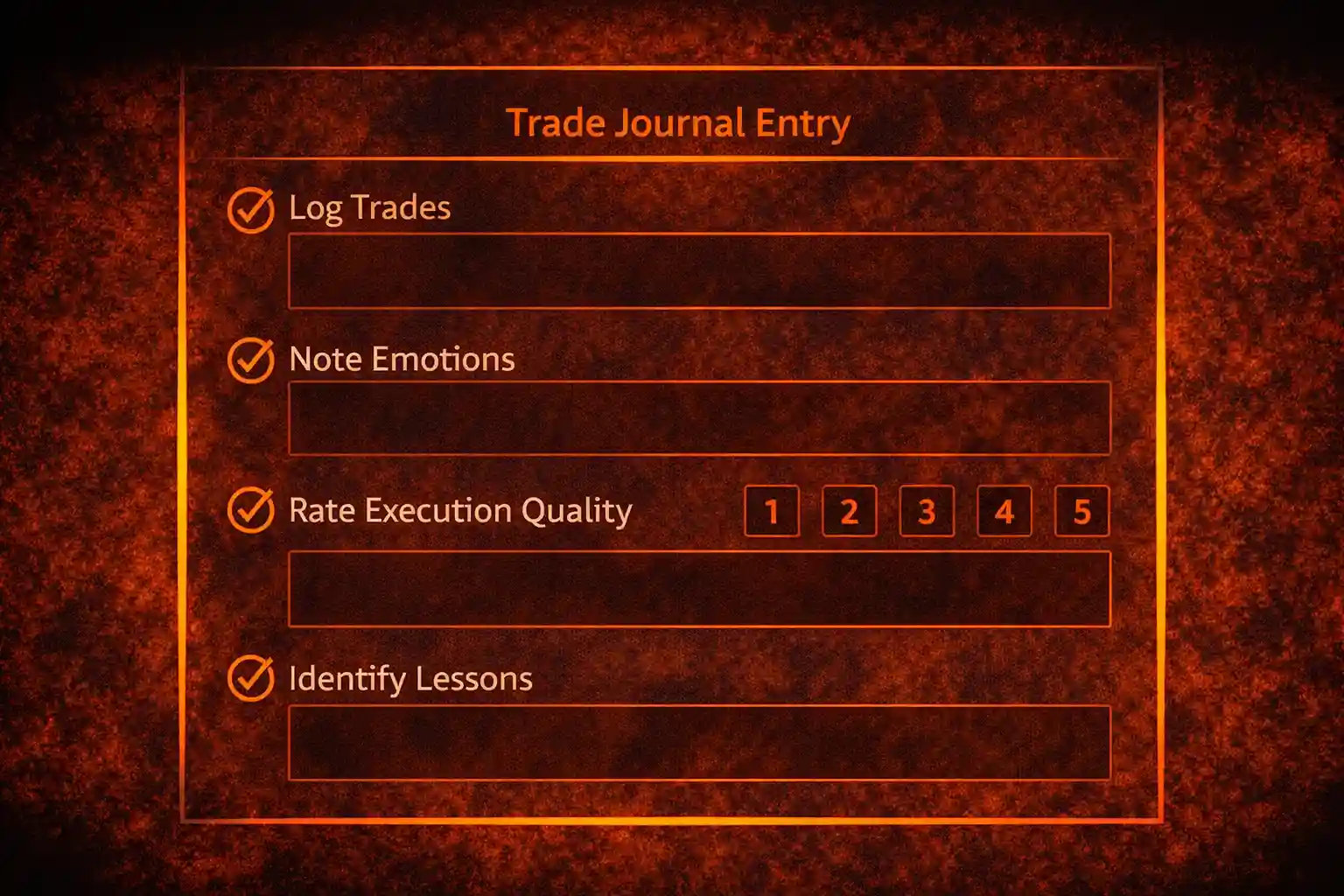
Every trade you took today needs to be logged. Your trade log should capture:
- Instrument, entry price, exit price, and position size
- The setup or reason for the trade
- Whether the trade followed your plan or was an improvisation
- Your emotional state before and during the trade
- The outcome in terms of R-multiple or dollar amount
This data is gold. Without it, you’re relying on memory, and memory is a terrible trading coach. It inflates the big wins and quietly erases the small, repeated mistakes that actually drain your account.
Identifying Patterns in Your Performance
Once you have a few weeks of logged data, patterns start surfacing. Maybe you consistently overtrade on Mondays. Maybe your best setups cluster in the first hour and your worst trades come in the last. Maybe you perform poorly the day after a big win because overconfidence creeps in.
These patterns are invisible without a journal. With one, they become obvious. And obvious problems are solvable problems. This is where trading psychology stops being abstract and becomes something you can actually act on.
Preparing for the Next Day
Your evening routine should end where tomorrow’s morning routine begins. Spend 10 minutes marking key levels on your charts, noting any overnight events worth watching, and writing a brief plan for the next session.
This small step means you don’t start from zero tomorrow. You walk into the morning prep with context already loaded, and that continuity is what makes the routine feel natural rather than forced over time.
We’ve now built a full-day framework. But does every trader need the same one?
Adapting Your Daily Trading Routine to Your Trading Style
A routine built for a full-time futures scalper would overwhelm a part-time swing trader. The principles stay the same, but the time allocations and specific tasks need to flex around your reality.
Day Traders vs. Swing Traders
Day traders need the most intensive daily routine because they’re making decisions in real time, often under pressure. Their pre-market prep is detailed, their session is fully engaged, and their evening review covers multiple trades.
Swing traders, by contrast, might condense their entire daily routine into 30 to 45 minutes. Their pre-market check is a quick scan for overnight developments affecting open positions. Their “active session” might be a single check-in to manage stops or entries. Their evening review focuses on the broader picture rather than individual intraday decisions.
Both still follow three phases. The depth and duration of each phase is what shifts.
Part-Time vs. Full-Time Traders
If you’re trading around a day job, your routine needs to be realistic. A 90-minute morning prep simply isn’t going to happen if you start work at 8 AM. Instead, consider:
- A 15-minute evening prep the night before (marking levels, checking tomorrow’s calendar)
- A 10-minute morning review before work (quick scan, set alerts)
- Limit orders and alerts instead of live screen time during the session
- A 20-minute evening review after work to log and reflect
The routine doesn’t need to be long. It needs to be consistent. A short routine you actually follow beats an elaborate one you abandon after a week, every single time.
What about the mistakes that knock traders off their routine entirely?
Common Mistakes That Destroy Trading Routines
Building a routine is one thing. Keeping it alive is another. Here are the two most common ways traders sabotage their own structure.
Overcomplicating the Process
If your routine has 47 steps and takes three hours before the market opens, you won’t do it. Complexity kills consistency. Start with the minimum viable routine (a basic version of each phase) and only add elements once the foundation is solid.
You can always build up. You can’t maintain something you dread sitting down to.
Abandoning the Routine After Losses
This is the trap that catches almost everyone at least once. You follow your routine for two weeks, hit a losing streak, and conclude the routine “doesn’t work.” So you throw it out, go back to reactive trading, and the cycle restarts.
Losing streaks happen to every trader, regardless of how good their routine is. The routine isn’t designed to prevent losses. It’s designed to help you respond to losses with clarity instead of panic. If you abandon it at the first sign of adversity, you never get to experience its long-term compounding effect on your discipline and decision-making.
The traders who hold to their routine through the rough patches are the ones who eventually look back and recognise it as the turning point.
Frequently Asked Questions