


How to Do a Post-Market Review That Actually Improves Your Trading
A post-market review is the bridge between raw experience and real skill. Most traders never cross it.
This guide walks you through a practical, repeatable post-market review process you can start using after your very next session. You’ll learn what to look at, what questions to ask yourself, and how to turn each day’s data into lessons that compound over time.
This content is for educational purposes only and does not constitute financial advice.

What Is a Post-Market Review?
A post-market review is a structured self-assessment you conduct after the market closes, or after your trading session ends. Think of it like a sports team watching game film. The game is over, the score is final, but the film session is where the coaching actually happens.
In practice, your end-of-day review is a dedicated block of time where you go back through your trades, your decisions, your emotional state, and the market conditions you operated in. The goal is to extract signal from that information. What did you do well? Where did you deviate from your plan? What would you do differently if the same setup appeared tomorrow?
It’s a focused diagnostic process with specific checkpoints. Done consistently, it becomes the single most reliable mechanism for turning screen time into genuine skill.
Why Most Traders Skip It (and Pay the Price)
Let’s be honest: by the time the closing bell rings, you’re mentally spent. The idea of sitting down for another 15 to 30 minutes of structured self-analysis feels like homework after a long exam. So most traders skip it. They tell themselves they’ll “remember” what happened. They glance at their P&L, feel good or bad about the number, and move on.
The price for that shortcut is invisible but enormous. Without a structured review, you’re relying on memory and emotion to guide your development.
Traders who skip the review repeat mistakes, sometimes for months or years, without realizing they’re stuck in a loop. So what actually separates the ones who break out?
Why an End of Day Review Matters More Than You Think
Few things in trading are as demoralizing as repeating the same mistakes day after day despite putting in real screen time. You feel like you’re working hard, but the results refuse to reflect the effort. A daily debrief is the missing link between effort and progress.
The Compound Effect of Daily Debriefs
One review session won’t transform your trading. But 30 consecutive review sessions can change everything. Each daily debrief is a small deposit into your development account. Individually, the insights might seem minor: “I entered 30 seconds too early,” “I sized up out of frustration,” “I ignored the larger timeframe context.” Stacked together, those micro-lessons form a detailed map of your tendencies, your edge, and your blind spots.
It’s the same principle behind compound interest. A 1% improvement in your process each week doesn’t feel dramatic in real time. Over months, though, the cumulative effect on your execution quality, your emotional discipline, and your confidence is substantial.
What Separates Improving Traders from Stagnant Ones
Improving traders have a system that forces them to confront their own data honestly. Stagnant traders rely on gut feelings and vague self-narratives: “I’m a good trader who just had bad luck this week.”
Your post-market review is your feedback loop. Without it, you’re flying without instruments. No matter how skilled the pilot, eventually that catches up with you.
What to Include in Your Post-Market Review
Knowing you should review is one thing. Knowing what to actually review is where most traders stall. A good post-market review covers four distinct areas, and skipping any one of them leaves a gap in your understanding.
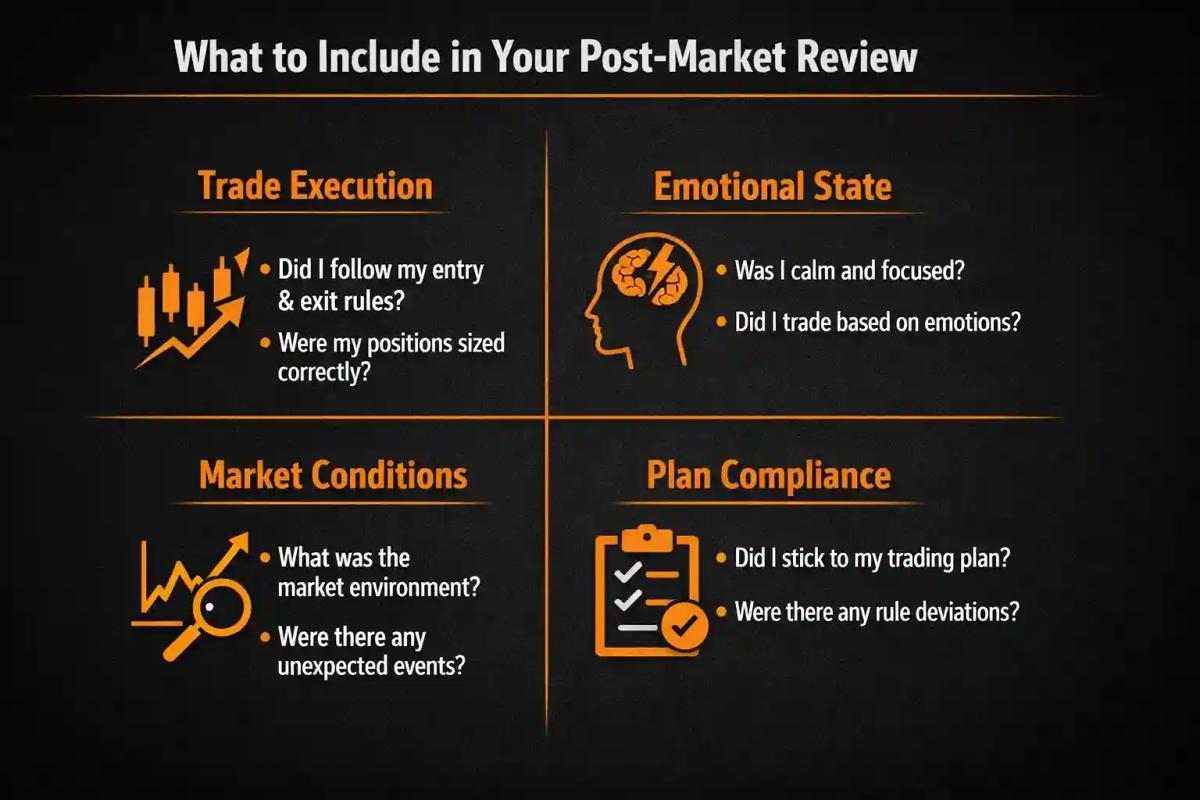
Trade Execution Review (Entries, Exits, Management)
This is where you look at the mechanics of what you did. For each trade, ask yourself:
- Entry quality: Did you enter where your plan said to enter, or did you chase, front-run, or hesitate?
- Exit quality: Did you take profits or cut losses according to your rules, or did you improvise?
- Trade management: Once in the trade, did you manage your position sizing and stops as planned, or did you widen stops, move targets, or add to losers?
The goal here is to judge whether you executed the process correctly. A losing trade with perfect execution is a good trade. A winning trade with sloppy execution is a warning sign.
Emotional and Psychological Check-In
Your internal state drives more of your decision-making than you probably realize. This part of the review asks you to honestly assess how you felt during the session:
- Were you calm and focused, or anxious and reactive?
- Did any specific moment trigger a strong emotional response (fear, greed, frustration, revenge)?
- Did your emotional state influence a specific trade decision?
- How did you feel after your first loss of the day? Did it shift your behavior going forward?
This is the area where trading psychology meets practical self-awareness. Over time, these check-ins reveal emotional patterns that prove just as important as your technical patterns.
Market Conditions and Context Assessment
Sometimes you trade well and the market simply doesn’t cooperate. Sometimes the market is generous and you still underperform. Your review should capture what kind of environment you operated in:
- Was the market trending, ranging, or choppy?
- Was volatility higher or lower than usual?
- Were there any news events or macro catalysts affecting price action?
- Did the conditions match the type of setups you trade, or were you forcing trades into a poor environment?
This context matters because it helps you separate your performance from the market’s behavior. Without it, you might blame yourself for a low-opportunity day or give yourself too much credit when everything moved in your favor.
Rule Adherence and Plan Compliance
Did you follow your trading plan? This is a yes-or-no question for each rule you have. If your plan says “no more than three trades per day” and you took five, that’s a deviation. If your plan says “only trade A+ setups” and you took a C-grade entry out of boredom, that’s a deviation.
Track these deviations explicitly. They’re some of the most valuable data in your entire review because they show you where discipline breaks down, and under what conditions. That awareness is the first step toward fixing it.
But knowing what to include is only half the battle. How do you actually walk through this efficiently, without it turning into a two-hour ordeal?
A Step-by-Step Post-Market Review Process
A repeatable process removes the guesswork and keeps your review focused. Here’s a five-step framework you can complete in 15 to 30 minutes, depending on how many trades you took.
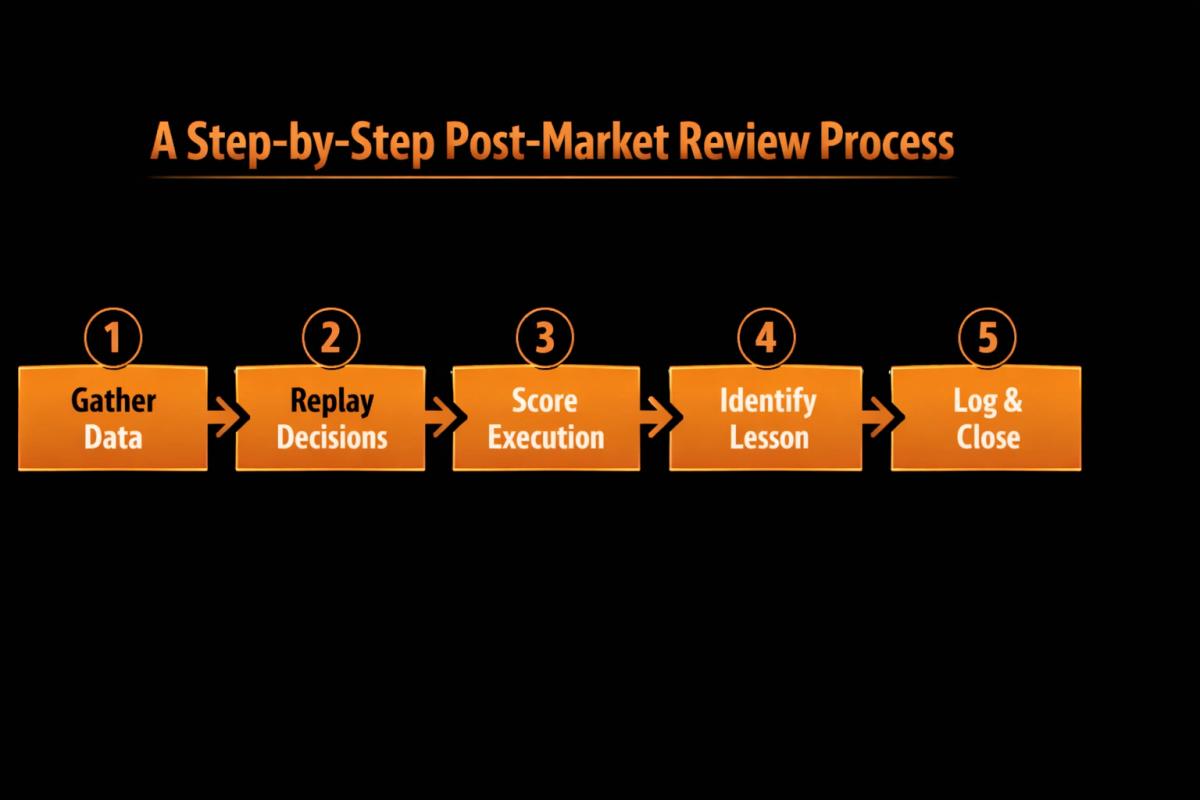
Step 1: Gather Your Trade Data
Before you analyze anything, get your raw data in front of you. This means:
- Pull up your trade log or broker statements for the session
- Open your charts to the timeframes you traded
- Have your trading plan or rules document accessible for reference
If you take screenshots during the trading day (a highly recommended habit), gather those as well. The goal is to have everything in one place so you’re working from facts, not memory.
Step 2: Replay Key Decisions
Go through each trade chronologically. For every entry and exit, ask yourself:
- What was my reasoning at the time?
- Was this setup part of my plan, or was it improvised?
- At what point did I make the final decision to act, and was that decision driven by analysis or emotion?
A few sentences is enough. The act of replaying the decision forces you to separate what actually happened from the story you’ve been telling yourself about it.
Step 3: Score Your Execution
Give yourself an honest execution score for the session. A simple 1-to-5 scale works well:
- 5: Followed the plan perfectly, excellent discipline
- 4: Minor deviations, but overall strong execution
- 3: Mixed execution, some good decisions and some poor ones
- 2: Multiple plan violations or emotionally driven trades
- 1: Complete breakdown of discipline
This is about creating a trackable metric that shows your execution quality trend over time, independent of P&L. You might have a losing day that scores a 5, or a profitable day that scores a 2. Both are important data points.
Step 4: Identify One Lesson and One Action Item
This is where the review becomes forward-looking. From everything you observed, distill the session down to:
- One lesson: The single most important insight from today (e.g., “I consistently enter too early on breakout setups when volume is below average”)
- One action item: A specific, concrete behavior change for tomorrow (e.g., “Wait for a volume confirmation candle before entering breakout trades”)
The constraint of picking just one of each is intentional. It keeps you focused. Trying to fix five things at once usually means you fix nothing. One lesson, one action item, applied consistently, creates real change.
Step 5: Log and Close the Day
Write your review entry into whatever format you use (more on that shortly). Then close your charts, close your journal, and walk away. This step matters more than it sounds. The “close” is a psychological boundary that tells your brain the trading day is truly over.
Carrying unresolved trading thoughts into your evening leads to rumination, which leads to emotional carry-over into the next session. A clean close protects your mental clarity for tomorrow.
So now you have a process. But what should you actually look for when you sit down to analyze your trades?
Analyzing Trades: What to Look For Beyond Profit and Loss
It’s tempting to evaluate your day purely by the number at the bottom of your P&L column. Green means good, red means bad. But that simplicity is a trap, and falling into it is one of the biggest obstacles to long-term improvement.
Process Quality vs. Outcome Quality
This distinction is the single most important concept in trade analysis. A trade can have a good process and a bad outcome: you followed your rules perfectly, but the trade hit your stop. A trade can also have a bad process and a good outcome: you revenge-traded with double your normal size, and it happened to work.
If you only look at outcomes, you’ll reinforce bad habits when they get lucky and punish good habits when they don’t. Over time, that erodes your edge instead of building it.
When analyzing trades, always ask: “Was this a good decision at the time I made it, given what I knew?” That’s the real measure. Outcomes carry a degree of randomness in the short term. Process quality is entirely within your control.
Recognizing Recurring Patterns in Your Behavior
After two or three weeks of consistent reviews, patterns start to surface. Maybe you notice that your worst trades happen in the first 15 minutes of the session. Maybe you realize you always over-trade on Fridays. Maybe your execution quality drops sharply after a big winner because overconfidence creeps in.
These patterns are gold. They’re the specific, personal insights that no trading book or course can hand you, because they’re unique to your psychology and your style. Your review process is the tool that uncovers them, but only if you’re looking beyond the surface-level numbers.
Insights, though, are only useful if you’re capturing them in a format that’s easy to revisit. Let’s talk about the practical side of logging your reviews.
Tools and Formats for Your Daily Debrief
What matters more when running an effective daily debrief is consistency. The format you choose should reduce friction, not create it.
Spreadsheet vs. Journal vs. Dedicated Software
Here are the most common options, along with their tradeoffs:
Many traders use a combination: a spreadsheet for the quantitative data and a brief written journal for the qualitative reflections. The best system is the one you’ll actually use every day.
What a Good Review Entry Looks Like (Template Reference)
Here’s a simple template structure you can adapt:
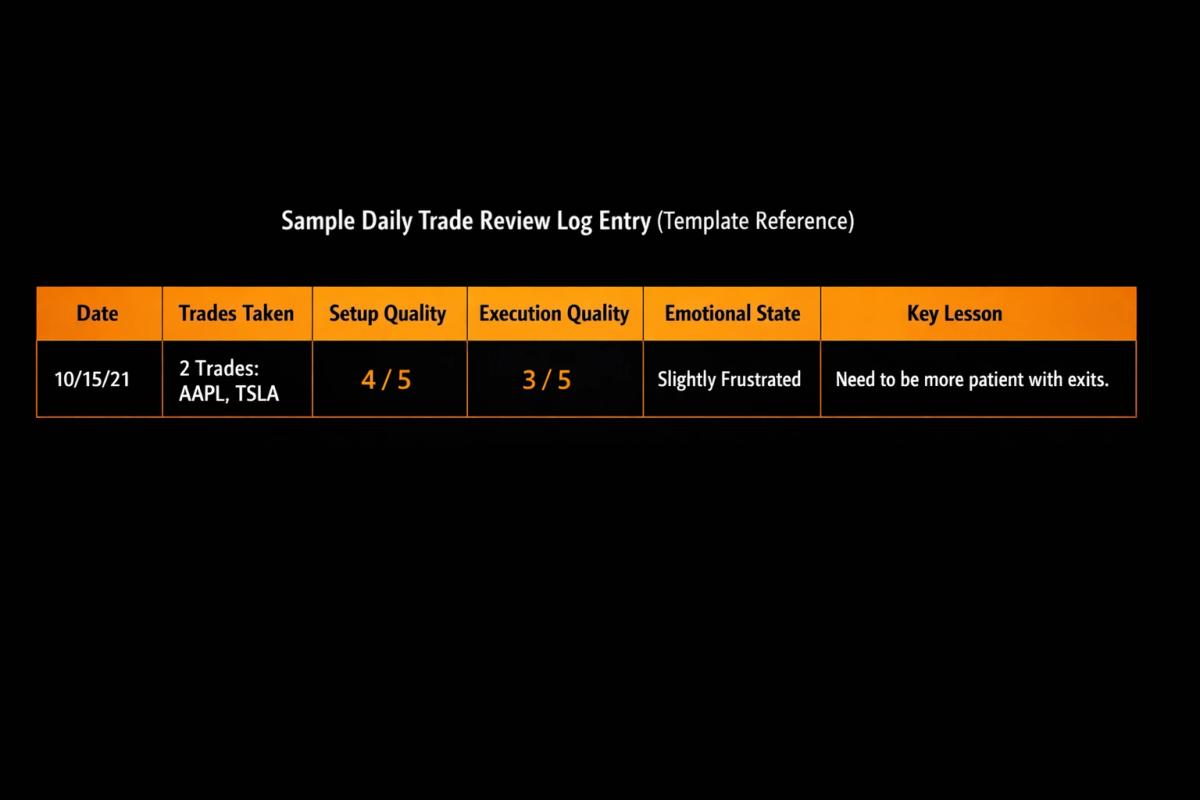
Your review entry doesn’t need to be long. A few key fields, honestly filled in, will deliver more value than a sprawling, unfocused narrative. The template above covers the essentials. If you’re already using a trading journal, you can integrate these fields into your existing workflow.
Now that you have a process and a format, let’s address the things that can quietly sabotage your entire review practice.
Common Mistakes That Undermine Your Review Process
Even traders who commit to reviewing can fall into traps that drain the value from the exercise. Catching these pitfalls early saves you from investing time in a process that isn’t actually helping you grow.
Reviewing Only Losing Trades
This is the most common mistake. When you only review losers, you develop a skewed picture of your own performance. You miss the chance to study what’s working and lean into it. Winning trades deserve just as much scrutiny. Was the win a product of good process, or did it succeed despite a flawed approach? Did you manage the winner optimally, or did you leave significant value on the table?
A complete review includes every trade, not just the ones that stung.
Turning Reviews into Self-Punishment Sessions
There’s a difference between honest self-assessment and beating yourself up. If your review consistently leaves you feeling worse, demoralized, or anxious about the next day, something is off with the approach, not with you.
Your review should be clinical, not emotional. Think of yourself as a mechanic inspecting an engine, not a judge delivering a verdict. When you notice a mistake, the right response is curiosity (“Why did I do that? What triggered it?”), not shame (“I’m terrible at this”). Shame doesn’t teach anything. Curiosity does.
Inconsistency and Skipping Days
A review you do three times a week is dramatically less valuable than one you do five times a week. The power of the process comes from pattern recognition that builds across consecutive sessions. Skip days, and you lose context.
If a full review feels like too much on certain days, do a shortened version. Even a two-minute entry covering your execution score, emotional state, and one lesson beats skipping entirely. Consistency beats thoroughness when you’re building a habit.
The real magic, though, happens when you stop looking at individual days in isolation and start connecting them together.
How to Turn Your Reviews into a Long-Term Edge
Daily reviews are the raw material. The deeper insights come when you zoom out and look at your data across longer time horizons. This is where analyzing trades becomes a strategic advantage rather than just a daily task.
Weekly and Monthly Rollup Reviews
Set aside time at the end of each week (15 to 20 minutes) and the end of each month (30 to 45 minutes) to review your daily entries as a batch. During these sessions, look for:
- Weekly patterns: Did your execution score trend up or down? Were certain days consistently better or worse? Did you follow through on your daily action items?
- Monthly themes: What were the top three recurring lessons? Which areas of your trading improved? Which problems persisted despite your awareness of them?
- Metric trends: Average execution score, number of plan deviations, emotional state distribution, and similar data points become far more meaningful over 20 or 30 sessions than they are on any single day.
These rollup reviews are where you make bigger strategic adjustments to your trading plan, your risk management approach, or your daily routine.
Learning from Your Day, Week Over Week
The goal of this entire system is to make sure the version of you sitting down to trade next month is measurably better than the version sitting down today, because you systematically identified and addressed the specific weaknesses in your own process.
Week over week, your reviews create a living document of your development as a trader. When you hit a rough patch (and you will), you can look back and see concrete evidence of how far you’ve come. When you’re tempted to abandon the process, the data reminds you why it matters.
That’s the real advantage: self-awareness, applied consistently, with a system that makes it impossible to hide from your own patterns.
Frequently Asked Questions
How long should a post-market review take?
A solid review typically takes 15 to 30 minutes, depending on how many trades you took that day. If you have a streamlined template and your data is organized, you can often finish in under 20 minutes. The key is to be thorough but focused. If your review regularly stretches past an hour, you're likely including too much detail or reviewing inefficiently.
Should I still do a review on days when I didn't take any trades?
Yes, and these can be some of your most valuable sessions. Ask yourself why you didn't trade. Was it because there were no valid setups (good discipline), or because you were afraid to pull the trigger (a pattern worth exploring)? A "no trade" day still holds data about your decision-making and emotional state.
What's the difference between a post-market review and a trading journal?
A trading journal is typically a broader record of your trades, including entry and exit details, P&L, and sometimes notes. A post-market review is a more focused, structured analysis session that evaluates your execution quality, emotional state, market context, and plan adherence. Your journal is the log. Your review is the analysis of that log. Many traders use one to feed into the other.
Should I do my review immediately after the market closes or later in the evening?
You want to review while the day is still fresh but after you've had a few minutes to decompress. Reviewing in the heat of the moment can lead to emotionally charged assessments. Waiting too long means you lose important details. A sweet spot for most traders is 15 to 30 minutes after their last trade, once the initial emotional charge has settled.
How do I stay consistent with reviews when motivation drops?
Lower the bar on tough days rather than skipping entirely. Create a minimum viable review that takes two to three minutes: execution score, one sentence on emotional state, one lesson. Consistency matters more than depth. You can also pair your review with an existing habit, like your post-market coffee or commute, to anchor it into your routine.
What should I do when my review keeps revealing the same mistake over and over?
First, recognize that awareness alone doesn't equal change. If the same mistake keeps surfacing, you need to escalate your response. Create a specific, pre-committed rule to address it (e.g., "If I catch myself doing X, I will immediately do Y"). You might also consider reducing your size or stepping away from live trading briefly to practice the corrected behavior in a simulated environment. Persistent patterns sometimes point to a deeper psychological issue worth exploring with a trading coach or mentor.
Do beginners need a different review process than experienced traders?
The core process is the same, but beginners should keep it simpler. Focus on two things: "Did I follow my plan?" and "How did I feel?" As you gain experience, you can layer in market context assessment, setup grading, and detailed execution scoring. Starting with a complex review process often feels overwhelming and leads to abandonment. Build the habit first, then add sophistication over time.
Can my post-market review include screenshots of my charts?
Absolutely, and it's one of the most effective review methods available. Screenshots capture exactly what you saw at the moment of decision, which is far more reliable than memory. Mark up your screenshots with your entry, exit, stop, and any notes about what you were thinking at the time. Over time, a library of annotated screenshots becomes a powerful learning resource you can revisit during weekly and monthly rollups.
About the authors


Related articles
Analysis Paralysis in Trading: Why You Freeze and How to Fix It
Learn to recognize analysis paralysis in trading, understand its psychological roots, and build a decision-making framework with confident execution.
Anchoring Bias in Trading: How Mental Price Traps Cost You Money
Learn how anchoring bias distorts your trading decisions. Spot mental price traps, break free from fixation on entry prices, and build systems to protect your returns.
Anger in Trading: Why It Happens and How to Control It
Learn why anger strikes during trading, how it destroys performance through revenge trades and broken rules, and proven techniques to control it.
0 comments