How to Read a Broker Review Without Being Fooled by Affiliate Bias
Most broker reviews you find online are not written to help you pick the right broker. They are written to earn a commission when you sign up with one. This guide gives you a practical, repeatable framework for reading any broker review critically, so you can extract what is useful and filter out what is promotional.
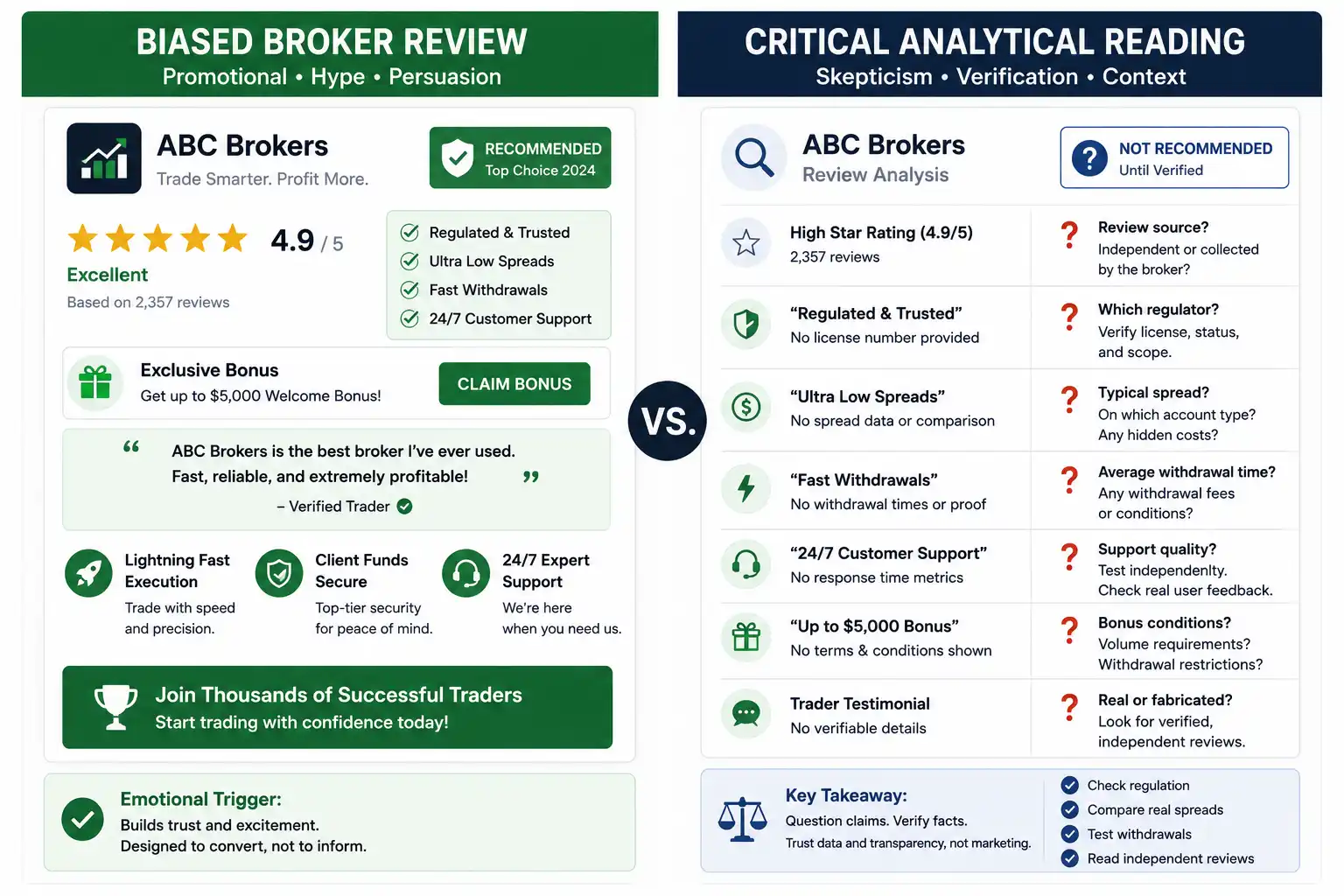
Why Most Broker Reviews Are Not Written for You
Here is something most review sites will never put in their headline: the review you are reading may have been written primarily to generate revenue from the broker being reviewed. That is a business model, and understanding how it works is the first step to protecting yourself from it.
The Affiliate Revenue Model Explained
Broker affiliate programs work like this: a review site signs up as an affiliate partner with a broker. When a reader clicks through from the review and opens a funded account, the site earns a payment. That payment takes one of two common forms:
- CPA (Cost Per Acquisition): a flat fee per new depositing client, often in the hundreds to thousands of dollars per referral
- Revenue Share: a percentage of the broker’s earnings from that client, sometimes paid indefinitely
Some programs offer a hybrid of both. The amounts involved are significant enough to create a genuine financial incentive to recommend a broker regardless of whether that broker is actually right for the reader.
This means the incentive structure points in a particular direction, and you should know which direction that is before you start reading.
How Incentive Structures Shape Review Content
When a site earns more from some brokers than others, editorial decisions start to reflect that, even subtly. Outright fabrication is rare. What you see more commonly is selective emphasis: positive features get prominent placement, limitations get a single line near the end, and the overall verdict lands where the commission structure points.
Brokers with higher affiliate payouts tend to rank higher in top lists on sites that carry those programs. Brokers with no affiliate program at all are less likely to appear in reviews on those same sites, not because they are inferior, but because they generate no referral revenue.
The result is a review ecosystem where coverage itself is commercially filtered before you read a single sentence.
The Anatomy of a Biased Broker Review
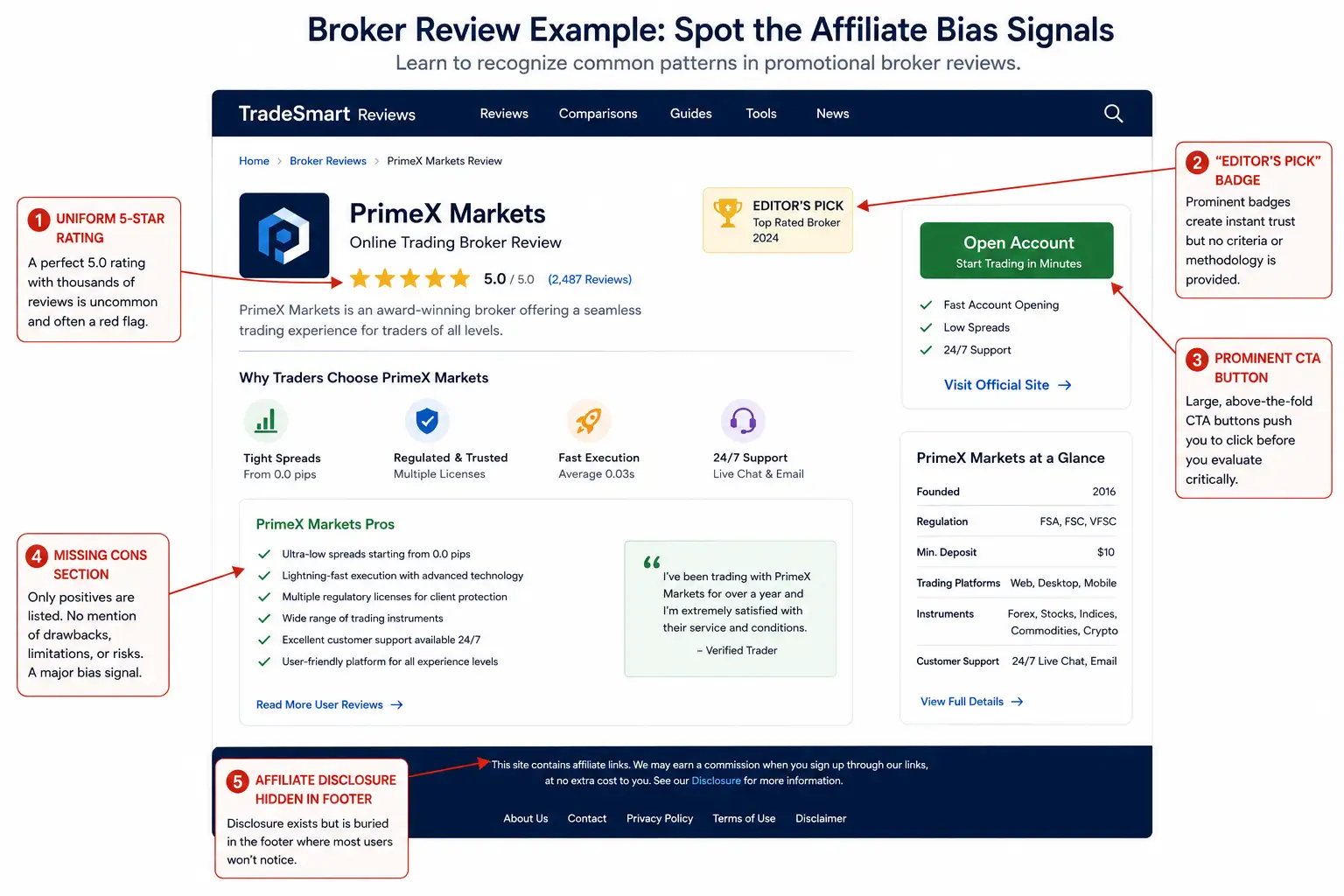
You can learn to spot a commercially compromised review from its structure and language alone, before you evaluate a single claim.
Language Patterns That Signal Promotional Intent
Promotional reviews have a vocabulary. Once you recognise it, you will see it everywhere:
- Superlatives with no basis: “industry-leading,” “best-in-class,” “top-rated” with no methodology cited
- Benefit stacking without counterpoint: five paragraphs on features, one sentence on risks
- Vague reassurance: “regulated by multiple authorities” without naming them or linking to registration records
- Urgency without context: references to limited-time offers, exclusive bonuses, or sign-up incentives woven into editorial copy
- First-person enthusiasm: “we love,” “we recommend,” “our top pick” with no explanation of how that conclusion was reached
None of these signals is conclusive on its own. Three or more appearing together in one review is a reliable indicator that you are reading marketing copy dressed as editorial.
Structural Red Flags (Rating Systems, Scoring Tables, Top Lists)
The design of a review can be as revealing as the writing. Watch for:
- Suspiciously clustered high scores: If every broker reviewed by a site scores between 8.5 and 9.8 out of 10, the scoring system is not an analytical tool. It is decoration.
- Top lists that rotate with affiliate agreements: A site that consistently places its highest-paying affiliates in positions one through three on its “best brokers” list is running a paid directory, not an editorial ranking.
- Scoring categories without sourced data: “Customer service: 9/10” means nothing without a methodology, a sample size, or a test conducted.
- Review dates that never change: A review marked “updated” with no actual content changes is being refreshed for search engine benefit, not reader accuracy.
What Is Consistently Missing from Paid Reviews
Absence tells you as much as presence. A review that omits the following is almost certainly incomplete:
- Withdrawal processing times and documented complaint history
- Spreads and commissions during high-volatility periods, not just baseline conditions
- Account inactivity fees or administrative charges
- Regulatory actions, warnings, or past enforcement history
- Limitations on leverage for retail clients in specific jurisdictions
If a review covers a broker’s trading platform in four paragraphs and its withdrawal policy in one sentence, you know where the writer’s priorities lie.
How to Assess the Source Before Reading a Single Word
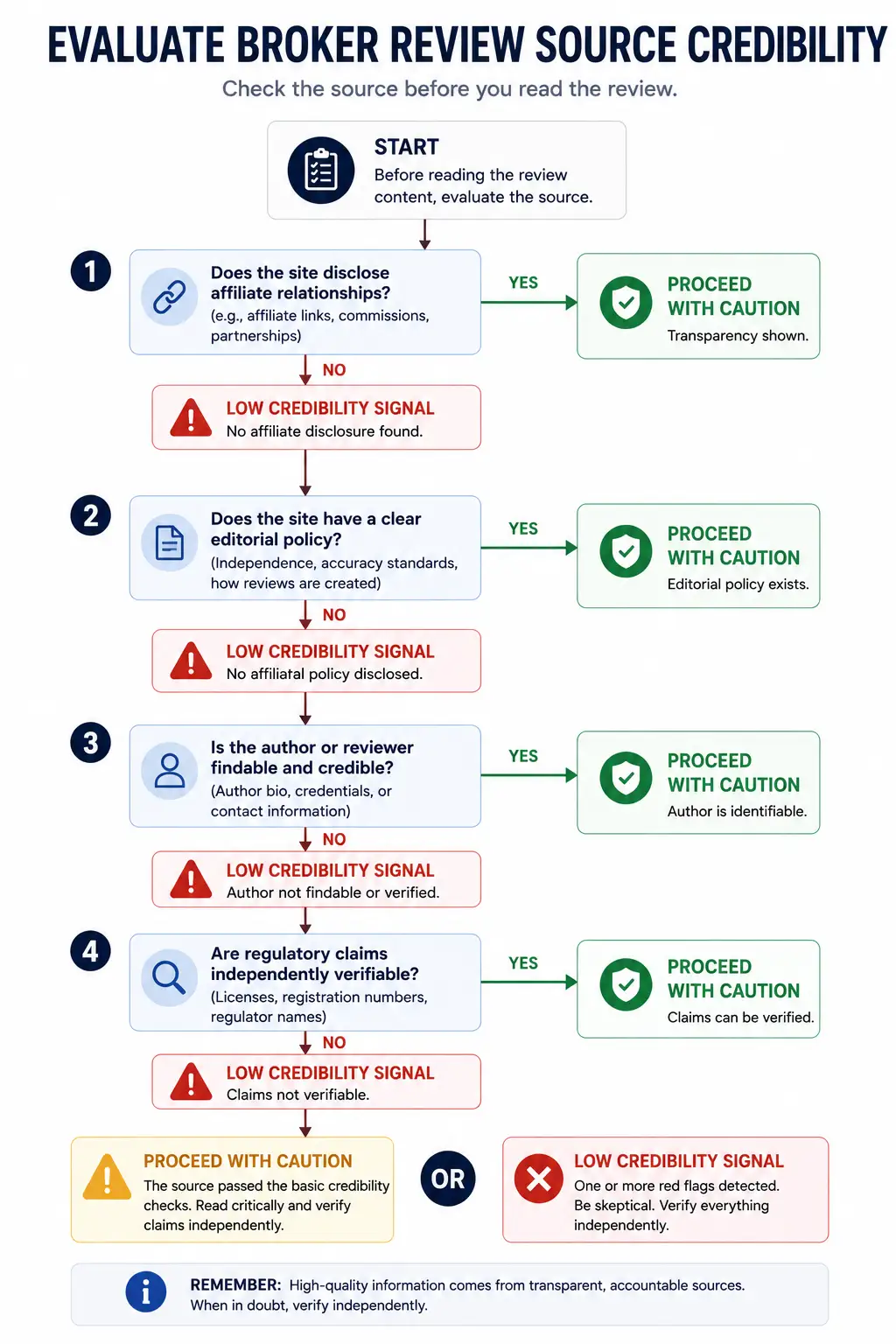
The review itself is secondary. The source it comes from is primary. Two minutes spent assessing the publisher before you read anything is two minutes well spent.
Evaluating the Publisher (Ownership, Disclosure, Editorial Policy)
Look for these things on the site before reading any review:
- Affiliate disclosure: Is there a clear, prominent statement that the site earns commissions from broker referrals? FTC guidelines in the US and ASA rules in the UK require this. A site that buries disclosure in small footer text, or omits it entirely, is not operating transparently.
- Editorial policy page: Does the site explain how it selects brokers to review, how it scores them, and who is responsible for that process? The absence of this is a meaningful gap.
- Ownership information: Is the site owned by a financial media company, a private individual, or a holding company with undisclosed interests? A quick search of the domain registration or company records can surface ownership the site itself does not advertise.
- Range of verdicts: A site that has never published a negative or mixed review of any broker it covers is not exercising independent editorial judgment.
Checking for FCA, SEC, or Equivalent Regulatory Disclosure Requirements
Reputable financial content publishers operating in regulated markets often carry their own compliance obligations. In the UK, financial promotions are generally expected to comply with FCA standards. In the US, content that influences investment decisions may fall under SEC or FINRA guidance.
A review site that discusses leverage, spreads, and account types without any regulatory disclosure language is either operating in a jurisdiction with minimal requirements or ignoring the ones that apply. Neither is reassuring.
Visible effort to comply with disclosure requirements is a positive credibility signal. Its absence is worth noting.
Cross-Referencing Author Credentials and Conflict of Interest Statements
Check the author byline, then check the author. A writer with a verifiable background in financial markets, journalism, or regulatory compliance carries more credibility than an anonymous contributor or a name that returns no search results at all.
Look for a conflict of interest statement at the article level. Does the author or their employer hold a relationship with the broker being reviewed? Some publications require writers to declare this; many do not. If that information is absent and you cannot locate it, factor that into how you read what follows.
A Practical Framework for Reading Any Broker Review
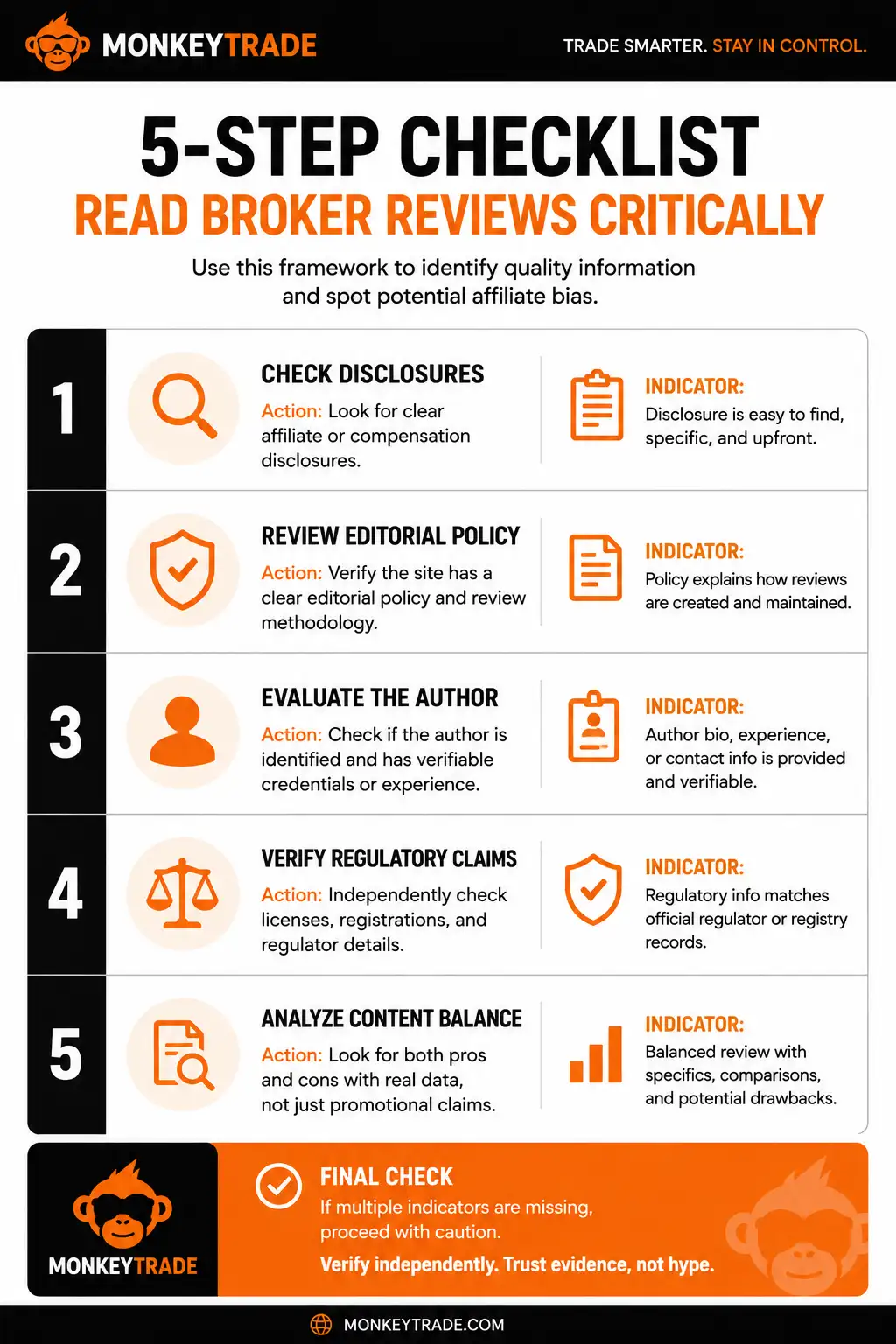
Apply this process to any review you encounter. It takes less time than reading the review itself, and it will immediately sort useful information from promotional noise.
Step 1 – Identify Monetisation Signals
Before reading the review body, scan for:
- Affiliate disclosure (present or absent)
- “Open account” or “visit broker” buttons with tracking links
- Star ratings or scores without methodology
- Bonus or promotion mentions in editorial copy
Where multiple monetisation signals appear, adjust your interpretation of everything that follows accordingly. The review may still contain factual information; you will just need to extract it more carefully.
Step 2 – Locate the Negatives
Go directly to the drawbacks, cons, or limitations section. Every credible review of a real broker has genuine negatives to report. If the negatives section is shorter than two or three substantive points, limited to minor technical issues, or absent entirely, the review is incomplete at best.
A broker with no meaningful drawbacks worth discussing does not exist.
Step 3 – Verify Regulatory Claims Independently
Never take a broker’s regulatory status from the review alone. Check it directly:
- FCA (UK): the Financial Services Register at register.fca.org.uk
- ASIC (Australia): ASIC Connect at connectonline.asic.gov.au
- CySEC (Cyprus/EU): the CySEC public register at cysec.gov.cy
- NFA (US): BASIC at nfa.futures.org
Search the broker’s name and registration number. Confirm the entity named in the review matches the registered entity. Some brokers operate multiple legal entities across jurisdictions, and not all carry equivalent protections. Check the regulated broker guide for a detailed walkthrough of this process.
Step 4 – Compare Across Multiple Source Types
No single source should be your deciding input. Cross-reference information across:
- Affiliate-monetised editorial sites (with appropriate scepticism applied)
- Independent financial press
- Regulatory body records
- Community discussion forums
- The broker’s own published terms and conditions
Where sources agree on a point, that agreement adds credibility. Where they diverge, investigate the disagreement rather than defaulting to whichever source you encountered first.
Step 5 – Check User Reviews as a Counterweight (with caveats)
User reviews on platforms like Trustpilot or community forums can surface genuine experiences that editorial reviews miss, particularly around withdrawal processing, customer service responsiveness, and platform reliability during volatile conditions.
Use them as a counterweight, not a replacement. User review platforms carry their own distortions:
- Brokers sometimes incentivise positive reviews from satisfied clients
- Negative reviews can be submitted by competitors or users whose experience was atypical
- Review counts and recency matter; a handful of reviews from three years ago tells you little about current operations
Look for patterns across a large sample, not individual data points in either direction. The MonkeyTrade broker comparison tool aggregates multiple source types for this reason.
Where to Find More Credible Broker Information
Credible information about brokers exists. It is distributed across sources that require a little more effort than a single search result, but they are accessible to any trader willing to look.
Regulatory Body Registers (FCA, CySEC, ASIC, NFA)
The registers listed in Step 3 are the most authoritative sources of factual broker information available to you. They will not tell you whether a broker’s spreads are competitive or its platform is intuitive, but they will confirm registration status, authorised activities, and in some cases, enforcement history.
Some regulators also publish warning lists of firms operating without authorisation. These are worth checking directly, rather than waiting for a review site to surface that information.
Community Sources and Their Limitations
Trading forums, subreddits, and Discord communities can be valuable for surfacing real trader experiences. The limitations mirror those of user review platforms: self-selection bias, emotional skew, and occasional coordinated manipulation.
Weight community sources more heavily for operational complaints, such as withdrawal delays, support responsiveness, and platform outages, and less heavily for assessments of overall broker quality. That kind of judgment requires broader context than individual experience can provide.
How to Use Affiliate Sites Without Being Used by Them
Affiliate-monetised review sites are not useless. The better ones invest in genuine research because their reputation depends on it, and because readers who make poor decisions based on their content eventually stop trusting them.
The practical approach: use these sites for structured feature comparison, covering account types, platforms supported, minimum deposits, and available instruments, while applying independent verification to anything involving regulatory claims, fees, or editorial verdicts. See how MonkeyTrade approaches broker reviews and what the editorial process looks like.
Treat affiliate review content as a starting map. It can point you in a direction. Confirming that direction is your responsibility.
Applying This to Your Broker Search
You now have a framework for reading reviews critically. Putting it to work in an actual broker search is a slightly different task, and it is worth thinking about how these skills fit into that process.
Start by establishing your requirements before you read a single review.
- What markets do you intend to trade?
- What is your capitalisation?
- Do you need a broker regulated in a specific jurisdiction because of where you are based?
Having clear answers to these questions before you start reading gives you a filter that no review site can replicate. A broker that earns a 9.5 on a review site is irrelevant to you if it does not support the instruments you trade or is not authorised to accept clients from your country.
Once your requirements are defined, use reviews for what they are actually good at: structured feature comparison. Regulatory status, supported platforms, account types, and minimum deposit thresholds are factual details that even commercially motivated reviews tend to report accurately, because getting them wrong generates complaints. Apply the scepticism from this guide most heavily to editorial verdicts, scores, and top-list placements.
If you are still building out your understanding of what to prioritise in a broker, reviewing what matters before you commit is time well spent. The guide to choosing the right broker covers the core criteria in detail.
Keep a short list of two or three candidates, then move to direct verification: check regulatory status on the appropriate register, read the broker’s own terms for fee structures and withdrawal conditions, and look at recent user reviews for any pattern of operational issues. At that point, you are working from verified information rather than a commercially filtered summary of it.
The goal is to triangulate a reliable picture from multiple imperfect sources. That is a more achievable standard, and one you can apply to every broker you evaluate from here.
Frequently Asked Questions