


Taking Trading Breaks: When Stepping Away Makes You a Better Trader
Here is something most traders never hear early enough: taking trading breaks is not quitting. It is one of the sharpest tools in your toolkit. The best traders in the world do not trade every single day. They step away on purpose, recharge their decision-making ability, and come back with clearer eyes and steadier hands.
This guide gives you a practical framework for knowing when to step away, how long to stay away, and exactly how to come back without falling into the same traps.

Why Most Traders Never Learn to Stop
There is a deeply ingrained belief in trading culture that more screen time equals more profit. That if you are not watching the market, you are leaving money on the table. This belief keeps traders glued to their screens long past the point of rational decision-making, and it costs them far more than any missed setup ever could.
The Cost of Trading Through Burnout
Think about the last time you were genuinely exhausted but forced yourself to keep trading. How did those trades turn out? Burnout quietly degrades your ability to assess risk, recognize patterns, and stick to your plan. Your brain starts taking shortcuts, and in trading, shortcuts almost always mean losses.
The real cost is the compounding damage. A losing trade breeds frustration. Frustration breeds revenge trading. Revenge trading digs a drawdown that takes weeks to climb out of. All because you did not close the laptop when your mind was already waving the white flag.
What Overtrading Actually Looks Like
Overtrading is sneaky. It does not always look like placing fifty trades in a day. You might be overtrading if:
- You are entering positions outside your trading plan just because “the chart looks interesting”
- You are increasing position size after losses to claw back to breakeven
- You feel anxious or restless when you are flat
- You are trading during low-probability sessions for your strategy
Overtrading is less about frequency and more about intent. If your trades are not coming from your plan, they are coming from your emotions. That is the clearest sign a break is overdue.
So how do you know for certain when it is time to step away?
Recognizing the Warning Signs You Need a Break
Your mind and body will tell you when you have hit the wall. The problem is, most traders have spent years training themselves to ignore those signals.
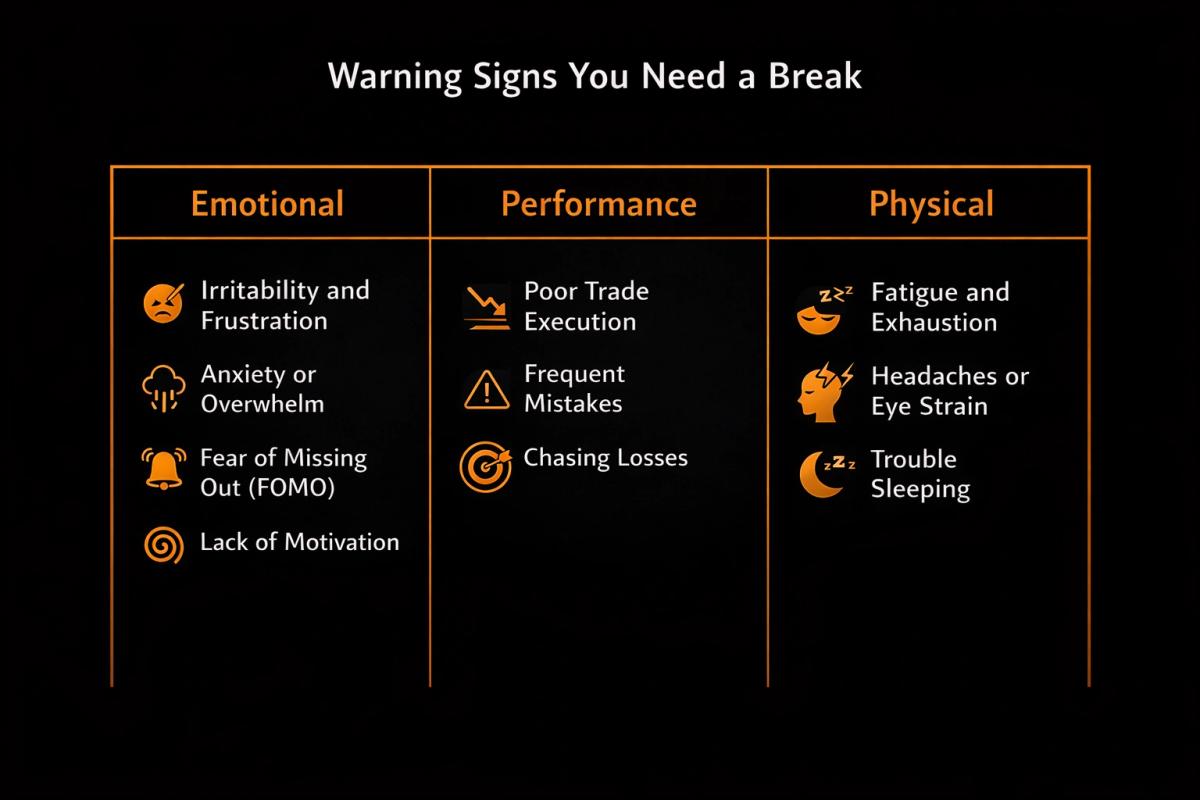
Emotional Signals
- Irritability and short temper – Losses feel personal rather than statistical
- Anxiety before market open – Instead of feeling prepared, you feel dread
- Revenge mindset – After a loss, your first thought is “I need to make that back right now”
- Apathy – You stop caring about your process and just want the day to be over
When your emotional baseline shifts from calm to reactive, your trading edge has already eroded. You just might not see it in the numbers yet.
Performance-Based Signals
Numbers do not lie. Watch your trading journal for:
- Unusual losing streaks that break your historical pattern
- Win rate dropping while trade frequency increases – the classic burnout signature
- Ignoring stop losses or nudging them further out
- Consistently poor entries or exits on setups you normally execute well
Physical and Lifestyle Signals
- Disrupted sleep – Lying awake replaying trades or waking up to check futures
- Eye strain, headaches, or back pain from too many hours at the screen
- Neglecting exercise, meals, or relationships
- Increased caffeine or substance use to stay “sharp”
If you recognized yourself in several of these, the next question is straightforward: what kind of break do you actually need?
Types of Trading Breaks and When Each Applies
Not all breaks serve the same purpose. A ten-minute walk is not the same as a week off. Here is a framework for matching the break to the problem.
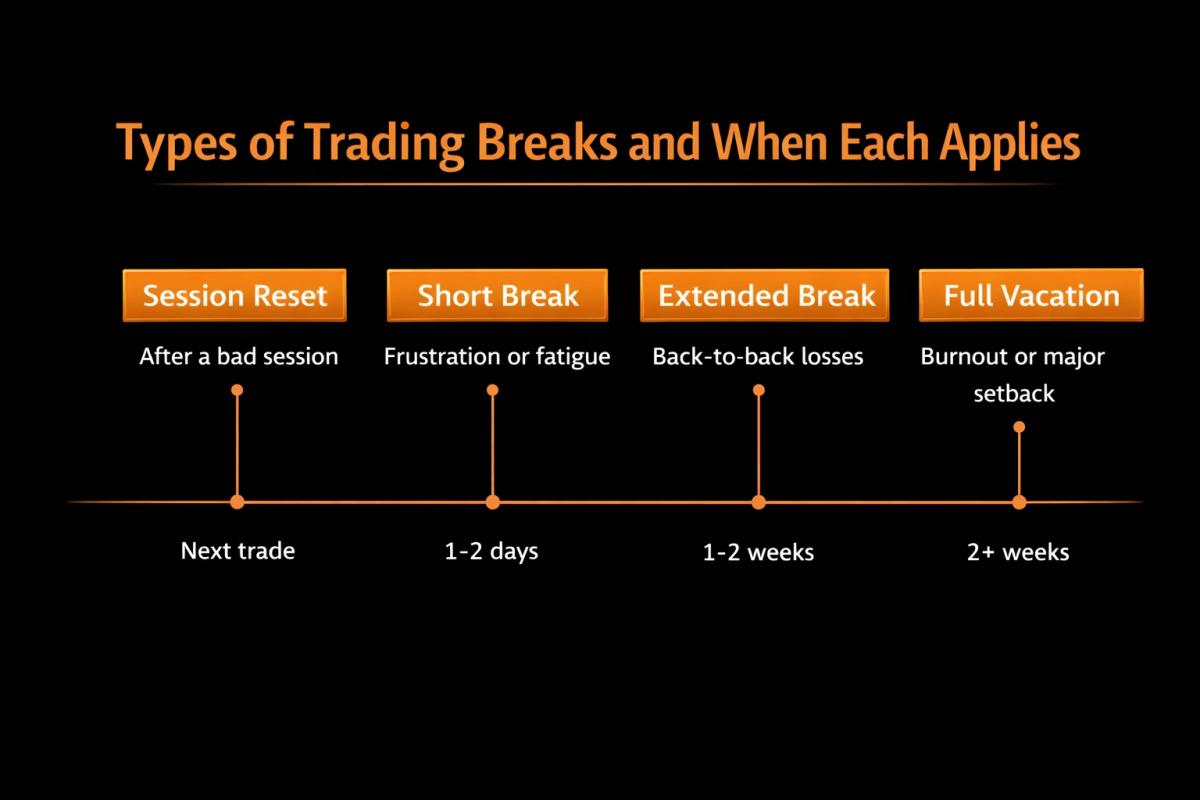
The Session Reset (Minutes to Hours)
When to use it: You have had a bad trade or two within a session, and you can feel your emotions grabbing the wheel.
Step away for 15 to 60 minutes. Go outside, stretch, eat something. The goal is to interrupt the emotional loop before it turns a small loss into a damaging one. Some traders set a hard rule: after two consecutive losing trades, screens go off for at least 30 minutes. No exceptions.
The Short Break (1-3 Days)
When to use it: You have had a rough week, your confidence is wobbling, or multiple warning signs are stacking up.
A day or two gives your nervous system a chance to actually downregulate. Use this time to review your journal and spend energy on non-trading activities that restore you.
The Extended Break (1-2 Weeks)
When to use it: You have hit a significant drawdown, you are questioning your strategy, or burnout symptoms have become persistent.
This is where real reflection happens. You can assess whether your strategy needs adjustment, whether your risk management held up, and whether life factors are bleeding into your trading. Think of it the way a professional athlete treats a recovery block between seasons.
The Full Vacation from Trading (2+ Weeks)
When to use it: You feel completely depleted, or you have been grinding without a real break for months.
Two or more weeks away can feel deeply uncomfortable, but it often produces the biggest breakthroughs in how you approach the markets when you return.
Knowing which type of break you need is one thing. Knowing what to actually do with that time is another challenge entirely.
How to Structure Your Time Away from the Markets
A break without structure can easily dissolve into aimless scrolling or sneaking back into trades out of boredom.
What to Do During a Trading Break
- Review your trading journal – Spot patterns objectively without the pressure of the next session looming
- Work on non-trading skills – Exercise, read, reconnect with people. A well-rounded life feeds better trading.
- Study without trading – Watch educational content or backtest a strategy, but keep your hands off the buy button
- Set concrete goals for your return – What will you do differently? Write it down before the motivation fades.
- Rest, genuinely – Let your mind wander without directing it toward tickers and setups
What to Avoid During a Trading Break
- Checking charts “just to see” – This keeps the mental load humming and defeats the entire purpose
- Following trade alerts or signal groups – Watching others trade is a fast track to FOMO
- Making impulsive strategy overhauls – Breaks are for reflection, not untested changes made in frustration
- Feeling guilty – You are doing this to get better, not because you are weak
Rest alone does not fix what went wrong, though. At some point, you need to look inward.
The Mental Reset: Rebuilding Your Trading Mindset
Stepping away from the screens is the first move. Rebuilding the mental foundation that supports good decisions is the deeper work, and it happens during the break.
Journaling and Self-Review During Breaks
Your trading journal is your most powerful tool during a break. Sit down with it and ask specific questions:
- What was your emotional state before your worst trades?
- Did you follow your rules, or did you deviate?
- Are there recurring triggers for impulsive behavior?
- What were you doing differently during your best stretches?
Writing reflective entries during your break adds another layer. What do you actually want from trading? What are your non-negotiable rules? This kind of honest review is nearly impossible while you are actively trading, because the urgency of the next session always pulls you forward before you can sit with the answers.
Separating Identity from Performance
If a losing streak makes you feel like a failure as a person, not just a trader having a rough patch, your identity has become too tightly wrapped around your P&L. During your break, pay attention to your self-talk. “I had a bad week” describes a temporary situation. “I am a bad trader” is an identity statement, and it quietly shapes every decision that follows.
This kind of mental clarity is exactly what you need before sitting back down at your desk. But coming back carries its own risks.
Coming Back: How to Re-Enter the Market After a Break
The return is where most traders undo all the good work their break accomplished. They come back feeling refreshed and immediately go full size, full speed. Do not make that mistake.
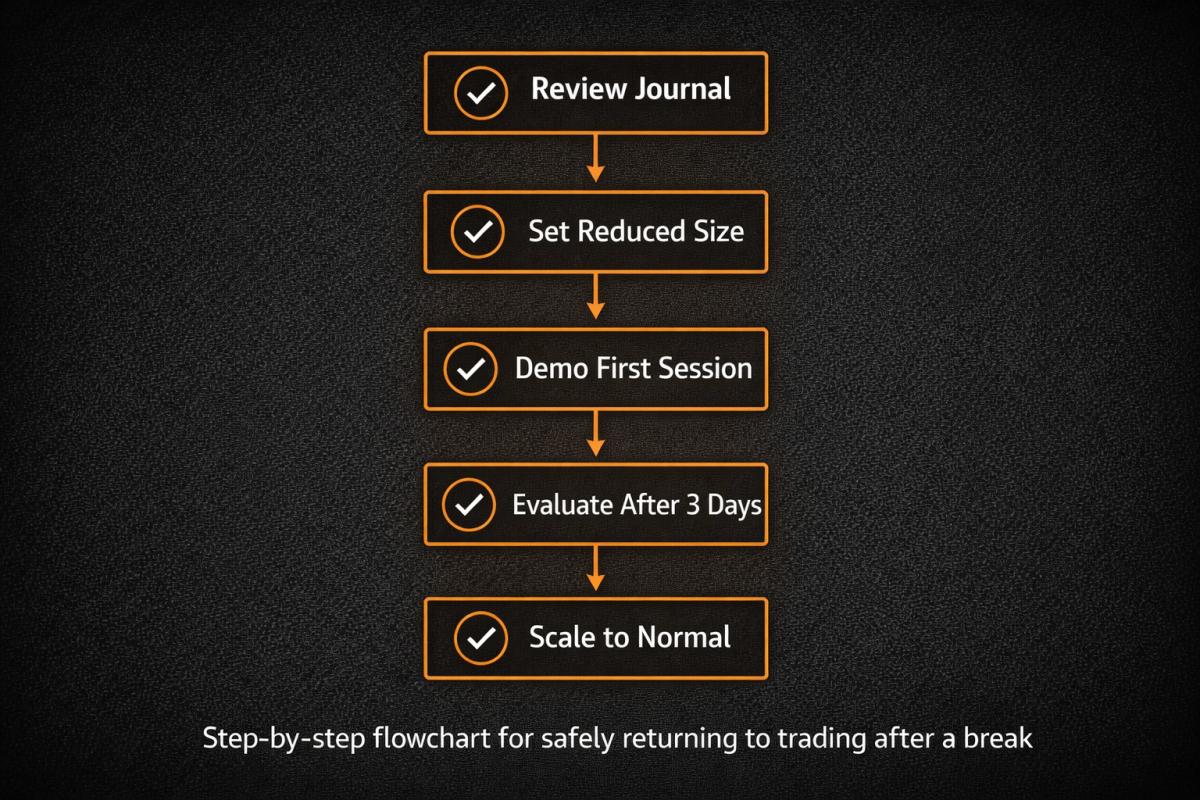
Scaling Back In with Reduced Size
Your first trades back should be at 25% to 50% of your normal position size. Think of it the way a runner returns after time off. You do not lace up for a marathon on day one. You jog a few easy miles and see how the body responds. Reduced size removes emotional weight from your early trades, turning small losses into data points rather than setbacks.
Using a Demo Account as a Warm-Up
If your break lasted longer than a week, consider running your first session or two on a demo account. This lets you re-establish your feel for price action and test whether your setups are valid in current market conditions, all without risking real capital.
Setting Rules for Your First Week Back
Before your first trade, write down simple return rules:
- Trade only your highest-confidence setup for the first three days
- No more than two trades per session
- Maximum position size at 50% of normal until five consecutive rule-following days
- End the session immediately if you catch yourself deviating
- Journal every trade in detail, including your emotional state
These guardrails prevent “fresh start” energy from turning into overconfidence. But what if you are trading a prop firm account? Do you even have the luxury of stepping away?
Trading Breaks and Prop Firm Rules
If you are trading a funded account or sitting mid-challenge, breaks can feel like a risk you cannot afford. But blowing your account because you traded while burned out is far worse than taking a strategic day off.
Inactivity Policies to Know About
Most prop firms have some form of inactivity policy. Common patterns include:
- Minimum trading day requirements within evaluation periods
- Maximum consecutive inactive days before accounts are flagged
- Funded account inactivity limits (often requiring at least one trade within 30 days)
Before taking any break, check the specific rules of your prop firm. Do not assume you know them. Read the fine print or contact support directly.
Planning Breaks Within Challenge or Funded Account Timelines
If your prop firm requires ten trading days within a 30-day evaluation, you have 20 potential rest days built in. That is more flexibility than most traders realize. Map out your evaluation period, identify the minimum activity requirements, and schedule break days in advance so you stay compliant while still protecting your mental edge.
Which brings us to the bigger picture: breaks should not be a reaction. They should be part of your plan from the start.
Building Breaks Into Your Trading Plan
The most effective traders do not just react to burnout. They build defenses against it before it arrives.
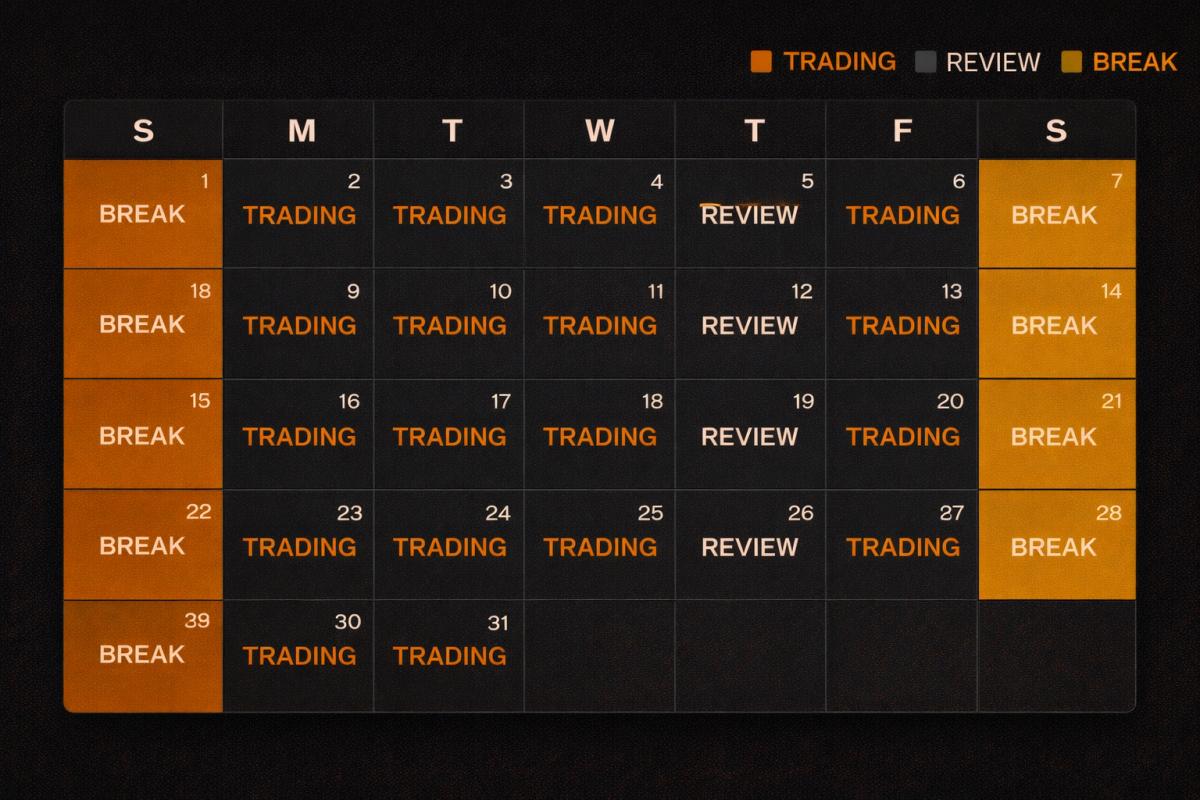
Scheduled vs. Reactive Breaks
Scheduled breaks are pre-planned rest days built into your calendar. Maybe every Friday off, or the first Monday of each month reserved for review. These happen regardless of performance, because they are maintenance, not repair.
Reactive breaks respond to warning signs, mounting losses, or emotional overload. They are necessary, but if reactive breaks are the only kind you take, you are always playing catch-up with your own burnout. Think of scheduled breaks as oil changes and reactive breaks as engine repairs. Both matter, but one is far cheaper and less stressful.
Creating a Personal Break Protocol
Write your protocol into your trading plan with the same weight you give entry and exit rules:
- Weekly: One full day off (no charts, no market news)
- Monthly: One review day for journal analysis and plan adjustments
- Trigger-based: Three consecutive losing days triggers a mandatory day off. Drawdown exceeding your set threshold triggers a minimum three-day break.
- Quarterly: One extended break of three to five days, regardless of how performance looks
The specific numbers matter less than the commitment to having a protocol at all. When it is written into your plan, stepping away stops feeling like failure and starts feeling like what it actually is: discipline.
Frequently Asked Questions
How long should a trading break last?
There is no universal answer. A session reset might be 30 minutes, while burnout recovery could require two weeks or more. Match the length to the severity of the problem. If a short break does not restore your clarity, extend it without hesitation.
Does taking a break mean I lack discipline?
Quite the opposite. It takes more discipline to step away when the market is open than to keep trading on impulse. Recognizing when you are not at your best and choosing to protect your capital is one of the most disciplined decisions you can make.
How do I deal with FOMO while on a break?
FOMO fades faster than you expect, especially if you stay away from charts, alerts, and trading social media. The market will still be there when you return. Missing one setup is far less costly than forcing trades from a burned-out state.
Should I check charts during a trading break?
For short session resets, brief checks may be fine. For longer breaks, avoid charts entirely. The goal is to let your brain fully disengage from market-scanning mode. "Casual" chart checking keeps your stress circuits active and quietly undermines recovery.
How do prop firm inactivity rules affect planned breaks?
Most prop firms allow some inactive days, but specifics vary widely. Always check your firm's rules before planning a break. Many evaluation periods have more built-in flexibility than traders assume. Plan your breaks within those constraints.
How do I know if I need a short break or a longer one?
Look at the warning signs. If you are catching emotional signals early, like irritability or a single revenge trade, a session reset or one-day break is likely enough. If you are seeing performance degradation across multiple days or noticing physical symptoms, a week or more is warranted.
What if my performance does not improve after returning?
A break is not a magic fix. If the same problems persist after rest, the issue might be strategic rather than psychological. Review your plan, reassess your strategy, or consider working with a mentor. If emotional difficulties continue, speaking with a qualified professional is a worthwhile step.
Is it better to schedule breaks or take them when needed?
Both, and they serve different purposes. Scheduled breaks prevent burnout before it starts. Reactive breaks catch the problems that slip through. Over time, consistent scheduled breaks reduce how often you need emergency reactive ones. This content is for educational and informational purposes only. It does not constitute financial advice or mental health counseling. If you are experiencing persistent difficulties with your mental wellbeing, please consult a qualified professional.
About the authors


Related articles
Analysis Paralysis in Trading: Why You Freeze and How to Fix It
Learn to recognize analysis paralysis in trading, understand its psychological roots, and build a decision-making framework with confident execution.
Anchoring Bias in Trading: How Mental Price Traps Cost You Money
Learn how anchoring bias distorts your trading decisions. Spot mental price traps, break free from fixation on entry prices, and build systems to protect your returns.
Anger in Trading: Why It Happens and How to Control It
Learn why anger strikes during trading, how it destroys performance through revenge trades and broken rules, and proven techniques to control it.
0 comments