


The Complete Trading Journal Guide: Build a System That Improves Your Results
You already know you should be keeping a trading journal. Every trading book mentions it. Every successful trader swears by it. And yet, most traders either never start one or fill it in dutifully for a week before it quietly dies in a forgotten spreadsheet tab.
The problem is that nobody shows you what a useful trading journal actually looks like when it’s working. This trading journal guide walks you through the entire lifecycle: what to record, how to structure your journal, which format fits the way you trade, and how to run review sessions that turn raw data into genuine performance improvements.
Trading involves risk, and past performance does not guarantee future results. This guide is educational, not financial advice.

What Is a Trading Journal and Why Do Traders Need One
Most traders hit a wall at some point. Money comes in some weeks, bleeds out the next, and no amount of staring at the P&L column explains what separates the good stretches from the bad. That gap between “I have a strategy” and “I’m consistently executing my strategy” is exactly where a trading journal lives.
Beyond a Simple Trade Log
A trade log records what happened: entry price, exit price, profit or loss. It’s a ledger that answers “what did I do?” and stops there.
A trading journal captures the why behind every trade, the context you were operating in, your emotional state, the setup that triggered your entry, and the reasoning behind your exit. If a trade log is a receipt, a trading journal is the story behind the purchase.
Why does this distinction matter? Because when you’re trying to figure out why you keep getting stopped out on breakout trades, a list of numbers won’t tell you much. Knowing that most of those losses happened on low-volume afternoons when you were bored and forcing entries? That’s the kind of insight only a real journal provides.
How Journaling Connects to Consistent Profitability
Think of it the way an athlete reviews game film. A basketball player doesn’t just look at the final score. They study shot selection, positioning, and footwork. Your trading journal serves the same purpose: it turns raw execution into repeatable performance.
When you track trades with enough context, patterns start surfacing. You might discover that your win rate on morning setups runs significantly higher than afternoon trades. You might notice a habit of widening your stop loss every time a trade moves against you by a certain amount. You might find that your best weeks happen when you take fewer trades, not more.
None of these insights exist without a journal. And without them, you’re left repeating the same mistakes while hoping for different results.
What to Record in Your Trading Journal
Recording too little makes your journal useless. Recording too much makes it a chore you’ll abandon inside a week. The sweet spot is capturing enough context to make reviews productive without turning every trade into a documentation project.
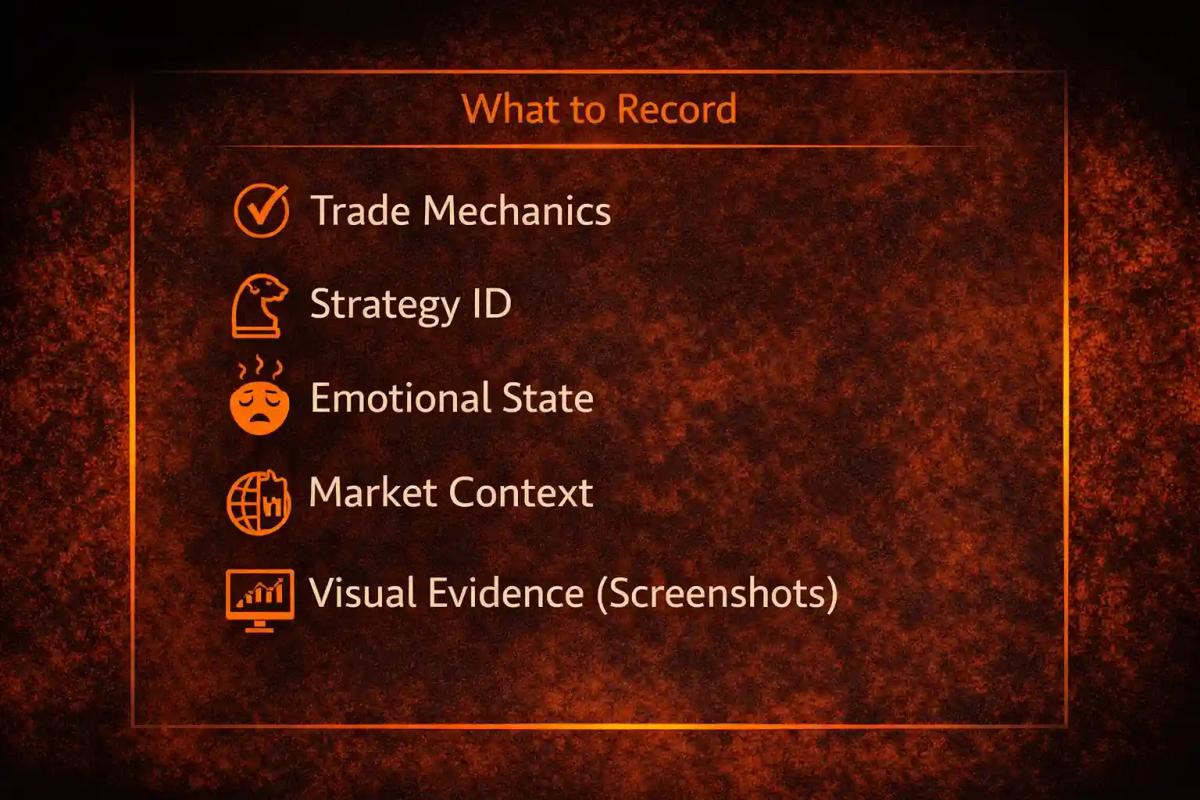
Trade Mechanics (Entry, Exit, Size, Instrument)
These are your baseline facts, the skeleton of every journal entry:
- Date and time of entry and exit
- Instrument, direction (long/short), position size
- Entry price, exit price, planned stop loss and take profit
- Risk-reward ratio (planned vs. realized)
- Net P&L including commissions
Setup and Strategy Identification
Every trade should connect back to a defined setup in your trading plan. For each trade, note:
- The setup name
- Whether all entry criteria were met
- Your confidence level at entry (a simple 1-5 scale works well)
Over time, you’ll see which setups actually make you money, and that feeds directly into how you manage your risk.
Emotional and Psychological State
This is the section most traders skip. It’s also arguably the most valuable. Before and after each trade, record:
- Your emotional state (calm, anxious, bored, frustrated)
- Whether you followed your plan
- Any external factors like poor sleep or unusual stress
Even a single word per field is enough. When you review a month’s entries and notice your worst losing days all carry “frustrated” or “revenge” in the emotional column, that’s a pattern you can actually do something about. Understanding your trading psychology is a measurable performance variable.
Market Context and Conditions
Record the overall market direction, volatility level, key nearby levels, notable events (earnings, economic releases), and trading session timing. This context turns isolated trades into a map of how your strategy performs across different environments.
Screenshots and Chart Markups
Screenshots capture what words can’t efficiently describe. Mark up your charts with entry and exit points, stop loss levels, and a brief annotation. Most platforms like MetaTrader allow direct chart image saves, and dedicated trading journal software often lets you embed screenshots inline.
So you know what to record. The next question: where does all of this actually go?
Choosing Your Trading Journal Format
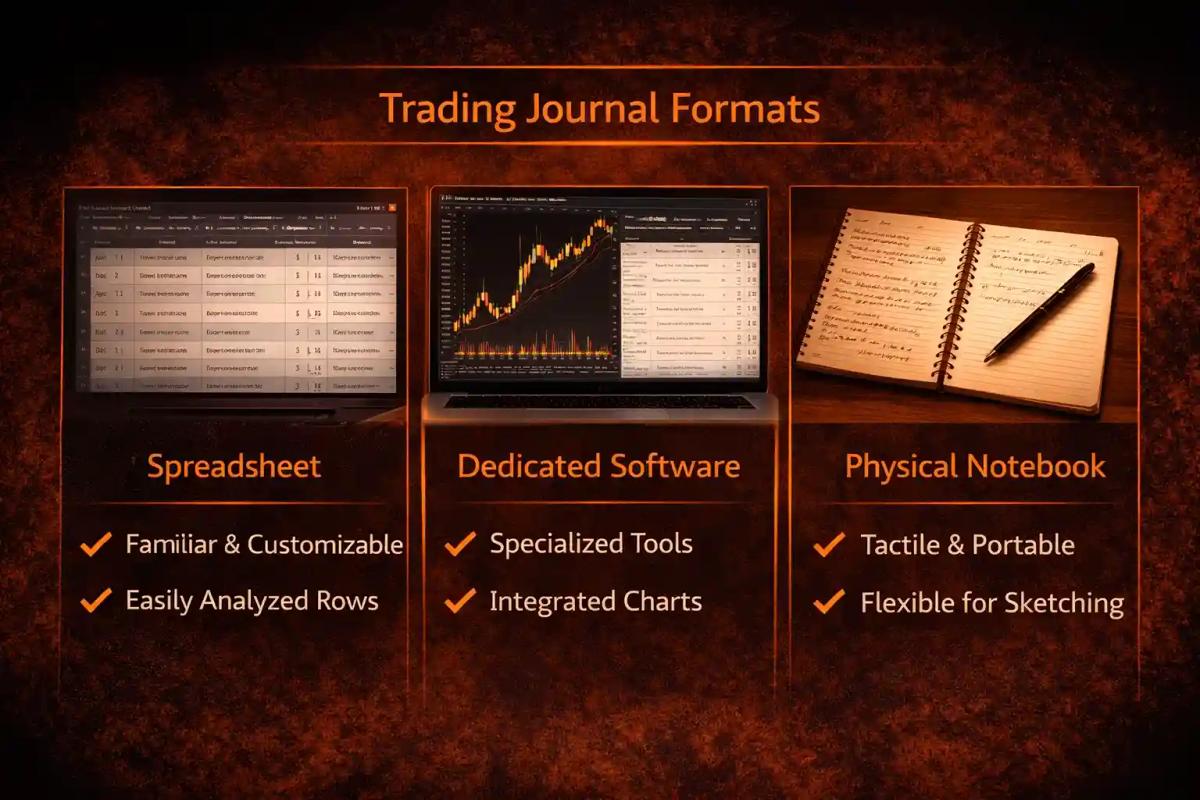
Spreadsheet-Based Journals
Free, fully customizable, and familiar. Spreadsheets give you complete control over layout and formulas. The downsides: manual data entry, limited screenshot embedding, and things tend to get unwieldy once you pass a few hundred trades. Still, spreadsheets are an excellent starting point, especially if you’re placing under 5-10 trades per day.
Dedicated Trading Journal Software
These platforms offer built-in trade imports, analytics dashboards, tagging systems, and chart replay. Some include AI-powered pattern detection. The tradeoff is subscription costs, less flexibility in customization, and a learning curve. Worth considering if you’re trading actively enough that automated imports save meaningful time.
Physical Notebooks and Hybrid Approaches
The physical act of writing engages your brain differently. A hybrid approach works well for many traders: use a spreadsheet for quantitative data and a notebook for qualitative observations. Whatever format you settle on, the most important factor is that you use it consistently.
How to Set Up Your Trading Journal Step by Step
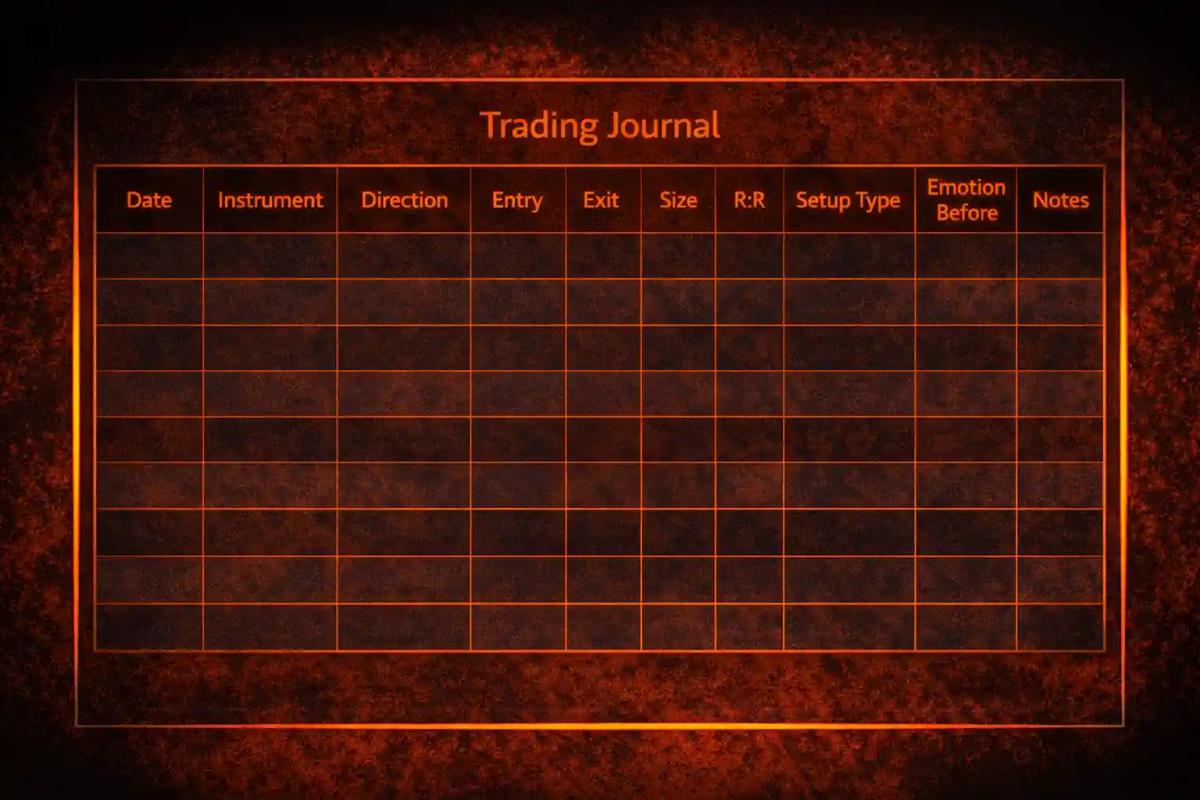
Defining Your Fields and Template
Start with the fields you’ll realistically fill in, then layer on more as the habit solidifies. A journal with 10 consistently completed fields beats one with 25 half-empty fields every time.
Pre-Trade Entry Workflow
Before entering a trade, take 30 seconds to record:
- The setup you’ve identified
- Your planned entry, stop, and target (which forces you to define risk before committing capital)
- Your emotional state
- Your confidence level
This brief pause also acts as a filter against impulsive entries. If you can’t articulate your setup in 30 seconds, the trade probably doesn’t meet your criteria.
Post-Trade Entry Workflow
After closing a trade, fill in:
- Your exit price and P&L
- Emotional state after the trade
- Whether you followed your plan
- A screenshot
- One sentence about what you’d do differently
The whole process should take 1-3 minutes.
The entries themselves are just raw material, though. The real value comes from what you do with them next.
How to Review Your Trading Journal Effectively
Recording trades without reviewing them is like getting blood work done and never reading the results. The review process is where your journal transforms from record-keeping into a performance improvement tool.
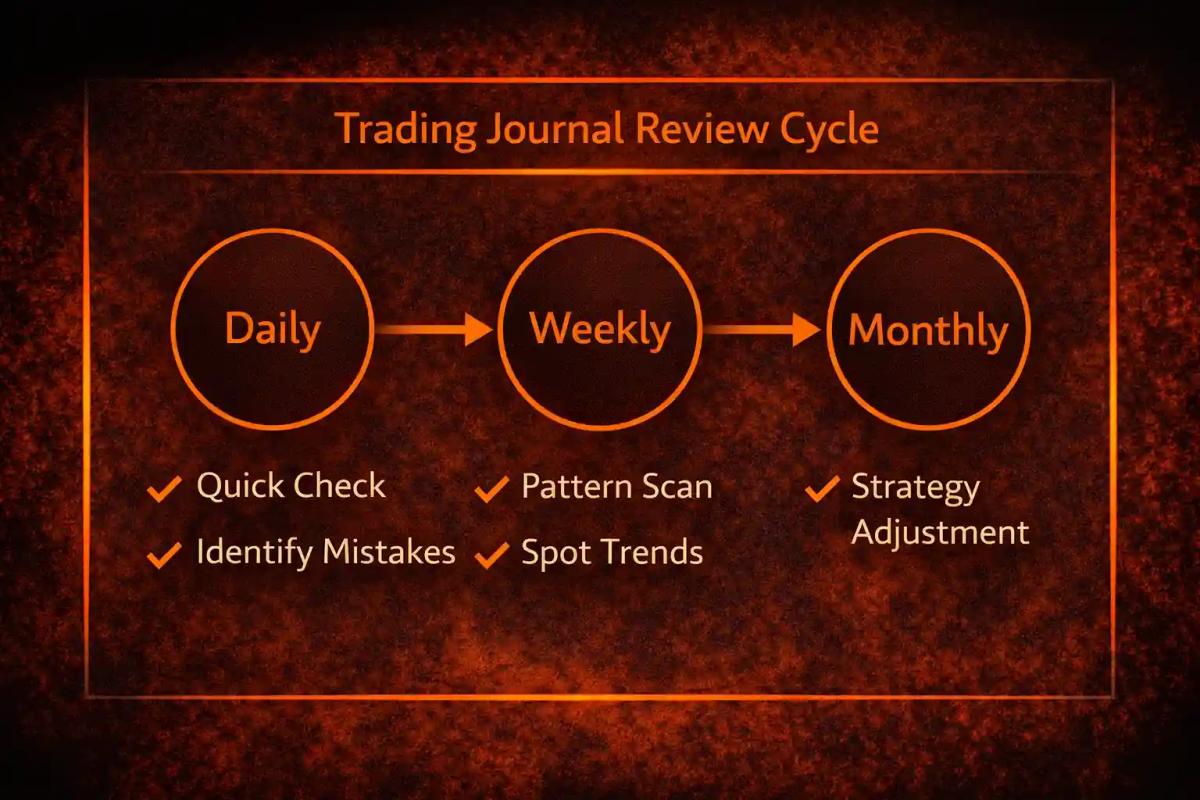
Daily Review Process
Spend 5-10 minutes at the end of each session. Read through the day’s entries, check for rule violations, note your emotional arc, and identify one thing you did well alongside one thing to improve. Think of it like brushing your teeth: short, non-negotiable, and compounding in its benefits.
Weekly and Monthly Review Cycles
Set aside 30-60 minutes weekly to examine win rate, setup performance, risk-reward averages, and emotional correlations. Monthly, zoom out further: evaluate strategy performance across a meaningful sample size, analyze drawdowns, and assess whether your position sizing is doing its job.
The monthly review is the appropriate time to consider strategic changes, not after a single rough week.
Identifying Patterns and Recurring Mistakes
Look for these common signals in your data:
- Time-of-day patterns in performance
- Overtrading triggers
- Revenge trading sequences
- Setup degradation over time
- Risk management drift
When you spot a recurring mistake, create a specific rule to address it. For example, if afternoon trades consistently underperform: “No new entries after 2:00 PM unless the setup meets all A-grade criteria.”
Knowing what to track and review isn’t usually the hard part. The real challenge is sidestepping the traps that make traders abandon journaling entirely.
Common Trading Journal Mistakes and How to Avoid Them
Recording Too Much or Too Little
The over-documenter writes paragraphs for every trade and burns out within a week. The under-documenter records only entry, exit, and P&L, producing a glorified trade log with zero context for meaningful review. Aim for 1-3 minutes per trade entry. If it’s taking longer, simplify your template.
Journaling Without Reviewing
This is the most common mistake by a wide margin. Set specific review appointments in your calendar (weekly and monthly) and treat them as non-negotiable. Five minutes of weekly review can save you from repeating a mistake that costs far more than the time invested.
Abandoning the Journal After a Losing Streak
The times you most want to stop journaling are exactly when your journal is doing its most valuable diagnostic work. Losing streaks reveal more about your process than winning streaks ever will. The discomfort of documenting losses honestly is part of the process, and those entries often become the most instructive pages in your entire journal.
That same discipline required to journal through difficult periods mirrors what you need for one of trading’s most demanding tests.
How a Trading Journal Helps You Pass Prop Firm Challenges
Prop firm evaluations are essentially tests of consistency, risk management, and disciplined execution over a defined period. Your journal is built to support all three.
During a challenge, your journal helps you:
- Track progress against evaluation targets (profit targets, drawdown limits, minimum trading days)
- Spot early warning signs that you’re approaching drawdown limits before they trigger a failure
- Maintain discipline under pressure by anchoring you to process rather than outcomes
- Document which setups work within the evaluation’s specific constraints (some setups that perform well in your regular account may carry too much risk given tight drawdown limits)
Many traders who fail challenges do so because evaluation pressure pulls them away from their normal approach. Your journal acts as an anchor: a concrete process that keeps you focused on executing your plan rather than chasing the profit target.
After completing or failing a challenge, your journal becomes a detailed debrief document. You can trace exactly what worked, what didn’t, and what to adjust for the next attempt. Traders who journal through evaluations tend to improve noticeably faster between tries.
About the authors


Related articles

Analysis Paralysis in Trading: Why You Freeze and How to Fix It
Learn to recognize analysis paralysis in trading, understand its psychological roots, and build a decision-making framework with confident execution.

Anchoring Bias in Trading: How Mental Price Traps Cost You Money
Learn how anchoring bias distorts your trading decisions. Spot mental price traps, break free from fixation on entry prices, and build systems to protect your returns.

Anger in Trading: Why It Happens and How to Control It
Learn why anger strikes during trading, how it destroys performance through revenge trades and broken rules, and proven techniques to control it.
0 comments