




FTMO Review 2026
Our Overall
Score
4.59


Traders Score
—
~€89
80%
11
- No Time Limit
- EAs Allowed
- Fee Refund
- Multiple Platforms
- Scaling Plan
Basic info
- República Checa, Praga
- 2015
- Simulated capital
- Yes
- Yes, up to 20%
 República Checa, Praga
Challenge specs
- ~€89
- €89 - €1,080
- 10%
- 5%
- 10%
- 4
- 1–2
- No limit
- 80%
- Yes (not on the 1-Step model)
Features
- 1:100 (Standard account type, per FTMO documentation)
- Yes
- 25% account balance increase every 4 months if trader shows at least 10% net simulated profit, at least 2 processed rewards in the 4-month window, and a positive balance at review. Scales up to $2,000,000. On the 2-Step path, hitting Scaling Plan also upgrades the split to 90%.
- On demand from day 14; configurable Profit Split Day between 14 and 60 days per cycle
- Forex, Indices, Commodities, Stocks, Cryptocurrencies
- English, Spanish, +18 more
- None active
You trade under a simulated capital model — the account is simulated and you operate under an evaluation agreement, not with your own funds.
Summary
- Registered entity in Prague operating since 2015
- Over $650M paid in rewards to date
- Daily loss measured on equity, not balance
- On-demand payouts from day 14
- Rules on funded phase match the challenge
Pros
- Decade-long track record with documented rewards
- Registered entity in Prague you can verify
- Identical rules on challenge and funded
- No time limit, no minimum days
- Broad platform choice including TradingView
Cons
- 2-Step split starts at 80%, not 90%
- Daily loss measured on equity, not balance
- Best Day Rule can delay payouts
- 1-Step Max Loss resets after each withdrawal
- Entry fees above cheaper competitors
FTMO stands as the reference in simulated-capital trading, with a verifiable entity in Prague and one of the most documented payout histories in the sector. The challenge is demanding but fair, with rules that carry over identically to the funded phase and on-demand withdrawals from day 14. That said, the 80% starting split, equity-based daily loss and Best Day Rule are real friction points, and we could not verify certain platform features or bind exact pricing, so budget accordingly. Recommended for disciplined traders who value transparency and long-term reliability over the cheapest entry fee on the market.
What makes FTMO different?
Behind this FTMO review sits a company you can look up in a public register: FTMO s.r.o., based in Prague, Czech Republic, running the same evaluation model since 2015. The firm's own figures put total rewards paid at over $650M across more than 4.5M customers worldwide, a paper trail that few operators in the prop trading sector can produce.
Before any rule detail, one clarification is essential. FTMO operates as an evaluation firm rather than a broker, so the account you open is a paid assessment on simulated capital instead of a live account funded with your money. Pass the evaluation, keep trading within the rules, and FTMO pays you real cash rewards from its own treasury based on your simulated performance. Keeping that structure in mind is what allows every figure in this article, from drawdowns to leverage and profit splits, to be read correctly.
Two evaluation paths are on offer, each with a 10% profit target, no time limit and no minimum trading days:
- 2-Step Challenge, with an initial phase and a verification phase before the funded stage.
- 1-Step Challenge, compressing evaluation into a single stage.
Rules on the funded phase carry over identically from the evaluation, which removes one of the most common frustrations in the industry: reaching the funded stage under conditions that suddenly tighten once you get there.
For a beginner comparing prop firms, FTMO sits at the premium end of the market. Entry fees run above the cheapest challengers in the space, and the 2-Step profit split opens at 80% before it can scale to 90%. What you get in return is a corporate entity you can look up, published rules that match what appears on the dashboard, and a payout history long enough to be scrutinised in public.

Account Options and Pricing Structure
Both evaluation paths at FTMO break down into the following stages:
- 2-Step Challenge: a first phase with a 10% profit target, a verification phase with a 5% target, followed by the funded stage.
- 1-Step Challenge: a single evaluation stage with the same 10% target, coupled with a tighter daily loss cap and a trailing maximum drawdown.
Neither path imposes a time limit or a minimum number of trading days, so completing the evaluation happens at the trader's own pace.
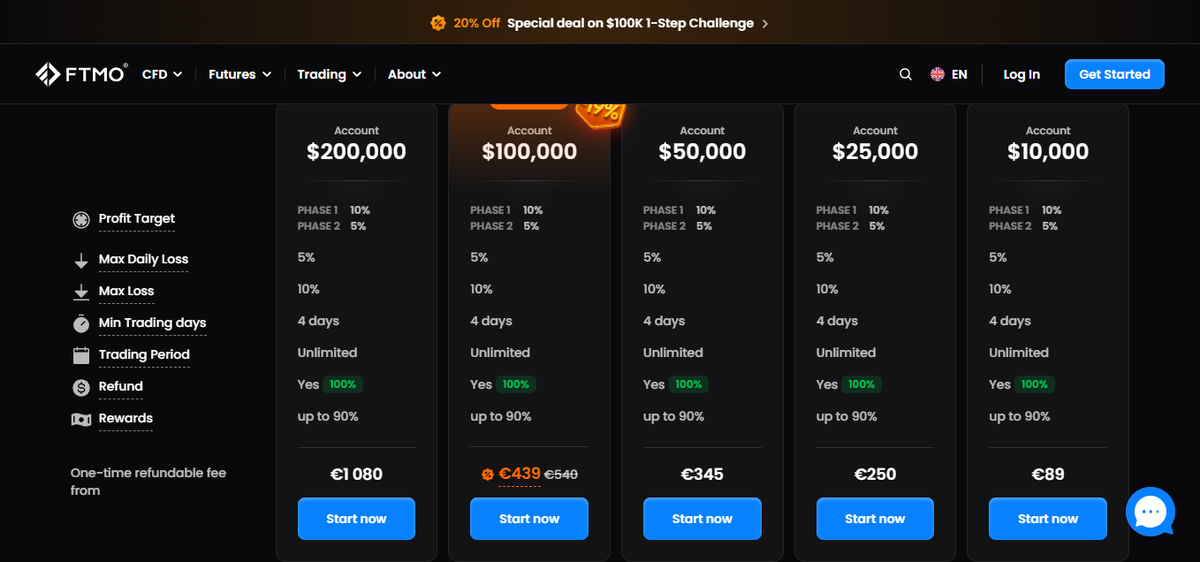
Account sizes for the CFD programme run from $10,000 to $200,000 and can be grown substantially through the Scaling Plan, covered further down. Each account size carries its own one-time evaluation fee. At current list prices, the 1-Step sits at a slightly lower entry price than the 2-Step at every account size, though its fee is non-refundable and its risk model differs: the 2-Step refunds 100% of the fee with the first reward, while the 1-Step does not.
The tables below show the current one-time list fees for each account size on both paths. FTMO occasionally runs promotional prices, so always confirm the exact live price on the FTMO site before buying, since promotions and list prices change independently. For instance, the $100,000 2-Step has appeared at €439 and the $100,000 1-Step at €399 on promotional pages.
2-Step Challenge: current list prices
| Simulated capital | One-time fee (2-Step) |
|---|---|
| $10,000 | €89 |
| $25,000 | €250 |
| $50,000 | €345 |
| $100,000 | €540 |
| $200,000 | €1,080 |
1-Step Challenge: current list prices
| Simulated capital | One-time fee (1-Step) |
|---|---|
| $10,000 | €79 |
| $25,000 | €199 |
| $50,000 | €319 |
| $100,000 | €499 |
| $200,000 | €999 |
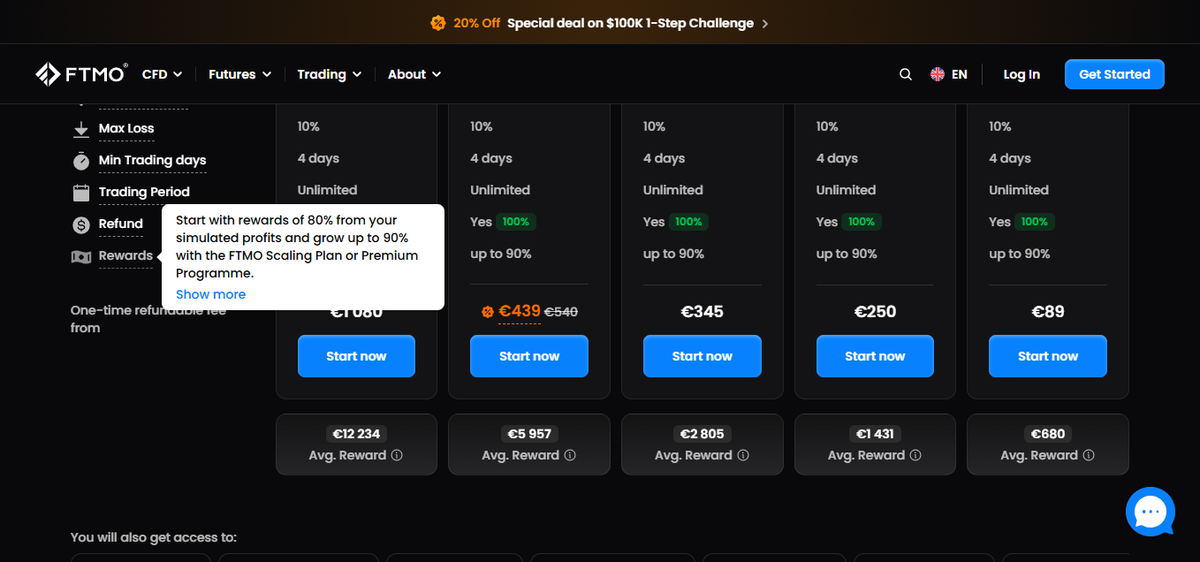
One pricing detail is worth flagging clearly, since it changes the effective cost of the FTMO challenge. When the first reward from the funded account lands, FTMO refunds 100% of the initial evaluation fee. In practice, the entry cost behaves more like a deposit against your ability to pass and reach the first payout than a straightforward purchase. Fail to pass, and the fee is lost; pass and withdraw, and it comes back in full.
Challenge Structure and Trading Rules
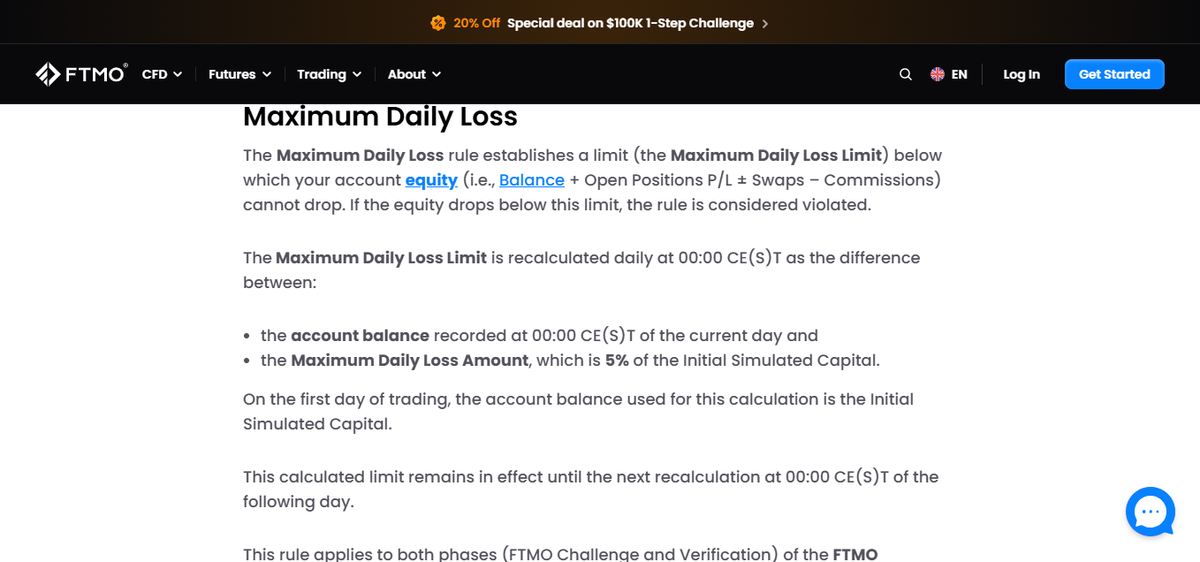
The FTMO rules are where most misunderstandings happen, so this section is worth reading carefully. The critical point on FTMO drawdown mechanics is that daily loss is measured on equity across every product, using intraday equity rather than end-of-day balance as the reference. Total maximum loss, meanwhile, behaves differently depending on which path you choose.
On the 2-Step, the 10% maximum loss is static and calculated from the starting balance, so it never trails your equity or your closed profits. The daily loss cap of 5% is measured on equity, which means floating losses on open positions count toward the limit in real time. The daily counter for the 2-Step Maximum Daily Loss resets at 00:00 CE(S)T using the balance recorded at that moment.
The 1-Step tightens the mechanics on both sides. Daily loss drops to 3% on equity with the same daily-reset schedule, and the 10% maximum loss becomes an end-of-day trailing figure. That trailing behaviour is why the 1-Step tends to feel more restrictive in practice, even when the headline target is the same 10%.
| Phase | Target | Max Daily Drawdown | Max Total Drawdown | Minimum Days | Time Limit |
|---|---|---|---|---|---|
| Phase 1 (2-Step Challenge) | 10% | 5% (equity, resets daily at 00:00 CET) | 10% (static, from initial balance) | 0 | Unlimited |
| Phase 2 (2-Step Verification) | 5% | 5% (equity, resets daily at 00:00 CET) | 10% (static, from initial balance) | 0 | Unlimited |
| Funded Account (2-Step) | — | 5% (equity) | 10% (static) | — | — |
| 1-Step Challenge | 10% | 3% (equity) | 10% (end-of-day trailing) | 0 | Unlimited |
| Funded Account (1-Step) | — | 3% (equity) | 10% (end-of-day trailing) | — | — |
A few consequences of these FTMO rules are worth spelling out.
- First, because daily loss is on equity, a fast intraday drawdown can breach the rule even if you would have closed the day green.
- Second, on the funded 1-Step account, the trailing maximum loss resets to 90% of the initial balance after each withdrawal, which reduces your buffer immediately after a payout.
- Third, there is no minimum trading day requirement, so you can pass the target in a single session if the market cooperates, which is unusual in this industry.
Prohibited strategies are published and enforced. Latency arbitrage, hedging across accounts, copy trading between accounts using third-party signals without approval, and news trading on the Standard account type are all restricted. If any of these are part of your strategy, read the full terms before paying the fee, because a rule breach on the funded phase can end the account regardless of profits.
Trading Environment and Conditions
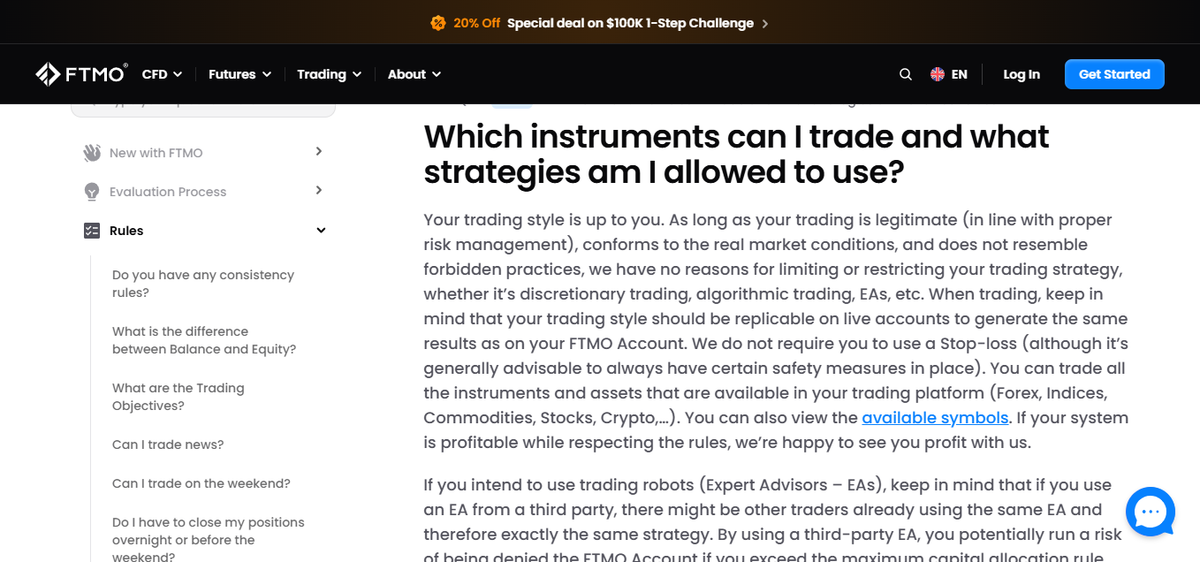
FTMO offers one of the widest platform stacks in the sector, covering MT4, MT5, cTrader and TradingView, which means most traders can keep the workflow they already use instead of adapting to a proprietary terminal. Instruments cover forex, indices, commodities, metals, equities and cryptocurrencies as CFDs, with maximum leverage of up to 1:100 on Standard accounts (and up to 1:30 on Swing) per FTMO documentation, though the exact figure varies by instrument, so it is worth checking the symbol specification for the pair you want to trade.
One detail that sets FTMO apart from many competitors is that trading conditions on the challenge and on the funded account are identical, since you trade against the same simulated feed with the same instruments and the same leverage from day one of the evaluation until whenever you stop, which keeps the transition to funded free of surprises.
On execution, FTMO does not publish a specific execution model in the material reviewed, and quoted spreads come from its liquidity provider without an explicit markup disclosed in official documentation. If spread sensitivity is central to your strategy, particularly on scalping, test the specific instruments you plan to trade on a free demo before committing to a fee.
A quick note for UK-based readers. FCA leverage caps do not apply to FTMO because the firm is not a UK-authorised broker and no client capital is deployed in a live market. Traders are paying for an evaluation, and any funded stage operates on simulated capital with rewards paid from FTMO's own funds, which is the standard structure for the prop firm model and the reason regulation in this space works on different terms from a retail broker relationship.
Payouts, Profit Split and Scaling
FTMO payouts are one of the more flexible parts of the offer. Your first reward can be requested from day 14 after the first placed trade on the funded account, and from there you can configure the Profit Split Day anywhere between 14 and 60 days per cycle. You can align payouts with your own cashflow rather than waiting for a fixed monthly window.
The FTMO profit split depends on the path. On the 2-Step Challenge the split starts at 80% and scales to 90% through the Scaling Plan or by opting into the Premium Programme once eligible. On the 1-Step Challenge the split is 90% from day one. The trade-off is essentially between a cheaper entry with a lower opening split on the 2-Step and a higher entry with an immediate 90% share on the 1-Step, which is one of the clearest decisions to weigh before buying.
Withdrawal methods include bank wire transfer, Visa Direct and Mastercard Send up to $20,000 per transaction, Skrill up to $3,000, and cryptocurrency. Bank wire remains the default for larger amounts, while cards and Skrill work well for faster smaller cycles.
One quirk worth understanding is the Best Day Rule. If a single trading day accounts for more than 50% of your profit from all positive days in the cycle, FTMO can hold the corresponding profit and roll the review, which extends the cycle. The purpose of the rule is to filter accounts whose evaluation depends on one outsized session instead of consistent trading over the cycle, and it can affect the timing of a payout even when everything else is in order.
The FTMO scaling plan grows the account size by 25% every 4 months if three conditions are met: at least 10% net simulated profit over the review window, at least 2 processed rewards inside that window, and a positive balance at review. Scaling continues up to a maximum simulated allocation of $2,000,000. On the 2-Step path, hitting the Scaling Plan also upgrades the split to 90%, which is the main route to the higher share for traders who started there.
Trader Experience and Support
FTMO provides proprietary tools including Account MetriX, which shows real-time drawdown, Best Day Rule status and other rule indicators alongside a statistical view of your trading, and a built-in Trading Journal for recording notes, screenshots and performance statistics on your trades. The educational side sits under the FTMO Academy label and includes articles, webinars, structured courses and a Trading Psychology Course.
Support runs through Live Chat, WhatsApp, email and phone. FTMO states its in-house support is available 24/7, with phone support Monday to Friday from 09:00 to 17:00 CET, and it lists coverage in 21 languages. If guaranteed response speed on a specific channel matters to your workflow, confirm the current coverage with the firm before buying.
For a beginner, the combination of the dashboard and the Academy library reduces one of the common friction points in prop firms: not knowing where you stand against the rules mid-trade. Real-time indicators for daily loss on equity and for the Best Day Rule take the guesswork out of decisions that would otherwise depend on your own calculations.
A broader observation on the trader experience is worth adding here. Because rules on the funded phase match the evaluation exactly, the mental model built during the challenge continues to apply after passing, which reduces the transition risk that traps some traders on firms where the funded stage introduces new constraints such as consistency percentages or minimum days that were absent during evaluation.

FTMO vs The Competition
FTMO competes on documentation and track record more than on price, and it is useful to compare it against three well-known alternatives with different angles.
The5ers focuses on instant funding programmes and evaluations with lower targets and a lighter two-phase structure. If your priority is getting to a funded stage quickly on a smaller allocation, The5ers is worth looking at. FundedNext and E8 Markets are two other well-known alternatives with different pricing and rule mixes. For any competitor, check the firm's own current pages for exact fees, targets and payout terms before drawing a direct comparison, since prop firm rules move frequently.
Against these three, FTMO's position is a straightforward one: a higher upfront cost for a firm that has been running the same model since 2015, publishes rules that match what appears on the dashboard, and has a corporate entity that can be verified in the Czech commercial register. For a beginner comparing options, the decision comes down to weighing documented track record against price, and whether a cheaper entry with a shorter operating history sits within an acceptable risk tolerance.
Clearing Up the Misinformation
Three claims about FTMO circulate widely and deserve a direct correction, because acting on them can lead to costly mistakes.
First, the funded account is not a real live-capital account. FTMO uses simulated capital across evaluation and funded phases, with rewards paid in real money from the firm's treasury based on your simulated performance. This is documented on FTMO's own site and is standard across most reputable prop firms, so the structure is not a defect in itself, though it does mean any expectation of trading a real broker account with genuine market impact would be misplaced.
Second, FTMO does not use pure balance-based drawdown across all products. The 2-Step total maximum loss of 10% is static and based on the starting balance, but daily loss on every product is measured on equity, which includes floating P/L from open positions. The 1-Step goes further and uses an end-of-day trailing maximum loss. Assuming a pure balance model can lead to a rule breach on a fast intraday move that you were planning to hold through.
Third, not every FTMO trader keeps 90% from the first payout. The 2-Step Challenge starts at 80% and only reaches 90% through the Scaling Plan or the Premium Programme once eligible. Only the 1-Step starts at 90% from day one. If the 90% figure was the reason you were considering FTMO, verify which path you are on before assuming the split.
Conclusion
FTMO fits beginner and intermediate traders who want the most documented and transparent prop firm in the sector and are comfortable paying for that. The corporate entity in Prague, the operating history since 2015, the rule parity between challenge and funded, and the flexible on-demand payout window from day 14 are the features that justify the premium.
The offer fits less well for traders who want a 90% split from day one on the cheaper track, who prefer looser daily drawdown mechanics measured on balance instead of equity, or for whom the entry fee is the primary variable in the decision. In those cases, cheaper competitors with different rule sets are worth comparing before buying. Either way, the FTMO challenge is worth understanding in detail, since its mechanics have become the reference point that other prop firms are measured against.
FTMO live spreads
We stream FTMO's pricing from a live evaluation account — the same feed a challenge trader is charged against, not a marketing figure. Spreads are a running cost on every trade, so on a tight profit target they decide how much of the move you actually keep. The history below shows whether they hold up through news and rollover.
How we rate prop firms
Five weighted dimensions — trust, fairness, payout terms, platform quality, and customer support.
What are your odds here?
Load FTMO’s rules into our Monte Carlo simulator, put in your own win rate and risk, and see how often that combination ends in a funded account — and which rule ends it when it doesn’t.
The full ranking
See how FTMO stacks up against the other top-rated prop firms in our independent ranking.
Frequently asked questions
Is FTMO a broker or a prop firm?
How much does an FTMO challenge cost?
When can I request my first payout?
Is the funded account real or simulated?
What happens if I hit the daily loss limit?
Can I use expert advisors on FTMO?
Trader reviews
Compare FTMO
Add FTMO to the comparison tool to put it side by side with other prop firms on fees, rules, and score.
Compare FTMO →Other prop firms to consider
- FundedNext4.25 / 5Beginner and intermediate traders who want a large, transparent prop firm with static drawdown, no time limit and flexible payout options, and who accept an offshore simulated model outside FCA protection.
- The5ers4.24 / 5Best for intermediate to experienced traders who value a proven track record, no time limits, and serious scaling potential.
- Instant Funding3.96 / 5Beginner to intermediate traders who want immediate funded account access without sitting through multi-phase evaluations, and experienced traders who value clean rules, aggressive scaling, and a hybrid model that covers both instant and traditional challenge accounts.
About the authors
