


A CFD (Contract for Difference) is a way to trade on the price movement of financial assets, like stocks, currencies, or commodities, without ever actually owning them. CFD trading explained in plain terms means you’re entering an agreement with a broker about where a price is headed. You profit or lose based on whether your call was right.
This guide breaks down exactly how CFDs work, the types you can trade, who sits on each side of every transaction, and how to start thinking about timing and risk. By the end, you’ll have the foundational knowledge to decide whether CFD trading deserves a closer look.
What Is a Contract for Difference (CFD)?
The Core Concept Behind CFDs
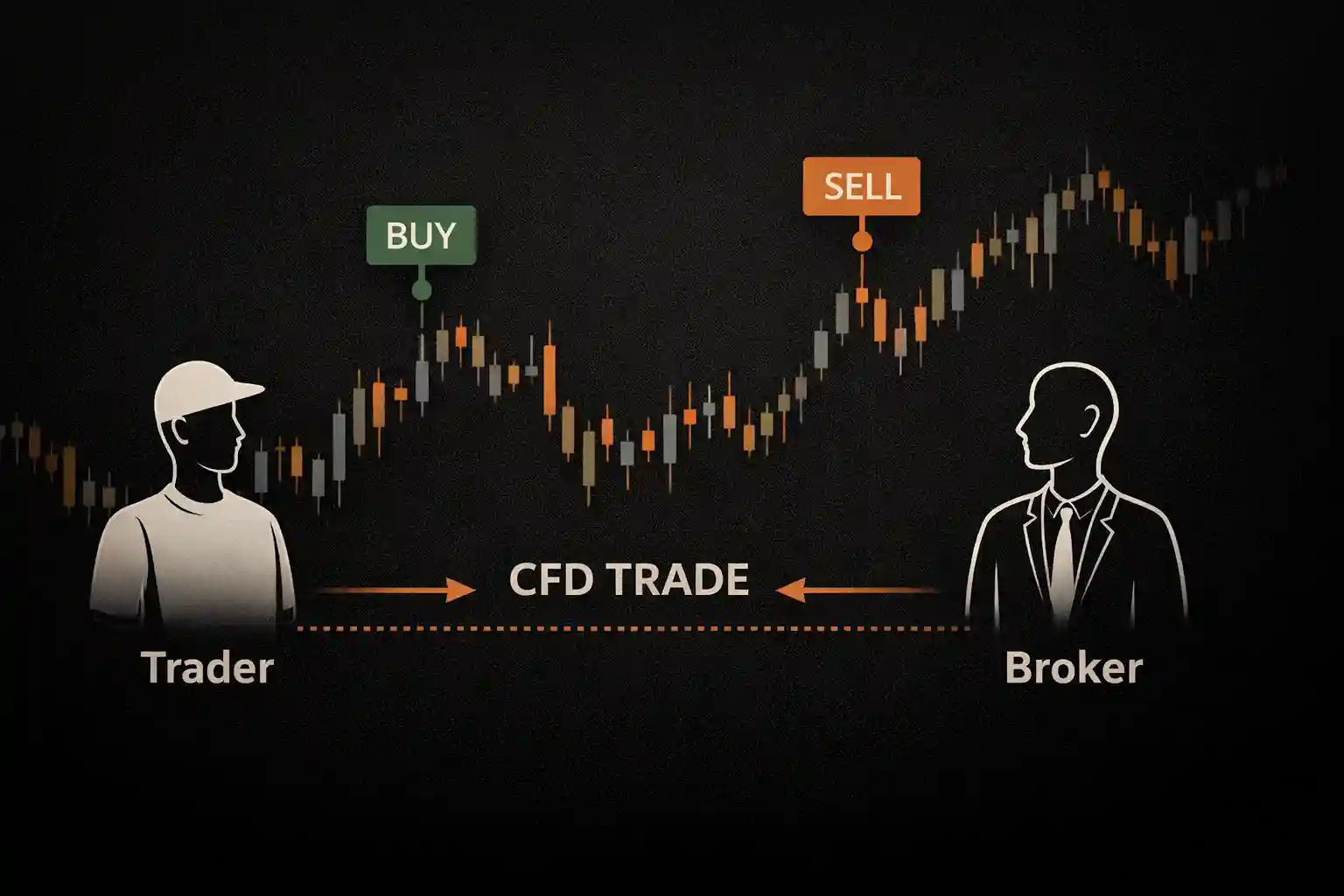
Picture a CFD as a structured agreement on where a price is going, without ever touching the thing you’re trading. You and your broker enter a contract that says: “Let’s settle the difference between the price when this trade opens and the price when it closes.”
That’s the “difference” in Contract for Difference.
If you think the price of an asset is heading up, you open what’s called a long position (you’re buying). If you believe it’s heading down, you open a short position (you’re selling). The profit or loss you walk away with depends entirely on how far the price moved and in which direction.
This is what makes CFDs a derivative product. Their value is derived from an underlying asset, whether that’s a stock, a currency pair, or an index, but you never own that asset directly. You’re trading the price movement, not the thing itself.
Why should that matter to you? Because it unlocks possibilities that traditional investing doesn’t offer easily. Profiting from falling prices. Accessing markets you couldn’t normally enter with a small account. But those possibilities carry their own trade-offs, which we’ll dig into shortly.
How CFD Profit and Loss Is Calculated
The math behind a CFD trade is more straightforward than most people expect. It boils down to three components:
- Entry price – the price when you open the position
- Exit price – the price when you close it
- Position size – how many units or contracts you’re trading
A quick example brings this to life. Say you open a long CFD on gold at $1,900 per ounce, trading 10 units. Gold climbs to $1,920. Your profit is ($1,920 – $1,900) x 10 = $200.
Now flip it. Gold drops to $1,880 instead. Your loss is ($1,900 – $1,880) x 10 = $200.
For a short position, the logic reverses. You profit when the price falls below your entry and lose when it rises above it.
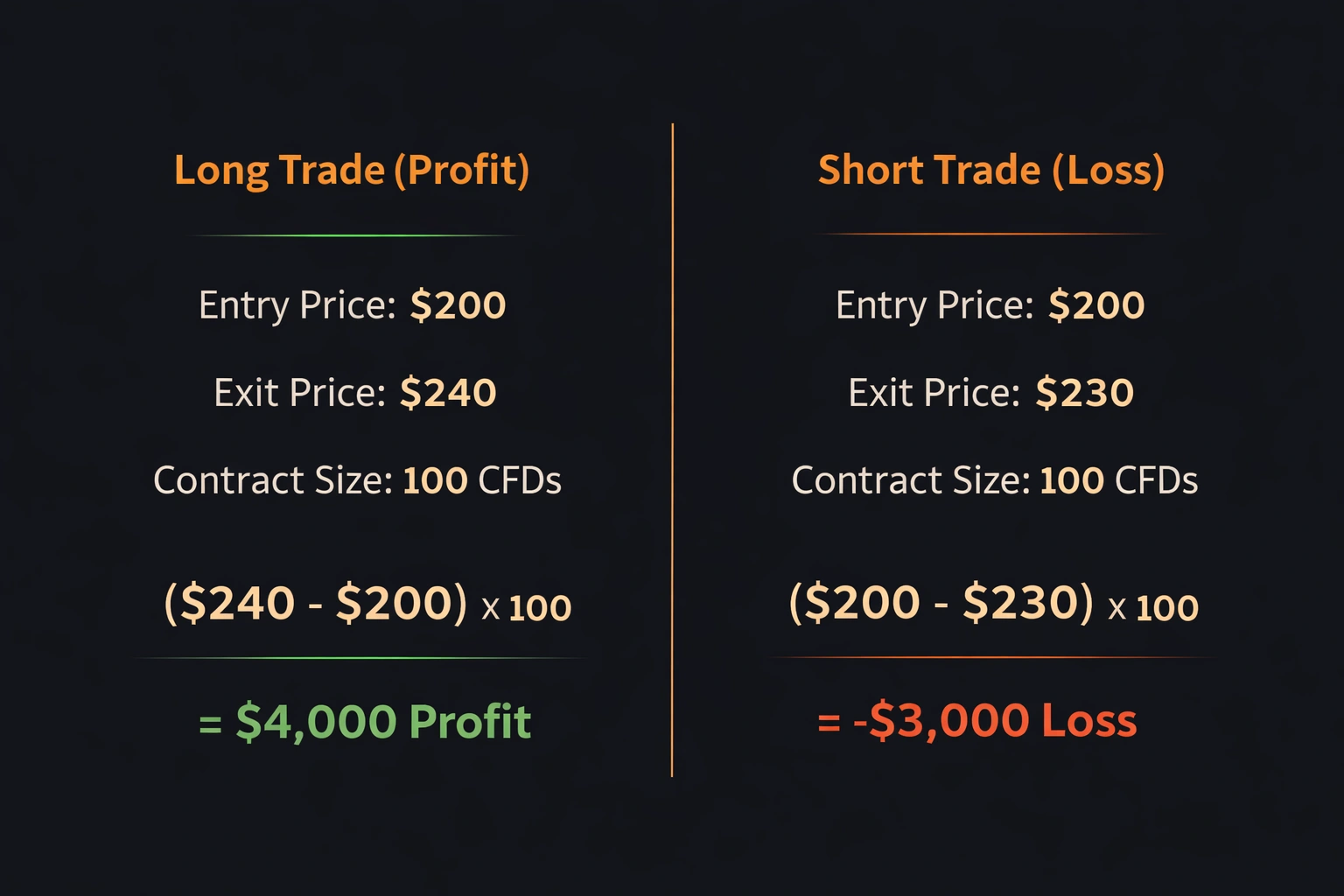
One critical detail worth pausing on: because CFDs use leverage, you don’t need to put up the full value of the trade. You post a margin, a fraction of the total position size. Your actual capital at risk relative to the trade’s size is much smaller, but gains and losses are calculated on the full position value.
Knowing how profit is made, though, is only part of the picture. Why would someone choose CFDs over simply buying the asset outright?
Why Trade CFDs?
Access to Multiple Markets Without Ownership
One of the most practical advantages of CFDs is the sheer range of markets available from a single trading account. Stocks in New York, forex pairs in London, gold futures in Asia: you can tap into price movements across all of these without needing separate brokerage accounts, currency conversions, or custodial arrangements for each asset class.
Because you never own the underlying asset, there’s no need to worry about storage (for commodities), transfer agents (for shares), or physical delivery of anything. You’re purely trading the price, and that simplifies your setup considerably.
Leverage and the Ability to Go Long or Short
Leverage lets you control a larger position with a smaller amount of capital. If a broker offers 10:1 leverage, you can open a $10,000 position with just $1,000 of margin. This amplifies your exposure to price movements, meaning potential profits are magnified relative to your deposit.
Equally important is the ability to go short. In traditional stock investing, profiting from a falling market is complex and often restricted. With CFDs, shorting is as simple as clicking “sell” instead of “buy.” You open the position expecting a price decline, and if the drop materializes, you profit on the difference.
That said, leverage amplifies losses in exactly the same proportion as gains. A small adverse move can erode your margin quickly. This remains one of the most misunderstood aspects of CFD trading, and one of the strongest reasons risk management deserves serious attention.
Lower Barriers to Entry Compared to Traditional Trading
Many CFD brokers allow you to start trading with relatively modest deposits compared to what you’d need to buy the underlying assets directly. Purchasing 100 shares of a company trading at $500 per share requires $50,000. A CFD on the same stock might only require a margin deposit of $5,000 or less, depending on the leverage ratio.
This lower entry point makes CFDs accessible to a wider range of traders. But accessibility and suitability are two different things. A lower deposit doesn’t reduce the actual financial risk involved.
Now that the “why” is clearer, it’s worth looking at exactly what’s available to trade. The variety might catch you off guard.
Types of CFDs You Can Trade
Most beginners don’t realize just how many markets open up once you understand CFDs. Here are the five most common categories you’ll find on virtually every major CFD platform.
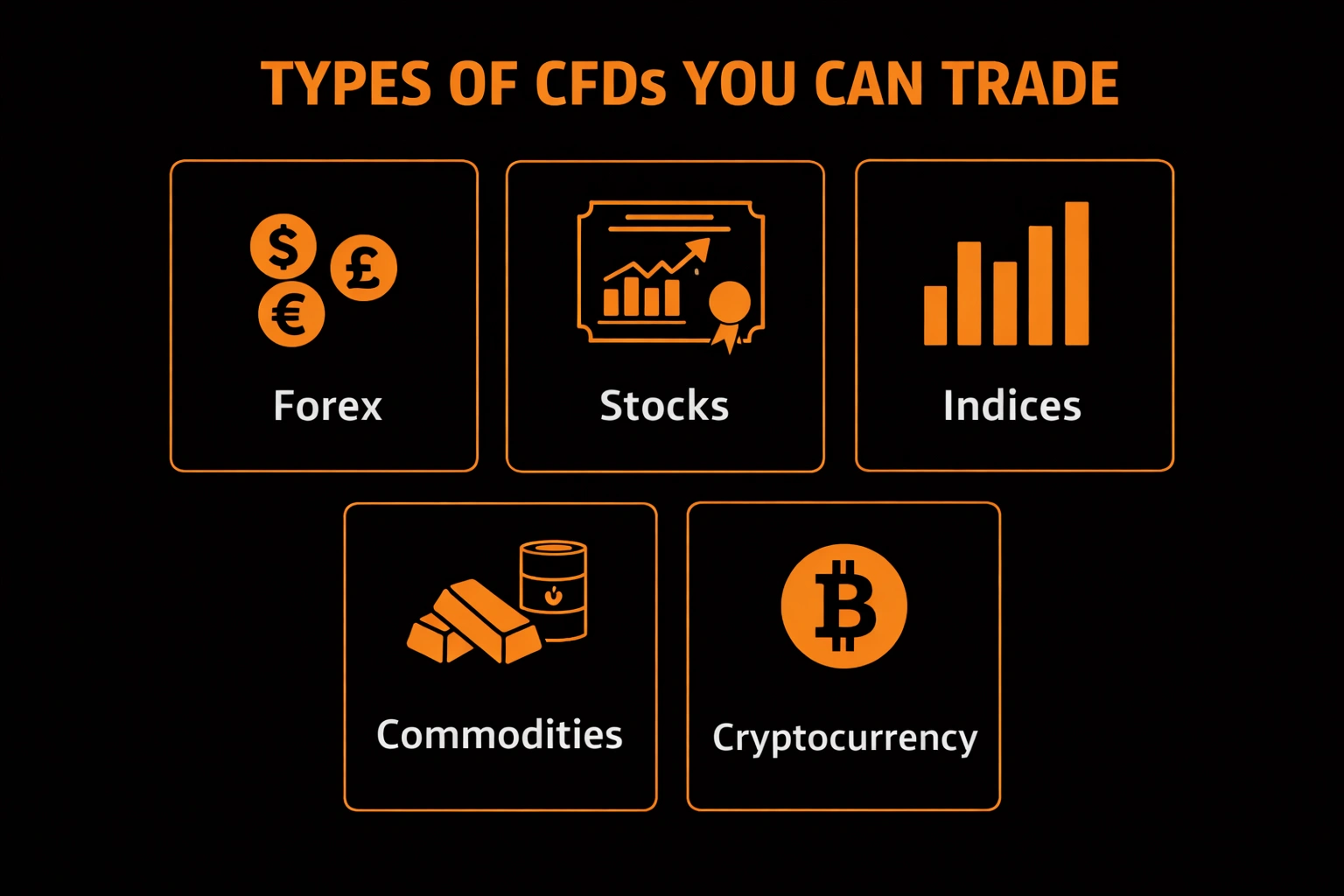
Forex CFDs
Forex CFDs let you trade currency pairs, like EUR/USD or GBP/JPY, based on exchange rate movements. The forex market is the largest and most liquid financial market globally, running nearly 24 hours a day during the trading week. Spreads (the cost of entering a trade) tend to be tightest on major pairs, which is one reason forex is a common starting point for many CFD traders.
Stock CFDs
With stock CFDs, you can speculate on the price movement of individual company shares (Apple, Tesla, HSBC) without buying and holding the actual stock. That means no shareholder voting rights and no dividend ownership in the traditional sense. On the flip side, you can go long or short on a company’s stock with a fraction of the capital required to buy shares outright.
Index CFDs
Index CFDs track the performance of an entire stock market index, like the S&P 500, FTSE 100, or DAX 40. Rather than picking individual stocks, you’re trading the collective movement of a basket of companies. This gives you broader market exposure in a single position, which is particularly useful if you want to trade on macroeconomic trends rather than company-specific news.
Commodity CFDs
Commodity CFDs cover raw materials and natural resources: gold, silver, crude oil, natural gas, agricultural products, and more. These markets are shaped by global supply and demand dynamics, geopolitical events, and seasonal patterns. Commodities often behave quite differently from stocks or forex, which is part of what makes them appealing for diversification.
Cryptocurrency CFDs
Cryptocurrency CFDs allow you to trade on the price movements of digital assets like Bitcoin, Ethereum, and others, without needing a crypto wallet or dealing with blockchain transactions directly. Crypto markets are known for pronounced volatility, which can mean larger price swings in both directions compared to more established asset classes.
With so many options on the table, the natural question becomes: where do you actually start?
How to Choose the Right CFDs to Trade
Matching CFD Types to Your Knowledge and Interests
Choosing what to trade shouldn’t be a coin flip. The strongest starting point is usually where your existing knowledge gives you a genuine edge. If you follow tech companies closely, stock CFDs on tech firms might make sense. If you understand macroeconomics and interest rate cycles, forex or index CFDs could be a natural fit.
Trading something you already follow gives you context for interpreting news, recognizing patterns, and making decisions rooted in understanding rather than guesswork.
Evaluating Liquidity, Volatility, and Spread Costs
Beyond interest, there are practical factors that shape your trading experience:
- Liquidity – Highly liquid markets (like major forex pairs or large-cap stock indices) tend to have tighter spreads and smoother execution. Less liquid markets can mean wider spreads and more erratic price movements.
- Volatility – Higher volatility means bigger potential moves in both directions. That can be appealing if you’re comfortable managing risk, but costly if you’re not. Crypto and smaller commodity markets tend to be more volatile than major indices.
- Spread costs – The spread is effectively your entry cost on every trade. Lower spreads mean you need less price movement in your favor before you start profiting. Compare typical spreads across the markets you’re considering.
Starting With Familiar Markets
Many seasoned traders suggest that beginners focus on one or two markets first, building familiarity with how that market behaves, what drives its price, and how it responds to news events. Spreading yourself across five different asset classes from day one tends to lead to shallow understanding and scattered attention.
Before you place any trade, though, it’s worth understanding who exactly sits on the other side of it. The structure of a CFD transaction involves more players than you might expect.
The Key Parties Involved in CFD Trading
The Trader (You)
You are one side of every CFD contract. You decide what to trade, when to open and close positions, how much margin to commit, and what level of risk you’re willing to accept. The broker doesn’t make trading decisions for you, and no one else manages your positions unless you’ve explicitly set up a managed account arrangement.
Your role carries all of the decision-making responsibility, along with all of the financial consequences that follow.
The CFD Broker
The broker is your counterparty. When you open a CFD trade, you’re entering a contract directly with the broker, not with another trader on an exchange. This is a key distinction from stock market trading, where buyers and sellers are matched on a centralized exchange.
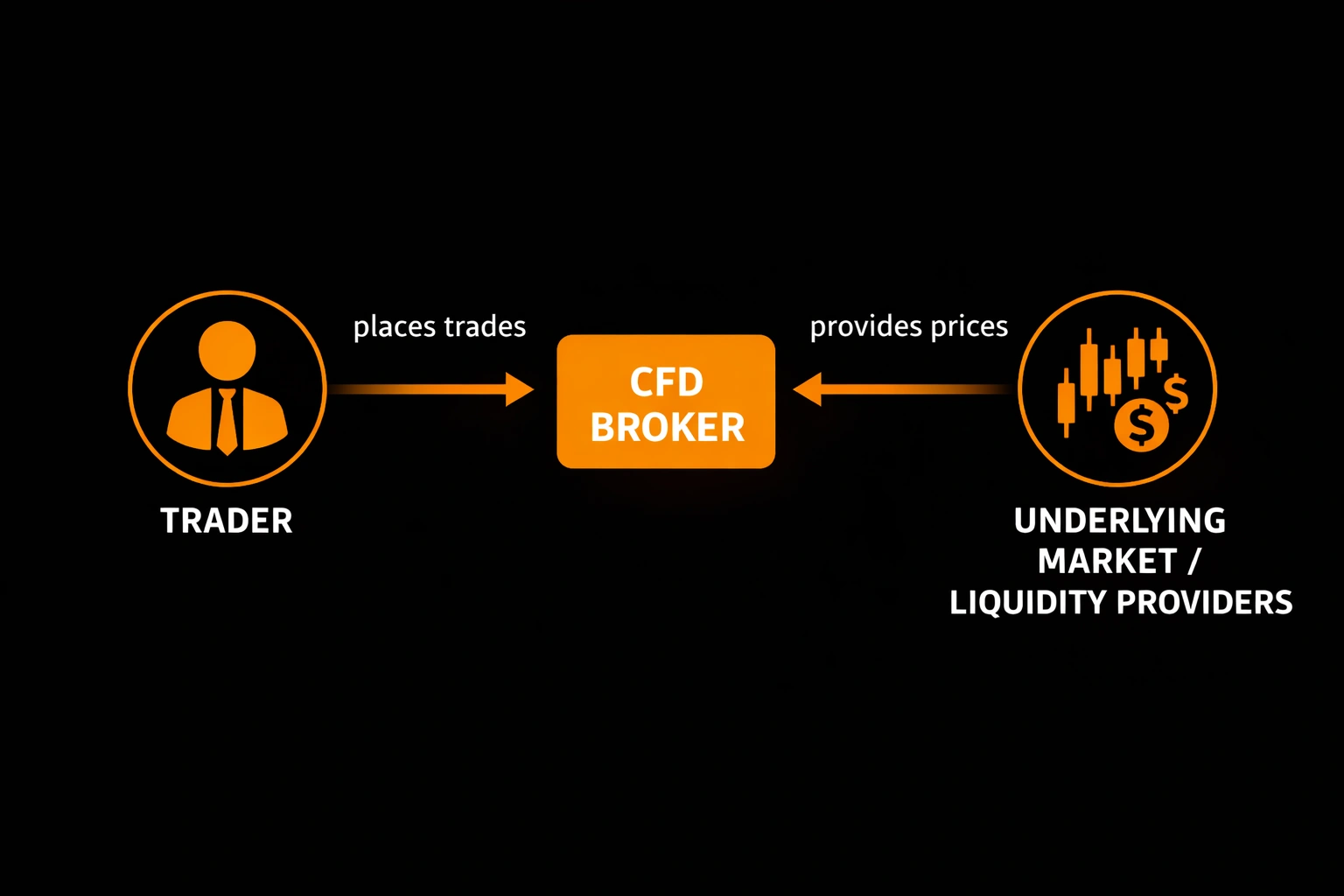
The broker provides the trading platform, sets the available leverage, determines the spreads, and facilitates execution. Some brokers hedge your positions in the underlying market; others may hold the opposite side of your trade internally. Understanding how your broker operates is worth the effort, because it affects pricing, execution quality, and the overall reliability of your trading experience. If you’re weighing different providers, a detailed CFD broker comparison can help you evaluate these factors side by side.
The Underlying Market and Liquidity Providers
Even though you’re not trading on a traditional exchange, the prices you see on your CFD platform are derived from real underlying markets. Your broker sources price data from liquidity providers (banks, financial institutions, exchanges) to ensure the CFD price tracks the real market as closely as possible.
This is why a CFD on Apple stock will move almost identically to Apple’s actual share price on the NASDAQ. The CFD acts as a mirror, not a separate market.
You now know what CFDs are, how they’re structured, and who’s involved. But there’s one factor that trips up many beginners: when you trade matters nearly as much as what you trade.
Why Timing Matters in CFD Trading
Market Hours and Their Impact on CFD Prices
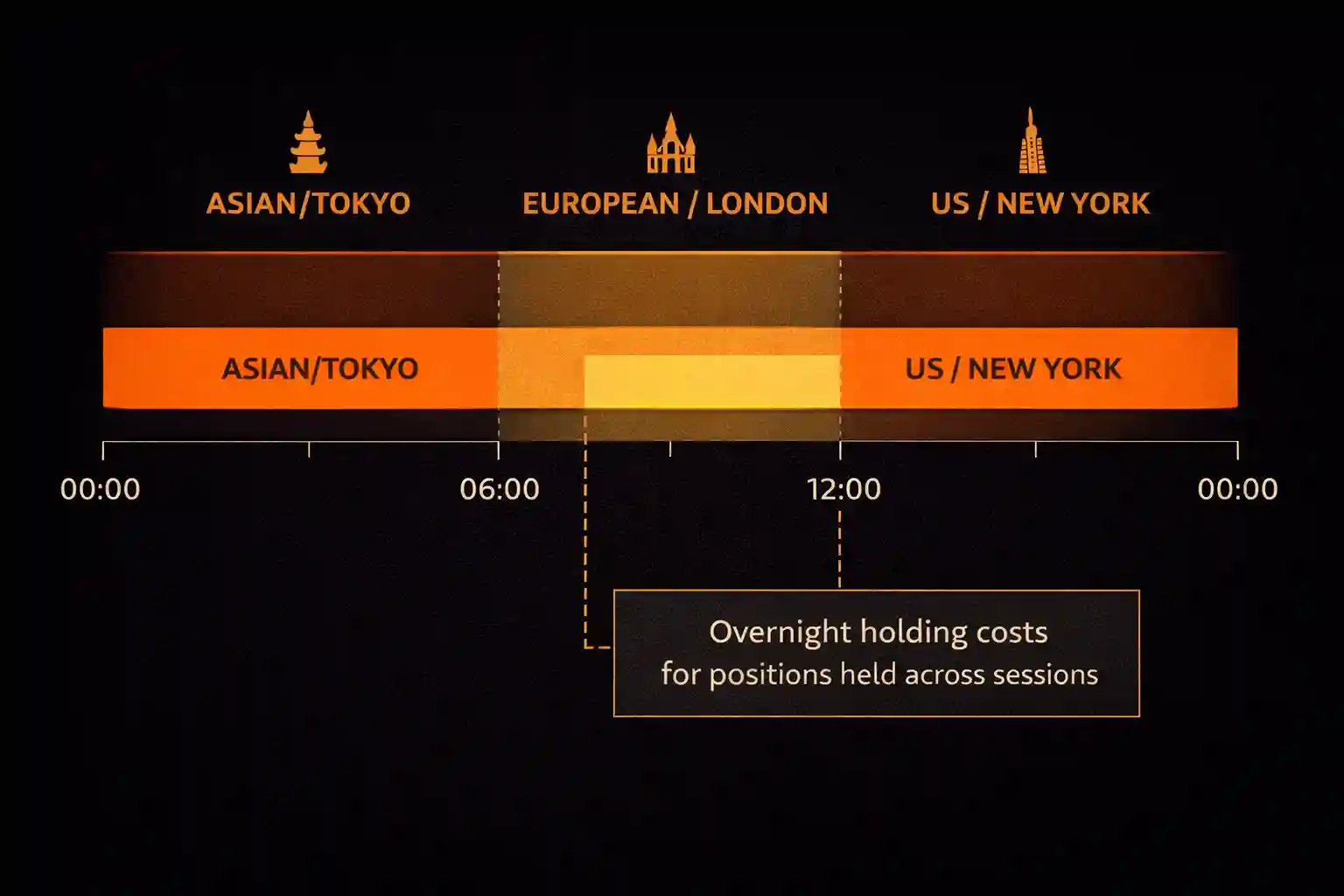
Not all markets are open at the same time. CFD pricing, spreads, and liquidity all shift depending on which sessions are active. The three major trading sessions are:
- Asian session (Tokyo) – typically lower volatility for forex and Western indices
- European session (London) – higher volume, tighter spreads on European assets and major forex pairs
- US session (New York) – the most active period for US stocks, indices, and many commodity markets
The overlap between the European and US sessions tends to be the highest-volume window of the trading day, bringing tighter spreads and faster price movements.
Overnight Holding Costs and Expiry Considerations
If you hold a CFD position open overnight, you’ll typically incur a swap fee (also called an overnight financing charge). This is essentially an interest cost for maintaining a leveraged position beyond the trading day.
For short-term trades, these fees are usually small. But if you hold positions for days or weeks, swap fees accumulate and can quietly chip away at your profits. Some CFD instruments also carry expiry dates (particularly index and commodity CFDs), meaning the contract automatically closes at a predetermined time. To maintain your exposure, you may need to roll over into a new contract.
Timing Entries Around Volatility and News Events
Major economic announcements (interest rate decisions, employment reports, earnings releases) can trigger sharp, sudden price movements. Some traders specifically target these windows for potential opportunities. Others steer clear entirely because the volatility can be unpredictable and spreads often widen during these moments.
As a beginner, simply recognizing that these events exist and influence pricing is more valuable than trying to trade them profitably right away. Getting familiar with the economic calendar and knowing which events affect your chosen market is a practical skill worth building early.
Timing adds a layer of complexity. But it’s the risk dimension that truly separates prepared traders from those who learn expensive lessons the hard way.
Risks of CFD Trading You Should Understand
Leverage Amplifies Losses as Well as Gains
This point deserves its own spotlight because it’s the single most common reason retail traders lose money with CFDs. Leverage makes it possible to lose more than your initial deposit if the market moves sharply against your position. A 10:1 leveraged trade means a 5% adverse price movement wipes out 50% of your margin.
Many brokers offer negative balance protection (preventing your account from going below zero), but it doesn’t eliminate the risk of significant losses along the way. Before trading with leverage, make sure you understand exactly how much you stand to lose in a worst-case scenario. Building a solid foundation in risk management principles is essential before committing real capital.
Counterparty Risk and Broker Selection
Because your CFD contract is with the broker, their financial health and regulatory standing matter directly to you. If a broker becomes insolvent or operates without proper oversight, your funds could be at risk.
This is why choosing a broker regulated by a recognized authority (such as the FCA, ASIC, or CySEC) is important. Regulated brokers are required to meet capital adequacy standards, segregate client funds, and follow conduct rules designed to protect retail traders.
In other words, the cheapest spreads or flashiest platform mean nothing if the broker behind it isn’t trustworthy.
Risk Disclaimer: CFDs are complex instruments and come with a high risk of losing money rapidly due to leverage. A significant percentage of retail investor accounts lose money when trading CFDs. You should consider whether you understand how CFDs work and whether you can afford to take the high risk of losing your money. This content is educational and does not constitute financial advice.
Frequently Asked Questions


Comments