





Pros
- Tier-1 FMA regulation from New Zealand
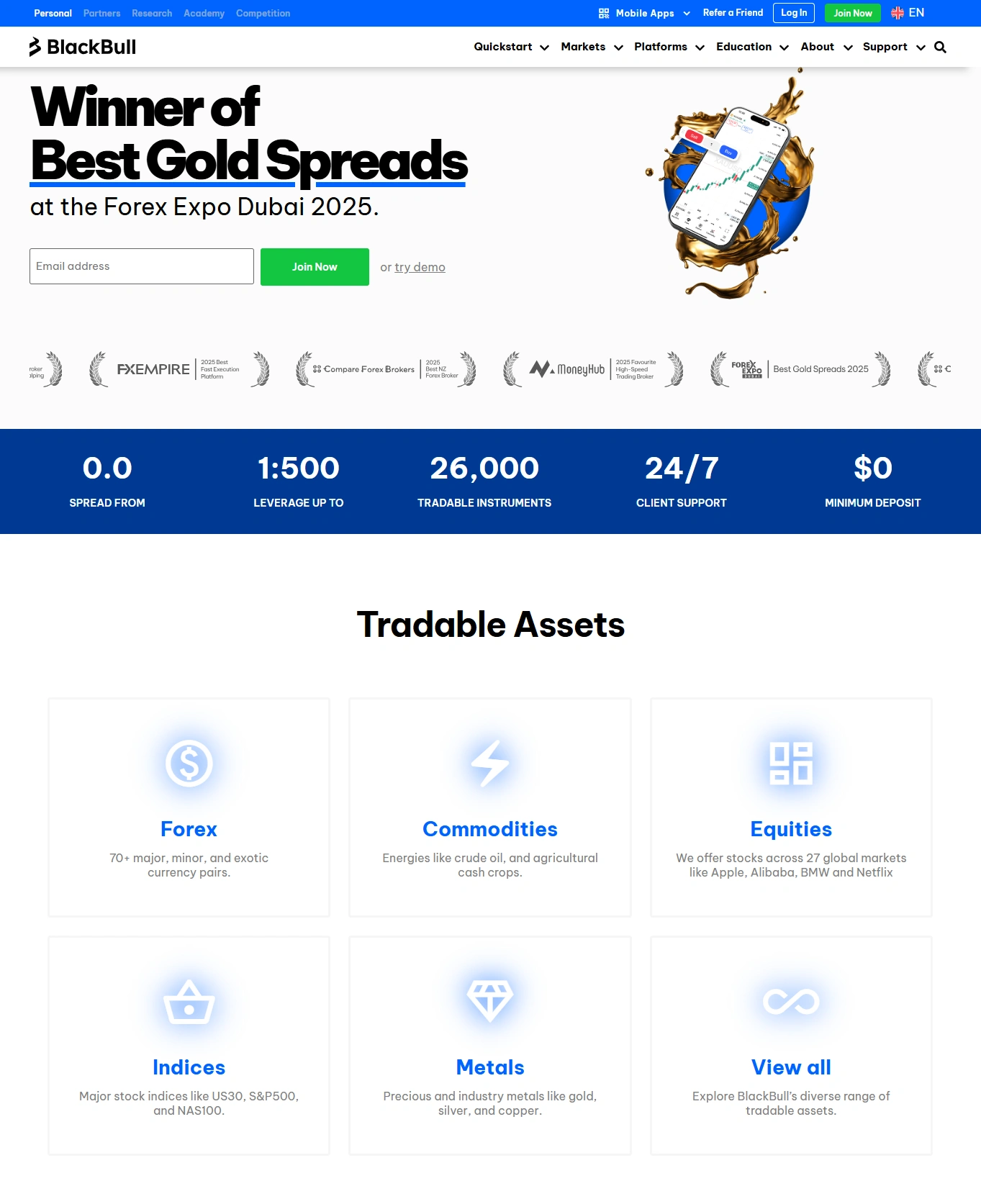
- 26,000+ tradeable instruments available
- Seven trading platforms including TradingView
- Raw spreads from 0.0 pips on Prime
- Free VPS and FIX API for algo traders </ul
Cons
- International clients under Seychelles regulation
- No investor compensation scheme available
- $5 fee on all withdrawals
- Education resources lag behind competitors
- No proprietary mobile trading app
BlackBull Markets is a New Zealand-based ECN broker that has been quietly building a reputation among active traders since 2014.
Regulated by the FMA (FSP403326) and operating a second entity under the FSA Seychelles (SD045), it offers access to over 26,000 tradeable instruments across seven trading platforms, with raw spreads starting from 0.0 pips on its Prime and Institutional accounts. A 20% stake held by institutional liquidity giant LMAX Group adds weight to BlackBull’s pitch as a bridge between institutional-grade conditions and the retail market.
But does the reality hold up? This review breaks down everything from regulation and fees to platform options and verified spread data, so you can decide whether BlackBull Markets deserves a spot on your shortlist.
What Makes BlackBull Markets Different?
Most ECN brokers lead with tight spreads and fast execution. BlackBull Markets delivers on both counts, but what earns it a closer look is how much it offers beyond that baseline.
Founded in 2014 in Auckland, New Zealand, BlackBull operates as a true ECN/NDD (No Dealing Desk) broker, meaning your orders are routed directly to liquidity providers with no dealing desk interference. Average execution speeds sit below 100 milliseconds, powered by Equinix data centers in New York (NY4), London (LD5), and Tokyo (TY3).
Platform diversity is where BlackBull clearly pulls ahead. Seven distinct trading platforms are available: MetaTrader 4, MetaTrader 5, cTrader, TradingView, ZuluTrade, BlackBull CopyTrader, and BlackBull Invest. That is one of the widest selections you will find from any single broker. Whether you prefer MT4’s familiarity, cTrader’s depth-of-market tools, or TradingView’s charting, you are not locked into a single ecosystem.
The instrument count also warrants context. BlackBull Markets advertises over 26,000 tradeable instruments, though equity CFDs offered through BlackBull Invest (powered via an Interactive Brokers partnership) make up the bulk of that figure. Beyond equities, you get roughly 70 forex pairs, 11+ indices, commodities, crypto CFDs, futures, options, bonds, and ETFs.
Algo traders and institutions get FIX API access and conditional free VPS hosting, which requires a $2,000 account balance and 20 lots traded per month. A genuine Islamic (swap-free) account is also available with no substitute fees.
In 2024, LMAX Group acquired a 20% stake in BlackBull, adding institutional credibility. Combined with backing from Milford Private Equity, this signals real financial stability behind the brand.
What BlackBull Markets Does Well
Trading infrastructure is BlackBull’s strongest suit. The ECN/NDD execution model, combined with Equinix server locations and sub-100ms speeds, delivers the kind of execution environment that active traders and scalpers actually need. Raw spreads on the Prime account average around 0.16 pips on EUR/USD, putting it in the same territory as IC Markets and Pepperstone.
The platform selection is a genuine differentiator. Having MT4, MT5, cTrader, and TradingView under one roof means you can switch platforms without switching brokers. Add ZuluTrade and BlackBull’s proprietary CopyTrader, and copy trading is well covered too.
FMA regulation in New Zealand provides a Tier-1 regulatory baseline, and client funds are held in segregated accounts at ANZ Bank. The LMAX investment adds a layer of institutional legitimacy that most brokers of this size simply cannot match.
Where BlackBull Markets Falls Short
The most significant caveat is regulatory. While BlackBull holds an FMA license, most international clients will be onboarded under the Seychelles entity (FSA, SD045), which offers substantially weaker protections. There is no investor compensation scheme under either entity. This matters: if the broker were to become insolvent, your recovery would depend entirely on whatever is recoverable from segregated accounts, not an external compensation fund.
The $5 flat withdrawal fee applies to every method, which adds up quickly for traders who move money frequently. Competitors like IC Markets and Pepperstone charge nothing for withdrawals.
Education and research resources, while improving, still fall short of what brokers like Pepperstone and IG provide. There is no Trading Central or Autochartist integration, and the educational content, while tiered by skill level, lacks the depth you would find at top-tier competitors.
BlackBull also lacks a unified proprietary mobile app. You can trade through third-party mobile apps for MT4, MT5, and cTrader, but there is no single BlackBull-branded app tying the experience together.
Regulation & Safety
Your money’s protection depends on which BlackBull entity you trade with, and that distinction matters more than most reviews acknowledge.
Regulatory Licenses
BlackBull Markets operates under two regulatory licenses:
Black Bull Group Limited is licensed by the Financial Markets Authority (FMA) in New Zealand, holding a Derivatives Issuer License under FSP number FSP403326. The FMA is a Tier-1 regulator, and this license has been active since August 12, 2020. This entity primarily serves New Zealand-based clients.
BBG Limited is licensed by the Financial Services Authority (FSA) in the Seychelles under license number SD045. The FSA is a Tier-4 offshore regulator with considerably lighter oversight. Most international clients will be onboarded under this entity.
BlackBull Group UK Limited exists as a payment clearing entity but does not hold an FCA license. UK clients trading with BlackBull are not covered by the Financial Services Compensation Scheme (FSCS).
BlackBull Markets has no regulatory sanctions or enforcement actions on its record. The Securities Commission Malaysia (SC) has issued a warning, though this likely relates to unauthorized solicitation in that jurisdiction rather than fraud.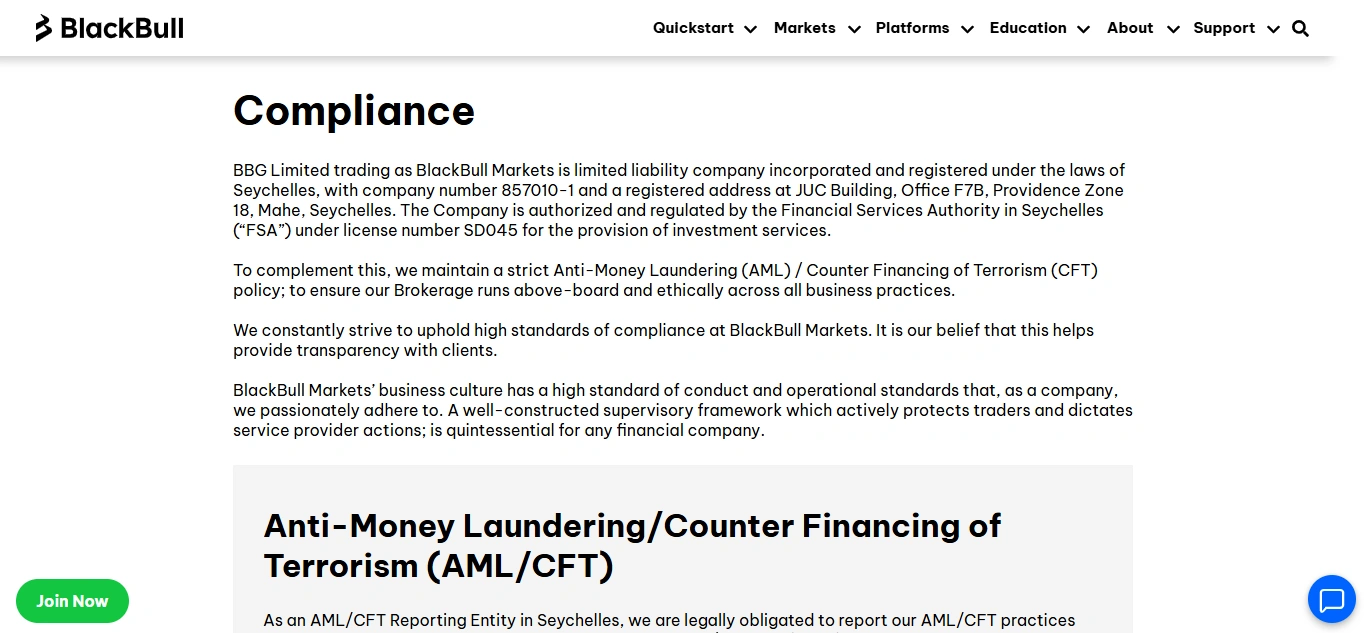
Client Fund Protection
Client funds are held in segregated accounts at ANZ Bank in New Zealand, kept separate from BlackBull’s operational funds. The broker is a member of the Financial Services Complaints Limited (FSCL) dispute resolution scheme, giving clients a formal route for complaints.
Negative balance protection is provided, so your account cannot go below zero. There is no investor compensation scheme under either the FMA or FSA entity, however. If BlackBull were to become insolvent, client recovery would depend entirely on the segregated funds held at ANZ Bank, not an external compensation fund.
Company History & Reputation
BlackBull Markets was founded in 2014 in Auckland, New Zealand. Over the past 12 years, it has built a consistently positive online reputation. On Trustpilot, the broker holds an “Excellent” rating across 3,100+ reviews, with customer service agents frequently praised by name. ForexPeaceArmy reviews are generally positive among long-term users.
Minor complaints about occasional withdrawal delays and isolated swap-free account disputes exist but fall within normal ranges for a broker of this size.
The FMA has issued a warning about imposter and clone websites misusing BlackBull’s registration details. The only official BlackBull Markets website is www.blackbull.com. Any other domain claiming to be BlackBull should be treated as fraudulent.
Account Types & Fees
BlackBull Markets offers three account tiers, each targeting a different level of trader. All accounts provide access to the full platform suite and support micro lots (0.01), leverage up to 1:500, and swap-free options.
ECN Standard is the entry-level account with a $0 minimum deposit. Spreads start from 0.8 pips on major pairs, and there are no commissions on forex trades (equity CFDs carry a 0.02% commission). Trading costs are built entirely into the spread, making per-trade expenses simpler to calculate. This account operates on a hybrid market maker/ECN execution model, which is worth noting if pure ECN execution matters to you.
ECN Prime is also available with a $0 minimum deposit (recently reduced from a previous $2,000 requirement). It offers raw spreads from 0.0 pips plus a $6 round-turn commission per standard lot ($3 per side). For active forex traders, this is the sweet spot: all-in cost on EUR/USD works out to approximately 0.76 pips.
ECN Institutional targets high-volume traders and requires a $20,000 minimum deposit. Spreads start from 0.0 pips with a reduced commission of $4 round-turn per standard lot ($2 per side). This is BlackBull’s tightest pricing tier.
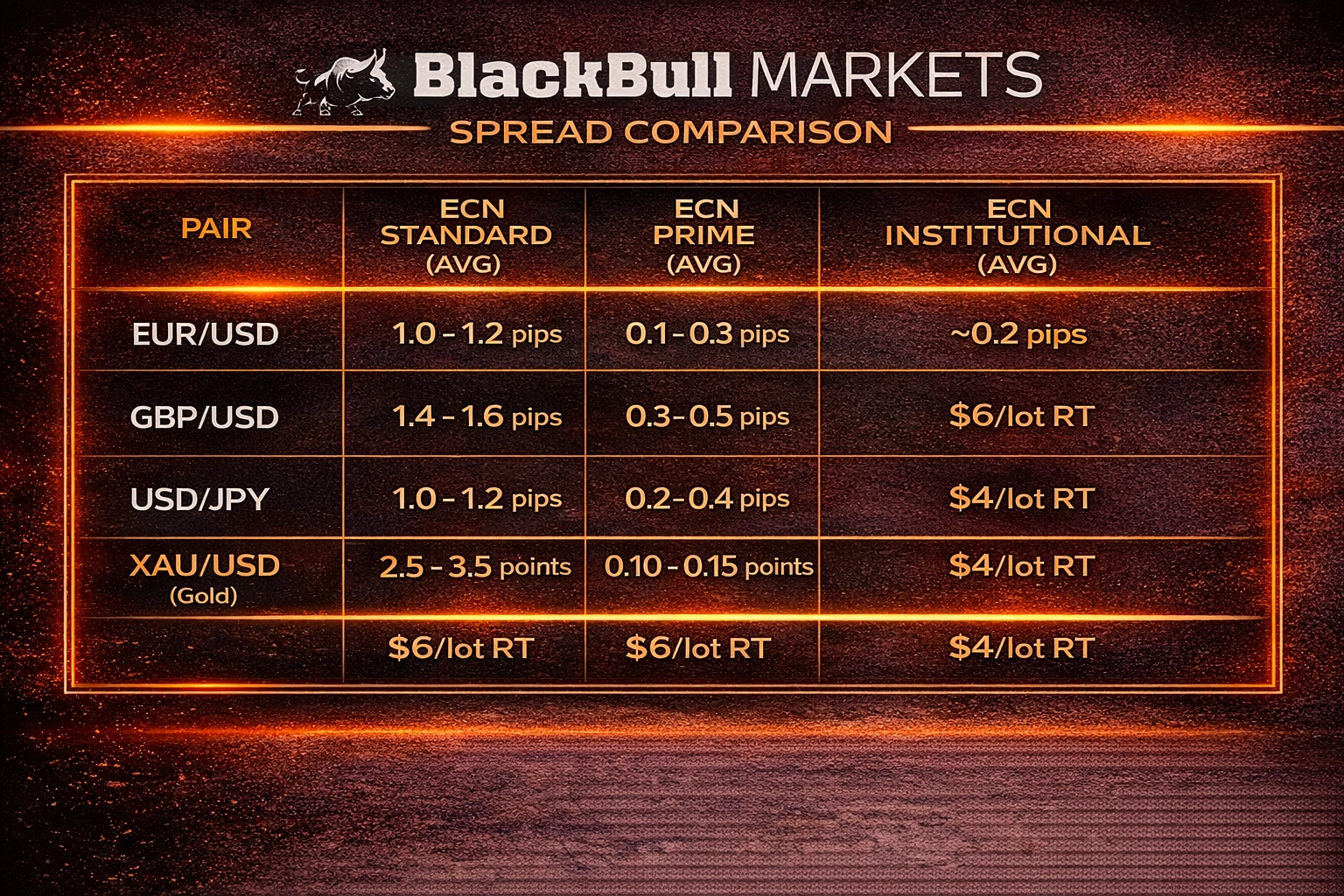
All three accounts include a demo option, though demo accounts are limited to 30 days with $100,000 in virtual balance.
Feature | ECN Standard | ECN Prime | ECN Institutional |
Minimum Deposit | $0 | $0 | $20,000 |
Spreads From | 0.8 pips | 0.0 pips | 0.0 pips |
Commission (RT) | None | $6/lot | $4/lot |
Leverage | Up to 1:500 | Up to 1:500 | Up to 1:500 |
Platforms | All 7 | All 7 | All 7 |
Swap-Free | Available | Available | Available |
Trading Platforms & Tools
BlackBull Markets offers one of the widest platform selections in the industry, with seven distinct trading environments.
MetaTrader 4 (MT4) remains the most widely used retail trading platform globally. BlackBull’s MT4 offering includes desktop, web, and mobile versions, with full support for Expert Advisors (EAs), custom indicators, and one-click trading.
MetaTrader 5 (MT5) expands on MT4 with additional order types, more timeframes, an integrated economic calendar, and access to a broader range of instruments. Available on desktop, web, and mobile.
cTrader was added to BlackBull’s lineup in 2023 and appeals to ECN traders for its depth-of-market visibility, advanced charting, and cTrader Copy for social trading. Desktop, web, and mobile versions are available.
TradingView, also integrated in 2023, brings BlackBull’s trading conditions into TradingView’s widely loved charting interface. You can place trades directly from TradingView charts using your BlackBull account.

ZuluTrade connects you to a global network of signal providers for copy trading. BlackBull CopyTrader is the broker’s proprietary copy trading platform, offering an alternative to ZuluTrade with a more integrated experience.
BlackBull Invest is a proprietary platform providing access to 26,000+ shares, options, bonds, and ETFs as underlying (unleveraged) assets, powered through a partnership with Interactive Brokers.
For algo traders, BlackBull offers FIX API access for direct connectivity to their liquidity pool. Free VPS hosting is available for eligible clients who maintain a minimum balance of $2,000 and trade at least 20 lots per month, ensuring low-latency execution for automated strategies running 24/5.
The main gap is the absence of a unified proprietary mobile app. You can trade on mobile through MT4, MT5, or cTrader, but there is no single BlackBull-branded mobile experience pulling everything together.
Markets & Instruments
BlackBull Markets advertises access to over 26,000 tradeable instruments, one of the largest counts in the industry. Context matters, though.
The headline number is heavily driven by equity CFDs, which make up the vast majority of the 26,000+ figure. These are available through BlackBull Invest and cover US, European, and Asian markets. Beyond equities, the instrument breakdown looks like this:
- Forex: Approximately 70 currency pairs covering majors, minors, and exotics
- Equities/Stock CFDs: 26,000+ (via BlackBull Invest/Interactive Brokers partnership)
- Indices: 11+ global indices
- Commodities: Energies (WTI, Brent), agriculture, and metals (gold, silver, platinum, copper)
- Cryptocurrencies: 17+ crypto CFDs including BTC, ETH, and major altcoins
- Futures CFDs: 31+ covering indices and commodities
- Options, Bonds, and ETFs: Available through BlackBull Invest (unleveraged)
For forex and CFD traders, the core offering of 70 pairs, 11 indices, commodities, and crypto is solid but average compared to specialists like CMC Markets (330+ forex pairs) or IG (80+ indices). The real breadth comes from the equity CFD side. If stock CFD trading is part of your strategy, BlackBull’s range is impressive.
Trading Costs & Conditions
Trading costs at BlackBull Markets vary significantly by account type, so choosing the right account is critical to managing your expenses.
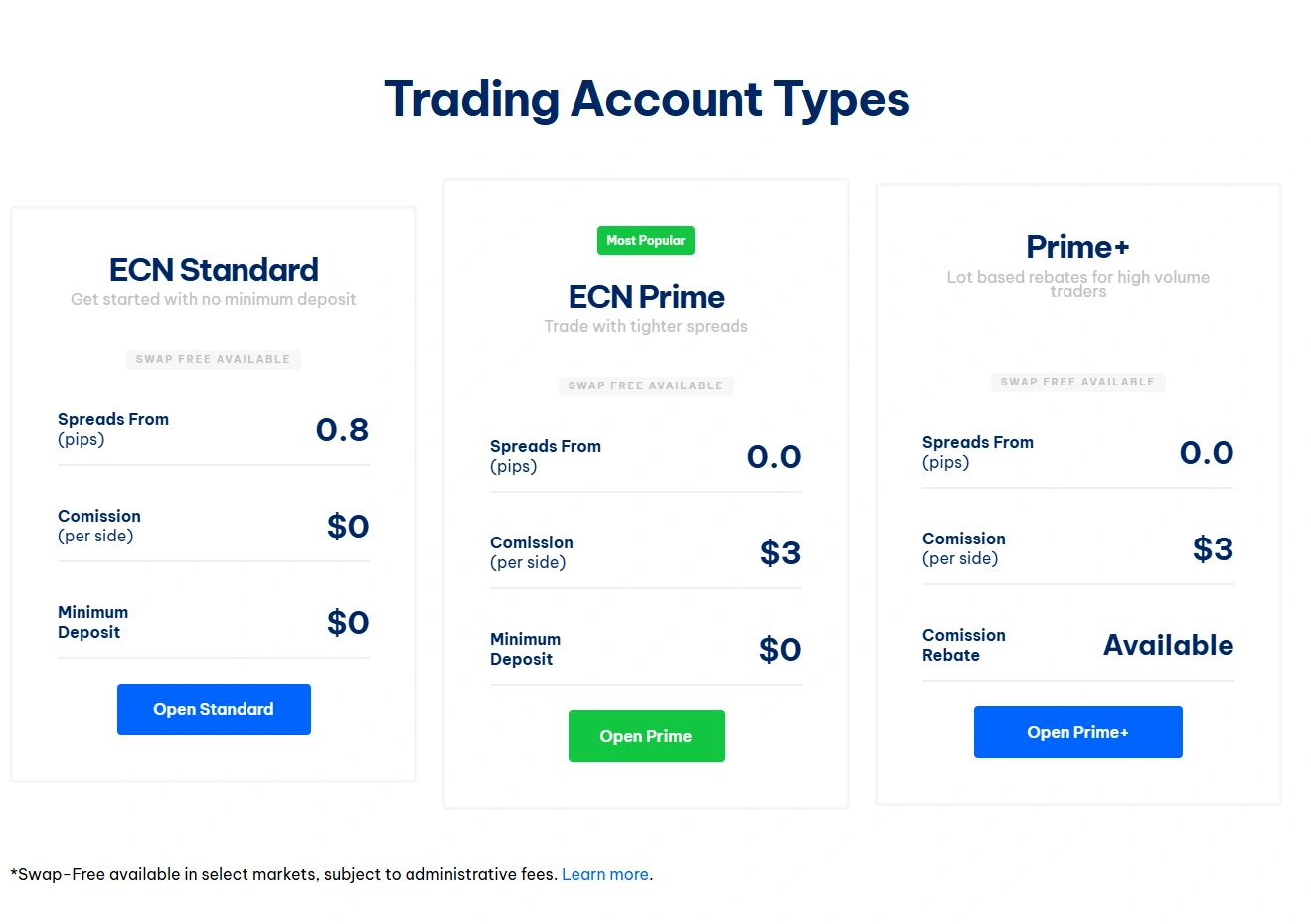
On the ECN Standard account, all costs are embedded in the spread. There are no separate commissions on forex trades, and EUR/USD averages around 1.0 to 1.2 pips during liquid sessions. That is competitive with industry norms for commission-free accounts.
The ECN Prime account is where BlackBull’s pricing sharpens considerably. Raw spreads on EUR/USD average approximately 0.16 pips, with a $6 round-turn commission ($3 per side). The all-in trading cost comes to roughly 0.76 pips on EUR/USD, competitive with IC Markets’ Raw Spread account and Pepperstone’s Razor account.
The ECN Institutional account offers the tightest pricing: EUR/USD raw spreads from 0.2 pips and a reduced $4 round-turn commission ($2 per side), though the $20,000 minimum deposit limits access.
Spread Comparison Table
Pair | ECN Standard (Avg) | ECN Prime (Avg) | ECN Institutional (Avg) | Commission (Prime) | Commission (Institutional) |
EUR/USD | 1.0 – 1.2 pips | 0.1 – 0.3 pips | ~0.2 pips | $6/lot RT | $4/lot RT |
GBP/USD | 1.4 – 1.6 pips | 0.3 – 0.5 pips | ~0.3 pips | $6/lot RT | $4/lot RT |
USD/JPY | 1.0 – 1.2 pips | 0.2 – 0.4 pips | ~0.2 pips | $6/lot RT | $4/lot RT |
AUD/USD | 1.0 – 1.2 pips | 0.2 – 0.4 pips | ~0.2 pips | $6/lot RT | $4/lot RT |
XAU/USD (Gold) | 2.5 – 3.5 points | 0.10 – 0.15 points | ~0.10 points | $6/lot RT | $4/lot RT |
BlackBull’s execution model routes orders through an ECN/NDD system with average execution speeds under 100 milliseconds. Liquidity is sourced from top-tier banks and non-bank liquidity providers.
Swap rates are calculated based on interest rates from global top-tier banks and liquidity providers. Triple swap applies on Wednesdays to account for the weekend market closure. For traders who need swap-free conditions, genuine Islamic accounts are available on both the Standard and Prime account types.
Deposits & Withdrawals
BlackBull Markets supports a broad range of funding methods across nine base currencies: USD, EUR, GBP, AUD, NZD, SGD, CAD, JPY, and ZAR.
Deposit methods include bank wire transfer, Visa, Mastercard, Apple Pay, Google Pay, Skrill, Neteller, FasaPay, UnionPay, and cryptocurrency (BTC, USDT, ETH). BlackBull does not charge deposit fees on any method.
Minimum deposits vary by method:
- Bank transfer: $1
- Cryptocurrency: $25
- Cards and e-wallets: $50
Most deposits are processed within minutes, though bank transfers can take longer depending on the originating bank.
Withdrawals carry a flat $5 fee regardless of the method, which is a notable downside compared to competitors offering free withdrawals. Processing typically occurs within 24 business hours on BlackBull’s end, with funds arriving in 1-3 business days for e-wallets and cards, and 3-5 business days for bank wires. There is no minimum withdrawal amount.
As part of AML (anti-money laundering) compliance, withdrawals must be returned to the original funding source up to the deposited amount. Any profits above that can be withdrawn via an alternative method.
Customer Support & Education
BlackBull Markets provides 24/7 customer support through live chat, email (support@blackbull.com), phone (+64 9 558 5142), and WhatsApp (+64 210 288 6398). This is a solid offering, and Trustpilot reviews consistently highlight the responsiveness and quality of individual support agents.
The broker maintains an active social media presence across Facebook, LinkedIn, Instagram, X (formerly Twitter), and YouTube.
Education is an area where BlackBull is improving but still trails industry leaders. The current offering includes tiered articles for beginner, intermediate, and advanced traders, along with trading courses, webinars, platform tutorials, and an in-house podcast. It covers the fundamentals but lacks the depth and polish of education hubs from brokers like Pepperstone or IG.
Research tools include an economic calendar, Myfxbook integration, and in-house market commentary. Notably absent are Trading Central and Autochartist, which are standard at many competing brokers.
BlackBull Markets vs The Competition
To put BlackBull Markets in perspective, here is how it stacks up against three brokers targeting a similar audience of active, cost-conscious traders.
Feature | BlackBull Markets | IC Markets | Pepperstone | FP Markets |
Regulation | FMA (NZ), FSA (Seychelles) | ASIC, CySEC, FSA (Seychelles) | FCA, ASIC, CySEC, BaFin, DFSA | ASIC, CySEC, FSA (SVG) |
EUR/USD Spread (Raw) | ~0.16 pips avg | ~0.02 pips avg | ~0.10 pips avg | ~0.0 pips avg |
Commission (Raw/ECN) | $6/lot RT | $6-7/lot RT | $7/lot RT | $6/lot RT |
Platforms | MT4, MT5, cTrader, TradingView, +3 more | MT4, MT5, cTrader, TradingView | MT4, MT5, cTrader, TradingView | MT4, MT5, cTrader, TradingView |
Instruments | 26,000+ | 2,200+ | 1,350+ | 10,000+ |
Min. Deposit | $0 | $200 | $0 | $100 |
Withdrawal Fees | $5 flat | Free | Free | Free |
Investor Compensation | None | None (Seychelles) / ICF (CySEC) | FSCS (UK), ICF (CySEC) | ICF (CySEC) |

BlackBull holds its own on raw spread pricing and wins on platform variety and instrument count. Where it falls behind is regulatory breadth. IC Markets and Pepperstone both offer entities regulated by the FCA and ASIC, giving international clients stronger protections. Pepperstone, in particular, provides FSCS coverage for UK clients (up to £85,000) and ICF coverage for EU clients (up to €20,000), protections that BlackBull cannot match under either of its entities.
If raw cost is your primary concern and you are comfortable with NZ or Seychelles regulation, BlackBull is competitive. If regulatory depth and investor compensation are priorities, Pepperstone or IC Markets may be the safer choice.
Conclusion
BlackBull Markets delivers a compelling package for intermediate to advanced traders who prioritize ECN execution, platform flexibility, and a wide range of instruments. Raw spreads averaging 0.16 pips on EUR/USD (Prime account), seven trading platforms, and institutional backing from LMAX Group make it a legitimate contender in the ECN broker space.
The broker suits active forex and CFD traders who value execution quality and platform choice over regulatory breadth. Algo traders will appreciate FIX API access and conditional free VPS, while copy traders have multiple options through ZuluTrade, cTrader Copy, and BlackBull CopyTrader.
International clients should be clear-eyed about the regulatory reality, though: most will trade under the Seychelles entity, which provides weaker protections than an FCA or ASIC-regulated broker. There is no investor compensation scheme under any BlackBull entity.
Beginners may find better support with brokers that offer more comprehensive educational resources and investor compensation, such as Pepperstone (FCA/ASIC regulated) or IG.
Risk Warning: CFDs are complex instruments and come with a high risk of losing money rapidly due to leverage. You should consider whether you understand how CFDs work and whether you can afford to take the high risk of losing your money. No investor compensation scheme applies to BlackBull Markets accounts.
Frequently Asked Questions


Compare BlackBull Markets with Other Brokers
See how BlackBull Markets stacks up against other brokers in our detailed comparison tool.
Login
Please login to comment
0 Reviews
Newest