


Most intraday trading content is contradictory. One source calls the 1-minute chart essential. Another swears by VWAP. A third tells you to ignore indicators completely. No wonder it’s hard to build any real structure around your trading.
This guide covers how intraday trading actually works, the timeframes and indicators worth understanding, strategies you can test, and the screeners that help you find setups before the market opens in a single, connected framework.
Risk disclaimer: Intraday trading involves significant risk of financial loss and is not suitable for everyone. The majority of retail day traders lose money. Everything in this article is educational content, not financial advice. Never trade with money you can’t afford to lose, and consider practicing on a simulator before committing real capital.
Whether you’re placing your first live intraday trade or trying to bring consistency to an approach that’s felt like guesswork, you’ll walk away with a clear mental model and a practical starting point.
What Is Intraday Trading and How Does It Work
Most people think intraday trading is just “buying and selling stocks fast.” That’s like saying surgery is just “cutting and stitching.” The speed is a feature, not the definition. Understanding the actual mechanics is what separates structured traders from people refreshing their P&L every thirty seconds.
Core Mechanics of Intraday Trading
Intraday trading means opening and closing all positions within the same trading session. Nothing carries overnight. By the time the market closes, your account is flat, with no open exposure.
Why should you care about that distinction? Because overnight risk is real. Earnings reports, geopolitical developments, pre-market gaps: these things can move a stock 5–10% before you’ve even poured your morning coffee. Intraday traders sidestep that entirely by closing everything before the bell.
Here’s how a typical intraday trade unfolds in practice:
- You identify a stock showing unusual volume or price movement during the session
- You enter a position (long or short) based on a predefined setup
- You set a stop-loss and a profit target before or immediately after entry
- You manage the trade according to your plan
- You exit, win or lose, before the closing bell
The instruments you trade intraday can include stocks, futures, forex pairs, or ETFs. The principles stay largely the same across asset classes: you’re exploiting short-term price movements driven by liquidity, momentum, and market structure.
Two concepts deserve your attention early: liquidity and the bid-ask spread. Liquidity refers to how easily you can enter and exit a position without significantly moving the price. The bid-ask spread is the gap between what buyers are willing to pay and what sellers are asking. Tight spreads and high volume are your allies in intraday trading. Wide spreads and thin volume? That’s where beginners bleed money through slippage.
So if intraday trading revolves around same-day entries and exits, where does it sit relative to other short-term approaches?
How Intraday Trading Differs from Swing Trading and Scalping
Think of short-term trading styles as a spectrum. At one extreme sits scalping, where traders hold positions for seconds to minutes, targeting tiny price movements at very high frequency. At the other end, swing trading, where positions are held for days to weeks, capturing broader price swings.
Intraday trading occupies the middle ground. You’re holding positions for minutes to hours, and your trades are typically shaped by the day’s price action, volume patterns, and key technical levels.
Feature | Scalping | Intraday Trading | Swing Trading |
Holding period | Seconds to minutes | Minutes to hours | Days to weeks |
Trades per day | Dozens to hundreds | A few to a dozen | A few per week |
Overnight exposure | None | None | Yes |
Typical timeframe | 1-min, tick charts | 5-min to 30-min | Daily, 4-hour |
Capital requirement | Higher (due to frequency) | Moderate | Lower relative to position size |
The key distinction for intraday traders is that they’re looking for setups that develop and resolve within a single session. They need to read what the market is telling you right now.
And that reading begins with choosing the right timeframe, which is where most beginners make their first significant mistake.
Best Timeframes for Intraday Trading
Picking a timeframe is a personality decision. The chart interval you trade on determines how fast you need to react, how much noise you’ll absorb, and how many opportunities surface in a session. Get this wrong, and even a solid strategy will feel chaotic.
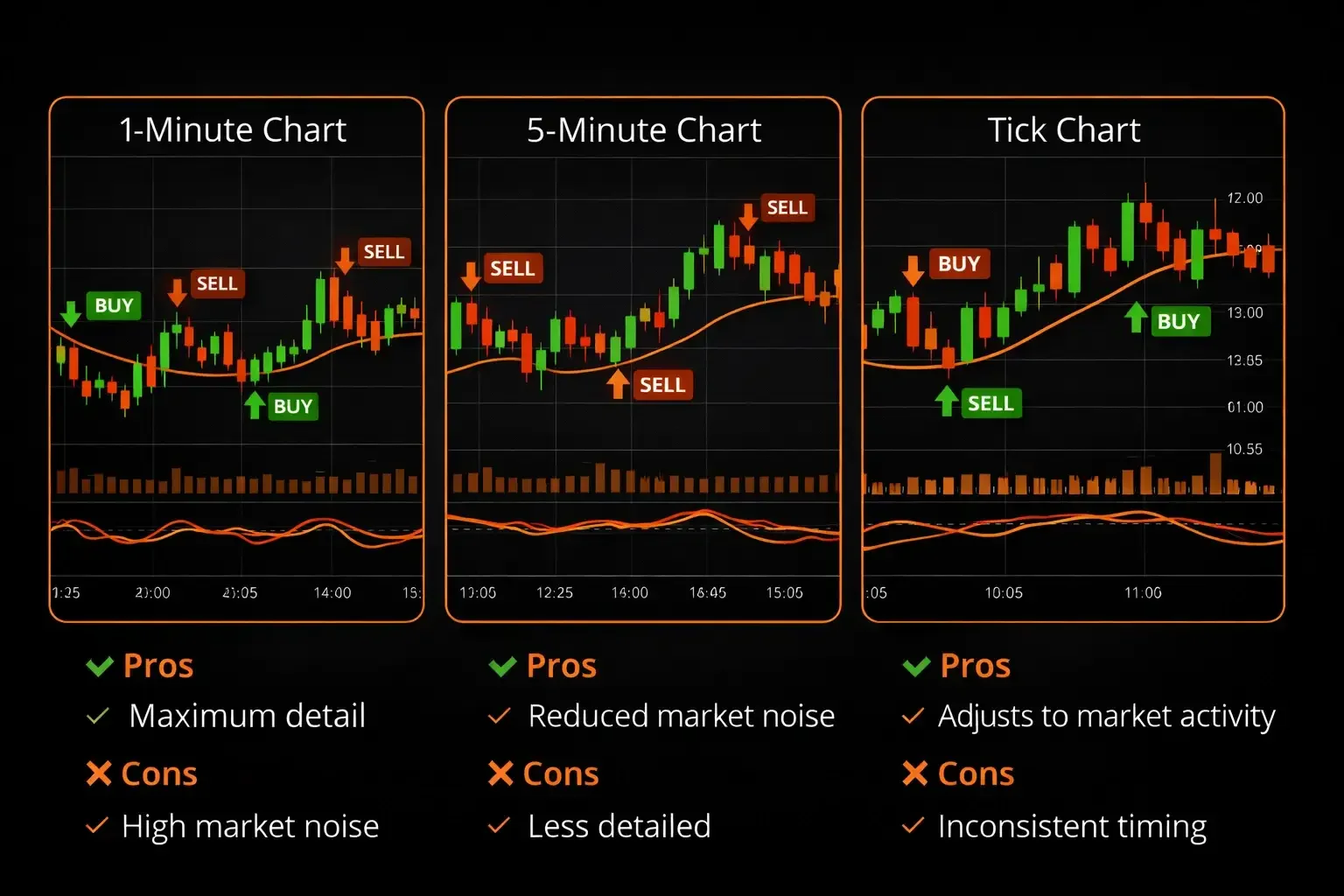
The 1-Minute and 5-Minute Charts
The 1-minute chart is the microscope of intraday trading. Every candle represents 60 seconds of price action, and the information density is relentless. It’s useful for precision entries and exits, particularly when you’re trading around a specific level. But it’s also noisy. False signals appear frequently, and if you’re not practiced at reading price action quickly, you’ll get chopped up.
The 5-minute chart is the sweet spot for many active intraday traders. It filters out much of the 1-minute noise while still providing enough granularity to catch moves early. Most of the intraday strategies you’ll encounter are designed around 5-minute candles, making it a strong default if you’re still finding your rhythm.
The 15-Minute and 30-Minute Charts
If you prefer a steadier pace (or you simply can’t stare at charts for six straight hours), the 15-minute and 30-minute charts offer a more measured intraday experience. You’ll see fewer setups per day, but they tend to carry more weight because more price data is condensed into each candle.
The 15-minute chart is popular among traders who focus on the first and last hours of the trading session, when volume and volatility tend to peak. The 30-minute chart works well if you’re approaching intraday trading as a part-time activity, checking in at key intervals rather than tracking every tick.
How to Combine Multiple Timeframes
Here’s a concept that separates structured intraday traders from reactive ones: multi-timeframe analysis. The idea is straightforward. Use a higher timeframe to identify the trend or key levels, then drop to a lower timeframe to time your entry.
Say you’re watching the 15-minute chart and notice a stock trending upward, approaching a support level. You switch to the 5-minute chart to look for a specific entry signal, maybe a bullish candle pattern or a moving average bounce, right at that support zone.
This layered approach gives you context from the higher timeframe and precision from the lower one. It’s one of the simplest ways to improve your accuracy without piling on complexity.
With your timeframes selected, the natural next question becomes: what actually belongs on those charts?
Best Indicators for Intraday Trading
Indicators are where most beginners veer off course. Not because indicators are unreliable, but because traders stack six or seven of them, turning their chart into a Christmas tree of conflicting signals. The goal is to use the right ones for your setup and to understand what each one is actually measuring.
Volume-Based Indicators
Volume is the fuel behind every price move. A breakout on low volume is like a car rolling downhill in neutral: it looks fast, but there’s no engine behind it. A breakout on high volume? That’s conviction.
The simplest volume tool is the standard volume bar chart at the bottom of your screen. Watch for volume spikes that coincide with price movements. If price breaks above a key level and volume surges, that’s confirmation. If price breaks out but volume stays flat or declines, treat the move with skepticism.
For deeper volume analysis, On-Balance Volume (OBV) tracks cumulative buying and selling pressure. When OBV is climbing while price consolidates, it can signal that buyers are quietly accumulating before a move higher.
Momentum Indicators (RSI, MACD, VWAP)
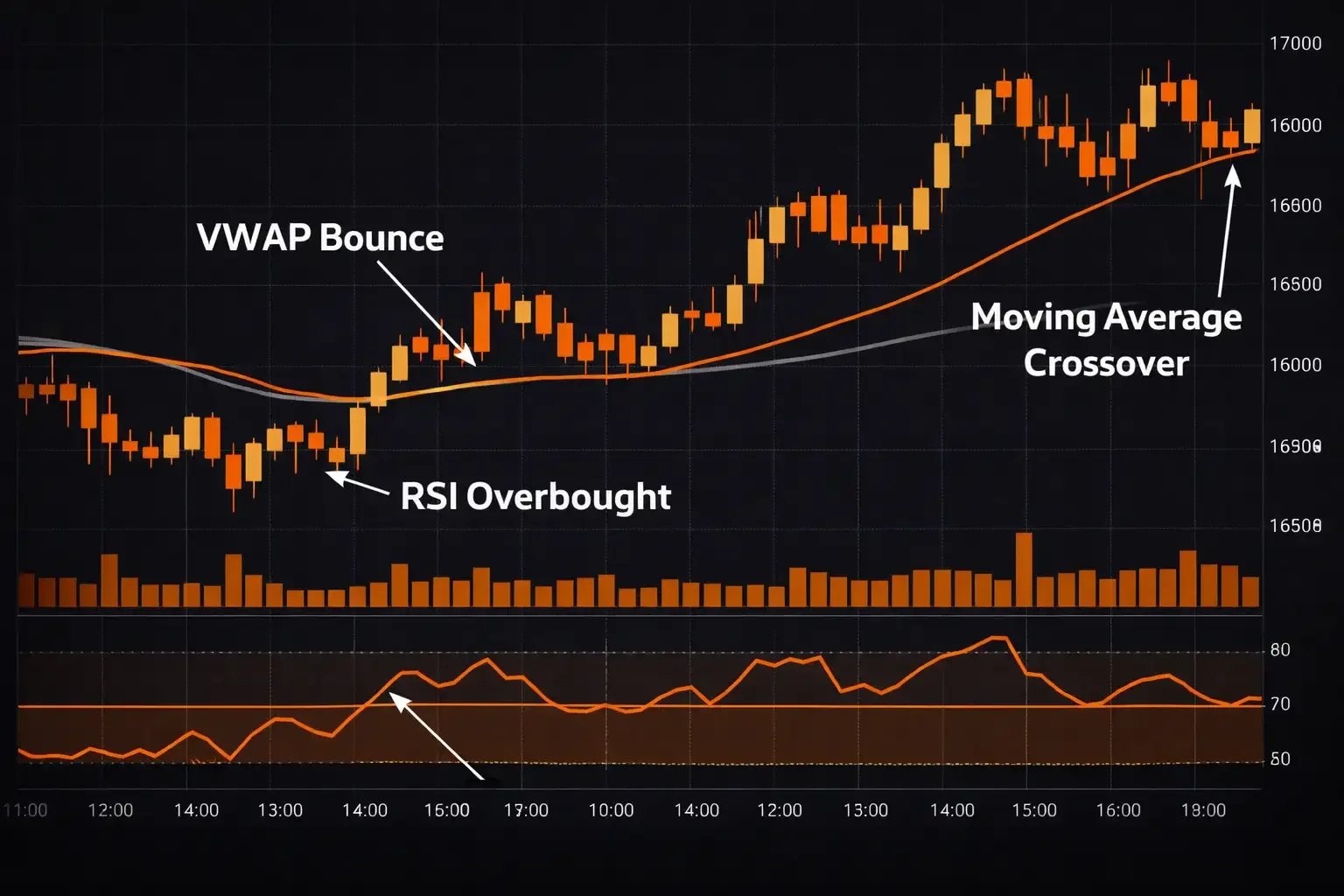
RSI (Relative Strength Index) measures how overbought or oversold a stock is on a scale from 0 to 100. For intraday purposes, readings above 70 suggest the move might be stretched to the upside, while readings below 30 suggest the opposite. But don’t lean on RSI as a standalone buy/sell trigger. In strong trends, RSI can remain overbought or oversold for extended stretches. It works best as a confirmation layer alongside price action.
MACD (Moving Average Convergence Divergence) shows the relationship between two moving averages, typically the 12-period and 26-period exponential moving averages. When the MACD line crosses above the signal line, it suggests bullish momentum. Below, bearish. For intraday trading, MACD is most useful on the 5-minute or 15-minute chart to confirm the direction of a move you’ve already spotted through price action.
VWAP (Volume Weighted Average Price) is arguably the single most important indicator for intraday traders. Think of VWAP as the average price institutions have paid throughout the day, weighted by volume. When price is above VWAP, the bias tilts bullish. Below VWAP, bearish. Many professional traders treat VWAP as a dynamic support/resistance level, watching for bounces off VWAP as entry opportunities. If you learn only one indicator for intraday trading, make it this one.
Moving Averages for Intraday Setups
Moving averages smooth out price data to reveal the underlying trend. For intraday trading, the most commonly watched are:
- 9 EMA (Exponential Moving Average): A fast-moving average that hugs price closely. Useful for reading short-term momentum.
- 20 EMA: A medium-speed average that many intraday traders rely on for pullback entries in a trending market.
- 50 SMA (Simple Moving Average): A slower average that serves as a broader trend filter on intraday charts.
The interplay between these averages is where things get interesting. When the 9 EMA crosses above the 20 EMA on a 5-minute chart, it can signal the start of an intraday uptrend. When price pulls back to the 20 EMA and bounces, that’s a potential continuation entry. If you want to explore moving averages and other technical analysis indicators in greater depth, a dedicated deep dive is worth your time.
How to Avoid Indicator Overload
Here’s the rule: pick one indicator from each category (volume, momentum, trend) and learn it deeply before adding anything else. Three indicators, maximum, on your chart at any given time.
Why? Because most indicators draw from the same underlying data: price and volume. Stacking five momentum indicators gives you five versions of the same information, plus analysis paralysis.
Start simple. VWAP plus a moving average plus volume bars is a clean, effective setup for most intraday styles. You can always layer in complexity later, but you can’t easily unlearn the habit of overcomplicating your charts.
With your timeframes set and your indicators chosen, the next step is putting them to work inside an actual strategy.
Simple Intraday Trading Strategies That Work
A strategy is a complete decision framework: when to enter, where to place your stop, where to take profit, and under what conditions to stay out entirely. Here are three proven approaches you can start testing.
Opening Range Breakout Strategy
The opening range breakout (ORB) is one of the oldest and most intuitive intraday strategies. The concept is simple: the first 15 to 30 minutes of the trading session establish a range (the high and low of that period). You then trade the breakout above the high or below the low.
Here’s the structure:
- Mark the high and low of the first 15 or 30 minutes after the open
- Wait for price to break above the high (long) or below the low (short)
- Enter on the breakout candle close, confirming with above-average volume
- Place your stop-loss at the opposite side of the range
- Target a 1:1.5 or 1:2 risk-reward ratio, or trail your stop using the 9 EMA
ORB works because the opening range often captures the tug-of-war between overnight sentiment and fresh morning orders. When one side wins convincingly, the resulting move tends to carry.

VWAP Reversion Strategy
This strategy builds on a well-observed tendency: price often reverts to VWAP during the trading day, especially during the mid-session lull when momentum fades.
Here’s how it plays out:
- Wait for price to move significantly away from VWAP (at least 1–2 ATR distance)
- Look for signs of exhaustion: declining volume, RSI divergence, or long candle wicks
- Enter a position toward VWAP (long if price is below, short if above)
- Set your stop-loss beyond the recent extreme
- Target VWAP itself as your profit level, or slightly beyond
This approach is particularly effective in range-bound or mean-reverting conditions. It tends to struggle on strong trend days, so pairing it with a broader read on market structure matters.
Moving Average Crossover Strategy
The crossover strategy uses two moving averages (typically the 9 EMA and 20 EMA on a 5-minute chart) to signal trend changes.
- When the 9 EMA crosses above the 20 EMA, go long
- When the 9 EMA crosses below the 20 EMA, go short
- Place your stop-loss below the most recent swing low (for longs) or above the recent swing high (for shorts)
- Exit when the opposite crossover occurs or when your target is hit
The crossover strategy performs best in trending markets and will generate false signals in choppy, sideways conditions. Filtering crossovers by requiring price to also be above or below VWAP can significantly cut down on whipsaws.
How to Choose a Strategy That Fits Your Schedule
Ask yourself:
- How much screen time can you commit? ORB trades typically resolve within the first 1–2 hours. VWAP reversion can develop anytime. Crossover strategies require ongoing monitoring.
- What’s your risk tolerance? ORB tends to have wider stops (the full opening range). VWAP reversion usually offers tighter ones.
- What market conditions do you read best? If you’re good at spotting trends early, crossovers suit you. If you’re better at identifying extremes, VWAP reversion is your lane.
Pick one strategy. Test it on a simulator for at least 20–30 trades. Track your results. Only then consider adding a second approach. If you want additional perspective on how scalping strategies compare to these setups, that context can help you calibrate expectations.
Knowing a strategy is one thing. Executing it with discipline is another.
Intraday Trading Tricks Professionals Actually Use
The gap between a struggling intraday trader and a consistent one rarely comes down to the strategy itself. More often, it’s everything surrounding the strategy: the preparation, the risk controls, and the willingness to sit on your hands when conditions don’t line up.
Pre-Market Preparation Routine
Professional intraday traders follow a structured pre-market routine that typically covers these steps:
- Check the economic calendar: Are there any scheduled data releases (jobs numbers, Fed announcements, earnings) that could trigger volatility spikes?
- Review overnight price action: Where did futures trade overnight? Is there a gap up or gap down from the previous close?
- Mark key levels: Identify the previous day’s high, low, and close, along with any significant support/resistance zones on your watchlist stocks.
- Run your screener: Filter for stocks meeting your criteria (volume, gap percentage, relative strength).
- Define your max risk for the day: Before the bell rings, know the dollar amount you’re willing to lose. If you hit that number, you stop trading. Period.
This routine takes 20–30 minutes. It’s not glamorous. But it’s what separates preparation from gambling.
Managing Risk with Intraday Position Sizing
Position sizing is where risk management becomes tangible. The core principle: never risk more than 1–2% of your trading account on a single trade.
Here’s the formula:
Position Size = (Account Risk Amount) / (Entry Price – Stop-Loss Price)
So if your account is $25,000, your max risk per trade is $250 (at 1%), and your stop-loss is $0.50 away from your entry, your position size is 500 shares.
This is emotional insurance. When you know exactly how much you stand to lose before entering, you can manage the trade rationally instead of spiraling when price moves against you.
Knowing When Not to Trade
This might be the most valuable skill in intraday trading, and the hardest to build. Not every day is a trading day. Some sessions are choppy, low-volume, and directionless. Forcing trades in those conditions is how accounts erode slowly.
Signs you should step aside:
- Volume is well below average with no catalyst on the horizon
- Major economic data is pending and the market is coiling in a tight range
- You’ve already hit your daily loss limit
- You’re emotionally off-balance (revenge trading after a loss, overconfident after a win)
The best traders protect their capital on bad days so it’s there for the good ones. That discipline carries more weight than any indicator setup. Exploring trading psychology at a deeper level can help you develop the mental frameworks to execute this consistently.
But before you can decide to sit out, you need to find potential trades worth evaluating. That’s where screeners earn their place.
Best Screeners for Intraday Trading
A good screener acts as a filter for the entire market. Instead of manually scanning hundreds of stocks, you set criteria and let the screener surface the handful that qualify. For intraday traders, this is essential infrastructure.
What to Look for in an Intraday Screener
Not all screeners are built for intraday work. Here’s what actually matters:
- Real-time or near-real-time data: Delayed data is functionally useless for intraday trading. You need current prices and volume.
- Customizable filters: At minimum, you should be able to filter by volume, price change percentage, relative volume, float size, and gap percentage.
- Speed: The screener should update quickly. One that lags during the opening bell is one that misses opportunities.
- Alert functionality: The ability to set custom alerts when a stock meets your criteria saves you from staring at the screener all session.
- Pre-market scanning: Many intraday setups take shape before the market opens. Your screener needs to work during pre-market hours.
Top Screener Options Compared
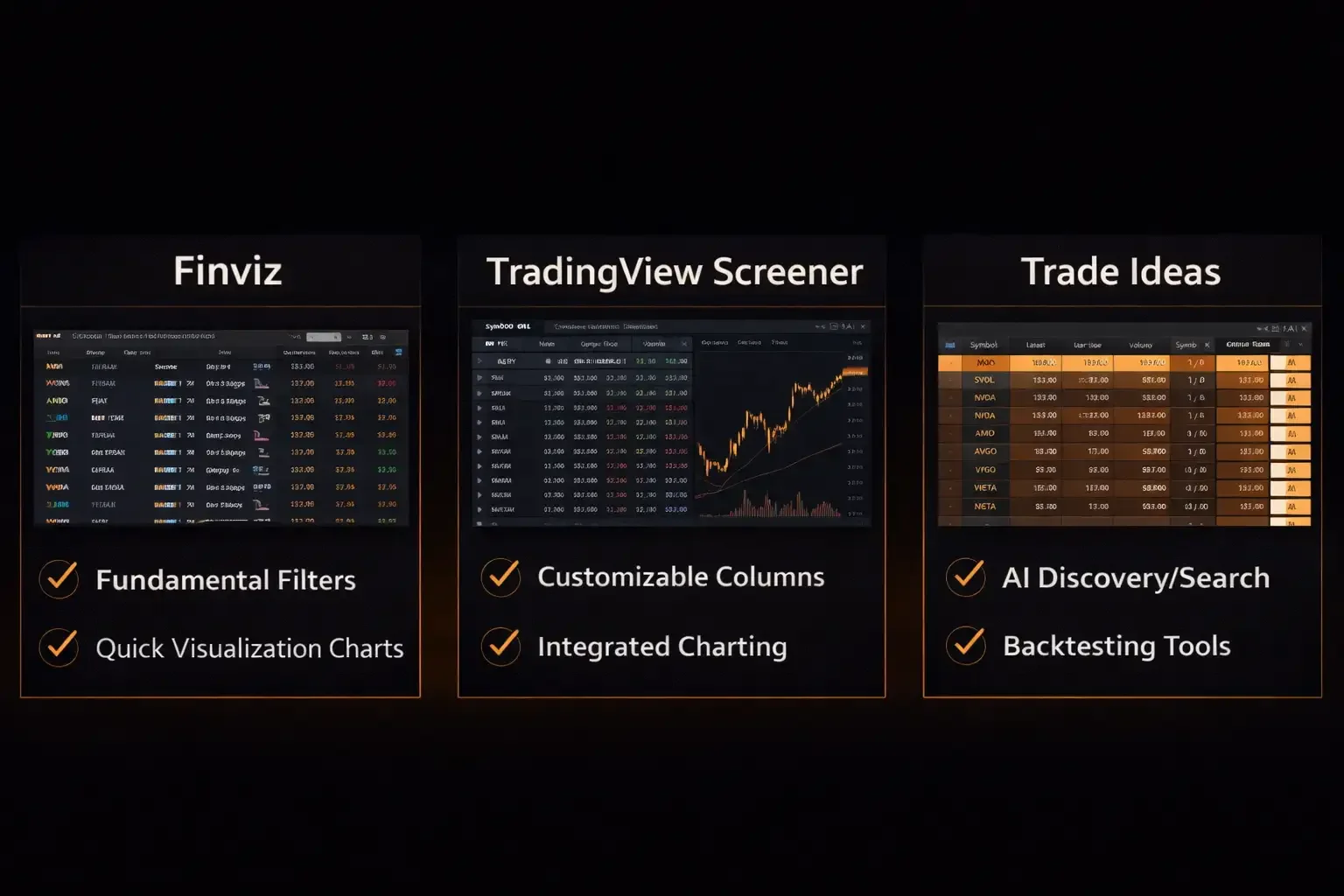
Feature | Finviz | TradingView Screener | Trade Ideas |
Real-time data | Elite plan only | Separate exchange add-ons required | Yes |
Pre-market scanning | Limited | Yes | Yes |
Custom alerts | Basic | Yes | Advanced (AI-driven) |
Ease of use | Very beginner-friendly | Moderate | Steeper learning curve |
Price | Free tier available; Elite ~$40/mo | Free tier; paid plans from ~$15/mo (+ exchange data fees) | ~$120+/mo |
Best for | Quick visual scans, end-of-day prep | All-around charting + screening | Serious intraday traders wanting automation |
Finviz is a strong starting point. Its visual heat maps and clean interface make it easy to get a quick snapshot of market conditions. The free tier is limited to delayed data, but even that proves useful for pre-market research and watchlist building.
TradingView combines charting and screening in one platform, which is convenient if you’d rather not bounce between tools. Its screener is flexible, and the community-driven indicator library is a welcome bonus. One thing to be aware of: TradingView’s paid subscription plans don’t include real-time data for most stock and futures exchanges. Real-time quotes from exchanges like NASDAQ, NYSE, and CME require separate data add-ons purchased on top of your plan, typically running a few dollars per month per exchange. By default, TradingView displays data from the Cboe exchange, which is real-time and free but may differ slightly from primary exchange pricing. Factor those additional costs into your decision if tick-level accuracy matters to your setup.
Trade Ideas is the power tool. It uses AI-driven scanning and can surface setups you might miss manually. The price tag reflects that capability, and it’s more than most beginners need. But if you’re committed to intraday trading as a daily practice, it’s worth evaluating once you’ve outgrown simpler options.
Choose based on where you are in your journey. A free Finviz scan combined with TradingView charts is a perfectly capable setup for your first six months.
Common Intraday Trading Mistakes to Avoid
Even with the right strategy, timeframe, and screener, certain behavioral patterns can quietly undermine your results. These are the mistakes that surface again and again, particularly among newer traders.
- Overtrading: Taking trades out of boredom or the compulsion to “be in the market.” Quality setups don’t appear every five minutes. If you’re placing 15+ trades a day as a beginner, you’re likely forcing it.
- Ignoring the stop-loss: Moving your stop further away because you “feel” the trade will come back is wishful thinking. And that is not a trading plan.
- Trading without a plan: Entering a position without knowing your stop-loss and target before you click the button. Every trade should have a predefined exit for both profit and loss.
- Sizing up after a win streak: Three consecutive winners means variance is temporarily in your favor. Keep your position sizing consistent.
- Chasing entries: Watching a stock run 5% and jumping in because you don’t want to “miss it.” By the time FOMO kicks in, the favorable risk-reward has usually passed.
- Neglecting commissions and fees: Frequent trading means frequent costs. If your per-trade expenses eat into your edge, you don’t have one.
- Not journaling trades: If you’re not recording your entries, exits, reasoning, and emotional state, you have no data to improve from. A simple spreadsheet is enough. Consistency with the habit matters more than the tool you use.
Most of these mistakes are discipline problems. And discipline is built through repetition, review, and honest self-assessment. If you’re looking for structured environments to sharpen that discipline under pressure, prop trading challenges offer one avenue for that kind of accountability.
Frequently Asked Questions


Comments