


Knowing exactly when you can and can’t trade is the backbone of any serious trading plan. Whether you’re timing entries around long weekends, managing option expirations, or simply trying to avoid the frustration of placing an order into a closed market, having the complete 2026 trading calendar at your fingertips puts you in control.
This guide covers every trading day, every market holiday, and every early-close session for 2026 across the NYSE, NASDAQ, London Stock Exchange, and other key global markets. Bookmark it, reference it all year, and stop second-guessing whether the market is open tomorrow.
Disclaimer: While this calendar is compiled from official exchange sources, schedules can be subject to change. Always verify dates against your broker’s specific calendar and the relevant exchange’s official schedule before making time-sensitive trading decisions.
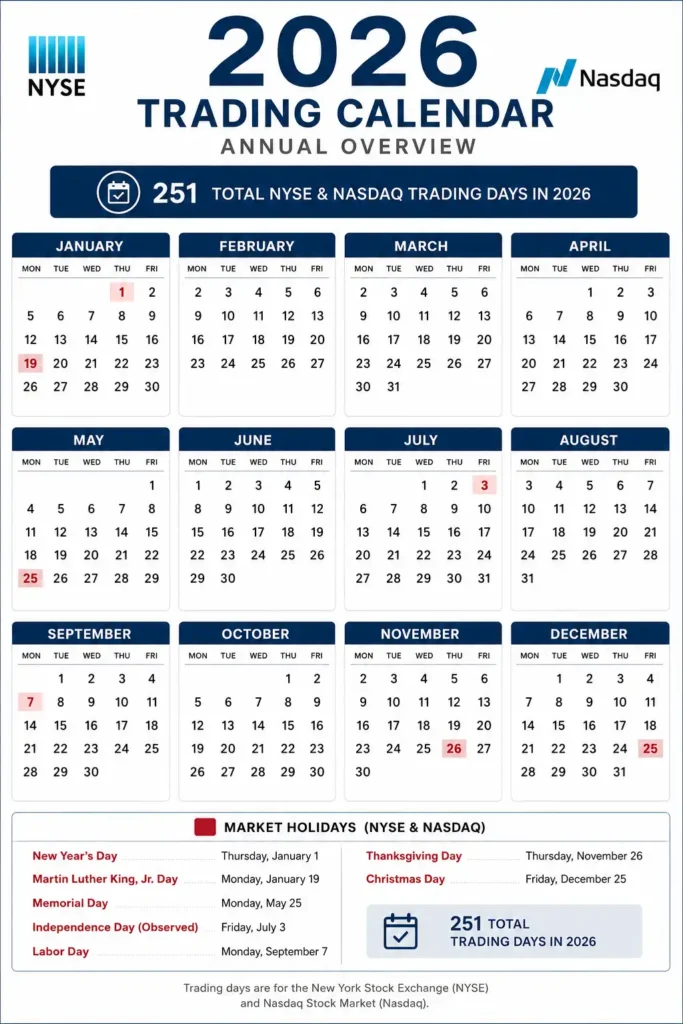
How Many Trading Days Are There in 2026?
Here’s how the major exchanges stack up in 2026:
Exchange | Total Trading Days (2026) | Full Holiday Closures |
NYSE | 251 | 10 |
NASDAQ | 251 | 10 |
London Stock Exchange (LSE) | ~252 | 8 |
Tokyo Stock Exchange (TSE) | ~245 | ~20 |
The NYSE and NASDAQ share an identical holiday schedule, so if one is closed, the other is too. The LSE observes fewer full holidays but adds early-close sessions at year-end. The Tokyo Stock Exchange, by contrast, has significantly more closures thanks to extended New Year observances and a cluster of national holidays in late April and early May known as Golden Week.
If you trade across multiple markets, there will be days when one exchange is open and another is shut. Those mismatches can create both opportunities and risks, particularly around settlement timing.
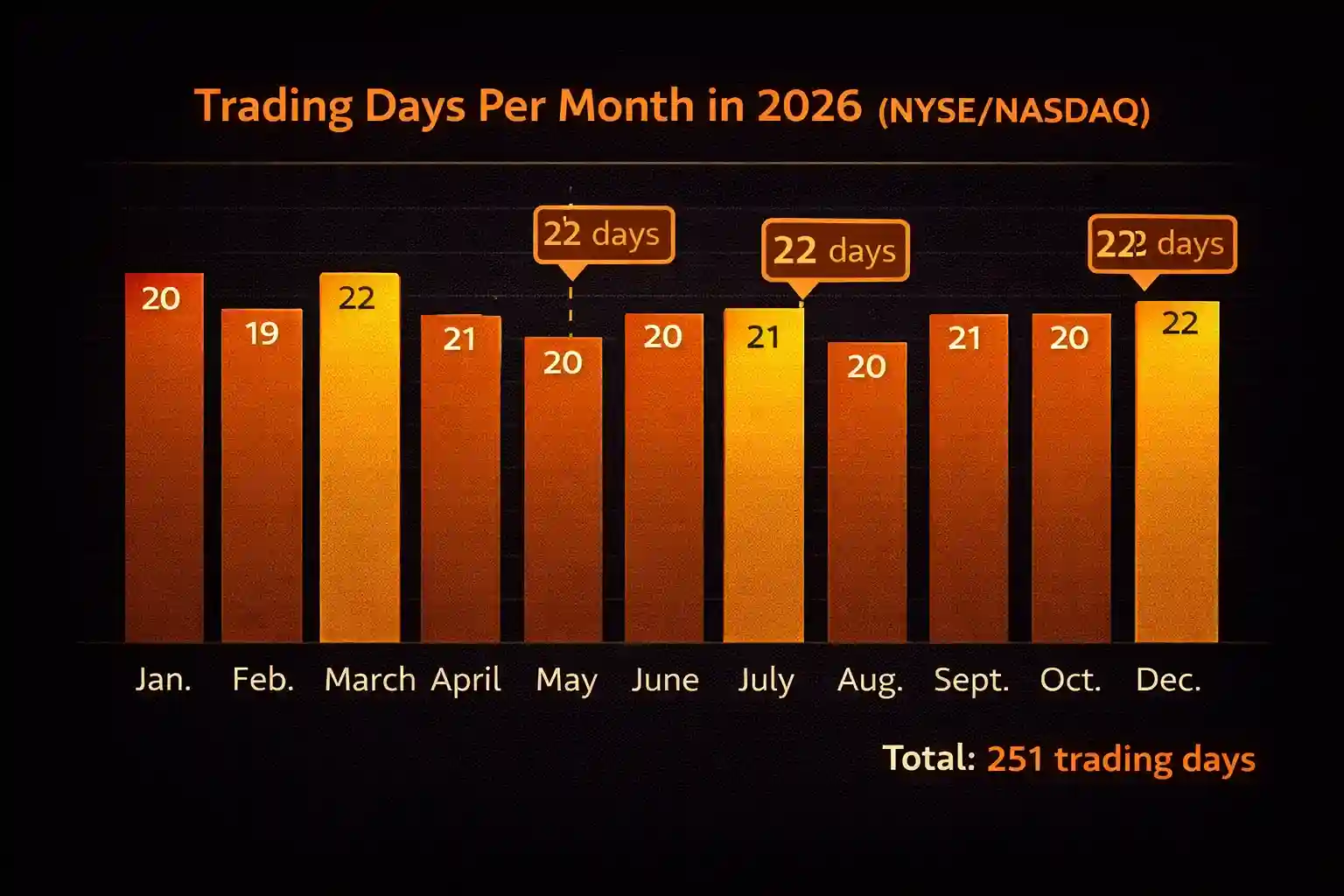
Monthly Breakdown of Trading Days in 2026
Here’s the complete monthly count for the NYSE and NASDAQ:
Month | Trading Days |
January | 20 |
February | 19 |
March | 22 |
April | 21 |
May | 20 |
June | 21 |
July | 22 |
August | 21 |
September | 21 |
October | 22 |
November | 20 |
December | 22 |
Total | 251 |
February is your shortest month at just 19 trading days, squeezed by being the calendar’s shortest month and the Presidents’ Day closure. March and October are your heaviest at 22 days each, giving you maximum room to execute longer-term strategies.
Knowing how many days you have is only half the equation, though. You also need to know exactly which days the market goes dark.
Stock Market Holidays 2026
Missing a market holiday can cost you more than a missed trade. Open orders sitting unexecuted, expiring options you forgot to roll, liquidity drying up the day before a long weekend: all of these can catch you off guard. Here’s every closure and shortened session you need to mark on your calendar.
NYSE and NASDAQ Holidays 2026
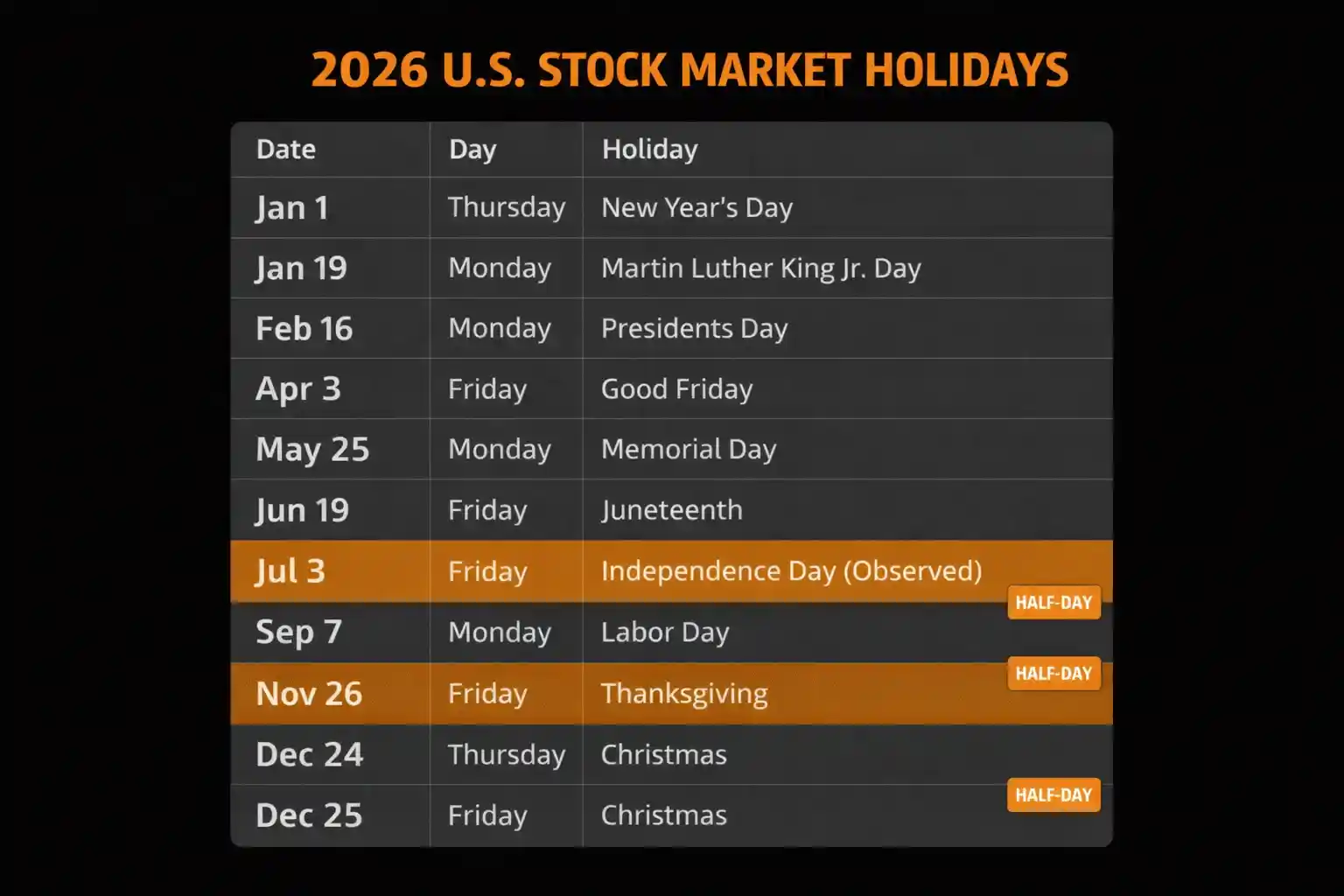
The NYSE and NASDAQ observe 10 full-day closures in 2026. On these days, regular trading is completely shut down. The exchange floors, both physical and electronic, go silent.
Date | Day | Holiday |
January 1 | Thursday | New Year’s Day |
January 19 | Monday | Martin Luther King Jr. Day |
February 16 | Monday | Washington’s Birthday (Presidents’ Day) |
April 3 | Friday | Good Friday |
May 25 | Monday | Memorial Day |
June 19 | Friday | Juneteenth National Independence Day |
July 3 | Friday | Independence Day (Observed) |
September 7 | Monday | Labor Day |
November 26 | Thursday | Thanksgiving Day |
December 25 | Friday | Christmas Day |
A few things worth flagging. Independence Day itself falls on Saturday, July 4, so the observed closure shifts to Friday, July 3. Good Friday is not a federal holiday, but U.S. stock exchanges have traditionally closed for it. The bond market, guided by the SIFMA (Securities Industry and Financial Markets Association) calendar, follows a slightly different schedule with additional closures and early-close days beyond what the equity exchanges observe.
Early Close and Half-Day Sessions 2026
Beyond full closures, the NYSE and NASDAQ also run shortened trading sessions where markets close at 1:00 PM Eastern Time instead of the usual 4:00 PM. These half-days often fly under the radar, but they matter. Trading volume tends to thin out significantly, which can widen bid-ask spreads and make execution less predictable.
In 2026, there are two scheduled early-close days:
Date | Day | Reason | Closing Time |
November 27 | Friday | Day After Thanksgiving | 1:00 PM ET |
December 24 | Thursday | Christmas Eve | 1:00 PM ET |
If you’re planning to execute meaningful trades on these days, consider getting your orders in during the morning session while there’s still reasonable volume.
With closures and half-days accounted for, let’s walk through the full year month by month to see how your trading calendar actually shapes up.
Trading Calendar 2026: Month-by-Month Overview
Looking at the year in quarterly chunks helps you plan strategically rather than reactively. Each quarter has its own rhythm, shaped by where holidays fall and how weekends align with the calendar.
Q1 (January, February, March)
Total Q1 Trading Days: 61
January opens the year with 20 trading days after losing New Year’s Day and MLK Day. Markets typically see fresh capital flowing in as institutions reset allocations and individual traders kick off new-year strategies. The MLK Day closure on January 19 (a Monday) gives you a three-day weekend early in the month.
February is the leanest month of the quarter at 19 days. Presidents’ Day on February 16 creates another Monday closure and long weekend. This tends to be a transition month as Q4 earnings season winds down.
March delivers the most trading days of the quarter at 22, with no market holidays. It’s a straight shot of uninterrupted weekday trading, making it well suited for executing longer-duration strategies or catching up if the first two months underperformed.
Q2 (April, May, June)
Total Q2 Trading Days: 62
April opens with a Good Friday closure on April 3, handing you a long weekend right at the top of the month. With 21 trading days remaining, April tends to be active as Q1 earnings season ramps up.
May offers 20 trading days, with Memorial Day falling on May 25 (Monday). The “Sell in May” crowd starts making noise, but your practical focus should be this: Memorial Day weekend often marks a noticeable shift in trading volume patterns as summer approaches.
June rounds out Q2 with 21 trading days. Juneteenth falls on Friday, June 19, creating a long weekend mid-month. June also brings quarterly rebalancing activity from index funds and institutional portfolios, particularly around the Russell Reconstitution (scheduled for June 26 in 2026).
Q3 (July, August, September)
Total Q3 Trading Days: 64
July offers 22 trading days despite the Independence Day observance on Friday, July 3. That Friday closure gives you a long weekend heading into what’s typically a slower summer stretch. July also kicks off Q2 earnings season, so expect pockets of heightened activity around major reports.
August delivers 21 trading days with no market holidays at all. It’s a full, unbroken stretch of trading, though volume historically tends to dip as many traders and institutional managers take summer vacations. Don’t mistake the quiet for a lack of opportunity, but do factor thinner liquidity into your position sizing.
September brings 21 trading days with Labor Day on September 7 (Monday) as the sole closure. After Labor Day, many traders consider the “real” trading year to resume, with institutional activity picking back up significantly through the fall.
Q4 (October, November, December)
Total Q4 Trading Days: 64
October is another clean month: 22 trading days, no market holidays. It’s often one of the most volatile months historically, and with maximum trading days available, you have plenty of room to maneuver.
November drops to 20 trading days thanks to Thanksgiving on November 26 (Thursday). Don’t overlook the early close on November 27 (Friday) either. Thanksgiving week typically sees declining volume starting around Tuesday, and the Friday session is notoriously light. Many traders effectively treat this as a half-week.
December gives you 22 trading days on paper, but December 24 (Thursday) is an early close and Christmas Day on December 25 (Friday) is a full closure. The final stretch between Christmas and New Year’s is known for very low volume, as many participants have already closed their books. Tax-loss harvesting and year-end rebalancing activity tend to concentrate in the first three weeks of the month.
With the U.S. calendar covered, let’s turn to what’s happening across the Atlantic and beyond.
Global Market Trading Days 2026
If you only trade U.S. stocks, the NYSE calendar is all you need. But if you hold international positions, trade ADRs, or follow global macro trends, you need to know when other major exchanges go dark. This is especially true on days when the U.S. market is open but London or Tokyo is not, and vice versa.
London Stock Exchange (LSE) Holidays 2026
The LSE observes 8 full-day closures and 2 half-day sessions in 2026. Regular trading hours are 8:00 AM to 4:30 PM GMT (London time). Early-close sessions end at 12:30 PM GMT.
Full Closures:
Date | Day | Holiday |
January 1 | Thursday | New Year’s Day |
April 3 | Friday | Good Friday |
April 6 | Monday | Easter Monday |
May 4 | Monday | Early May Bank Holiday |
May 25 | Monday | Spring Bank Holiday |
August 31 | Monday | Late Summer Bank Holiday |
December 25 | Friday | Christmas Day |
December 28 | Monday | Boxing Day (Substitute) |
Early-Close Sessions (12:30 PM GMT):
- December 24 (Thursday) – Christmas Eve
- December 31 (Thursday) – New Year’s Eve
One key detail: Boxing Day (December 26) falls on a Saturday in 2026, so the substitute bank holiday shifts to Monday, December 28. The LSE also closes for Easter Monday, which U.S. exchanges do not observe. That means on April 6, the NYSE and NASDAQ are open while London is closed, creating a gap for cross-market traders to watch.
Key International Market Closures
Beyond the U.S. and UK, here are some notable closures on other major global exchanges worth keeping on your radar:
Tokyo Stock Exchange (TSE): The TSE has approximately 20 market holidays in 2026, making it one of the most holiday-heavy major exchanges. Key closures include an extended New Year break (January 1-3), Golden Week in late April to early May (a cluster of four national holidays), and multiple standalone holidays throughout the year including Vernal Equinox Day, Marine Day, Mountain Day, and more. The TSE’s trading hours are 9:00 AM to 3:25 PM JST (Japan Standard Time) with a midday break.
Hong Kong Stock Exchange (HKEX): The HKEX observes around 14 full market closures in 2026, including Lunar New Year (multiple days in February), Ching Ming Festival, Buddha’s Birthday, and several other cultural holidays not shared with Western exchanges.
Frankfurt Stock Exchange (Xetra): Germany’s primary exchange follows a calendar similar to the LSE but adds closures for Whit Monday and a few other European-specific holidays.
For traders operating across time zones, the critical takeaway is this: there will be multiple days in 2026 where one major market is open while another is closed. These mismatches can trigger unusual price gaps when the closed market reopens, particularly if significant news breaks during the closure.
With the full global picture in hand, let’s talk about why all these closures matter beyond simply knowing when to set your alarm.
How Market Holidays Affect Your Trading
A holiday is a disruption to the normal flow of orders, liquidity, and price discovery. Understanding how these disruptions ripple through your trading helps you sidestep common pitfalls and position yourself more effectively around closures.
Liquidity and Volatility Around Holidays
In the days leading up to a market holiday, especially multi-day closures like Thanksgiving or Christmas, trading volume often drops noticeably. Many institutional traders and portfolio managers close or reduce positions before the break to avoid holding risk over the closure. This pullback in participation has a few practical effects worth understanding.
First, bid-ask spreads tend to widen. With fewer buyers and sellers active, the gap between what someone is willing to pay and what someone is willing to sell for grows. That means your market orders may fill at less favorable prices. Second, price moves can be more erratic. It takes less buying or selling pressure to push a stock when there’s thin volume behind it. A headline that would normally cause a 0.5% move on a busy Tuesday might trigger a 1-2% swing on the Wednesday before Thanksgiving.
The day after a holiday, or the day a market reopens after a multi-day break, can be equally unpredictable. News that accumulated during the closure needs to be priced in all at once, which often leads to gaps at the open.
It’s also worth noting that futures and forex markets operate on different schedules than equity exchanges. Futures on major indices (like S&P 500 E-minis) may have modified hours on some holidays even when the stock exchange is fully closed. Forex markets trade 24 hours a day during weekdays and don’t observe most national holidays, though liquidity can still thin around major global holidays. Cryptocurrency markets, of course, never close. But that doesn’t mean holiday periods have no effect on crypto. Reduced participation from institutional traders during traditional market holidays can still influence crypto volumes.
Planning Your Trading Schedule Around Closures
The most practical thing you can do with this calendar is use it proactively rather than reactively. Here are some ways to put it to work:
- Review open positions before long weekends. If you’re holding short-term trades or leveraged positions, decide in advance whether you’re comfortable carrying that risk over a three-day (or longer) break. Overnight risk becomes “over-weekend” risk, which becomes “over-holiday” risk.
- Adjust your order management. Any limit or stop orders you have in place will sit idle during market closures. They won’t execute until the market reopens, and the reopening price may gap past your stop level entirely. Be aware of this exposure.
- Front-load your activity in holiday-shortened weeks. If you know volume is going to evaporate by Wednesday afternoon of Thanksgiving week, do your important trading earlier in the week when liquidity is still normal.
- Watch for post-holiday volatility. The first hour of trading after a market holiday is often one of the most active and volatile windows. If you don’t have a plan for how to handle that, consider sitting on the sidelines until the initial repricing settles.
- Use the quiet periods for planning. Market holidays are excellent opportunities to review your trading journal, reassess your strategy, and prepare for the next active stretch. The market will always be there when it reopens.
The goal is to respect market holidays’ impact on how the market behaves and factor that into your routine.
Frequently Asked Questions


Comments