


Most traders who try scalping quit within weeks because they dive in without a plan, stare at a 1-minute chart drowning in noise, and start clicking buttons on instinct.
Scalping trading is one of the fastest and most punishing styles in the markets. You’re in and out of trades within seconds or minutes, harvesting small price moves again and again. Done right, with clear rules, the right timeframe, and indicators you genuinely understand, it becomes a repeatable process. Done poorly, it’s the fastest way to drain an account.
This guide breaks down how scalping works in practice. You’ll find specific timeframe guidance, indicator setups with real parameter values, two step-by-step strategies you can test in your next session, and the risk management rules that keep scalpers solvent long enough to actually improve.
Disclaimer: This content is for educational purposes only and does not constitute financial advice. Trading involves significant risk of loss. Never trade with money you can’t afford to lose, and always practice on a demo account before risking real capital.
What Is Scalping Trading and Why Do Traders Choose It
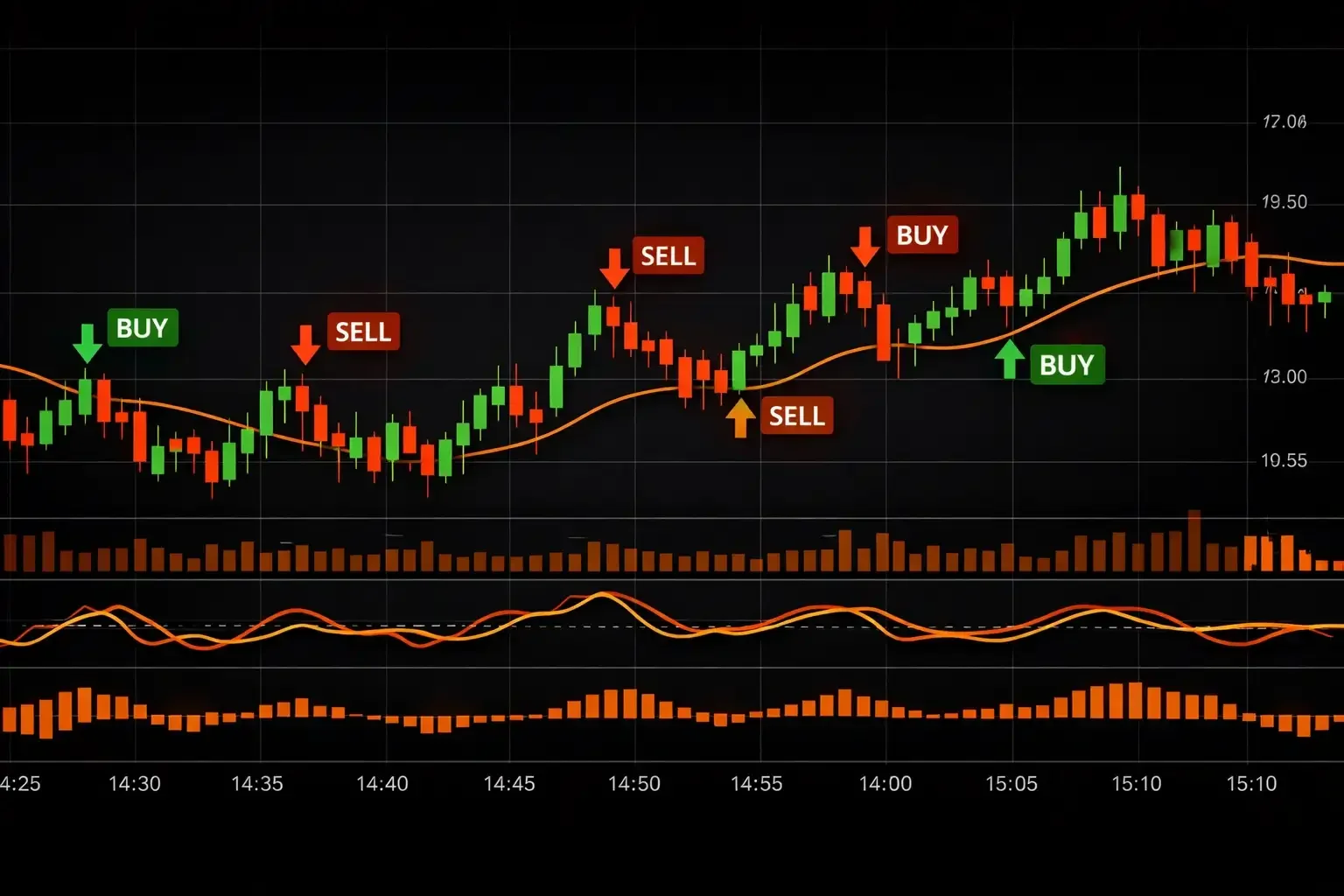
Scalping is about extracting small, consistent profits from tiny price movements. You hold positions for seconds to minutes, reading short-term momentum, getting in, grabbing a few pips or ticks, and getting out before the market turns against you.
Each session hands you dozens of opportunities. You stay actively engaged, making decisions in real time, and your exposure window stays razor-thin. Surprise news events and overnight gaps rarely catch you off guard.
But that speed comes at a cost. Scalping demands intense focus, fast execution, and airtight risk management. One careless trade can wipe out ten good ones. Understand that trade-off clearly before you go any further.
How Scalping Differs from Day Trading and Swing Trading
The boundaries between these styles blur easily, so let’s draw them sharply.
- Scalping: Trades last seconds to minutes. You target 3–10 pips per trade in forex (or equivalent in other instruments). You might take 15–50+ trades in a single session. You use 1-minute, 5-minute, or tick charts.
- Day trading: Trades last minutes to hours. You target 20–100+ pips per trade. You might take 2–8 trades per day. You typically use 5-minute to 1-hour charts.
- Swing trading: Trades last days to weeks. You target larger moves (100+ pips). You take a handful of trades per week. You use 1-hour to daily charts.
The real distinction is how you structure risk. Scalpers accept a smaller reward per trade but compensate with volume and a higher win rate. Day traders and swing traders take fewer positions but chase bigger individual payoffs. Neither approach is inherently superior. They suit different personalities, schedules, and risk tolerances.
Who Scalping Is Best Suited For
Scalping isn’t for everyone, and there’s nothing wrong with that. You’re likely a good fit if you can hold focus for extended stretches without drifting, make rapid decisions without second-guessing yourself, and absorb losing streaks without going on tilt.
You’re probably not suited for scalping if you tend to overtrade when frustrated, struggle with screen fatigue, or prefer to study trades carefully before committing. Scalping also demands a platform with fast execution and low spreads, which rules out some brokers entirely.
Be honest with yourself here. The best scalping strategy ever designed won’t save you if your temperament clashes with the pace.
So what’s the first practical decision you need to make? Choosing your timeframe.
Best Timeframes for Scalping
Choosing the wrong timeframe is the most common early mistake in scalping. Pick one that’s too fast and you’re drowning in noise. Pick one that’s too slow and you’re not really scalping anymore; you’re day trading with tighter stops. Understanding what each timeframe offers, and what it costs, is the foundation everything else builds on.
The 1-Minute Chart: Speed, Noise, and When It Works
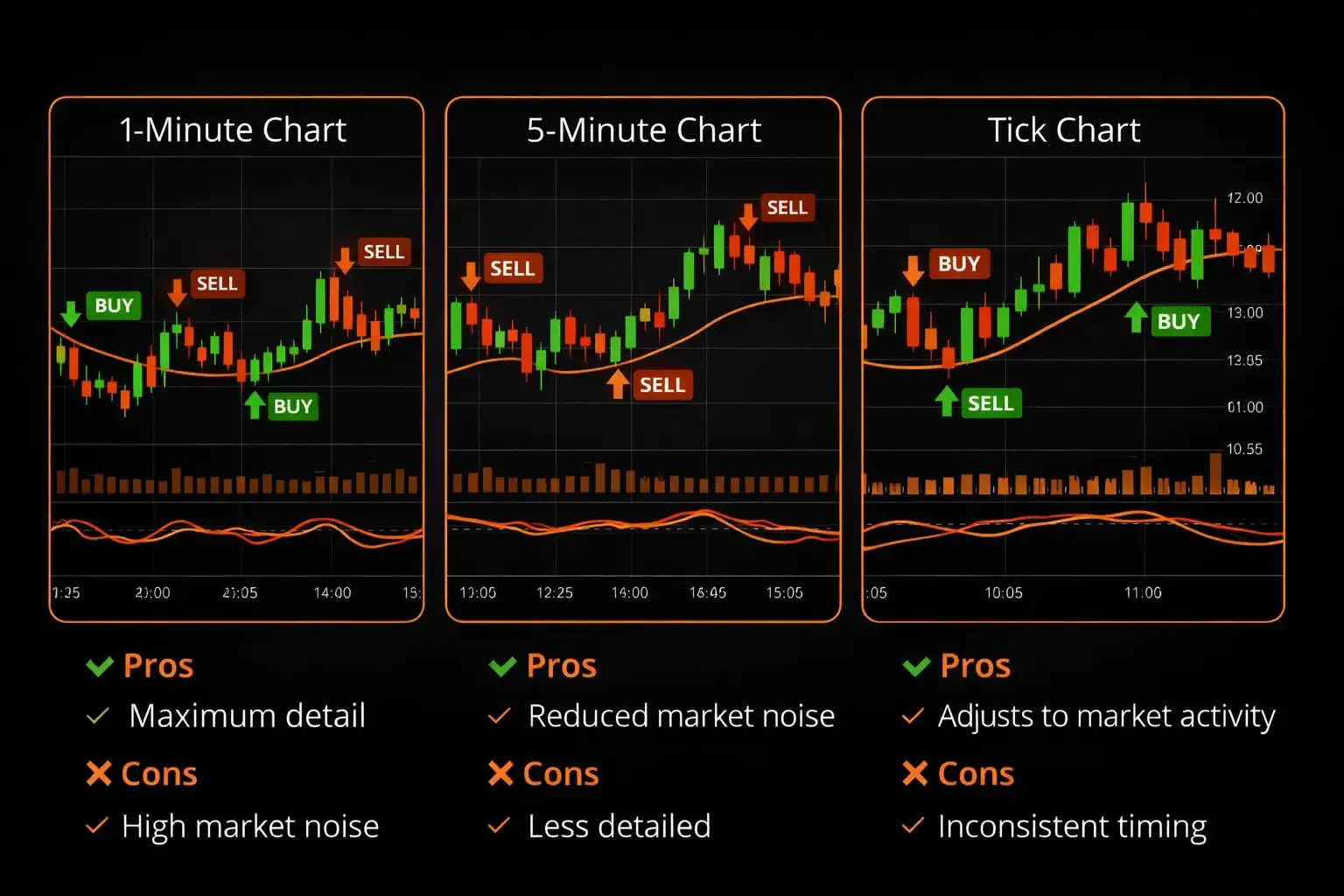
The 1-minute chart is the classic scalping timeframe, and for good reason. It delivers the most trade opportunities per session and lets you catch very short-term momentum shifts before they surface on higher timeframes.
Here’s the catch: 1-minute charts are noisy. Every random tick, every minor order flow fluctuation, shows up as its own candle. Without a clear system for filtering that noise, you’ll spend the entire session chasing phantom signals.
The 1-minute chart works best when you combine these conditions:
- You’re trading during high-liquidity periods (the London and New York session overlap, roughly 8:00 AM to 12:00 PM EST for forex)
- You’re on major pairs like EUR/USD or GBP/USD where spreads are tightest
- You pair it with at least one confirmation indicator to filter entries
Outside of peak hours, the 1-minute chart becomes unreliable. Spreads widen, price action turns choppy, and your win rate drops noticeably.
The 5-Minute Chart: The Balance Between Speed and Clarity
If the 1-minute chart is a firehose, the 5-minute chart is a focused stream. You still get plenty of scalping opportunities, but each candle carries more meaningful price information. That translates to fewer false signals, cleaner setups, and more breathing room before you commit.
For beginner and intermediate scalpers, the 5-minute chart is usually the stronger starting point. You’ll take fewer trades per session (perhaps 5–15 instead of 20–50), but your accuracy tends to improve because you’re not reacting to every minor fluctuation.
The 5-minute chart also holds up better during moderate-liquidity periods. You can scalp the London session open or the New York session with reasonable results, even outside the overlap window.
Tick Charts: What They Are and When to Use Them
Tick charts form a candle every N transactions (for example, every 133 ticks or every 233 ticks). Think of them as a heartbeat monitor for the market: when activity surges, candles form rapidly; when things quiet down, they slow to a crawl.
This makes tick charts particularly effective at filtering out dead zones. During low-activity stretches, you simply don’t get new candles, so you’re not tempted to trade noise. During high-activity bursts, you get granular data that time-based charts might compress into a single candle.
Tick charts see the most use in futures markets (especially the E-mini S&P 500 and Nasdaq futures) and require platforms that support tick data feeds. MT4’s native tick chart support is limited, so you’d typically need a platform like NinjaTrader or Sierra Chart for proper tick-based scalping.
For most retail forex scalpers, tick charts are an advanced tool, not a starting point.
How to Choose the Right Scalping Timeframe
Here’s a practical decision framework:
- Choose 1-minute if you’re experienced with fast execution, trade during peak liquidity hours, and want maximum trade frequency.
- Choose 5-minute if you’re newer to scalping, prefer fewer but cleaner setups, or trade during moderate-liquidity sessions.
- Choose tick charts if you trade futures, have a platform that supports tick data, and want activity-based rather than time-based analysis.
Start with the 5-minute chart. If it feels too slow after a few weeks of steady practice, step down to the 1-minute. If you’re trading futures and want to explore further, experiment with tick charts on a demo account first.
Now that you know which chart to look at, the next question is what to put on it.
Best Indicators for Scalping
Indicators are where most aspiring scalpers lose their way. They stack five or six on a chart, get conflicting signals, and freeze. Or worse, they cherry-pick the one signal that confirms what they already want to do.
The goal is to use two or three indicators that complement each other and hand you a clear yes-or-no decision on every setup.
Moving Averages for Scalping Entries and Exits
Moving averages serve as your trend filter. On a scalping chart, they reveal the short-term direction so you’re not fighting momentum.
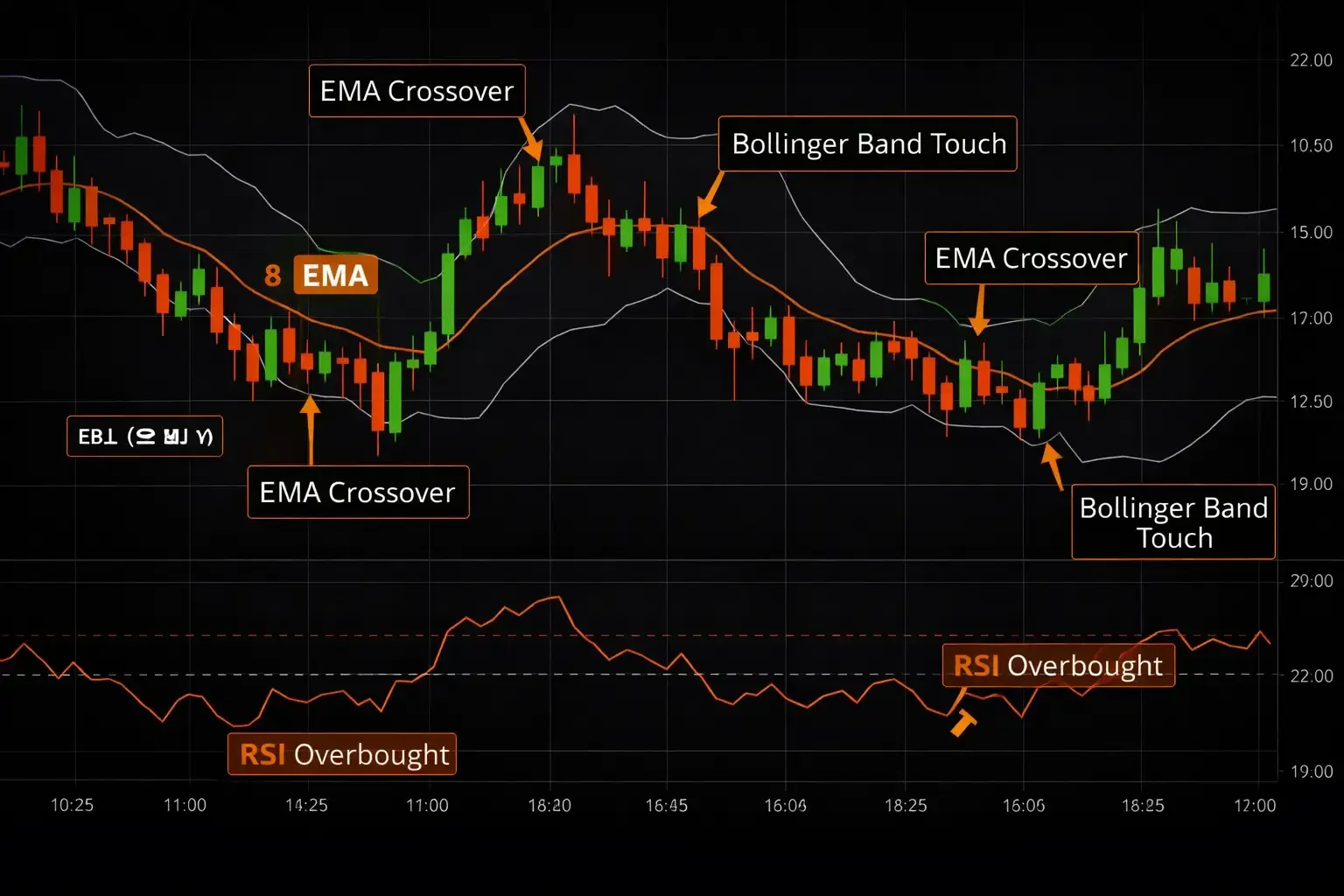
For scalping, exponential moving averages (EMAs) respond faster than simple moving averages (SMAs), which makes them the better fit. A proven and effective pairing:
- 8-period EMA (fast line): Tracks immediate price momentum
- 21-period EMA (slow line): Tracks the short-term trend
When the 8 EMA sits above the 21 EMA, you look for long entries only. When it sits below, shorts only. The crossover itself can also act as a signal, but on 1-minute charts, crossover signals alone produce too many false entries. You’ll want additional confirmation.
RSI and Stochastic for Overbought/Oversold Scalping Signals
The Relative Strength Index (RSI) and the Stochastic Oscillator are momentum indicators that help you identify when a short-term move has likely exhausted itself.
For scalping:
- RSI settings: Period 7 (faster than the default 14). Overbought level at 80, oversold level at 20. On a 1-minute chart, default RSI (14) reacts too slowly to catch scalping-speed reversals.
- Stochastic settings: %K period 5, %D period 3, slowing 3. Overbought at 80, oversold at 20.
These confirm entries rather than generate them. For example, if your EMAs point to a short-term downtrend and RSI is climbing above 80, that’s a potential short entry. The indicator reinforces the directional bias you’ve already established from the moving averages.
VWAP and Bollinger Bands for Mean Reversion Scalping
Mean reversion scalping rests on a straightforward idea: price tends to snap back to an average after short-term extremes. Two tools make this approach workable.
VWAP (Volume Weighted Average Price) shows the average price weighted by volume for the current session. Institutional traders watch VWAP closely, which turns it into a natural magnet for price. When price pushes well above VWAP, a short scalp back toward it carries a statistical edge, and vice versa.
Bollinger Bands (settings: 20 period, 2 standard deviations) build a dynamic envelope around price. When a candle touches or pierces the upper band during a range-bound market, it flags a potential short scalp. A touch of the lower band flags a potential long.
The critical nuance is that mean reversion scalping only holds up in ranging or low-trend conditions. If the market is trending hard, price will ride the bands and VWAP will lag behind, leaving you fading a trend and absorbing repeated losses.
Scalping Indicator Setups for MT4
If you’re using MetaTrader 4, here’s how to configure a practical scalping indicator layout:
- Add EMA (8): Insert > Indicators > Trend > Moving Average. Set period to 8, method to Exponential, apply to Close. Color it blue or green.
- Add EMA (21): Same path. Set period to 21, method to Exponential. Color it red or orange.
- Add RSI (7): Insert > Indicators > Oscillators > Relative Strength Index. Set period to 7. Adjust overbought/oversold levels to 80/20.
- Add Bollinger Bands (20, 2): Insert > Indicators > Trend > Bollinger Bands. Period 20, deviation 2.
Save this as a template (Chart > Template > Save Template) so you can apply it instantly to any chart. Keep your chart clean: use a dark background with high-contrast candle colors, and strip away any elements that don’t directly inform your entry or exit decisions.
With your indicators configured, let’s build the actual strategies.
1-Minute Scalping Strategy (Step-by-Step)
This strategy pairs trend direction with momentum confirmation. It’s built for high-liquidity sessions and performs best on major forex pairs. Avoid using it during Asian session hours or around major news releases; the noise will overwhelm your signals.
Entry Rules
For a long entry:
- The 8 EMA must be above the 21 EMA (confirming short-term uptrend).
- Price pulls back to touch or come within 1–2 pips of the 8 EMA.
- RSI (7) reads between 30–50 during the pullback (confirming the pullback isn’t a reversal).
- Enter long when a bullish candle closes above the 8 EMA after the pullback.
For a short entry:
- The 8 EMA must be below the 21 EMA (confirming short-term downtrend).
- Price pulls back up toward the 8 EMA.
- RSI (7) reads between 50–70 during the pullback.
- Enter short when a bearish candle closes below the 8 EMA after the pullback.

Exit Rules and Stop-Loss Placement
- Stop-loss: Place your stop 3–5 pips beyond the 21 EMA (above for shorts, below for longs). This gives the trade room to breathe without exposing you to outsized risk.
- Take-profit: Target 5–8 pips, or exit when price reaches the opposite Bollinger Band if you have bands on the chart.
- Time stop: If the trade hasn’t moved in your favor within 3–5 candles (3–5 minutes), close it at market. Stalled trades tie up both your capital and your focus.
Your risk-to-reward ratio on this strategy typically runs around 1:1.5 to 1:2. That’s workable for scalping because a well-executed version of this setup can produce a win rate around 55–60%, though your individual results will depend heavily on market conditions and execution quality.
When to Avoid This Strategy
Stay flat during these conditions:
- First and last 15 minutes of a major session (spreads spike, liquidity behaves erratically)
- During or within 5 minutes of high-impact news events (NFP, FOMC, CPI releases)
- When the 8 and 21 EMA are nearly flat and tangled together (no clear trend direction)
- When your spread exceeds 1.5 pips on your trading pair
If you’re uncertain whether conditions are right, they’re not.
How does the picture change when you slow down just slightly? Let’s look at the 5-minute version.
5-Minute Scalping Strategy (Step-by-Step)
The 5-minute strategy follows the same core logic but gives you more room to operate. Signals are cleaner, false entries drop off, and you have more time to assess before pulling the trigger. This is where most intermediate scalpers find their rhythm.
Entry Rules
For a long entry:
- The 8 EMA is above the 21 EMA on the 5-minute chart.
- Price touches or bounces off the lower Bollinger Band (20, 2) while the EMAs still tilt upward.
- Stochastic (%K 5, %D 3, slowing 3) crosses upward from below the 20 level.
- Enter long on the candle close following the Stochastic crossover.
For a short entry:
- The 8 EMA is below the 21 EMA.
- Price touches or bounces off the upper Bollinger Band.
- Stochastic crosses downward from above the 80 level.
- Enter short on the candle close following the Stochastic crossover.

Exit Rules and Stop-Loss Placement
- Stop-loss: Place your stop 7–10 pips beyond the entry candle’s high (for shorts) or low (for longs).
- Take-profit: Target 10–20 pips, or exit when price reaches the middle Bollinger Band (the 20-period moving average).
- Trailing option: Once the trade moves 8+ pips in your favor, you can trail your stop to breakeven and let the position run toward the opposite band.
This setup naturally yields a stronger risk-to-reward ratio than the 1-minute strategy (often 1:2 or better), which means you can remain profitable with a win rate around 45–50%, provided you manage entries and exits consistently.
When to Avoid This Strategy
- During very low volatility when the Bollinger Bands are tightly compressed (this signals a potential breakout, not a mean reversion opportunity)
- When EMAs are flat and crisscrossing repeatedly (no trend to lean on)
- During major economic announcements
- Late in the trading session when volume is thinning out
Both the 1-minute and 5-minute strategies depend on you respecting the market’s rhythm. But what if you want to trade based on activity rather than time? That’s where tick scalping enters the picture.
Tick Scalping: How It Works in Practice
Tick scalping removes the time element entirely and zeroes in on pure market activity. It’s a different lens for reading price, and for certain instruments and conditions, it surfaces patterns that time-based charts obscure completely.
Setting Up Tick Charts
To use tick charts, you need a platform that supports tick data. NinjaTrader and Sierra Chart are the most widely used options for futures scalping. In these platforms, you select a tick count for your chart. Common choices include:
- 133 ticks or 233 ticks for the E-mini S&P 500 (ES)
- 144 ticks (Fibonacci-based) for Nasdaq futures (NQ)
- 89 ticks for faster, more granular analysis
The tick count you choose determines how many transactions build each candle. Lower counts give you finer detail (more candles, faster updates), while higher counts smooth the data out.
Your indicator setup on tick charts can mirror what you’d use on time-based charts. EMAs, Bollinger Bands, and volume-based indicators all translate. The key difference is that your signals will compress during active stretches and spread out during quiet ones.
Reading Price Action on Tick Data
On tick charts, watch how quickly candles form. Rapid formation means high activity, and that means your signals carry more weight because real volume is driving the moves. When candle formation slows to a trickle, the market is quiet and you should step back.
Volume spikes on tick charts are especially telling. A sudden burst of large-bodied candles with heavy volume often precedes a directional move. If your trend indicators align with that volume spike, you’re looking at a high-conviction scalp entry.
One important caveat: tick data feeds can vary between brokers and platforms. What you see on one platform may not match another exactly. Stick with one platform consistently and learn its behavior rather than bouncing between data sources.
Regardless of which timeframe or chart type you choose, none of it holds together without disciplined risk management.
Risk Management Rules for Scalpers
Here’s the uncomfortable truth that separates surviving scalpers from blown accounts: your strategy’s edge is thin. You’re targeting a few pips per trade with a win rate that might sit around 55–65%. That edge only compounds into real returns when your risk management is airtight. A single oversized loss or one revenge trade can wipe out an entire session’s gains.
Position Sizing for Scalping
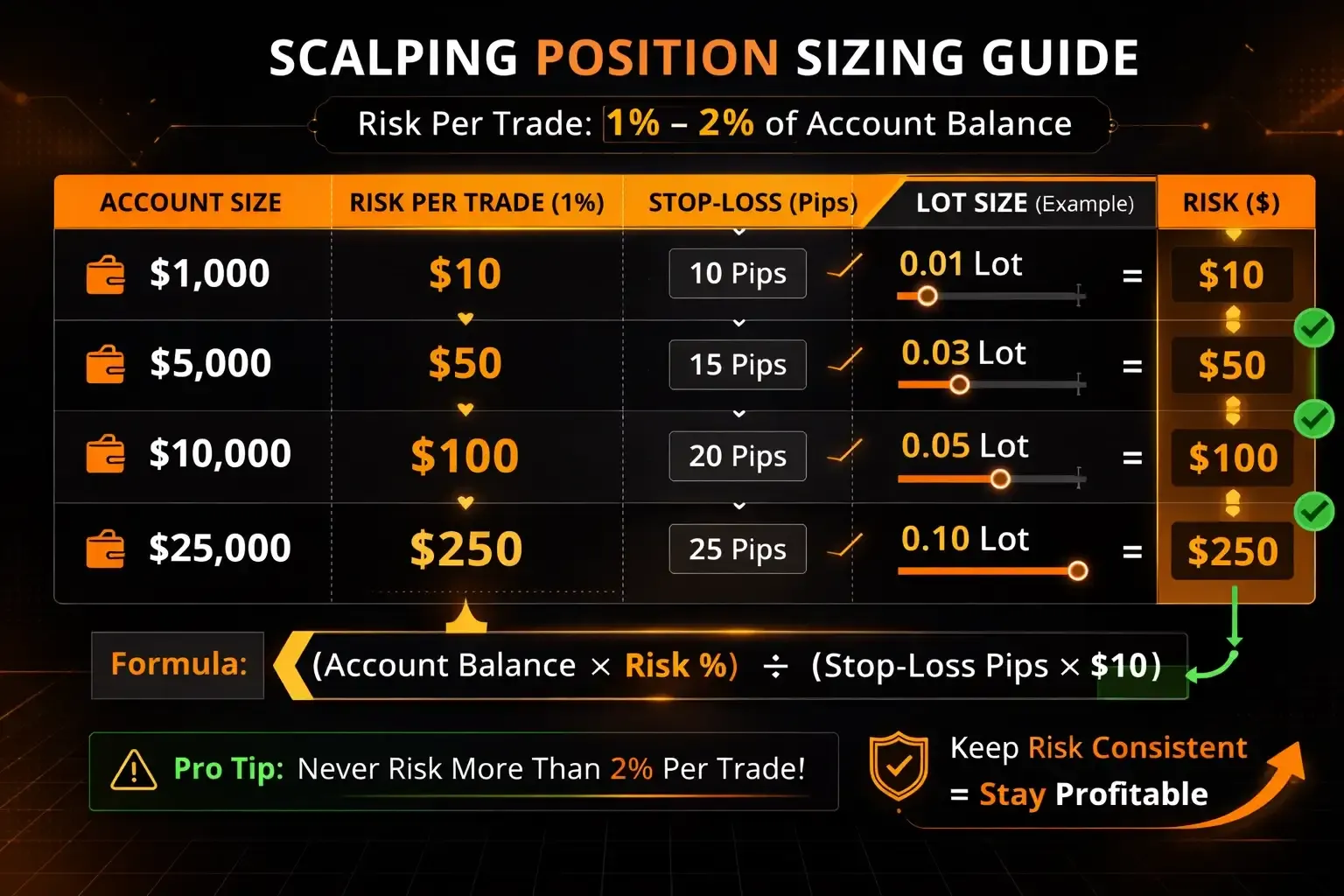
The golden rule is to risk no more than 0.5–1% of your account per trade. For scalping, staying closer to 0.5% is the wiser choice because you’re placing many trades per session, and a string of losses compounds quickly.
Here’s what that looks like in practice:
Account Size | Risk Per Trade (0.5%) | Stop-Loss (5 pips) | Approximate Lot Size (Forex) |
$1,000 | $5 | 5 pips | 0.10 lots (mini) |
$5,000 | $25 | 5 pips | 0.50 lots |
$10,000 | $50 | 5 pips | 1.00 lot (standard) |
$25,000 | $125 | 5 pips | 2.50 lots |
Calculate your lot size before every trade based on your stop distance. Never adjust it mid-trade, and never add to a losing position.
Managing Losses and Drawdowns in Fast Markets
Set a daily loss limit and honor it without exception. A widely used rule is to stop trading for the day if you lose 2–3% of your account, or after three consecutive losing trades, whichever hits first.
Why three consecutive losses? Because by the third loss, your mental state has shifted: you’re trading your frustration. Walking away at that point is likely the most profitable decision you’ll make on a losing day.
Track your performance by session, too. Many scalpers discover they perform well during certain hours and poorly during others. If you consistently bleed money during the New York afternoon, stop trading it. Your edge is time-dependent, and your risk management approach should reflect that reality.
Common Scalping Mistakes and How to Avoid Them
Every scalper stumbles early on. What separates those who last from those who don’t is how fast they spot and correct these patterns.
Overtrading out of boredom. No setup means no trade. Watching the screen without clicking is itself a skill. The market doesn’t owe you an entry every five minutes.
Ignoring the spread. If your target is 5 pips and your spread is 2 pips, you need a 7-pip move just to reach your target. On pairs with spreads above 1.5 pips, tight scalping becomes mathematically hostile. Always fold the spread into your profit calculations.
Moving your stop-loss. This is the single fastest route to blowing up a scalping account. Your stop was placed for a reason. If price reaches it, you were wrong. Take the small loss and move on to the next setup.
Failing to adapt to market conditions. A strategy that hums during the London open can fall apart in a low-volume afternoon. When conditions shift, your activity level should shift with them, often down to zero.
Revenge trading after losses. After a losing trade, the impulse is to jump straight back in and “make it back.” This almost invariably leads to a worse entry, a bigger loss, and a downward spiral. Follow your daily loss limit rules.
Neglecting to journal trades. You can’t improve what you don’t track. Even a bare-bones spreadsheet logging entry time, pair, direction, result, and a brief note on your reasoning will expose patterns invisible in the moment.
These mistakes reflect that the human side of trading needs as much development as the technical setup. Consistency comes from building habits, not just strategies.
Frequently Asked Questions


Comments