


Algorithmic trading was once the exclusive province of hedge funds and Wall Street quant desks. Over time, it has steadily filtered down to retail traders like you, propelled by accessible platforms, richer data, and tools that no longer demand a computer science degree to operate.
This guide breaks down exactly how algorithmic trading works, walks you through the core strategies behind most automated systems, lays out the software landscape so you can evaluate your options, and gives you a realistic framework for building your first algorithm.
Disclaimer: This article is educational content, not financial advice. Algorithmic trading carries a real risk of financial loss, and past backtested performance does not guarantee future results. Always do your own research and consider your risk tolerance before deploying capital.
What Is Algorithmic Trading?
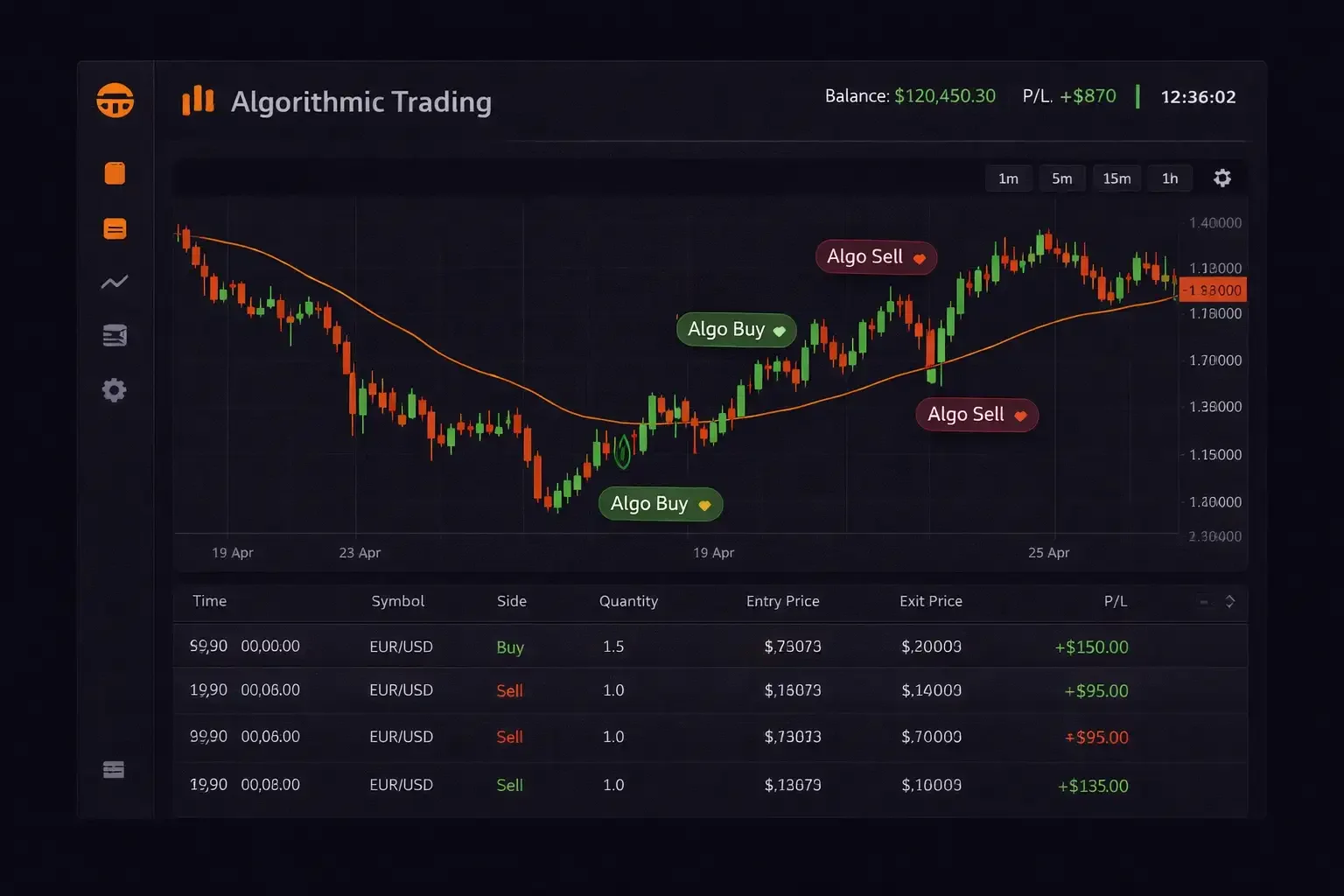
Algorithmic trading is the use of computer programs to execute trades based on a pre-defined set of rules. Those rules can be as simple as “buy when the 50-day moving average crosses above the 200-day” or as layered as a multi-factor model weaving together volatility, volume, sentiment, and price momentum.
The key distinction is that algorithmic trading is not just placing a limit order or setting a stop-loss. Those are basic order automation features your broker already offers. True algo trading involves the system analyzing data, reaching a decision, and acting on it, all without you hovering over the screen.
Think of it like the difference between cruise control and a self-driving car. Cruise control holds your speed (basic automation). A self-driving system reads the road, adjusts for traffic, decides when to brake, and routes around obstacles (algorithmic execution). Your algorithm reads the market, interprets signals, decides when to act, and manages risk on its own.
How Algorithmic Trading Works (Order Execution Flow)
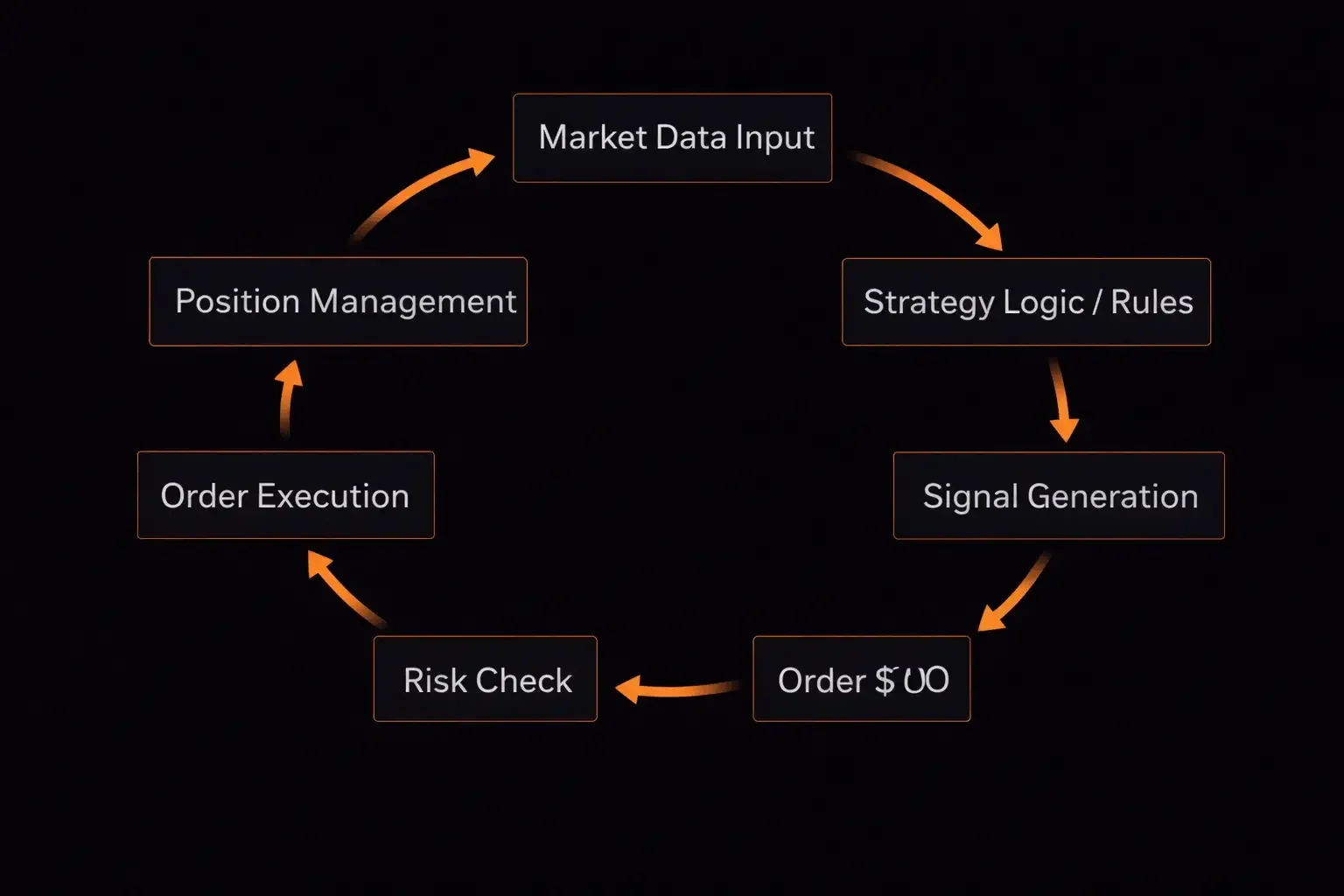
Understanding the mechanics strips away most of the mystery. Every algorithmic trading system follows a core loop, regardless of how sophisticated the strategy gets.
- Market data input: The system receives real-time or historical price data, volume, order book depth, and sometimes alternative data like news feeds.
- Strategy logic and rules: Your algorithm applies its decision-making criteria to the incoming data. This is where your strategy lives: the conditions that trigger a buy, sell, or hold.
- Signal generation: When market conditions match your rules, the system produces a trading signal.
- Order execution: The signal triggers an order sent to your broker, specifying the instrument, direction, size, and order type.
- Risk check: Before or during execution, the system validates the order against risk parameters (position size limits, maximum drawdown thresholds, exposure caps).
- Position management: Once in a trade, the algorithm monitors the position, managing exits, trailing stops, and adjustments according to its rules.
This entire loop can fire in milliseconds for high-speed systems, or unfold over minutes and hours for longer-timeframe strategies. The speed depends on your strategy and infrastructure, not on some universal requirement.
Algorithmic Trading vs. Manual Trading
The core difference boils down to consistency and speed. When you trade manually, every decision filters through your brain, your emotions, your fatigue level, and your biases. Some days you are razor-sharp. Other days you chase trades you know you should skip.
An algorithm does not have bad days. It follows the same rules whether the market is calm or chaotic. It will not revenge-trade after a loss or hesitate on a valid signal because the last three trades went against you.
That said, manual trading offers something algorithms cannot easily replicate: nuanced judgment. An experienced discretionary trader can read context (breaking news, unusual market structure, geopolitical shifts) in ways that rule-based systems often miss. For many retail traders, the most effective approach blends both worlds, using algorithms for execution discipline while keeping human oversight for broader context.
Who Uses Algorithmic Trading Today?
Algorithmic trading is not reserved for quant PhDs in Manhattan. Today, you will find it across a broad spectrum:
- Institutional firms and hedge funds use complex, high-speed algorithms handling massive order flow.
- Prop trading firms deploy algorithmic strategies across equities, futures, and forex, often providing capital to traders who can demonstrate systematic edge.
- Retail traders increasingly use off-the-shelf platforms or basic scripting to automate strategies on stocks, forex, and futures.
- Market makers rely on algorithms to provide liquidity and manage inventory risk.
The fastest-growing segment is retail. Platforms have lowered the barrier to entry significantly over the past five years, and you no longer need a Bloomberg terminal or a co-located server to participate.
So what is actually fueling this shift toward automation? The appeal runs deeper than convenience alone.
Why Traders Are Moving to Algorithmic Strategies
If manual trading works, why bother automating? Because the advantages of algorithmic execution are structural. Understanding them will help you decide whether this path deserves your time and effort.
Speed and Precision Advantages
Markets move in milliseconds. By the time you spot a setup, calculate your position size, and click the button, the price may have already shifted. An algorithm collapses that entire process into a fraction of a second.
Precision is another critical aspect. Your algorithm places orders at exactly the price level you specify, with exactly the position size your risk rules dictate, every single time.
For strategies that depend on tight entries and exits, like scalping or short-term momentum trading, this precision is the difference between a profitable edge and random noise.
Removing Emotional Decision-Making
Here is a painful truth most traders eventually learn: your biggest opponent in the market is yourself. Fear, greed, overconfidence, and loss aversion warp your decision-making in ways you often do not recognize until the damage is already done.
Algorithmic trading strips emotional interference from the execution process. Your rules are your rules. The system honors them regardless of whether you just had your best week ever or your worst drawdown.
This is about enforcing the discipline you already know matters but struggle to maintain when real money is on the line. You set the rules when your head is clear, and the algorithm holds the line when the market tries to shake you out.
Backtesting and Data-Driven Confidence
One of the most powerful advantages of algorithmic trading is the ability to test your strategy against historical data before risking a single dollar. This is backtesting, and it transforms strategy development from guesswork into a structured, evidence-based process.
Instead of trading a new idea with real capital and hoping it works, you can run it against years of market data to see how it would have performed. You can measure win rate, drawdown, risk-adjusted returns, and dozens of other metrics.
Backtesting gives you something invaluable: a rational basis for confidence. You are making informed decisions grounded in data, and that is a fundamentally different starting point than most manual traders ever reach.
With the “why” covered, the natural next question becomes “how.” What strategies actually power these algorithms? Let’s break down the main categories.
Core Algorithmic Trading Strategies
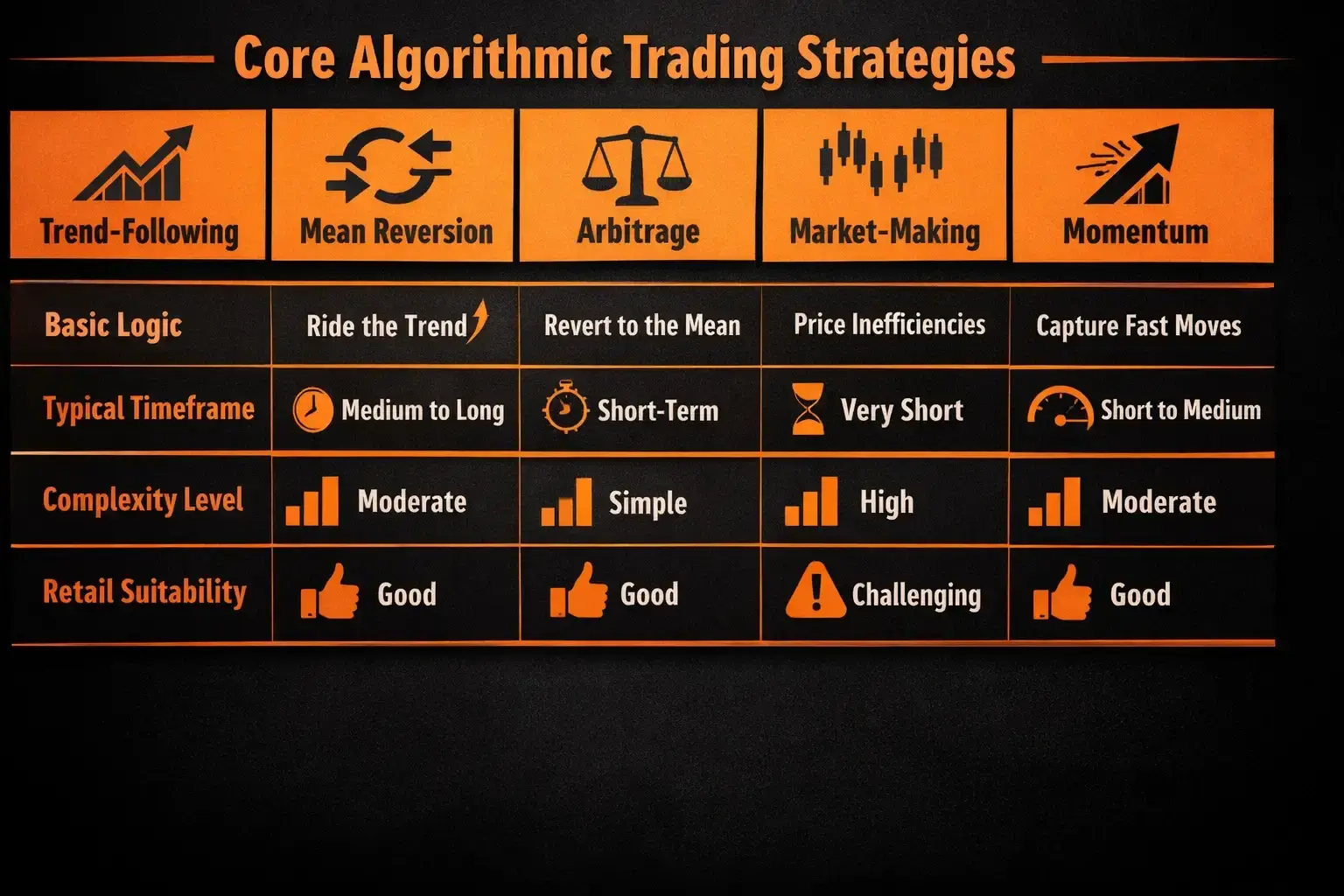
Not all algorithms do the same thing. The strategy driving your system determines everything, from the timeframe you trade to the market conditions where you thrive (or struggle). Here are the five core categories you will encounter most often, along with the logic behind each.
Trend-Following Strategies
The simplest concept in algo trading, and still one of the most widely deployed. Trend-following algorithms detect when an asset is moving in a sustained direction and ride that movement until the trend shows signs of exhaustion.
The underlying logic is intuitive: markets tend to continue in the direction they are already moving, at least for a while. Your algorithm monitors indicators like moving averages, breakouts from price ranges, or momentum measurements, and enters positions aligned with the prevailing trend.
- Typical timeframe: Medium to long-term (hours to weeks)
- Common indicators: Moving average crossovers, Donchian channels, ADX
- Retail accessibility: High; one of the easiest strategies to automate
- Key risk: Choppy, sideways markets generate false signals and repeated small losses (known as whipsaws)
Trend-following deliberately sacrifices the first and last portion of a move in exchange for capturing the middle. If you are comfortable with that trade-off, it is a solid starting point.
Mean Reversion Strategies
Where trend-following bets on continuation, mean reversion bets on the opposite: that prices tend to snap back toward an average or equilibrium after stretching too far in one direction.
Think of it like a rubber band. Pull it too far from center, and the tension eventually snaps it back. Mean reversion algorithms identify when an asset is statistically “stretched” beyond normal levels (overbought or oversold) and trade the expected return toward the mean.
- Typical timeframe: Short-term (minutes to days)
- Common indicators: Bollinger Bands, RSI, z-scores of price deviation
- Retail accessibility: Moderate; requires understanding of statistical norms
- Key risk: Trends can persist far longer than statistical models expect, and what looks “overbought” can keep climbing
This strategy performs best in range-bound or mean-reverting market regimes. In strong trending markets, mean reversion gets crushed. That is exactly why understanding when to deploy which strategy type matters so much.
Arbitrage Strategies
Arbitrage algorithms exploit price discrepancies between related instruments or markets. The textbook example: an asset trading at slightly different prices on two exchanges. The algorithm buys where it is cheap and sells where it is expensive, capturing the difference.
In practice, pure arbitrage opportunities are extremely rare and short-lived at the retail level, because institutional players with faster infrastructure snap them up first. However, related forms of statistical arbitrage (trading correlated instruments that temporarily diverge) are more within reach.
- Typical timeframe: Very short (seconds to minutes)
- Common approaches: Pairs trading, cross-exchange arbitrage, ETF vs. underlying basket
- Retail accessibility: Low for pure arbitrage; moderate for statistical arbitrage
- Key risk: Execution speed disadvantage against institutional competitors; transaction costs eating into thin margins
For retail traders, statistical arbitrage through pairs trading is the most realistic variant. Pure latency-based arbitrage remains largely an institutional game.
Market-Making Strategies
Market-making algorithms continuously place both buy and sell orders around the current price, profiting from the bid-ask spread. They provide liquidity to the market and earn small amounts on each transaction, relying on high volume to accumulate returns.
Picture running a currency exchange booth at an airport. You buy euros slightly below the market rate and sell them slightly above. You profit from the spread between your buy and sell prices, and you need consistent foot traffic (volume) to make it worthwhile.
- Typical timeframe: Continuous (milliseconds to seconds)
- Common approaches: Spread capture, inventory-based models
- Retail accessibility: Low; requires significant infrastructure and capital
- Key risk: Adverse selection (getting stuck holding inventory when prices move against you); demands very low latency
Market-making appears here for completeness, but it is generally not a realistic starting point for retail traders. It requires specialized infrastructure and a deep grasp of order flow dynamics.
Momentum and Statistical Strategies
Momentum strategies occupy similar territory to trend-following but operate differently in practice. Rather than riding a sustained trend, momentum algorithms look for short-term acceleration in price or volume and trade the continuation of that burst.
Statistical strategies go a step further, using quantitative models to surface patterns, correlations, or anomalies in price data that suggest a probabilistic edge.
- Typical timeframe: Short to medium-term (minutes to days)
- Common approaches: Relative strength, volume-weighted momentum, factor-based models
- Retail accessibility: Moderate; some platforms offer pre-built momentum indicators
- Key risk: Momentum can reverse abruptly (momentum crashes), and statistical models are vulnerable to shifting market regimes
These strategies reward traders who enjoy working with data and are comfortable with probabilistic thinking rather than certainty.
Now that you have a map of the strategy landscape, the practical question becomes: what software actually lets you build and run these systems?
Algorithmic Trading Software and Platforms
Choosing the right platform is one of the most consequential decisions you will make in your algo trading journey. The wrong tool breeds frustration and walls you in. The right one accelerates your learning and frees you to focus on strategy rather than infrastructure.
What to Look for in Algo Trading Software
Before comparing specific platforms, pin down your evaluation criteria. Not every platform needs to do everything, but you should know what matters for your particular situation:
- Broker integration: Can it connect directly to your broker for live execution? Which brokers are supported?
- Programming language support: Does it use Python, C++, proprietary scripting, or visual/no-code tools?
- Backtesting capabilities: How robust is the historical data access? Can you test across multiple timeframes and instruments?
- Data quality and sources: Does it provide clean, reliable market data, or will you need to source your own?
- Cost structure: Is it free, subscription-based, or commission-based? Are there hidden data fees?
- Community and documentation: Is there an active user community? Are tutorials and documentation thorough?
- Asset class coverage: Does it support the markets you want to trade (stocks, forex, futures, crypto)?
- No-code options: If you are not a programmer, can you build strategies visually?
Prioritize based on where you are right now. If you have never coded, no-code capabilities matter more than language flexibility. If you are already a Python developer, you want robust API access and library support.
Popular Platforms for Retail Algo Traders
The landscape has expanded considerably, and several platforms and brokers now cater specifically to retail algorithmic traders. Here is a general overview of the categories you will encounter:
Platform Type | Typical Cost | Code Required? | Best For |
Broker-integrated tools (e.g., broker-native scripting) | Free with account | Light scripting | Traders already using a specific broker |
Dedicated algo platforms (standalone software) | Free to $100+/month | Varies | Serious strategy development and backtesting |
Python-based frameworks (open-source libraries) | Free | Yes (Python) | Developers who want full control |
No-code/visual builders | Free to $50+/month | No | Non-programmers getting started |
Cloud-based algo platforms | $30–$200+/month | Varies | Traders wanting managed infrastructure |
Each category involves trade-offs. Broker-native tools are convenient but often limited in backtesting depth. Open-source Python frameworks offer maximum flexibility but require programming skill. No-code builders dramatically lower the barrier but may constrain advanced customization.
No-Code vs. Code-Based Platforms
This is the fork in the road that trips up most beginners. Should you learn to code, or lean on a visual, no-code platform?
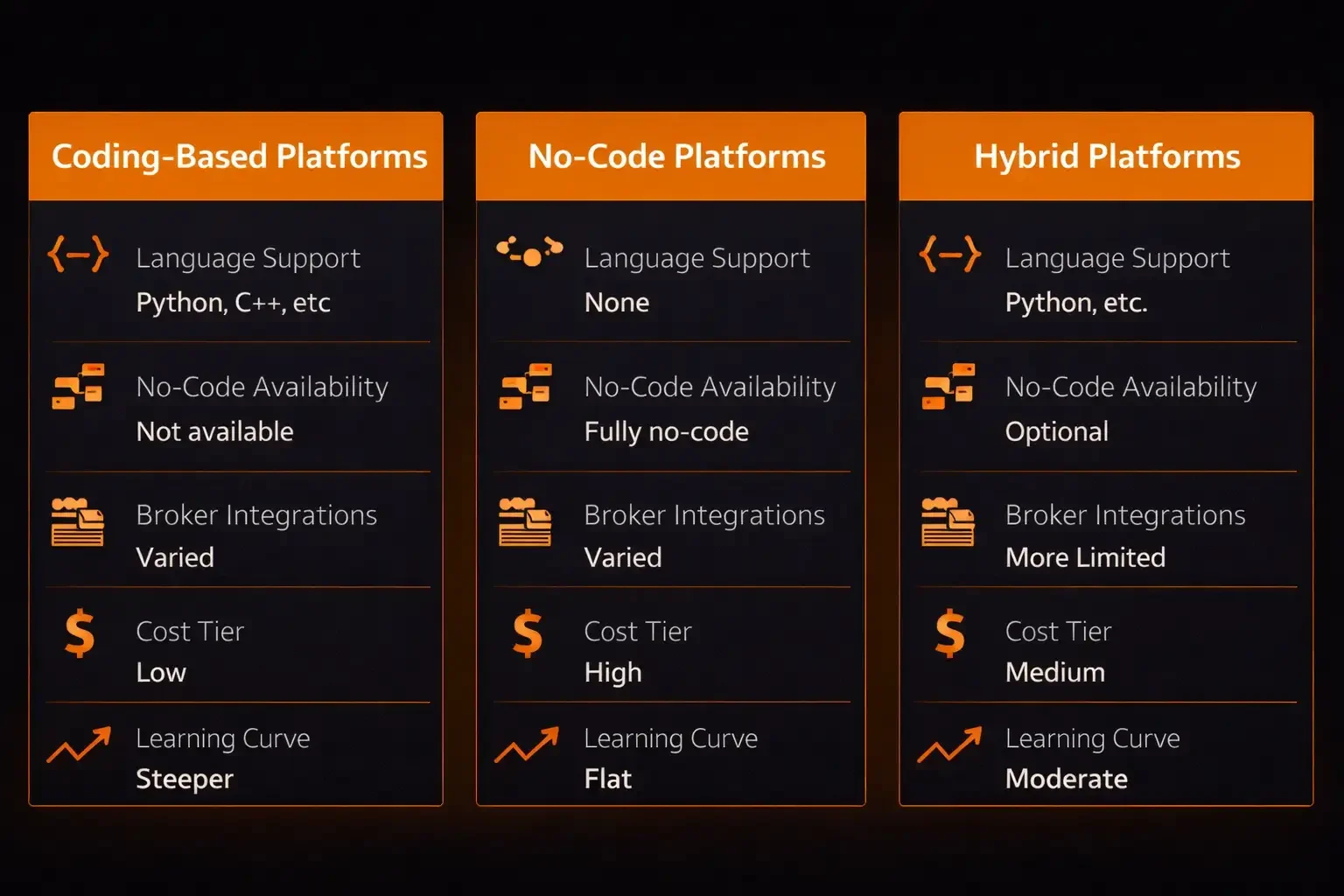
No-code platforms let you build strategies using drag-and-drop interfaces, visual flowcharts, or dropdown menus. You define your rules by selecting conditions and actions from pre-built blocks. The upside is speed to first strategy. The ceiling is flexibility: you can only combine what the platform offers.
Code-based platforms (Python being the dominant language in this space) hand you complete control. You can implement any logic, pull from any data source, and customize every element of your system. The trade-off is a steeper learning curve.
Here is a practical way to think about it: start no-code if your primary goal is understanding strategy logic and seeing results quickly. Shift to code-based if you find yourself bumping into the walls of what the visual builder allows. Many traders begin with no-code tools to validate ideas, then graduate to Python or another language when they need more firepower.
Neither approach is inherently superior. The best platform is the one that gets you from idea to testable strategy without unnecessary friction.
Ready to stop evaluating and start building? Let’s walk through what it actually takes to go from zero to your first working algorithm.
How to Get Started with Algorithmic Trading
The gap between “interested in algo trading” and “running a working system” feels enormous from the outside. But when you break it into concrete steps, it becomes a manageable process. Here is what you genuinely need, and what you can pick up along the way.
Skills and Knowledge Requirements
Let’s be straightforward about this, because sugarcoating it would only set you up for frustration later.
What you actually need before starting:
- Basic trading knowledge: You should understand how markets work, what order types do, and how risk management functions. If terms like stop-loss, position sizing, and drawdown are unfamiliar, start there first.
- Strategy logic understanding: You need a clear picture of what conditions define a trade entry and exit. This requires structured thinking about market behavior.
- Familiarity with backtesting concepts: Grasping why and how you test a strategy against historical data is non-negotiable before going live.
What helps but is not strictly required to start:
- Programming skills: Useful, but no-code platforms let you begin without writing a single line. If you do want to learn, Python is the most practical choice for trading applications.
- Statistical knowledge: Helpful for evaluating strategy performance and sidestepping common pitfalls like overfitting. You can build this gradually.
- Advanced mathematics: Only necessary for certain quantitative strategies. Most retail algo trading does not call for calculus or linear algebra.
The critical insight here: you do not need to master all of these before taking your first step. You need enough trading knowledge to define a sensible strategy, and a platform that matches your current skill level. Everything else you can learn in motion.
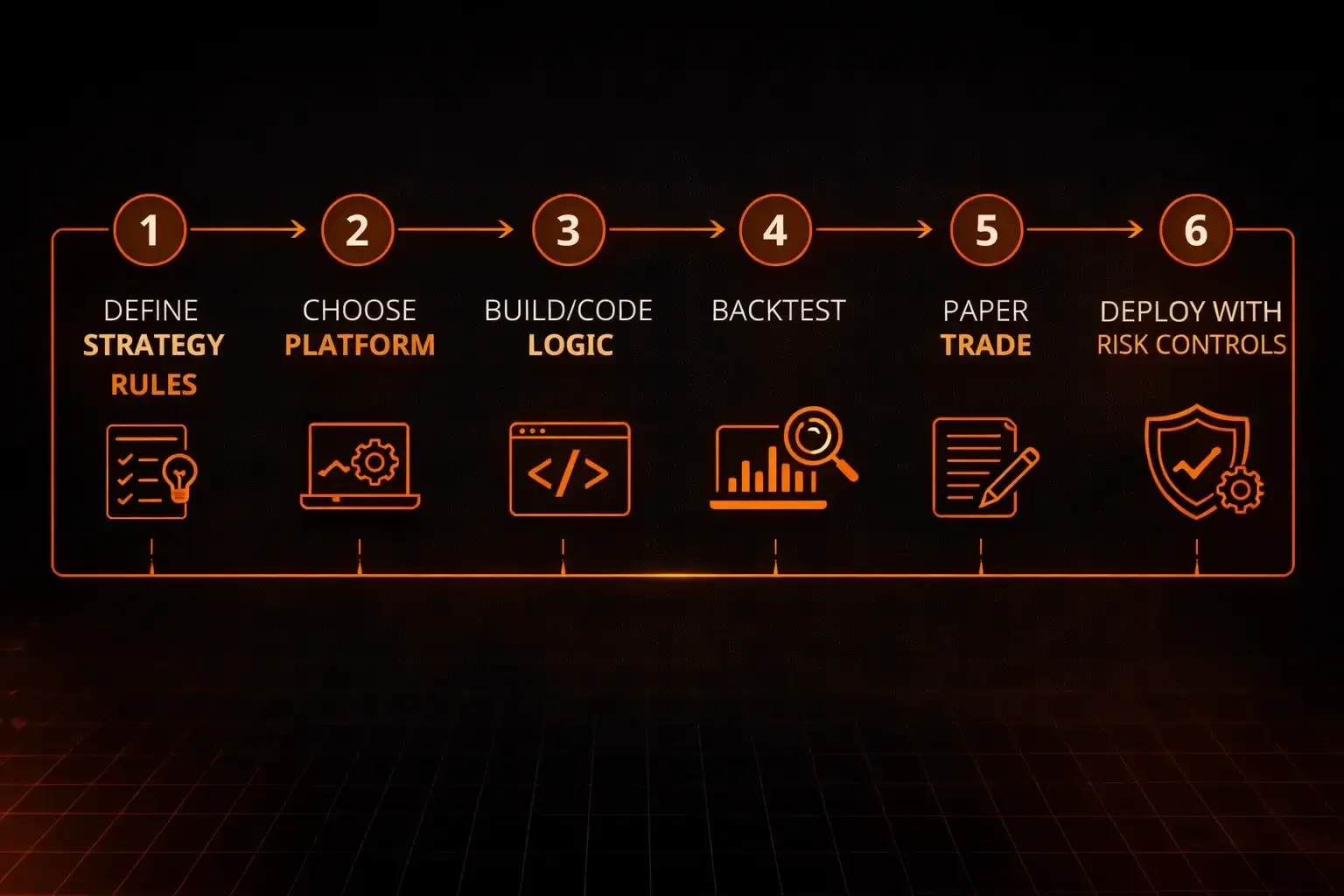
Building Your First Algorithm (Step-by-Step Framework)
This framework applies whether you are using a no-code builder or writing Python scripts. The process stays the same; only the implementation method changes.
- Define your strategy rules clearly. Before touching any software, write out your entry conditions, exit conditions, position sizing rules, and risk limits in plain language. If you cannot explain your strategy in a sentence, you are not ready to build it.
- Choose your platform. Based on your skill level and the criteria discussed above, select a platform that supports your strategy type and target market.
- Build or code your logic. Translate your written rules into the platform’s format, whether that is drag-and-drop blocks, a scripting language, or Python code.
- Backtest on historical data. Run your strategy against past market data. Examine total return, maximum drawdown, win rate, and the distribution of gains and losses. Be skeptical of results that look too good.
- Paper trade in real time. After backtesting, deploy your algorithm in a simulated environment with live market data but no real money. This stress-tests execution in real conditions without financial risk.
- Deploy with strict risk controls. Only after paper trading confirms your strategy behaves as expected should you go live. Start with the smallest position sizes your rules allow.
Paper Trading and Backtesting Before Going Live
This step deserves extra weight because impatience is where otherwise solid strategies fall apart. Skipping paper trading is like test-driving a car by entering a highway race. You need to know how the system behaves before you put real capital behind it.
Backtesting tells you how your strategy would have performed historically. Paper trading tells you how it performs right now, with live data, real spreads, and actual execution conditions. Both are essential, and they reveal different things.
During backtesting, watch for:
- Unrealistically high returns (often a sign of overfitting)
- Large drawdowns relative to gains
- Profits concentrated in a handful of trades rather than spread across consistent performance
- Assumptions about execution that may not hold in live markets (like always getting filled at your exact price)
During paper trading, pay attention to:
- Execution slippage (the gap between expected and actual fill price)
- How the strategy handles varied market conditions (volatile days, low-volume stretches, news events)
- Whether the system behaves the way your rules intended
A minimum paper trading period of two to four weeks is reasonable for most strategies, and longer for systems that trade infrequently. Resist the urge to rush this phase. The market will still be there when you are ready.
Even the best-tested strategy is not bulletproof, though. Before you go live, you need to understand exactly what can go wrong.
Risks and Limitations of Algorithmic Trading
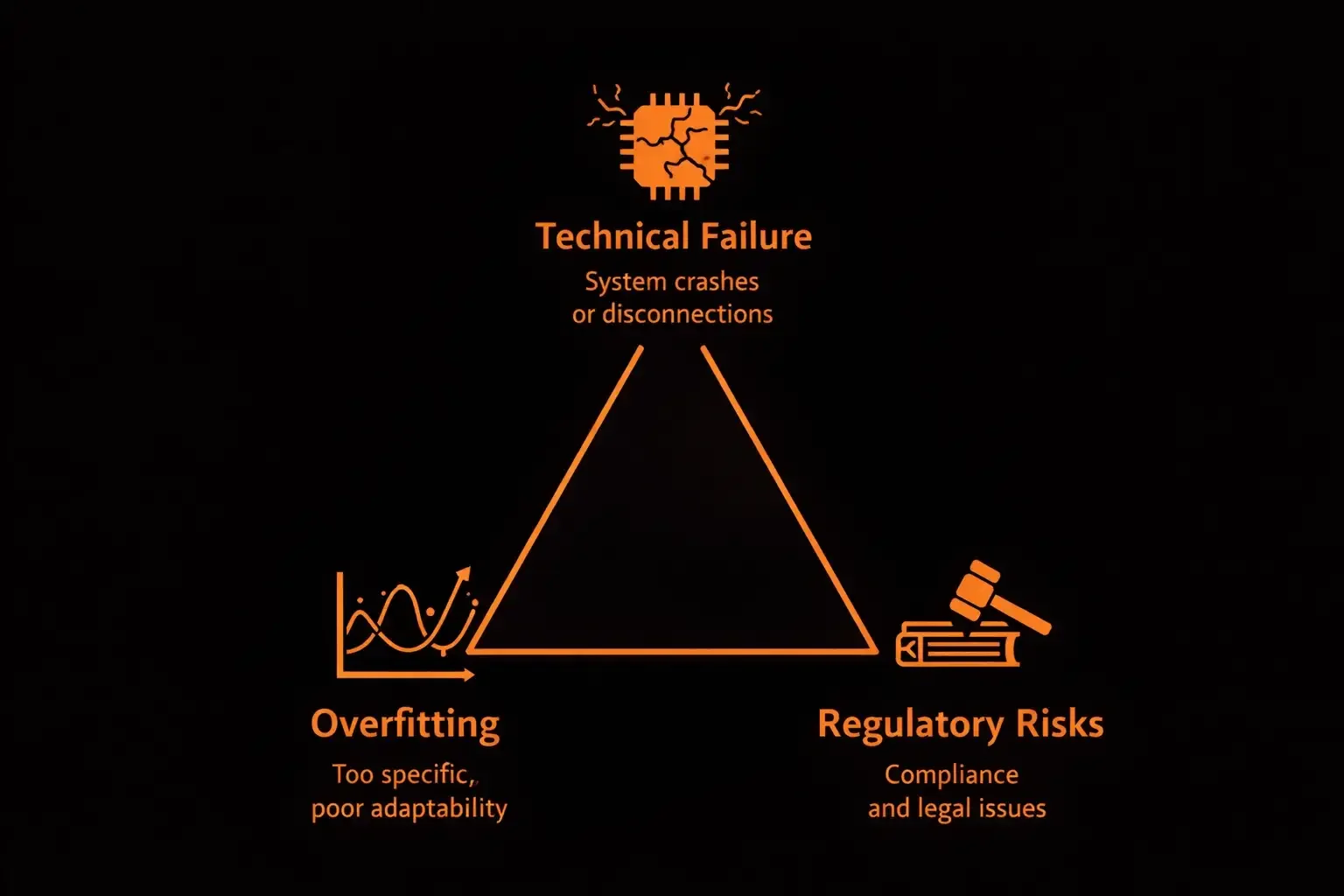
Algorithmic trading can sharpen your execution and strip out emotional noise, but it introduces its own category of risks that manual traders never face.
Technical Failures and Execution Risk
Your algorithm is software running on hardware connected to the internet. Every link in that chain can break.
- Internet disconnections can leave positions unmanaged.
- Platform outages can block order execution at critical moments.
- Data feed errors can pump incorrect information into your algorithm, triggering bad trades.
- Software bugs in your own code can cause unintended behavior (buying when you meant to sell, sizing positions incorrectly).
Mitigation is not optional here. At minimum, you need hard stop-losses at the broker level (not just inside your algorithm), position size caps that prevent catastrophic single-trade losses, and monitoring alerts that flag unexpected behavior. Never assume your algorithm is running correctly just because it was running correctly yesterday.
Overfitting and Curve-Fitting Traps
This is the most insidious risk in algorithmic trading, because it disguises itself as success. Overfitting happens when you optimize your strategy so precisely to historical data that it “fits” the past perfectly but crumbles on new, unseen data.
Imagine tailoring a suit so exactly to a mannequin that it cannot fit any actual human body. That is overfitting. Your strategy looks flawless in backtesting because it has essentially memorized past price patterns rather than capturing a genuine, repeatable market behavior.
Warning signs of overfitting:
- Piling on more and more parameters to squeeze out better backtest results
- Strategy performs brilliantly on one specific time period but poorly on others
- Backtest results that seem too good to be true (they usually are)
- Performance collapses the moment you move to paper trading or live deployment
The antidote is simplicity and out-of-sample testing. Keep your strategy rules as lean as possible. Test on data your algorithm has never encountered. Be suspicious of perfection.
Regulatory Considerations for Retail Traders
Algorithmic trading is legal for retail traders in most major markets, but the regulatory landscape is far from uniform. Rules around automated trading, order-to-trade ratios, and market manipulation vary by jurisdiction and asset class.
A few practical points worth keeping in mind:
- Some brokers have specific terms of service governing automated trading activity. Check yours before deploying.
- Rapid order placement and cancellation can trigger exchange surveillance flags, even when your intent is entirely legitimate.
- Leverage used in automated systems amplifies both gains and losses. Understanding position sizing and risk limits becomes critical when an algorithm is making decisions faster than you can intervene.
- Tax treatment of algorithmic trading gains may differ depending on your jurisdiction, trading frequency, and account type.
When in doubt, consult a financial professional familiar with trading regulations in your region.
Frequently Asked Questions


Comments