


Arbitrage trading is built on a deceptively simple idea: buy an asset cheaply in one place, sell it at a higher price somewhere else, and keep the difference. It is a fast-moving, capital-intensive discipline where the window of opportunity can close in milliseconds. If you’ve heard the term and wondered whether it’s something a regular trader can pull off, or whether it belongs exclusively to hedge funds with server farms, this guide is worth your time.
What follows is a clear breakdown of what arbitrage trading actually involves, how the mechanics work, the main types and strategies worth knowing, and where opportunities tend to surface. You’ll also get an honest look at what execution demands in practice, and whether the math works for someone trading from a retail account.
This article is for informational and educational purposes only. It is not financial advice. Trading involves risk, and you should consult a qualified financial professional before making any trading decisions.
What Is Arbitrage Trading?
The word “arbitrage” gets used loosely in trading circles, sometimes to describe anything that involves buying low and selling high. But real arbitrage is more specific than that, and understanding the distinction matters if you want to trade with clarity.
The Core Principle Behind Arbitrage
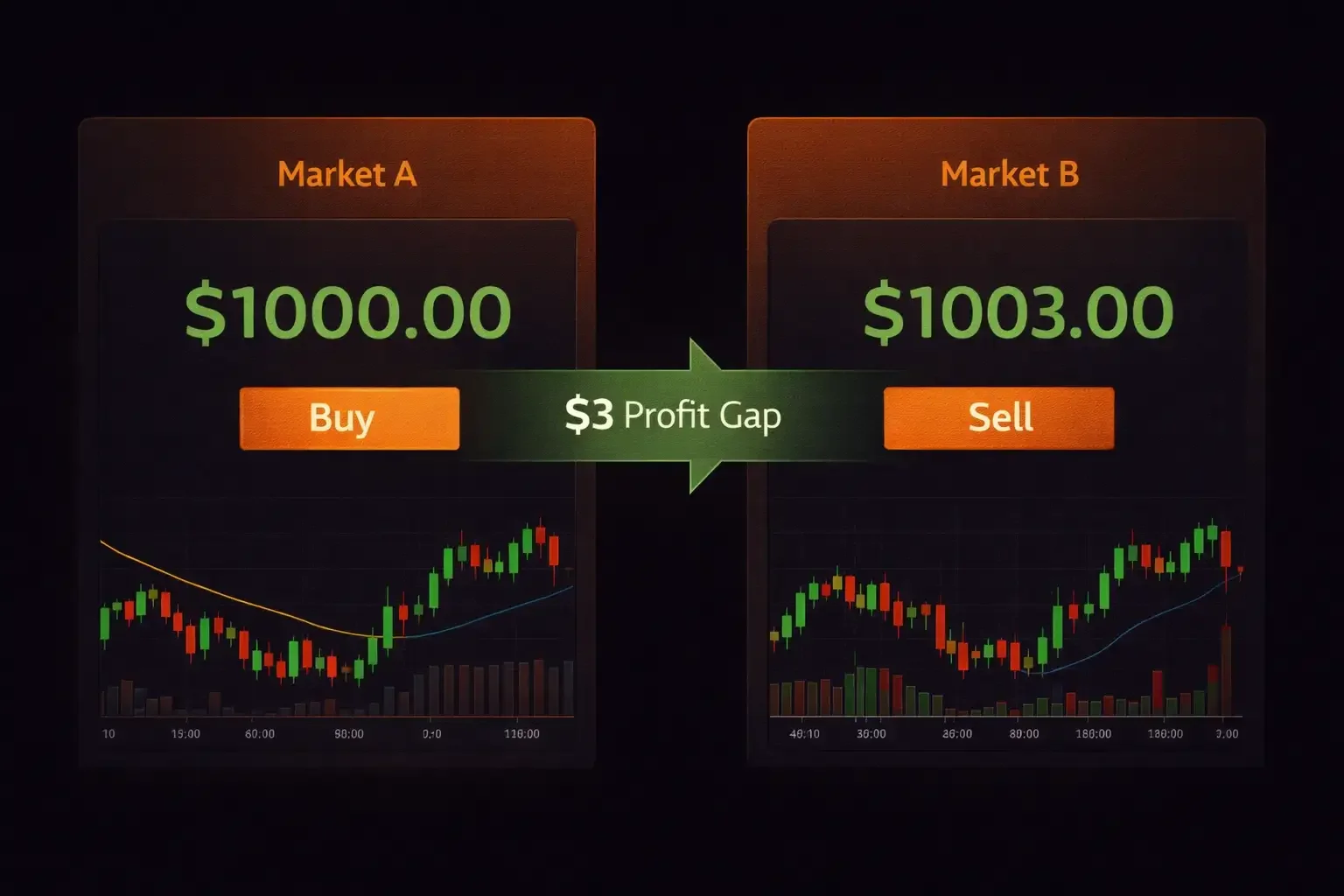
At its simplest, arbitrage trading means simultaneously buying and selling the same asset (or equivalent assets) in different markets to profit from a price difference. The operative word is simultaneously. You’re exploiting a gap that exists right now, in this moment, between two or more venues.
Picture the same pair of sneakers priced at $80 in one store and $95 in the store across the street. If you could buy from the first and instantly sell to the second, you’d lock in a $15 spread without any directional risk. That logic sits at the heart of every arbitrage trade, regardless of the asset class.
This is why arbitrage is often described as “risk-free profit,” though that label deserves heavy qualification. However, there are risks: slippage, fees, latency, and liquidity can all eat into or erase that spread before you ever capture it.
Why Price Discrepancies Exist
If markets were perfectly efficient, arbitrage wouldn’t exist. Prices would be identical everywhere, instantly. But markets are messy, and several forces create the cracks that arbitrageurs hunt for:
- Market fragmentation: The same asset can trade on multiple exchanges, platforms, or geographic markets, each with its own pool of buyers and sellers. Prices don’t always align perfectly across these venues.
- Latency differences: Information travels fast, but not instantaneously. Price updates on one exchange might lag behind another by fractions of a second, opening brief windows of misalignment.
- Liquidity variation: An asset with deep liquidity on one exchange might be thinly traded on another. Lower liquidity means prices can drift further from the “true” value.
- Time zone and market hours: Different markets operate on different schedules. When one market is closed and another is open, pricing gaps can emerge based on new information that hasn’t been absorbed everywhere.
- Regulatory and structural differences: Currency controls, trading restrictions, and market structure differences across countries can create persistent (or semi-persistent) price gaps.
These inefficiencies are constantly being hunted and closed by traders and algorithms, which is precisely why arbitrage opportunities tend to be small and short-lived. So how does capturing one of these gaps actually work in practice?
How Arbitrage Trading Works
Most people grasp the concept of buying low and selling high. Arbitrage compresses that entire cycle into something that often plays out in seconds or less. The mechanics matter here, because a great opportunity means nothing if you can’t execute it cleanly.
A Step-by-Step Breakdown
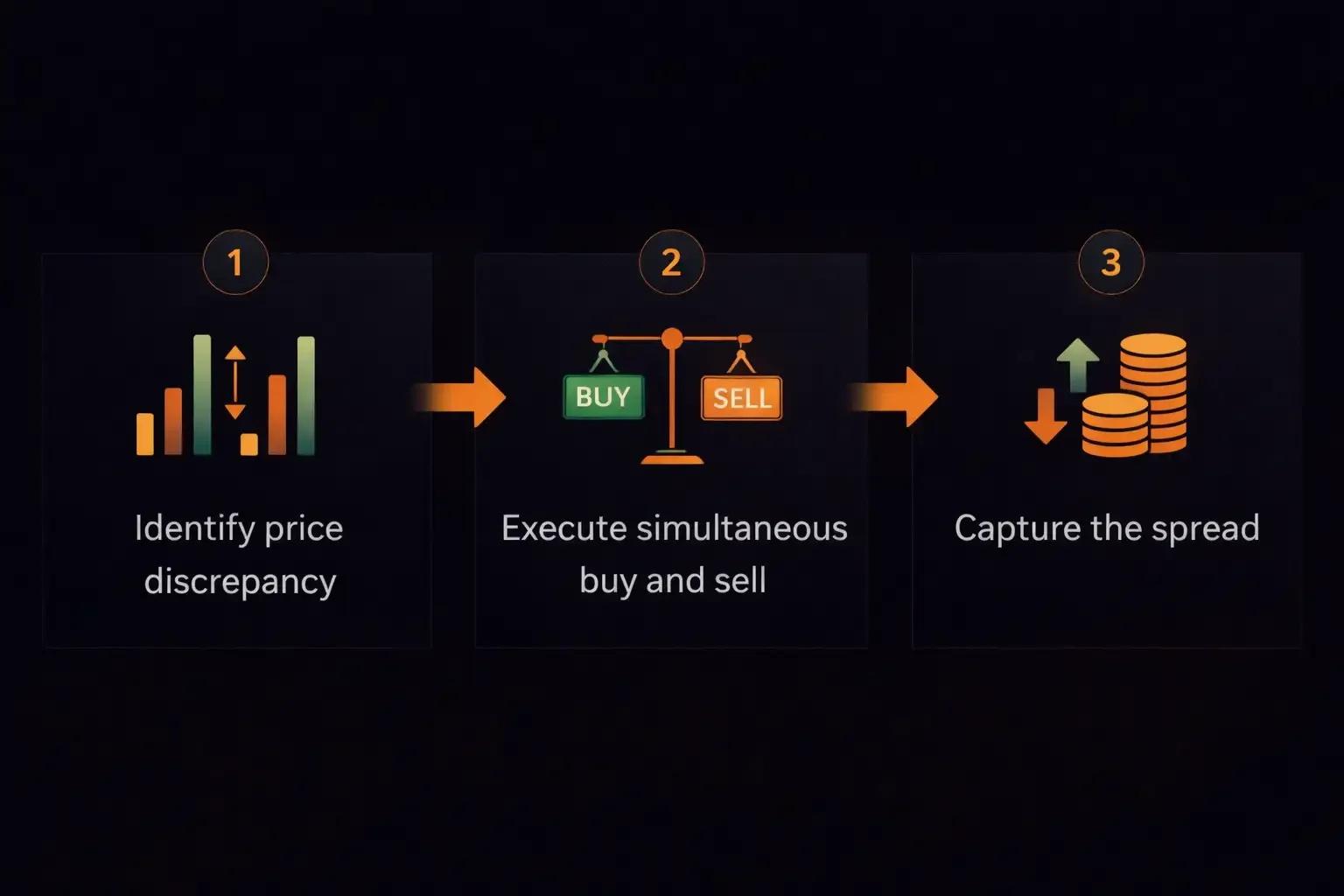
Here’s how a basic arbitrage trade unfolds:
- Identify the discrepancy. You spot the same asset priced differently on two markets. For example, a stock trading at $100.10 on Exchange A and $100.35 on Exchange B.
- Execute simultaneous orders. You buy on the cheaper market (Exchange A at $100.10) and sell on the more expensive market (Exchange B at $100.35) at the same time.
- Capture the spread. The difference between your buy and sell price ($0.25 per share in this case) is your gross profit, before accounting for fees and costs.
- Account for costs. Subtract transaction fees, exchange fees, transfer costs, and any slippage from your gross profit. What’s left is your actual gain.
That’s the framework. Simple in concept, unforgiving in execution.
The Role of Speed and Execution
This is where the gap between textbook arbitrage and live trading becomes stark. Arbitrage opportunities in liquid markets can exist for fractions of a second. By the time you’ve noticed a price gap on your screen, an algorithm has very likely already closed it.
Speed is the defining constraint. High-frequency trading (HFT) firms invest millions in co-located servers, low-latency connections, and custom hardware specifically to capture these micro-opportunities faster than anyone else. They win with better infrastructure.
For a retail trader, the implications are direct. In highly efficient markets like major forex pairs or large-cap equities, competing on speed is essentially impossible without institutional-grade technology. That means the playing field matters, and some markets are considerably more accessible than others.
What kinds of arbitrage strategies actually exist, and which ones are most relevant to different types of traders?
Types of Arbitrage Trading
Arbitrage is a family of approaches, each exploiting a different kind of market inefficiency. Some are straightforward. Others require sophisticated modeling. Knowing the main types helps you figure out which, if any, fall within your reach.
Spatial (or Simple) Arbitrage
This is the most intuitive form: the same asset is priced differently on two separate exchanges or markets, and you buy on the cheaper one while selling on the more expensive one. It’s the sneaker store example scaled up to financial markets.
Spatial arbitrage is common in fragmented markets, particularly crypto, where dozens of exchanges list the same tokens with varying liquidity. The catch is that transfer times between exchanges can destroy the opportunity. By the time you move your asset from Exchange A to Exchange B, the price gap may have vanished.
Triangular Arbitrage
Triangular arbitrage exploits pricing inconsistencies between three related currency pairs. Instead of comparing the same asset across two markets, you cycle through three conversions and end up with more of your starting currency than you began with.
Say you start with USD, convert to EUR, then convert EUR to GBP, then convert GBP back to USD. If the exchange rates between these three pairs are slightly misaligned, the round trip nets a profit.
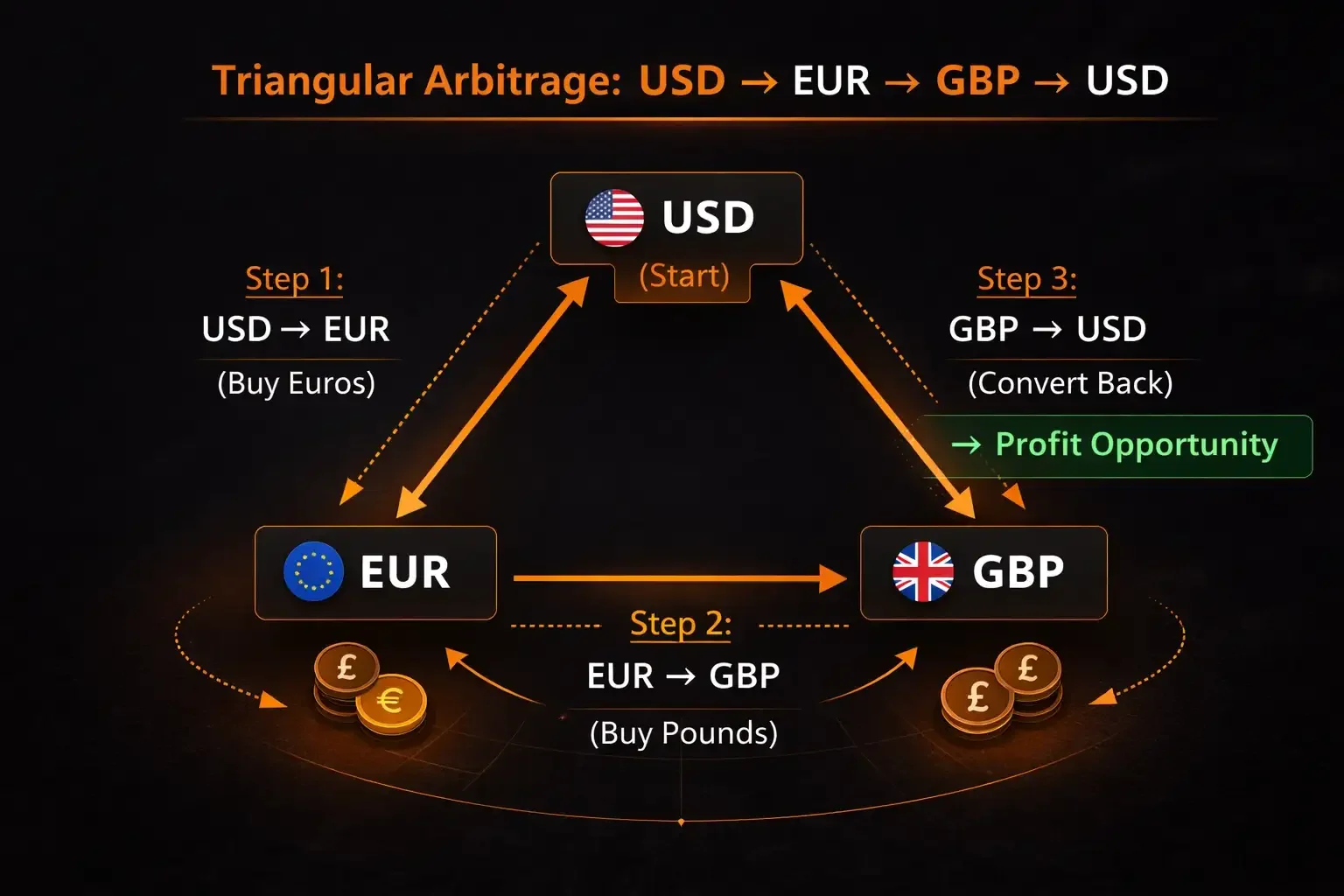
This type of arbitrage lives almost entirely in the domain of algorithms within the forex market. The discrepancies are tiny, the calculations need to happen in real time, and execution across all three trades needs to be near-simultaneous. Conceptually fascinating, but practically very difficult without automation.
Statistical Arbitrage
Statistical arbitrage (often called “stat arb”) takes a fundamentally different approach. Rather than exploiting a clear, observable price gap, it uses quantitative models to identify assets that are statistically mispriced relative to each other.
Consider two stocks that historically move in lockstep, like two major airlines. If one suddenly drops while the other holds steady, a stat arb strategy might short the one that held steady and go long on the one that dropped, betting that the historical relationship will reassert itself.
This isn’t “pure” arbitrage in the textbook sense because it carries directional risk. The historical relationship might break down permanently. But it’s widely practiced by quantitative hedge funds and falls under the broader arbitrage umbrella.
Merger (or Risk) Arbitrage
When a company announces it’s acquiring another company, the target’s stock price typically jumps, but usually not all the way to the announced acquisition price. The gap between the current trading price and the deal price reflects the market’s uncertainty about whether the deal will actually close.
Merger arbitrage involves buying the target company’s stock at the current (discounted) price and waiting for the deal to close at the higher price. The “risk” in risk arbitrage is real: if the deal collapses, the stock can drop significantly.
This type of arbitrage is more accessible to individual traders since it doesn’t hinge on lightning-fast execution. It does, however, demand strong analysis of deal probability, regulatory risk, and financing conditions.
Crypto Arbitrage
Cryptocurrency markets are, in many ways, the modern frontier for arbitrage. The crypto ecosystem is heavily fragmented, with hundreds of exchanges operating globally, varying levels of liquidity, and less mature market-making infrastructure compared to traditional finance.
Price differences for the same token across exchanges can be notably larger and more persistent than what you’d find in forex or equities. That makes crypto one of the more realistic arenas for arbitrage, especially for retail traders.
The trade-offs are operational. You need accounts on multiple exchanges, you need to manage funds across platforms, and you need to factor in network fees and transfer times that can erode your edge. Decentralized finance (DeFi) has also opened up a newer niche, with arbitrage bots exploiting price differences across decentralized exchanges, though this space requires deeper technical knowledge.
Knowing the types is only part of the picture. How do traders actually structure these opportunities into repeatable strategies?
Common Arbitrage Trading Strategies
The types above describe the kind of inefficiency being exploited. Strategies are about how you structure and execute trades around those inefficiencies in a repeatable way.
Cross-Exchange Arbitrage
This is the most direct strategy: you maintain balances on multiple exchanges and execute trades when you spot a price difference for the same asset between them. Rather than transferring the asset between exchanges (which is slow), you hold funds on both sides and trade simultaneously.
If Bitcoin is trading at $60,000 on Exchange A and $60,150 on Exchange B, you buy on A and sell on B at the same time. You then periodically rebalance your holdings across exchanges.
The key requirements are pre-funded accounts on multiple platforms, real-time price monitoring tools, and fast execution. This strategy is particularly popular in crypto markets for good reason.
Futures-Spot Arbitrage (Cash and Carry)
This strategy exploits the price difference between an asset’s spot price (current market price) and its futures price (the price for delivery at a future date). When the futures price trades at a premium to the spot price, you can buy the asset in the spot market and simultaneously sell a futures contract, locking in the spread.
As the futures contract approaches expiration, the futures and spot prices converge, and you collect the difference. This is considered one of the lower-risk arbitrage strategies because the convergence is structurally guaranteed (futures must settle at the spot price at expiration), though it ties up capital for the duration of the contract.
Currency Arbitrage
Currency arbitrage encompasses several approaches within the forex market, including triangular arbitrage (discussed above) and cross-broker arbitrage, where different forex brokers quote slightly different prices for the same pair.
Forex is the largest and most liquid market in the world, which means arbitrage windows are extraordinarily narrow. Most currency arbitrage today is dominated by institutional players and automated systems. For retail traders, the fees and spreads charged by brokers often consume any arbitrage profit that might theoretically exist.
Understanding where these strategies play out in practice is essential for judging whether any of them are within your reach.
Where Arbitrage Opportunities Appear
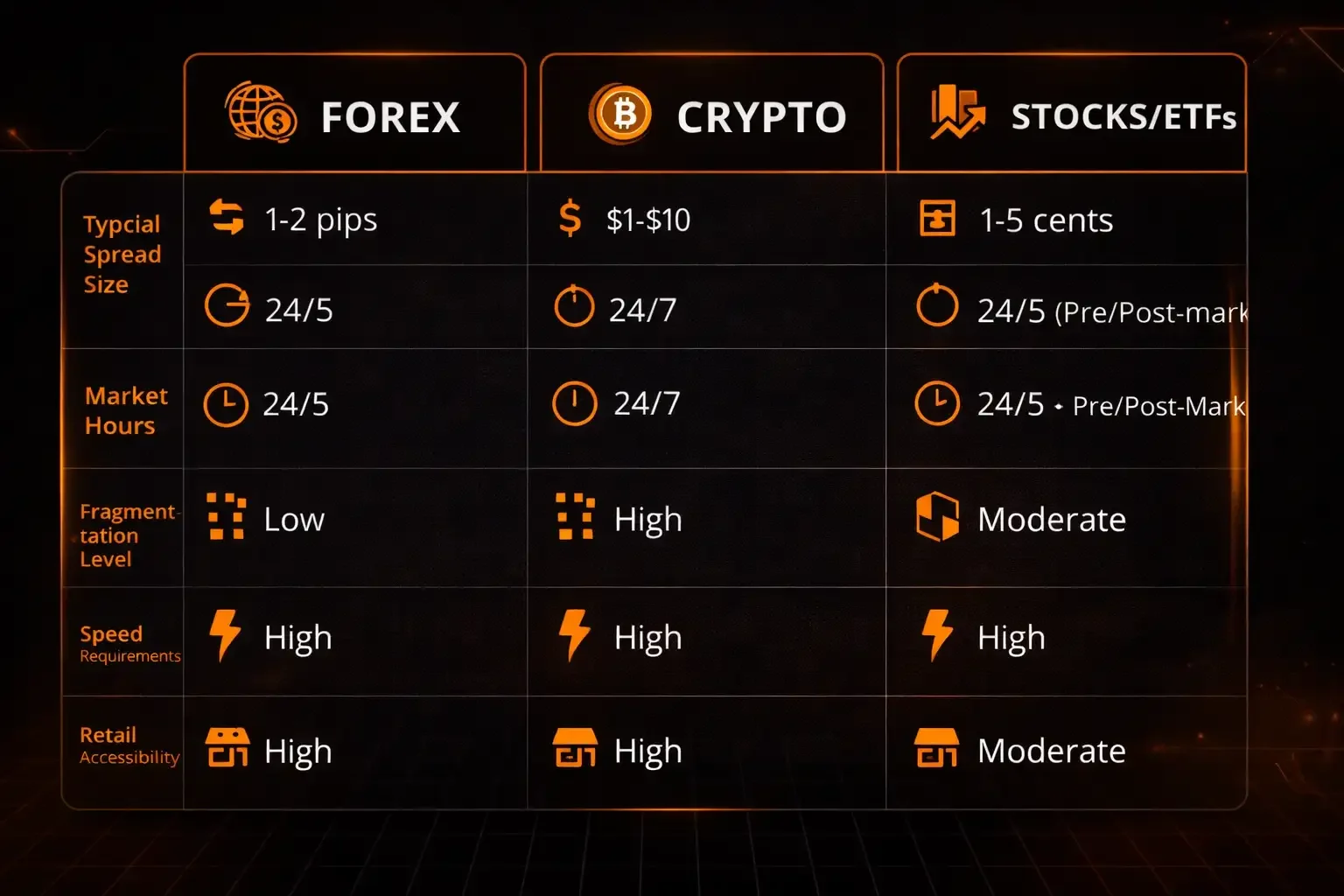
Not all markets offer the same conditions for arbitrage. The structure, fragmentation, and efficiency of a market determine how often opportunities arise and how realistic they are to capture.
Forex Markets
The forex market is massive, liquid, and highly efficient. Arbitrage opportunities exist, but they’re microscopic and fleeting. The major currency pairs (EUR/USD, GBP/USD, USD/JPY) are quoted consistently across platforms, and any deviations are corrected almost instantly by institutional algorithms.
For retail traders, forex arbitrage is largely impractical. The spreads your broker charges typically exceed any arbitrage gap you’d find between platforms. Exotic or less-traded currency pairs might offer slightly wider windows, but liquidity constraints make execution unreliable.
Cryptocurrency Markets
Crypto is arguably the most accessible market for arbitrage today. The reasons are structural:
- Hundreds of exchanges with varying liquidity
- No single centralized pricing mechanism
- 24/7 trading with global participation
- Regulatory fragmentation creating regional price differences (the “Kimchi premium” in South Korea is a well-known example)
The trade-off is operational complexity. You need accounts on multiple exchanges, you need to manage funds across platforms, and you need to factor in network fees and transfer times that can quietly erode your edge.
Stock and ETF Markets
In traditional equity markets, arbitrage opportunities are rare for retail participants. Stocks and ETFs are primarily priced efficiently by market makers and HFT firms. Still, some niches do produce exploitable gaps:
- ETFs can temporarily trade at a premium or discount to their net asset value (NAV), especially during volatile sessions or for less liquid funds.
- Dual-listed stocks (companies listed on exchanges in different countries) can show price differences due to currency movements and time zone gaps.
- Newly listed securities or those experiencing unusual volume can briefly misprice relative to correlated assets.
Across all of these markets, one thing holds true: you need the right tools to even spot opportunities, let alone act on them fast enough.
Tools and Requirements for Arbitrage Trading
Spotting and executing arbitrage trades isn’t something you can do reliably with a standard brokerage app and intuition. The requirements are specific, and understanding them upfront will save you from costly frustration.
Technology and Software
At minimum, you need:
- Real-time price feeds from multiple exchanges or platforms, not delayed quotes
- Arbitrage scanning tools or bots that monitor price differences across venues and alert you (or execute automatically) when a threshold is met
- Low-latency internet connection to minimize the delay between your decision and your order reaching the market
- API access to exchanges, if you’re using automated strategies, so your software can place orders programmatically
For crypto arbitrage specifically, there are several open-source and commercial tools that scan multiple exchanges for price gaps. In traditional markets, the barrier is higher because exchange data feeds and co-location services carry significant costs.
Capital Requirements
Arbitrage profits per trade are typically very small in percentage terms. You might capture 0.1% to 0.5% on a single trade. To make that meaningful, you need enough capital to trade in volume.
Beyond that, strategies like cross-exchange arbitrage require you to maintain balances on multiple platforms simultaneously, which further increases your capital needs. Cash-and-carry strategies tie up capital for the duration of the futures contract.
There’s no universal minimum, but attempting arbitrage with a small account (under a few thousand dollars) is unlikely to produce returns that justify the time, fees, and complexity involved.
Brokerage and Account Considerations
Your choice of broker or exchange matters more in arbitrage than in most other trading styles. Key factors include:
- Fee structure: High per-trade fees or wide spreads can completely eliminate arbitrage margins.
- Execution speed: You need a broker or exchange with fast order execution and minimal requotes.
- Multi-platform access: You’ll likely need accounts on several exchanges, each with their own verification, deposit, and withdrawal processes.
- Withdrawal policies: Especially in crypto, exchanges that delay withdrawals or impose high withdrawal fees can undermine your entire strategy.
None of these are deal-breakers on their own, but together they form a checklist worth evaluating honestly before committing capital.
If the tools exist and the concepts make sense, why isn’t everyone profiting from arbitrage? Because what can go wrong often does.
Risks and Limitations of Arbitrage Trading
The “risk-free” label that often gets attached to arbitrage is one of the most misleading phrases in trading. Here’s what can and does go wrong.
Execution Risk
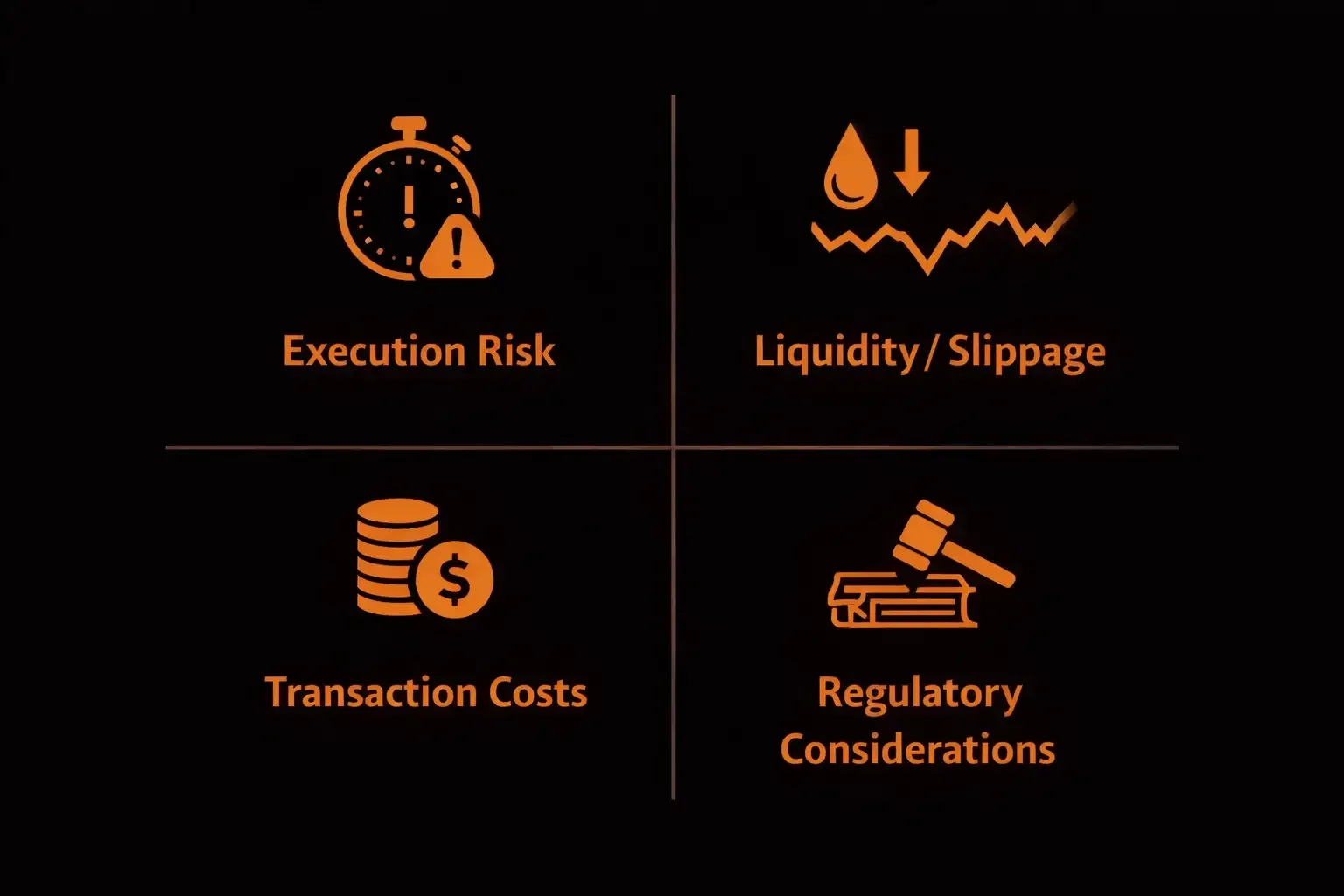
The single biggest risk in arbitrage is failing to execute both sides of the trade simultaneously. You buy on one exchange, but by the time your sell order hits the other exchange, the price has moved. Now you’re holding a position with directional exposure, which is exactly what arbitrage is designed to avoid.
This risk scales with market speed. In fast-moving environments, even a one-second delay can turn a profitable trade into a loss.
Liquidity and Slippage
Your arbitrage calculation might assume you can buy 1,000 units at $100.10 and sell 1,000 units at $100.35. But if the order book on either side is thin, your actual fill prices will likely be worse. This is slippage, and it’s a silent margin killer in arbitrage trading.
Lower-liquidity assets and smaller exchanges are particularly vulnerable. The very markets that offer bigger price gaps often have the liquidity conditions that make those gaps harder to capture cleanly.
Transaction Costs
Every trade has costs: exchange fees, broker commissions, network fees (in crypto), spread costs, and potential currency conversion charges. When your gross profit per trade is measured in fractions of a percent, these costs can consume the entire margin.
Successful arbitrageurs tend to be obsessive about fee optimization. If you’re paying standard retail fees, the math often simply doesn’t work.
Regulatory Considerations
Arbitrage itself is legal in virtually all jurisdictions. It’s a legitimate market activity that actually contributes to price efficiency. However, specific execution methods can brush up against regulatory gray areas:
- Some forex brokers explicitly prohibit latency arbitrage in their terms of service.
- Cross-border crypto arbitrage can involve regulatory and compliance complications.
- Tax reporting for high-volume, multi-exchange trading can be complex.
Before engaging in any form of arbitrage, it’s worth understanding both the trading regulations in your jurisdiction and the specific terms of service on the platforms you plan to use.
With all of these realities in view, the natural question is whether any of this is worth pursuing if you’re not running an institutional fund.
Is Arbitrage Trading Realistic for Retail Traders?
Pure arbitrage in highly efficient markets like major forex pairs or large-cap equities is, for all practical purposes, out of reach for individual retail traders. The opportunities are too small, too brief, and too aggressively competed for by institutional players with vastly superior technology.
But that doesn’t make the entire concept irrelevant. The picture is more nuanced:
- Crypto markets remain the most accessible space for retail arbitrage due to market fragmentation and comparatively less institutional dominance (though this gap is narrowing).
- Merger arbitrage doesn’t require speed advantages and can be executed through a standard brokerage account, though it requires strong analytical skills and carries meaningful deal-failure risk.
- Statistical arbitrage at a basic level can be explored by traders with quantitative skills, though it’s not “pure” arbitrage and involves directional risk.
- Cash-and-carry strategies in crypto futures markets have been accessible to retail traders during periods of elevated futures premiums.
The realistic takeaway is that arbitrage is less a shortcut to easy profits and more a niche discipline that rewards deep market knowledge, technical infrastructure, and measured expectations. If the concept appeals to you, start by studying specific markets, understanding fee structures, and paper-trading strategies before committing real capital.
For most retail traders, the greatest value in learning about arbitrage may not be executing arbitrage trades at all. It’s developing a sharper understanding of how markets price assets, why inefficiencies arise, and how institutional players operate. That knowledge sharpens your trading instincts regardless of the strategy you ultimately pursue.
Frequently Asked Questions


Comments