


Disclaimer: This article is for informational purposes only and does not constitute investment or tax advice. ETF eligibility, costs, and tax treatment vary by jurisdiction and individual circumstances. Always verify your own situation before investing.
If you’re a European investor, you’ve probably come across SPY, QQQ, or VTI more times than you can count. They appear in every investing podcast, Reddit thread, and YouTube video going.
The problem is that you likely can’t buy them. This guide pairs the most widely discussed US ETFs with their closest UCITS-compliant European equivalents, so you know exactly what to look for and why.
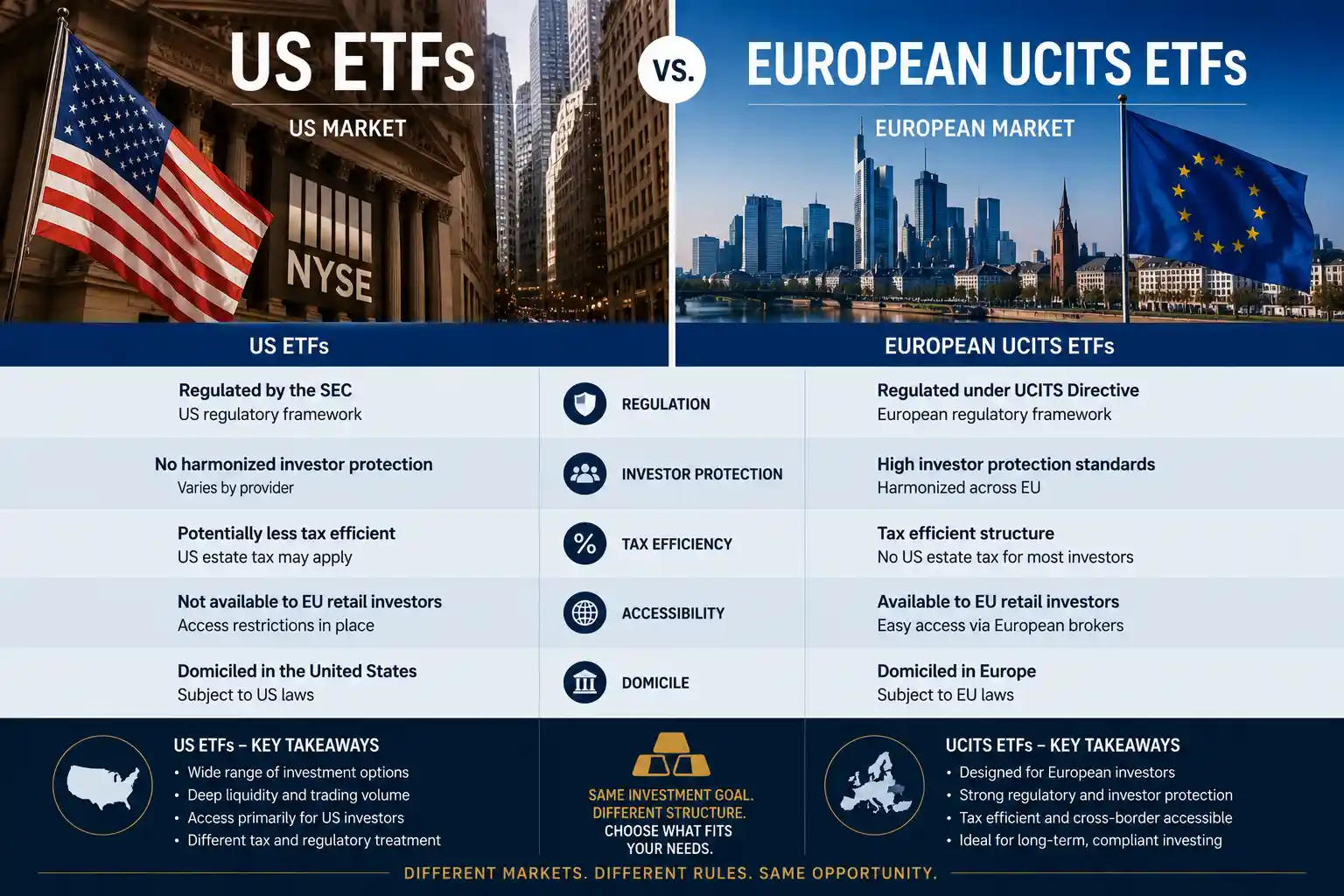
Why European Investors Cannot Simply Buy US ETFs
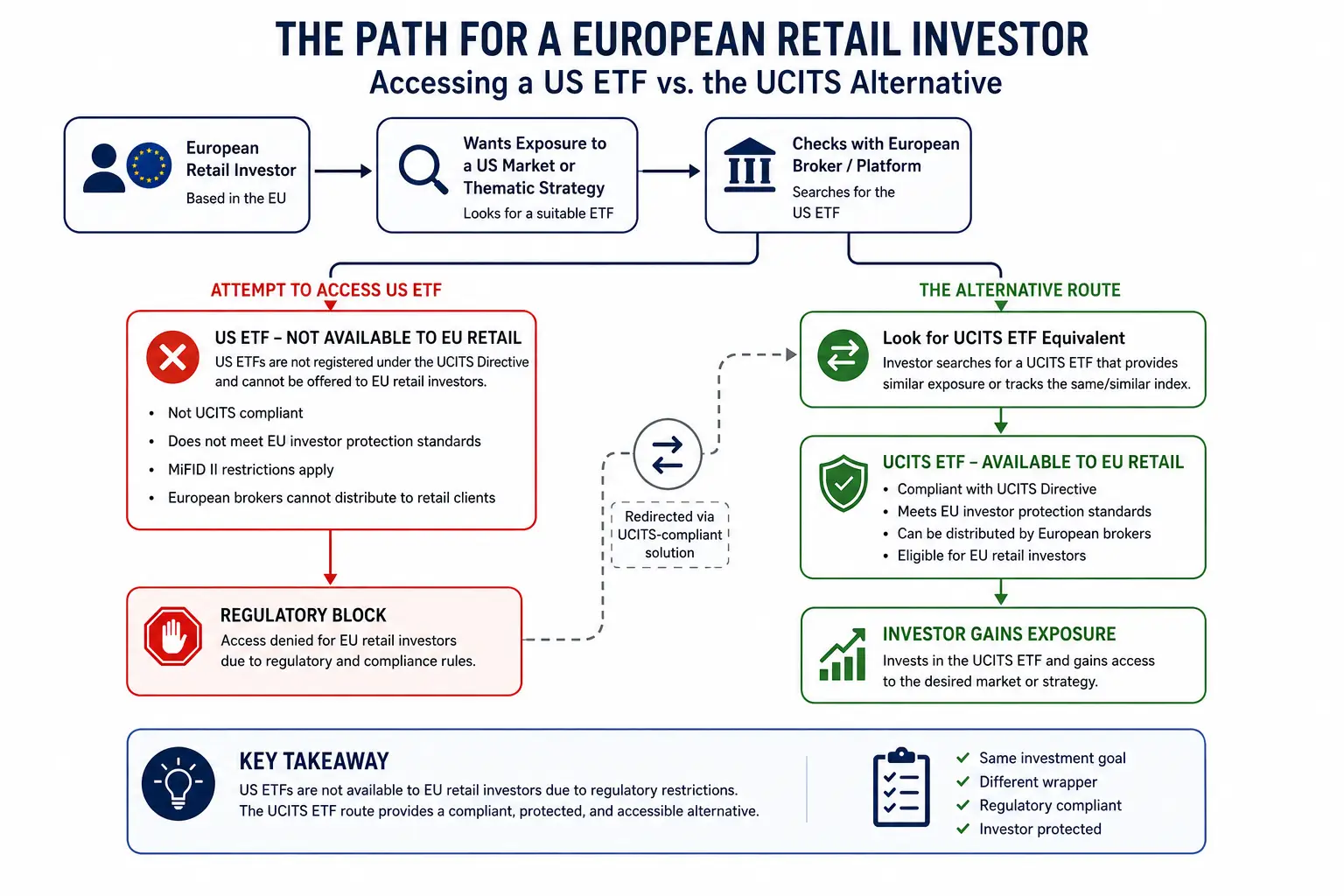
You’re not doing anything wrong. The US ETFs you keep reading about are simply not available through most European brokers, and the reason is regulatory.
The PRIIPs and MiFID II Regulatory Barrier
Two pieces of European regulation are responsible: PRIIPs (Packaged Retail and Insurance-based Investment Products) and MiFID II (Markets in Financial Instruments Directive II).
Under these rules, any investment product sold to European retail investors must come with a standardised document called a Key Information Document (KID). US ETF providers such as Vanguard, BlackRock, and State Street have not produced KIDs for their US-listed funds, and they have little commercial incentive to do so. Without a KID, a European broker cannot legally distribute the product to retail clients.
The PRIIPs and MiFID II frameworks are constantly subject to ongoing regulatory review, so it’s important to stay updated on regulation updates and modifications.
SPY and QQQ are visible on financial news sites, discussed freely online, and fully accessible to institutional investors. But for European retail investors, they’re off the shelf. It’s regulatory friction, and it has a straightforward solution.
What UCITS Means and Why It Matters for European Investors
UCITS stands for Undertakings for Collective Investment in Transferable Securities. It’s the regulatory framework that sets the standard for investment funds distributed across the European Union. A UCITS ETF meets the European compliance requirements that US ETFs do not, which is why they’re the funds you’ll actually find on your brokerage platform.
Most UCITS ETFs are domiciled in Ireland or Luxembourg. Ireland is the more common choice, partly due to its tax treaty with the United States, which reduces withholding tax on US dividends from 30% to 15% for Irish-domiciled funds. That matters when you’re holding funds that track US indices.
The practical point is that a UCITS ETF tracking the S&P 500 is doing the same job as SPY. It holds (or replicates) the same index, runs at comparable cost, and is built for long-term investors. The UCITS label is a compliance wrapper, not a downgrade.
How to Read This Guide (Comparison Criteria)
Before getting into the pairings, here’s what’s being compared and why each factor is worth knowing.
Index Tracked
The most important question is whether the European fund tracks the same index as its US counterpart. Most of the time it does. Where it doesn’t, or where there’s a subtle difference, that’s noted.
Total Expense Ratio (TER) vs Expense Ratio
US ETFs quote an expense ratio. European UCITS ETFs quote a TER (Total Expense Ratio). Both represent the annual cost of holding the fund, expressed as a percentage of your investment.
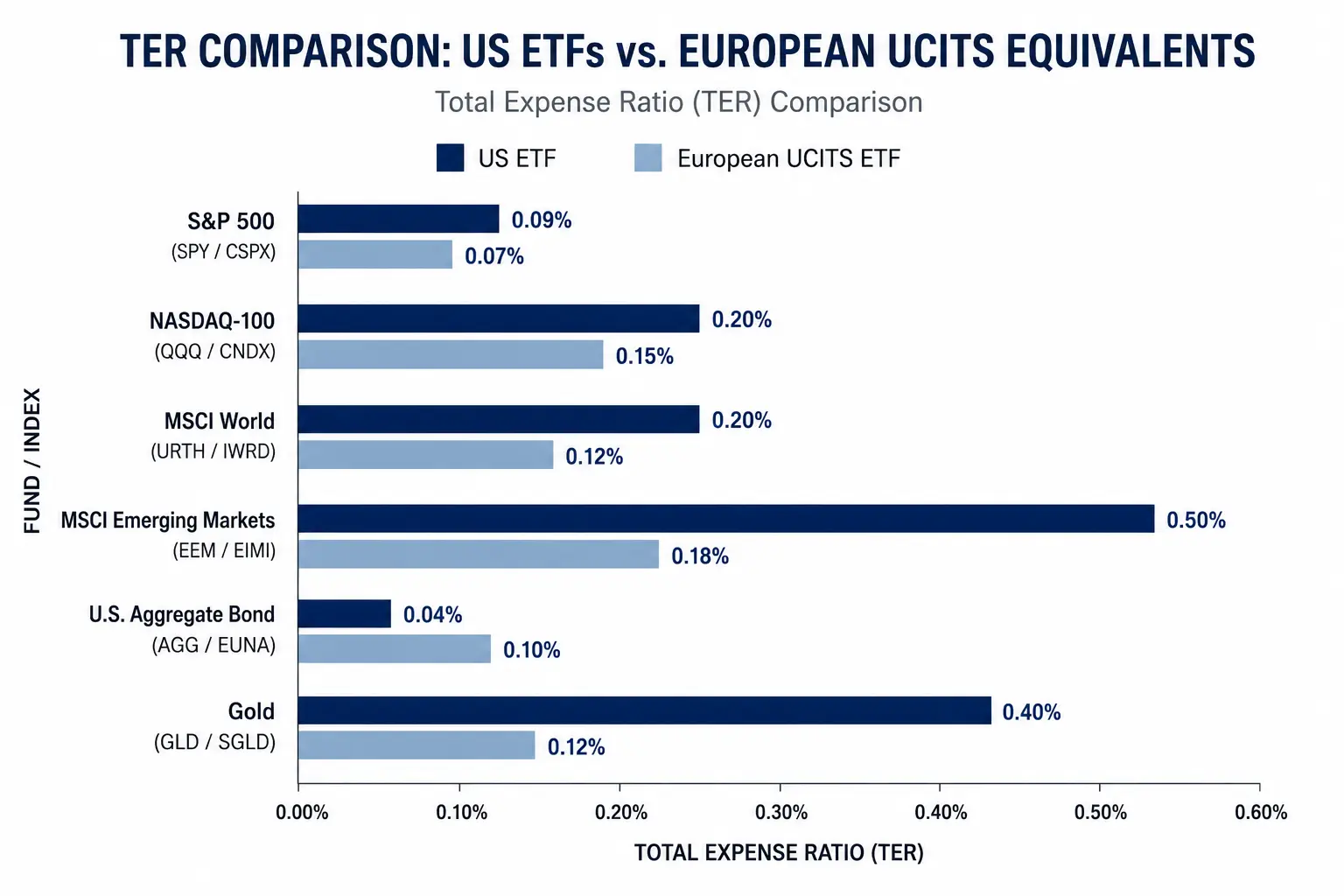
UCITS ETFs generally cost slightly more than their US equivalents, though the gap has narrowed significantly over the past decade. Whether that difference is meaningful over the long term depends on the size of your portfolio. There’s more on that in the FAQ.
Accumulating vs Distributing Share Classes
This distinction matters more in Europe than in the US:
- A distributing ETF pays out dividends as cash.
- An accumulating ETF automatically reinvests dividends back into the fund.
From a return perspective, accumulating is often more efficient because you avoid dividend drag and don’t need to manually reinvest. From a tax perspective, the right choice depends entirely on your country of residence and how your tax authority treats each structure.
This guide flags which share classes are available for each fund but does not advise on which to choose. That’s a conversation for your local tax rules or a qualified adviser.
Currency and Hedging Considerations
Most UCITS equivalents of US ETFs are priced in USD, EUR, or GBP depending on the share class. The underlying currency exposure of a fund tracking a US index remains in USD regardless of the currency the shares are quoted in. Currency-hedged variants exist for some funds but come at higher cost. Where a hedged class is materially relevant, it’s mentioned.
SPY and Its European Equivalent
SPY (SPDR S&P 500 ETF Trust) is the world’s largest ETF by assets under management and the one most non-US investors encounter first. It tracks the S&P 500, the benchmark index of 500 large-cap US companies.
What the US ETF Tracks
SPY tracks the S&P 500 Index and carries an expense ratio of 0.0945% . It distributes dividends quarterly and is listed on the NYSE Arca.
The Closest European UCITS Alternative
Two funds compete for this spot:
- iShares Core S&P 500 UCITS ETF (CSPX): Domicile: Ireland. TER: 0.07%. Accumulating. Listed on the London Stock Exchange (USD). Managed by BlackRock.
- Vanguard S&P 500 UCITS ETF (VUAA): Domicile: Ireland. TER: 0.07%. Accumulating. Listed on multiple European exchanges. Managed by Vanguard.
Both track the same S&P 500 Index. Both are physically replicated, meaning they hold the actual underlying stocks. The VUAA vs SPY comparison is straightforward: same index, slightly different cost structure, different regulatory wrapper.
Key Differences to Know
SPY uses a unit investment trust structure that prevents dividend reinvestment, so it must distribute dividends. CSPX and VUAA, as accumulating share classes, reinvest dividends automatically. On cost, CSPX and VUAA are actually cheaper than SPY on TER.
QQQ and Its European Equivalent
QQQ (Invesco QQQ Trust) is the go-to fund for US tech exposure, tracking the Nasdaq-100 Index, which covers the 100 largest non-financial companies listed on the Nasdaq.
What the US ETF Tracks
QQQ tracks the Nasdaq-100 Index and carries an expense ratio of 0.18%. It distributes dividends and trades on Nasdaq.
The Closest European UCITS Alternative
- Invesco EQQQ Nasdaq-100 UCITS ETF (EQQQ): Domicile: Ireland. TER: 0.30%. Distributing. Listed on multiple European exchanges. Also available as an accumulating share class (EQQU on some platforms).
Invesco manages both QQQ and EQQQ, making this one of the more direct pairings in this guide. Same index, same manager, different legal structure.
Key Differences to Know
EQQQ costs more than QQQ. The distributing share class is more common, but the accumulating variant is available through many brokers. If you’ve already done your research on the Nasdaq-100 and you’re looking for its European equivalent, EQQQ is the fund to find.
VTI and Its European Equivalent
VTI (Vanguard Total Stock Market ETF) tracks the CRSP US Total Market Index, covering the entire US equity market across large, mid, small, and micro-cap companies.
It’s the broadest possible exposure to US equities in a single fund, and it’s the one pairing in this guide where no single UCITS fund replicates the index exactly. That’s worth knowing before you invest.
What the US ETF Tracks
VTI tracks the CRSP US Total Market Index with an expense ratio of 0.03%. It distributes dividends quarterly.
The Closest European UCITS Alternative
No UCITS ETF tracks the CRSP US Total Market Index. The practical answer for most European investors is a two-fund approach: a broad US large/mid-cap UCITS ETF paired with a US small-cap UCITS ETF.
For the large and mid-cap portion, the most commonly used options are:
- iShares MSCI USA UCITS ETF (CSU1): Domicile: Ireland. Tracks the MSCI USA Index (large and mid caps). Accumulating and distributing share classes available. Managed by BlackRock.
- SPDR MSCI USA UCITS ETF: Domicile: Ireland. Also tracks the MSCI USA Index. Distributing. Verify the correct ticker for this fund against its ISIN on your broker platform or the SSGA fund documentation before investing, as tickers vary across exchanges.
For small-cap coverage to complement either of the above:
- iShares MSCI USA Small Cap UCITS ETF (CSUS): Domicile: Ireland. Tracks the MSCI USA Small Cap Index. Provides exposure to the segment of the US market that large/mid-cap funds omit.
Together, a broad US UCITS ETF and a small-cap UCITS ETF get close to total US market coverage.
Investors who are comfortable holding only large and mid caps, which represent roughly 80 to 85% of the US market by capitalisation, often use a single broad US or S&P 500 UCITS ETF as a practical substitute.
Key Differences to Know
The index gap is real and cannot be closed with a single fund. The two-fund approach introduces a second TER and requires occasional rebalancing to maintain your intended split.
For investors who want simplicity over precision, an S&P 500 UCITS ETF such as CSPX or VUAA covers the large-cap majority of the US market in a single holding, at the cost of omitting small and mid caps entirely.
VXUS and Its European Equivalent
VXUS (Vanguard Total International Stock ETF) gives US investors exposure to every equity market outside the United States. It’s the complement to VTI for a globally diversified portfolio.
What the US ETF Tracks
VXUS tracks the FTSE Global All Cap ex US Index with an expense ratio of 0.05%. It distributes dividends.
The Closest European UCITS Alternative
- Vanguard FTSE All-World UCITS ETF (VWCE): Domicile: Ireland. TER: 0.19%. Accumulating. Listed on XETRA and other European exchanges.
VWCE is technically a global fund that includes US equities, so it’s not a perfect structural equivalent to VXUS. For European investors who don’t already hold a separate US equity fund, however, VWCE functions as a single-fund global portfolio solution covering the same international markets.
Key Differences to Know
If you’re building a two-fund portfolio of US equities plus international, VWCE includes US exposure and may overlap with a separate S&P 500 UCITS ETF. Many European investors use VWCE as a single all-world holding rather than pairing it with a US fund. Whether that suits your allocation depends on your intended split.
A note on share classes: VWCE and VWRL are distinct products. VWCE is the accumulating share class, which reinvests dividends automatically. VWRL is a separate distributing share class that pays dividends as cash. They track the same index but are not interchangeable, and searching by ticker alone may return either product depending on the exchange. Always confirm the share class and ISIN before placing an order.
GLD and Its European Equivalent
GLD (SPDR Gold Shares) is the world’s most traded gold ETF, offering exposure to spot gold prices through physical bullion holdings.
What the US ETF Tracks
GLD tracks the spot price of gold bullion. Expense ratio: 0.40% [FACT-CHECK REQUIRED].
The Closest European UCITS Alternative
- iShares Physical Gold ETC (SGLN/IGLN): Domicile: Ireland. TER: 0.12%. This is an Exchange Traded Commodity (ETC), not strictly a UCITS ETF, but it is UCITS-equivalent compliant and widely available on European platforms. Backed by physical gold.
- Invesco Physical Gold ETC (SGLD): Domicile: Ireland. TER: 0.12%. Also physically backed.
Note: Gold ETCs are structured differently from equity ETFs but serve the same economic purpose for investors seeking gold price exposure.
Key Differences to Know
GLD charges significantly more than its European counterparts. Both SGLN and SGLD are physically backed, as is GLD, so the replication method is consistent across all three. The ETC structure used by European gold products differs slightly from a UCITS fund structure but does not materially change the investor experience.
AGG and Its European Equivalent
AGG (iShares Core US Aggregate Bond ETF) provides broad exposure to the US investment-grade bond market, including government, corporate, and mortgage-backed securities.
What the US ETF Tracks
AGG tracks the Bloomberg US Aggregate Bond Index with an expense ratio of 0.03% .
The Closest European UCITS Alternative
- iShares Core US Aggregate Bond UCITS ETF (IUAG/SUAG): Domicile: Ireland. TER: 0.25%. Accumulating and distributing share classes available. Managed by BlackRock.
This is one of the cleaner pairings in the guide: same manager, same underlying index, UCITS wrapper.
Key Differences to Know
The TER gap on bond ETFs is more pronounced than on equity ETFs. AGG at 0.03% versus IUAG at 0.25% is a meaningful difference at scale. For fixed income allocations, that cost comparison is worth factoring into your decision.
Side-by-Side Comparison Table
US ETF | European Equivalent | Index Tracked | US Expense Ratio | UCITS TER | Acc/Dist | Domicile |
SPY | CSPX (iShares) | S&P 500 | 0.0945% | 0.07% | Accumulating | Ireland |
SPY | VUAA (Vanguard) | S&P 500 | 0.0945% | 0.07% | Accumulating | Ireland |
QQQ | EQQQ (Invesco) | Nasdaq-100 | 0.18% | 0.30% | Dist/Acc | Ireland |
VTI | CSU1 + CSUS (iShares) | MSCI USA + MSCI USA Small Cap | 0.03% | Varies by fund | Acc/Dist | Ireland |
VXUS | VWCE (Vanguard) | FTSE All-World | 0.05% | 0.19% | Accumulating | Ireland |
GLD | SGLN/IGLN (iShares) | Spot Gold | 0.40% | 0.12% | N/A (ETC) | Ireland |
AGG | IUAG (iShares) | Bloomberg US Agg Bond | 0.03% | 0.25% | Acc/Dist | Ireland |
TER figures are approximate and subject to change. No single UCITS fund replicates the CRSP US Total Market Index tracked by VTI; the two-fund approach listed is the closest available equivalent. Verify current figures with the fund provider before investing.
Which Brokers Offer These UCITS ETFs
Most of the UCITS ETFs listed in this guide are widely available across major European brokerage platforms. Broker availability varies by country of residence, so what’s accessible in Germany may differ from what’s listed in the Netherlands or Sweden.
Platforms that generally offer access to UCITS ETFs include:
- Interactive Brokers: broad UCITS ETF coverage across European exchanges
- Degiro: widely used across Europe with a strong UCITS ETF selection
- Saxo Bank: multi-exchange access including XETRA and LSE listings
- Trading 212: popular for retail investors, covering key UCITS ETFs including VUAA and VWCE
- Scalable Capital: common in Germany and Austria, partnering with BlackRock for iShares access
When searching for a UCITS ETF on any platform, use the fund’s ISIN rather than its ticker. Tickers vary by exchange and share class. The ISIN is the universal identifier that will pull up the correct fund regardless of which platform you’re using.
If you are unsure about which broker to choose, try MonkeyTrade’s matchmaking tool to find the best fit.
Frequently Asked Questions


Comments