

Pros
- Regulated by FCA, ASIC, and MAS
- 13,500+ markets including spread betting
- Proprietary platform with TradingView integration
- Guaranteed stop-loss orders available
- NASDAQ-listed parent company (StoneX)
Cons
- Average forex spreads versus low-cost brokers
- No MetaTrader 5 support
- No copy trading or social features
- GBP 12/month inactivity fee after 12 months
- Limited cryptocurrency CFD selection
City Index has been around longer than most traders have been alive. Founded in London in 1983, it now operates under StoneX Group Inc., a NASDAQ-listed financial services company (ticker: SNEX). With access to 13,500+ markets, oversight from three Tier-1 regulators, and a proprietary platform built on TradingView, City Index occupies a distinctive space in the brokerage landscape. But does four decades of history translate to quality in 2026? This review breaks down regulation, costs, platforms, and known issues to help you decide whether City Index fits your trading needs.
What Makes City Index Different?
In an industry where brokers launch and vanish within a few years, City Index has been operating for over 40 years. That kind of survival says something. But longevity only matters if the broker has kept pace, and City Index has.
The broker is owned by StoneX Group Inc., publicly traded on the NASDAQ. This matters because the parent company files regular financial reports with the SEC, creating a level of financial transparency that privately held brokers simply cannot offer.
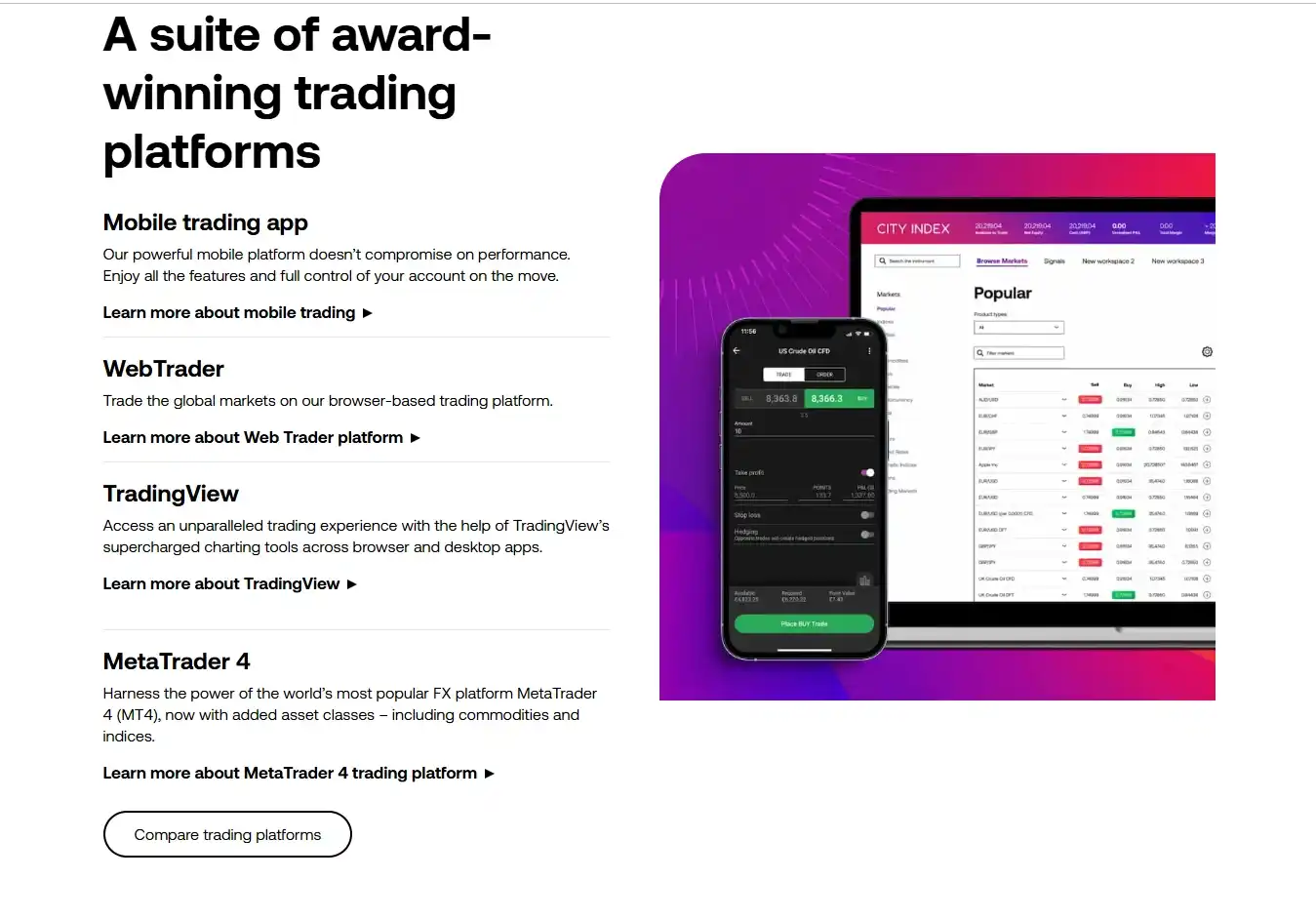
City Index genuinely differentiates itself in three areas. First, its proprietary Web Trader platform integrates TradingView charting natively, so you get advanced chart analysis without paying for a separate TradingView subscription. Second, for UK-based traders, City Index offers spread betting (a tax-free form of derivatives trading available in the UK under current rules) across the full range of 13,500+ markets. Third, City Index provides guaranteed stop-loss orders, known as GSLOs. These ensure your position closes at the exact price you set, even during market gaps when prices can jump past your stop level. Few brokers offer this.
The market range is broad:
- Forex: 84+ currency pairs
- Share CFDs: 4,700+
- Indices: 20+
- Commodities: 25+
- Bonds, options, and cryptocurrency CFDs
Whether you trade major forex pairs or thematic baskets like the “Magnificent Seven” tech stock index, City Index has it covered.
City Index operates regulated entities in the UK (FCA), Australia (ASIC), Singapore (MAS), Cyprus (CySEC), and the Cayman Islands (CIMA). It also serves clients in the UAE under its FCA license. For an intermediate trader looking for a broker with genuine pedigree, platform depth, and multi-jurisdiction oversight, City Index is a credible choice.
What City Index Does Well
Regulatory coverage, platform quality, and market access are where City Index earns its reputation. The combination of FCA, ASIC, and MAS regulation means your funds benefit from some of the strongest investor protection frameworks in the world. The proprietary Web Trader, with TradingView integration and built-in Trading Central research, gives you a solid analytical toolkit without requiring third-party subscriptions. Performance Analytics, launched in 2024, lets you review your own trade patterns and spot discipline issues. It is a practical feature that most competitors have not built.
For UK traders, spread betting is a significant draw. Trading across 13,500+ markets with tax-free profits (under current UK Capital Gains Tax rules) is something only a handful of brokers offer at this scale.
Where City Index Falls Short
City Index is not the cheapest broker you will find. Its average EUR/USD spread of around 0.74-0.8 pips is respectable, but it falls behind low-cost specialists like Pepperstone, which offers spreads from 0.0 pips plus commission on its Razor account. If you are a high-frequency scalper where every fraction of a pip affects your bottom line, that pricing gap compounds quickly.
The absence of MetaTrader 5 is worth flagging. MT5 offers improved backtesting, more timeframes, and a built-in economic calendar, all features that active traders may miss. There is no copy trading or social trading functionality either. And the GBP 12/month inactivity fee after 12 months, while common in the industry, is worth noting if you trade infrequently.
Regulation & Safety
Regulation is the foundation of broker trust, and City Index has a strong regulatory profile across multiple jurisdictions.
Regulatory Licenses
City Index operates through regulated entities in five jurisdictions:
- FCA (UK): StoneX Financial Ltd, reference number 446717 (Tier 1)
- ASIC (Australia): StoneX Financial Pty Ltd, AFSL 345646 (Tier 1)
- MAS (Singapore): StoneX Financial Pte Ltd, registration 201130598R (Tier 1)
- CySEC (Cyprus): StoneX Europe Ltd, license 400/21 (Tier 2)
- CIMA (Cayman Islands): GAIN Global Markets Inc., license 25033 (Tier 3)
Three of these are Tier-1 regulators, which represents an above-average regulatory footprint for a retail broker. The parent company, StoneX Group Inc., is also regulated by the CFTC (US), CIRO (Canada), and JFSA (Japan).
Client Fund Protection
Under the FCA, City Index clients are covered by the Financial Services Compensation Scheme (FSCS), which protects up to GBP 85,000 per person if the broker becomes insolvent. Client funds are held in segregated accounts, meaning your money is kept separate from the company’s own operating funds. Retail clients trading under the FCA and ASIC entities also benefit from negative balance protection, so you cannot lose more than your deposited funds.
Company History & Reputation
City Index was founded in 1983 in London and has operated continuously for over 40 years. It was previously owned by GAIN Capital Holdings before being acquired by StoneX Group in 2020. The broker holds a 4.3/5 rating on Trustpilot from approximately 391 reviews and has received positive assessments from BrokerChooser (4.4/5) and ForexBrokers.com.
The track record is not entirely clean, though. In 2023, City Index’s Australian entity was one of seven CFD brokers found by ASIC to have breached local leverage limits, resulting in a combined AUD 4.3 million compensation payout to approximately 1,500 retail clients. Under previous ownership, the broker received a GBP 490,000 fine from the FSA for failing to report approximately 2 million transactions. In 2012-2013, ASIC also took action regarding misleading website statements and client money handling deficiencies.
These are documented regulatory events. They do not make City Index unsafe today, but they are part of the historical record and worth knowing about before you open an account.
Account Types & Fees
City Index offers several account types designed for different trader profiles.
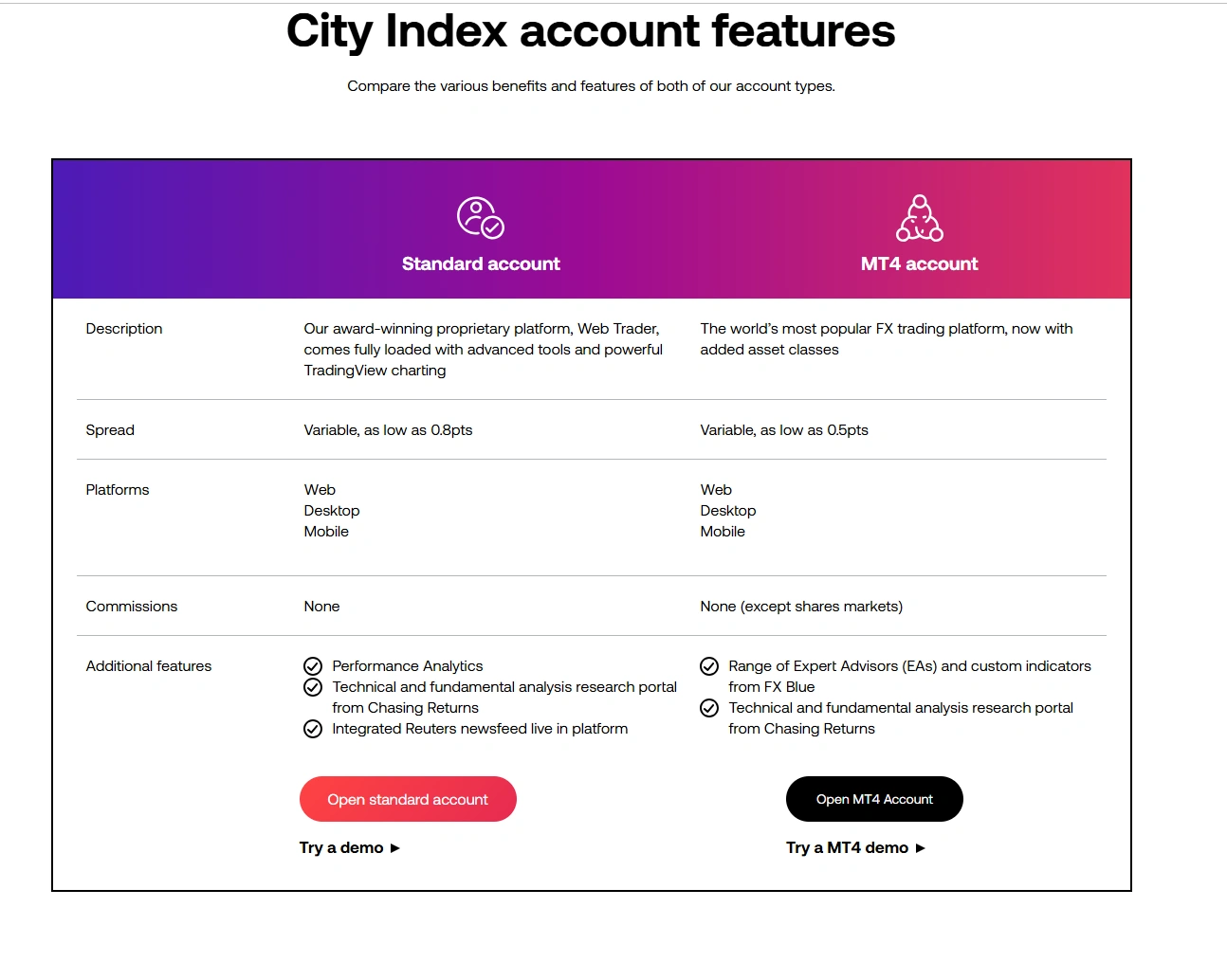
The Standard Account uses the proprietary Web Trader platform and TradingView. Forex spreads start from 0.8 pips with no separate commission on forex trades. This is the default account for most traders and requires no minimum deposit for UK clients (though GBP 100 is recommended). Another attractive feature is the interest payment scheme, eligible to users with an average balance of GBP 20,000 and regular activity.
The MT4 Account provides access to MetaTrader 4 with tighter forex spreads starting from 0.5 pips and no commission on forex. It is designed for traders who want algorithmic trading through Expert Advisors (EAs), which are automated trading programs that execute strategies on your behalf. Market access is limited compared to standard, with only 300 instruments available to trade.
City Index also offers a Corporate Account with multi-user access and dedicated account management, and a Demo Account with GBP 10,000 in virtual funds (12-week limit).
In Australia, a RAW FX Account is available with spreads from 0.0 pips plus a commission of AUD 5/USD 5 per side, though the AUD 25,000 minimum deposit puts it out of reach for many retail traders. Standard Australian accounts require AUD 150. Base currencies include EUR, GBP, USD, PLN, and CHF. A 0.5% currency conversion fee applies when trading instruments denominated in a different currency to your account base.
City Index does not offer a dedicated Islamic (swap-free) account, nor a zero-spread or raw account for non-Australian clients.
The inactivity fee is GBP 12 per month (or the equivalent of your remaining balance if less than GBP 12), applied after 12 consecutive months of no trading activity.
Trading Platforms & Tools
City Index provides four trading platform options, each suited to a different type of trader.
Web Trader is the proprietary flagship. It features a customizable workspace, TradingView-powered charts with 80+ technical indicators, integrated Trading Central research, one-click trading, and support for guaranteed stop-loss orders. It runs entirely in your browser with no download required.
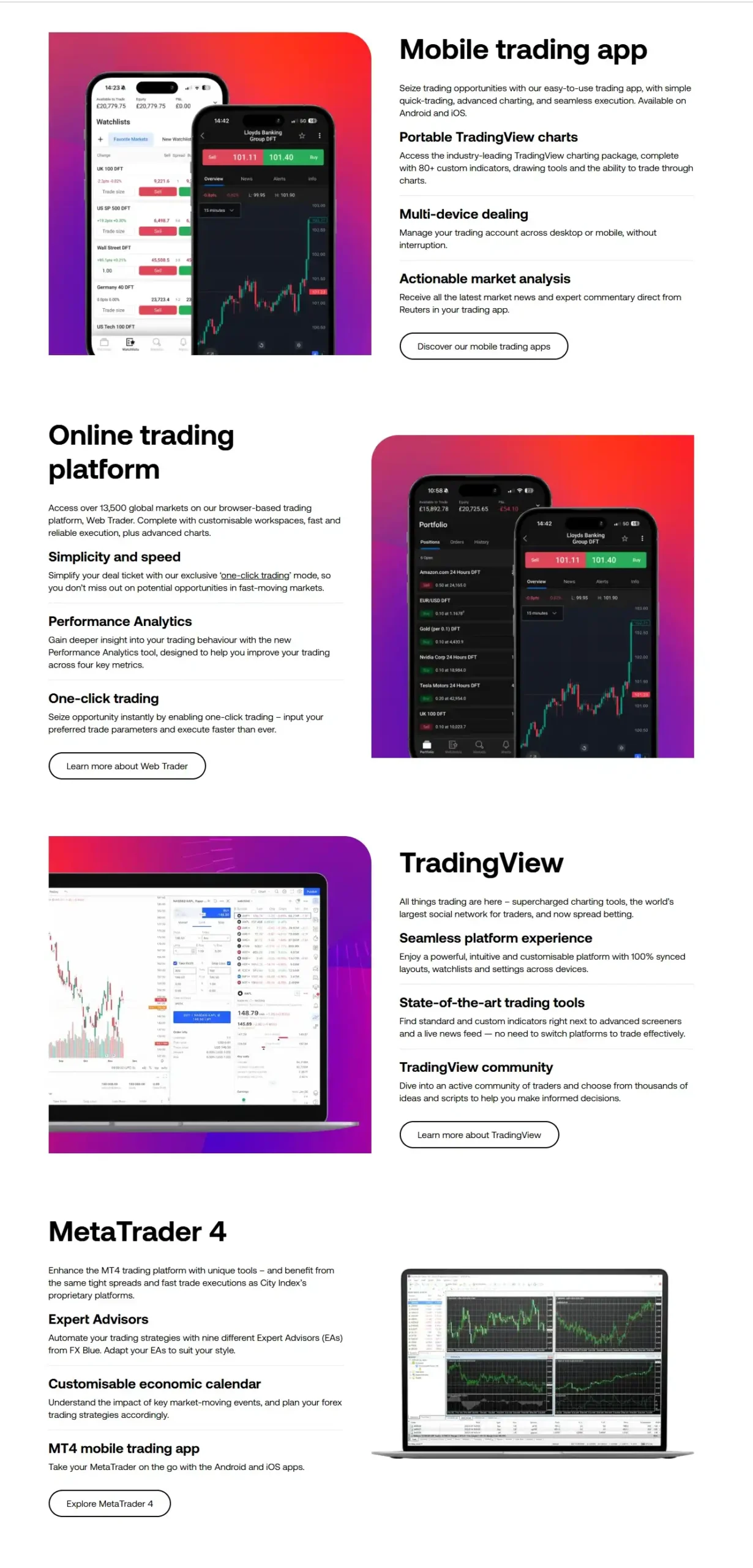
MetaTrader 4 (MT4) is available for traders who prefer algorithmic execution. It supports Expert Advisors, custom indicators, backtesting, and the standard MT4 feature set. City Index does not offer MetaTrader 5, however, so you miss out on MT5’s improved backtesting engine, additional timeframes, and built-in economic calendar.
TradingView integration is available as a standalone platform option, providing access to TradingView’s advanced charting with 100+ indicators and community-driven analysis directly connected to your City Index account.
Mobile apps for iOS and Android feature TradingView-powered charts, integrated Trading Central modules, push notifications, and one-click trading.
Two tools are worth highlighting. PlayMaker is an award-winning risk management tool that helps you plan and manage trades with predefined risk parameters. Performance Analytics, launched in 2024, analyzes your trading history and surfaces insights into your patterns, helping you identify where discipline or strategy could improve.
The former desktop platform (AT Pro) has been discontinued, and there is no proprietary desktop application available.
Markets & Instruments
City Index offers access to over 13,500 tradeable markets across multiple asset classes.
- Forex: 84+ currency pairs including majors, minors, and exotics
- Shares/Stocks: 4,700+ CFDs covering US and European exchanges
- Indices: 20+ global indices including FTSE 100, Dow Jones, DAX, and Nikkei
- Commodities: 25+ including precious metals (gold, silver, platinum), energies (crude oil, natural gas), and softs (coffee, sugar)
- Bonds and Interest Rates: 50+ instruments
- Cryptocurrency CFDs: Limited selection, professional clients only under FCA
- Options and Forwards: Available across select markets
- Thematic Indices: Curated baskets like the “Magnificent Seven” tech stocks
Spread betting is available across all asset classes for UK clients, providing a tax-free trading option under current UK Capital Gains Tax rules.
City Index does not offer real stocks or ETFs for direct ownership. All trading is conducted through CFDs or spread bets. There is no copy trading or social trading functionality.
Trading Costs & Conditions
Understanding City Index’s full cost structure matters, because the broker uses a spread-only model for most instruments. There is no separate commission on forex; the spread is the cost, and it varies by account type and market conditions.
For forex, the Standard Account offers spreads from 0.8 pips with no separate commission, while the MT4 Account offers tighter spreads from 0.5 pips, also commission-free. The average EUR/USD spread sits at approximately 0.74-0.8 pips. That is competitive for a spread-only model, but not in the same bracket as raw-spread brokers.
Stock CFD trading carries a commission of 0.08%, with a minimum charge of GBP 10, EUR 10, or USD 10 per trade. Index CFDs are spread-only, with spreads starting from 0.4 points on major indices like the FTSE 100 and Dow Jones.
Spread Comparison Table
Pair | City Index Min | City Index Avg | IG (Avg) | CMC Markets (Avg) |
EUR/USD | 0.5 pips | 0.74-0.8 pips | 0.6 pips | 0.65-0.7 pips |
GBP/USD | 0.9 pips | ~1.4 pips | 0.9 pips | 1.0 pips |
USD/JPY | 0.6 pips | ~1.0 pips | 0.7 pips | 0.7 pips |
AUD/USD | 0.5 pips | ~1.1 pips | 0.6 pips | 0.8 pips |
Note: Spreads are variable and may differ at time of trading.
The table tells a clear story. City Index’s average spreads are roughly in line with competitors on EUR/USD but wider on other major pairs. Cost-sensitive traders will find significantly tighter spreads at Pepperstone or IC Markets through raw/ECN accounts, though those come with per-trade commissions.
Guaranteed stop-loss orders carry a premium in the form of a wider spread. That is the trade-off for ensuring your position closes at the exact price you specify, even when markets gap past your intended exit.
Overnight financing (the cost of holding a leveraged position past the daily close) is calculated at the benchmark interest rate plus or minus 2.5%. Borrowing costs may also apply when shorting certain CFDs tied to hard-to-borrow underlying assets.
Leverage is capped at 1:30 for retail clients in the EU, UK, and Australia (in line with regulatory requirements), 1:50 in Singapore, and up to 1:400 for professional account holders. Higher leverage amplifies both gains and losses, so the professional tier carries real additional risk.
Deposits & Withdrawals
City Index offers a straightforward funding process with no fees on most deposit and withdrawal methods.
Deposit methods include bank transfer, Visa and Mastercard (debit and credit), and PayPal. City Index does not charge deposit fees, though third-party payment providers may apply their own charges. Minimum deposits are GBP 100 for debit cards, GBP 50 for PayPal (some sources indicate GBP 500 for PayPal), and no minimum for bank transfers (UK). A maximum of three cards can be linked to a single account.
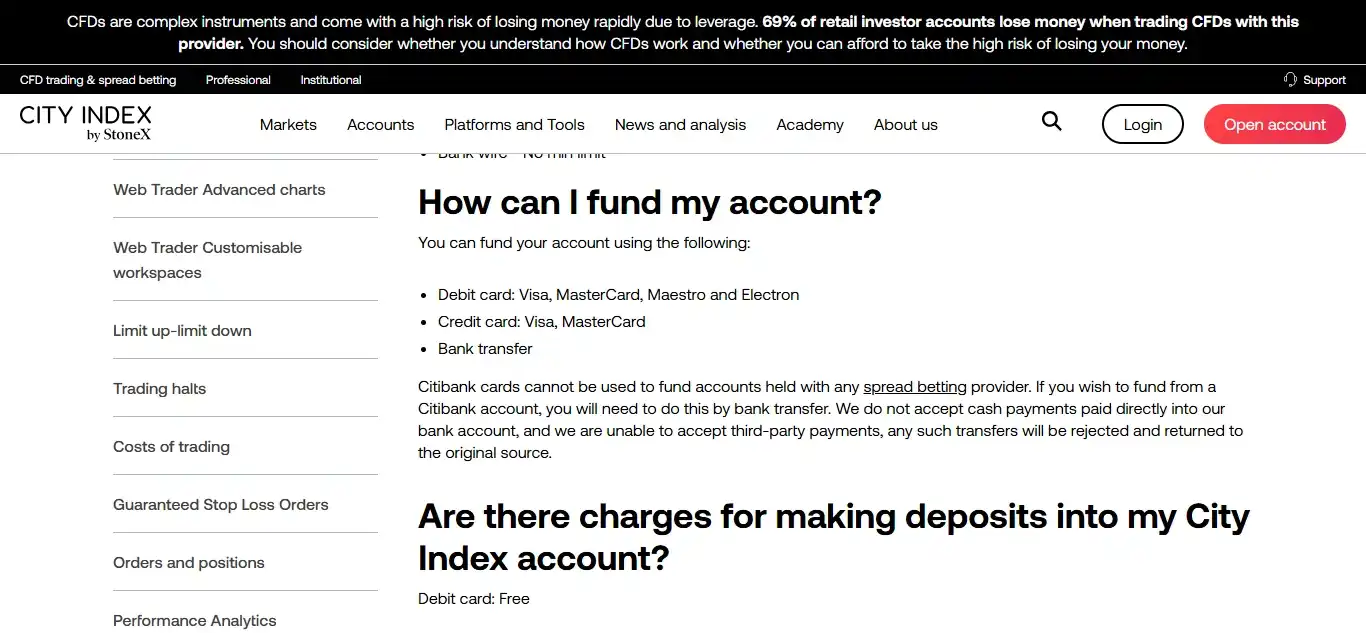
Processing times are instant for card and PayPal deposits, while bank transfers typically take 1-3 business days.
Withdrawals are returned to the original deposit source, a standard anti-money-laundering requirement. There are no withdrawal fees, except for same-day CHAPS bank transfers (GBP 25 fee). The minimum withdrawal amount is GBP/USD 100 (or your full balance if less). Standard processing takes 3-5 business days.
KYC verification (Know Your Customer checks) is required before depositing or withdrawing funds. You will need a valid passport or government-issued ID and proof of address.
Customer Support & Education
City Index offers customer support through phone, live chat, and email (support.uk@cityindex.com).
Support hours run 24/5, from Sunday 15:00 GMT to Friday 22:00 GMT. UK phone numbers include 0800 032 1948 (toll-free), +44 207 429 7900 (international), and 0203 194 1801 (local rate). There is no weekend support.
Customer service feedback is generally positive, with a multilingual team available for account and trading queries.
On the education side, City Index provides a trading academy with courses, video tutorials, a glossary, and market analysis. Research tools include Trading Central integration, an economic calendar, analyst views, and Featured Ideas. Webinars are available but infrequent and typically require an active account. The demo account (GBP 10,000 virtual funds, 12-week limit) lets you test the platform before committing real capital.
City Index vs The Competition
How does City Index stack up against its closest rivals?
City Index vs IG: Both are FCA-regulated, long-standing UK brokers offering spread betting. IG has the edge on market range (17,000+ versus 13,500+), supports MT5, and offers DMA (Direct Market Access) pricing with broader research coverage. City Index counters with native TradingView integration and guaranteed stop-loss orders. On spreads, IG averages around 0.6 pips on EUR/USD versus City Index’s 0.74-0.8 pips. If MT5 or the widest possible market range matters to you, IG wins. For TradingView-powered charting built into the broker platform, City Index holds its own.
City Index vs CMC Markets: Both are FCA-regulated and offer spread betting. CMC Markets provides a much larger forex selection (330+ pairs versus 84+) and supports MT4, MT5, and TradingView. CMC’s average EUR/USD spread of around 0.65-0.7 pips is slightly tighter than City Index. City Index differentiates with its NASDAQ-listed parent, guaranteed stop-loss orders, and 40+ year track record. If platform variety and forex pair selection are priorities, CMC Markets has the advantage.
City Index vs Pepperstone: This is the comparison for cost-conscious traders. Pepperstone offers spreads from 0.0 pips plus a low commission on its Razor account, making it significantly cheaper for active forex trading. It also supports MT5, cTrader, and copy trading, all features City Index lacks. City Index counters with spread betting (which Pepperstone does not offer through its non-UK entities), a longer operating history, and its publicly traded parent. For the lowest trading costs, Pepperstone wins. For regulatory pedigree and spread betting, City Index wins.
Conclusion
City Index is a well-established, multi-regulated broker with real strengths in platform quality, market breadth, and regulatory security. Backed by NASDAQ-listed StoneX Group and regulated by three Tier-1 authorities, it offers institutional credibility that many competitors cannot match. The proprietary Web Trader with native TradingView integration, spread betting for UK clients, and guaranteed stop-loss orders are clear differentiators.
That said, City Index is not the cheapest option available. Traders who prioritize the lowest possible spreads will find better pricing at Pepperstone or IC Markets. The lack of MT5, the absence of copy trading, and a limited cryptocurrency selection are genuine gaps that may steer certain traders elsewhere.
City Index is best for intermediate to advanced traders, particularly those based in the UK, who want a regulated broker with a proven track record, strong platforms, and access to spread betting. It is not the best fit for cost-sensitive scalpers or traders who need MT5, copy trading, or extensive crypto CFD options.
Disclaimer: CFDs are complex instruments and come with a high risk of losing money rapidly due to leverage. 69% of retail investor accounts lose money when trading CFDs with this provider. You should consider whether you understand how CFDs work, and whether you can afford to take the high risk of losing your money.
Frequently Asked Questions


Compare City Index with Other Brokers
See how City Index stacks up against other brokers in our detailed comparison tool.
Login
Please login to comment
0 Reviews
Newest