



Pros
- ASIC Tier-1 regulation with segregated funds
- Raw spreads from 0.0 pips on Edge
- 12,000+ tradable instruments across multiple classes
- ECN execution via Equinix NY4 servers
- No deposit or withdrawal fees
Cons
- No investor compensation scheme available
- TMGM Academy discontinued in 2023
- Offshore entities offer weaker regulatory protection
- Inactivity fee applies on dormant accounts
- IRESS accounts require $5,000 minimum deposit
What Makes TMGM Different?
The broker you trade with affects everything from execution quality to how protected your money is. TMGM (TradeMax Global Markets) has carved out a distinct position by bringing institutional-level infrastructure to retail traders.
Founded in 2013 in Sydney by former interbank foreign exchange dealers, TMGM was built from the ground up around professional-grade execution rather than bolted-on retail features. Originally operating as TradeMax before rebranding in 2018, the company now serves traders in over 150 countries.
That institutional DNA shows most clearly in TMGM’s ECN (Electronic Communication Network) execution model, where your orders are matched electronically with other market participants rather than processed by an internal dealing desk. Orders route through Equinix NY4 data centers in New York, the same facilities used by major banks and hedge funds, with pricing pulled from 10+ Tier 1 liquidity providers through OneZero technology. Average execution speed sits at approximately 30 milliseconds.
Instrument range is another genuine differentiator. Over 12,000 tradable instruments span 60+ forex pairs, 10,000+ share CFDs (via the IRESS DMA platform), metals, energies, indices, and cryptocurrencies. That places TMGM among the largest product selections available to retail traders.
TMGM operates through a multi-entity structure with primary ASIC regulation in Australia (Tier 1) and additional licenses in New Zealand, Vanuatu, Mauritius, Seychelles, and Kenya. Which entity handles your account depends on your country of residence, and this directly affects the level of protection you receive. The broker has also built brand visibility through partnerships with Chelsea FC and the Brooklyn Nets.

What TMGM Does Well
TMGM’s core strengths revolve around trading infrastructure and cost efficiency. The ASIC regulation under Trademax Australia Limited (AFSL 436416) provides a solid regulatory foundation, with client funds held in segregated accounts at National Australia Bank (NAB).
Spreads on the Edge account are genuinely competitive. During peak sessions, EUR/USD averages around 0.1 pips and frequently touches 0.0 pips. Paired with a $7 round-turn commission per standard lot, the total cost of trading sits in line with leading ECN brokers like IC Markets and Pepperstone.
The 12,000+ instrument count is a significant draw, particularly for share CFD traders. The IRESS platform gives you DMA (Direct Market Access) to exchanges in the US, UK, Australia, Hong Kong, China, and Singapore, complete with Level 2 order book depth. Very few retail brokers offer this level of exchange access.
Where TMGM Falls Short
The most significant gap is the absence of an investor compensation scheme. To put this in context: brokers regulated by the FCA offer up to GBP 85,000 through the FSCS, and CySEC-regulated brokers provide EUR 20,000 through the ICF. ASIC does not mandate any such fund. TMGM does carry Civil Liability Insurance of up to AUD 10 million, but insurance and a statutory guarantee are fundamentally different things.
Traders outside Australia and New Zealand should also note that they will likely be onboarded under one of TMGM’s offshore entities (Vanuatu, Seychelles, Mauritius), where regulatory protections are considerably lighter than the ASIC-regulated Australian entity.
There is also some inconsistency around the inactivity fee. Some sources report $10 per month after 12 months of dormancy, while others cite $30 per month after 6 months with a balance under $500. This is worth confirming directly with TMGM based on your specific entity before you open an account.
Regulation & Safety
Your broker’s regulatory status determines how protected your funds are when things go wrong. TMGM operates through six regulated entities across multiple jurisdictions.
Regulatory Licenses
TMGM holds the following licenses:
- Trademax Australia Limited – ASIC (AFSL 436416) – Tier 1
- Zero Markets (NZ) Limited – FMA New Zealand (FSP 569807) – Tier 2
- Trademax Global Limited – VFSC Vanuatu (40356) – Tier 3
- Trademax Global Markets (International) Pty Ltd – FSC Mauritius (GB22201012) – Tier 3
- Trademax Global Markets (SE) Limited – FSA Seychelles (SD224) – Tier 3
The ASIC license anchors TMGM’s regulatory credibility. ASIC is a Tier-1 global regulator with strict capital adequacy requirements. That said, most international clients will end up onboarded under one of the offshore entities, where the level of oversight and protection drops significantly.
In May 2024, ASIC issued two interim DDO (Design and Distribution Obligations) stop orders against Trademax Australia Limited, relating to deficiencies in client onboarding questionnaires. These were procedural compliance measures, not fraud allegations. The orders were issued May 23, extended June 13, and lifted June 25, 2024 after TMGM implemented improvements. For context, similar orders have been issued to other brokers, including FXCM in 2025.
TMGM does not accept clients from the United States, Canada, or Japan.
Client Fund Protection
Client funds held under the Australian entity are kept in segregated accounts at National Australia Bank (NAB), an AA-rated Australian authorized deposit-taking institution. In practical terms, your trading capital is held separately from TMGM’s own operational money.
TMGM carries Civil Liability Insurance providing coverage of up to AUD 10 million. While this adds a layer of protection, it does not function the same way as a statutory investor compensation scheme, which guarantees a fixed payout regardless of the broker’s financial position.
Negative balance protection is available for clients under the ASIC and FMA (New Zealand) entities, meaning you cannot lose more than your deposited funds. If you are onboarded under an offshore entity, confirm whether this protection applies to your account before trading.
Company History & Reputation
TMGM has been operating since 2013, with headquarters in Sydney and additional offices in Melbourne, Adelaide, Brisbane, Canberra, Auckland, and Taiwan.
The broker holds a Trustpilot rating of approximately 3.9/5 (around 836 reviews on tmgm.com). ForexBrokers.com assigns a Trust Score of 83/99 (Trusted). Positive themes in reviews include low spreads, fast execution, and responsive support. On the negative side, there are scattered reports of account freezes during compliance reviews and occasional withdrawal delays.
A significant reputational concern is the existence of clone and scam websites (tmgm-llc.net, tmgm.win, tmgm-q.com, tmgm-sapp.shop) that impersonate the real broker. Many negative reviews attributed to TMGM actually trace back to these fraudulent sites. Always verify you are on the official tmgm.com domain.
Account Types & Fees
TMGM keeps its account lineup simple: two core MetaTrader account types and a separate tier for IRESS DMA share trading.
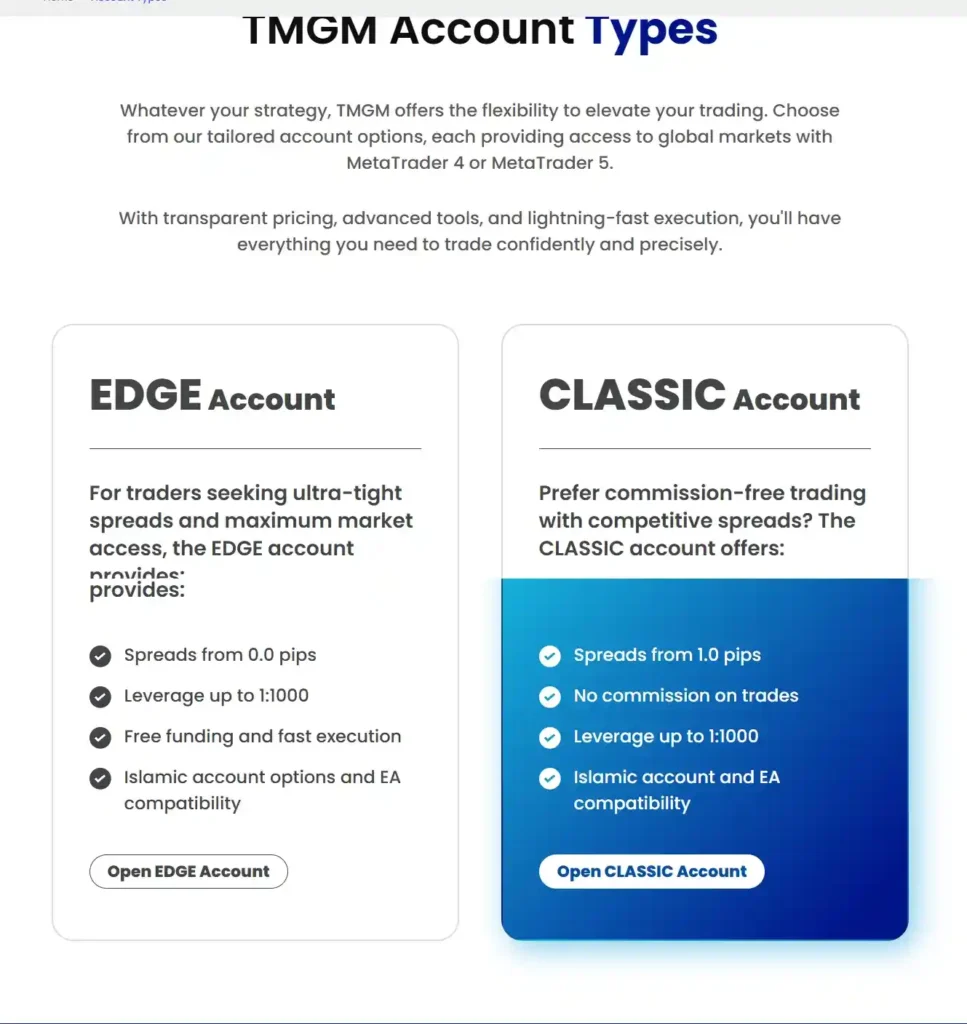
Edge Account – This is TMGM’s ECN account with raw pricing. Spreads start from 0.0 pips, with a commission of $3.50 per side ($7 round turn) per standard lot on forex and metals. Indices and share CFDs on MetaTrader remain spread-only, even on Edge. The minimum deposit is $100.
Classic Account – A commission-free account where trading costs are built into wider spreads. Typical EUR/USD spreads range from 1.0 to 1.4 pips during active sessions. The minimum deposit is $100. This works well for traders who prefer a single, visible cost per trade and trade lower volumes.
Islamic (Swap-Free) Account – Available on both Edge and Classic accounts for clients who follow Sharia law. Instead of overnight swap charges, a fixed administrative financing fee applies, which varies by instrument (for example, $2 for major forex pairs, $10 for indices and energies, $20 for exotics and metals).
Demo Account – Unlimited demo accounts are available with virtual balances of up to $50,000 and a 365-day validity period.
All MetaTrader accounts support six base currencies: USD, AUD, EUR, GBP, NZD, and CAD. EA trading, scalping, and hedging are permitted on all account types.
Inactivity Fee – TMGM does charge a fee on dormant accounts. The specific terms may vary by entity. Traders should confirm the applicable inactivity policy directly with TMGM support upon account opening.
Trading Platforms & Tools
TMGM offers a focused platform selection rather than spreading itself thin. The emphasis falls on MetaTrader and IRESS, supplemented by a proprietary mobile app.
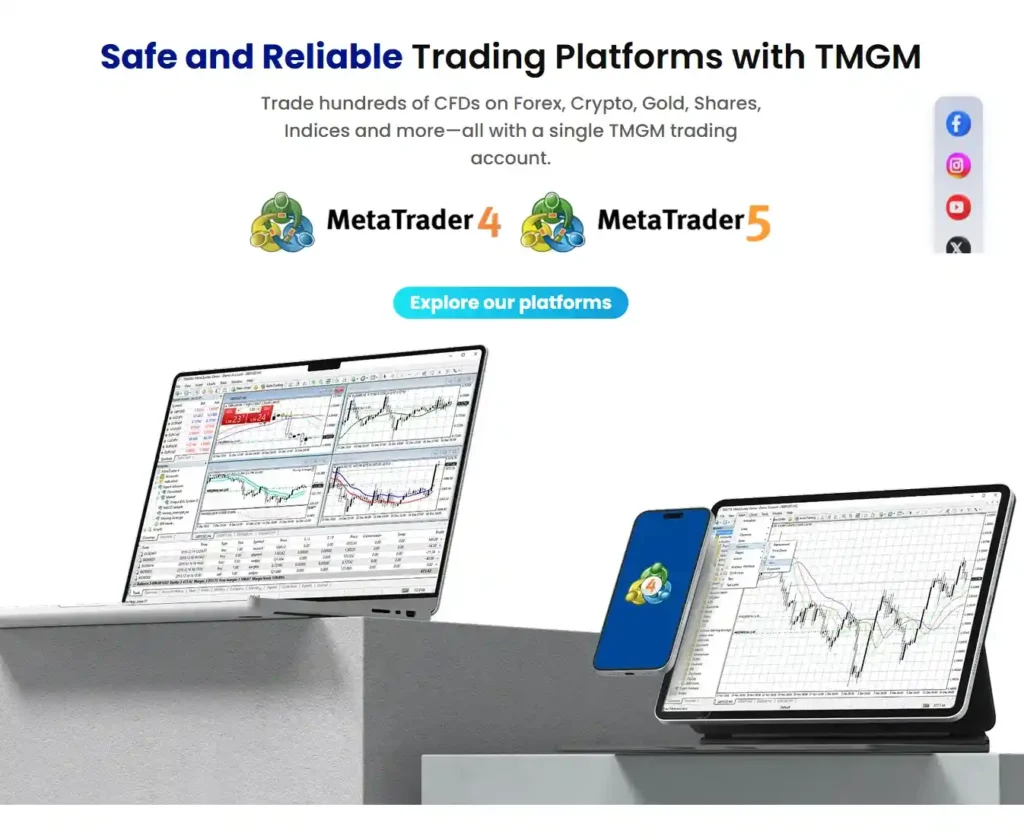
MetaTrader 4 (MT4) – TMGM’s most popular platform, offering full charting, 30+ technical indicators, one-click trading, and Expert Advisor (EA) support. Available on desktop, web, and mobile (iOS/Android). Share CFD access on MT4 is limited to the 30 most popular US stocks.
MetaTrader 5 (MT5) – Adds more timeframes, additional order types, an integrated economic calendar, and broader asset class access including cryptocurrencies. Available on desktop, web, and mobile.
TMGM Mobile App – Proprietary app for account management, deposits/withdrawals, and basic trading.
Additional Tools:
- Trading Central – Market analysis and trading ideas, available as an MT4 plugin
- Acuity Trading – AI-powered market sentiment and news analysis
- HubX Copy Trading and MT Signals for social/copy trading
- ForexVPS – Free with 7+ lots/month and $3,000+ deposit
- Trading Calculator for position sizing
One notable gap worth flagging: TMGM does not currently offer cTrader or TradingView integration, both of which are available at IC Markets and Pepperstone. If either platform is part of your workflow, this is a meaningful limitation.
Markets & Instruments
Instrument range is one of TMGM’s clearest competitive advantages, with over 12,000 tradable instruments across seven asset classes.
Forex – 60+ currency pairs covering majors, minors, and exotics. Available on MT4, MT5, and IRESS.
Share CFDs – Over 10,000 share CFDs from US, Australian, UK, Hong Kong, Chinese, and Singaporean exchanges. This is TMGM’s standout category. Full access is exclusive to IRESS; MT4 offers only 30 US stocks.
Indices – 15+ global cash indices including AUS200, US30, SPX500, NAS100, GER40, and HK50.
Precious Metals – Gold, silver, platinum, and palladium. Edge gold spreads start from 0.12 USD.
Energies – Spot CFDs on WTI, Brent crude oil, and natural gas (cash-settled, with overnight financing applying to open positions).
Cryptocurrencies – 10+ crypto CFDs against USD, including Bitcoin, Ethereum, Ripple, and Litecoin. Available on MT5 with 24/7 access.
Leverage varies by jurisdiction: 1:30 for major forex under ASIC (retail), 1:20 for indices, and up to 1:500 (or 1:1000) on offshore entities. This matters because higher leverage amplifies both gains and losses. All products are cash-settled CFDs, meaning you never own the underlying asset.
Trading Costs & Conditions
Understanding your total cost of trading is essential, because spreads alone do not tell the full story. TMGM’s cost structure depends on your account type: the Edge account offers raw spreads plus a fixed commission, while the Classic account uses wider, all-inclusive spreads with no separate commission.
Spread Comparison Table
The table below compares TMGM’s average spreads against two leading competitors during London-New York session overlap, when liquidity is highest. All figures are for raw/ECN accounts.
Instrument | TMGM Edge (Raw) | TMGM Classic | IC Markets (Raw) | Pepperstone (Razor) |
EUR/USD | Avg. 0.1 pips (+$7 RT) | From 1.0-1.2 pips | Avg. 0.02 pips (+$7 RT) | Avg. 0.10 pips (+$7 RT) |
GBP/USD | From 0.0 pips (+$7 RT) | From 1.4 pips | Avg. 0.1 pips (+$7 RT) | Avg. 0.37 pips (+$7 RT) |
AUD/USD | From 0.0 pips (+$7 RT) | From 1.0 pips | Avg. 0.1 pips (+$7 RT) | Avg. 0.27 pips (+$7 RT) |
USD/JPY | From 0.0 pips (+$7 RT) | From 1.0 pips | Avg. 0.1 pips (+$7 RT) | Avg. 0.17 pips (+$7 RT) |
RT = Round Turn commission per standard lot. Spread figures sourced from broker websites and third-party review aggregators. Actual spreads vary with market conditions and trading session.
On the Edge account, the $7 round-turn commission applies to forex and metals only. Indices and share CFDs on MetaTrader are spread-only, so the cost is already baked in.
Swap rates (the cost of holding a position overnight) apply to all standard accounts. Indicative figures: EUR/USD long positions cost approximately -$6.21 per standard lot per night, while shorts receive around $2.28. Swap-free accounts carry fixed administrative fees instead.
TMGM uses an STP/ECN execution model with no dealing desk. Liquidity is aggregated from eight banks and three non-bank market makers, processed through OneZero technology at Equinix NY4.
Deposits & Withdrawals
Funding your account and accessing your profits should be straightforward, and TMGM largely delivers here. The broker supports a broad range of payment methods and charges no fees on its end.
Deposit Methods: Visa, MasterCard, Bank Transfer (1-5 business days), PayPal, Skrill, Neteller, UnionPay, Revolut, Wise, FasaPay, USDT, and USDC.
Minimum Deposit: $100 for Edge and Classic accounts, $5,000+ for IRESS accounts.
Withdrawal Processing: Requests lodged before 14:00 AEST are processed the same business day. E-wallet withdrawals typically arrive within hours; bank transfers take 2-5 business days. Minimum withdrawal is $100.
Fees: TMGM charges no deposit or withdrawal fees. Third-party payment processors or banks may impose their own charges. Using a base currency that matches your bank account avoids unnecessary conversion costs.
Supported Base Currencies: USD, AUD, EUR, GBP, NZD, and CAD.
Important: Some deposit methods (UnionPay, FasaPay, Visa, MasterCard) cannot be used for withdrawals. Funds are returned to the original deposit source up to the deposited amount. KYC (Know Your Customer) verification is required before any withdrawal can be processed.
Customer Support & Education
Responsive support and quality learning materials matter, particularly when you are navigating a new broker’s systems or resolving account issues.
Support Channels: 24/7 live chat (chatbot routing to live agents), email (support@tmgm.com), phone, WhatsApp, Telegram, and social media. Over 10 languages are supported. User reviews consistently highlight fast response times and knowledgeable agents.
Education: TMGM offers a solid educational offering through its TMGM Academy, a structured learning platform designed to help traders at every stage of their development. The Academy is organised into three clearly defined levels: beginner, intermediate, and advanced. Each building on the last to take traders from foundational concepts through to more sophisticated techniques.
TMGM vs The Competition
How does TMGM measure up against the two brokers it is most frequently compared to? Below is a direct feature-by-feature comparison.
Feature | TMGM | IC Markets | Pepperstone |
Primary Regulation | ASIC (436416) | ASIC, CySEC | ASIC, FCA, CySEC, BaFin |
Founded | 2013 | 2007 | 2010 |
Min. Deposit | $100 | $200 | $0 (recommended $200) |
Total Instruments | 12,000+ | 3,583 | 1,726 |
EUR/USD Raw Spread | Avg. 0.1 pips | Avg. 0.02 pips | Avg. 0.10 pips |
Commission (ECN) | $7 RT | $7 RT (MT4/5) | $7 RT (MT4/5) |
Platforms | MT4, MT5 | MT4, MT5, cTrader, TradingView | MT4, MT5, cTrader, TradingView |
Share CFDs | 10,000+ | 2,100+ | 1,000+ |
Education | Limited (Academy closed) | In-depth | Comprehensive |
Investor Compensation | None | None (ASIC); ICF (CySEC) | FSCS (FCA); ICF (CySEC) |
Where TMGM wins: Instrument count is the standout advantage. Over 12,000 instruments and IRESS DMA access for share CFDs put TMGM well ahead in product breadth. The $100 minimum deposit undercuts IC Markets’ $200 threshold. And TMGM’s Equinix NY4 infrastructure matches the server setup IC Markets uses.
Where TMGM falls behind: Platform variety is a clear weakness. Both IC Markets and Pepperstone offer cTrader and TradingView, which TMGM does not. On the regulatory front, Pepperstone’s FCA regulation provides FSCS coverage up to GBP 85,000, and IC Markets’ CySEC entity offers ICF coverage up to EUR 20,000. TMGM offers neither. On raw spreads, IC Markets holds a slight edge with a 0.02-pip EUR/USD average versus TMGM’s 0.1, though the practical cost difference works out to roughly $0.80 per standard lot.
The verdict: All three deliver competitive ECN pricing. Choose TMGM if instrument range and access are your priorities. Look to IC Markets or Pepperstone if platform variety and investor compensation carry more weight.
Conclusion
TMGM is a credible, ASIC-regulated broker that delivers institutional-grade infrastructure to retail traders. ECN execution through Equinix NY4, raw spreads from 0.0 pips, and over 12,000 instruments give it genuine competitive strengths.
The broker suits intermediate-to-advanced traders who value tight pricing, fast execution, and broad market access, especially those interested in share CFD trading. Active traders who do not need extensive hand-holding will find a strong trading environment at competitive costs.
TMGM is less ideal for beginners, traders who prioritize investor compensation schemes, or those whose workflow depends on cTrader or TradingView. If any of these factors matter to you, Pepperstone or IC Markets may be stronger alternatives.
Always verify you are signing up through the official website (tmgm.com) and confirm which regulatory entity you are being onboarded under.
Risk Warning: Trading forex and CFDs carries a high level of risk and may not be suitable for all investors. You could lose more than your initial deposit. Only trade with money you can afford to lose.
Frequently Asked Questions


Compare TMGM with Other Brokers
See how TMGM stacks up against other brokers in our detailed comparison tool.
Login
Please login to comment
0 Reviews
Newest