


Discliamer: This article is for informational and educational purposes only. It does not constitute financial advice. Always do your own research before making any financial or investment decisions.
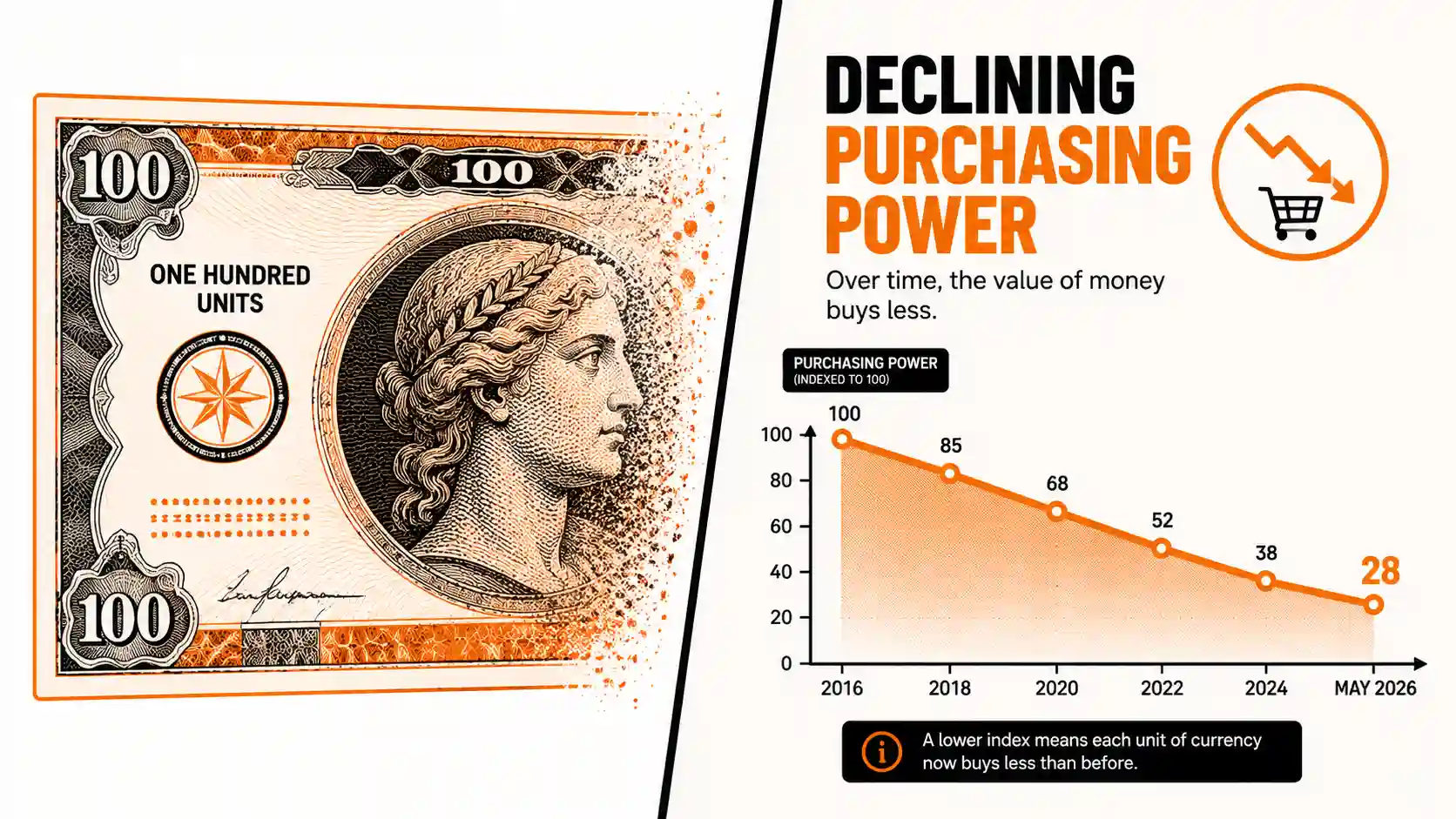
Currency debasement gets thrown around constantly in financial media and explained precisely almost never. This article gives you a structured framework of 8 observable signs that a currency is being systematically debased, along with what each sign means and how to recognize it in the data.
These signs are measurable. You do not need headlines or gut feelings. Watch specific data points, understand what they signal, and draw your own analytical conclusions.
What Currency Debasement Means
Most people have a rough sense that their money buys less over time. What they are less clear on is why, and whether what they are observing is routine economic friction or something more structural.
Currency debasement refers to a systematic reduction in the real value of a currency, driven by policy decisions that expand the money supply faster than the productive output of the economy grows. Each unit of currency ends up representing a smaller and smaller claim on real goods, services, and assets.
This is a process that happens over time and rarely announces itself.
Debasement vs. Inflation: Why the Distinction Matters
Inflation and currency debasement are related, but they are not the same thing, and conflating them leads to poor analysis.
Standard inflation can be temporary. A supply shock, a spike in commodity prices, a disrupted logistics chain; these can all drive prices higher for a period, then normalize when the underlying cause resolves. The currency itself has not necessarily changed in structural terms.
Debasement, on the other hand, is a persistent, policy-driven erosion of the currency’s foundation. When a government or central bank consistently expands the money supply beyond what economic growth justifies, the currency’s relationship to real value shifts over time. Prices rise not because goods became scarcer, but because the money chasing them became more abundant.
The practical distinction means that inflation can reverse; but debasement, once structural, leaves a permanent mark on purchasing power.
That line between the two is exactly what the following 8 signs help you identify.
Sign 1: Rapid and Sustained Expansion of the Money Supply
If one sign sits at the foundation of all the others, this is it. Everything downstream of monetary policy begins here.
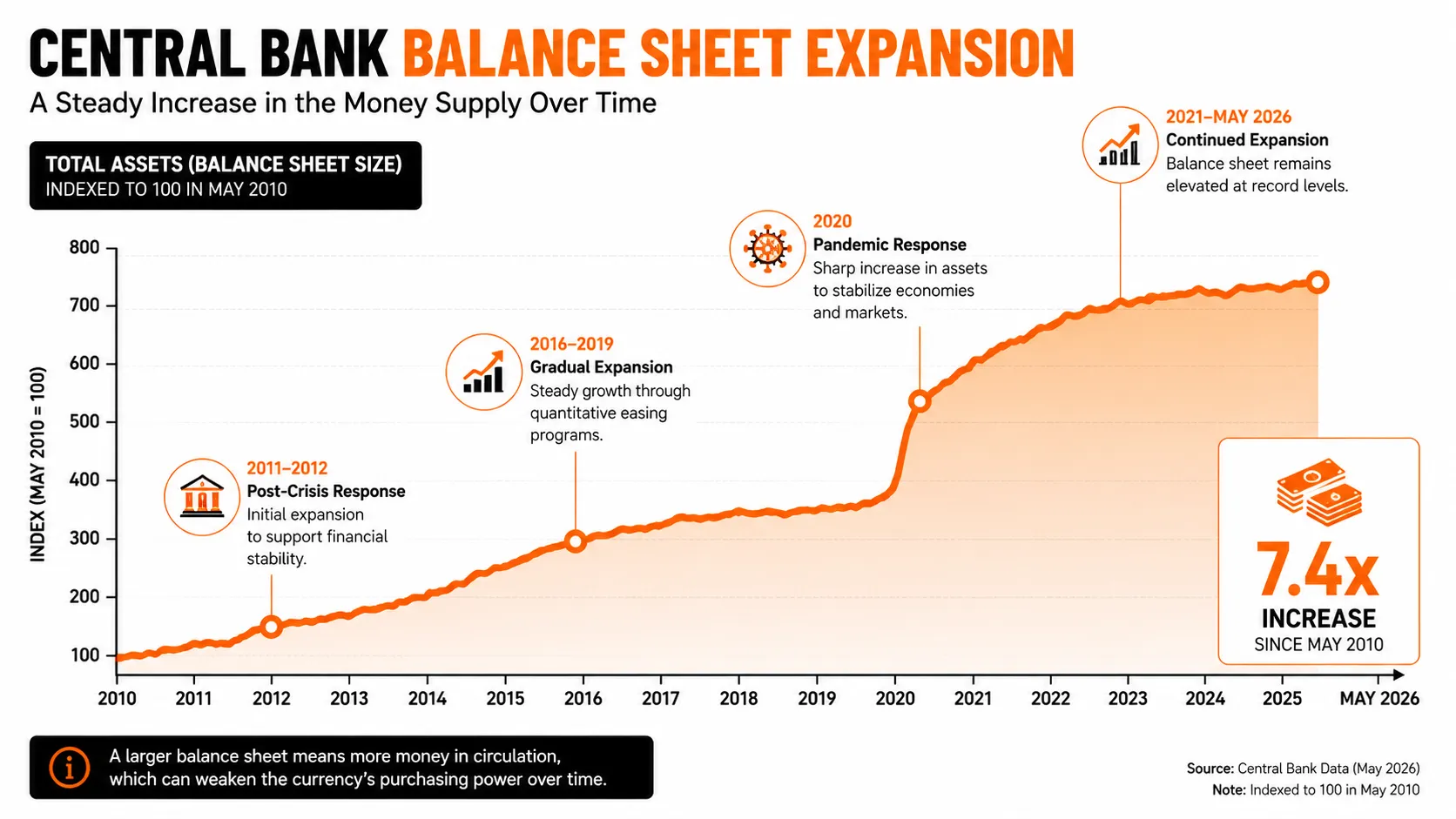
When central banks expand the monetary base faster than economic output grows, more units of currency are chasing roughly the same amount of real output. The math is straightforward, even if the consequences take time to materialize.
What to Watch: M1, M2, and Central Bank Balance Sheet Growth
The key data points here are:
- M1: The narrowest measure: physical currency in circulation plus demand deposits. A rapid M1 surge typically reflects direct monetary injection.
- M2: A broader measure that includes M1 plus savings accounts, time deposits, and money market funds. M2 growth is the more widely tracked signal for longer-term monetary expansion.
- Central bank balance sheet: When central banks purchase assets (government bonds, mortgage-backed securities) through quantitative easing programs, their balance sheet expands. A balance sheet that doubles or triples over a short period, without a corresponding growth in real output, is a structural signal worth tracking.
In practical terms: if M2 growth is running at 15-20% annually in an economy growing at 2-3%, the gap between monetary expansion and real output is widening. That gap typically finds its way into prices. Understanding how central bank policy decisions drive market conditions helps connect the monetary mechanics here to what you actually see moving in markets.
Sign 2: Persistent Negative Real Interest Rates
Interest rates are, in theory, the price of money. When that price falls below the rate at which money is losing value, something structurally important is happening.
Why Rates Below Inflation Are a Structural Signal
Real interest rates are calculated by subtracting inflation from nominal interest rates.
If a central bank sets rates at 1% and inflation is running at 4%, the “real” interest rate is -3%. Savers holding cash or low-yield instruments are losing purchasing power every year they hold them, in real terms.
One quarter of negative real rates can be a policy response to an economic shock: manageable, often intentional, and historically temporary.
Persistent negative real rates, sustained over multiple years, are a different signal entirely. They indicate that the cost of holding currency is suppressed, which tends to:
- Encourage borrowing and leverage over saving
- Inflate asset prices as capital chases yield
- Erode the real return on anything denominated in that currency
When real rates remain consistently negative across multiple rate cycles, you are looking at a structural feature of how that monetary system is operating.
The next question follows naturally: if negative real rates are suppressing the value of holding currency, where does that value go?
Sign 3: Accelerating Erosion of Purchasing Power
Purchasing power erosion is the lived experience of debasement. It is also the most politically sensitive sign, which is partly why it is often the most contested.
How to Track Real Purchasing Power Decline Over Time
The standard measure is the Consumer Price Index (CPI), which tracks the price of a representative basket of goods and services over time. CPI is useful as a directional indicator, but it carries well-documented limitations:
- The basket composition changes over time, which affects comparability
- Hedonic adjustments can reduce measured price increases for goods that technically improve in quality
- Housing costs and asset price inflation are only partially captured
- Regional and demographic variation in spending patterns means CPI reflects an average household
For a more grounded picture of purchasing power erosion, compare:
- The nominal price of a fixed set of essential goods (food, energy, housing, healthcare) over a 10-20 year period
- Wage growth in real terms against those price increases
- The price of assets like property, expressed in units of average annual wages over time
When the number of labor hours required to purchase a given basket of goods increases steadily over a decade, real purchasing power compression is happening regardless of what the headline CPI figure says.
This sign compounds. Accelerating erosion, rather than steady erosion, tends to confirm that the monetary dynamics driving it are structural rather than cyclical. Traders who incorporate inflation trading strategies into their broader framework are better positioned to interpret these signals when they converge.
Sign 4: Rising Hard Asset Prices Relative to the Currency
Gold has been priced in currencies for a very long time. When gold’s price rises persistently in terms of a given currency, one useful interpretation is that the currency is depreciating against a fixed reference point.
Gold, Real Estate, and Commodities as Debasement Gauges
Hard assets (physical goods with intrinsic utility or finite supply) tend to maintain their real value across monetary cycles because they are not subject to the same supply expansion dynamics as fiat currency. Their price behavior in currency terms makes them a useful debasement gauge.
Key indicators to watch:
- Gold price trends: Sustained multi-year gold appreciation in currency terms is one of the more historically consistent debasement signals. Gold produces no yield, so investors holding it are specifically expressing a preference against currency-denominated assets. For traders looking at the mechanics of this market, a grounding in how to trade gold and what drives its price movements is worth having alongside the debasement framework.
- Real estate prices relative to wages: When property prices rise persistently faster than wage growth, the asset is partly absorbing currency depreciation rather than reflecting genuine demand growth alone.
- Commodity price baskets: A broad commodity index rising in local currency terms (particularly when the rise is not explained by supply disruption) can reflect currency weakness rather than commodity strength.
One important distinction: rising hard asset prices can have multiple causes. Demand shifts, supply constraints, and speculative cycles all move these markets. The debasement signal strengthens when multiple hard assets rise simultaneously, in the same currency, over a sustained period.
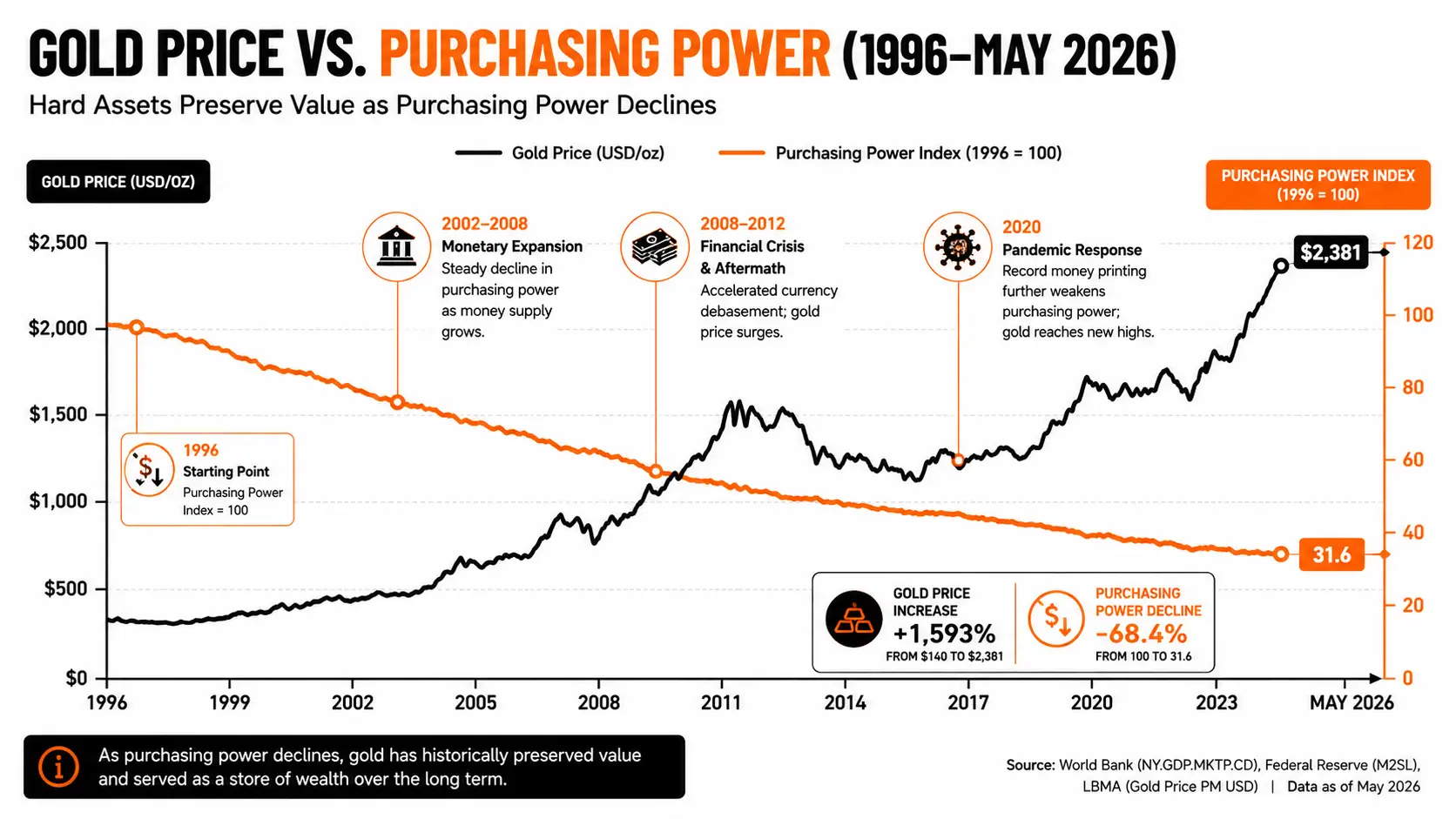
When gold, real estate, and commodities are all moving in the same direction at once, that tends to say more about the currency than the assets.
Sign 5: Government Debt Monetization at Scale
This is the sign that moves debasement from passive drift into active acceleration, and it is the one that most directly connects monetary policy to fiscal reality.
When Central Banks Become the Primary Buyer of Sovereign Debt
Governments borrow money by issuing bonds. In a functioning market, those bonds are purchased by private investors (pension funds, banks, foreign governments, and individuals) who demand a yield in return for lending. The market sets the price.
Debt monetization occurs when a central bank purchases government bonds directly or on the secondary market at scale, effectively creating new currency to fund government spending. The practical effect: the government’s borrowing costs are suppressed, and the money supply expands in proportion to the purchases.
At modest and temporary levels, this is a standard policy tool. At sustained and large scale, it signals something more serious:
- The government cannot fund its spending through market demand alone
- The central bank is absorbing debt that private markets will not buy at acceptable yields
- New currency creation is directly linked to sovereign fiscal needs rather than economic output
When a central bank’s balance sheet expansion closely correlates with government deficit spending over multiple years, the two dynamics are feeding each other. That feedback loop is one of the more reliable structural signals in the debasement framework.
Sign 6: Loss of Reserve Currency Confidence
Global currency dynamics operate on confidence. When that confidence shifts, it tends to do so slowly at first, then faster than anyone anticipated.
Early Warning Signals in FX Markets and Foreign Holdings Data
Reserve currency status is not guaranteed permanently to any currency. It is maintained by a combination of economic size, financial market depth, institutional credibility, and the willingness of foreign governments and institutions to hold that currency as a store of value and trade settlement mechanism.
Signals to monitor:
- Foreign holdings of sovereign debt: Central bank and government holdings of another country’s debt, tracked through published Treasury International Capital (TIC) data or IMF reserve composition reports, show whether foreign confidence is growing or declining. A sustained reduction in foreign holdings is a meaningful signal.
- FX market trends: A persistently weakening currency against a basket of peers, adjusted for relative inflation differentials, indicates that market participants are pricing in reduced confidence in that currency’s value.
- Bilateral trade settlement shifts: When major trading relationships begin settling transactions in currencies other than the established reserve currency, it is an early structural signal that reserve status is being questioned in practice.
- Currency diversification announcements: Official statements from foreign central banks about diversifying away from any given reserve currency are rare and meaningful when they occur.
No single quarter of data makes this case. This is a multi-year trend to watch.
Sign 7: Wage Growth That Lags Price Increases Persistently
The previous signs are largely detectable through financial data. This one is detectable in daily life, which is partly what makes it the most politically significant.
The Real Standard-of-Living Compression Signal
When wages grow more slowly than prices over a sustained period, real household income falls. Workers earn more nominal currency but can purchase less with it. This is currency debasement as most people actually experience it: at the household level, in the weekly shop.
The distinction between a temporary squeeze and a structural one:
- Temporary lag: Wages fall behind prices for one to two years following a supply shock, then recover as labor markets adjust
- Structural divergence: Wages consistently trail price growth across multiple economic cycles, with no meaningful convergence over five to ten year periods
Key data to watch:
- Real wage growth (nominal wage growth minus CPI)
- Productivity growth relative to wage growth: if productivity rises but wages do not, the labor share of output is declining regardless of monetary dynamics
- Discretionary spending share of household income: when essential costs (housing, food, energy) consume a growing share of income over time, purchasing power compression is occurring at the standard-of-living level
Persistent real wage declines are not always a debasement story in isolation. But when wage stagnation occurs alongside money supply expansion, negative real rates, and rising hard asset prices, it fits a recognizable pattern.
That pattern has historical precedents worth examining directly.
Sign 8: Historical Parallel Recognition
History does not repeat, but it does provide data. Several well-documented historical cases show what the full constellation of debasement signs looks like when they compound over time into visible economic breakdown.
Weimar, Zimbabwe, Argentina: What the Pattern Looks Like at Scale
These three cases are the most frequently cited in discussions of currency collapse, and for good reason. Each is extensively documented, analytically distinct, and instructive at different stages of the debasement arc.
Weimar Germany (1921-1923): The post-World War I German government faced reparations obligations it could not fund through taxation or external borrowing. The Reichsbank monetized government debt at scale, the money supply expanded exponentially, and the currency lost virtually all value within a compressed timeframe. The progression from monetary expansion to hyperinflation moved faster than most contemporary observers believed possible.
Zimbabwe (2000s): Land reform policies that disrupted agricultural output, combined with sustained deficit spending funded through money printing, produced one of the most severe hyperinflationary episodes in modern history. Foreign currency confidence collapsed, official exchange rates became disconnected from parallel market rates, and the central bank ultimately abandoned its own currency. The early signs (money supply expansion, negative real rates, hard asset price surges in local currency terms) were present years before the terminal phase.
Argentina (recurring): Argentina represents a different and arguably more instructive case precisely because it has repeated across decades. The pattern of fiscal imbalances, monetary expansion, peso depreciation, loss of reserve confidence, capital controls, and eventual restructuring has occurred multiple times. The early-stage signs are well-established and recognizable. Argentina demonstrates that structural debasement can recur in the same economy across different political administrations when the underlying fiscal and monetary dynamics remain unresolved.
The analytical value of these cases is that they document the sequence: monetary expansion precedes purchasing power erosion; purchasing power erosion precedes loss of reserve confidence; loss of reserve confidence accelerates the process. The signs are observable at each stage.
With all signs established, the practical question becomes: how do you actually track these factors?
How to Monitor These Signs as a Trader or Investor
None of the 8 signs in this framework require specialist tools or proprietary data access. Most of the relevant data is publicly available, regularly updated, and free to access.
Here is a practical starting framework:
Monetary data (Signs 1 and 5)
- M1 and M2 data is published regularly by central banks (the Federal Reserve, ECB, Bank of England, and others)
- Central bank balance sheet size and composition is publicly reported. Track total assets as a percentage of GDP for meaningful context
- Government bond auction results and central bank participation rates are published through finance ministry and central bank communications
Rate and inflation data (Signs 2 and 3)
- Nominal interest rates are set by central banks and widely reported
- CPI data is published monthly by national statistics agencies
- Real rate calculation: subtract CPI from the central bank’s policy rate
- For purchasing power tracking, shadow statistics publications and alternative inflation measures provide useful supplementary context alongside official CPI
Asset price behavior (Sign 4)
- Gold spot price history is widely available
- Real estate price-to-income ratios are tracked by academic institutions and property research organizations in most developed markets
- Commodity indices (such as the CRB Index or Bloomberg Commodity Index) provide a broad basket view
Reserve confidence and FX (Sign 6)
- IMF Currency Composition of Official Foreign Exchange Reserves (COFER) data tracks global reserve currency allocation by quarter
- US Treasury International Capital (TIC) data shows foreign holdings of US securities
- FX rate trends are observable through any standard trading platform
Wage data (Sign 7)
- Real wage growth data is published by national statistics agencies and OECD for most developed economies
- Bureau of Labor Statistics (US), ONS (UK), Eurostat (EU), and equivalent agencies in other jurisdictions publish regular wage and earnings reports
The most useful monitoring approach is to watch for convergence across signs. One sign moving in a concerning direction has multiple plausible explanations. Three or four signs moving together, in the same currency and over the same period is where the analytical signal strengthens considerably.
Frequently Asked Questions


Comments