


Analysis Paralysis in Trading: Why You Freeze and How to Fix It
Disclaimer: This article is for informational and educational purposes only. It does not constitute financial or psychological advice. If you experience persistent anxiety related to trading or decision-making, consider consulting a qualified professional.
Analysis paralysis is the inability to make a decision because you are overwhelmed by information, options, or the fear of being wrong. In trading, it shows up when excessive research, indicator stacking, or constant second-guessing prevents you from executing a valid setup. Instead of improving decision quality, overanalysis often leads to missed opportunities, inconsistent performance, and reduced confidence. Understanding how analysis paralysis develops is the first step toward building a structured decision-making process that balances preparation with timely execution.

What Is Analysis Paralysis in Trading?
Analysis paralysis in trading is the state where you become so consumed by evaluating information, so fixated on finding certainty, that you fail to act at all.
Picture standing in front of a restaurant menu with 200 options. You are hungry, you know what you generally like, but the sheer volume of choices locks you up. In trading, the menu is your charts, indicators, news feeds, and the voices in your head insisting this could go wrong.
The Psychology Behind Overthinking Trades
Analysis paralysis is rooted in cognitive overload and fear. Your brain is wired to seek safety, and in uncertain environments like the markets, it interprets inaction as protection. The more information you consume, the more potential problems you identify, and the more risk feels unacceptable.
This creates a feedback loop. The more you analyze, the more conflicting data surfaces. The less confident you feel, the more you analyze. Round and round it goes until the opportunity vanishes entirely. Analytical traders are especially prone to this trap because they believe a “right” answer is hiding somewhere in the data. Waiting for the perfect trade is a recipe for inaction.
Analysis Paralysis vs. Healthy Due Diligence
Healthy due diligence has a defined endpoint. You check your criteria, confirm the setup matches your trading plan, assess your risk, and decide. Analysis paralysis has no stopping point. You keep circling the same data, layering in new inputs, and never reaching a conclusion.
Productive analysis moves you toward a decision. Overthinking moves you away from one. If you have been staring at the same chart for 15 minutes and feel less certain than when you started, you have crossed the line.
So how do you know when you have crossed it? The warning signs are more specific than you might expect.
Warning Signs You Are Stuck in Analysis Paralysis
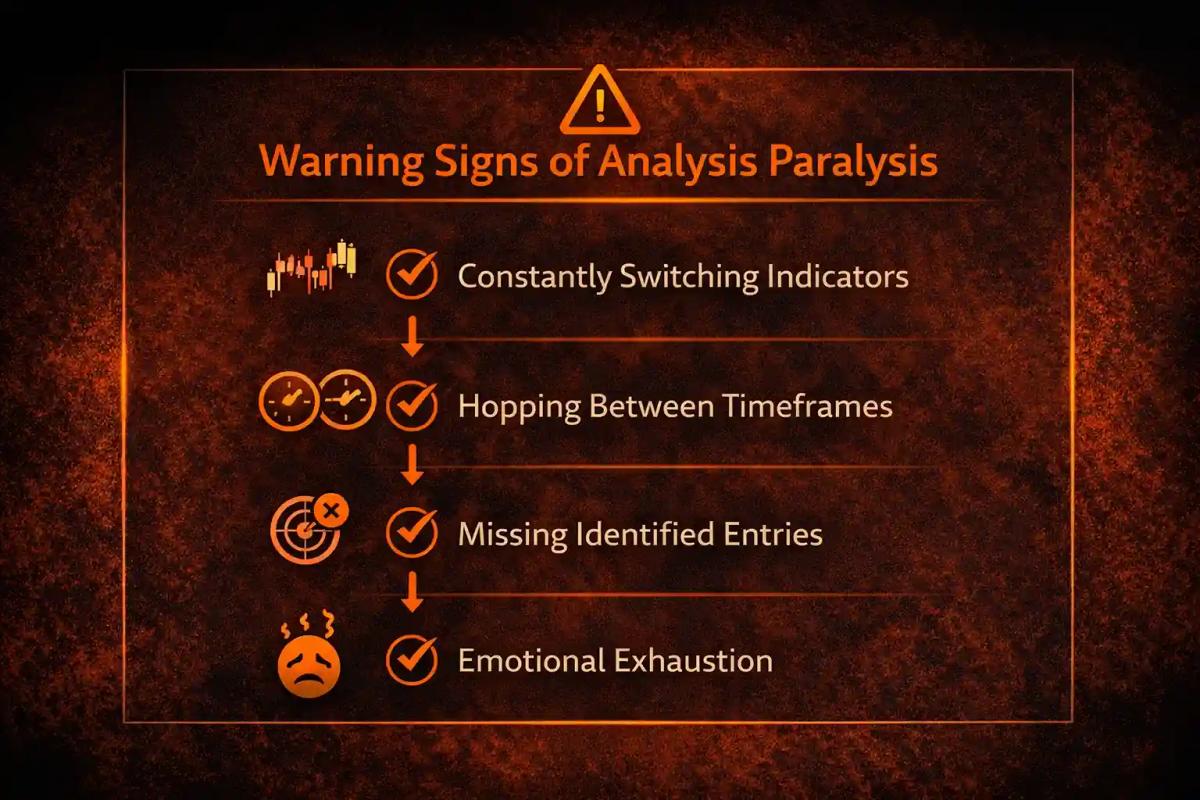
Recognizing the pattern is the first step to breaking it. Analysis paralysis does not always announce itself with dramatic frustration. More often, it creeps in quietly, disguised as thoroughness.
Behavioral Indicators
- Constant indicator switching. You add an RSI, then a MACD, then Bollinger Bands, then volume. Each new indicator introduces information but moves you no closer to pulling the trigger.
- Timeframe hopping. You check the 5-minute, then the 15, then the 1-hour, then the daily, hunting for perfect agreement that rarely exists.
- Missing entries you already identified. You spotted the setup, marked your levels, then watched price hit your entry without placing the order because you were still analyzing.
- Trades analyzed and never acted on – that is a red flag worth paying attention to.
Emotional Indicators
- Frustration after missed trades you knew were valid setups
- Relief when you avoid a trade, even when the setup was solid (your brain rewarding avoidance behavior)
- Mental exhaustion after sessions where you placed few or no trades
- Growing self-doubt about your ability to read charts or follow through on a strategy
These emotional signals suggest overthinking has become your default mode.
Why Traders Fall Into the Overthinking Trap
Most traders dealing with this issue are affected by one or more of the following root causes. Understanding which one applies to you makes the fix far more targeted.
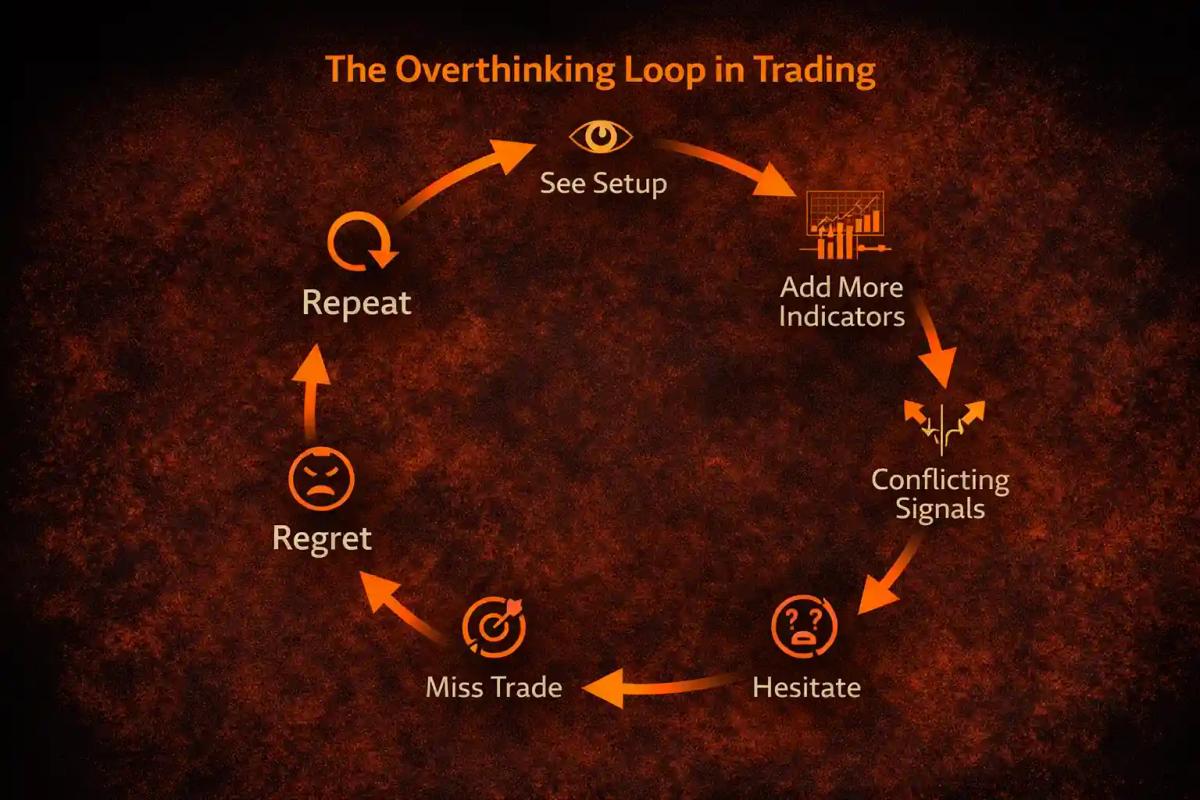
Fear of Loss and Perfectionism
The root fear driving most analysis paralysis is not really about the trade. It is about being wrong. If you believe you need to be “right” on every trade, each decision carries the weight of your entire self-image as a trader.
The reality is that skilled traders have losing trades regularly. Risk management exists precisely because losses are a normal, expected part of trading. The goal is to have an edge over a series of trades and manage your downside consistently.
Information Overload and Indicator Stacking
More data feels like more safety, but past a certain threshold, additional information actually degrades decision quality. When you have three indicators, they might agree. When you have seven, some will confirm and some will contradict. Now you are not analyzing the market; you are analyzing the disagreements between your own tools, adding noise rather than clarity.
Lack of a Defined Trading Plan
Without a clear, written trading plan that spells out entry criteria, exit criteria, position sizing, and risk parameters, every trade becomes a fresh decision from scratch. That is exhausting. A trading plan gives you a finish line for your analysis. Without one, there is no signal telling you “the analysis is done, now act.”
The Real Cost of Decision Paralysis in Trading
Analysis paralysis feels harmless because you are not losing money in the traditional sense. But the costs are real, and they compound over time.
Missed Opportunities and Delayed Entries
Every valid setup that passes you by is potential profit that never materialized. Over weeks and months, those missed opportunities stack up. Then there is the delayed entry problem: you eventually take the trade much later than planned, with a worse risk-to-reward ratio and a compromised stop-loss position. You took the same trade, just with worse odds.
Emotional Fatigue and Compounding Mistakes
Spending hours overanalyzing without executing is mentally draining. Decision fatigue is well-documented in psychology, and traders are not immune to it. After a session of agonizing over entries you never took, your judgment is genuinely compromised.
This is where the compounding effect hits hardest. Exhausted and frustrated from inaction, some traders swing to the opposite extreme, taking impulsive, poorly planned trades late in the session just to feel like they did something. The overcaution of analysis paralysis can directly fuel the recklessness it was trying to prevent.
It is one of the crueler ironies in trading psychology.
So what can you actually do about it?
How to Overcome Analysis Paralysis
The solution is to structure your thinking so it has a clear beginning, middle, and end.
Build a Rule-Based Trading Checklist
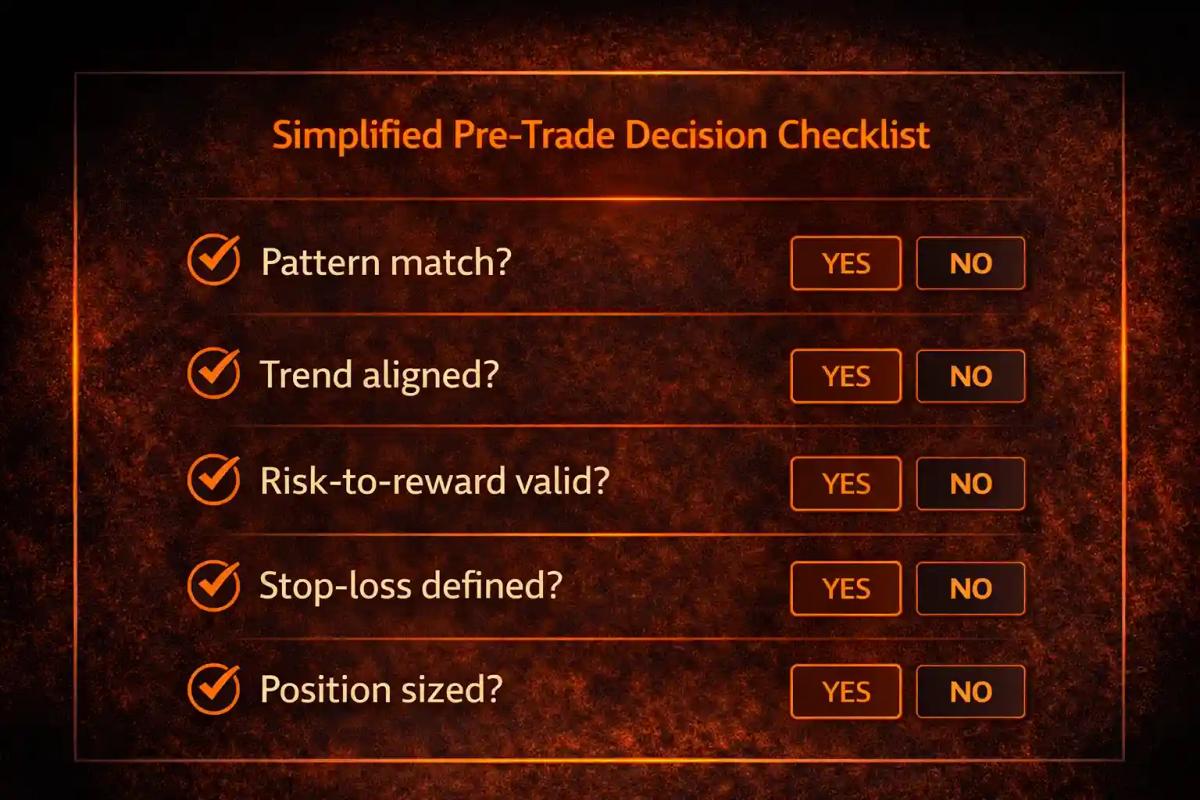
This is the single most effective tool against analysis paralysis. A pre-trade checklist converts your analysis from an open-ended exploration into a finite process. Include 4 to 6 binary yes/no questions:
- Does this setup match one of my predefined patterns?
- Is the trend direction aligned with my trade?
- Is my risk-to-reward ratio at least 1:2?
- Have I defined my stop-loss level?
- Is my position size within my risk parameters?
The checklist removes the grey area that paralysis thrives in.
Limit Your Indicators and Timeframes
Pick two to three indicators that serve different purposes (trend, momentum, volume confirmation). Remove everything else from your chart. Choose one or two timeframes: a higher one for context and a lower one for entries. Fewer inputs means fewer conflicting signals and faster, cleaner decisions.
Set Time Boundaries on Your Analysis
Give yourself a specific time limit for analyzing any single trade. Whether that is 2 minutes, 5 minutes, or 10 minutes depends on your strategy. When time is up, decide: take it or leave it. If you cannot decide within your window, the setup was not clear enough, and that is your answer. Move on without guilt.
Use a Trading Journal to Track Patterns
A trading journal serves as your personal feedback loop. For overcoming analysis paralysis specifically, track the trades you did not take and why. Over time, you will likely notice something telling: the trades you agonized over and skipped were actually winners more often than not. This kind of data turns overthinking from a vague feeling into a measurable behavior you can work on deliberately.
Practice With Smaller Position Sizes
One reason traders overthink is that the financial stakes feel too high. If you reduce your position size temporarily, you reduce the emotional weight of each decision. This creates space to practice executing without the paralysis trigger of large risk exposure. As your execution confidence builds, you can scale back up.
When to Walk Away From a Trade Setup
Not every hesitation is analysis paralysis. Sometimes the right call is to pass on a trade. The key is making that decision based on criteria, not feelings. If the setup genuinely does not meet your checklist, passing is the correct disciplined move. If everything checks out and you still will not act, that is paralysis.
The “If in Doubt, Stay Out” Rule and Its Limits
This old trading adage has real merit in specific contexts: when market conditions are genuinely ambiguous, when you are off your trading schedule, or when a major news event is pending. However, it can become a crutch. If “if in doubt” becomes your default response to any uncertainty, you are using discipline language to justify avoidance behavior.
Distinguishing Hesitation from Discipline
If the setup meets all your checklist criteria and you are still frozen, that is paralysis. The fix is execution. If the setup does not meet your criteria, or a specific element is genuinely unclear (a pending news event, choppy price action, thin liquidity), then your caution is warranted. Trust it.
The difference between a disciplined pass and a fear-based miss comes down to whether you can articulate a specific, rule-based reason for not taking the trade. “It did not meet criterion three on my checklist” is discipline. “I just was not sure” is paralysis.
Frequently Asked Questions
Is analysis paralysis the same as being cautious or risk-averse?
Not quite. Being cautious means you have evaluated a situation and decided the risk is not worth taking. Analysis paralysis means you cannot reach a decision at all. Caution ends in a clear "no." Paralysis ends in no answer, just more analysis going in circles.
How many indicators should I realistically use to avoid overload?
Most experienced traders settle on two to three indicators that serve distinct purposes. If your chart is so cluttered you cannot quickly read price action, you have too many. A good starting point: remove anything redundant or anything you do not actively reference when making a decision.
Does analysis paralysis affect experienced traders or only beginners?
Traders at every level can experience it. Beginners often freeze from lack of confidence. Intermediate and advanced traders may freeze after a losing streak, when scaling up in size, or when moving to an unfamiliar market. Experience tends to reduce the frequency, but it does not eliminate the vulnerability entirely.
How long should I spend analyzing a single trade setup?
This varies depending on your strategy and timeframe. A scalper might need 30 seconds to 2 minutes. A swing trader might take 5 to 10 minutes. The important thing is to set a specific limit before you start analyzing, and hold yourself to it.
Does demo trading help or worsen analysis paralysis?
Demo trading is useful for practicing your checklist and execution mechanics without financial risk. That said, it does not fully replicate the emotional pressure that triggers paralysis in live conditions. Use it to build process confidence, but recognize that transitioning to live trading with small positions is where real habit-building happens.
What is the connection between analysis paralysis and revenge trading?
After a session of overthinking and missed trades, frustration can push you into impulsive, unplanned trades to compensate for the inaction. This is one of the most damaging secondary effects: it takes you from overcaution to recklessness within the same session.
Can a trading mentor or community help reduce overthinking?
An experienced mentor or structured community can validate your analysis, point out when you are overcomplicating things, and hold you accountable to your plan. The key is finding mentors focused on process and discipline rather than on calling trades for you. The goal is to strengthen your own decision-making confidence, not to outsource it.
About the authors


Put this into practice
Prop firms we have reviewed
Scored on the same five dimensions, with the rules that decide payouts. Here are three — the full list is on the prop firms page.



Related articles

Anchoring Bias in Trading: How Mental Price Traps Cost You Money
Learn how anchoring bias distorts your trading decisions. Spot mental price traps, break free from fixation on entry prices, and build systems to protect your returns.
Anger in Trading: Why It Happens and How to Control It
Learn why anger strikes during trading, how it destroys performance through revenge trades and broken rules, and proven techniques to control it.

Anxiety in Trading: Understanding and Managing Doubt
Trading anxiety isn't a flaw — it's biology. Learn why doubt strikes, how it warps your decisions, and practical techniques to manage it before, during, and after every trade.
0 comments