


Trading Work-Life Balance: How to Trade Without Losing Yourself
Trading work-life balance is the foundation that keeps you in the game long enough to become profitable, and to actually enjoy the life your profits are supposed to fund.
This guide is for traders who feel the pull of the screen more than they’d like to admit. Whether you’re day trading equities, swinging forex, or watching crypto around the clock, you’ll walk away with a concrete system for drawing lines between your trading life and your actual life.
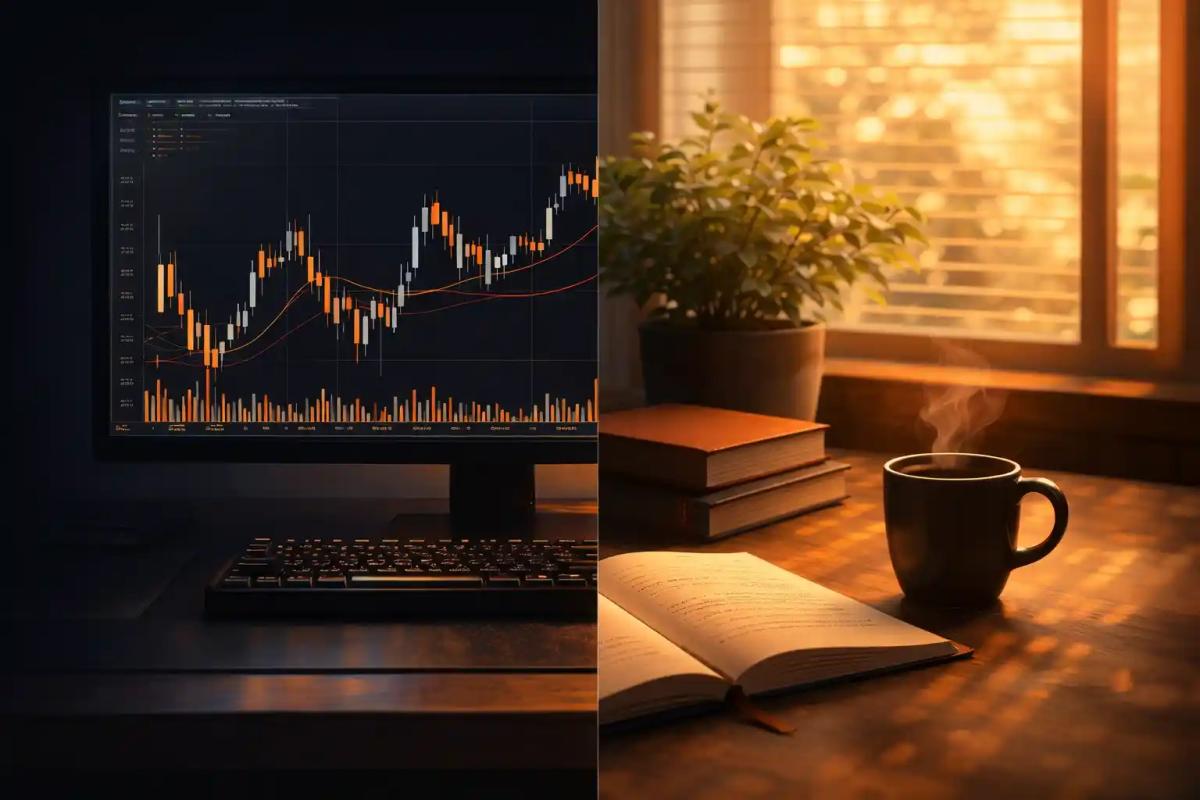
Why Trading Makes Work-Life Balance Unusually Hard
Most professions come with built-in guardrails. You clock in, you clock out, and the office doesn’t follow you home. Trading is different, and pretending otherwise is where most traders start losing themselves before they ever lose money.
The Always-Open Market Problem
If you trade forex, your market runs five days straight with no closing bell. Crypto has no bell at all. Ever. Even equity traders face pre-market sessions kicking off at 4 AM and after-hours trading stretching past 8 PM.
This constant access creates a psychological trap that most careers simply don’t impose. There’s always a chart ticking somewhere. There’s always a setup “forming” that feels urgent. Your phone buzzes with a price alert at dinner, and your brain whispers that stepping away right now could mean missing the trade of the week.
Here’s the thing: the market doesn’t need you watching it constantly. But the feeling that it does is what makes trading so uniquely difficult to contain. It’s like carrying a casino in your pocket that never closes, while telling yourself you’ll only peek once.
Emotional Carryover From Wins and Losses
A surgeon doesn’t take her scalpel home. But you carry your P&L everywhere, whether you want to or not.
A big win floods you with dopamine, and suddenly you’re replaying the trade at the dinner table, mentally sizing up what a larger position would’ve returned. A loss does the opposite: it gnaws at you while you’re trying to be present with the people who matter most. Either way, the emotional residue of trading bleeds into every hour of your day if you let it.
This carryover is a predictable consequence of work where your decisions are measured in real-time dollars. Recognizing it is the first step toward containing it.
So how do you know when normal engagement has crossed into something more destructive?
Warning Signs Your Trading Is Taking Over Your Life
Most traders don’t wake up one day and realize they’ve gone off the deep end. It happens gradually, one “quick chart check” at a time, until the exceptions quietly become the routine.
Behavioral Red Flags
Be honest with yourself. Do any of these sound familiar?
- You check charts during meals, conversations, or family events
- You wake up in the middle of the night to look at positions
- You extend your session “just 15 more minutes” almost every single day
- You feel restless or anxious when you can’t access your trading platform
- You skip hobbies, social plans, or exercise because you “need to watch the market”
- You open your broker app reflexively, the same way you’d open social media
These habits are signals that the boundary between trading and living has dissolved. That erosion always costs you eventually, whether in relationships, health, or (ironically) in trading performance itself.
Relationship and Health Indicators
The people around you often see the problem before you do. If your partner has started making comments about screen time, if your kids have learned not to interrupt during “market hours” that seem to stretch all day, or if friends have stopped inviting you to things because you always cancel… those are data points worth logging.
On the physical side, watch for:
- Disrupted sleep
- Skipped meals (or mindless eating at the desk)
- Chronic back or neck tension
- The slow disappearance of any exercise routine you once had
Your body and your relationships are lagging indicators of a trading-life imbalance. By the time they flash red, you’ve been off-track for a while.
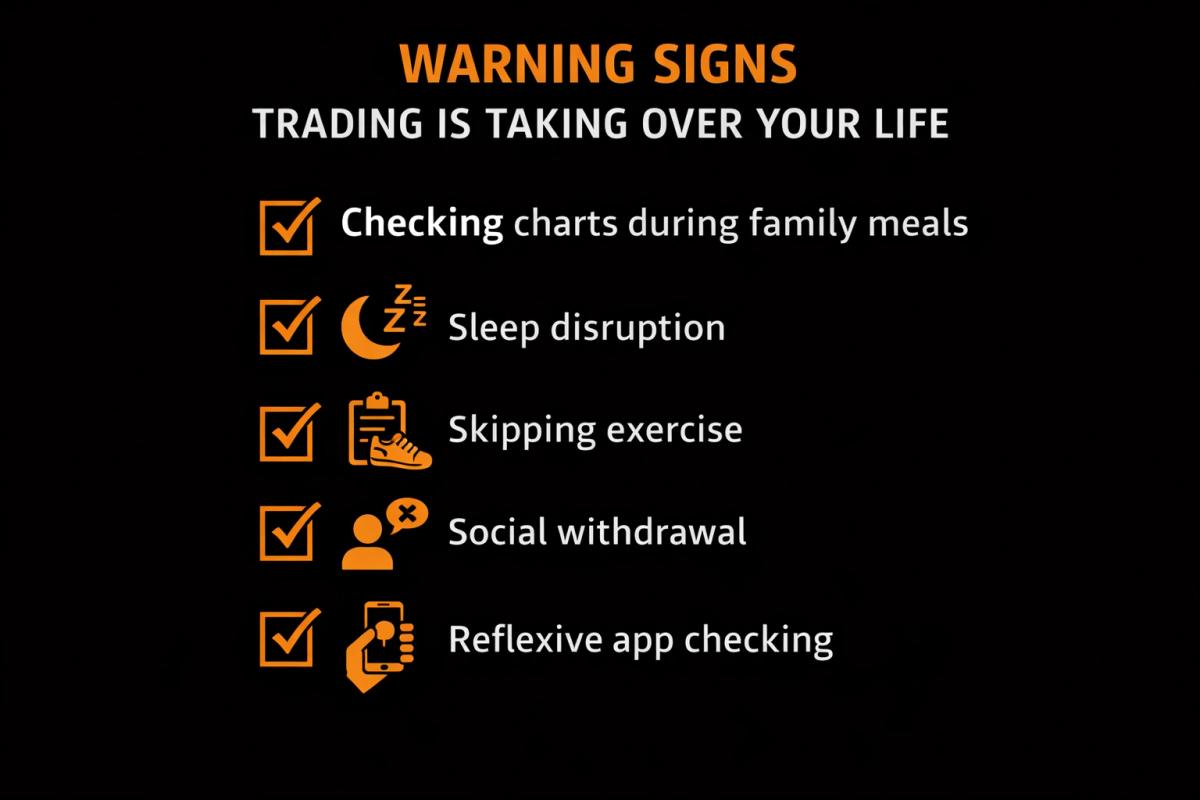
Recognizing the pattern is the hardest part. Building a structure to fix it is far more straightforward than you’d expect.
How to Build a Trading Schedule That Protects Your Personal Life
Structure is the container that keeps opportunity from swallowing your entire day. The traders who last decades in this business aren’t the ones who watched every candle. They’re the ones who showed up consistently within defined hours.
Defining Your Trading Window
Start by choosing a specific block of time for active trading, and commit to it the way you’d commit to a job you can’t afford to lose. This window should rest on two pillars:
- When your market offers the best liquidity and volatility (London/New York overlap for forex, the first two hours after the opening bell for equities, etc.)
- When you are personally sharpest and least likely to be interrupted
For most retail traders, 2 to 4 hours of focused screen time is more than enough. If that sounds too short, consider this: professional traders at institutions often work within strict session windows. The myth that more hours equals more profit is one of the most expensive beliefs in retail trading.
Pre-Market and Post-Market Routines
Your trading window works best when it’s bookended by short, structured routines:
- Pre-market (15-30 minutes): Review your watchlist, check overnight news, mark key levels, and define your plan for the session. This is where you decide what you’re looking for, not where you start placing trades.
- Post-market (15-30 minutes): Log your trades, note what worked and what didn’t, and close your platform. This is your debrief. Once it’s done, the trading day is over.
These bookends transform trading from an open-ended activity into a contained event with a clear beginning and end.
The Power of a Hard Stop Time
This is the single most important boundary you can set: a time after which you do not trade, do not check charts, and do not engage with market content.
Pick a time. Write it down. Set an alarm if you need to. When it goes off, you close the platform and you’re done for the day.
Will you feel the pull to keep watching? Absolutely. Will you miss a trade occasionally? Probably. But here’s the reframe that matters: every trade you “miss” outside your window is also a bad trade you avoided taking when your focus and energy were already spent.
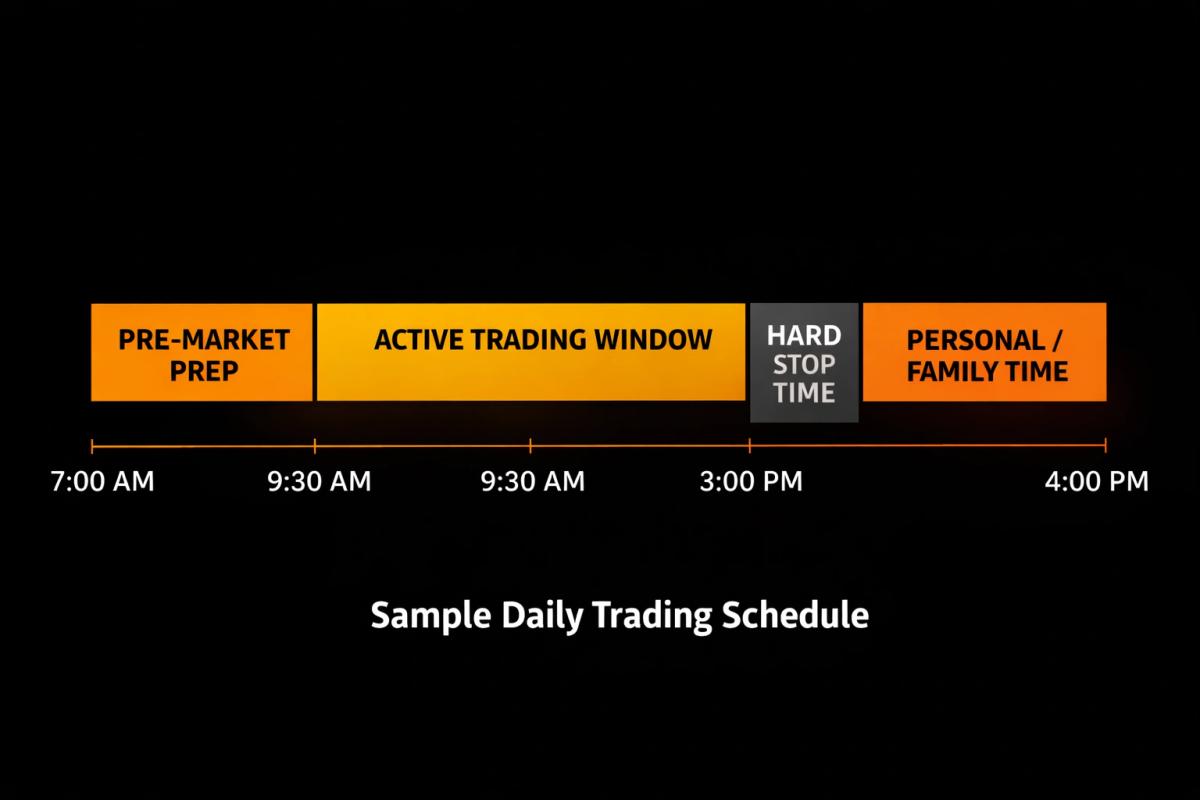
A schedule protects your time. But what about the constant digital tug that pulls you back to the screen even after you’ve “stopped”?
Setting Boundaries With the Screen
The screen is where trading lives. If you’re not intentional about your relationship with it, it will colonize every quiet moment in your day.
Notification and App Management
Price alerts and trading notifications serve a purpose during your session. Outside of it, they’re just triggers.
- Turn off push notifications from your broker and charting apps after your hard stop time
- Use your phone’s scheduled “Do Not Disturb” or focus modes to block trading app alerts during personal hours
- If your platform supports it, set alerts only for extreme levels that would genuinely require action, not every minor wiggle
Think of it this way: you wouldn’t let your employer text you every 15 minutes after you’ve clocked out. Your trading platform doesn’t deserve that access either.
Separating Trading Devices From Personal Devices
If possible, trade on a dedicated device (a desktop or a specific laptop) that stays in one room. When you walk away from that room, you walk away from trading.
If you must trade on your phone, move your broker and charting apps into a folder that’s off your home screen. Add friction between you and the impulse to “just check.”
The goal is to make the unconscious, reflexive checking harder, so that when you do engage with the markets, it’s a deliberate choice.
Managing your screen habits is only half the equation, though. The people in your life also require your attention.
Protecting Relationships and Family Time as a Trader
Trading is isolating by nature. You sit alone, make decisions alone, and carry the emotional weight alone. Left unchecked, that isolation can quietly erode the relationships that keep you grounded.
Communicating Your Schedule to Family
Your partner, your kids, your close friends: they don’t need to understand candlestick patterns. But they do need to understand when you’re “at work” and when you’re truly available.
Share your trading window with the people in your life. Make it explicit:
- “I trade from 9:00 to 11:30. During that time, I need to focus. After 11:30, I’m fully here.”
- “I do a 15-minute review after the close, and then I’m done for the day.”
Simple as this sounds, it accomplishes two things. It gives your family predictability (they know when to expect your attention), and it gives you accountability (you’ve made a public commitment to a boundary).
Creating Non-Negotiable Offline Time
Block at least one chunk of time each day, ideally in the evening, where screens are completely off.
- Eat dinner without your phone on the table
- Spend weekend mornings fully offline
- Designate at least one full day per week as a no-trading day
The relationships that survive a trading career are the ones that got consistent, protected attention, not leftover scraps of focus between candle closes.
What holds all of this together, though, is what’s happening inside your own head. Let’s talk about the habits that keep you mentally fit for the long haul.
Mental Health Habits That Support Long-Term Trading Careers
You can have the perfect schedule, the cleanest boundaries, and a supportive family, and still burn out if you’re neglecting the basics of mental and physical health. Trading is a performance activity. Performers need maintenance.
Physical Exercise and Sleep
There’s a direct, practical link between your physical state and your ability to make clear decisions under uncertainty.
- Exercise: Even 30 minutes of movement per day (walking, lifting, swimming, anything that raises your heart rate) reduces cortisol, sharpens focus, and gives your brain something to process besides price action.
- Sleep: Chronic under-sleeping degrades decision-making faster than almost anything else. If you’re setting alarms to catch the Asian session and then trading the New York open on five hours of sleep, you’re not dedicated. You’re impaired.
Protect your sleep the way you protect your capital. Both are finite resources you simply can’t trade without.
Journaling Beyond Trade Logs
Most traders who journal only track entries, exits, and P&L. That’s useful, but it misses the deeper layer.
Try adding a few lines each day about how you felt during and after trading. Were you anxious? Bored? Revenge-minded after a loss? Overconfident after a win? This emotional log, kept consistently, will surface patterns that no trade journal alone can reveal.
Over time, you’ll start to notice which emotional states precede your worst decisions. And you’ll catch yourself in those states before they cost you.
Knowing When to Step Away From the Markets
Sometimes the most productive thing a trader can do is not trade. A losing streak that’s bleeding into your mood and relationships isn’t a challenge to push through with more screen time. It’s a signal to step back, reset, and return with a clear head.
Taking a planned break, even a few days, is risk management for your mental capital. The market will be there when you come back.
Note: If you find that stepping away feels impossible, or that trading is causing persistent anxiety, depression, or relationship crisis, please consider speaking with a mental health professional. This article offers general wellness framing, not clinical advice.
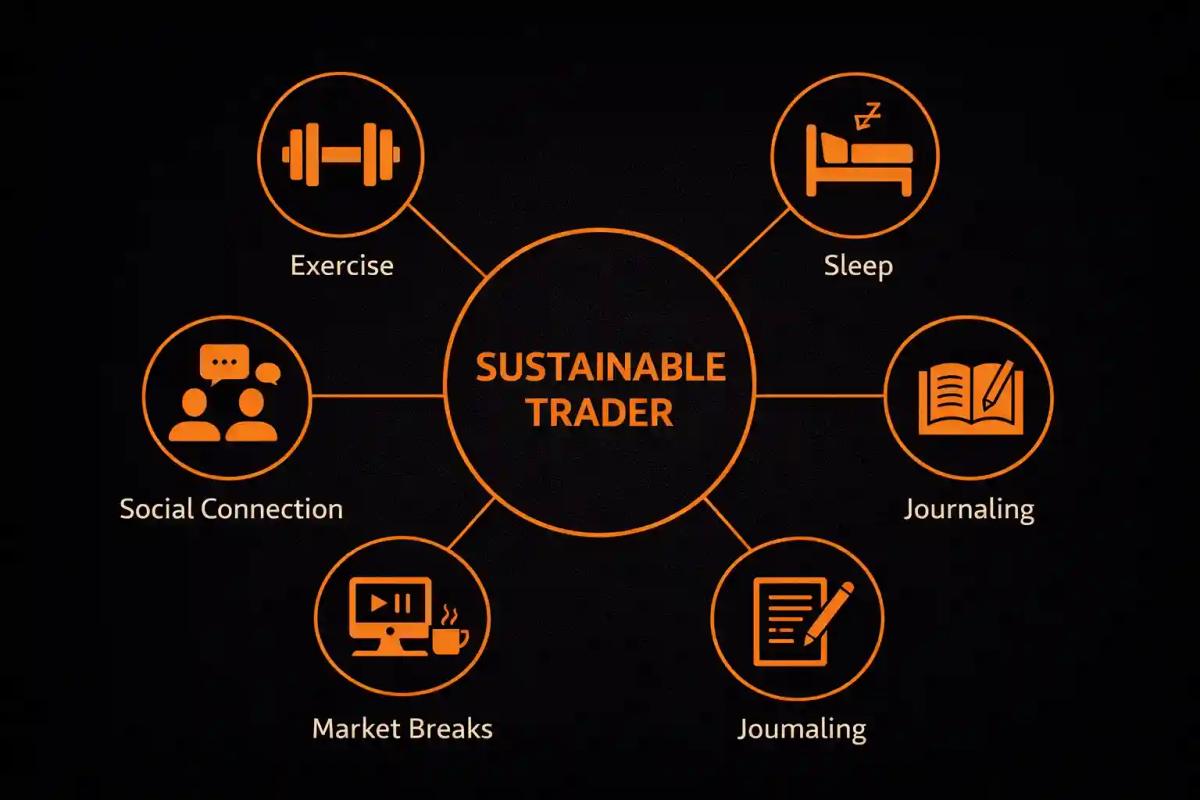
Healthy habits keep you in the game. But how do you maintain discipline day after day without tipping into the very obsession you’re trying to avoid?
How to Stay Consistent Without Becoming Obsessed
There’s a fine line between a disciplined trader and an obsessed one. The disciplined trader follows a process. The obsessed trader follows the market. The difference shows up in how you define success on any given day.
Process Goals vs. Outcome Goals
Outcome goals (“make $500 today”) chain your emotional state to something you can’t fully control. Process goals (“follow my plan, respect my stop losses, close the platform by noon”) anchor you to behaviors you own completely.
When your daily measure of success is “did I execute my process,” you can walk away from a losing day feeling satisfied, because the goal was discipline. That distinction is what allows you to close the laptop without spiraling.
Weekly Review Rituals
Set aside 30 to 60 minutes once a week (weekends work well) to zoom out and review:
- Did you stick to your trading window every day?
- Did you honor your hard stop time?
- How was your emotional state throughout the week?
- Were there moments you broke a boundary, and what triggered it?
- What’s one thing you’ll adjust next week?
This weekly ritual replaces constant daily monitoring with a structured checkpoint. It gives you dedicated time to think about your trading life as a whole, so you’re not running that analysis in the background all week long.
Think of it as your personal performance review, one that covers both the trading and the living.
Frequently Asked Questions
Can you be a profitable trader without trading full-time?
Yes. Many consistently profitable traders operate within focused windows of just a few hours per day. Profitability comes from the quality of your setups and execution, not from the quantity of hours spent watching charts. In fact, overexposure to the screen often leads to overtrading, which tends to hurt performance more than it helps.
How many hours a day should a trader realistically spend on the screens?
For most active retail traders, 2 to 4 hours of focused screen time during peak market hours is a practical range. Add 15 to 30 minutes on each side for pre-market preparation and post-market review. Beyond that, you're likely watching noise rather than signal, and the mental fatigue compounds quickly.
How do you deal with the fear of missing opportunities when you step away?
Remind yourself that the market generates new opportunities every single day. The setup you "miss" today will have a cousin tomorrow. Building a watchlist and defining your setups in advance helps you trust that if a trade meets your criteria during your session, you'll catch it. The ones outside your window simply weren't your trades to take.
Do day traders face more balance challenges than swing or position traders?
Generally, yes. Day trading requires active screen engagement during market hours, which creates a more rigid schedule and a stronger temptation to extend sessions. Swing and position traders can set alerts and check in less frequently, which naturally builds in more breathing room. That said, any style can become consuming if boundaries aren't set with intention.
How do you explain a trading career to family members who don't understand it?
Focus on the structure, not the mechanics. Your family doesn't need to grasp order flow or technical analysis. What helps is sharing your schedule, your rules, and your goals in plain language: "I work these hours, I have a plan, and when I'm done, I'm done." Transparency about your routine builds trust, even when the profession itself feels unfamiliar to them.
What should you do when a losing streak is affecting your mood and relationships?
First, recognize it. A losing streak that spills into your personal life is a sign your position sizing or emotional management (or both) needs adjusting. Scale down your risk, shorten your sessions, or take a few days completely off. Talk to the people around you about what's happening. Pretending everything is fine while trading angry or desperate only deepens the hole.
Does taking extended breaks from trading hurt long-term performance?
Not meaningfully, and often the opposite is true. Traders who return from a deliberate break tend to come back with sharper focus, cleaner decision-making, and renewed energy. The skills and knowledge you've built don't disappear over a week or two away. What does disappear is the accumulated fatigue and emotional static that were clouding your judgment. This content is educational and for informational purposes only. It is not a substitute for professional financial advice or mental health support. If you are experiencing significant emotional distress related to trading or any other aspect of your life, please consult a qualified professional.
About the authors


Related articles
Analysis Paralysis in Trading: Why You Freeze and How to Fix It
Learn to recognize analysis paralysis in trading, understand its psychological roots, and build a decision-making framework with confident execution.
Anchoring Bias in Trading: How Mental Price Traps Cost You Money
Learn how anchoring bias distorts your trading decisions. Spot mental price traps, break free from fixation on entry prices, and build systems to protect your returns.
Anger in Trading: Why It Happens and How to Control It
Learn why anger strikes during trading, how it destroys performance through revenge trades and broken rules, and proven techniques to control it.
0 comments