


Return on investment (ROI) ranks among the most widely used metrics in trading and investing, and for good reason. Knowing how to calculate ROI gives you a clear read on profitability. This guide walks through the ROI formula, shows you how to apply it step by step, and explains what your results actually mean in practice.

What Is Return on Investment (ROI)
Return on Investment (ROI) Definition
ROI stands for return on investment. It’s a percentage-based metric that measures how much profit or loss an investment has generated relative to its original cost. Put simply, it tells you how efficiently your money worked for you.
An ROI of 20% means that for every dollar invested, you earned 20 cents in profit. A negative ROI indicates a loss: your investment returned less than you put in.
Why ROI Matters in Trading and Investing
ROI offers a straightforward way to evaluate performance across different investments. It allows you to:
- Compare the profitability of different trades or assets
- Gauge whether your investment strategy is delivering results
- Communicate outcomes clearly without wading into complex financial jargon
- Track progress over time using a consistent format
For traders and investors, ROI provides a common language for understanding gains and losses. Rather than looking at raw dollar amounts in isolation, ROI contextualizes those figures against what you originally put at risk.
The ROI Formula
Basic ROI Formula
The standard ROI formula is:
ROI = (Net Profit / Total Investment Cost) × 100
Where:
- Net Profit = Final Value of Investment − Initial Investment Cost − Any Associated Costs
- Total Investment Cost = The amount you originally invested, including purchase price and any fees to enter the position
The result comes out as a percentage. Positive means a gain; negative means a loss.
Annualized ROI Formula
The basic formula doesn’t account for holding period. An investment returning 20% in one year looks very different from one that takes five years to reach the same figure.
To compare investments across different time horizons, use the annualized ROI formula:
Annualized ROI = [(1 + ROI)^(1/n) − 1] × 100
Where:
- ROI = Your calculated ROI expressed as a decimal (e.g., 20% = 0.20)
- n = Number of years the investment was held
Annualized ROI normalizes returns to a yearly basis, making it far more meaningful to compare a three-month trade against a two-year investment.
How to Calculate ROI Step by Step
Step 1: Identify Net Profit
Start by determining your net profit: the difference between what you received when you sold (or the current value) and what you originally paid, minus costs incurred along the way.
Net Profit = Selling Price − Purchase Price − Fees and Costs
Make sure to include all relevant costs:
- Transaction fees or commissions
- Exchange fees
- Any other costs directly tied to the investment
Step 2: Identify Total Investment Cost
Your total investment cost is what you initially put into the position. This typically includes:
- The purchase price of the asset
- Any fees paid to acquire the investment
Don’t include costs you incurred when selling. Those get subtracted when calculating net profit.
Step 3: Apply the Formula
With both figures in hand, divide your net profit by your total investment cost, then multiply by 100 to convert to a percentage.
ROI = (Net Profit / Total Investment Cost) × 100
Calculation Example

Say you purchase shares worth $1,000. You later sell those shares for $1,250. You paid $25 in commission when buying and another $25 when selling.
Step 1: Calculate Net Profit
- Selling Price: $1,250
- Purchase Price: $1,000
- Total Fees: $50
- Net Profit: $1,250 − $1,000 − $50 = $200
Step 2: Identify Total Investment Cost
- Purchase Price: $1,000
- Buying Commission: $25
- Total Investment Cost: $1,025
Step 3: Apply the Formula
- ROI = ($200 / $1,025) × 100 = 19.51%
Your ROI on this trade comes to approximately 19.5%.
ROI in Trading Contexts
Calculating ROI on a Single Trade
For a single trade, the calculation follows the standard formula. Take your net profit from that specific trade and divide it by the total amount invested in that position.
Single Trade ROI = (Trade Net Profit / Trade Investment Cost) × 100
This isolates how that individual trade performed, independent of your other positions.
Calculating ROI on a Portfolio
When calculating ROI for an entire portfolio, you aggregate total gains and losses across all positions, then compare them against your total invested capital.
Portfolio ROI = (Total Portfolio Net Profit / Total Capital Invested) × 100
A few different approaches exist:
- Simple ROI calculates the total return from start to finish without accounting for when you added or withdrew funds
- Time-weighted return adjusts for cash flows in and out of the portfolio, giving a more accurate picture when you’ve made multiple deposits or withdrawals
For most individual investors tracking personal performance, simple ROI provides a reasonable approximation. Portfolios with frequent contributions may benefit from time-weighted calculations.

What Is a Good ROI
ROI Benchmarks by Asset Class
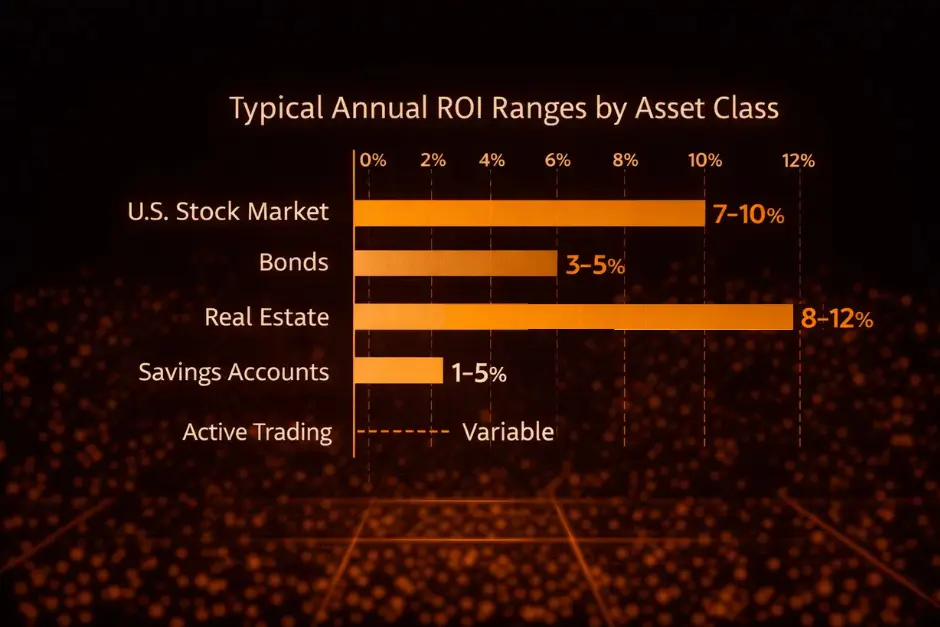
What counts as a “good” ROI varies considerably depending on the asset class and the risk involved. Historical averages offer some context:
Asset Class | Typical Annual ROI Range |
U.S. Stock Market (broad index) | 7–10% |
Bonds (investment grade) | 3–5% |
Real Estate | 8–12% |
Savings Accounts | 1–5% |
Active Trading | Highly variable |
These figures represent historical averages, not guarantees of future performance. Actual returns fluctuate with market conditions, economic factors, and individual investment choices.
Context Matters
A 15% annual ROI on a low-risk bond fund would be exceptional, while the same return on a highly speculative trade might be unremarkable given the risk assumed.
When evaluating your ROI, consider:
- The time period over which the return was generated.
- The level of risk you took on.
- How the investment performed relative to a relevant benchmark.
- Whether the return adequately compensates for the risk.
ROI alone doesn’t tell you whether an investment was wise. A high ROI achieved through excessive risk may prove unsustainable or inappropriate for your financial situation.
Common ROI Calculation Mistakes
Ignoring Fees and Costs
One of the most frequent errors is calculating ROI based on gross returns rather than net returns. Failing to subtract transaction fees, commissions, management fees, or other costs will overstate your actual return.
Always include:
- Brokerage commissions.
- Exchange or transaction fees.
- Fund management fees (expense ratios).
- Currency conversion costs if applicable.
- Any other costs directly associated with the investment.
Even modest fees compound over time and can meaningfully erode your real returns.
Misunderstanding Time Periods
Comparing a 50% return earned over five years to a 10% return earned in three months is misleading without normalization. The holding period matters.
When comparing investments with different time horizons, convert to annualized ROI for a fair comparison. A 10% return in six months represents stronger performance than 15% over two years once you express both on an annual basis.
ROI Limitations
What ROI Does Not Tell You
ROI is useful, but it has notable limitations as a standalone metric:
- Risk stays hidden. Two investments with identical ROIs may carry vastly different risk profiles. ROI doesn’t capture volatility or the probability of loss.
- Time value gets obscured. Basic ROI treats a 20% return the same whether it took one month or five years to achieve.
- Cash flow timing is ignored. ROI doesn’t account for when returns are received, which matters if you’re looking to reinvest.
- Opportunity cost isn’t reflected. A 10% ROI might seem acceptable until you realize an alternative investment offered 15% with comparable risk.
For a fuller picture of investment performance, consider ROI alongside other metrics. CAGR (compound annual growth rate) and risk-adjusted return measures can add context, though detailed comparison of these falls outside this guide’s scope.
ROI works well as a quick, intuitive measure of profitability. It works less well as the sole basis for comparing complex investments or making major financial decisions.
Frequently Asked Questions


Comments