

Every trader approaches the markets differently. Some sleep soundly after opening a leveraged position; others check their screens every few minutes when holding even a small trade. These differences reflect something fundamental: your trading risk profile.
Understanding your risk profile is one of the more important steps you can take before placing a single trade. It shapes everything from position size to strategy selection. Yet many traders skip this self-assessment entirely, jumping into the markets without knowing how much risk they can actually handle. This guide explains what a trading risk profile is, how to determine yours, and how to put that knowledge to work.
This content is for educational purposes only and does not constitute financial advice. Consider consulting a qualified professional for personalized guidance.
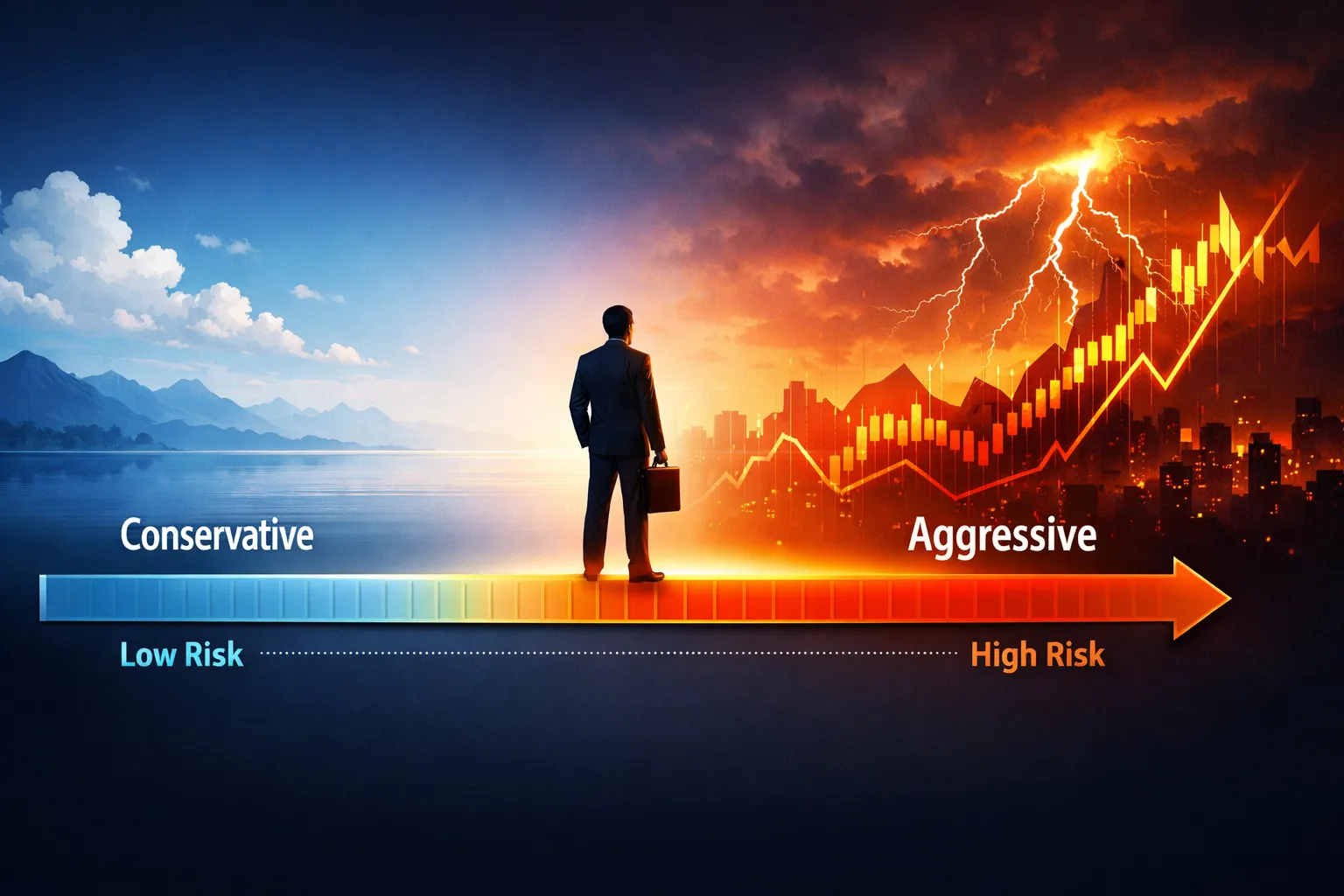
What Is a Trading Risk Profile?
A trading risk profile is a comprehensive assessment of how much risk you can and should take when trading. It combines objective factors (available capital, financial obligations, time horizon) with subjective elements like your emotional response to losses and your comfort with uncertainty.
Think of it as a personal blueprint for making trading decisions aligned with who you are.
Risk Profile vs. Risk Tolerance vs. Risk Appetite
These three terms often get used interchangeably, but they describe distinct aspects of your relationship with risk.
Risk tolerance refers to your emotional and psychological capacity to handle losses and volatility. It’s how you actually feel when a trade moves against you. A trader with high risk tolerance can watch a position drop significantly without panicking or making impulsive decisions.
Risk appetite describes how much risk you’re willing to pursue in exchange for potential returns. It’s a choice about the level of risk you want to take on, given your goals and circumstances. Someone might have high risk tolerance but choose a low risk appetite because they’re trading retirement funds.
Risk capacity is the objective, financial side of the equation. It measures how much risk you can afford to take based on your capital, income, financial obligations, and time horizon. You might have a high appetite for risk but limited capacity if you’re trading with money you can’t afford to lose.
Your overall risk profile integrates all three: what you can emotionally handle, what you’re willing to pursue, and what your financial situation actually supports.
Why Your Risk Profile Matters in Trading
Trading without understanding your risk profile is like driving without knowing how your vehicle handles. You might get lucky for a while, but eventually, conditions will test you in ways you’re not prepared for.
When you trade outside your risk profile, problems compound quickly. You may take positions too large for your account, leading to severe losses from ordinary market movements. You might use leverage inappropriately, amplifying both gains and losses beyond what you can psychologically manage. Or you could find yourself in strategies that don’t match your available time, capital, or skill level.
Knowing your risk profile helps you set appropriate position sizes, choose suitable strategies, and maintain emotional stability during inevitable drawdowns. It provides a framework for consistent decisions rather than impulsive reactions to price movements.
The Three Main Risk Profile Types
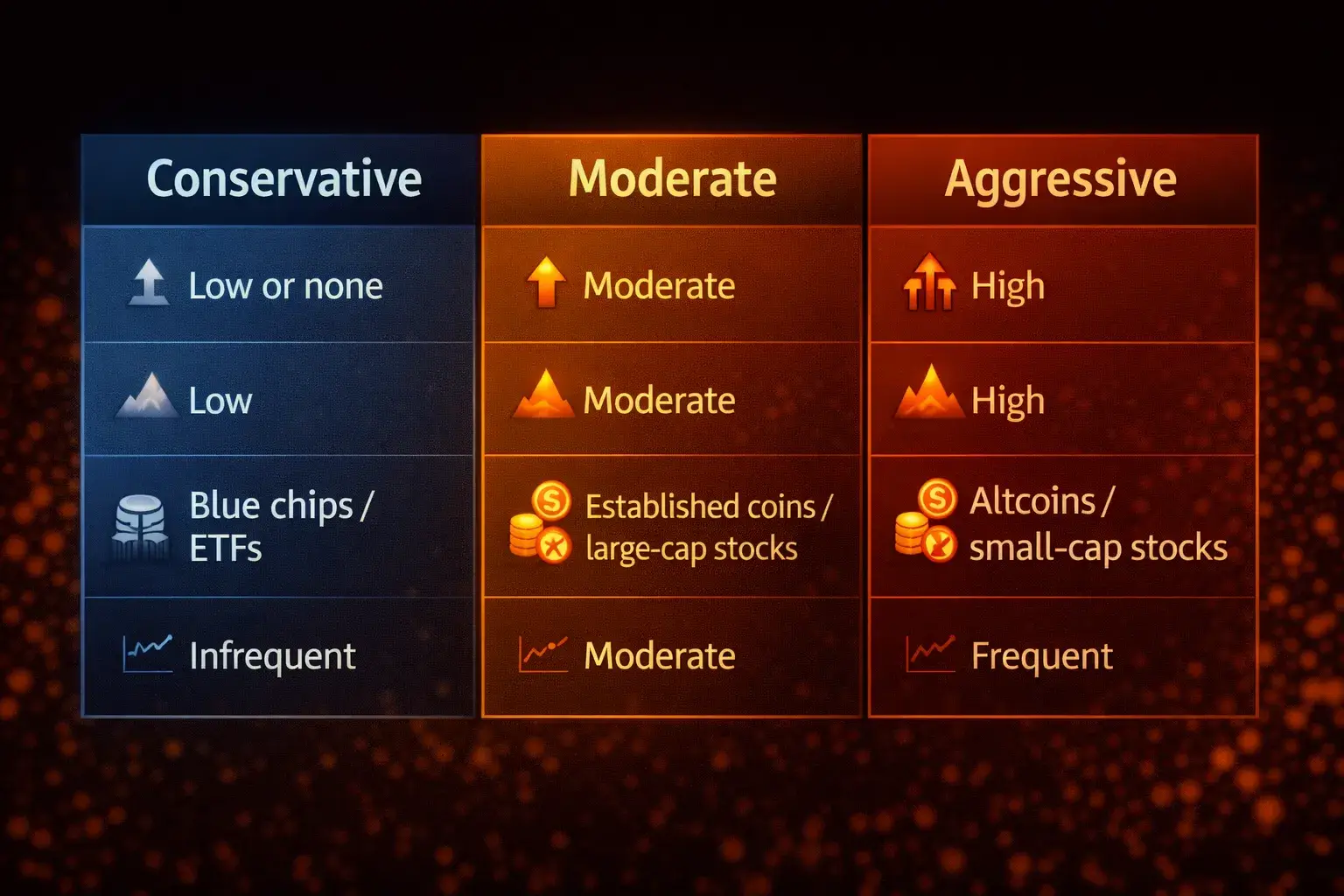
Risk profiles exist on a spectrum, but traders generally fall into three broad categories. Understanding these types helps you identify where you currently fit and what trading approaches align with your profile.
Conservative Risk Profile
Conservative traders prioritize capital preservation over aggressive growth. They accept lower potential returns in exchange for reduced volatility and smaller drawdowns.
Characteristics of conservative traders typically include:
- Preference for lower leverage or no leverage at all
- Smaller position sizes relative to account balance (often 1% or less risk per trade)
- Focus on highly liquid, established markets
- Longer holding periods with wider stop-losses
- Acceptance of steady, modest returns rather than dramatic gains
- Strong emphasis on risk management rules
Conservative trading isn’t synonymous with inferior trading. Many consistently profitable traders operate with conservative profiles, prioritizing longevity and compound growth over short-term excitement.
Moderate Risk Profile
Moderate traders seek a balance between growth and preservation. They’re comfortable with some volatility and drawdowns but set clear boundaries to protect their capital.
Characteristics of moderate traders typically include:
- Selective use of leverage within defined limits
- Position sizing that risks 1–2% of capital per trade
- Diversification across different setups and sometimes different markets
- Willingness to hold through normal market fluctuations
- Mix of trading timeframes depending on opportunity
- Defined maximum drawdown thresholds
The moderate profile suits traders who want meaningful growth potential while maintaining emotional stability and account longevity.
Aggressive Risk Profile
Aggressive traders accept higher volatility and larger potential drawdowns in pursuit of significant returns. They’re comfortable with substantial swings in account equity and have the capital, experience, and psychological makeup to manage this approach.
Characteristics of aggressive traders typically include:
- Higher leverage usage
- Larger position sizes relative to account balance
- Willingness to trade volatile or less liquid markets
- Shorter holding periods with tighter risk parameters
- Concentration in high-conviction setups rather than diversification
- Acceptance of significant drawdowns as part of the process
Aggressive trading requires not just psychological fortitude but sufficient capital to withstand inevitable losing streaks, plus the experience to manage elevated risk effectively.
How to Determine Your Trading Risk Profile
Assessing your risk profile requires honest self-reflection about both your financial situation and your psychological makeup. It’s about identifying the one that actually fits.
Key Factors That Shape Your Risk Profile
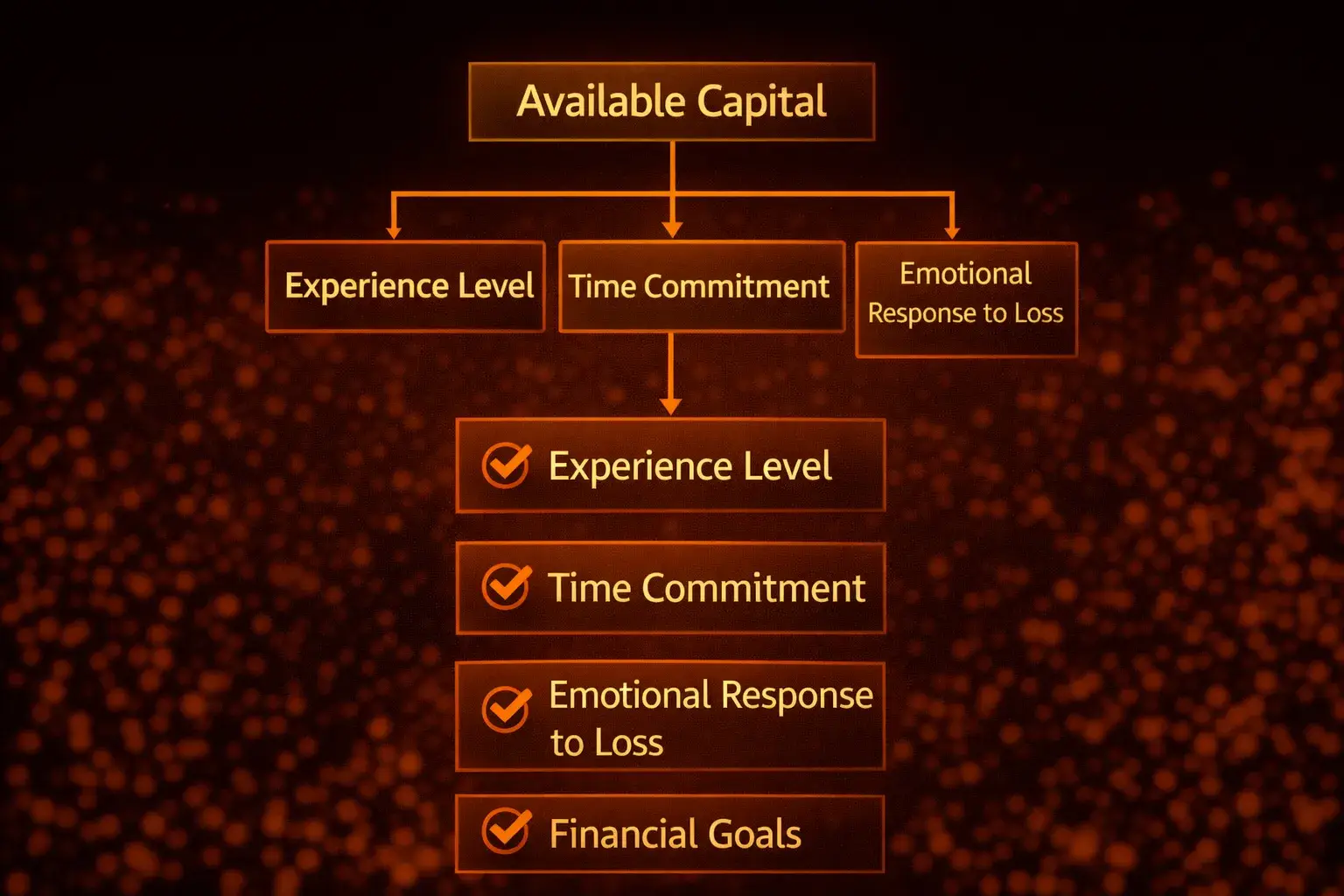
Several elements combine to determine where you fall on the risk spectrum:
Available capital: How much can you genuinely afford to lose without impacting your lifestyle or financial security? Trading capital should be money you don’t need for immediate obligations.
Trading experience: Newer traders generally benefit from more conservative approaches while they develop skills and build a track record. Experience brings both technical knowledge and emotional resilience.
Time horizon and commitment: Are you trading actively every day, or checking positions occasionally? Your available time affects which strategies and risk levels are manageable.
Income and financial stability: Steady income outside trading provides a buffer that can support slightly higher trading risk, while trading as your primary income typically requires more conservative capital management.
Emotional temperament: How do you genuinely react to losses? Some people can detach emotionally from trading outcomes; others feel significant stress from even small drawdowns.
Financial goals: What are you trying to achieve? Growing capital aggressively for a short-term goal differs from building wealth steadily over decades.
Self-Assessment Questions
Consider these questions honestly to help clarify your profile:
- If you lost 20% of your trading account this month, how would you respond emotionally? How would it affect your daily life?
- What percentage of your total savings is your trading capital? Could you lose it entirely without financial hardship?
- How much trading experience do you have? Have you traded through both rising and falling market conditions?
- How much time can you dedicate to monitoring positions, researching markets, and managing trades?
- What is your primary goal: aggressive growth, steady income, capital preservation with modest growth, or something else?
- How do you typically make decisions under pressure? Do you stay calm, or do emotions drive your choices?
- Have you experienced a significant trading loss before? How did you handle it?
Your answers reveal where you genuinely fit rather than where you might aspire to be.
How Your Risk Profile Affects Trading Decisions
Understanding your risk profile should directly influence how you trade. Two traders can look at the same setup and make different decisions, both validly, based on their respective profiles.
Position Sizing and Leverage
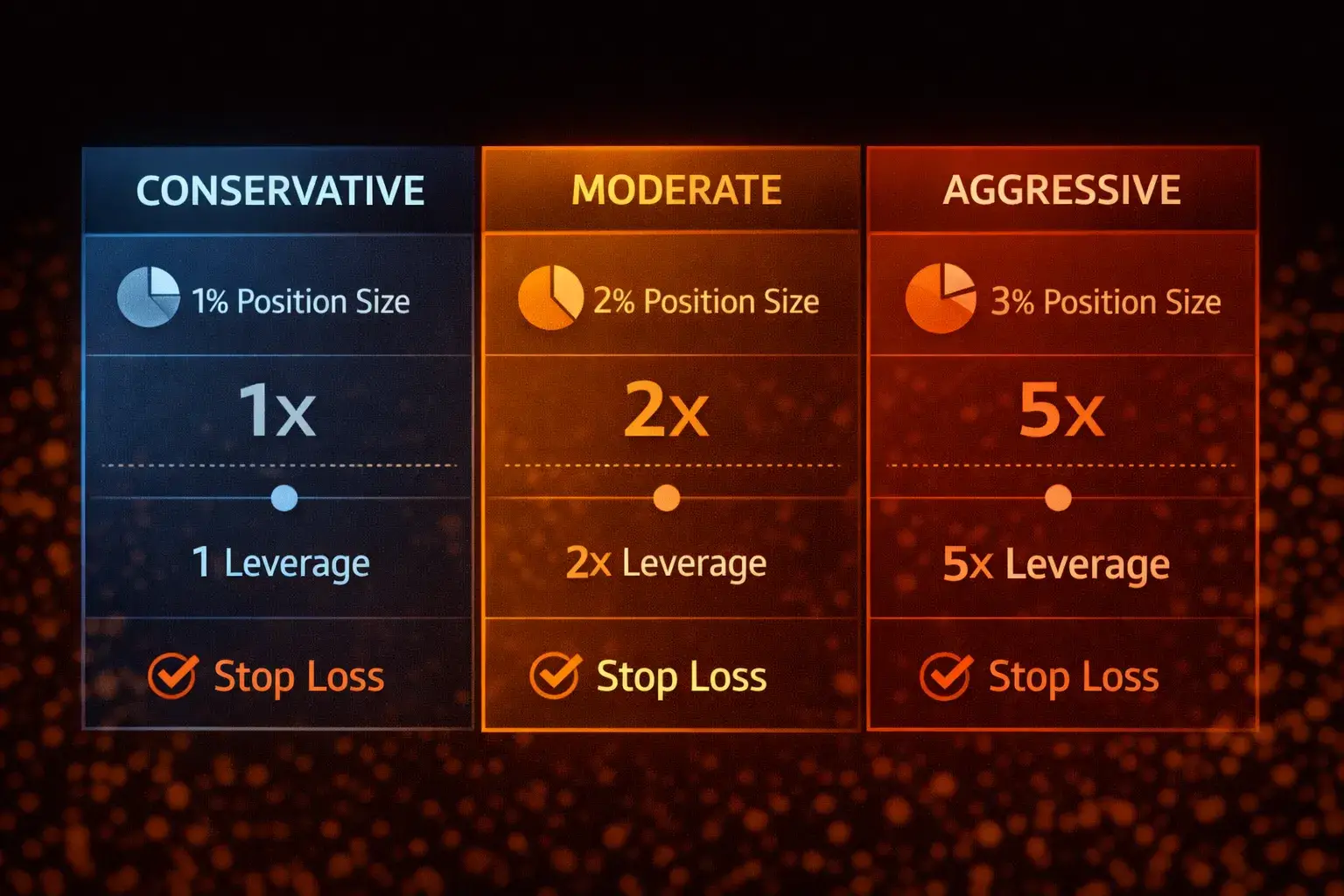
Your risk profile directly determines appropriate position sizing and leverage use.
Risk Profile | Typical Risk Per Trade | Leverage Approach |
Conservative | 0.5%–1% of capital | Minimal or none |
Moderate | 1%–2% of capital | Selective, controlled |
Aggressive | 2%–5% of capital | Active, within limits |
These ranges are guidelines, not rules. A conservative trader using high leverage contradicts their profile, while an aggressive trader risking only 0.5% per trade might be leaving potential on the table relative to their capacity and goals.
Position sizing should ensure that even a string of consecutive losses won’t devastate your account. Conservative traders build in larger buffers; aggressive traders accept smaller cushions in exchange for greater growth potential.
Asset Selection and Strategy Fit
Different trading strategies and assets suit different risk profiles.
Conservative traders often gravitate toward highly liquid markets with established price behavior, longer-term trend-following approaches, and strategies with defined, limited risk.
Moderate traders might diversify across multiple setups and timeframes, including some shorter-term trades alongside position trades, across various liquid markets.
Aggressive traders may pursue volatile markets, shorter timeframes requiring active management, and concentrated positions in high-conviction setups.
Matching your strategy to your profile helps ensure you can execute consistently without emotional interference.
Can Your Risk Profile Change Over Time?
Yes, and expecting your risk profile to remain static is unrealistic. Several factors can shift your profile:
Experience: As you develop skills and build a track record, you may feel comfortable taking on more risk. Alternatively, experiencing significant losses might make you more conservative.
Life circumstances: Changes in income, financial obligations, or major life events often require profile adjustments.
Capital changes: Growing your account might allow for slightly more aggressive positioning, while significant drawdowns might warrant a temporary shift toward more conservative approaches.
Market conditions: Some traders adjust their approach based on market environment, trading more conservatively during high-uncertainty periods.
Age and time horizon: As time horizons shorten, many traders naturally shift toward more conservative profiles to protect accumulated capital.
Reassessing your risk profile periodically (perhaps quarterly or after significant life or account changes) helps ensure your trading approach stays aligned with your current reality.
Common Mistakes When Assessing Risk Profile
Many traders inaccurately assess their risk profile, leading to misaligned decisions. Watch for these errors:
Confusing aspirations with reality: Wanting to be an aggressive trader doesn’t make you one. Your profile should reflect who you actually are, not who you want to become.
Ignoring emotional capacity: Focusing only on financial factors while ignoring how you respond to losses creates a profile that works on paper but fails in practice.
Overestimating risk tolerance during calm markets: It’s easy to feel aggressive when markets are quiet or positions are profitable. True risk tolerance reveals itself during drawdowns and volatility.
Letting recent performance dictate profile: After winning streaks, traders often feel more aggressive; after losses, more conservative. Your profile should be more stable than your recent results.
Comparing yourself to other traders: Social media is filled with traders showcasing aggressive approaches. Your profile should be based on your circumstances, not someone else’s highlight reel.
Failing to account for the total financial picture: Trading capital isn’t isolated from your broader financial life. Assessing risk profile requires considering your complete situation.
Assuming more risk equals better trading: There’s no inherent superiority in aggressive trading. The most appropriate profile is one you can execute consistently while meeting your goals and maintaining psychological stability.
Understanding your trading risk profile provides a foundation for every trading decision you make. It helps you choose appropriate strategies, set proper position sizes, and maintain emotional equilibrium through the inevitable ups and downs of trading. Take time to honestly assess where you fall on the risk spectrum, and let that assessment guide your approach; not the other way around.


Comments