


You’ve studied the charts. You’ve backtested a strategy. You know exactly where your stop-loss should go. Then price ticks against you, and something takes over: your finger hits the close button two minutes early, or worse, you double down on a losing position because your gut insists it’ll turn around.
That gap between what you know and what you do? That’s trading psychology. And it’s the single biggest factor separating traders who survive from those who blow up their accounts.
This guide unpacks why your mind fights your trading plan, names the specific psychological traps that catch nearly every trader, and gives you a concrete system for building the mental discipline that makes consistent execution possible.
This content is educational and does not constitute financial advice or mental health guidance. Trading involves significant risk of loss.
What Is Trading Psychology?
The Mental Side of Every Trade
Every time you open a position, you’re running a mental obstacle course. Your confidence, your mood, what happened on your last three trades, even how well you slept: all of it bleeds into the choices you make on the screen.
Trading psychology is the study of how emotions, cognitive patterns, and mental states shape trading behavior. It covers everything from the euphoric rush after a big win to the quiet dread that makes you hesitate at a textbook entry. This isn’t some abstract concept reserved for sports psychologists and Wall Street therapists. It’s the operating system running beneath every single trade you place.
Why Strategy Alone Is Never Enough
If you hand two traders the exact same strategy: identical entries, exits, position sizing, and risk parameters; and come back in six months, one might be up 15%, the other down 30%.
The difference is psychological. A solid strategy executed with fear, impulsiveness, or ego becomes a mediocre one. Your edge only works if you can execute it, trade after trade, without interference from the voice in your head whispering “just this once.”
If your technical knowledge is sharp but your results don’t reflect it, the bottleneck isn’t your chart reading. It’s between your ears.
The Core Psychological Challenges Every Trader Faces
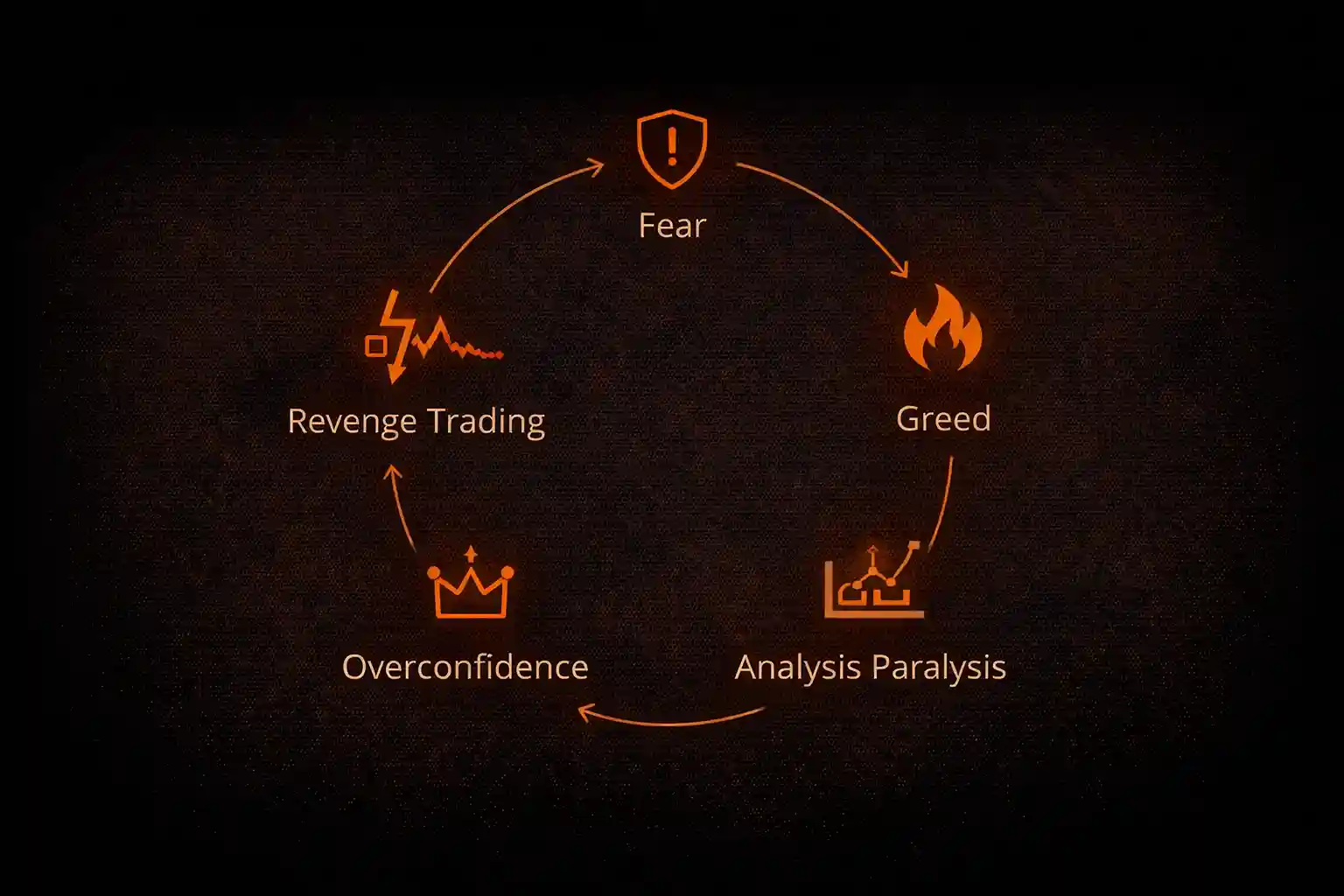
The emotional traps below catch nearly every trader at some point: what matters is whether you recognize them in real time or only in the post-mortem.
Fear of Loss and Premature Exits
You enter a trade with a clear target. Price dips slightly, and suddenly the target doesn’t exist anymore: all you can see is the worst-case scenario. Your stop-loss is in place. Your risk is defined. But your hands don’t care. You close out, lock in a tiny gain or a small loss, and watch price run exactly where your plan said it would.
Fear of loss is one of the most universal experiences in trading. It’s based on experience: you have lost money before, and your brain remembers that pain with uncomfortable clarity. But when fear starts overriding your plan, it becomes the very thing costing you money.
Greed and Overtrading
The flip side of fear is just as corrosive. After a string of winners, something shifts. You start seeing setups everywhere. Position sizes creep up. You ignore your rules because you’re “feeling it” today. Greed doesn’t always announce itself. Sometimes it wears the mask of confidence or enthusiasm.
Overtrading is its most common symptom: the compulsive need to be in the market, to squeeze more from a winning streak, to make up for a slow week. By the time you recognize what happened, you’ve given back days or weeks of gains in a single session.
Revenge Trading and Emotional Spirals
You take a loss. Now there’s a burning need to make it back right now. You jump into the next trade without your usual analysis, size up because you need a bigger win, and the spiral begins.
Revenge trading is your ego trying to rewrite history in real time. It’s one of the fastest ways to turn a manageable loss into a catastrophic one, because every decision in that state is fueled by emotion, not analysis. The market doesn’t owe you anything, and it won’t cooperate with your timeline for recovery.
Overconfidence After Winning Streaks
Five wins in a row and it feels like you’ve cracked the code. You start trusting your instincts over your system. Rules feel like suggestions. Risk management feels like an unnecessary brake on your momentum.
This is where some of the steepest account drawdowns begin. Overconfidence blinds you to risk precisely when vigilance matters most. Markets have a way of humbling traders right after they finish flattering them.
Analysis Paralysis and Hesitation
Not every psychological challenge is dramatic. Sometimes it’s quieter: you stare at a clean setup, check one more indicator, flip to another timeframe, read another opinion, and the entry passes. You knew it was good. You just couldn’t pull the trigger.
Analysis paralysis grows from a desire for certainty in an environment that will never provide it. The irony cuts deep: by trying to avoid mistakes, you miss the trades that would have worked.
Recognizing these patterns is only half the equation. To understand why they fire so reliably, you need to look at what’s happening beneath the surface.
The Science Behind Trader Behavior
Cognitive Biases That Distort Decision-Making
Your brain isn’t wired for trading. It’s wired for survival, and those ancient circuits create predictable distortions in how you process market information.

Loss aversion is among the most powerful. Research consistently shows that the psychological sting of losing money is roughly twice as intense as the pleasure of gaining the same amount. That asymmetry explains why you’ll hold a losing trade far too long, hoping it recovers, while cutting a winner short to lock in the pleasure before it vanishes. You’re not being illogical. You’re being human. But in the markets, that hardwiring bleeds your account dry.
Confirmation bias is equally sneaky. Once you’ve committed to a trade idea, your brain starts filtering information to defend that belief. Bullish analysis stands out; bearish signals get waved away. You’re not seeing the market anymore, you’re seeing the version that validates what you already decided.
Recency bias gives your last few trades outsized influence over the next one. A string of losses can make you timid on a valid setup. A string of wins can make you reckless. Either way, you’re weighting recent experience over your system’s actual track record.
These biases aren’t character flaws. They’re features of human cognition that kept your ancestors alive but work against you in probabilistic environments like financial markets.
How Stress Affects Trading Performance
When stress rises, your body’s fight-or-flight system activates. Cortisol floods your system, narrowing your focus and nudging you toward quick, reactive decisions rather than measured, plan-based ones.
Think of it like driving in a rainstorm. You can still drive, but your reaction time shifts, your field of vision shrinks, and you grip the wheel harder. Under trading stress, you process less information, default to emotional shortcuts, and struggle to follow layered rules.
Stress is only human, so it will affect you. The question is: Will you have systems ready to catch you when it does?
Building a Resilient Trader Mindset
Knowing your vulnerabilities is valuable. But awareness without a system to act on it just makes you a self-aware trader who still loses money. Here’s how to build the psychological scaffolding that turns insight into action.
Developing Emotional Awareness
Before you can manage your emotions, you need to notice them. That’s harder than it sounds. Most traders don’t realize they’re trading from fear or greed until the position is closed and the damage is done.
Emotional awareness starts with one small habit: before every trade, pause and ask yourself: “What am I feeling right now?” Not what the chart is telling you. What’s happening inside you.
Are you anxious? Excited? Bored? Still stewing over the last trade? Each emotional state nudges you toward specific behaviors:
- Anxiety: premature exits, undersizing, skipping valid setups
- Excitement: oversizing, chasing entries, ignoring risk parameters
- Boredom: forcing trades that don’t meet your criteria
- Frustration: revenge trading, abandoning the plan
Learning to name what you’re feeling is the first step toward breaking the automatic chain from emotion to action.
Creating Pre-Trade Routines

Elite performers across every discipline rely on routines because they reduce the number of decisions you face under pressure. The same principle holds in trading.
A solid pre-trade routine might include:
- Market review: scan your watchlist and flag potential setups before the session opens
- Emotional check-in: honestly assess your mental state and energy level
- Rule review: re-read your trading rules (yes, every session, even though you wrote them)
- Risk parameters: confirm your maximum risk per trade and daily loss limit
- Intention setting: define what “a good day” means in terms of process, not profit
This isn’t busywork. A routine creates a buffer between you and the market: a structured bridge from “person with feelings” to “trader executing a plan.”
Using a Trading Journal for Psychological Insight
A trading journal is the most underused tool in a trader’s kit, and its real value goes well beyond logging entries and exits.
After each session, document not just what you traded, but how you felt before, during, and after. Note when you deviated from your plan and what emotion drove that choice. Over weeks and months, patterns surface that you simply cannot see in the moment.
In other words, a journal turns invisible habits into visible data. And once a pattern is visible, you can interrupt it.
But what about those moments when you’re mid-trade, emotions are surging, and you need something that works right now?
Practical Techniques to Manage Emotions in Real Time
Breathing and Grounding Methods
This might sound too simple to matter, but controlled breathing is one of the fastest ways to interrupt a stress response. When cortisol is surging and your finger is hovering over the button, your nervous system needs a physical reset.
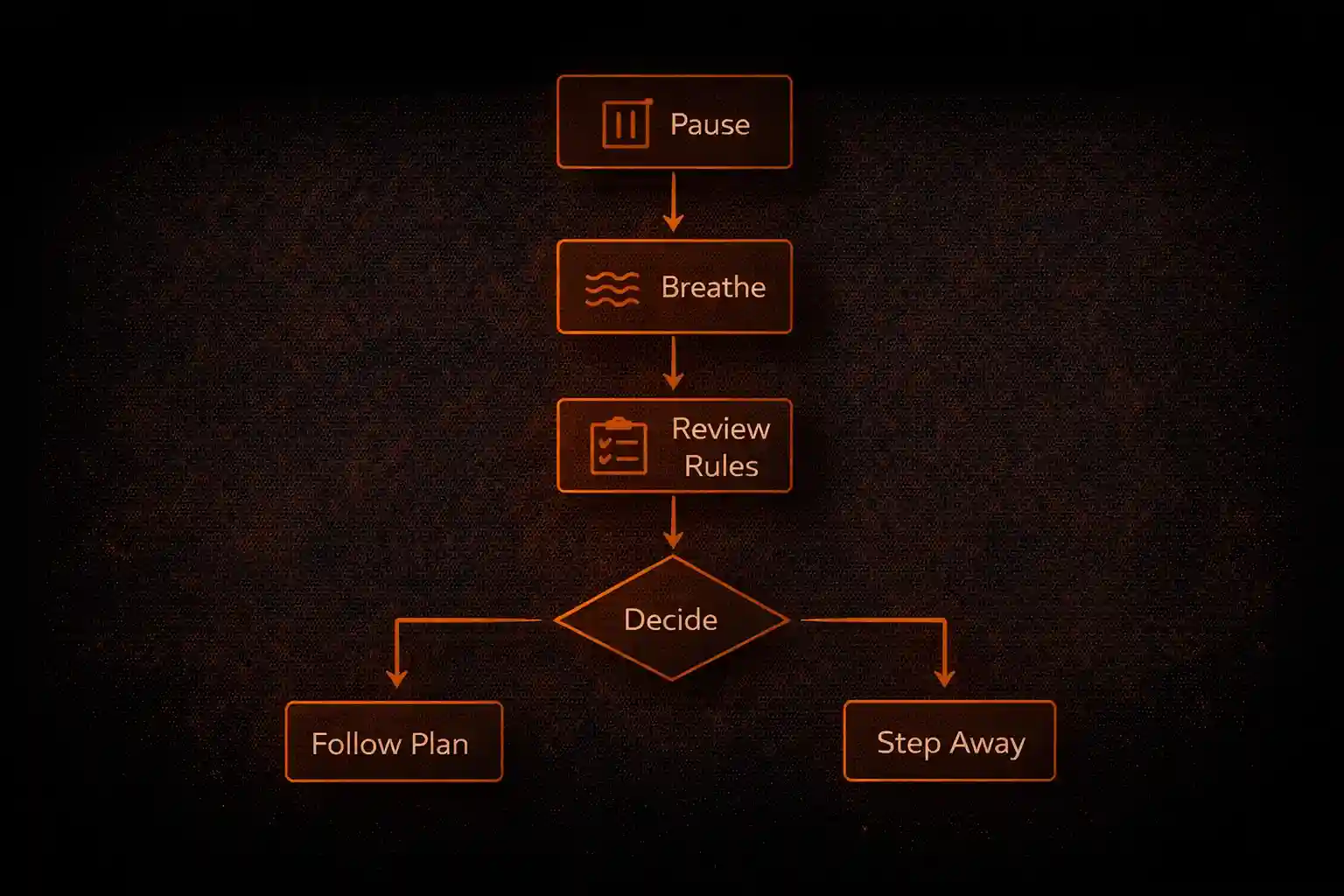
Try this the next time emotions threaten to pull you off-plan:
- Remove your hand from the mouse
- Take 3 slow breaths: inhale for 4 counts, exhale for 6 counts
- Name the emotion you’re feeling (even silently: “I’m angry about that last trade”)
- Ask: “What does my plan say to do right now?”
- Act only on the plan, or step away entirely
It takes less than 30 seconds. It won’t erase the emotion, but it opens a gap between impulse and action. And that gap is where discipline lives.
Rule-Based Trading as a Psychological Shield
If you’re making trading decisions on the fly, every trade becomes a psychological negotiation. But when your rules are clear, specific, and pre-committed, most of those internal battles never start.
Rule-based trading means defining your criteria before the market opens. This includes:
- Entry criteria: specific conditions that must all be met before you take a trade
- Exit criteria: predefined targets and stop-loss levels
- Position sizing: calculated from account size and risk tolerance, not adrenaline
- Daily limits: maximum number of trades and maximum daily loss before you stop
Think of your rules as guardrails on a mountain road. They keep you from going over the edge when visibility drops. Managing risk through clear rules takes the heaviest emotional decisions off your shoulders during live trading.
When to Step Away from the Screen
Sometimes the best trade is no trade. If you’ve hit your daily loss limit, if you’re emotionally compromised, or if something just feels off, walking away is a skill.
Set hard rules for when you step back:
- You’ve hit your predefined daily loss limit
- You’ve made two consecutive emotional (non-plan) trades
- You notice physical stress signals (clenched jaw, racing heart, shallow breathing)
- You’re trading to “make back” a loss rather than following a setup
The market will be open tomorrow. Your capital won’t be if you don’t protect it today.
Mastering in-the-moment techniques keeps you in the game. But lasting change requires a longer view.
Long-Term Psychological Development
Treating Trading as a Skill, Not a Gamble
Traders who develop genuine psychological resilience share one foundational belief: trading is a skill refined through deliberate practice, not a lottery ticket redeemed through luck.
This distinction matters because it reshapes how you respond to losses. If trading is gambling, a loss means the odds turned against you. If trading is a skill, a loss is data: feedback that sharpens your process. If you’re new to trading, internalizing this mindset early can save you years of frustration.
Skill development rarely follows a straight line. There are stretches of rapid improvement, followed by plateaus that feel like you’re sliding backward. That’s normal. The traders who quit during plateaus are the ones who expected a smooth upward curve.
The Role of Consistency Over Perfection
Perfectionism is a quiet killer in trading. The trader who needs every position to be a winner will never survive long enough to benefit from a positive edge played out over hundreds of trades.
Your job isn’t to be right on every trade. Your job is to follow your process consistently enough that your edge expresses itself over time. That means absorbing losses as a cost of doing business, not as evidence of personal failure.
A useful reframe: judge your performance by the quality of your decisions, not the outcome of any single trade. A trade that followed your plan but lost money was a good trade. A trade that broke your rules but made money was a bad trade. Once you internalize that distinction, losses stop being emotionally devastating: they become part of the math.
When to Seek External Support or Coaching
There’s no shame in getting help. Professional trading psychologists and performance coaches work with traders at every level, from retail beginners to institutional desk traders. If you’ve been stuck in the same patterns for months despite genuine effort, an outside perspective can cut through blind spots you can’t see on your own.
Options worth exploring:
- Trading psychology books: accessible starting points for structured self-study
- Peer communities: groups of serious traders who share experiences and hold each other accountable
- Performance coaches: professionals who specialize in helping traders strengthen mental discipline
- Journaling accountability: partnering with another trader to review journal entries and surface patterns
You don’t have to do this alone. And recognizing when self-directed work has hit its ceiling is itself a sign of psychological maturity.
Key Takeaways for Your Trading Psychology Journey
Trading psychology isn’t a side topic you skim once and shelve. It’s the foundation beneath every technical skill you build. Here’s what matters most:
- Your mind is your biggest trading tool, and your biggest risk. Technical knowledge without emotional discipline produces erratic results, no matter how sharp your strategy.
- The emotional challenges are universal. Fear, greed, revenge trading, overconfidence, and hesitation affect virtually every trader. Spotting them in real time is a learnable skill.
- Cognitive biases are hardwired, not optional. You can’t delete loss aversion or confirmation bias, but you can build systems that blunt their influence on your decisions.
- Structure beats willpower. Pre-trade routines, clear rules, a trading journal, and hard stop limits protect you when emotions run high.
- Consistency matters more than perfection. Judge yourself on process quality, not individual trade outcomes. Your edge needs hundreds of trades to reveal itself.
- This is a long game. Psychological growth doesn’t happen overnight. Treat it like any other skill: with patience, deliberate practice, and the willingness to ask for help when you’re stuck.
Your technical skills got you to the screen. Your psychological skills will determine whether you stay there.


Comments