


You know the setup isn’t quite there yet. The price is close, but not at your level. Your rules say wait. And yet your finger hovers over the mouse, your chest tightens, and before you’ve fully decided, you’re in too early, again.
Impatience in trading is a behavioral pattern with identifiable triggers and, crucially, trainable countermeasures. The problem is that most advice tells you to “just be more disciplined,” as if patience were a switch you could flip through sheer willpower.
This guide breaks down what trading impatience actually looks like, why it keeps happening even when you know better, and how to systematically build the ability to wait for setups without white-knuckling your way through every session. By the end, you’ll have a concrete process for turning patience into a genuine edge.
This content is for educational purposes only and does not constitute financial or psychological advice.
What Impatience in Trading Actually Looks Like
Impatience rarely announces itself. In the moment, it feels like decisiveness, like you’re finally taking action instead of just watching. That’s precisely what makes it dangerous.
Common Behavioral Patterns
The signs of impatience are easier to spot in hindsight than in real time. But once you know what to look for, certain patterns emerge:
- Entering before confirmation: You see price approaching your zone and jump in early because “it’s going to get there anyway.” The reasoning sounds logical. The results often aren’t.
- Shrinking your timeframe mid-session: You planned to trade the hourly chart, but nothing’s happening, so you drop to the 5-minute looking for action. Suddenly setups appear everywhere.
- Increasing position frequency: On slow days, you find yourself taking setups you’d normally skip just to have something working.
- Exiting winners too early: The trade is moving your way, but you grab profit quickly because the discomfort of waiting for your target outweighs the potential gain.
- Revenge entries: After a loss, you immediately scan for another trade to “make it back,” abandoning your usual criteria in the process.
These behaviors share a common thread: they prioritize action over quality. The discomfort of waiting becomes harder to tolerate than the risk of a subpar trade.
The Cost of Rushing Trades
Every premature entry carries a cost, even when it works out. When you enter early and the trade happens to be profitable, you reinforce the behavior. Your brain logs it as a win, making you more likely to repeat it. Except the odds eventually catch up.
The real cost is the erosion of your edge. If your strategy has a 55% win rate when you follow your rules but only 45% when you force entries, impatience is mathematically expensive. You’re no longer trading your system. You’re trading your impulses.
Which raises a harder question: why does this keep happening when you already know it’s a problem?
Why Traders Struggle to Wait for Setups
Understanding the mechanics behind impatience is the first step toward managing it. This has nothing to do with weakness or lack of commitment: your brain is doing exactly what evolution designed it to do. Those instincts just happen to be poorly suited to markets.
Psychological Drivers of Impulsive Trading
Several psychological forces conspire to make waiting feel almost unbearable:
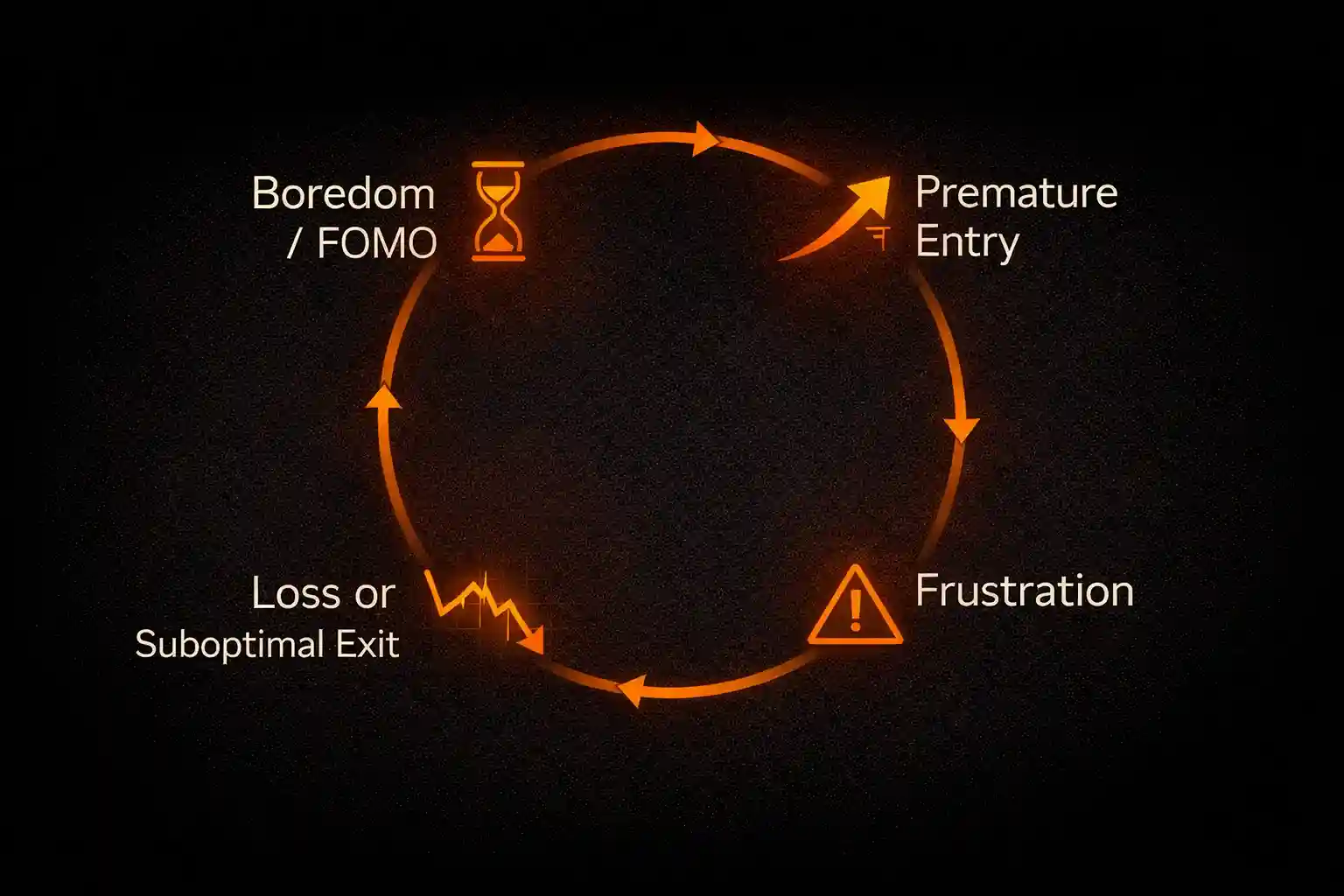
- Dopamine and anticipation: Your brain releases dopamine when you anticipate a potential reward. Clicking the buy button feels good because it activates that anticipation circuit, regardless of whether the trade is objectively sound.
- FOMO (Fear of Missing Out): Watching price move without you triggers loss aversion. Missing a move feels like losing money you already had, even though you never had it. The pain is real even when the loss isn’t.
- Boredom intolerance: Sitting in front of charts with no position tests your ability to tolerate inactivity. For many traders, doing nothing feels like failing to do their job.
- Action bias: Humans are wired to prefer action over inaction, especially under uncertainty. Taking a trade feels more productive than waiting, even when waiting is the strategically correct choice.
These aren’t character flaws. They’re default neurological settings. The traders who develop patience are those who build systems to override them.
Market Conditions That Amplify Impatience
Certain environments make impulse control significantly harder:
- Low volatility or ranging markets: When price isn’t moving, every small wiggle looks like the start of something bigger. You get baited into trades that go nowhere.
- After a winning streak: Confidence bleeds into overconfidence. You start feeling like your judgment has become sharper than your rules.
- After a losing streak: Desperation sets in. You need a win to feel okay, so you lower your standards to manufacture opportunity.
- High-impact news days: The fear of being on the sidelines during a big move pushes you to enter before your setup confirms.
Recognizing these conditions in advance lets you prepare, or avoid trading entirely when your patience is most likely to buckle.
Yet even when you manage the psychology, impatience has a way of infiltrating another critical area: how you handle risk.
The Relationship Between Impatience and Poor Risk Management
Impatience and risk management failures are deeply intertwined. When you rush into trades, you’re often compromising your position sizing, stop placement, and exit strategy along with it.
Think of a solid trade plan as a chain of decisions: entry, size, stop, target. When impatience drives the entry, the rest of the chain gets yanked along. You enter early, so your stop is tighter than it should be, or you widen it to “give it room,” which inflates your risk. You don’t wait for confirmation, so your position size is based on a zone price hasn’t reached yet. The math unravels.
Impatient traders also tend to micromanage positions. Once you’re in a trade you forced, anxiety kicks in. You watch every tick, adjusting your stop or taking profits too early. The original plan, if there was one, gets abandoned within minutes.
This isn’t about being bad at trading psychology. It’s about recognizing that one impulsive decision creates a cascade of compromised decisions. The entry is simply where the damage starts.
So how do you build the capacity to wait without relying on willpower alone?
How to Develop Patience as a Trading Skill
Patience isn’t a fixed trait you either possess or don’t. It’s a skill built through deliberate practice and environmental design. The goal is to create conditions where acting on them becomes harder than waiting.

Pre-Session Routines and Rules-Based Waiting
The most effective time to fight impatience is before the session starts.
- Define your setups in writing before you trade. If you don’t have a specific, written description of what you’re waiting for, you’re gambling. Specificity forces patience because it gives you clear criteria to check against.
- Use a pre-session checklist. Before opening your platform, review your rules, your risk limits, and your mental state. This creates friction between impulse and action.
- Set alerts instead of watching. If your setup triggers at a specific price, set an alert and step away from the screen. Watching price move in real time erodes patience faster than almost anything else.
- Commit to a minimum wait time. Some traders use rules like “no trades in the first 30 minutes” or “wait 60 seconds between identifying a setup and entering.” These artificial delays break the impulse-action loop.
The underlying principle is structure. Rules-based waiting externalizes your discipline.
Using Process Goals Instead of Outcome Goals
Outcome goals (making a certain amount, hitting a win rate) put pressure on each individual trade. That pressure feeds impatience. If you need this trade to work, you’re more likely to force it.
Process goals flip the focus:
- “I will only take A+ setups today” instead of “I will make $500 today.”
- “I will follow my entry checklist on every trade” instead of “I will win 3 out of 4 trades.”
- “I will stop trading after two consecutive rule violations” instead of “I will stop trading when I’m up or down a certain amount.”
Process goals reward discipline, not results. When your success metric becomes “did I wait for my setup?” rather than “did I make money?”, patience transforms from an obstacle into the path itself.
Environmental and Behavioral Modifications
Your trading environment shapes your behavior more than you might expect. Small changes can yield meaningful differences:
- Reduce screen time on slow days. If the market isn’t offering setups, watching it won’t conjure them. Give yourself permission to step away.
- Trade smaller when you notice impatience rising. If you catch yourself wanting to enter without a clear reason, reduce your size. Lower stakes lower the emotional intensity.
- Keep a journal entry specifically for patience. Note each day whether you waited for setups or forced trades. Over time, patterns emerge: certain days, times, or conditions where your patience consistently breaks down.
- Use physical cues. Some traders stand up, take a breath, or physically move away from their desk before entering any trade. The friction slows the impulse.
The point isn’t to make trading joyless. It’s to make impulsive trading harder than patient trading. When the path of least resistance aligns with your rules, discipline stops requiring heroic effort.
What if you’re doing all this and impatience still dominates your sessions?
Recognizing When Impatience Is a Symptom of a Larger Problem
Sometimes persistent impatience isn’t simply a discipline issue—it’s a signal that something deeper needs attention.
If you find yourself unable to wait despite implementing multiple strategies, consider whether any of these apply:
- Your strategy doesn’t fit your personality. If you’re trading a slow system but thrive on activity, the mismatch creates constant friction.
- You’re undercapitalized for your goals. When your account can’t realistically generate the returns you need, impatience becomes a natural response. The pressure to grow quickly overrides discipline at every turn.
- You’re trading to escape something else. Boredom, anxiety, or dissatisfaction outside of trading can drive compulsive activity at the screen. Trading becomes a distraction rather than a deliberate practice.
- You’re experiencing burnout. After extended periods of screen time and emotional strain, your capacity for patience depletes. What feels like impatience might actually be exhaustion wearing a different mask.
There’s an important distinction between impatience and legitimate urgency. If a valid setup is forming and you need to act quickly to capture it, that’s not impatience but execution. The difference lies in whether your action is driven by your criteria or your discomfort.
If impatience persists despite your best efforts, stepping back from active trading to reassess your approach, your goals, or whether you need support beyond self-directed learning may be worthwhile. Recognizing this is part of the process.
Key Takeaways
- Impatience in trading shows up as premature entries, timeframe hopping, overtrading, and early exits, all of which erode your edge over time.
- Psychological drivers like dopamine anticipation, FOMO, and action bias make waiting inherently uncomfortable. This is normal, not a character flaw.
- Market conditions like low volatility, winning streaks, and losing streaks amplify impulsive tendencies. Knowing your vulnerable moments helps you prepare.
- Impatience compromises risk management by distorting position sizing, stop placement, and trade management.
- Building patience requires systems: pre-session routines, written rules, alerts instead of screen-watching, and process goals over outcome goals.
- Environmental modifications (reducing screen time, trading smaller when triggered, journaling patience specifically) reinforce discipline without relying on willpower.
- Persistent impatience despite multiple interventions may indicate a deeper issue: strategy mismatch, undercapitalization, emotional avoidance, or burnout.
Patience isn’t about becoming a different person. It’s about building structures that make waiting easier than acting impulsively, and recognizing when your impatience is trying to tell you something worth hearing.


Comments