


Most trading psychology content lumps all emotions into the same bucket, tells you to “control your feelings,” and moves on. But sentimentality operates on a different frequency than panic selling or FOMO buying. It’s the attachment you form to specific assets, to trades that defined a chapter of your journey, or to narratives you’ve woven around certain positions.
This guide breaks down what sentimental trading actually looks like, why your brain defaults to it, and how to build a process that replaces attachment with objectivity. You won’t find vague advice here. You’ll walk away with a framework you can use the next time that familiar pull tries to override your logic.

What Is Sentimentality in Trading?
Sentimentality in trading is the emotional attachment you develop toward specific assets, positions, or past outcomes that causes you to make decisions based on personal feelings rather than market data. It’s the bias that makes you treat a stock like a relationship instead of a probability.
Picture keeping a car that breaks down every month because it was your first car. You know it’s costing you more than it’s worth. You know a replacement would serve you better. But the history, the memories, the identity wrapped up in owning that car keeps you paying the repair bills. In trading, those “repair bills” are unrealized losses, missed opportunities, and portfolio concentration that makes no strategic sense.
Sentimentality vs. Fear and Greed: A Different Kind of Bias
Fear and greed get all the attention in trading psychology discussions, and for good reason. They’re loud, immediate, and easy to spot. Fear makes you sell at the bottom. Greed makes you chase tops. Both tend to hit fast and burn out quickly.
Sentimentality builds slowly, wrapping itself around your reasoning over weeks and months. Where fear says “get out now,” and greed says “get in now,” sentimentality says “stay, because this one matters to you.” It doesn’t spike your heart rate. It whispers rationalizations. It makes you feel like loyalty to a position is a virtue rather than a vulnerability.
Here’s the critical distinction: fear and greed are reactions to market conditions. Sentimentality is a reaction to your own narrative. It’s about what the trade means to you.
Common Forms of Sentimental Attachment in the Markets
Sentimental bias wears different disguises depending on the trader. These are the most common ways it shows up:
- The “first win” asset: You made your first significant profit on a particular stock or coin, and now you return to it repeatedly, even when fundamentals no longer support it.
- The identity trade: You’ve talked about a position publicly, recommended it to friends, or built part of your trading identity around it. Closing it feels like admitting you were wrong about who you are.
- The inherited conviction: Someone you respect, whether a mentor, a financial influencer, or a family member, introduced you to an asset. You hold it partly out of loyalty to that relationship.
- The comeback story: You rode a position through a major drawdown and it recovered once before. Now you assume it will always come back, regardless of changed conditions.
- The “I understand this one” comfort zone: You’ve traded one asset for so long that branching out feels uncomfortable, so you keep allocating capital to it even when better opportunities exist elsewhere.
Any of those hit close to home? If so, you’re not alone. Recognizing the pattern is the first step toward breaking it.
Why Traders Become Emotionally Attached
You didn’t choose to become sentimental about a trade. Your brain did it for you. It had its reasons, even if those reasons work against you in the markets.
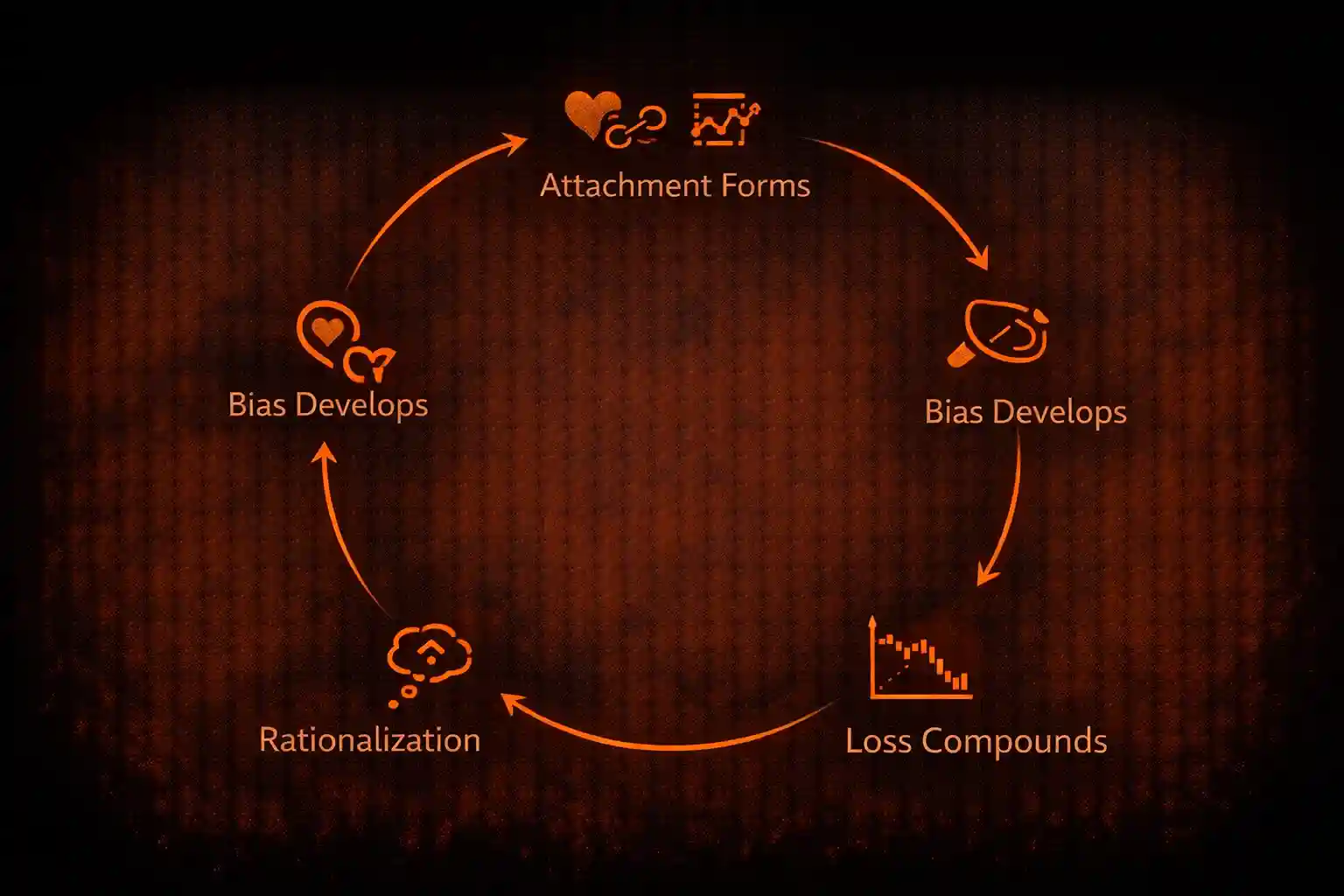
The Psychology Behind Sentimental Trades
Three well-documented psychological mechanisms drive sentimental attachment in trading:
- The endowment effect makes you value something more simply because you own it. Imagine you buy a coffee mug for $5. Once it’s yours, you wouldn’t sell it for less than $8 or $9. Nothing changed about the mug. Ownership changed your perception of its worth. The same distortion happens with your positions. The moment you own shares, your brain inflates their value beyond what the market data supports.
- Loss aversion, a concept extensively studied in behavioral finance by researchers like Daniel Kahneman, means losses feel roughly twice as painful as equivalent gains feel good. Closing a sentimental position means making that loss real, and your brain will construct elaborate justifications to avoid that pain.
- The sunk cost fallacy convinces you that the time, money, and emotional energy you’ve already invested in a trade is a reason to keep holding. It isn’t. The market doesn’t care what you’ve already spent. Only the forward-looking probability matters.
These are hardwired cognitive shortcuts that served humans well for thousands of years. They just happen to be poorly suited to a market environment where objectivity determines survival.
Identity, Narrative, and the Trades You Refuse to Let Go
This is where sentimentality digs in deepest. When a trade becomes part of your story, your sense of self fuses with the position. You’re not just “someone who owns this asset.” You become “the person who believed in this asset when nobody else did.”
That narrative feels good. It gives your trading a sense of purpose beyond profit. But it also creates a psychological trap: closing the position doesn’t just mean taking a loss on a trade. It means losing a piece of your identity.
This is why you’ll sometimes see traders defend a failing position with increasing intensity the worse it performs. The money stopped being the point long ago. It’s about being right. It’s about the story they’ve told themselves and others.
So how does this attachment actually play out when real capital is on the line?
How Sentimentality Distorts Trading Decisions
Sentimentality doesn’t announce itself with a red flag. It disguises itself as patience, conviction, or experience. But the distortions it creates in your trading are concrete and measurable.
Holding Losers Too Long
This is the most direct consequence. You hold a losing position past every rational exit point because letting go feels like betrayal. You tell yourself you’re being “patient” or “long-term,” but if you’re honest, the reason you’re still in the trade has nothing to do with your original thesis. It has everything to do with how it feels to imagine closing it.
The cost isn’t just the paper loss. It’s the opportunity cost: capital sitting in a position that no longer meets your criteria while better setups pass you by.
Overconcentrating in “Favorite” Assets
Sentimentality nudges you to allocate disproportionate capital to assets you feel connected to. You might have solid risk management rules, but when it comes to “your” asset, you bend them.
This concentration creates fragility in your portfolio. A single adverse move in your sentimental favorite can do more damage than a broad market downturn, precisely because you’ve weighted your exposure around emotion rather than strategy.
Ignoring Exit Signals Because of Past Wins
Past success with an asset creates a dangerous halo effect. Because it worked before, your brain assumes it will work again, even when the conditions that drove the original win have completely changed.
You’ll find yourself dismissing technical breakdowns, deteriorating fundamentals, or shifts in market structure because “this one always comes back.” That confidence isn’t based on analysis. It’s based on memory. And memory is one of the least reliable tools you have in trading.
Taken together, the pattern is consistent: sentimentality makes you slower to act, more concentrated than you should be, and blind to signals you’d otherwise respect. But recognizing these distortions in the abstract is one thing. Catching them in yourself, in real time, while you’re in the position? That’s something else entirely.
Recognizing Sentimental Bias in Your Own Trading
The hardest part about sentimentality isn’t understanding it. It’s admitting it’s happening to you, right now, in positions you currently hold.
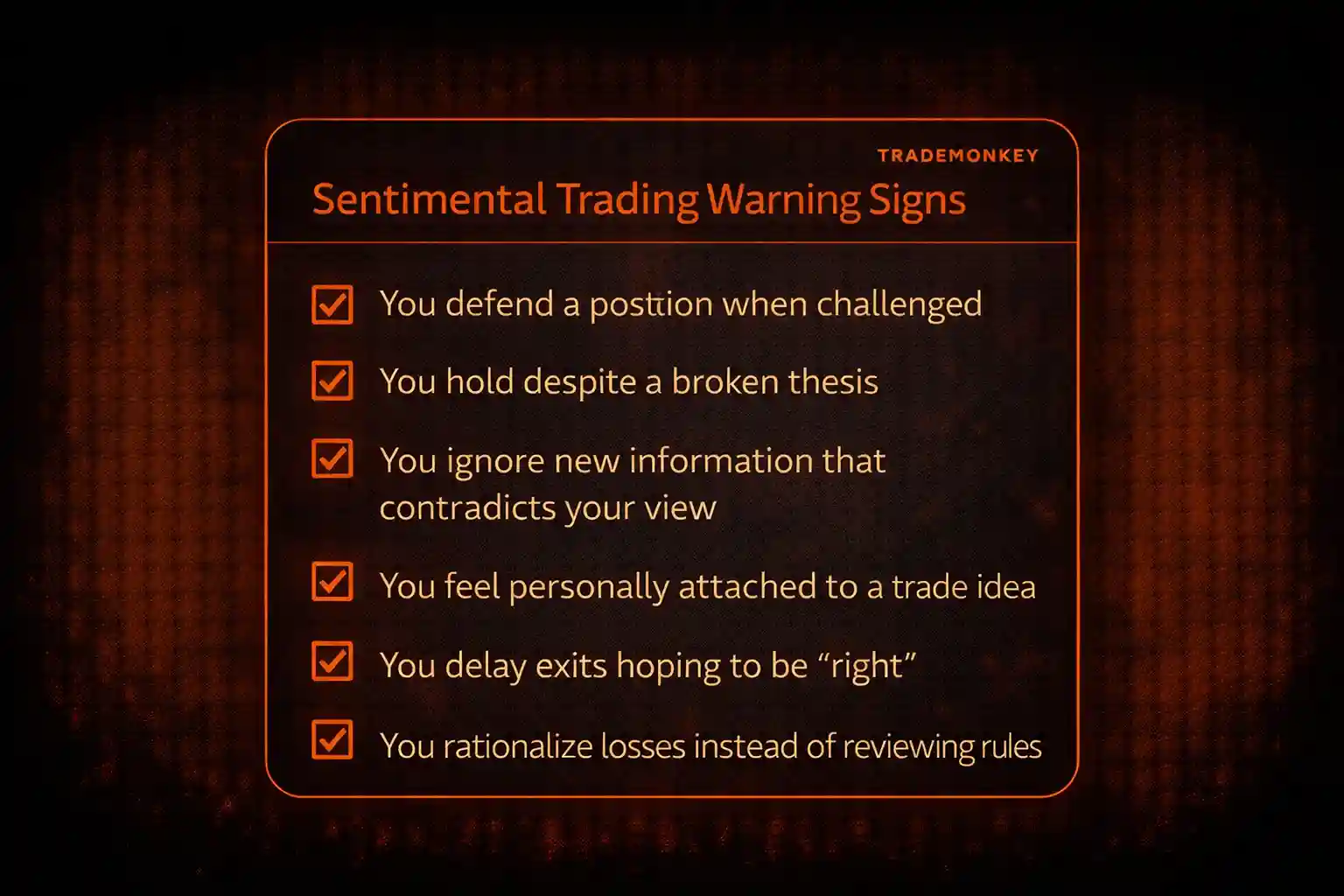
Warning Signs and Self-Assessment Questions
Run through these questions honestly. If you answer “yes” to three or more, there’s a good chance sentimentality is influencing your decisions:
- Do you check one particular asset’s price more frequently than anything else in your portfolio?
- Have you ever described a position using language like “my stock” or “I believe in this company”?
- When someone challenges your trade, do you feel personally attacked rather than analytically curious?
- Are you holding any position where your original entry thesis has clearly broken, but you haven’t exited?
- Have you added to a losing position primarily because you “know” it will recover?
- Do you avoid looking at the P&L on a specific trade because seeing the number might force you to act?
- Would closing a particular position feel like giving up on something meaningful, not just taking a loss?
These aren’t trick questions. They’re patterns that every honest trader has experienced at some point. The goal isn’t to judge yourself. It’s to see clearly.
Journal Prompts to Surface Hidden Attachments
A trading journal is one of your best tools for catching sentimentality before it compounds. But generic journaling won’t cut it. You need prompts that dig specifically into emotional attachment:
- “If I had no position in this asset and saw the current chart for the first time, would I enter this trade today at this price?”
- “What would need to happen for me to close this position? Have any of those conditions already occurred?”
- “Am I holding this because of forward-looking data, or because of what this trade has meant to me in the past?”
- “If a trader I respect told me they were exiting this exact position, what would my first emotional reaction be?”
- “What story am I telling myself about this trade, and is that story based on current evidence?”
Writing these answers forces you to externalize the internal narratives your brain prefers to keep hidden. What feels like conviction in your head often looks a lot like attachment on paper.
You’ve identified the problem. Now what do you actually do about it?
How to Remove Emotional Attachment from Your Trades
Knowing you’re sentimental doesn’t fix the problem. You need systems that make objectivity the default, not something you have to summon through willpower each time the market tests you.
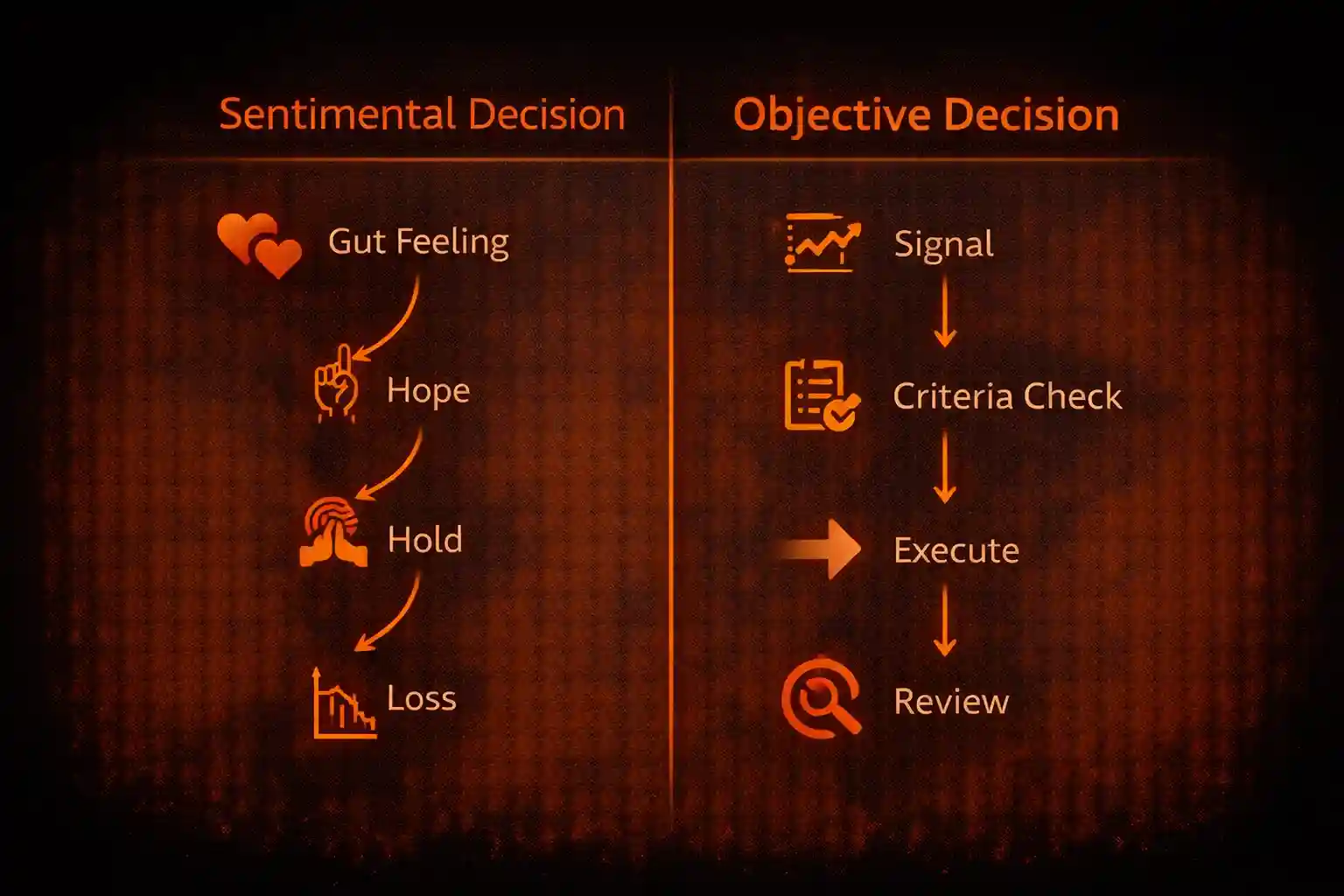
Building a Rules-Based Trading Framework
The most effective antidote to sentimentality is removing yourself from as many decisions as possible. A rules-based framework defines exactly when you enter, how much you risk, and when you exit, before any emotional attachment can form.
Think of it as pre-committing to a diet by only keeping healthy food in the house. You’re not relying on willpower when the craving hits. You’ve already made the decision in advance, during a moment of clarity.
Your framework doesn’t need to be complex. At minimum, it should cover:
- Entry criteria: What specific conditions must be true before you open a position?
- Position sizing: How much capital do you allocate, and does this rule apply uniformly across all assets?
- Stop loss placement: Where does the trade get invalidated, and is this level determined by data or by how much pain you’re willing to tolerate?
- Profit targets or trailing exit rules: How do you define “enough” before attachment has time to develop?
The key is writing these rules down and committing to them before you enter any trade. Sentimentality is strongest when decisions are made in the moment, under pressure, with money on the line.
Using Pre-Defined Entry and Exit Criteria
Pre-defined criteria work because they shift the question from “how do I feel about this trade?” to “does this trade meet my criteria, yes or no?”
That binary framing is powerful. It takes a complex emotional situation and reduces it to a checklist. Either the conditions are met, or they aren’t. Your history with the asset, your identity, your public statements about the position: none of that gets a vote.
Some traders find it helpful to write exit criteria on a physical card they keep near their trading setup. When you’re tempted to override your rules, having to physically look at the criteria you set during a clear-headed moment creates a friction point. That small pause can be enough to slow down an impulsive, sentimental override.
The Role of Trading Journals and Accountability
A trading journal pulls double duty against sentimentality. First, it forces you to articulate your reasoning at entry, creating a written record you can compare against your reasoning for holding later. If the two don’t match, you’ve found your bias.
Second, regular journal review creates accountability. When you look back at trades where you held for sentimental reasons and can see the cost in black and white, the pattern becomes undeniable. It’s much harder to rationalize attachment when the data is staring back at you from your own handwriting.
Consider sharing your journal entries with a trading partner or accountability group. External perspective is one of the fastest ways to spot sentimentality, because other people aren’t emotionally invested in your positions. What feels like conviction to you often looks like stubbornness to someone on the outside.
Some traders also find that the structured discipline required in environments like prop firm challenges naturally counters sentimental habits, since external rules force compliance regardless of personal attachment.
Objective Trading in Practice: Replacing Sentiment with Process
Understanding the theory is essential. But objectivity only matters if it survives contact with a live market and a real position.
Treating Every Position as a New Decision
This mental shift changes everything: every single day you hold a position, you are choosing to re-enter it at the current price. You’re not passively “holding.” You’re actively deciding that this is the best use of your capital right now.
When you frame it this way, the sentimental weight of past decisions loosens its grip. The question stops being “should I sell this position I’ve had for six months?” and becomes “if I had this cash right now, would I buy this asset at today’s price?”
If the answer is no, you have your signal. And it has nothing to do with feelings.
Systematic Review Habits That Reinforce Objectivity
Objectivity isn’t a one-time achievement. It’s a practice you maintain through consistent habits:
- Weekly portfolio audit: Review every open position against your current criteria. Flag any position you’re holding for reasons that don’t appear in your trading plan.
- Monthly attachment check: Use the self-assessment questions from earlier in this article. Look for new attachments that may have formed without you noticing.
- Quarterly journal deep-dive: Review your trading journal entries for patterns. Are the same assets showing up repeatedly? Are your rationalizations for holding certain positions shifting over time while the thesis stays broken?
- Pre-trade checklist: Before entering any new position, confirm that your decision is based on current data and criteria, not on familiarity, nostalgia, or narrative.
These reviews aren’t busywork. They’re the maintenance that keeps your trading psychology calibrated. Without them, sentimentality creeps back in gradually, and you won’t notice until the damage is already done.
Building objectivity is a process, not a destination. You won’t become perfectly rational overnight, and you don’t need to. What matters is that you keep narrowing the gap between what you feel and what you do.
Frequently Asked Questions


Comments