


You know what you’re supposed to do. You’ve studied the charts, built a watchlist, maybe even written out your trading plan. But when the moment comes to click that buy or sell button, something freezes. Your finger hovers. Your mind cycles through every worst-case scenario. And before you know it, the setup you spent an hour preparing for has moved without you.
That hesitation is a confidence problem, and one of the most common struggles traders face at every experience level. Trading confidence is built, brick by brick, through preparation, repetition, and honest self-assessment.
This guide breaks down why your confidence wavers, what’s actually driving that hesitation, and how to construct a repeatable system that turns self-doubt into steady, process-driven trust in your own decisions. No motivational fluff. No empty platitudes. Just a framework you can start using today.
This article is for educational purposes only and does not constitute financial advice. Trading involves significant risk, and past performance does not guarantee future results.

What Trading Confidence Actually Means
The word “confidence” gets thrown around in trading circles like it’s some magical switch you flip on. But real trading confidence has nothing to do with feeling invincible or being certain about every trade. It’s something far more practical, and far more useful.
Trading confidence is the quiet trust that you’ve done the work, that your process is sound, and that you can execute your plan regardless of whether any single trade wins or loses. It’s not the absence of fear. It’s the ability to act despite uncertainty because you trust your preparation more than you fear the outcome.
Confidence vs. Overconfidence: The Critical Difference
Here’s where a lot of traders get tripped up. Confidence and overconfidence might look similar on the surface, but they lead to completely different places.
Confidence says: “I’ve tested this setup, my risk is defined, and I’m comfortable with the potential loss.” Overconfidence says: “I’ve been on a winning streak, I feel great, so I’ll double my position size.”
One is grounded in process. The other is grounded in emotion. Confident traders still respect their stop losses and risk management rules. Overconfident traders start bending those rules because they feel untouchable. The moment you confuse a hot streak with skill, you’ve crossed a line. You’re not confident anymore. You’re reckless.
A useful mental check: if your conviction about a trade increases without any additional evidence from your process, that’s overconfidence creeping in, not genuine confidence growing.
Why Confidence Is a Skill, Not a Personality Trait
Nobody is born knowing how to parallel park. The first time you tried, you were probably sweating, over-correcting, and scraping the kerb. After doing it a hundred times? You barely think about it. That’s confidence built through repetition and feedback.
Trading confidence works the same way. It’s not a fixed trait some people have and others don’t. It develops when you repeatedly expose yourself to a process, evaluate the results honestly, and adjust. The traders who seem effortlessly confident aren’t fearless. They’ve simply logged enough reps with their system that execution feels natural.
So if you’re sitting there thinking you’re “just not a confident person,” stop. That belief is both inaccurate and unhelpful. You haven’t built the reps yet. That’s all.
But if confidence is built through experience, why do so many traders who have been at it for months or even years still struggle with it?
Why Traders Lose Confidence
Losing confidence is often faster and more violent than building it. One bad week can undo months of progress if you don’t understand the forces that tear confidence down. Those forces, though, are more predictable than you might think.
The Damage of Unplanned Losses
Every trader takes losses. That’s built into the game. But there’s a massive psychological difference between a planned loss and an unplanned one.
A planned loss is one where you defined your risk before entry, your stop was hit, and you moved on. It stings, but it doesn’t shake your foundation because you expected it as a possibility. An unplanned loss is a different animal entirely. Moving your stop, averaging into a losing position, trading without a clear exit plan: these create losses that feel chaotic and out of control.
That sense of chaos is what erodes confidence: the feeling that you weren’t in control of the process. Your brain starts associating trade execution with unpredictability and pain, and that’s when hesitation takes root.
Comparison Traps and External Validation
Social media has made this worse than ever. You open Twitter or a Discord channel and see someone posting a 500% gain on a single trade. Suddenly your steady 2% weekly return feels pathetic, and you start questioning everything about your approach.
This is the comparison trap, and it’s a quiet confidence killer. When you measure your performance against someone else’s highlight reel (and it’s always a highlight reel), you shift your source of validation from internal to external. Your confidence becomes dependent on how you stack up against others rather than how well you’re following your own process.
The fix is to be brutally honest with yourself about when external noise is shaking your internal compass.
Strategy-Hopping and the Cycle of Doubt
This one is devastatingly common. You try a strategy, take a few losses, decide the strategy is broken, switch to a new one, take a few more losses while learning it, decide that one’s broken too, and the cycle continues.

Every time you abandon a strategy prematurely, you restart the learning curve. You never build enough data to know whether the approach actually works. And each restart reinforces the belief that nothing works for you. The doubt compounds with every reset.
Here’s the irony: strategy-hopping feels proactive. It feels like you’re doing something about the problem. But it’s actually the problem itself, disguised as a solution.
So what does the opposite look like? What does it actually mean to build confidence from the ground up?
The Foundation: Confidence Through Preparation
Here’s a truth that sounds obvious but most traders overlook in practice: you cannot be confident in something you haven’t prepared for. Confidence isn’t generated by willpower or positive thinking. It’s generated by evidence, and evidence comes from preparation.
Building a Trading Plan You Actually Trust
A trading plan that sits in a Google Doc you never open isn’t a plan. It’s a wish list. A confidence-building trading plan is one you’ve tested, refined, and believe in because you’ve seen it produce results.
Your plan should cover, at minimum:
- Market and instrument selection: What do you trade and why?
- Setup criteria: Exact conditions that must be present before you consider a trade
- Entry rules: How and where you enter
- Exit rules: Both profit targets and stop losses, defined before entry
- Position sizing: How much you risk per trade, tied to your account size and risk management framework
- Conditions for not trading: When you sit on your hands
The more specific your plan, the less room there is for improvisation. And improvisation under pressure is exactly where confidence collapses.
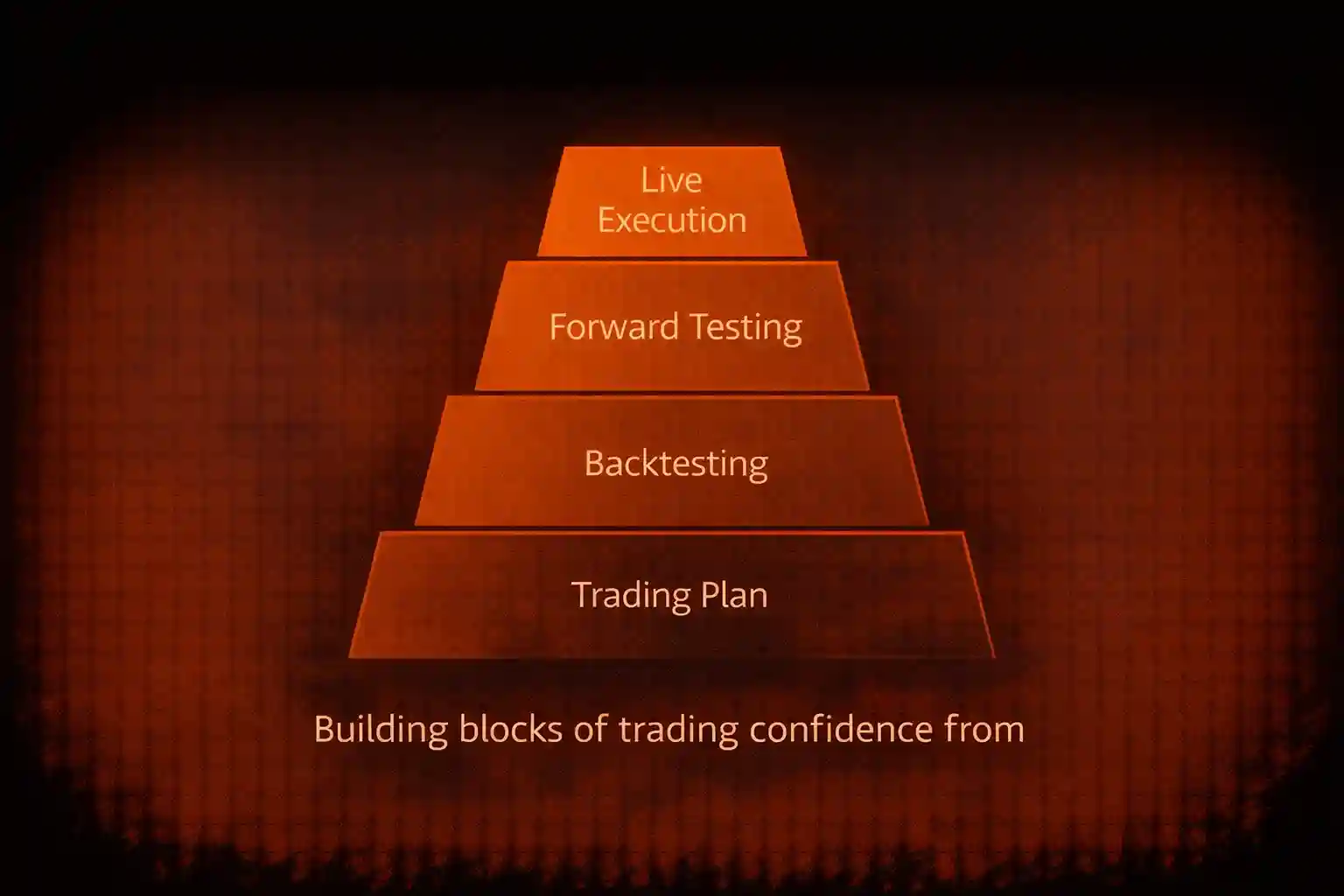
The Role of Backtesting and Forward Testing
Backtesting is where you build your first layer of evidence. By running your strategy through historical data, you develop a statistical baseline: win rate, average gain, average loss, maximum drawdown. These numbers aren’t just performance metrics. They’re the raw material of confidence.
When you know, based on 200 backtested trades, that your strategy has a 55% win rate and a 1.5:1 reward-to-risk ratio, a losing streak of four trades in a row stops feeling like proof that you’re failing. You can look at the data and see that such streaks are normal and expected within a profitable system.
Forward testing (paper trading your strategy in live market conditions) adds the next layer. It bridges the gap between “this worked historically” and “this works in real-time conditions where I have to make decisions under pressure.”
Demo to Live Transition Without Losing Confidence
The jump from demo to live trading is one of the most common confidence collapse points. Everything felt smooth on the simulator, but the moment real money is on the line, your psychology shifts dramatically.
This happens because demo trading removes the one variable that matters most: genuine risk. Your brain processes simulated losses and real losses in fundamentally different ways.
The key to managing this transition is to make it gradual:
- Start with the smallest position size your broker allows
- Focus exclusively on execution quality, not profit
- Treat your first 20-30 live trades as an extension of your testing phase
- Increase size only after you’ve demonstrated consistent execution at the current level
Going from demo to full-size live trading is like jumping from jogging on a treadmill to sprinting on a mountain trail. Same muscles, completely different environment. Give yourself permission to scale in slowly, and don’t mistake small position sizes for a lack of ambition. It’s strategic patience.
But preparation alone isn’t enough if your daily habits undermine it. So what does a confidence-building daily practice actually look like?
Daily Habits That Build Trading Confidence
Confidence is maintained through daily habits that reinforce your trust in your own process. Skip these habits, and even a well-prepared trader will find their confidence quietly eroding over time.
Pre-Market Routine and Mental Readiness
How you start your trading day sets the tone for every decision you’ll make. Jumping straight into live charts with no preparation is like showing up to a job interview without knowing the company’s name. You might get lucky, but you’ll feel off-balance the whole time.
An effective pre-market routine doesn’t need to be complicated. It just needs to be consistent:
- Review key levels and setups from your watchlist preparation
- Check the economic calendar for news events that could affect your instruments
- Set your daily risk limit (the maximum amount you’re willing to lose before you stop trading)
- Do a brief mental check-in: Are you tired? Stressed? Distracted? If so, adjust your expectations or reduce your size accordingly
That last point matters more than most traders admit. Self-awareness about your own mental state is a superpower when it comes to confidence. Knowing when you’re not at your best, and adjusting for it, prevents the kind of sloppy trades that torch confidence in a single session.
Journaling as a Confidence Feedback Loop
If you only adopt one habit from this entire article, make it this one. A trading journal is the single most powerful confidence-building tool available to you, and it costs nothing but 10 minutes of honesty after each session.
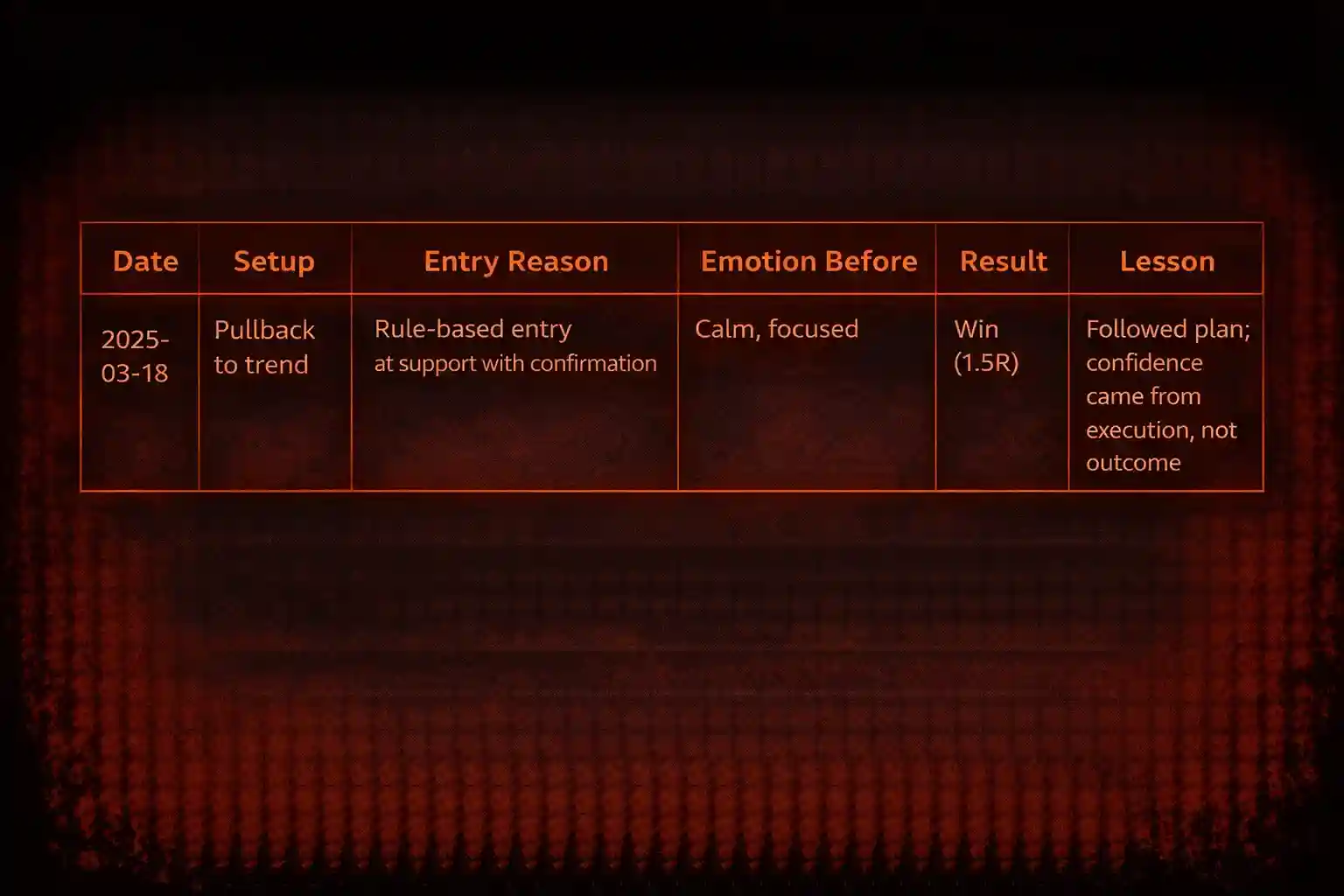
Your journal should capture more than just entries and exits. Record:
- The setup you identified and why it met your criteria
- Your emotional state before and during the trade
- Whether you followed your plan or deviated
- The outcome (win, loss, breakeven)
- One lesson or observation from the trade
Over time, this journal becomes a personal data set that shows you, in your own words, that you can follow a plan, manage risk, and learn from mistakes. That’s not motivation. That’s evidence. And evidence is what confidence actually runs on.
Reviewing Wins and Losses With Equal Objectivity
Most traders carry a dangerous review bias. When they win, they feel good and move on. When they lose, they agonise and second-guess everything. This creates a distorted picture where losses loom larger and feel more significant than wins.
Confidence requires balanced review. A winning trade that broke your rules is actually more dangerous to your long-term development than a losing trade that followed your plan perfectly. Start categorising your trades not just by outcome, but by execution quality:
- Good process, good outcome: Reinforce this. It’s your ideal.
- Good process, bad outcome: Accept this. It’s a normal cost of doing business.
- Bad process, good outcome: Be wary. This is luck disguised as skill, and it builds false confidence.
- Bad process, bad outcome: Learn from this. Identify the specific deviation and address it.
This kind of objective review turns every trade, win or loss, into a confidence data point rather than an emotional event.
But what about those moments when self-doubt hits in real time, right when you need to execute?
Overcoming Self-Doubt in Live Trading
Reading about confidence is one thing. Maintaining it with an open position and real money moving is something else entirely. Self-doubt in live trading is normal, but it becomes a problem when it paralyses your decision-making.
Recognising Hesitation Patterns
Self-doubt rarely shows up as a single thought. It manifests as patterns you can learn to spot:
- Entry hesitation: You see your setup, it meets all your criteria, but you can’t pull the trigger. You wait for “one more confirmation” that isn’t part of your plan.
- Early exit: You’re in a winning trade but close it prematurely because you’re afraid of giving back profits.
- Stop widening: You move your stop loss further away because you can’t accept the possibility of being wrong.
- Revenge trading: After a loss, you take an impulsive trade to “make it back,” driven by frustration rather than process.
Once you recognise which pattern is yours (and most traders have a dominant one), you can build specific countermeasures. For entry hesitation, that might mean placing limit orders in advance so the decision is already made. For early exits, it might mean setting alerts instead of watching price tick by tick.
Reframing Losses as Data
This is one of the most important mental shifts you can make as a trader. A loss is not evidence that you’re bad at this. A loss taken according to plan is a data point that confirms you can manage risk and follow rules.
Think of it like a doctor running diagnostic tests. Not every test comes back with the result you want, but every test gives you useful information. A loss that followed your plan tells you something about market conditions, your setup selection, or your timing. A loss that broke your rules tells you something about your discipline. Either way, it’s information you can use.
The traders who build lasting confidence are the ones who genuinely internalise this shift. They stop asking “why did I lose?” and start asking “did I follow my process, and what can I take from this?”
When to Step Away and When to Push Through
Not every moment of doubt means you should stop trading, and not every losing day means you should keep pushing. Knowing the difference is a skill in itself.
Step away when:
- You’ve hit your pre-defined daily loss limit
- You’re trading to recover losses rather than following setups
- You feel physical signs of stress (racing heart, tension, inability to focus)
- You’re angry, frustrated, or emotionally compromised
Push through when:
- You’re following your plan but experiencing normal discomfort
- Your setups are still appearing and meeting your criteria
- You’ve taken a loss but your process was sound
- The doubt you’re feeling is habitual rather than situational
The distinction comes down to whether your doubt is signal or noise. If your process is intact and you’re simply uncomfortable, that discomfort is often where growth happens. If your process has broken down and you’re improvising, that’s a warning sign worth heeding.
This kind of in-the-moment awareness builds over time. And that brings us to the bigger picture: how do you sustain confidence not just for a day or a week, but across an entire trading career?
Long-Term Confidence: Building a Track Record
Short-term confidence comes and goes with individual trades. Long-term confidence is something different entirely. It’s the deep, stable trust that comes from looking back at months or years of data and seeing clear evidence that your process works.
Process Goals vs. Outcome Goals
Most traders set outcome goals: “I want to make $5,000 this month” or “I want a 70% win rate.” The problem with outcome goals is that they’re only partially within your control. Markets move in ways no one can predict with certainty, and tying your confidence to outcomes you can’t fully control is a recipe for instability.
Process goals, on the other hand, are entirely within your control:
- “I will follow my entry criteria on every trade this week”
- “I will journal every trading session”
- “I will respect my daily loss limit without exception”
- “I will complete my pre-market routine before opening any positions”
When you meet a process goal, your confidence grows because you’ve proven something about your discipline and commitment. When you miss one, you know exactly what needs fixing. Either way, you stay in control of the narrative.
Scaling Up Gradually
As your confidence grows, you’ll naturally want to increase your position sizes. This is healthy, but it needs to be managed carefully. Jumping from risking 0.5% per trade to 2% overnight can shatter confidence just as quickly as a blown strategy.
Scale up incrementally, and always within the boundaries of sound position sizing principles. A reasonable approach:
- Demonstrate consistent execution quality over a minimum number of trades (20-50) at your current size
- Increase position size by a small, predetermined increment (e.g., 25-50% increase, not doubling)
- Treat the new size as a fresh evaluation period
- If execution quality deteriorates, scale back down without shame or judgment
Think of it like strength training. You don’t jump from lifting 20 kilograms to 100 kilograms because you had one good week. You add weight gradually and deload when needed. Your trading account deserves the same kind of respect.
Using Metrics to Prove Confidence to Yourself
Feelings are unreliable. Data isn’t. One of the most powerful things you can do for your long-term confidence is track metrics that reflect your process quality, not just your P&L.
Consider tracking:
- Plan adherence rate: What percentage of your trades followed your plan exactly?
- Average risk-to-reward achieved: Are you consistently hitting reasonable R:R ratios?
- Maximum consecutive losses: How does this compare to your backtested expectations?
- Equity curve trend: Is the overall direction positive, even if individual weeks are rough?
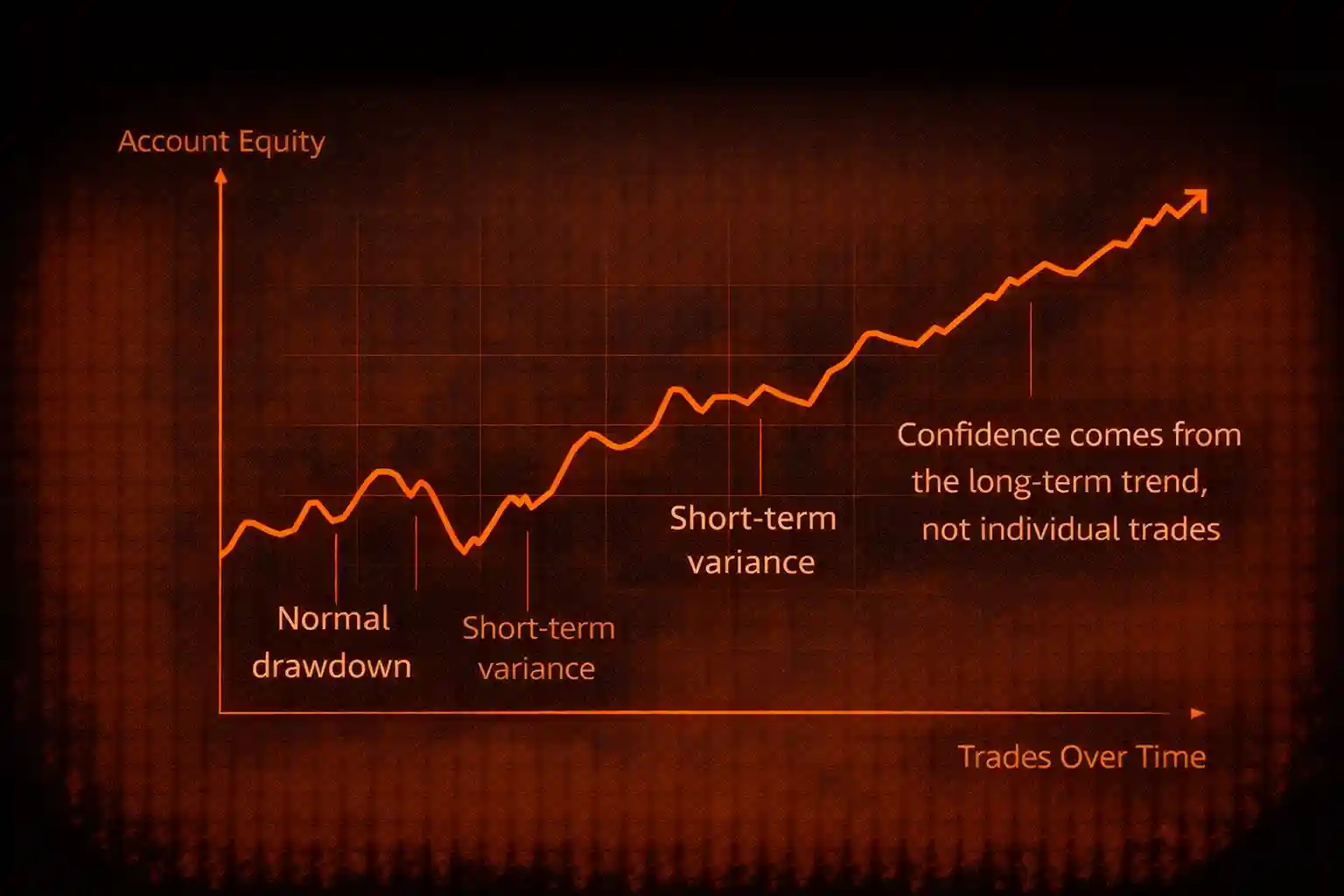
When self-doubt creeps in (and it will, periodically, even for experienced traders), these metrics give you something concrete to anchor to. You’re not relying on how you feel about your trading. You’re looking at what you’ve actually done.
Frequently Asked Questions


Comments