


The gap between knowing what to do and actually doing it is where most traders bleed money. Mindfulness in trading is the skill that closes that gap, not by turning you into a monk, but by training you to notice what’s happening inside your own head before it hijacks your decisions.
This guide breaks down what mindfulness actually looks like at a trading desk, gives you concrete techniques you can use in your next session, and shows you how to build a daily routine around it. No vague advice to “just breathe.” Just practical tools grounded in real trading scenarios.
This article is educational content about trading psychology. It is not financial advice, and no technique described here guarantees trading profitability.
What Mindfulness in Trading Actually Means
Most traders hear “mindfulness” and picture someone sitting cross-legged with their eyes closed. That image does more harm than good because it creates a disconnect between the concept and what you actually need at your desk.
Mindfulness in trading is simpler and more specific than the wellness version. It means maintaining deliberate awareness of your thoughts, emotions, and physical state while you’re making trading decisions. You’re not trying to empty your mind. You’re trying to see clearly what’s already in it.
The Difference Between General Mindfulness and Trading Mindfulness
General mindfulness is broad: being present in everyday life, noticing the taste of your coffee, feeling your feet on the ground. Useful, sure, but not directly targeted at the pressure of a live market.
Trading mindfulness narrows the lens to specific internal signals that directly affect your execution. The tightness in your chest when a position moves against you. The rush of excitement that makes you size up too aggressively. The mental fog that settles in after three hours of screen time.
The distinction matters because you don’t need a general meditation practice to become a more aware trader (though it can help). What you need is the ability to observe yourself in the moments that count, right before you click buy or sell.
Why Your Brain Works Against You in Live Markets
Your brain evolved to keep you alive, not to manage risk-reward ratios. When you’re in a live trade, especially one moving fast, your nervous system doesn’t distinguish between “I might lose $500” and “a predator is chasing me.” The threat response is identical: narrowed focus, impulse to act immediately, difficulty thinking through consequences.
This is why smart, disciplined people do irrational things in markets. It’s not a character flaw. It’s biology. Your amygdala, the brain’s alarm system, can override your prefrontal cortex (the part responsible for planning and rational thought) in milliseconds. You’ve probably felt this as the moment you “knew” you shouldn’t take a trade but your hand moved to the mouse anyway.
Mindfulness creates a small window between the impulse and the action. That window is where better decisions live.
So what does it actually cost you when that window doesn’t exist?
How Lack of Awareness Costs Traders Money
You can have a solid strategy, strong risk parameters, and years of experience and still lose money consistently if you’re not aware of your own mental state. The losses that come from poor awareness are the most frustrating kind because they feel avoidable in hindsight. They always do.
Autopilot Trading and Pattern Blindness
Think about driving a familiar route. You arrive and realize you don’t remember the last ten minutes of the drive. That’s autopilot, and it happens in trading more often than most people admit.
Autopilot trading looks like clicking through setups without genuinely evaluating them. Taking trades because “it looks like the pattern” rather than because it meets your criteria. Sitting in front of charts for hours without any real engagement. You’re physically present but mentally checked out.
The danger is that autopilot feels productive. You’re “trading.” You’re “watching the market.” But you’re not actually processing information; you’re reacting to surface-level stimuli. This is where pattern blindness creeps in: you stop seeing what the market is actually doing and start seeing what you expect it to do.
Emotional Cascades: From One Bad Trade to a Blown Account
One loss doesn’t blow an account. What blows an account is the emotional cascade that follows an unprocessed loss. You know the sequence: a loss triggers frustration, frustration triggers the urge to “make it back,” that urge leads to a larger or unplanned trade, which leads to a bigger loss, which deepens the frustration. This is the anatomy of revenge trading, and it’s almost always rooted in a lack of awareness.
The trader caught in a cascade isn’t thinking clearly. They’re not weighing probabilities or consulting their plan. They’re acting from a compressed emotional state where the only thought is “fix this.” Mindfulness is what interrupts that loop before it starts, or at least before it spirals.
Understanding the cost of unawareness is one thing. Having tools to build that awareness is another entirely. Here are the specific techniques worth learning.
Core Mindfulness Techniques for Traders
These four techniques form the backbone of a mindful trading practice. Each targets a different phase of the trading process, and together they create a cycle of awareness that compounds over time.
Pre-Session Body and Mental Check-In
Before you look at a single chart, check in with yourself. This takes two minutes, and it’s one of the highest-value habits you can build.
Here’s what the process looks like:
- Sit at your desk before opening your platform. Close your eyes or soften your gaze.
- Scan your body from head to feet. Notice tension, fatigue, restlessness, or pain. You’re not trying to fix anything. Just notice.
- Name your current emotional state in one or two words. “Anxious.” “Flat.” “Eager.” “Frustrated from yesterday.”
- Rate your mental clarity on a simple 1–5 scale. Be honest.
- Decide if you’re fit to trade. If you’re below a 3, consider reducing size or sitting the session out entirely.
A trader who recognizes they’re slightly agitated going in will catch themselves faster when that agitation colours a decision. A trader who skips this step won’t notice until the damage is already done.
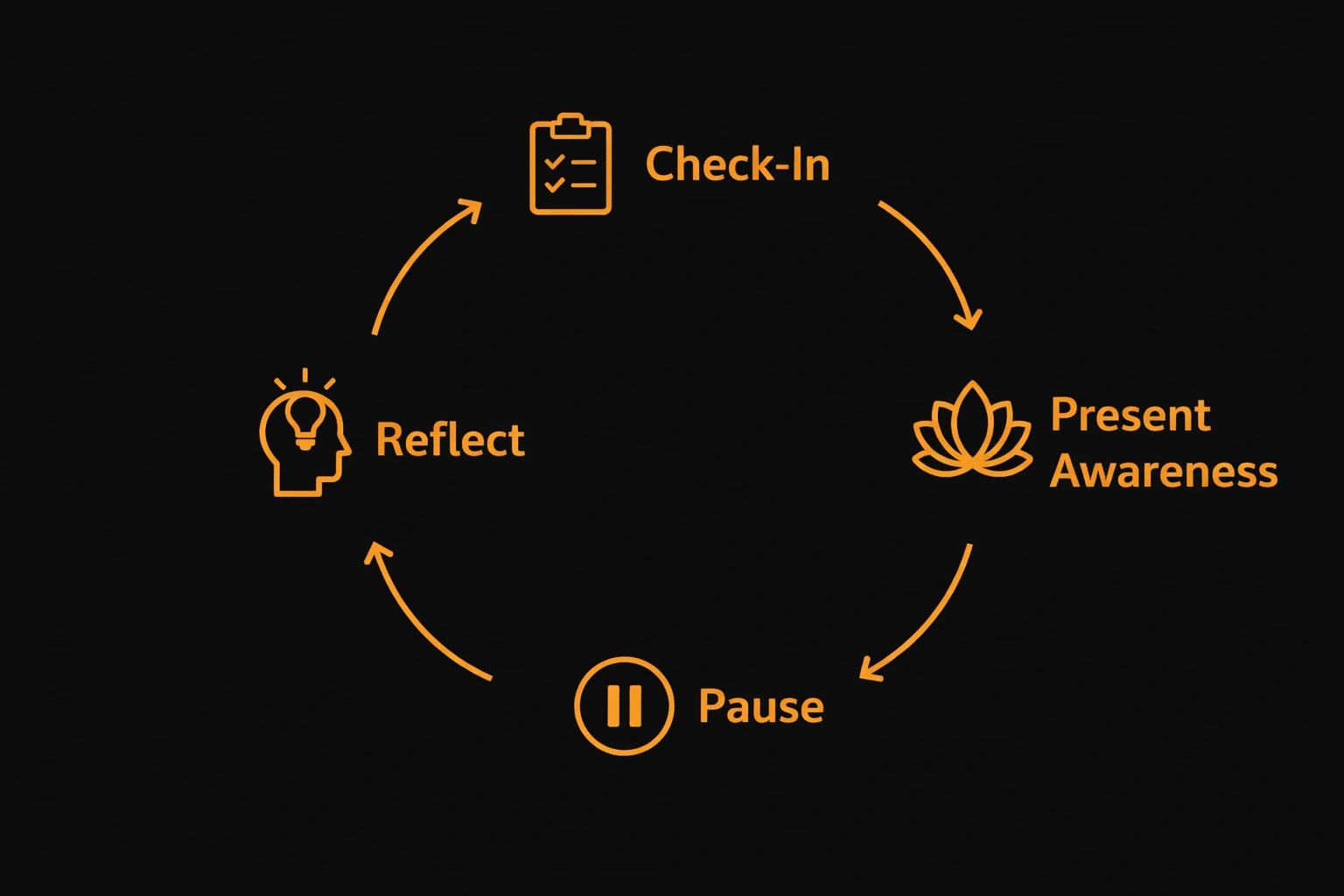
Present Moment Awareness During Live Trades
This is the hardest technique to practice because live markets pull your attention in every direction. Present moment trading means keeping part of your awareness on your internal state even while you’re processing external market data.
In practice, it looks like this: you’re watching price approach your entry level, and simultaneously you notice your breathing has quickened and your shoulders have tensed. Instead of ignoring those signals, you register them. “I’m getting excited. That’s fine. Let me check if this setup still meets my criteria.”
A helpful anchor is your breath. You don’t need a formal breathing exercise. Just notice whether your breathing is shallow and fast, or slow and even. Shallow, rapid breathing is your body signaling stress activation. When you catch it, take one slow, deliberate breath before making any decision. One breath. That’s the entire practice.
The goal isn’t to be perfectly calm. It’s to maintain enough self-awareness that your emotions inform you rather than drive you.
The Pause Technique Between Trades
The space between trades is where most traders lose their discipline, particularly after a win or a loss. The pause technique means deliberately inserting a gap between closing one trade and entering the next.
After you close a trade, do the following:
- Step away from the screen for 60–90 seconds. Stand up, stretch, look out a window.
- Name the emotion you’re feeling right now. Relief? Frustration? Euphoria? Boredom?
- Ask yourself one question: “Is my next trade based on my plan, or based on what just happened?”
That last question is the real filter. If the honest answer is “what just happened,” you’re not ready for the next trade yet. This pause prevents emotional cascades and keeps each trade independent of the last one.
Post-Session Reflection Without Judgment
After the session ends, most traders either close the platform immediately (avoidance) or obsess over what went wrong (rumination). Neither is useful.
Mindful post-session reflection is structured and non-judgmental. Open your trading journal and record:
- What was your mental state during the session?
- Which trades followed your plan? Which didn’t?
- What emotions did you notice, and when?
- What would you do differently, not in terms of strategy, but in terms of awareness?
The key word here is “notice,” not “judge.” Writing “I chased that entry because I felt FOMO” is useful. Writing “I’m an idiot for chasing that entry” is not. The first builds awareness. The second builds shame, and shame makes you less likely to journal honestly next time.
These techniques work well individually, but they’re strongest when woven into a consistent daily structure. Here’s how to build that routine.
Building a Mindful Trading Routine
Knowing the techniques is one thing. Having a structure that prompts you to use them daily is what turns awareness from an occasional effort into your default operating mode. The routine below is designed for active day traders or swing traders with dedicated session times, but the timing can be adapted to fit your schedule.
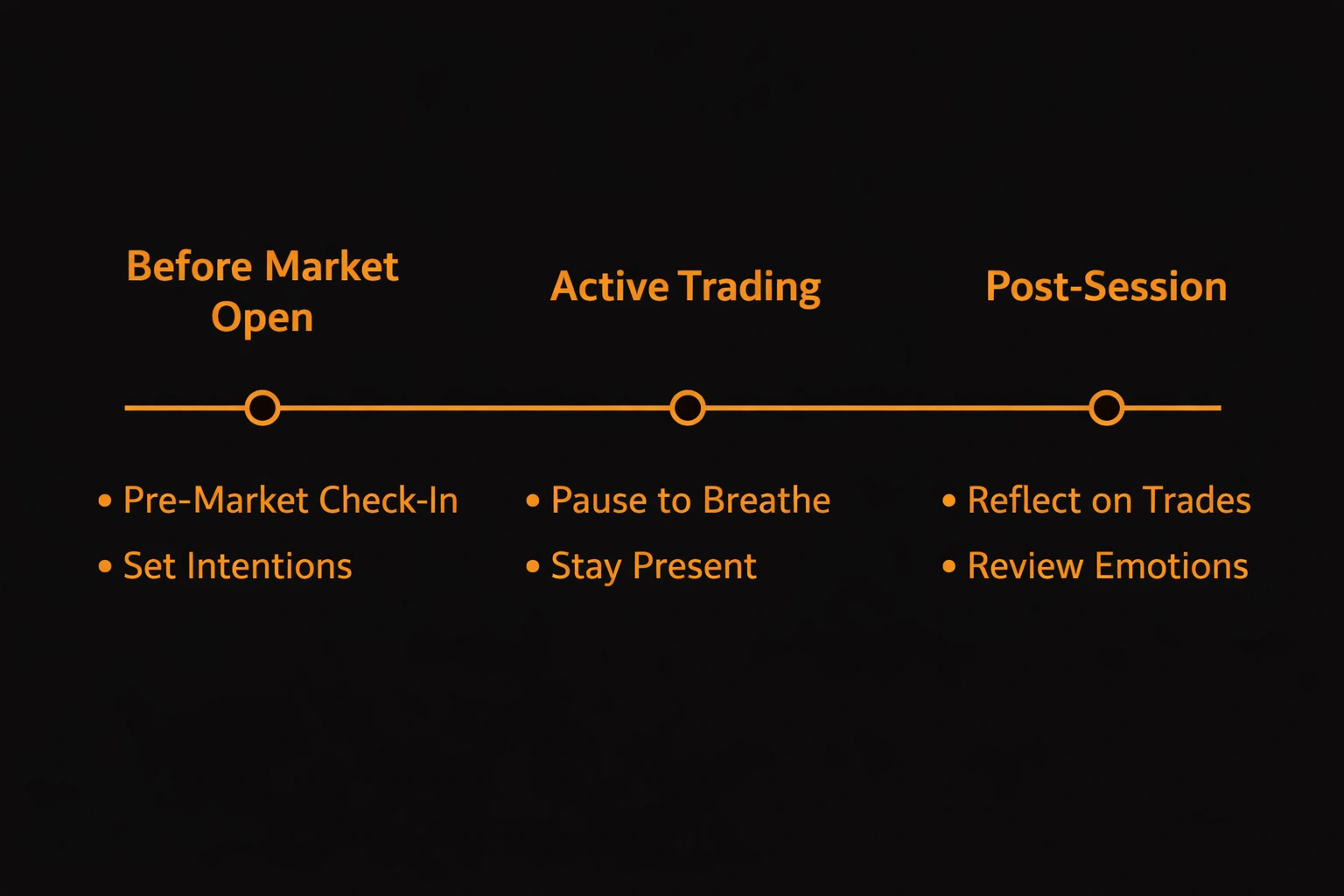
Before the Market Opens
Start 15–20 minutes before your session begins. This is not chart prep time; that should be done earlier or the night before. This is mental prep.
- Body and mental check-in (2 minutes): the technique described above.
- Intention setting (1 minute): state one specific awareness goal for the session. Example: “Today I will notice if I’m rushing entries.” Keep it to a single focus point.
- Breathing reset (2–3 minutes): slow, deliberate breathing. Box breathing works well here (inhale for 4 counts, hold for 4, exhale for 4, hold for 4). This isn’t about relaxation. It’s about shifting your nervous system from reactive to responsive.
By the time the market opens, you’re not just prepared strategically. You’re prepared mentally. You know where you are, and you know what you’re watching for.
During Active Trading Hours
You can’t meditate in the middle of a fast market, and you shouldn’t try. But you can build in micro-checkpoints:
- Between trades: use the pause technique. Every single time.
- Every 60–90 minutes: take a 3–5 minute break. Step away. Drink water. Do a quick body scan. Hours of continuous screen time degrades focus and decision-making quality, whether you feel it happening or not.
- When you feel a strong urge to act: that’s your signal to slow down, not speed up. Strong emotional urges (fear of missing out, anger after a loss, excitement during a streak) are not trading signals. They’re psychological signals that deserve your attention before anything else.
Staying focused during active hours isn’t about white-knuckling your concentration. It’s about cycling between engagement and brief, deliberate check-ins.
After the Session Ends
Give yourself 10–15 minutes for the post-session reflection described earlier. Do this before checking social media, talking about your trades, or reviewing what you “missed.”
The reason for doing it immediately is that your emotional memory of the session fades fast. Within an hour, you’ll start rationalizing decisions that were actually impulsive. The journal captures the truth while it’s still fresh.
Over time, your post-session reflections become a goldmine of self-knowledge. Patterns emerge: maybe you consistently overtrade on Mondays, or your worst decisions cluster after the first hour. That kind of data doesn’t come from charts. It comes from paying attention to yourself.
And that self-awareness connects directly to one of the most practical dimensions of your trading: how you manage risk.
Mindfulness and Risk Management: The Connection
Mindfulness and risk management might seem like separate topics, but they’re deeply connected. Every risk management rule you set is only as strong as your ability to follow it in the moment. And your ability to follow it depends entirely on your level of self-awareness when the pressure builds.
How Awareness Improves Position Sizing Discipline
You’ve set your max risk per trade at 1%. You know the rule. But then a setup appears that “looks perfect,” and you feel a surge of confidence. Without awareness, that confidence translates directly into a 3% position. You didn’t consciously decide to break your rule. You just… didn’t notice you were breaking it.
Mindful position sizing means pausing before every entry to consciously verify your size against your rules. Not mechanically, but with genuine attention. Ask yourself: “Am I sizing this based on my plan, or based on how I feel about this trade?” That single question prevents a significant portion of position sizing violations.
Recognizing Tilt Before It Escalates
Tilt, borrowed from poker, is the state where emotional frustration degrades your decision-making. In trading psychology, tilt usually starts small: a slightly larger position here, a skipped stop-loss there. By the time you recognize full tilt, the damage is already significant.
Early tilt signals tend to be physical and emotional:
- Jaw clenching, shallow breathing, restless legs
- Thoughts like “I need to make this back” or “the market owes me”
- Breaking small rules (skipping your pause, ignoring your check-in result)
- A feeling of urgency that isn’t connected to any specific setup
If you’re practicing the awareness techniques described earlier, you’ll catch these signals at stage one, not stage five. Catching tilt early gives you the option to step away, reduce size, or simply name what’s happening (“I’m tilting”), which by itself reduces its grip on your behaviour.
But mindfulness isn’t without its pitfalls. There are common mistakes that can turn a helpful practice into an obstacle.
Common Mistakes When Practicing Mindful Trading
Like any skill, mindfulness can be misapplied. Two mistakes in particular are common among traders who are new to this practice.
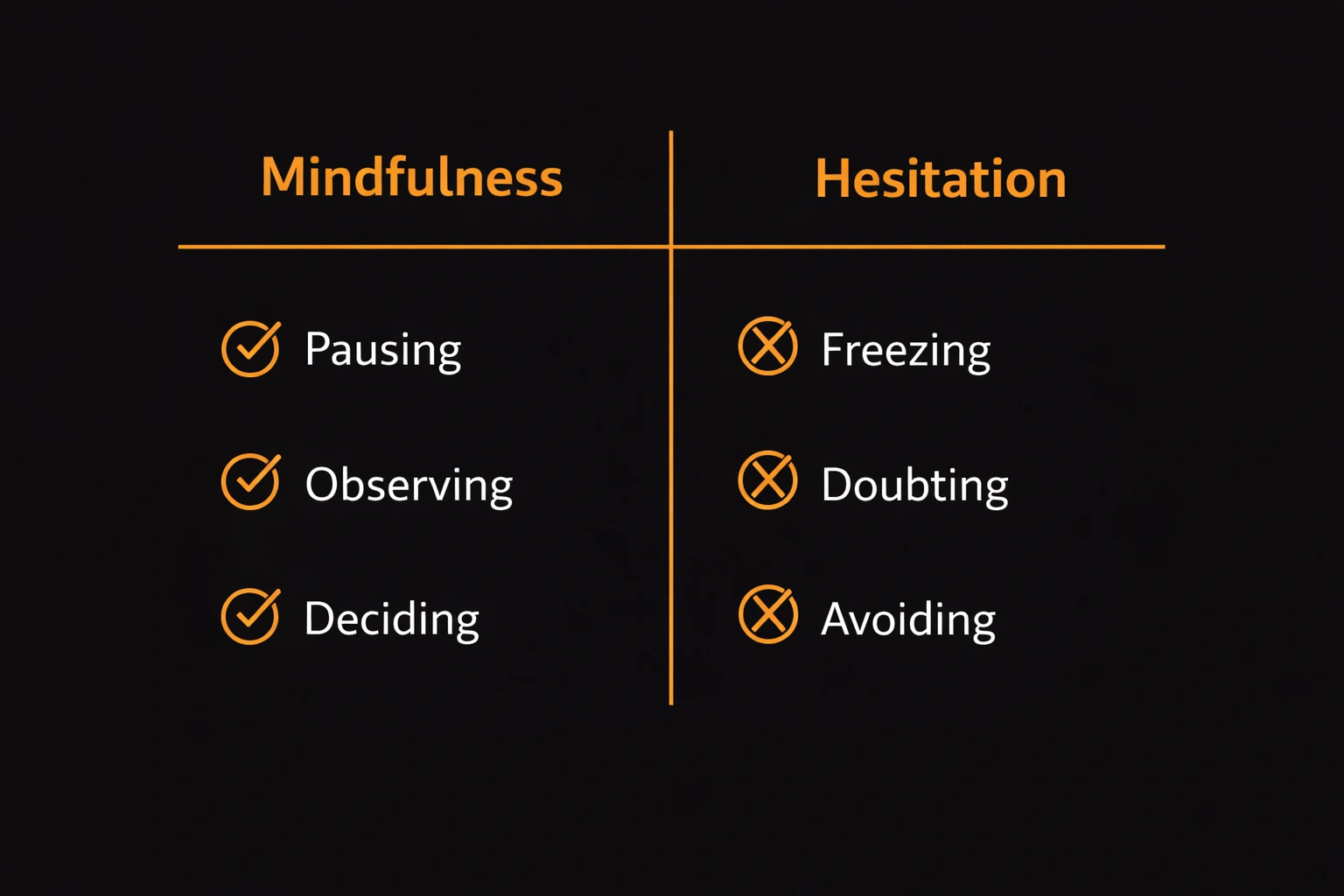
Confusing Mindfulness With Hesitation
This is the big one. Mindfulness asks you to pause and observe before acting. Hesitation is freezing because you’re afraid to act. They look similar from the outside, but the internal experience is completely different.
When you’re being mindful, you pause with a purpose. You check in, verify your criteria, and execute. The pause has a clear beginning and end, and it leads to a decision (even if the decision is “no trade”).
When you’re hesitating, the pause has no structure. You’re stuck in a loop of “what if” thinking. You watch a valid setup pass by because the act of committing feels threatening. Hesitation is driven by fear. Mindfulness is driven by clarity.
If you find yourself consistently missing valid setups after starting a mindfulness practice, examine whether you’re genuinely practicing awareness or quietly using “being mindful” as a cover for avoidance.
Expecting Immediate Results
You won’t sit down for one pre-session check-in and suddenly trade like a different person. Mindfulness is a skill, and like every skill in trading, it develops through repetition over weeks and months, not hours.
The early phase often feels unproductive. You’ll notice your impulses more clearly, but you won’t always be able to override them. That’s normal. In fact, noticing the impulse and still acting on it is genuine progress compared to not noticing at all. Awareness always precedes change.
Set realistic expectations. In the first two weeks, your goal is simply to build the habit of checking in and pausing. Weeks three through six, you’ll start catching emotional reactions earlier. Beyond that, the practice becomes more intuitive, and you’ll notice shifts in your state automatically without needing a formal prompt.
Frequently Asked Questions


Comments