


Trading burnout is a quiet performance killer that chips away at your decision-making, your discipline, and eventually your account balance. This guide will help you spot it early, prevent it with practical daily routines, and claw your way back if you’re already deep in the fog.
Note: This content is educational and not a substitute for professional mental health support. If you’re experiencing persistent distress, please consult a qualified professional.
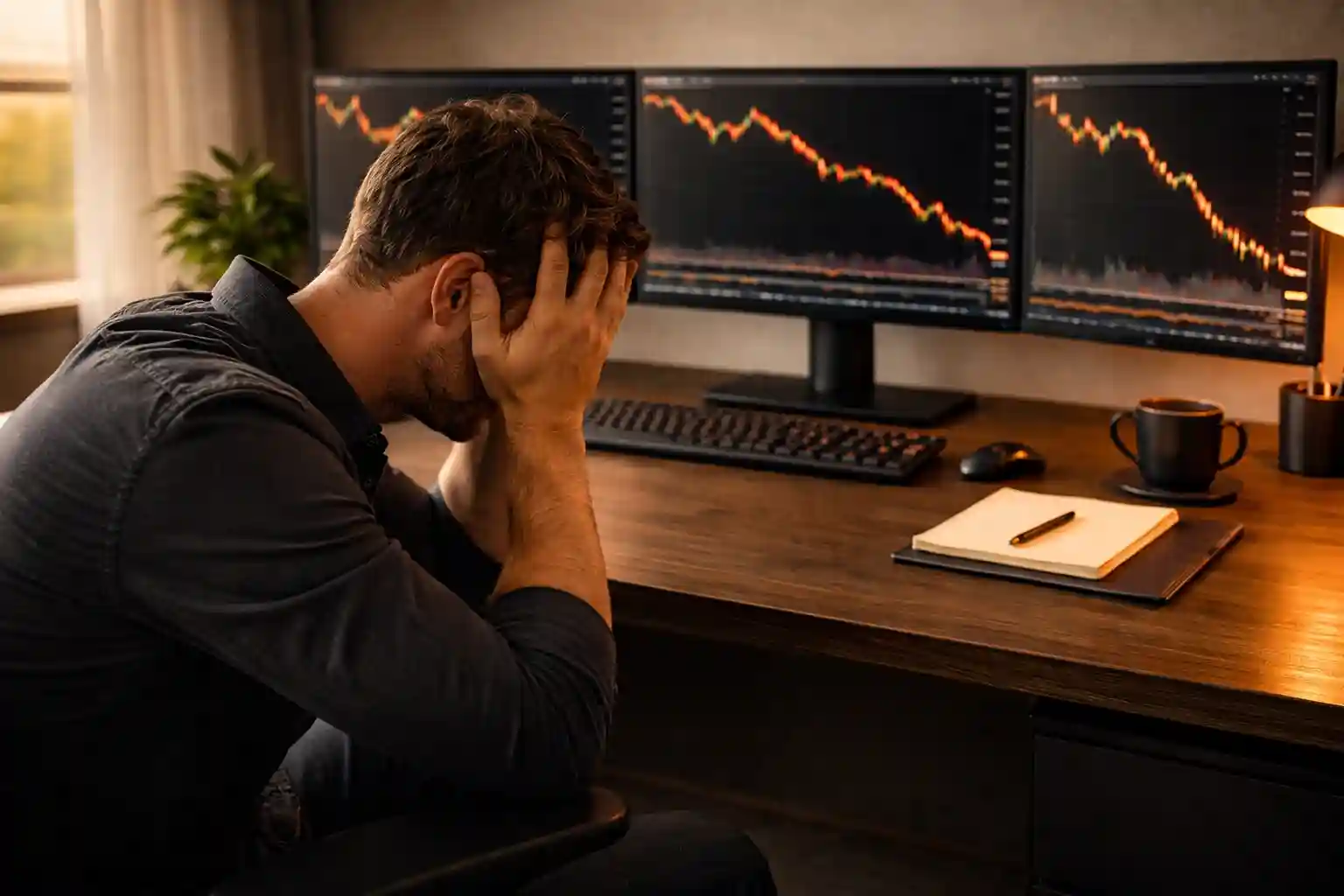
What Trading Burnout Actually Looks Like
It’s tempting to write burnout off as simple fatigue from too much screen time. But that misses what’s really happening. Burnout sets in when sustained stress crosses a threshold your mind can no longer absorb, and it surfaces in ways you might never connect to your trading psychology.
Here’s a useful distinction: normal stress tends to lift after a solid trade or a day off. Burnout lingers no matter what the results look like.
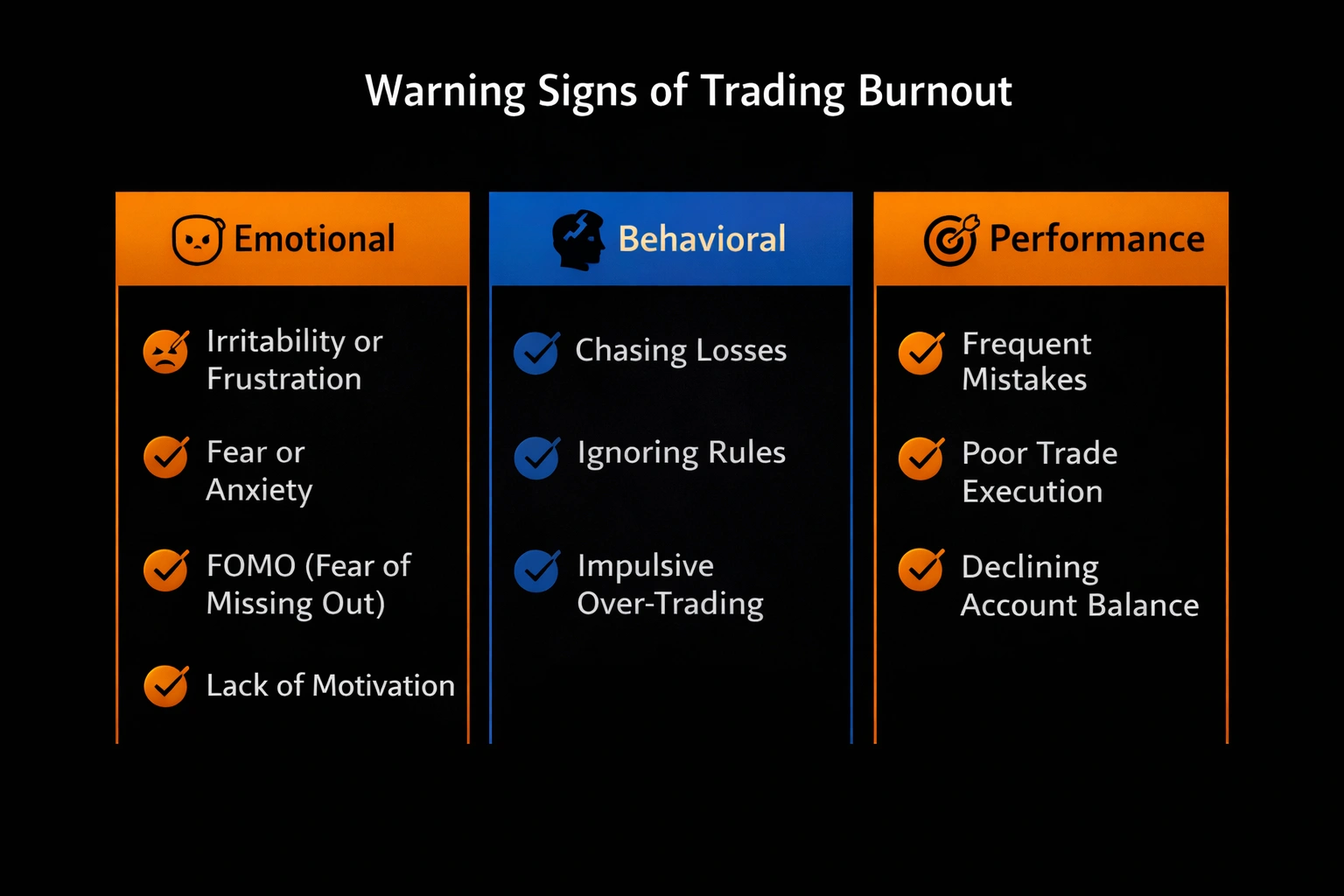
Emotional Warning Signs
- Chronic dread before market open, even with no positions on
- Emotional numbness toward wins and losses alike
- Irritability that bleeds well beyond your trading desk
- Persistent anxiety that doesn’t resolve when you step away from the screens
If several of these are showing up most days for weeks running, you’re in burnout territory.
Behavioral Warning Signs
Burnout reshapes what you do, not just how you feel:
- Skipping your pre-market routine or journaling
- Racking up more screen time without finding higher-quality setups
- Overtrading low-probability entries just to “feel something”
- Withdrawing from trading communities you once genuinely valued
Think of it like athletic overtraining. An overtrained runner doesn’t just feel tired. They skip warm-ups, let their form collapse, and run straight through injuries they know they should respect.
Performance-Based Warning Signs
This is where burnout starts costing you real money:
- Consistently breaking your own risk management rules
- Taking revenge trades after losses
- Cutting winners short because anxiety won’t let you hold
- Declining win rate or expectancy stretched across several weeks
When your trading data tells a story that no longer matches your skill level, burnout is almost always the missing variable.
Recognizing burnout is only half the battle. Understanding why traders are uniquely vulnerable helps you build defenses that actually hold up.
Why Traders Burn Out Faster Than They Expect
Trading ranks among the most cognitively demanding activities you can pursue on a daily basis, and the structure of modern markets only compounds the pressure.
The Always-On Market Problem
Forex runs 24/5. Crypto never closes. Even equity traders face pre-market sessions starting at 4 AM and after-hours extending to 8 PM. The fear of missing a setup keeps you tethered to screens far longer than your plan ever called for.
It’s like working in a restaurant that never shuts its doors. Even when you’re off the clock, you know the kitchen is still firing orders. That low-grade awareness alone creates a cognitive drain that compounds over weeks and months. Without firm boundaries, the market will happily consume every waking hour you offer it.
Isolation and Decision Fatigue
Few professions are as isolating as trading. You make hundreds of micro-decisions each session, every one carrying direct financial consequences, and you make them entirely alone. Decision fatigue is well-documented in cognitive research: each choice draws from a limited reservoir of mental energy. By mid-afternoon, you’re running on fumes.
Tying Self-Worth to P&L
When your profit-and-loss statement doubles as your personal scorecard, every losing day stops feeling like a statistical event and starts feeling like a character verdict. You can’t step away without the nagging sense you’re falling behind. You can’t lose without feeling like something inside you is breaking.
So what actually happens when you ignore all of this and keep grinding?
The Real Cost of Ignoring Burnout
Pushing through burnout makes you dangerous, both to your account and to your longevity in this career.
Impact on Risk Management and Discipline
Burnout degrades the exact cognitive functions trading demands most. Your prefrontal cortex, the region responsible for impulse control and rational assessment, deteriorates first under chronic stress. You start drifting from your plan, rationalizing weak trades, and holding losers because you simply lack the energy to accept the loss.
Risk management is a cognitive skill that requires a rested, functioning mind. Burnout strips you of precisely that.
Account Damage and Revenge Trading Cycles
Burnout feeds directly into revenge trading, and the cycle is vicious. You take a loss, frustration flares, you immediately enter another position to “make it back,” that trade loses too, and now you’re emotionally hijacked. One revenge trading session can unravel weeks of disciplined work in a matter of hours.
The cruelest part is that burned-out traders often recognize they’re revenge trading in the moment yet feel powerless to stop. That’s a resource depletion problem.
Prevention isn’t optional at that point. Let’s look at what actually works.
Daily Habits That Prevent Trading Burnout
Effective prevention relies on structure that safeguards your mental energy before you need to spend it.
Structured Screen Time and Session Limits
The single most effective burnout prevention tool is a hard cap on screen time. Define your session before the market opens:
- Pre-market prep: 30–45 minutes
- Active trading: 2–4 hours maximum
- Mid-session breaks: 10–15 minutes every 90 minutes
- Hard stop time: Non-negotiable, regardless of what the market is doing
This eliminates the constant internal debate of “should I keep going?” The schedule decides for you, which preserves your mental energy for the decisions that actually matter.
Pre-Market and Post-Market Routines
Bookending your trading day with consistent routines creates psychological boundaries between “trading mode” and the rest of your life.
Pre-market: Review your watchlist, check key levels, note any scheduled news events, and set your intentions.
Post-market: Log trades in your trading journal, record your emotional state, and identify one strength and one area to refine.
These bookends prevent the kind of rumination that keeps you mentally trapped in the market long after you’ve closed your platform.
Physical Movement and Cognitive Breaks
Your brain needs movement, oxygen, and variety to perform. Build a 20-minute walk or quick workout into your trading day as a scheduled commitment. Cognitive breaks where you fully disengage from anything analytical (listening to music, cooking, stepping outside) reset your capacity far more effectively than another cup of coffee ever will.

Daily habits form your foundation. But lasting burnout prevention also depends on a longer-term rhythm.
Weekly and Monthly Reset Practices
Think of daily habits as your frontline defense. Weekly and monthly practices are your maintenance schedule.
Scheduled No-Trade Days
At least one day per week should be a complete trading blackout. Your brain needs full recovery periods the same way muscles need rest days after intense training.
Journaling for Self-Awareness, Not Just Performance
Most trading journals track entries, exits, and P&L. That’s a solid start, but try adding a brief emotional check-in: rate your stress, confidence, and focus on a 1–5 scale before and after each session. Over a few weeks, patterns will surface. This transforms your journal from a performance log into an early warning system.
Periodic Strategy Review vs. Constant Tweaking
Burned-out traders tweak obsessively, cycling through indicators or timeframes after every losing stretch. This “strategy hopping” actually accelerates burnout by stripping away any sense of mastery or progress.
A better approach: schedule one focused strategy review per month. Assess your edge using data, not emotion. Make adjustments only when the numbers support them.
How do you weave all of this into something you can realistically sustain for years?
Building a Sustainable Trading Routine
Sustainability is about doing the right things consistently without depleting yourself in the process.
Defining Your Trading Hours and Sticking to Them
Pick your hours based on your market, your strategy, and your personal energy patterns, not on fear of missing out. Write them down. Treat them the way you’d treat a meeting with your most important client. Constraints, paradoxically, create freedom: when you know exactly when you’ll trade, you stop hemorrhaging mental energy wondering whether you should be at your desk.
Setting Process Goals Instead of Outcome Goals
Outcome goals (“make $500 today”) are burnout fuel. Process goals keep you anchored to what you can actually control:
- “Follow my plan on every entry”
- “Take my first break by 10:30 AM”
- “Complete my journal within 30 minutes of session close”
When you hit your process goals, you’ve had a successful day. Regardless of what your P&L says.
When to Scale Back Without Guilt
If you’re noticing multiple warning signs from the burnout checklist above, reduce your activity before things deteriorate further:
- Trade only your highest-conviction setups
- Cut session time
- Reduce position size
The traders who last decades in this business learned something critical: pulling back at the right moment preserves both financial and mental capital.

But what if you’ve already blown past the prevention stage?
When Burnout Has Already Set In: Recovery Steps
If burnout has already settled in, recovery is absolutely possible. It does, however, require honesty, patience, and a willingness to follow a structure.
Taking a Deliberate Break
A deliberate break is planned and intentional. It’s not the same as passively skipping a day.
- Mild burnout: A long weekend away from the screens
- Moderate burnout: One to two full weeks
- Severe burnout (persistent numbness or dread): A month or more
During your break, resist the pull to watch charts passively. Give your cognitive and emotional systems permission to fully reset.
Returning to Demo or Reduced Size
Don’t leap straight back into full-size live trading. Start with demo accounts or significantly reduced positions to rebuild your routine and confidence without the emotional weight of real losses pressing down on every click. Like physical rehab after an injury, you build back progressively. Rushing it only risks a setback.
Seeking External Support
Trading burnout thrives in isolation. Break that pattern with:
- Trading communities where others genuinely understand the pressures
- Mentorship for perspective and accountability
- Professional counseling, particularly from someone versed in performance psychology
- Trusted people in your life who can offer emotional grounding
Reaching out for support is self-awareness in action and that is the most valuable edge a trader can develop.

Frequently Asked Questions


Comments