


Setting realistic trading goals is about building a system that keeps you in the game long enough for genuine growth to happen. Most traders never learn how to do this well.
Without a grounded sense of what “good” actually looks like at your stage, you end up flying blind, measuring yourself against benchmarks that don’t apply to you, and making emotional decisions the moment reality falls short of the fantasy.
This guide gives you a clear, practical method for setting trading goals that fit your experience level, your account size, and the way markets actually move. What you will walk away with is a framework you can put to work in your very next trading session.

Why Most Trading Goals Fail Before the First Trade
Most trading goals are dead on arrival, mostly because the goals themselves rest on distorted information and flawed math. Before you can set a realistic target, you need to see why your current expectations might be way off.
The Social Media Distortion Effect
Your feed is packed with screenshots showing $10,000 days, five-figure funded accounts, and traders who apparently turned $500 into $50,000 in three months. What you never see is the 47 blown accounts behind that screenshot, the cherry-picked timeframe, or the simple fact that some of those screenshots are fabricated entirely.
Social media warps your reference point. When you watch “normal” traders posting massive gains day after day, your brain quietly recalibrates what’s possible and, more dangerously, what’s expected. A 2% monthly return starts to feel embarrassing when, in reality, it represents solid performance for most experience levels.
This distortion chips away at your confidence when you hit perfectly normal results. You start second-guessing strategies that are genuinely working because they don’t match the fantasy version of trading you’ve been absorbing online.
Confusing Revenue With Profit
Another quiet goal killer: failing to account for costs. When you set a target of “make $1,000 this month,” are you factoring in commissions, spreads, platform fees, and the taxes you’ll eventually owe on those gains? Most newer traders don’t.
A gross return of 5% can shrink to 3% or less once real trading costs come off the top. If your goals are pinned to gross numbers, you’re always going to feel like you’re falling behind, even when your actual performance is perfectly fine. Build your goals around net figures from the start and you’ll sidestep a lot of unnecessary frustration.
So what does “realistic” actually look like in hard numbers? Let’s get specific.
What Realistic Trading Returns Actually Look Like
If you’ve ever searched “average trading returns” and walked away more confused than when you started, you’re in good company. The numbers vary wildly depending on the source, and almost nobody provides useful context alongside them. Let’s change that.
Monthly Return Benchmarks by Experience Level
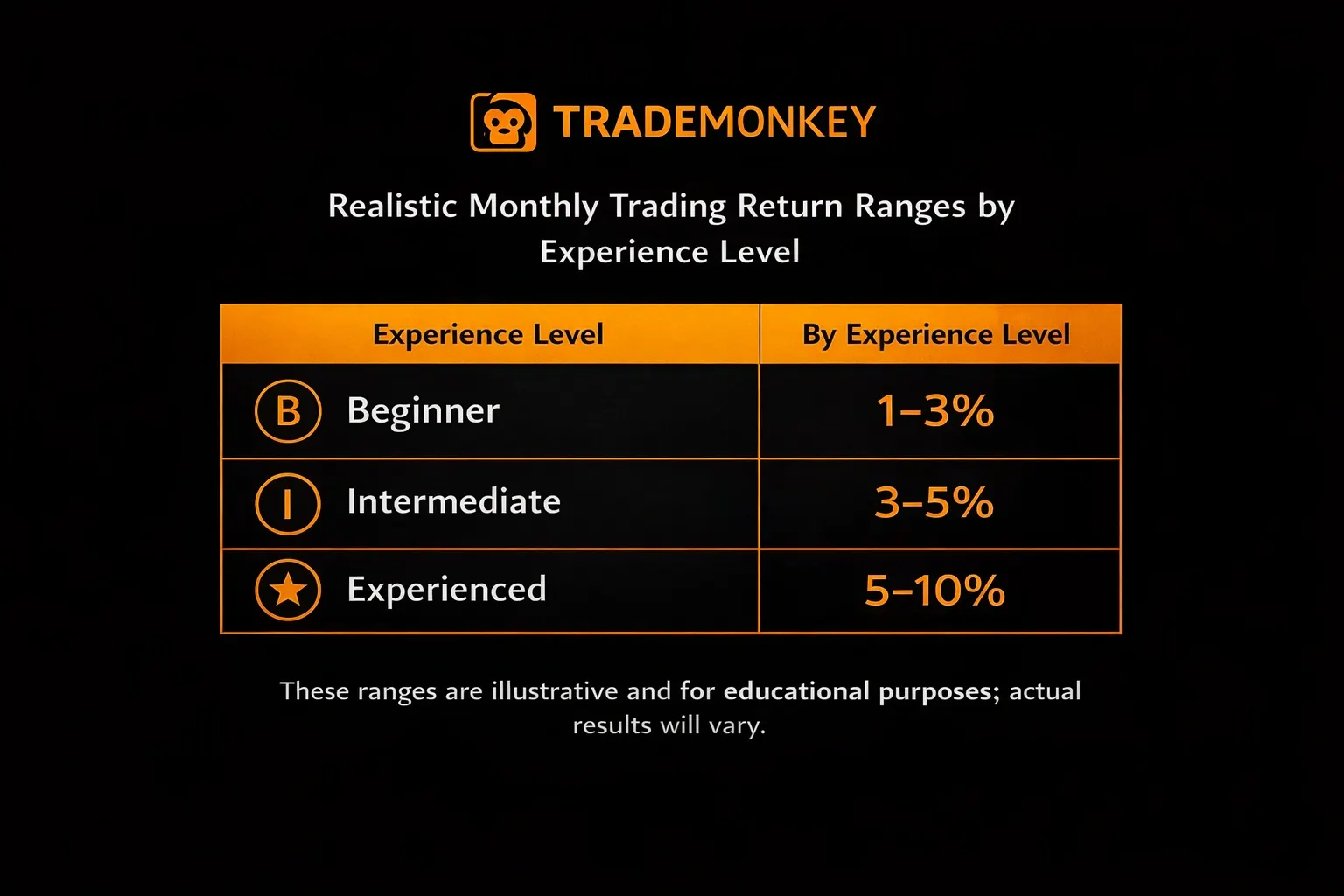
The ranges below are general observations drawn from retail trading performance data and prop firm evaluation standards. They are not guarantees. Individual results depend heavily on strategy, risk management, market conditions, and consistency.
Experience Level | Monthly Return Range | Context |
Beginner (0–12 months) | 1–3% | Focus should be on not losing money, not maximizing gains |
Intermediate (1–3 years) | 3–5% | Consistent profitability is the real milestone here |
Experienced (3+ years) | 5–10% | Achieved by traders with refined edge and strict risk management |
These figures are illustrative ranges for educational purposes, not predictions or promises of performance. Many traders at every level experience months with negative returns.
A 3% monthly return on a $10,000 account comes out to $300. That might feel underwhelming next to the screenshots flooding your feed, but compounded over 12 months (assuming consistency, which is a big assumption), that works out to roughly 42% annual growth. For perspective, the long-term average annual return of the S&P 500 hovers around 10%. Context reshapes everything.
How Prop Firms and Institutional Traders Define Success
Prop firm evaluation targets offer a useful external benchmark for calibrating your own goals. Most funded trader programs set profit targets in the 8–10% range over a 30-day evaluation period, paired with maximum drawdown limits of 5–10%. These numbers reflect what experienced risk managers consider achievable under controlled conditions.
Institutional traders often measure success differently than retail traders expect. Consistency, risk-adjusted returns (like Sharpe ratio), and drawdown management frequently carry more weight than raw percentage gains. If the professionals prioritize not losing over winning big, that tells you something important about where your own focus should sit.
Knowing the benchmarks, though, is only half the equation. How do you translate those numbers into goals that actually work for your situation?
The SMART Framework Applied to Trading
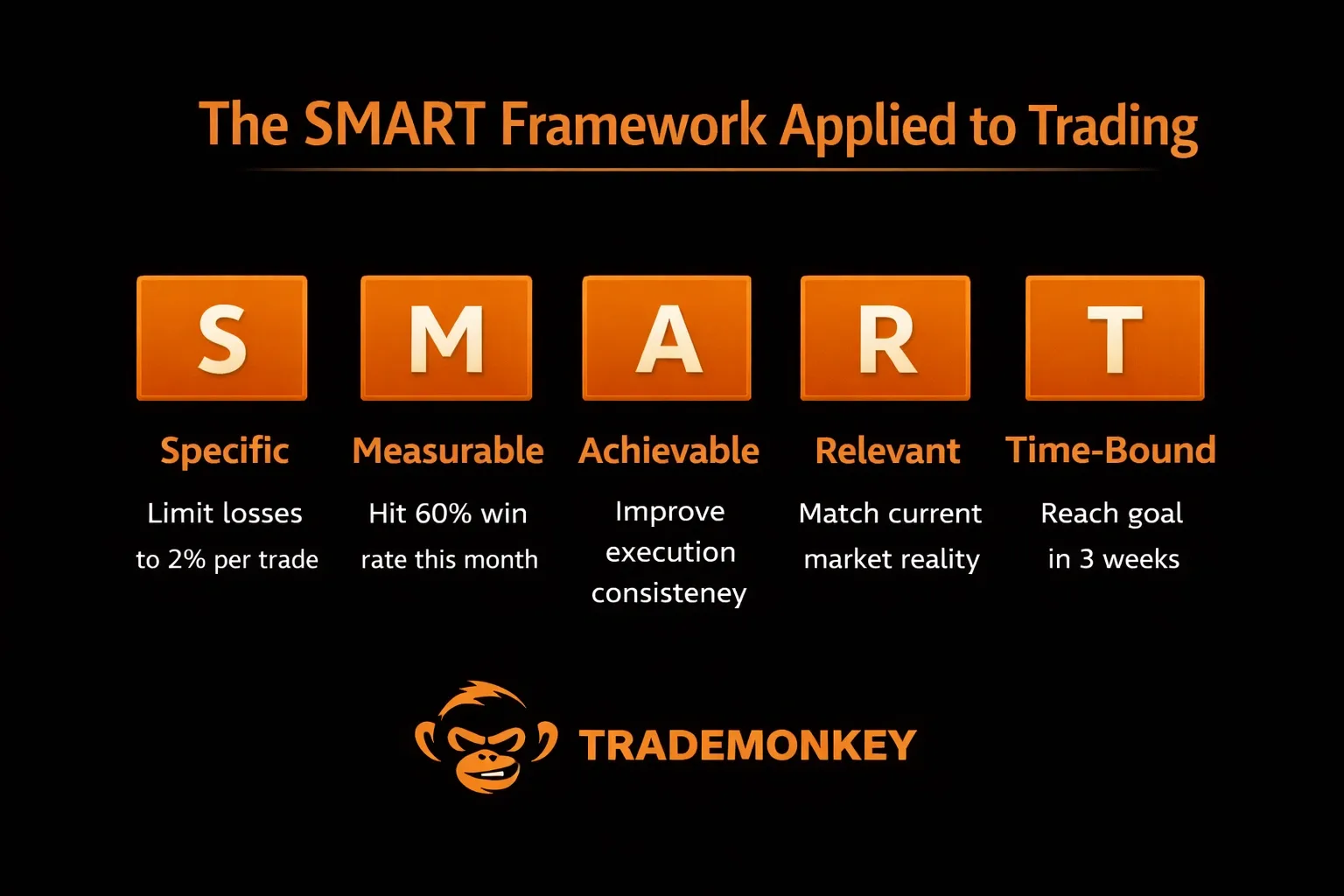
You may have encountered SMART goals before, but most explanations stay so generic they become useless for traders. Here’s how each element translates into something you can actually put inside a trading plan.
Specific: Defining What You Actually Control
“I want to be a profitable trader” is not a goal. It’s a wish. A specific trading goal pins down the exact behavior or metric you’re targeting.
- Vague: “I want to improve my trading.”
- Specific: “I will risk no more than 1% of my account per trade for the next 30 days.”
Notice the difference? The specific version zeroes in on something entirely within your control. You can’t dictate whether the market hands you profits, but you can control your position sizing on every single trade.
Measurable: Metrics Beyond P&L
Profit and loss is the obvious metric, but it’s far from the only one worth tracking. Measurable goals should include data points you can review objectively:
- Win rate per setup type
- Average risk-to-reward ratio achieved (not planned, but actually executed)
- Number of trades taken outside your plan
- Average holding time relative to your strategy’s design
- Percentage of trades where you followed your stop-loss rules
These metrics reveal whether your process is sound, and that matters more than any single month’s P&L number. Over time, strong process metrics almost always translate into stronger financial results.
Achievable: Calibrating to Account Size and Strategy
A goal of making $5,000 per month means nothing without context. On a $500,000 account, that’s a 1% return, extremely conservative. On a $5,000 account, it’s a 100% monthly return, which is essentially a fantasy target for sustained performance.
Your goals need to be calibrated to two things:
- Your account size – Percentage-based targets are almost always more useful than flat dollar amounts for exactly this reason
- Your strategy’s historical performance – If your backtested win rate is 55% with a 1.5:1 reward-to-risk ratio, don’t set goals that require a 75% win rate to hit
Relevant: Aligning Goals With Your Trading Stage
If you’ve been trading for four months, your primary goal shouldn’t be income generation. It should be skill development and capital preservation. Goals need to match where you actually are:
- First 6 months: Focus on following your trading plan consistently and limiting losses
- 6–18 months: Focus on achieving breakeven or small positive returns while refining your edge
- 18+ months: Begin setting modest return targets grounded in your demonstrated track record
Setting income goals before you’ve proven you can be consistent is like training for a marathon by signing up for a race next week. The sequence matters more than the ambition.
Time-Bound: Weekly, Monthly, and Quarterly Horizons
A goal without a deadline is a daydream. But in trading, the timeframe you choose also affects how useful the goal actually is.
- Weekly goals work best for process-oriented targets (e.g., “I will journal every trade this week”)
- Monthly goals are ideal for performance snapshots, but recognize that any single month can be an outlier
- Quarterly goals give you enough data to evaluate whether your system is working or needs a real adjustment
The quarterly horizon is arguably the most valuable one for newer traders. One rough month doesn’t mean your strategy is broken. One rough quarter might mean it’s time to reassess.
How do you make sure you’re setting the right type of goal in the first place? That’s where the line between process and outcome goals becomes critical.
Process Goals vs. Outcome Goals in Trading
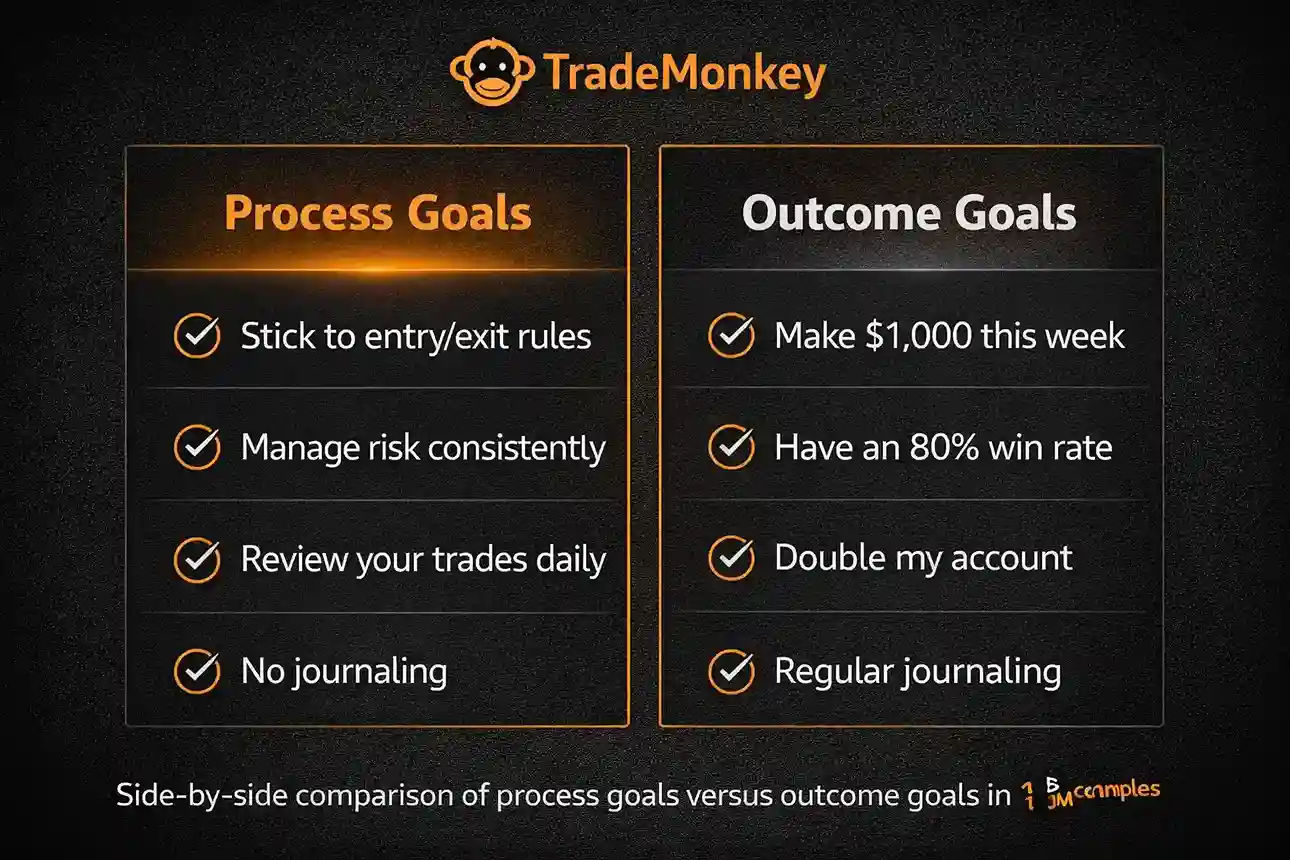
Most traders only set outcome goals: “Make $2,000 this month,” “Achieve a 60% win rate,” “Grow my account by 15% this quarter.” These targets have their place. But they carry a hidden cost that can quietly wreck your trading psychology if you’re not careful.
Why Process Goals Protect Your Psychology
Outcome goals depend on variables you can’t fully control. Market conditions, volatility, and the random distribution of wins and losses all influence whether you hit a profit target, regardless of how well you trade.
When your only goals are outcome-based, every losing trade feels like failure. Every drawdown feels like proof that you’re doing something wrong. This creates a psychological pressure cooker that breeds revenge trading, stop-loss tampering, and strategy abandonment at the worst possible moment.
Process goals redirect your attention to what you can actually control. When you execute your process well and still lose money (and this will happen), you can evaluate the situation with a clear head instead of a clenched jaw. That distinction separates traders who survive drawdowns from traders who blow up during them.
Examples of Process Goals That Improve Results
Here are process goals that directly feed long-term profitability:
- Follow your pre-trade checklist on 100% of entries this week
- Keep position sizes within your risk parameters on every trade
- Review and journal all trades within 24 hours of closing
- Take zero trades that don’t meet your setup criteria
- Walk away from the screen after hitting your daily loss limit
Notice that none of these mention money. Yet a trader who consistently nails these process goals will almost certainly outperform someone who ignores them while chasing a dollar target.
With the right blend of process and outcome goals locked in, the next challenge is knowing when to adjust them and when to hold steady.
How to Track and Adjust Your Trading Goals
A goal you set and forget is barely better than no goal at all. Your goals should function as living benchmarks that evolve alongside your growing dataset of real trading performance.
Building a Simple Goal Review System
You don’t need expensive software for this. A spreadsheet or a dedicated section in your trading journal does the job. Here’s a simple structure:
- Weekly check-in (10 minutes): Review process goal adherence. Did you follow your rules? Where did you slip?
- Monthly review (30 minutes): Stack your performance metrics against your targets. Compare actual returns, win rate, and risk metrics to your goals.
- Quarterly deep review (1–2 hours): Step back and evaluate whether the goals themselves need updating based on three months of data. This is the right time to adjust targets, not mid-month when emotions are running hot.
If you’re using a trading journal, this review process becomes significantly easier since your data is already organized and ready for analysis.
When to Revise a Goal vs. When to Stay the Course
This is where most traders stumble. You’ve had two losing months back to back. Do you lower your targets, or sit tight?
Revise your goal when:
- Three or more months of data consistently show your target is misaligned with actual performance
- Your account size has changed significantly (up or down)
- You’ve switched your strategy or timeframe
- Market conditions have shifted in a fundamental way (e.g., a prolonged low-volatility stretch for a momentum strategy)
Stay the course when:
- You’re within normal drawdown parameters for your strategy
- Your process metrics look solid but outcomes are temporarily negative
- You’ve been trading for less than one quarter with the current goal set
- Emotional frustration, not data, is driving the urge to change
The key question to ask yourself: “Am I changing this goal because the data supports it, or because I’m uncomfortable?” If it’s the latter, hold steady.
Common Goal-Setting Mistakes That Cost Traders Money
Even traders who understand the importance of goal setting regularly fall into traps that undermine their progress. Spotting these patterns in advance can save you months of frustration and real capital.
Setting Income Targets Before Proving Consistency
This is the single most common mistake, and it’s entirely understandable. You started trading because you want to make money. But locking in a specific income target ($2,000/month, $50,000/year) before you’ve demonstrated at least three to six months of consistent, rule-based trading is putting the cart squarely before the horse.
Income targets create pressure to force trades. When you “need” to make $500 this week to stay on pace, you start taking setups you’d normally pass on, holding losers longer than you should, or sizing up recklessly. The goal that was supposed to guide you becomes the very thing that blows your account apart.
Prove consistency first. The income follows.
Ignoring Drawdown Periods in Goal Planning
Every trading strategy goes through drawdowns. If your goal framework doesn’t account for stretches of negative or flat performance, you’ll abandon perfectly solid strategies during their natural down cycles.
A practical approach: build a “drawdown buffer” into your annual goals. If you’re targeting 30% annual returns, model a scenario where two or three of those twelve months are negative. Does your plan still hold together? If your goal requires ten winning months out of twelve to succeed, it’s too fragile for the real world.
Understanding drawdown tolerance is a core piece of risk management, and it should sit at the center of how you structure every trading goal.
Disclaimer: This article is for educational purposes only and does not constitute financial advice. Trading involves significant risk of capital loss. Past performance, including any return benchmarks referenced in this article, does not guarantee future results. Consult a qualified financial professional before making trading decisions.
Frequently Asked Questions


Comments