


The gap between knowing what to do and actually doing it consistently is where most traders live, and it’s the most frustrating place to be.
This guide is a practical framework for building trading habits that become automatic, so you stop white-knuckling your way through each session and start relying on structure instead of motivation. You’ll learn how habits actually form, how to layer new ones into your existing routine, how to dismantle the destructive patterns bleeding your performance, and how to design a trading day that holds up even when you don’t feel like showing up.
Good trading habits will make you more consistent, more self-aware, and far less likely to blow up your account on a random Tuesday because you “had a feeling.”

Why Most Traders Fail at Building Habits
You’ve probably tried to change your trading behavior before. And if it didn’t stick, it’s because the approach itself was broken from the start.
The Willpower Trap in Trading
Here’s a pattern you might recognize: you have a bad week, you get fed up, and you tell yourself “starting Monday, everything changes.” You write out new rules, commit to journaling every trade, and promise yourself you’ll never revenge trade again. Monday goes well. Tuesday is decent. By Thursday, you’re sliding back into old patterns like nothing happened.
The problem is that you’re treating willpower like a renewable resource when it behaves more like a phone battery. It drains throughout the day, especially when you’re making high-stakes decisions under uncertainty, which is what trading is at its core. Every time you resist an impulse, override an emotion, or force yourself to follow a rule, you’re spending willpower.
Relying on willpower to sustain trading habits is like relying on adrenaline to run a marathon. It might carry you through the first mile, but it’s not a system.
So if willpower isn’t the answer, what is? It starts with understanding how habits actually form, often without your conscious involvement at all.
How Bad Trading Habits Form Without You Noticing
Destructive patterns creep in through small, repeated behaviors that get reinforced by the market’s random feedback.
Here’s how it typically plays out: you skip your stop loss once, the trade recovers, and your brain quietly files that away as proof that skipping stops works. You check your P&L mid-trade, feel a spike of anxiety, and close early for a small profit. Relief washes in, and now your brain has learned that closing early feels good. You take an unplanned trade out of boredom, it wins, and suddenly “going with your gut” feels validated.
Each of these moments is a habit being wired into your nervous system. The unsettling part is that you don’t even realize it’s happening until the behavior is already automatic. You’re running a program that was installed one small reinforcement at a time.
Breaking these patterns requires understanding the mechanics underneath them.
The Anatomy of a Trading Habit
Every habit you have, good or bad, follows the same underlying structure. Once you see this structure clearly, you gain the ability to engineer new habits intentionally instead of letting them form by accident.
Cue, Routine, Reward in a Trading Context
At its core, every habit runs on a three-part loop:
- Cue: The trigger that kicks off the behavior. In trading, this could be a price alert, the market opening, seeing a large unrealized loss, or even just the flat boredom between setups.
- Routine: The behavior itself. This is the action you take in response to the cue, whether that’s scanning your watchlist, moving your stop, opening a revenge trade, or pulling up your journal.
- Reward: The payoff your brain receives. This doesn’t have to be financial. Relief, excitement, a sense of control, or even just the distraction from anxiety all qualify.
Here’s a concrete example.
- Cue: you see your open position drop into the red.
- Routine: you widen your stop loss.
- Reward: temporary relief from the fear of being stopped out.
That loop, repeated enough times, becomes automatic. You stop consciously deciding to move your stop. You just do it.
The same loop works for productive habits too:
- Cue: your morning alarm goes off.
- Routine: you open your economic calendar and review the day’s events.
- Reward: you feel prepared and grounded before the session starts.

Understanding this loop is the foundation. But there’s a deeper layer that determines whether new habits actually last.
Identity-Based Habits vs. Outcome-Based Goals
Most traders set outcome-based goals: “I want to make $500 a day” or “I want to stop revenge trading.” These goals carry a fundamental weakness: they focus on what you want to achieve, not who you want to become.
Identity-based habits flip this entirely. Instead of “I want to journal my trades,” the frame becomes “I am a trader who reviews every trade.” Instead of “I need to stop overtrading,” it’s “I’m the kind of trader who only takes planned setups.”
Why does this distinction matter? Because your behavior tends to align with your self-image. When journaling is something you’re trying to do, it’s easy to skip. When it’s part of who you are as a trader, skipping it creates real friction.
Every time you complete your pre-market checklist, you’re casting a vote for the identity of a prepared, process-driven trader. Every vote counts, and over time, those votes accumulate into a genuine belief about who you are.
But which specific habits are worth building that identity around?
Core Trading Habits Worth Building
Not all habits carry equal weight. Some create a ripple effect that lifts everything else. These are the ones worth your energy, especially early on.
Pre-Market Preparation Routine
The minutes before you start trading set the tone for your entire session. A pre-market routine replaces the scramble of figuring out what to do when the market opens with a calm, repeatable process.
A solid pre-market routine typically includes:
- Reviewing the economic calendar for scheduled events
- Checking overnight price action on your key instruments
- Identifying your watchlist for the day based on your strategy criteria
- Writing down your plan: what setups you’re looking for, where key levels sit, and what you’ll do if certain scenarios unfold
- Doing a quick internal check: Am I in the right headspace to trade today? Am I tired, distracted, or carrying something emotional into the session?
That last point matters more than most traders admit. Some of your best trading decisions will be the days you decide not to trade at all.
Trade Journaling as a Daily Habit
If you’re not journaling your trades, you’re navigating without a map.
Without a record, you can’t identify patterns in your behavior, and you certainly can’t fix what you can’t see.
The key is making journaling a habit rather than a chore you do when you remember.
A habit has a trigger, a fixed time, and a minimal viable version. Journaling works best when you do it immediately after each trade, or at minimum, immediately after each session. The longer you wait, the less accurate your emotional recall becomes, and emotional recall is half the value.
Your journal doesn’t need to be elaborate. At minimum, capture:
- The setup and why you took it
- Your emotional state before, during, and after
- What you did well and what you’d change
- Whether the trade followed your plan
Over weeks and months, this data becomes a mirror. It shows you exactly who you are as a trader, not who you think you are.
Post-Session Review and Reflection
Journaling captures the raw data. The post-session review is where you actually extract lessons from it. This is a 10- to 15-minute habit at the end of your trading day where you step back and look at the session as a whole.
Ask yourself:
- Did I follow my plan today?
- What was my emotional arc through the session?
- Were there moments I deviated? What triggered the deviation?
- What’s one thing I want to do differently tomorrow?
This habit closes the feedback loop. Without it, you’re collecting data but never processing it, like recording lectures you never listen to again.
Risk Management as Automatic Behavior
Your risk management rules should never be something you negotiate with yourself in the heat of the moment. Position sizing, stop placement, maximum daily loss, and number of trades per day all need to be preset and non-negotiable before you touch a single order.
The habit here is building a process where risk parameters are locked in before you ever enter a trade. When you calculate position size before placing the order every single time, it stops being a decision and becomes muscle memory. That’s the goal: pulling risk management out of the realm of in-the-moment judgment, where emotions have a vote, and anchoring it in pre-programmed routine.
So you’ve got the habits worth building. But how do you actually install them into your daily life without it feeling like a second job?
How to Build Trading Habits Using Habit Stacking
Trying to build five new habits at once is a recipe for building zero. Habit stacking gives you a practical method for layering new behaviors onto existing ones, one at a time.
What Habit Stacking Is and Why It Works for Traders
Habit stacking is a technique where you attach a new habit to an existing one using a simple formula: “After I [current habit], I will [new habit].”
The reason this works comes down to how your brain is wired. You already have strong neural pathways for your existing routines. By linking a new behavior to an established one, you’re borrowing the existing cue rather than trying to manufacture a new trigger from scratch. Think of it like adding a new car to an already-moving train instead of trying to build momentum from a dead stop.
For traders, this is particularly powerful because your trading day already has natural anchor points: waking up, sitting at your desk, opening your platform, finishing a trade, closing your platform. Each of these is a potential hook for stacking.
Practical Habit Stacking Examples for Trading Routines
Here are some concrete stacking sequences you can adapt:
- After I pour my morning coffee, I will open my economic calendar and review today’s events.
- After I check the economic calendar, I will review overnight price action on my watchlist.
- After I review my watchlist, I will write my trade plan for the session.
- After I close a trade, I will log it in my journal before looking at anything else.
- After I close my trading platform, I will spend 10 minutes on my post-session review.

Start with one stack. Get it automatic, which usually takes a few weeks of consistent practice. Then add the next link. Rushing this process is one of the most common reasons traders abandon new routines before they take root.
Now, building new habits is only half the equation. What about the destructive ones you’re already carrying?
How to Break Destructive Trading Habits
You can’t just delete a bad habit. Your brain doesn’t work that way. But you can redirect the loop, and that starts with honestly identifying what’s actually driving the behavior.
Identifying Your Habit Triggers
Every destructive trading habit has a trigger, and it’s often not what you think it is. Revenge trading, for example, is typically triggered by the emotional state that follows the loss: frustration, a bruised ego, the urgent need to “fix” something right now.
To identify your triggers, start paying close attention to the moments just before you engage in the unwanted behavior:
- What just happened? (A loss? A missed entry? A stretch of nothing?)
- What were you feeling? (Frustrated? Anxious? Riding high on a win?)
- What time of day was it? (Late in the session when fatigue sets in?)
- What were you telling yourself? (“I need to make this back” or “Just one more trade”)
Your trading journal is invaluable here. Over time, patterns surface that you’d never spot in real time. You might discover that your overtrading always kicks in after 2 PM, or that you skip your stops specifically on trades where you feel most convinced about the direction.
Once you know the trigger, you can intervene before the routine kicks in.
Replacing Bad Habits Instead of Eliminating Them
Trying to simply stop a bad habit leaves a vacuum. Your brain still receives the cue, still craves the reward, and with nothing to fill the gap, it defaults right back to the old routine.
The more effective approach is replacement. Keep the cue, keep the reward, but swap the routine.
For example:
- Old loop: Cue (take a loss) > Routine (immediately enter a new trade to recover) > Reward (feeling of action, temporary relief)
- New loop: Cue (take a loss) > Routine (step away from the screen for 5 minutes, then review the loss in your journal) > Reward (feeling of control, clarity from processing the loss)
The reward satisfies the same underlying need: regaining a sense of agency after a setback. Over time, the new routine becomes the default response.
This requires patience and repeated practice. But it’s how lasting change actually works, one loop at a time.
Routine Development: Designing Your Trading Day
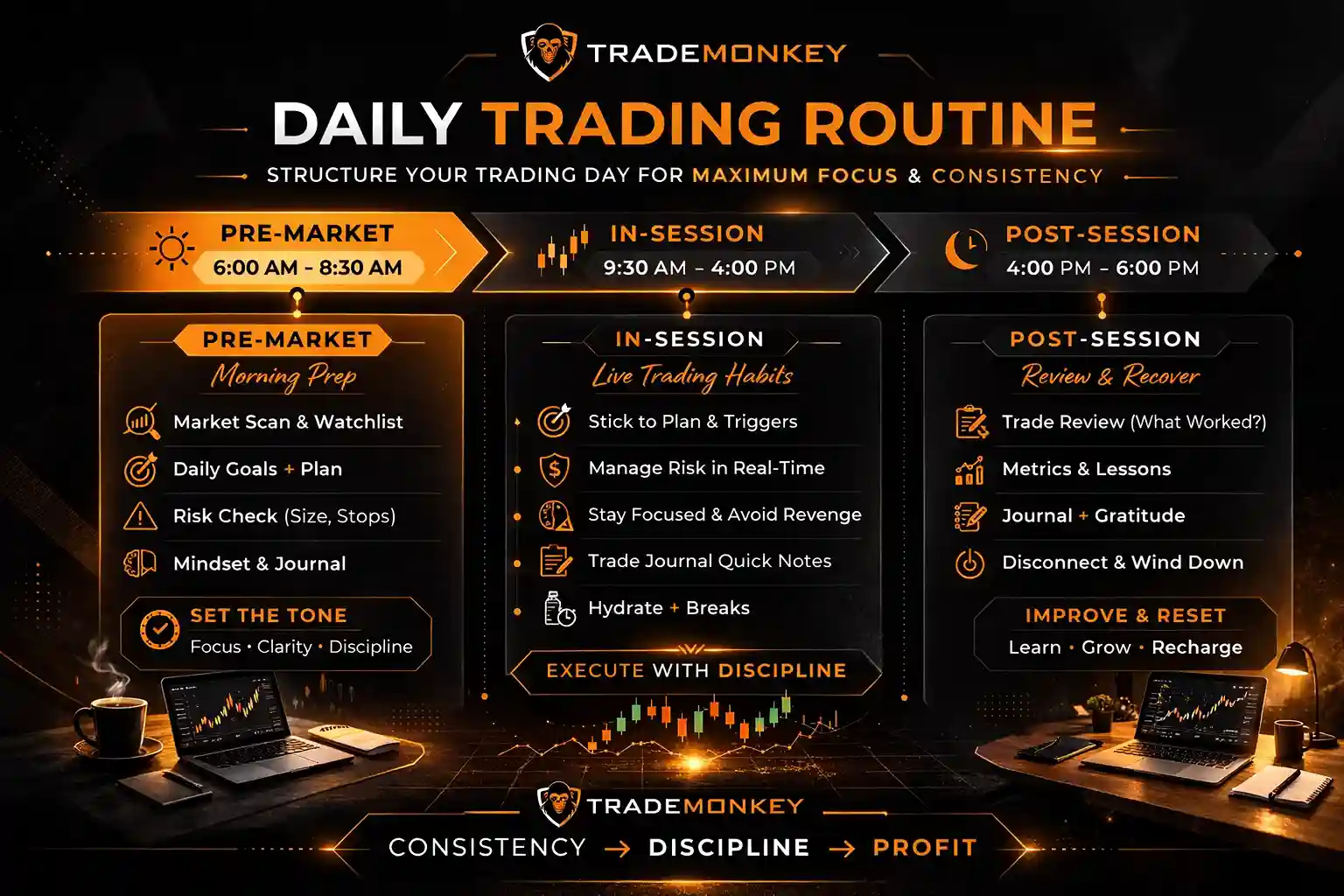
Scattered, unstructured trading days breed impulsive decisions. A well-designed day creates a container for your habits and reduces the number of choices you need to make when the pressure is on.
Morning Routine for Traders
Your morning routine is about transitioning from “regular person” mode into “trader” mode with intention.
A practical morning routine might look like this:
- Brief personal check-in (How am I feeling? Am I rested? Anything weighing on me?)
- Economic calendar review
- Overnight price action scan
- Watchlist refinement and trade plan creation
- Platform setup and order presets
The entire sequence doesn’t need to take more than 20 to 30 minutes. The point is that by the time the market opens, you’re executing.
During-Session Habits
In-session habits are the hardest to maintain because this is where emotions run hottest. A few key habits that create structure during live trading:
- Pre-trade checklist: Before every entry, run through a 3- to 5-point checklist. Does this match my plan? Is my position size correct? Is my stop in place? This takes 30 seconds and acts as a circuit breaker against impulsive entries.
- Timed screen breaks: Set a timer to step away from the screen for 2 to 3 minutes every hour. Physical distance reduces emotional reactivity more than you’d expect.
- Real-time journaling: Log trades as they happen, not hours later. Even a quick note (“entered EURUSD long, felt confident, followed plan”) takes 15 seconds and reinforces the journaling habit.
- P&L hiding: If checking your profit and loss mid-session triggers emotional decision-making, consider hiding it entirely. Focus on execution quality, not the dollar amount.
End-of-Day Wind-Down
How you end your trading day matters just as much as how you start it. A wind-down routine creates a clean psychological break between trading and the rest of your life.
This can be as simple as:
- Close all trading-related tabs and platforms
- Complete your post-session journal review
- Write one takeaway or intention for tomorrow
- Physically leave your trading space (if possible)
Deliberately closing the trading day signals to your brain that the work is done. Without this ritual, many traders find themselves mentally replaying trades for hours, which leads to fatigue and worse decision-making the next day.
But what happens when you’ve built these routines and then, inevitably, your motivation drops off a cliff?
Staying Consistent When Motivation Fades
Motivation is what gets you started. Systems are what keep you going. Every trader hits stretches where they don’t feel like following their routine, and the ones who maintain their edge are the ones who planned for that moment in advance.
Tracking and Accountability Systems
You can’t improve what you don’t measure. A simple habit tracker, whether it’s a spreadsheet, a dedicated app, or even a paper calendar where you mark off each day, creates a visual record of consistency.

The power of tracking is the psychological weight of the streak. When you’ve completed your pre-market routine for 14 consecutive days, the cost of breaking that streak feels tangible. That friction is quietly working in your favor.
Some traders also benefit from external accountability:
- A trading buddy or mentor who checks in weekly
- Sharing weekly stats in a trading community
- Regular self-review sessions where you assess habit adherence (not just P&L)
For funded traders or those pursuing prop firm challenges, consistency rules are often built into the evaluation itself, giving you external structure to lean on.
Adjusting Habits as You Progress
Your trading habits shouldn’t be frozen in place. A beginner might need a detailed 10-point pre-trade checklist. An experienced trader might compress that into 3 key checks because the other 7 have become truly automatic.
Review your habit system monthly. Ask yourself:
- Which habits are now automatic and need less conscious effort?
- Which ones am I still struggling with, and why?
- Are there new habits I need to add based on recent performance patterns?
- Am I doing anything purely out of routine that no longer serves a purpose?
Frequently Asked Questions


Comments