


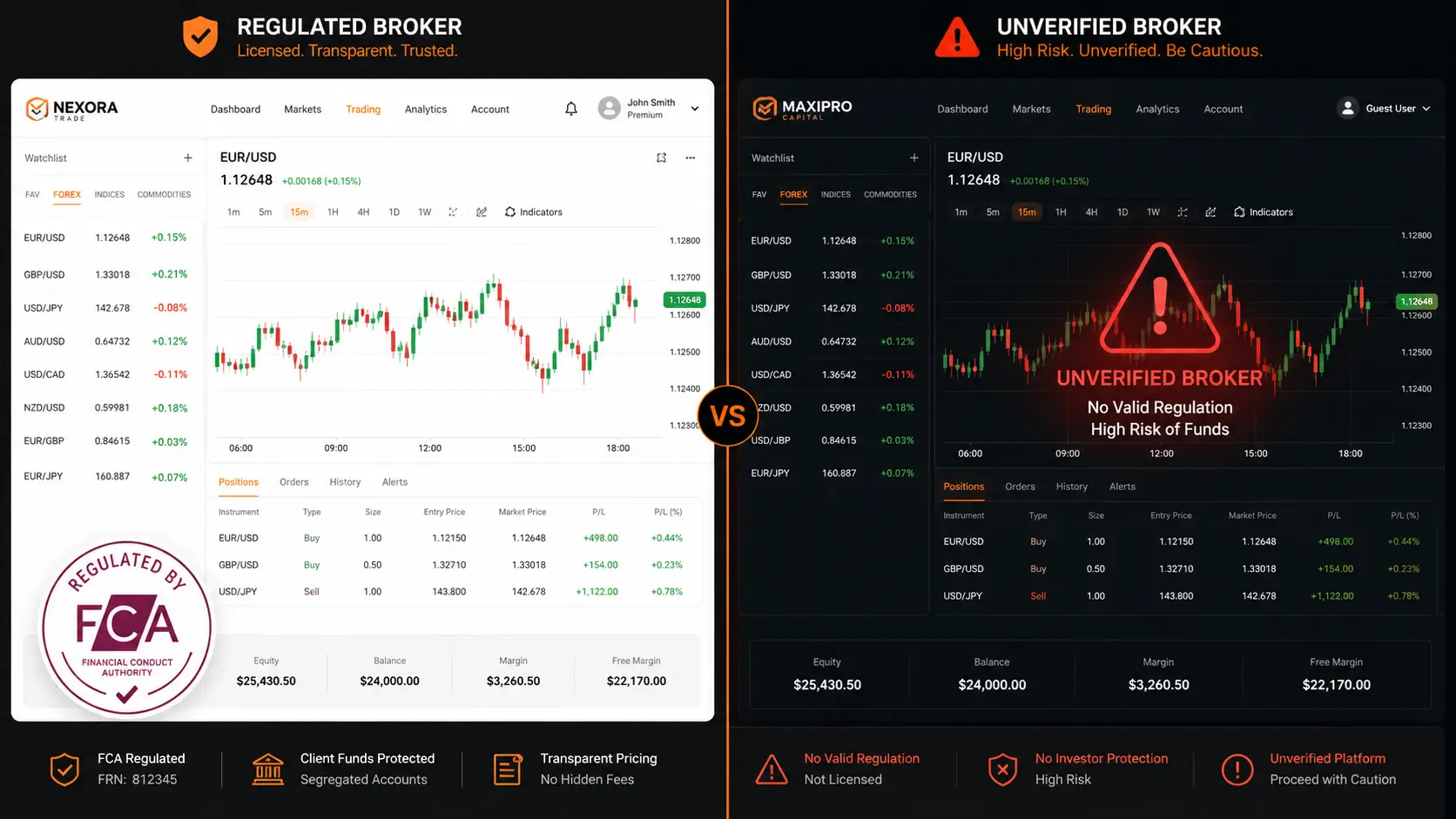
Choosing a forex broker is one of the most consequential risk management decisions you will make as a trader. This guide covers 10 concrete forex broker red flags, explains what each signals about a broker’s intent, and gives you a practical verification framework to use before any money moves. Blocked withdrawals, fabricated licenses, and untraceable company registrations are all avoidable if you know what to check.
Why Broker Selection Is a Risk Management Decision
Most traders treat broker selection as an administrative task: pick a platform, open an account, fund it, trade. But the broker relationship is the foundation every single trade sits on. If that foundation is rotten, your edge, your strategy, and your capital do not matter.
The cost of getting this wrong
The financial cost of choosing a bad broker goes well beyond a poor spread or sluggish execution. In the worst cases, it means total loss of deposited funds with no legal recourse, particularly when the broker is registered in an offshore jurisdiction with no investor protection scheme in place.
Beyond the financial damage, there is the time cost: months of dispute processes, circular customer service interactions, and the grim discovery that the broker’s registered address is a law firm in a country you have never visited. None of that is recoverable.
Most fraudulent or predatory brokers do leave visible tracks. You just need to know where to look.
Red Flag 1: No Verifiable Regulatory License
A broker without a verifiable regulatory license has no external accountability for how it handles your funds. Regulation is the mechanism that enforces client fund protection, complaint procedures, and minimum capital requirements. It is also the clearest filter available at the start of any broker evaluation.
What Tier 1 regulation looks like and where to check it
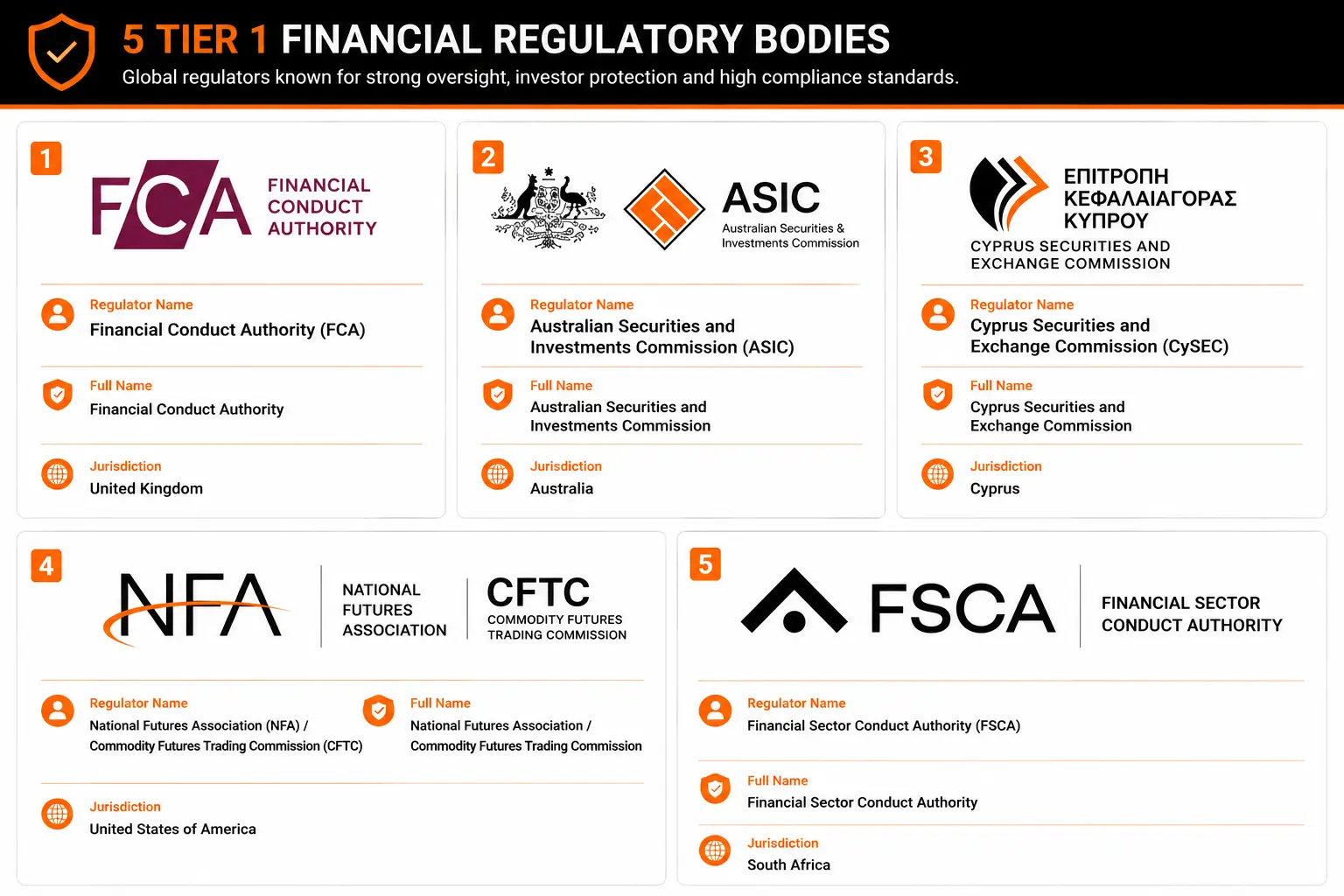
Tier 1 regulatory bodies are the most rigorous financial regulators in the world. They impose strict capital requirements, mandatory client fund segregation, leverage caps, and investor compensation schemes. The main Tier 1 regulators to know:
- FCA (Financial Conduct Authority) — United Kingdom
- ASIC (Australian Securities and Investments Commission) — Australia
- CySEC (Cyprus Securities and Exchange Commission) — European Union
- NFA / CFTC (National Futures Association / Commodity Futures Trading Commission) — United States
- FSCA (Financial Sector Conduct Authority) — South Africa
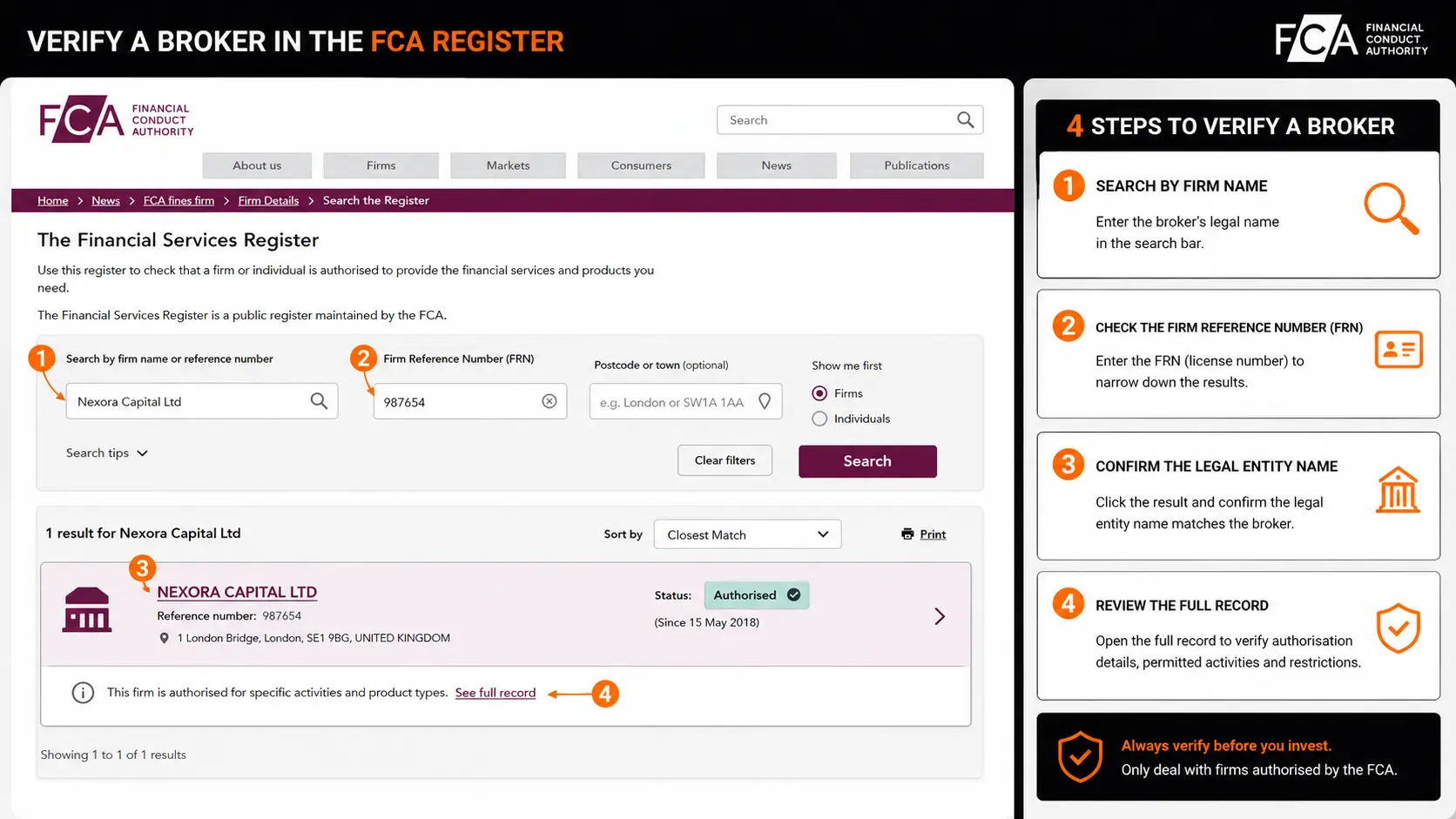
Each maintains a public register you can search directly. The process is straightforward:
- Find the broker’s stated license number on their website, usually in the footer.
- Go to the relevant regulator’s official website.
- Search the register using that exact license number.
- Confirm the legal entity name matches the broker you are evaluating.
If the license number does not appear, returns a different company name, or the regulator’s site shows the entity is no longer authorised, stop there.
Offshore jurisdictions such as Saint Vincent and the Grenadines, Vanuatu, or the Marshall Islands do register financial firms, but typically with little to no active oversight. Offshore registration means operating without the consumer protections that Tier 1 regulation provides.
Red Flag 2: Pressure to Deposit Quickly
You found a broker through an ad, a social media post, or a referral. The offer expires soon. There is a limited-time bonus attached to your first deposit. Someone is following up repeatedly to ask when you are transferring funds.
Urgency tactics and what they signal about broker intent
Manufactured urgency is a textbook high-pressure sales tactic. Legitimate brokers do not need you to fund your account by Tuesday. Their business model is built on long-term client relationships and recurring trading activity.
When a broker pushes you to deposit quickly, that pressure reflects something about their actual revenue model. Regulated brokers with institutional backing do not run fund-this-week campaigns.
Treat time pressure as a firm signal to slow down.
Red Flag 3: Unrealistic Profit Claims or Guaranteed Returns
Any broker that promises returns, guarantees profits, or implies that trading with them produces consistent positive outcomes is either misleading you or has a poor grasp of the business they are in.
Why no legitimate broker promises outcomes
Forex trading carries significant risk of loss. Every Tier 1-regulated broker is legally required to publish risk warnings disclosing the percentage of retail client accounts that lose money, and those published figures are consistently high across the industry. Profit guarantees in forex directly contradict the disclosures regulators require brokers to publish, which makes them a liability signal worth taking seriously.
Red Flag 4: Withdrawal Problems or Excessive Conditions
The moment most traders discover a broker is problematic is at withdrawal. Getting money in is usually frictionless, but getting it out can become a bureaucratic maze that never resolves.
How to test withdrawal friction before committing capital
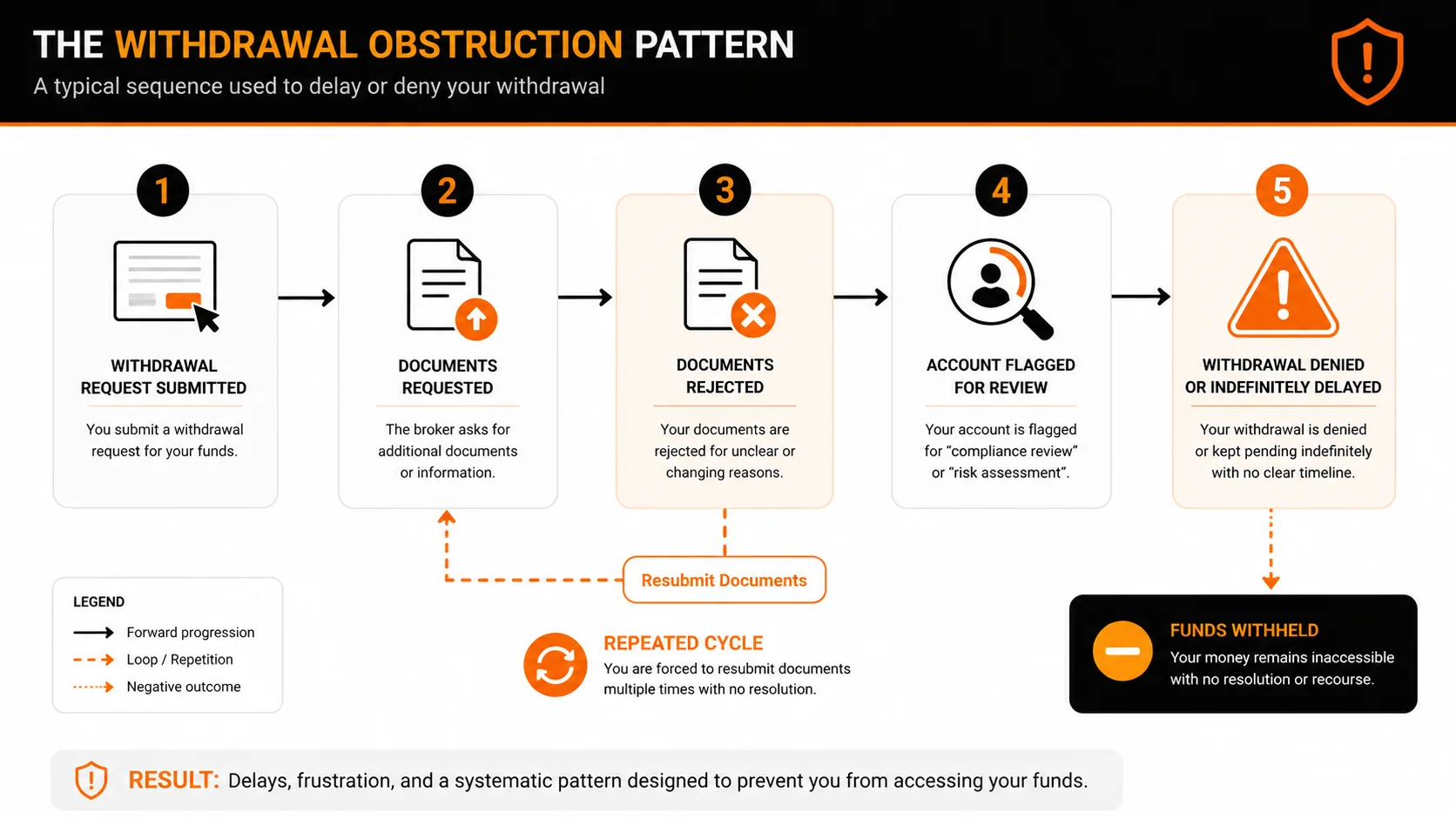
Common withdrawal obstruction patterns include:
- Bonus lock-ins: A bonus was applied to your deposit, and the terms require you to trade an enormous volume before withdrawals are permitted.
- Excessive KYC loops: Documents are repeatedly rejected for minor or fabricated reasons, delaying withdrawal indefinitely.
- Sudden account restrictions: Your account is flagged for review at exactly the point you try to withdraw.
- Minimum withdrawal thresholds: Thresholds are set high enough to trap smaller balances.
Before depositing significant capital, test the withdrawal process with a small amount, typically the minimum withdrawal allowed. A legitimate broker processes this cleanly and within the timeframe stated in their terms. Friction at this stage, at any scale, tells you what to expect later.
Red Flag 5: Opaque Fee Structures or Hidden Spreads
You should be able to look at a broker’s website and understand exactly what it costs to open and close a trade. Spreads, commissions, overnight financing rates, inactivity fees, and withdrawal fees should all be clearly documented, without needing to submit a support ticket to find them.
What transparent cost disclosure looks like
A transparent broker publishes:
- Typical and minimum spreads per instrument, clearly labelled
- Commission structures per lot or per trade, if applicable
- Overnight swap rates, or a link to a live swap calculator
- Any account maintenance or inactivity fees
- Withdrawal and deposit fees by payment method
If you cannot locate this information without contacting support, or if it is vague, buried in a lengthy PDF, or inconsistent across pages, that is a disclosure problem. Opaque fee structures are a mechanism for extracting costs from your account without your informed consent.
Red Flag 6: No Segregated Client Funds
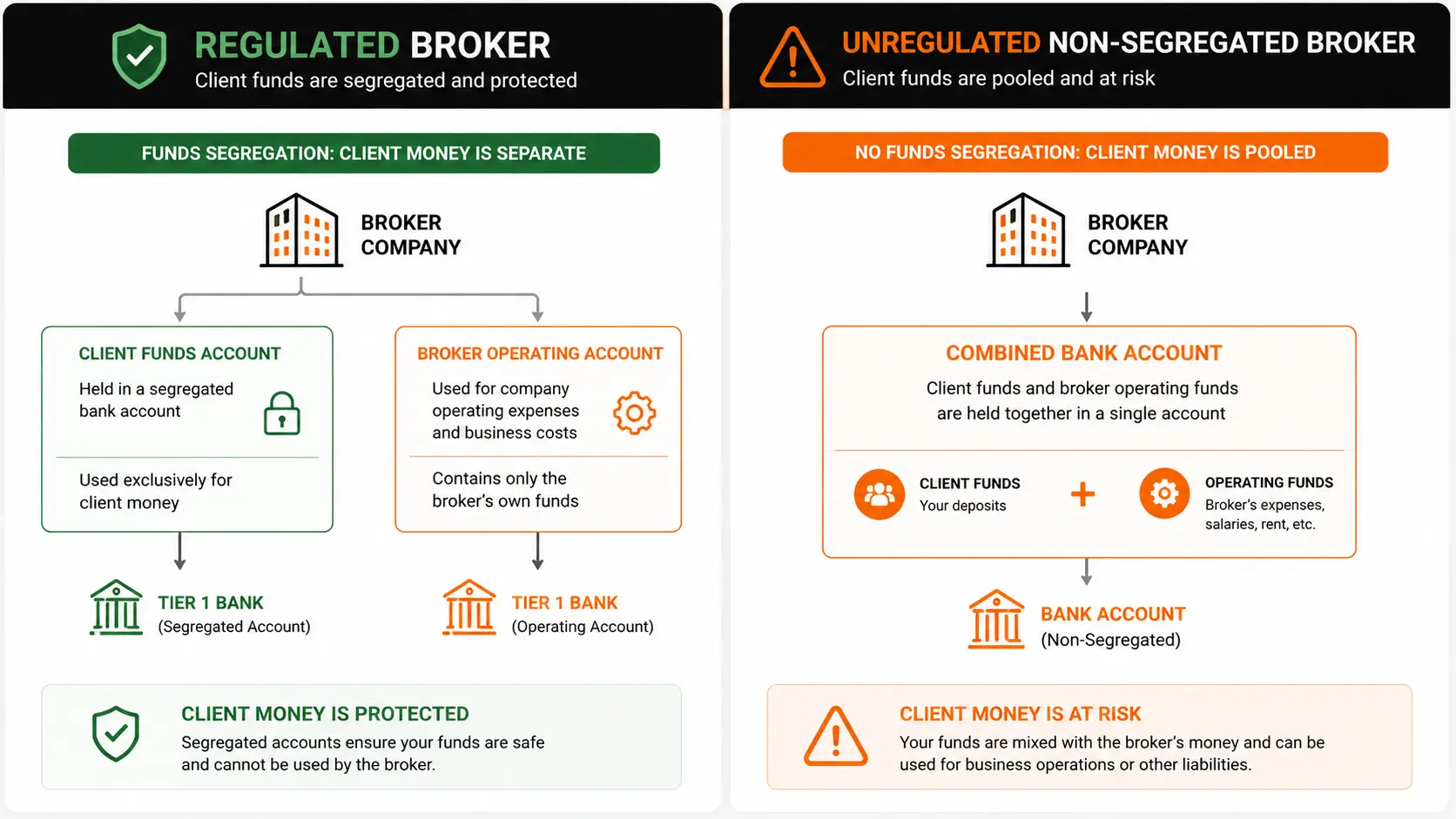
Fund segregation is the practice of keeping client deposits in separate bank accounts from the broker’s own operating funds. It means that if the broker becomes insolvent, your money is not treated as a company asset.
Why fund segregation is non-negotiable
Without segregation, your deposited funds are effectively a loan to the broker. If the company faces financial difficulty, creditors can make claims against the pool of client funds. You become an unsecured creditor, a category that tends to receive very little in insolvency proceedings.
All Tier 1-regulated brokers are required to maintain segregated client accounts. To verify:
- Check the broker’s legal documentation and client agreement for explicit reference to segregated accounts.
- Look for mentions of the specific bank or banks holding client funds.
- Confirm the regulator’s rules require segregation. The FCA and ASIC both mandate it.
If a broker’s documentation is silent on fund segregation, ask them directly in writing. Their response, or absence of one, is informative.
Red Flag 7: Anonymous or Unverifiable Company Information
A broker should be able to tell you who they are, where they are incorporated, who their directors are, and which regulator oversees them. This is the basic legal identity of a financial services company.
Jurisdiction shopping, offshore registration, and what to look for
Some brokers are deliberately structured to obscure accountability. Common patterns include:
- A website with a UK or EU postal address, but a license from an offshore jurisdiction with minimal oversight
- Registered company details that trace back to a nominee service or law firm rather than an actual trading company
- Multiple brand names sharing the same underlying entity, making it hard to track complaints or regulatory history
- No named directors, executives, or physical office address
Search the company’s registered name in the relevant national business registry. In the UK, that is Companies House. In Australia, it is ASIC’s company register. Cross-reference the legal entity name against the regulatory license. If these do not align, there is a structural problem worth taking seriously.
Red Flag 8: Suspiciously High Leverage with No Risk Disclosure
Leverage ratios vary by jurisdiction because regulators set limits based on investor protection standards. In Europe, ESMA caps leverage for retail forex traders at 30:1 on major currency pairs. ASIC applies similar restrictions. These limits exist because higher leverage dramatically increases the speed and scale of potential losses.
How leverage offerings outside regulatory norms indicate risk
Offshore brokers frequently advertise leverage of 1:500, 1:1000, or higher. Those figures sit well outside the limits Tier 1 regulators impose on retail clients, which tells you something meaningful about the regulatory environment the broker is operating in. High leverage paired with absent risk disclosure, or combined with profit guarantee language, indicates a broker more interested in large positions than in your long-term viability as a client.
Also check whether the broker publishes a risk warning disclosing the percentage of retail accounts that lose money. In most Tier 1 jurisdictions, the absence of that disclosure is itself a regulatory compliance failure.
Red Flag 9: Poor or Evasive Customer Support
Contact support before you open an account. Use multiple channels: live chat, email, and phone if available. Ask a specific, answerable question about their withdrawal process or their regulatory status. How they handle a simple pre-sales enquiry tells you a great deal about how they will handle a withdrawal dispute six months in.
Support quality as a proxy for operational integrity
The quality of support at the pre-sales stage reliably previews what you will receive when you actually need help. Red flags in support interactions include:
- Generic scripted responses that do not address your question
- Long response delays on channels advertised as real-time
- Inability to provide a direct answer about regulatory details or fund policies
- Defensive or dismissive responses to basic questions
A broker that cannot clearly and promptly answer where their license can be verified has a support infrastructure built around avoiding hard questions. That is worth knowing before any money moves.
Red Flag 10: Negative Patterns in Independent Reviews
Online reviews are imperfect. Traders who lose money on legitimate brokers sometimes leave negative reviews that reflect their own trading outcomes rather than broker misconduct. At the same time, review manipulation, including clusters of fake positives designed to bury legitimate complaints, is a documented practice in the industry.
How to read broker reviews without being misled by fake ones
When evaluating broker reviews, look for patterns rather than individual data points.
Focus on complaints that describe:
- Withdrawal requests denied or indefinitely delayed
- Accounts closed or frozen without explanation
- Bonus terms applied retroactively that prevented withdrawals
- Discrepancies between quoted and executed prices
These describe systemic broker behaviour. Ten reviews describing the same withdrawal obstruction pattern tell you something concrete about how that broker operates.
For review sources, prioritise:
- Trustpilot — high volume, some manipulation risk, but patterns are still visible
- Forex Peace Army — community-focused, with detailed complaint narratives
- Regulatory complaint registers — the FCA, ASIC, and NFA publish formal complaints data
Also check whether the broker has been subject to regulatory warnings or enforcement actions. Most Tier 1 regulators maintain a public warnings list. Search the broker’s name there before you search anywhere else.
Key Takeaways
- Regulatory verification is the first step. Use the regulator’s own public register.
- Pressure to deposit, profit guarantees, and high leverage without risk disclosure are consistently associated with predatory broker models.
- Withdrawal friction is the most common point of failure. Test it with a small amount before committing meaningful capital.
- Fund segregation and transparent fee disclosure are baseline standards.
- Review patterns matter more than individual ratings. Systemic complaints about withdrawals and account restrictions are the signals worth acting on.
How to Verify a Broker Before You Open an Account
You now have ten signals to watch for. Here is how to apply them systematically before depositing a cent.
Regulatory databases to check
Regulator | Jurisdiction | Public Register URL |
FCA | United Kingdom | |
ASIC | Australia | |
CySEC | Cyprus (EU) | |
NFA | United States | |
FSCA | South Africa |
Each register allows you to search by firm name, license number, or individual. Use all three where possible. Cross-reference the legal entity name on the register against the name on the broker’s website, client agreement, and bank transfer details.
A pre-deposit checklist
Use this before funding any new trading account. Completing this checklist reduces your exposure to obvious broker red flags; it does not eliminate all trading risk or guarantee the broker will meet your expectations in all circumstances.
- [ ] License number verified on the relevant regulator’s public register
- [ ] Legal entity name matches across website, license, and client agreement
- [ ] Fund segregation confirmed in writing or in published client terms
- [ ] Withdrawal process tested with a minimum amount
- [ ] Full fee schedule (spreads, commissions, swaps, withdrawal fees) located and understood
- [ ] No unsolicited pressure to deposit by a specific date
- [ ] No profit guarantees or unrealistic return claims found on the site
- [ ] Leverage ratio consistent with the regulatory standards in your jurisdiction
- [ ] Customer support tested and responsive on at least two channels
- [ ] Independent reviews checked for systemic complaint patterns
- [ ] No active regulatory warnings found for this broker or its parent entity
Frequently Asked Questions


Comments