


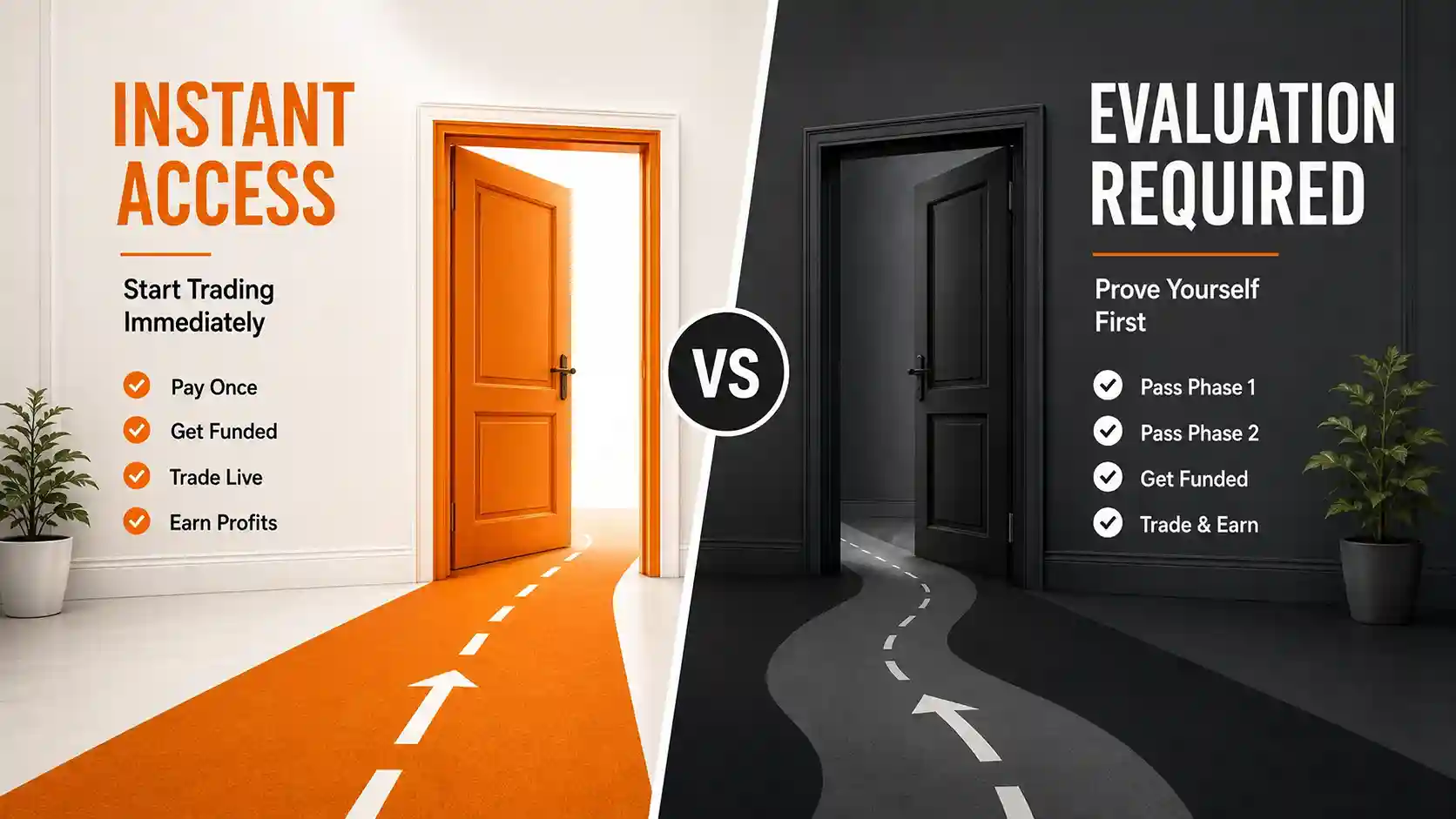
Prop firms give traders access to capital they don’t own, in exchange for a share of the profits. This article compares two entry models (instant funding and two-step challenges) on cost, trading conditions, and the realistic path to getting paid, so you can decide which one is worth it for your situation.
The fee you pay upfront, the spreads you trade on, the drawdown rules you operate under, and the payout terms you accept all determine whether a funded account is a genuine opportunity or an expensive lesson.
A brief note before we go further: prop firm trading involves financial risk. Fees are non-refundable in most cases, and funded account access can be withdrawn if you breach firm rules. This article does not constitute financial advice.
What Is an Instant Funding Prop Firm?
Instant funding removes the evaluation step that most prop firms require before granting funded account access. Understanding what replaces that step is what determines whether the model suits your situation.
How the Model Works
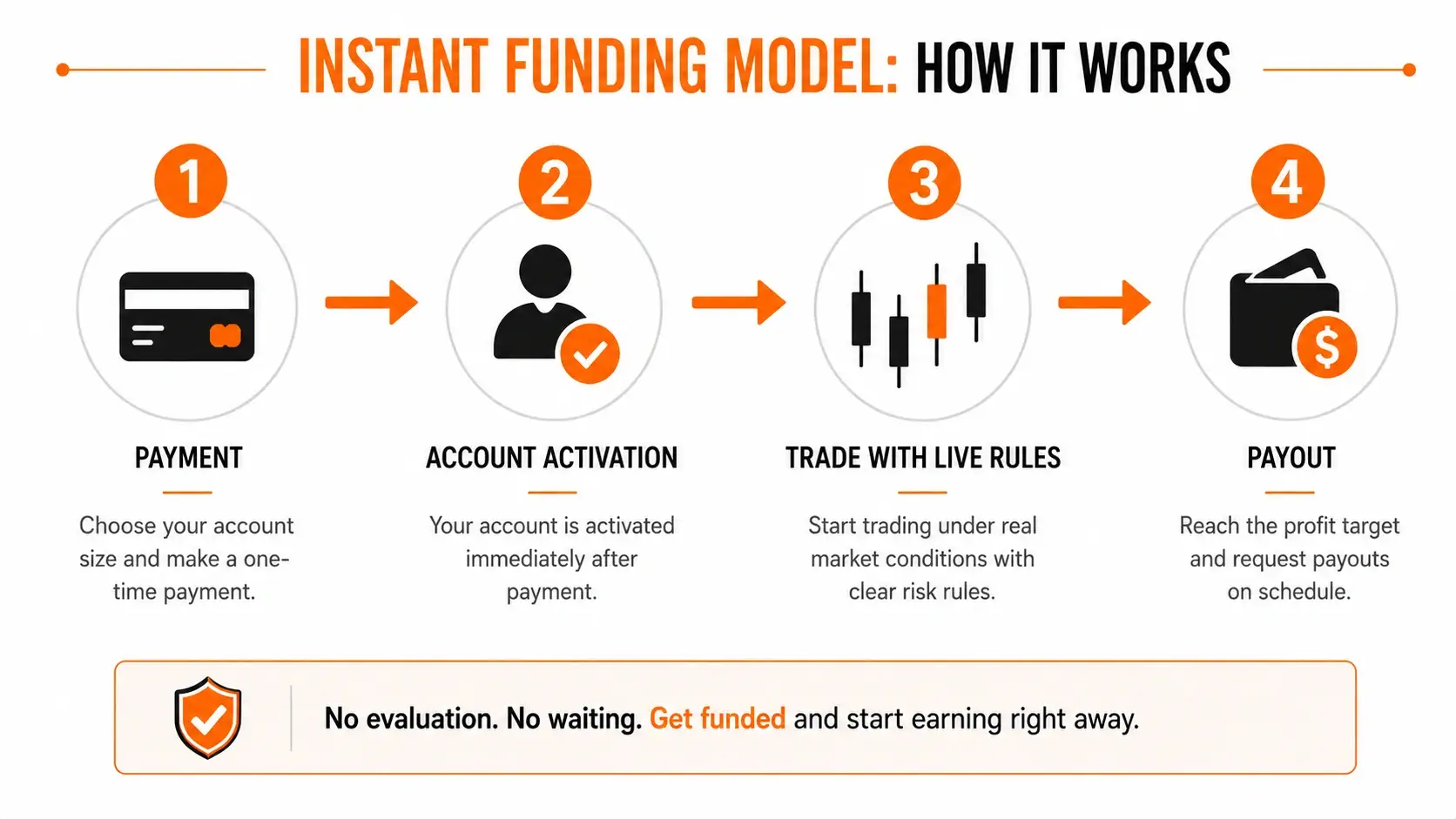
With an instant funding prop firm, you pay a fee and receive immediate access to a funded trading account. There is no evaluation period and no performance targets to hit first. You can open trades from day one.
The firm is extending capital based on your agreement to follow their rules. That trust has a price, and it shows up in the account conditions rather than an upfront evaluation fee.
Your account is live, but it operates inside a risk-managed environment. The firm controls that risk through tight drawdown parameters, restricted instruments, and in many cases, wider spreads than you would find on a standard retail account. The evaluation mechanism is embedded in the ongoing conditions rather than placed upfront.
Typical Cost Structure and Account Conditions
Instant funded accounts are typically priced as a one-time purchase, with fees that scale by account size.
As a general illustration, a $25,000 instant account might cost a few hundred dollars, while a $100,000 account could run significantly higher. Pricing varies considerably across firms and changes frequently, so treat any specific figures as a starting point for research rather than a benchmark.
Key conditions to expect:
- Profit splits: Often lower than challenge-based firms, commonly in the 60-80% range, though some firms offer higher splits with additional restrictions
- Drawdown limits: Frequently tighter, and often trailing (more on that distinction shortly)
- Payout cycles: Can begin quickly, but minimum profit thresholds and consistency rules may apply
- Account reset: If you breach the drawdown, you typically need to purchase a new account or pay a reset fee
What Is a Two-Step Challenge Prop Firm?
Two-step challenge firms are the more established model in the prop space, and they operate on a fundamentally different premise: demonstrate that you can trade before you get access to real capital.
How the Evaluation Process Works
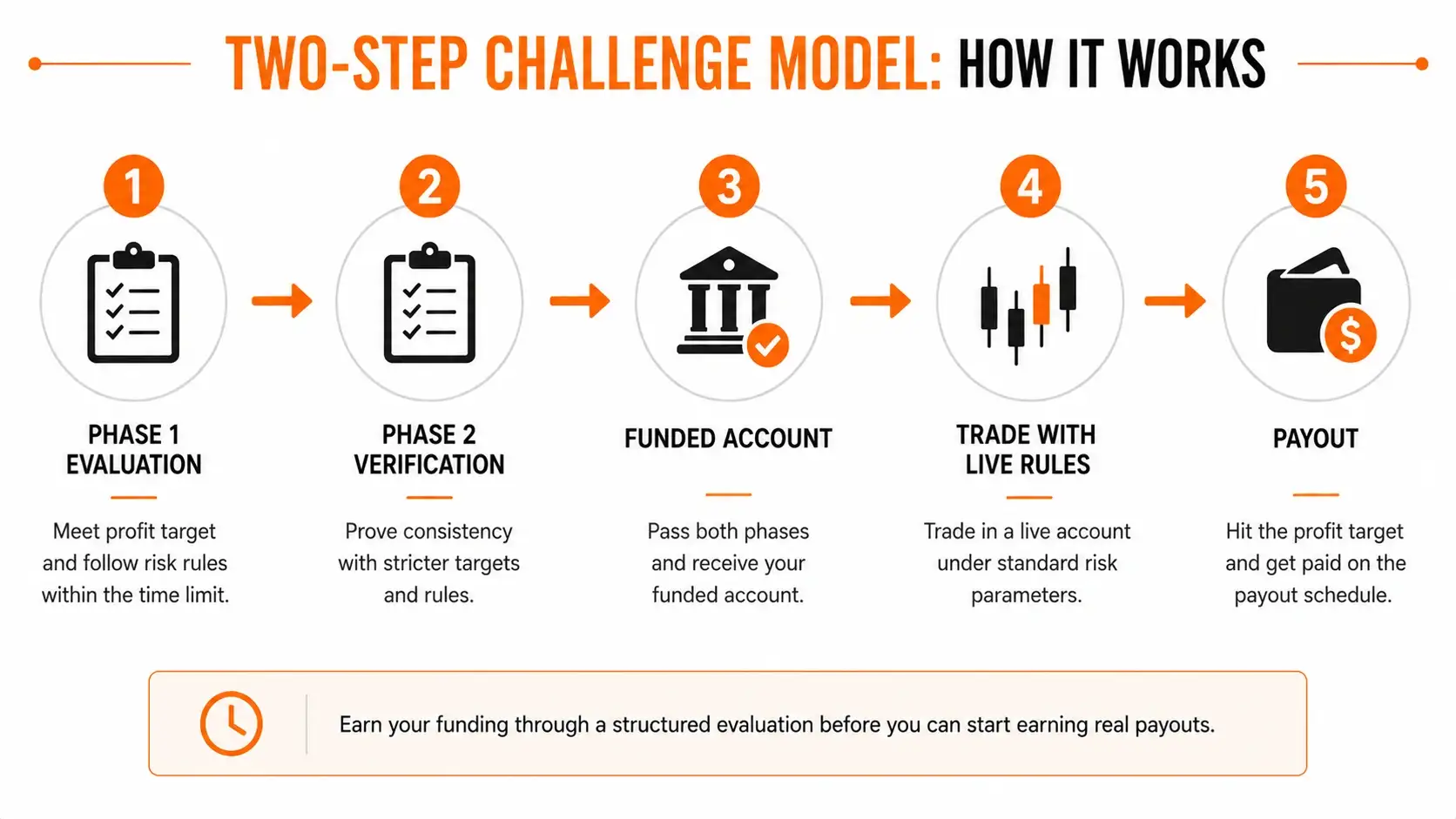
The two-step challenge (also called an evaluation or assessment) requires you to hit a profit target while staying within specified drawdown limits across two sequential phases. Phase 1 typically carries a higher profit target; Phase 2 requires a lower target under the same risk rules.
Pass both phases and you receive a funded account. Breach the drawdown rules at any point during either phase and the evaluation ends. You either pay for a new attempt or absorb the loss.
The logic behind the model is straightforward: a trader who can navigate two evaluation phases under live-like conditions has demonstrated some level of discipline and risk management. It also serves the firm’s interests, since they have identified traders less likely to blow accounts immediately after funding.
Typical Cost Structure and Account Conditions
Challenge fees are generally lower upfront than instant funding purchases. A $100,000 challenge account might carry a fee in the low hundreds of dollars. Again, treat these as illustrative figures that vary by firm and change over time.
The trade-off for the lower entry cost is the evaluation requirement:
- Profit splits: Typically higher, often in the 80-90% range for funded accounts, with some firms offering up to 90% after scaling
- Drawdown limits: Often static, fixed from the initial balance, which is generally more forgiving than trailing drawdown
- Payout cycles: Begin after the funded phase is reached; the first payout may require a minimum trading period
- Challenge refund: Some firms refund the challenge fee on your first funded payout; read the terms carefully, as conditions apply
Key Differences Between the Two Models
The surface-level difference is clear: one has a gate, one doesn’t. The more consequential differences live in the conditions that follow.
Upfront Cost vs Ongoing Conditions
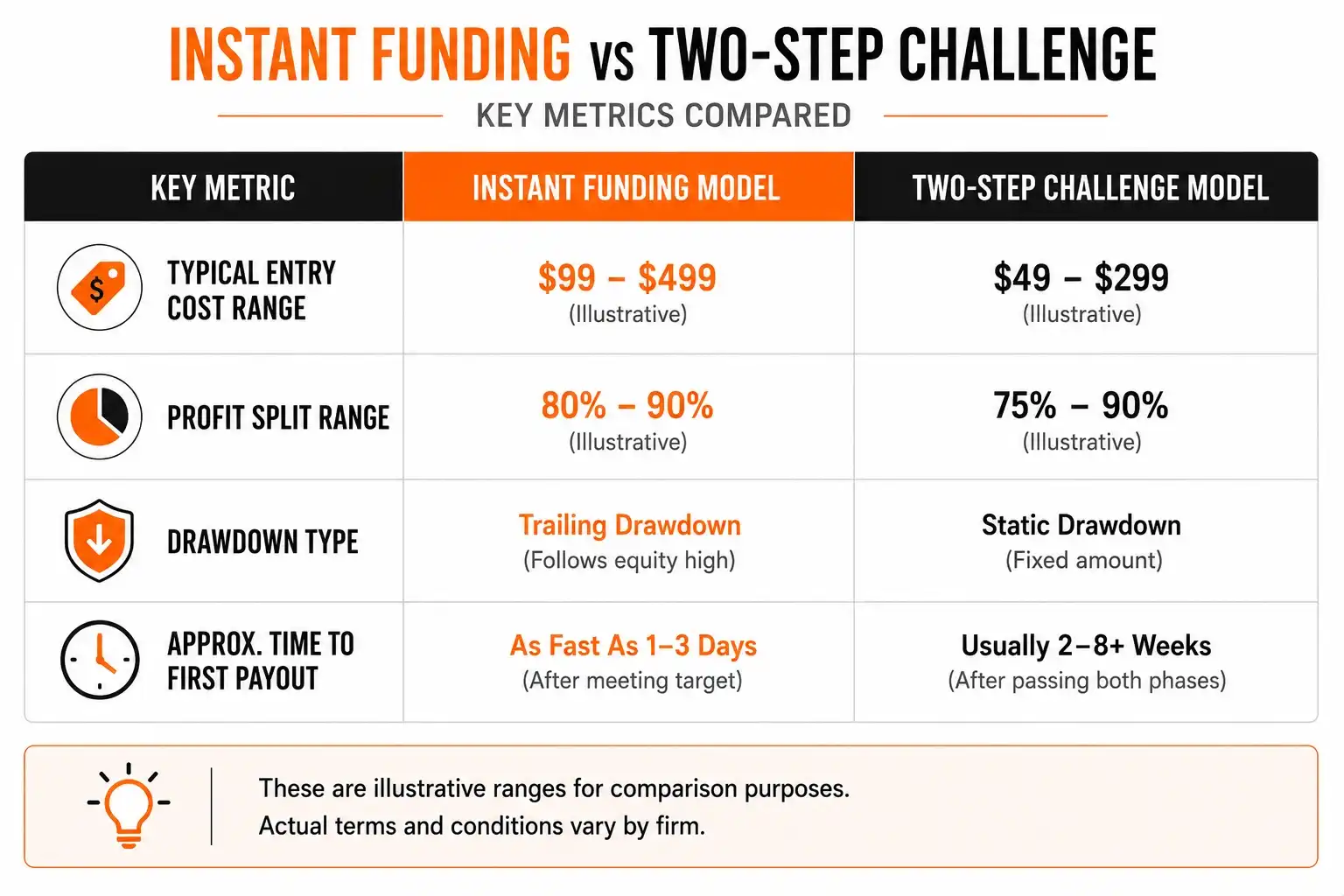
Instant funding charges more upfront. Two-step challenges charge less to enter but require demonstrated performance before you access capital.
Factor | Instant Funding | Two-Step Challenge |
Entry cost | Higher one-time fee | Lower challenge fee |
Access speed | Immediate | Weeks (evaluation period) |
Proof of skill required | No | Yes (two phases) |
Fee refundable | Rarely | Sometimes (on first payout) |
Reset cost if breached | Repurchase or reset fee | New challenge purchase |
The cost calculation doesn’t end at the entry fee. A trader who fails two or three challenge attempts has often spent more than the equivalent instant funding fee, without ever reaching a funded account. Equally, a trader who buys an instant account, breaches the drawdown quickly, and repurchases has compounded their losses through a different route.
Profit Split and Payout Mechanics
Two-step challenge firms generally offer more competitive profit splits on funded accounts. If you are consistently profitable, that percentage difference accumulates meaningfully over time.
Instant funding accounts frequently offer lower splits as part of the model’s economics. The firm accepted more upfront risk by skipping the evaluation, and they adjust the ongoing terms accordingly.
Payout conditions also differ. Some instant funding firms impose stricter consistency rules, minimum trading day requirements, or hold periods before your first withdrawal. Challenge-based firms often have their own versions of these, but the terms tend to be more clearly defined at the point of purchase – partly because the evaluation process itself functions as a filter.
Drawdown Rules and Risk Parameters
This is where the two models diverge most significantly, and it is worth understanding the mechanics before you commit.
Trailing drawdown moves with your account’s peak equity. If your account grows, the floor rises with it; meaning a strong start can actually tighten your risk ceiling over time. Instant funding accounts use trailing drawdown more frequently.
Static drawdown is fixed from your starting balance (or sometimes your initial equity). It doesn’t move as your account grows. This is more common in challenge-based models and is generally considered more trader-friendly.
To make it concrete:
- On a $100,000 account with a 10% static drawdown, your floor is fixed at $90,000 regardless of how high your account climbs.
- On a trailing drawdown account, hitting $110,000 in equity moves your floor to $99,000 and a bad week can cost you the account even though you are still nominally profitable overall.
Poor drawdown management can be the sole reason why your prop trading account gets terminated. To learn how to protect yourself against it, visit our drawdown psychology guide.
Time to First Payout
Instant funding wins on raw speed. You can, in theory, reach a payout within your first trading week if the account conditions allow it.
Two-step challenges add the evaluation period to the timeline. Depending on the firm’s minimum trading day requirements and how long it takes to hit profit targets consistently, the full process from purchase to first funded payout can take anywhere from a few weeks to a few months.
If time is a meaningful factor (say you are trying to demonstrate performance for a specific purpose or you are confident in your current edge) instant funding compresses that timeline. If you are still developing consistency, the evaluation period provides useful structure rather than an arbitrary delay.
Who Should Choose Instant Funding?
Instant funding suits a specific trader profile. It’s a strong fit for the right trader, and an expensive mismatch for the wrong one.
Instant funding is the stronger fit if you:
- Have a documented trading history with consistent risk management
- Trade a well-defined strategy with known drawdown characteristics
- Want to begin generating funded account data immediately, for scaling or performance review purposes
- Understand trailing drawdown mechanics and can operate within tighter risk parameters
- Have already passed evaluations at other firms and want additional capital without repeating the process
The model is a weaker fit if you are still stress-testing your strategy or haven’t traded with strict drawdown discipline before. Tighter conditions under live pressure can expose weaknesses that demo trading or relaxed retail accounts didn’t reveal.
Who Should Choose a Two-Step Challenge?
The two-step challenge model rewards preparation and patience. For most traders approaching prop firms for the first time, it is the more appropriate starting point.
A two-step challenge is the stronger fit if you:
- Are new to prop firm rules and want the evaluation period to build familiarity before real capital is at stake
- Trade a strategy that takes time to reach profit targets but stays well within drawdown limits
- Want a higher profit split on the funded account side
- Prefer static drawdown structures that don’t shift against you as your account grows
- Are working with a limited budget where the lower entry cost matters
The evaluation is a filter, and most traders benefit from passing through one before managing someone else’s capital. The process introduces structure before capital is at stake, which many traders find valuable before scaling.
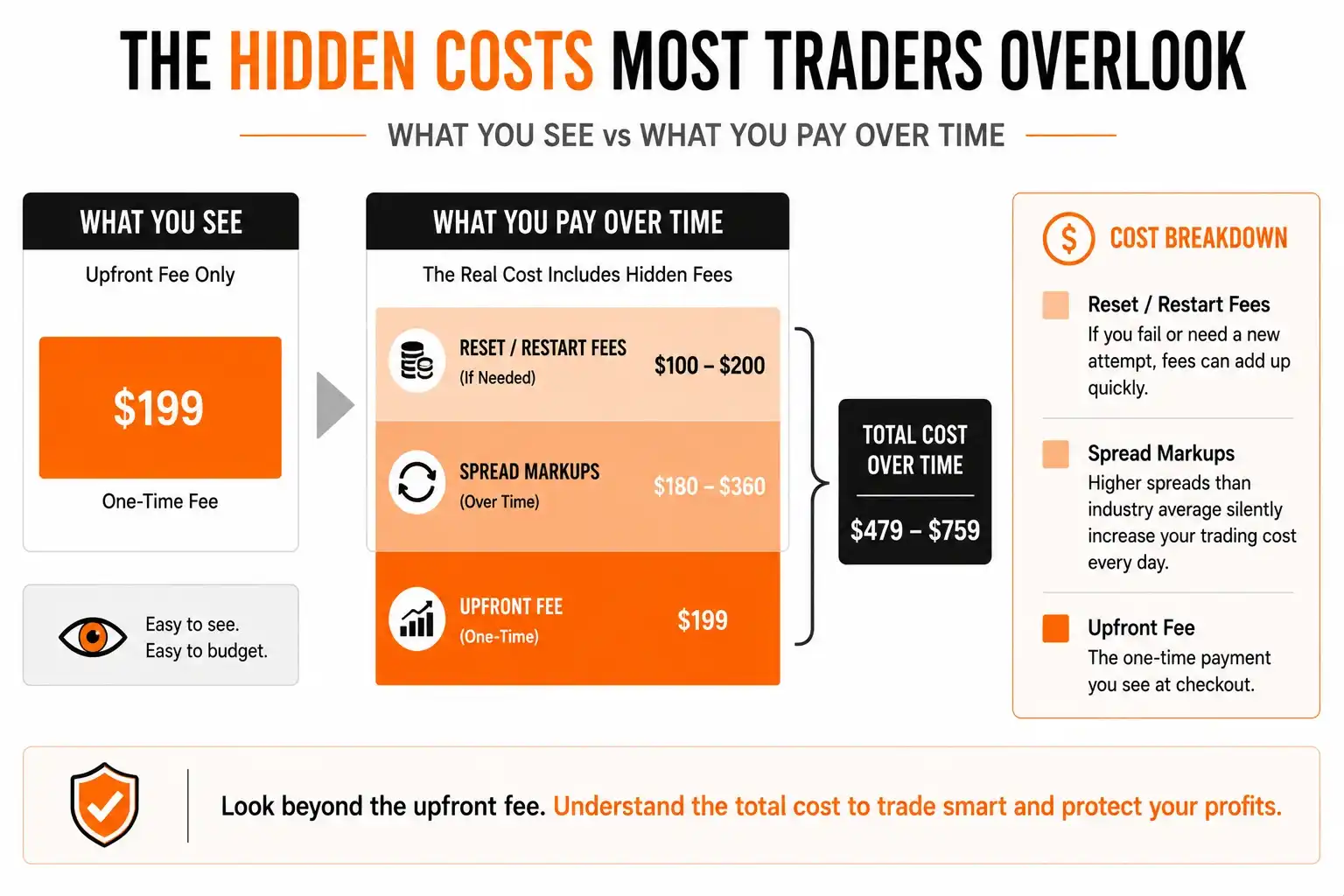
The Hidden Costs Most Traders Overlook
The fee you pay to enter either model is the most visible cost, but it is rarely the most significant one.
Spread Markups and Instrument Restrictions
Most prop firms, across both models, generate part of their revenue through spread markups. The spreads you trade on a prop account are often wider than what you would access on a standard ECN retail account. On high-frequency strategies or instruments with naturally tight spreads, this difference can meaningfully reduce your net profitability.
Instrument restrictions are also common. Some firms limit the assets you can trade, restrict news trading, or prohibit overnight and weekend holds. These restrictions affect certain trading styles far more than others. Before purchasing any account type, map your strategy’s typical trades against the firm’s specific rules. An account that looks affordable can become expensive if a significant portion of your setups are technically non-compliant.
Reset Fees, Refund Policies, and Renewal Terms
If you breach the drawdown on a challenge account, you pay for a new challenge. If you breach it on an instant funding account, you typically repurchase the account or pay a reset fee. Neither option is free, and neither credits you for previous fees paid.
The cost structure gets significantly more expensive for traders who breach accounts regularly. Two or three resets on either model can exceed the original entry cost. This is worth modelling before you enter: if your strategy has a realistic drawdown range, does it fit within the firm’s parameters with meaningful margin to spare, or are you regularly operating near the limit?
Refund policies on challenge fees vary. Some firms offer a refund of the challenge fee on your first funded payout, but that refund is almost always conditional on completing a minimum trading period, hitting specific consistency metrics, or both. Read the refund clause specifically, not the headline.
Which Model Has the Better Risk-Reward for Traders?
The risk-reward comparison depends almost entirely on your profile as a trader.
For a consistently profitable trader with defined risk parameters and a verifiable track record, instant funding offers faster capital access and removes the evaluation variable. The lower profit split and tighter drawdown are costs worth bearing if the alternative is spending weeks in an evaluation that adds no new information about your trading.
For a trader still building consistency, the two-step challenge model offers a better structural fit. The evaluation phase enforces discipline before the stakes are real, the profit splits are higher once funded, and the static drawdown conditions are more forgiving during the learning curve.
A few questions that help clarify the decision:
- Can you document at least 3-6 months of trading that shows your strategy’s typical drawdown range?
- Does your strategy fit within the specific drawdown type (trailing or static) offered by the accounts you are comparing?
- Have you calculated your expected net return after the profit split and estimated spread costs?
- What is your plan if you breach the account on day one?
If you can answer all four with specifics rather than approximations, you are in a position to make a rational comparison. If any of those questions gives you pause, that pause is informative.
For a broader look at how specific firms structure their evaluation and funding terms, a best prop firms comparison hub can help you apply this framework to actual options in the market.
Instant funding is faster and costs more in ongoing conditions. Two-step challenges are slower and cost more in time and evaluation risk. The model that fits you is the one whose costs align with what you can actually manage.
Frequently Asked Questions


Comments