


This article is for informational purposes only and does not constitute financial advice. Trading leveraged financial instruments involves significant risk of loss.
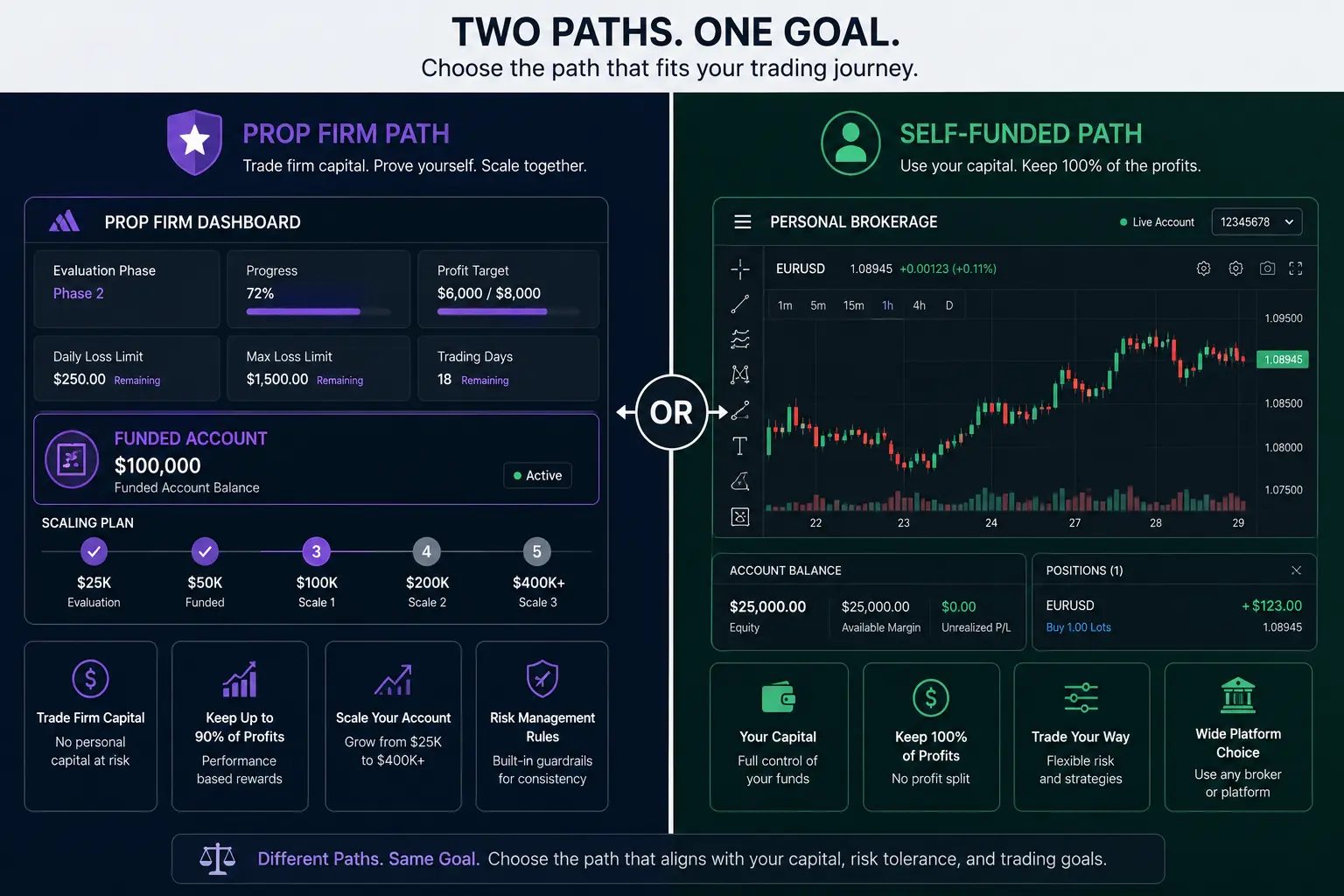
Deciding between prop firm trading and self-funded trading? This article gives you a direct, structured framework for making that call. These two paths differ fundamentally across capital exposure, risk structure, trading freedom, and earning trajectory; and the right choice depends entirely on where you are right now.
What You Are Actually Comparing (Framing the Decision Correctly)
The more useful question is which model is better for you, given your current capital position, your trading strategy, and your risk tolerance. Get that framing right, and the rest of the decision becomes considerably easier.
How Prop Trading Works in Practice
A prop firm gives you access to a funded trading account (typically ranging from $10,000 to $200,000 or more) after you pass an evaluation process, commonly called a challenge. You pay a one-time fee to attempt it, meet performance and risk targets over a set period, and if you pass, you receive a funded account with real capital to trade.
Your profits are then split with the firm. Common arrangements run from 70/30 to 90/10 in the trader’s favour, depending on the firm and the tier you reach through their scaling program.
You are trading the firm’s capital. If you breach their risk rules, you lose the account – not your personal savings.
How Self-Funded Trading Works in Practice
Self-funded trading means deploying your own capital in a live account with a broker. You keep 100% of your profits, set your own risk parameters, and answer to nobody. Your drawdown limit is whatever you decide it is, and your position sizing is yours to control entirely.
The trade-off is direct: every dollar you lose is a dollar from your own pocket. There is no funded cushion, no firm absorbing the downside beyond your deposit.
Both models can support a professional trading career. The question is which structure suits your current situation; and that starts with what it actually costs to get in.
Capital Requirements and Barrier to Entry
This is where the two paths diverge most visibly, and where the most common misunderstandings tend to cluster. Neither option is truly low-cost, they just distribute that cost very differently.
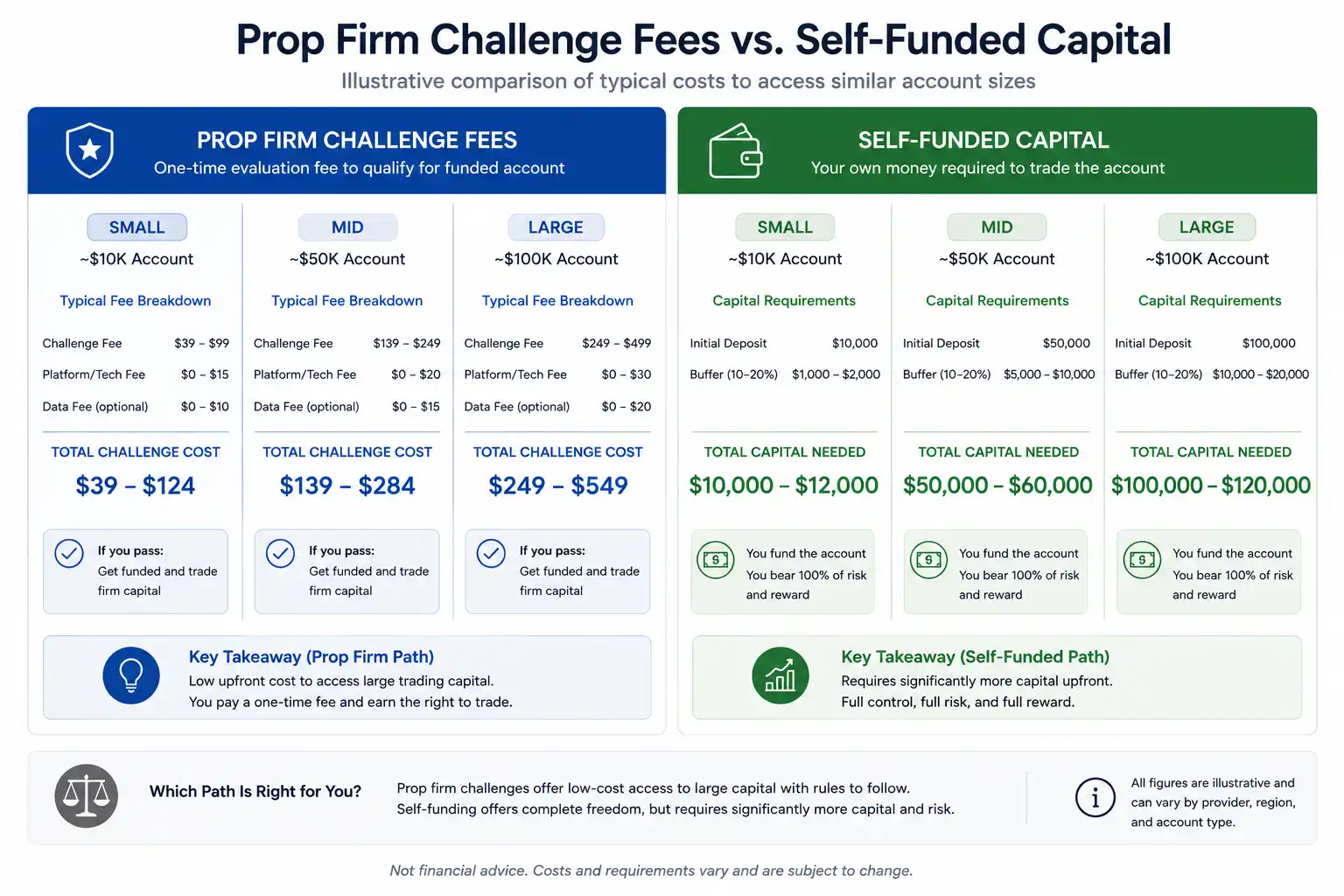
The Cost of a Prop Firm Challenge
Challenge fees vary by firm and account size, but the general range looks something like this:
Account Size | Typical Challenge Fee Range |
$10,000 | $50 – $100 |
$25,000 | $150 – $250 |
$50,000 | $250 – $400 |
$100,000 | $400 – $700 |
$200,000 | $800 – $1,500+ |
These fees are non-refundable if you fail. Many firms offer a refund of the first fee, but that is conditional on passing, which is not guaranteed.
A challenge fee is capital at risk, with a binary outcome. Fail once and you pay again. Fail multiple times and the cumulative cost becomes meaningful.
The Real Cost of Building a Personal Trading Account
Self-funded trading requires enough capital to trade meaningfully while surviving normal drawdown. In practice, this means:
- Forex and CFD trading: Most retail brokers accept deposits from a few hundred dollars, but to trade with sensible position sizing on a 1-2% risk-per-trade model, most traders need at least $2,000 to $10,000 before the numbers start working in their favour.
- Futures trading: Margin requirements vary by contract, but day-trading margins can run from $500 to several thousand per contract, and you need buffer beyond the margin itself.
- Opportunity cost: Capital sitting in a trading account is capital not deployed elsewhere.
Neither path is free. The prop firm path front-loads risk into a fee you could lose entirely. The self-funded path front-loads risk into live capital that can erode through normal trading losses. Understanding that distinction is what solid risk management is built around.
Risk Exposure: Whose Money Is on the Line?
Capital cost and risk exposure are related, but they are not the same thing. Knowing who carries the downside (and under what conditions) changes how you should think about each path.
Risk in Prop Trading (Fees, Drawdown Rules, Resets)
In a prop firm account, your direct financial risk is capped at what you have paid in fees. The firm’s capital is protected by two primary mechanisms:
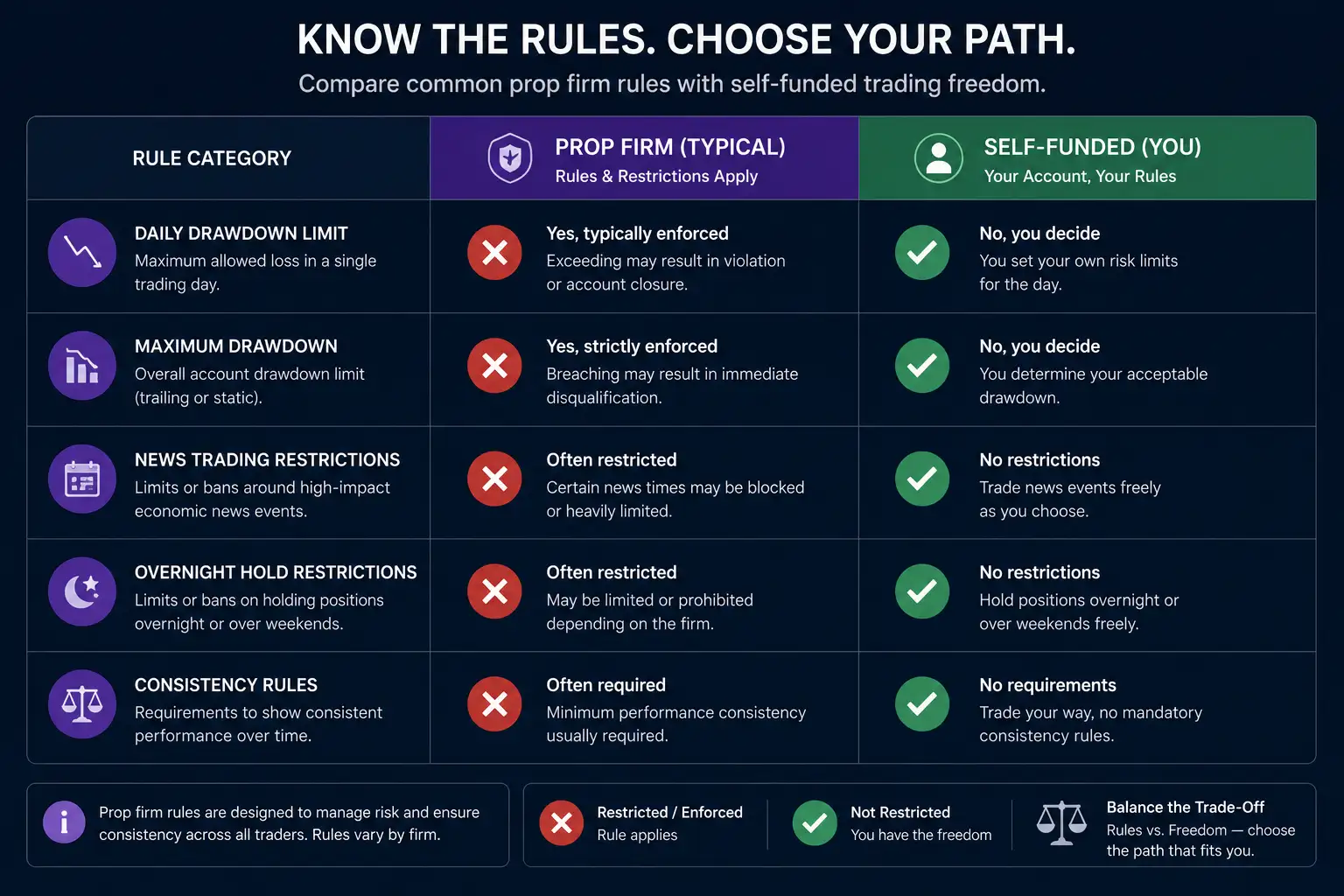
- Daily drawdown limit: A maximum loss you are allowed to incur in a single trading day, typically 4-5% of the account value. Breach it and the account closes.
- Overall (maximum) drawdown limit: A total account loss threshold, usually 8-10%. Some firms use a trailing drawdown that moves with your peak balance rather than the initial account value.
These rules mean that a prop firm is never exposed to unlimited downside from a single trader, and you are never exposed to losing more than your fee, plus any profit you had built up before a breach.
The risk that most traders underestimate is the consistency requirement. Many firms impose rules around how regularly you must profit, how concentrated your gains can be across days, and sometimes even time-of-day restrictions. One bad session can breach a drawdown limit that wipes out a previously strong account.
Risk in Self-Funded Trading (Full Capital Exposure)
Self-funded trading carries a fundamentally different risk structure. Your entire deposit is exposed. A bad week, a gap event, or a lapse in discipline can draw down your account by 30%, 50%, or more – with no external stop beyond your own controls.
There is no automatic account closure protecting you from yourself. That can be a strength if your discipline is strong and a serious liability if it is not.
Leverage amplifies this in both directions. A self-funded forex account with 30:1 leverage (standard in many jurisdictions) means a 3.33% adverse move against a fully margined position wipes the account. The same leverage is available in a prop firm context, but the firm’s drawdown limits act as an external circuit breaker that your personal account does not have by default.
Rules, Restrictions, and Trading Freedom
Many traders discover that their specific strategy is partially or entirely incompatible with how prop firms operate. Evaluating the rules before you commit is not optional.
Prop Firm Rules That Will Affect Your Strategy
Prop firms impose operational rules that go beyond drawdown limits. The most significant ones to evaluate before committing:
- News trading bans: Many firms prohibit opening or holding positions within a set window, commonly 2-5 minutes, around major economic data releases. If your edge lives in news volatility, this is a hard constraint.
- Overnight and weekend holding restrictions: Some firms do not allow you to hold positions past the daily market close or over weekends. Swing traders and position traders will find this severely limiting.
- Expert Advisor (EA) and automated trading rules: Most firms allow EAs, but many ban specific categories – particularly high-frequency strategies, latency arbitrage, and copy trading. If you run an automated system, verify compatibility explicitly before committing.
- Consistency rules: Some firms require that your single-day profit does not exceed a set percentage of your total profit. One exceptional trading day that skews your results can fail a challenge you otherwise passed on every other metric.
- Minimum trading day requirements: Challenges often require a minimum number of active trading days before you can request a payout or pass the evaluation.
These are strategic constraints, not minor administrative details. Evaluate each one against your actual trading method before spending a fee on a challenge. A comparison of how different firms structure these constraints is available in MonkeyTrade’s prop firm review hub.
What Full Autonomy Looks Like in a Self-Funded Account
A self-funded account has no external rules on strategy. You can trade news events, hold positions for weeks, run automated systems, scale in and out however you like, and operate across sessions and instruments without restriction.
The only constraints are your broker’s terms (generally far less restrictive than prop firm rules) and your own risk framework. If your strategy depends on flexibility (holding through volatility, trading around major events, or running a rules-based automated system without outside interference), a self-funded account provides that without negotiation.
That freedom is only as valuable as your risk discipline. An empty rulebook means your trading plan is the only thing standing between a solid account and a blown one.
Profit Potential and Long-Term Earning Trajectory
Both paths can generate income. The structure of that income (and how it compounds over time) is where the real differences show up.
Profit Splits and Scaling in Prop Firms
Prop firm profit splits typically start at 70-80% in the trader’s favour and can increase through scaling programs as you demonstrate consistency. At an 80% split on a $100,000 account, a 5% monthly return means you receive $4,000 of the $5,000 generated.
The significant upside of the prop firm model is access to account sizes that most retail traders could not self-fund. A trader with $3,000 in personal capital who passes a challenge for a $100,000 account is effectively trading with 33 times the buying power they could access alone. At an 80% split, they take home four times what they would earn from their personal account, even after giving up 20%.
Firms that offer structured scaling programs (increasing your account size as you hit profit targets) can dramatically accelerate your earning ceiling without requiring proportional personal capital.
Scaling is conditional, though. Continued rule compliance and consistent performance are required at every stage. Breach a drawdown rule and you are back to a new challenge fee.
Compounding and Full Retention in Self-Funded Accounts
In a self-funded account, you keep 100% of every profitable trade. Compounding on personal capital is mathematically clean: every dollar of profit retained becomes part of the base you trade from next month.
A trader starting with $10,000 and compounding at 5% per month reaches roughly $17,000 in one year. The percentages stay consistent; the dollar amounts grow as the base grows.
The ceiling on this model is your available capital. Compounding 5% monthly on $10,000 looks very different from compounding the same percentage on $100,000, which is precisely the advantage the prop firm model offers to undercapitalised traders who can demonstrate the skill.
The time horizon is the real trade-off. Building a meaningful self-funded account from a small base takes years of consistent compounding. A prop firm can accelerate access to larger account sizes, but at the cost of ongoing rule compliance and split earnings.
Which Path Fits Which Trader Profile?
There are clear indicators that point most traders in one direction or the other.
Choose Prop Trading If…
- You have strong trading skills but limited personal capital. Prop trading is one of the few ways to access meaningful buying power without years of savings.
- Your strategy is compatible with common prop firm rule sets, with no dependence on news trading or strict overnight holding requirements.
- You prefer a capped downside on your personal funds: losing a challenge fee is painful, but structurally different from losing $20,000 of personal savings.
- You want access to a structured scaling program that increases your account size as you perform.
- You are willing to trade within a defined rule framework in exchange for the capital access it provides.
Choose Self-Funded Trading If…
- You have sufficient capital to trade meaningfully and manage drawdown on your own terms.
- Your strategy depends on trading freedom: news events, overnight holds, automated systems, or unconventional timing.
- You want full retention of profits with no external compliance requirements affecting your decisions.
- You have a track record of disciplined risk management that makes external circuit breakers unnecessary.
- You are building a long-term compounding account and have the capital base to make that trajectory viable.
A hybrid approach is worth noting briefly: some experienced traders run a self-funded account for strategy development and a prop firm account as a capital multiplier for strategies that fit within the rule set. Logistically manageable, but it requires careful mental accounting and clear strategy separation between accounts.
The right trading capital path is the one that matches where you are right now – not where you want to be.
Frequently Asked Questions


Comments