


Forex broker scams are rarely obvious, and that is exactly how fraudsters want it. This guide gives you a concrete, repeatable verification process so you can assess any broker before a single dollar leaves your account.
This article is for informational purposes only and does not constitute legal or financial advice.
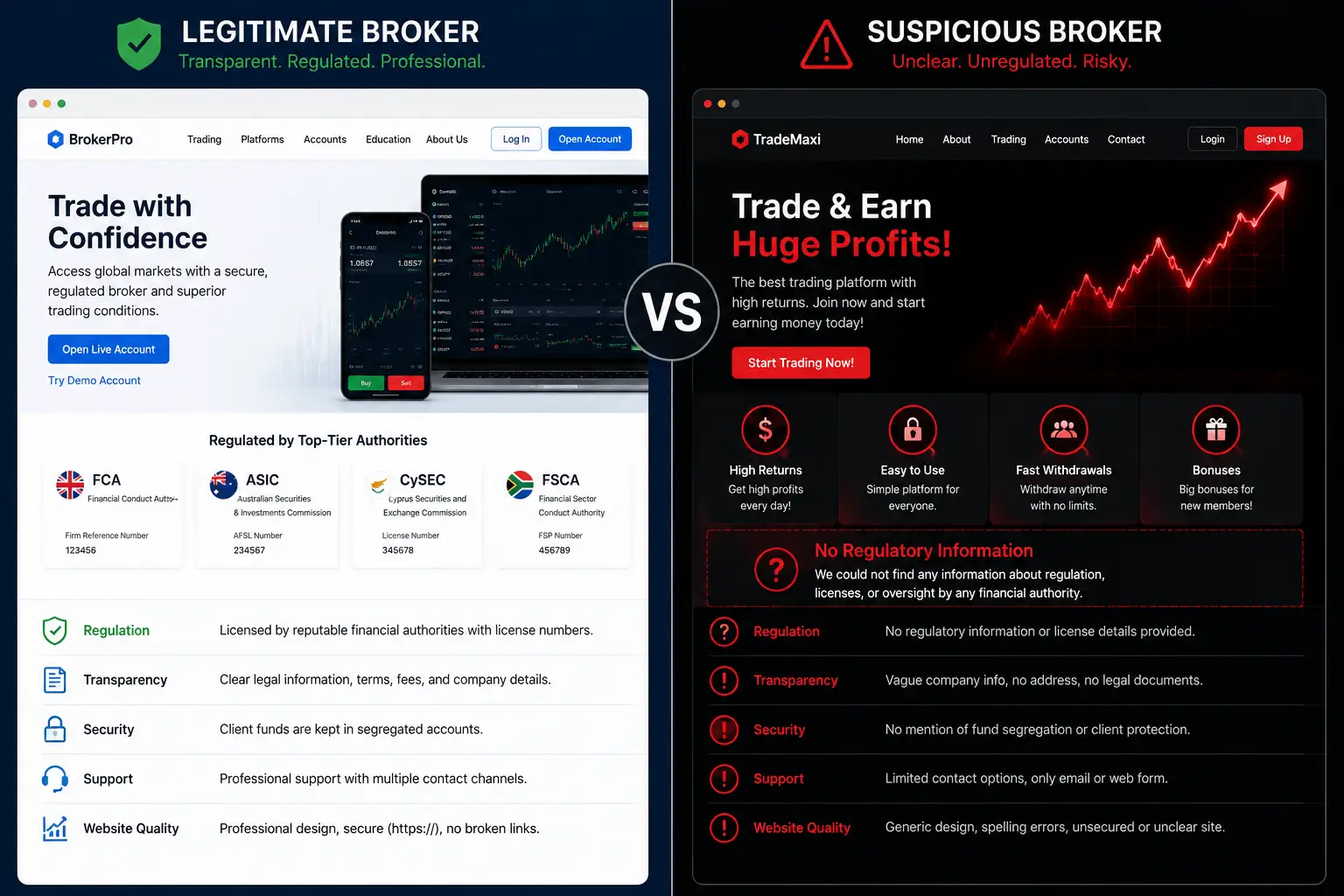
Why Forex Attracts More Scams Than Most Markets
The forex market is the largest financial market in the world by daily trading volume. That scale is a magnet for fraud.
Understanding why helps you stay appropriately alert without becoming suspicious of every broker you encounter.
The Combination of Leverage, Anonymity, and Retail Demand
Three factors make forex uniquely fertile ground for scammers.
Leverage. Forex brokers routinely offer 50:1, 100:1, or higher leverage ratios to retail clients in less-regulated jurisdictions. That means a fraudster can convince you to deposit a small amount while implying enormous profit potential.
Anonymity. A forex broker can operate from almost anywhere with a website, a payment processor, and a customer service script. Unlike a bank, there is no physical branch you can walk into. The entire relationship is digital, which substantially lowers the barrier for bad actors.
Retail demand. Millions of people try forex trading for the first time every year, many of them searching for financial independence or additional income. Scammers build entire businesses targeting that demand: running paid ads, operating fake review sites, even paying people to leave positive testimonials.
This leads to a tricky situation where legitimate, well-regulated brokers co-exist alongside outright fraudsters and a range of operators in between. Your job, before you deposit, is to know which side of that line your broker sits on. If you are still at the stage of evaluating your options, our guide to choosing a broker covers what to look for from a standing start.
Red Flag 1 – No Verifiable Regulation or a Fake License
Regulation is the single most important factor in broker selection. A broker claiming to be regulated is not the same as a broker that actually is. This is where most retail traders skip a step, and where most preventable losses happen.
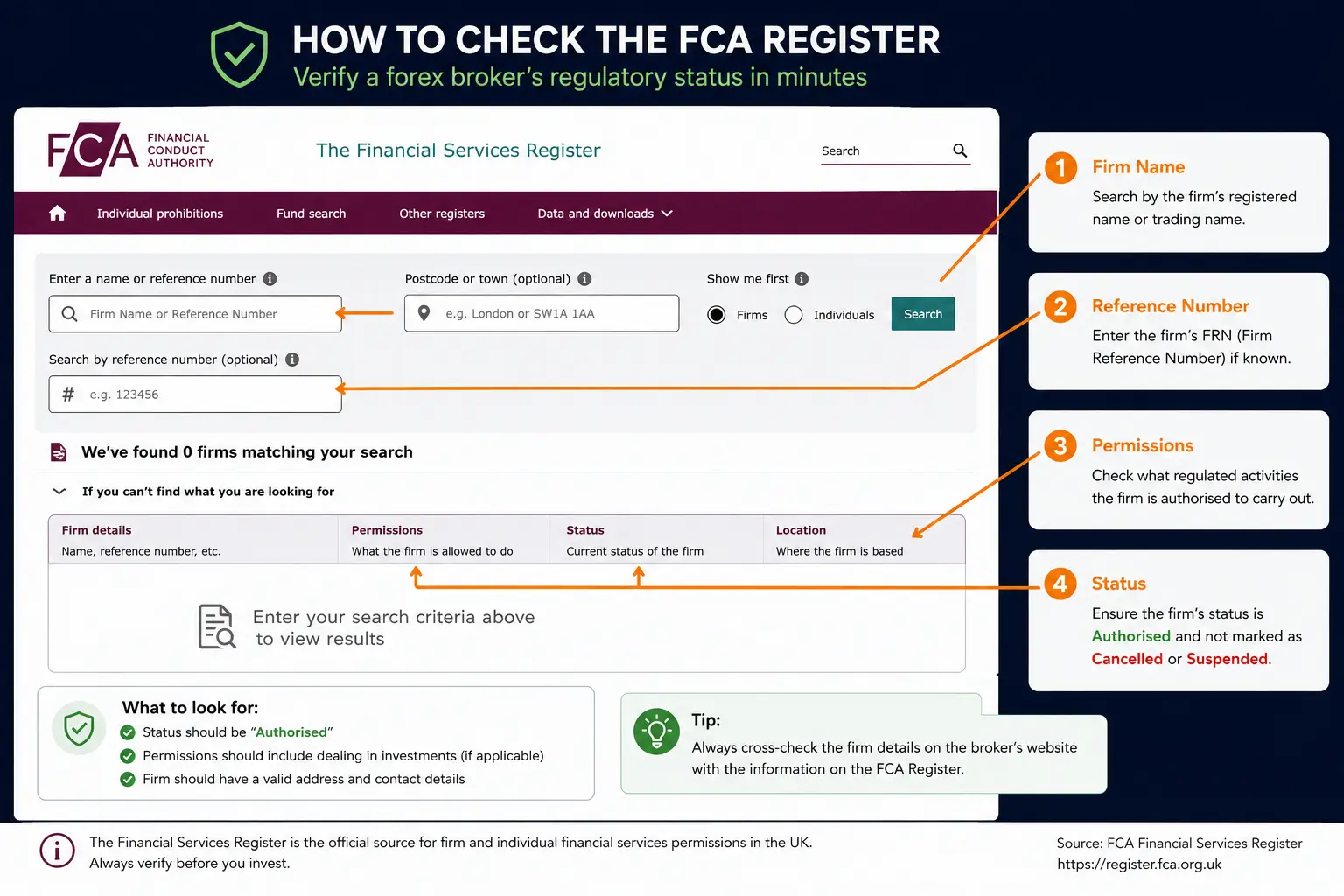
How to Check the FCA Register (and Why It Takes 60 Seconds)
The UK’s Financial Conduct Authority maintains a public register of every firm authorised to provide financial services in the UK. If a broker claims FCA regulation, an FCA register check takes less time than brewing a coffee.
Here is the process:
- Go to register.fca.org.uk
- Enter the broker’s name or their stated FCA registration number in the search bar
- Review the result: check that the firm name matches exactly, that their permissions include the relevant activity (such as dealing in investments), and that their status shows as “Authorised”
- Cross-reference the contact details shown on the register with those on the broker’s website
If the broker does not appear, appears with a different status, or the details do not match, treat that as a hard stop. A register search that returns no matching firm is not an ambiguous signal.
Other Tier-1 Regulators Worth Knowing (ASIC, CySEC, CFTC, BaFin)
The FCA is one of several regulators considered Tier-1, meaning they enforce meaningful conduct standards, capital requirements, and client protection rules. If you are not based in the UK, the equivalent check applies to the regulator covering your region or the broker’s home jurisdiction.
Key Tier-1 regulators and their public registers:
Regulator | Jurisdiction | Register URL |
FCA | United Kingdom | |
ASIC | Australia | |
CySEC | Cyprus / EU | |
CFTC / NFA | United States | |
BaFin | Germany |
Each of these registers is publicly accessible and searchable. If a broker claims authorisation under any of these bodies, you can confirm it independently in under a minute.
Offshore Jurisdictions That Offer Zero Meaningful Protection
Some brokers are registered in offshore jurisdictions such as the Seychelles, Vanuatu, Saint Vincent and the Grenadines, or the Marshall Islands. These registrations are sometimes real, in the sense that the broker has filed paperwork somewhere. They are effectively meaningless in terms of protecting you.
Offshore registration typically means:
- No minimum capital requirements
- No client money segregation rules
- No complaints process with teeth
- No compensation scheme if the broker fails
- No realistic route to recovering funds if something goes wrong
An offshore-registered broker doesn’t necessarily mean that broker is a scam. The absence of Tier-1 regulation does, however, mean you have no meaningful recourse if things go wrong.
When you are ready to start comparing your options properly, our list of regulated forex brokers filters by Tier-1 jurisdiction so you can begin from a verified starting point.
Red Flag 2 – Guaranteed Profits or Unrealistic Return Claims
Any broker, or account manager connected to a broker, who promises guaranteed returns is either lying or operating illegally. There is no middle ground here.
Forex trading involves real risk and even experienced traders take losses. The idea that a broker can guarantee a return on a leveraged speculative position is mathematically impossible and legally prohibited in every Tier-1 regulated jurisdiction.
What Legitimate Brokers Are Legally Allowed to Promise
Under FCA rules, and equivalent requirements elsewhere, regulated brokers must include risk warnings that specifically state the percentage of retail accounts that lose money.
A legitimate broker will tell you that trading carries significant risk of loss. A scam broker will tell you their proprietary algorithm generates 15% monthly returns with minimal risk.
Guaranteed profit claims, high-return promises with vague justifications, and testimonials from traders showing implausibly consistent gains are all signals to treat the whole operation with suspicion. The more emphatic the profit promise, the more sceptical you should be.
Red Flag 3 – Withdrawal Problems and Manufactured Delays
A broker’s true character only becomes visible when you try to take your money out. This is where many forex scams reveal themselves, after the deposit has been made and trust has been established.
Common Tactics Used to Prevent You Accessing Your Funds
Scam brokers have developed a consistent playbook for blocking withdrawals. Recognising these tactics in advance is your best protection:
- Bonus clause traps. You accepted a bonus at sign-up, sometimes without fully realising it, that requires you to trade a multiple of your deposit before withdrawing. The threshold is set high enough to be practically unreachable.
- Verification escalation. The broker keeps requesting additional documents beyond what is reasonable, sometimes repeatedly asking for documents already submitted.
- Manufactured account issues. Sudden claims that your account is under review, flagged for suspicious activity, or requires compliance clearance, with no clear timeline given.
- Fee demands. Requests for an upfront tax payment, withdrawal fee, or release fee before your funds can be sent. Legitimate brokers deduct fees from your balance. They do not ask you to send more money to unlock a withdrawal.
- Account manager pressure. Your assigned contact discourages withdrawal, suggests reinvesting, or claims your profits are about to increase significantly if you stay in.
If you experience any of these, stop depositing immediately and begin documenting everything.
Red Flag 4 – Pressure Sales Tactics and Unsolicited Contact
Legitimate brokers do not need to chase you. They have websites, reviews, and trading platforms that do the work. If a broker is contacting you, the question worth asking is: why?
Cold Calls, Social Media DMs, and the “Account Manager” Pattern
Unsolicited contact is one of the clearest unregulated broker red flags. Common patterns include:
- Cold calls from people claiming to represent a well-known broker, offering exclusive trading opportunities or account upgrades.
- Social media DMs, particularly on Instagram, WhatsApp, and Telegram, from people presenting as successful traders who want to share their strategy or introduce you to their broker.
- Romantic or social contact that gradually introduces investment opportunities. This approach is sometimes called pig butchering in fraud prevention circles: the social relationship is cultivated carefully before the financial pitch arrives.
- Account managers who contact you persistently after a small initial deposit, encouraging you to increase your position and move to a VIP account.
Once a personal account manager is involved, the pressure tends to escalate. Deposits are encouraged, withdrawals are discouraged, and urgency increases. That pattern is consistent across hundreds of documented fraud cases.
FCA-authorised brokers can conduct marketing, but they must do so within strict conduct rules. Unsolicited, high-pressure contact from an account manager is not standard industry practice for legitimate operators.
Red Flag 5 – Clone Firms and Copycat Websites
Clone firms are among the most sophisticated fraud methods operating in retail finance today. Rather than building a fictional broker from scratch, the scammer impersonates a real, regulated one. They copy the branding, the regulatory numbers, even the website layout. The only difference is who receives your deposit.
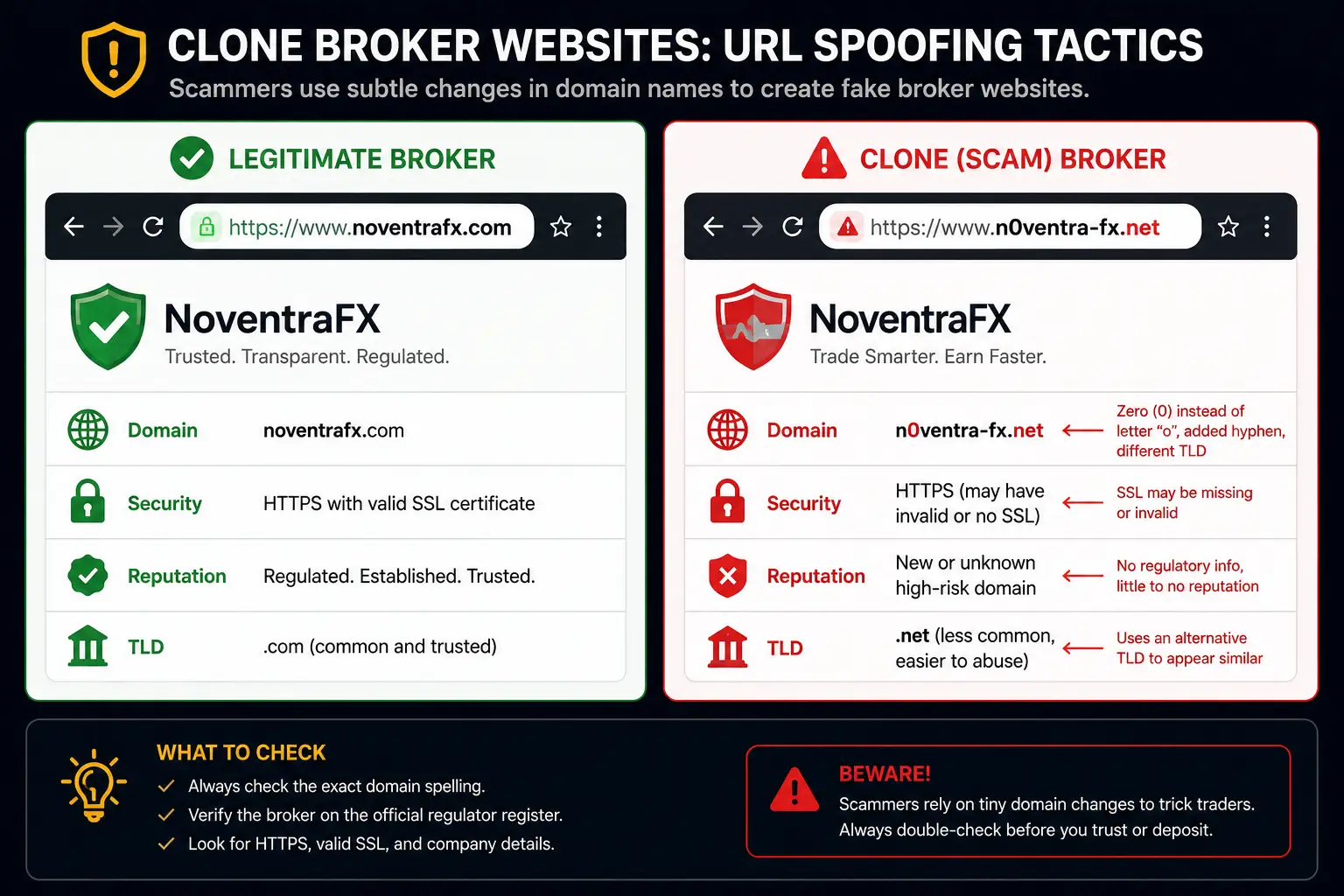
How to Verify You Are on the Real Broker’s Website
Clone firms typically operate through domains that look almost identical to the real broker’s site. Common tricks include:
- Adding or removing a hyphen: broker-name.com versus brokername.com
- Using a different top-level domain: .com replaced with .co, .net, or .trade
- Subtle character substitution: replacing an “l” with a “1” or an “o” with a zero
- Adding words like “official,” “markets,” or “group” to the domain
To verify you are dealing with the real firm:
- Go to the FCA register (or the relevant Tier-1 regulator’s register) and look up the firm
- Find the website address listed on the official register entry
- Compare that URL, character by character, with the site you are currently on
- Do not navigate to the broker’s site from a search ad; go directly from the regulator’s register
The FCA also maintains a specific warning list of known clone firm websites at fca.org.uk/consumers/warning-list-unauthorised-firms.
Red Flag 6 – No Negative Balance Protection or Segregated Funds
These two terms appear in broker documentation and regulatory materials. They describe whether your money has any protection at all.
What These Terms Mean and Why Their Absence Matters
Negative balance protection means that if a trade goes badly wrong and your account moves into negative territory, the broker absorbs that loss. You cannot owe more than you deposited. Under FCA rules, this protection is mandatory for retail clients. In jurisdictions where it is not required, losses can theoretically exceed your deposit, leaving you in debt to the broker.
Segregated client funds means your deposited money is held in a separate account from the broker’s own operational funds. If the broker becomes insolvent, your money is not part of the estate that creditors can claim. Without segregation, your deposit and the broker’s business capital sit in the same pool. If the broker fails, or simply disappears, your funds go with them.
Legitimate brokers operating under FCA, CySEC, and ASIC regulation are required to maintain both of these protections for retail accounts. Requirements vary under CFTC/NFA and other Tier-1 jurisdictions. If a broker’s terms and conditions are vague on these points, or if a customer service agent cannot clearly answer how client funds are held, that vagueness is itself a warning sign.
Sound risk management starts before you place a single trade. Understanding how your funds are held and whether your account has a negative balance floor is part of protecting yourself at the structural level.
Red Flag 7 – Vague or Missing Company Information
A legitimate financial services firm has a registered address, a company registration number, named directors in some jurisdictions, and contact details that actually work. Scam brokers often hide or fabricate this information because the details would not survive even basic scrutiny.
What a Legitimate Broker’s Website Must Display
Under FCA requirements and equivalent rules in other Tier-1 jurisdictions, a regulated broker’s website must include:
- Full legal company name, not just a trading name
- Registered company number
- Registered address: a real and verifiable physical address
- Regulatory reference number from the authorising body
- A clear risk warning stating the percentage of retail accounts that lose money
- Accessible terms and conditions written in plain language
Run a basic company search using the registration number. In the UK, that means Companies House at find-and-update.companieshouse.gov.uk. If the company does not appear, or the details on the register conflict with what the broker claims, take that seriously.
Your Pre-Deposit Verification Checklist
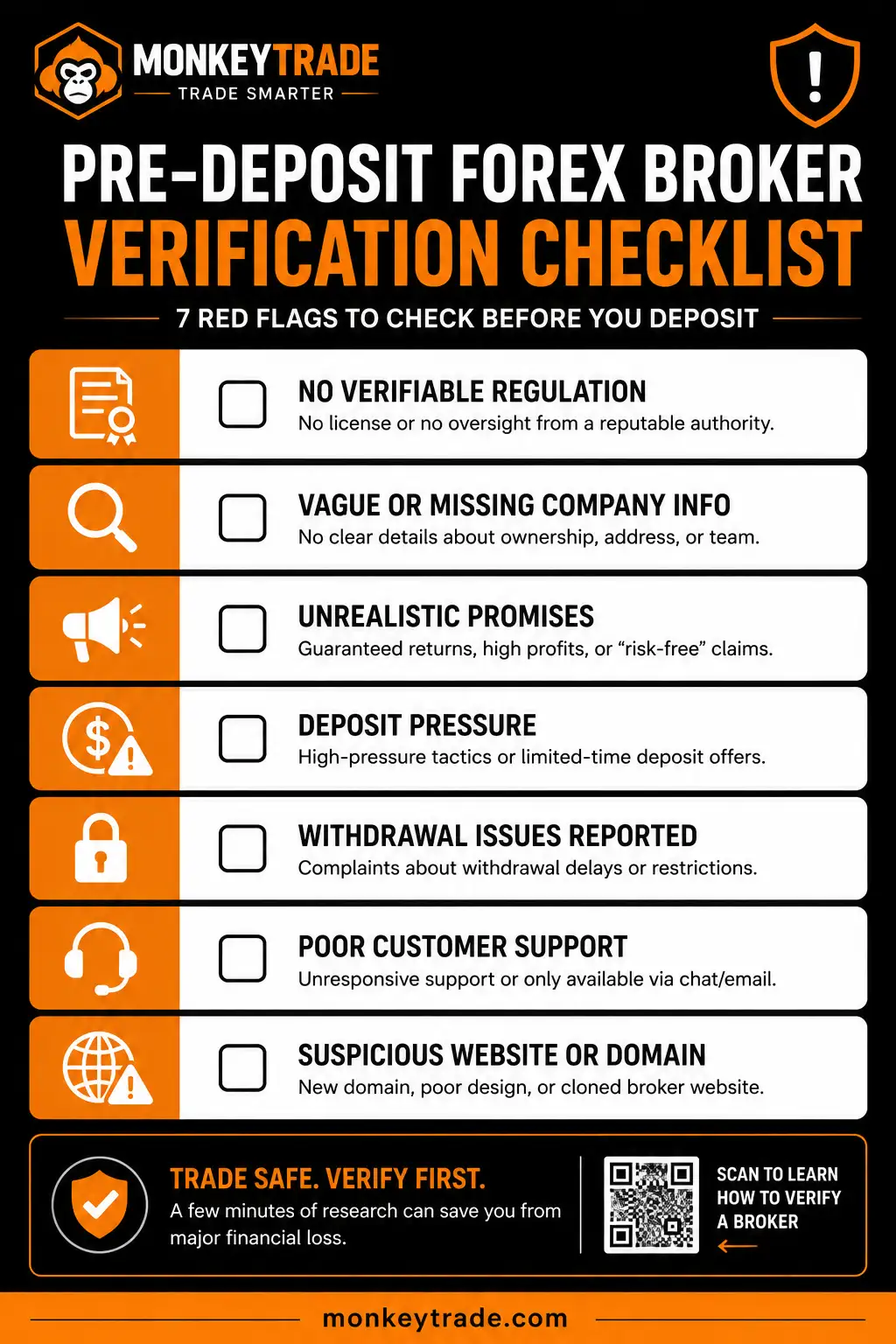
Work through every item on this list before depositing with any broker. Each check should return a clean result. A single failure is sufficient reason to stop and investigate further.
- Regulation verified independently. You searched the relevant Tier-1 register by name and registration number. You did not simply take the broker’s word for it.
- No guaranteed profit claims. The broker’s marketing includes mandatory risk warnings and makes no promises of fixed returns.
- Withdrawal process is clear. Terms and conditions specify withdrawal timelines, fees are stated upfront, and there are no unusual conditions attached to accessing your funds.
- No unsolicited contact. You found this broker through your own research, not through a cold call, a DM, or a social media introduction.
- Website URL verified against the regulator’s register. The domain you are using matches the address listed on the official register entry, character for character.
- Negative balance protection confirmed. The broker’s terms explicitly state that retail clients are protected from negative balances.
- Client funds are segregated. The broker’s terms confirm that client money is held separately from operational funds.
- Company information checks out. Registered name, number, and address are verifiable through an independent company registry.
Please bear in mind that this checklist is not a guarantee of trading success or of perfect broker conduct. Use it as a starting point.
What to Do If You Think You Have Been Scammed
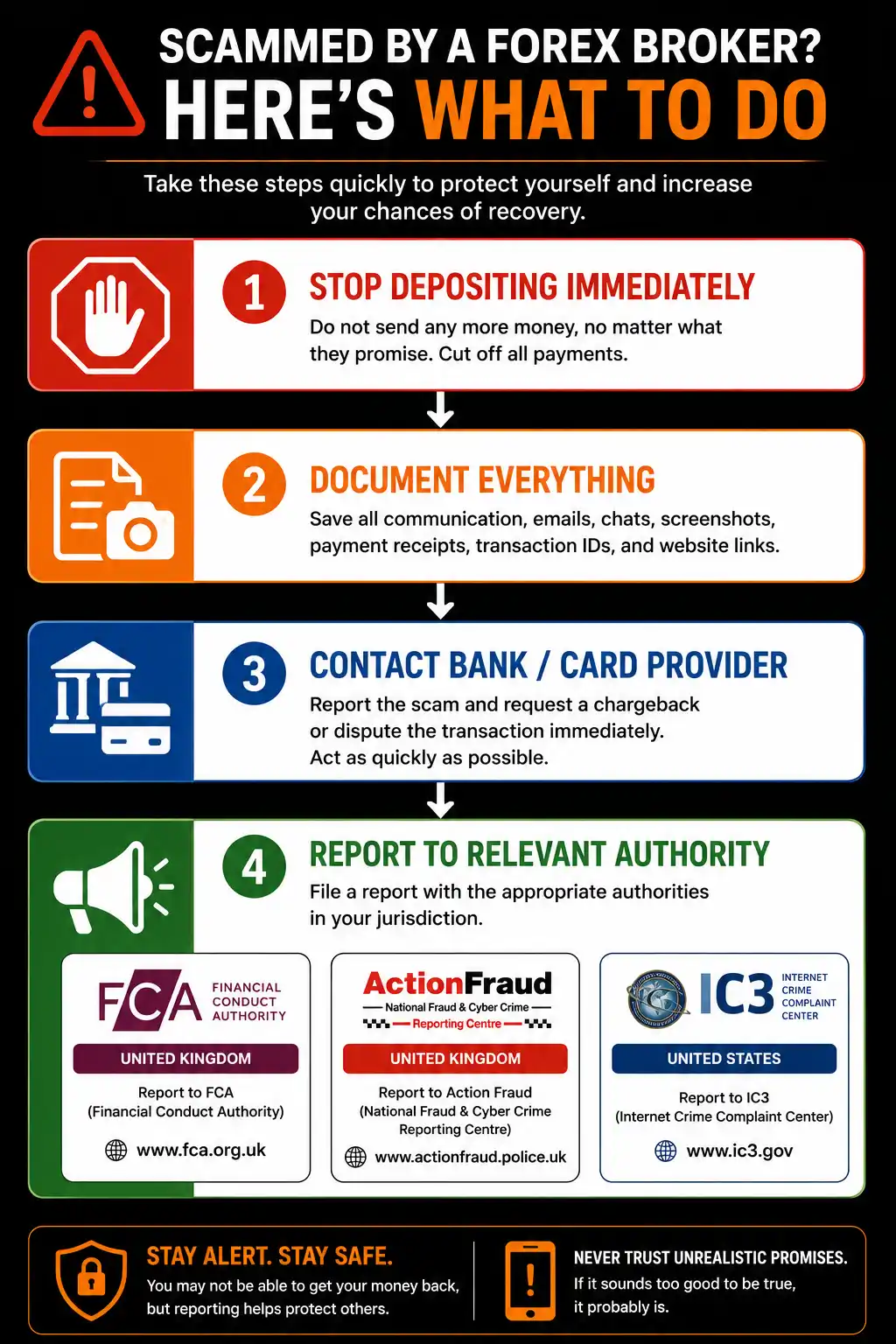
If you suspect a broker is fraudulent, act quickly and systematically, regardless of whether you have already deposited or are simply concerned.
Step 1: Stop all deposits immediately. Do not send additional funds for any reason, including claims that a fee is required to release your existing balance.
Step 2: Document everything. Save screenshots of your account, all communications, transaction records, and any promotional materials you received. Do this before the broker has any reason to restrict your account access.
Step 3: Contact your bank or payment provider. If you paid by card, request a chargeback. Do this promptly, as there are time limits. If you paid by bank transfer, contact your bank immediately and ask them to initiate a recall. Neither process guarantees recovery, but acting quickly gives you the best available chance.
Step 4: Report to the relevant authority.
Who to Report To (FCA, Report Fraud, IC3 by jurisdiction)
Your Location | Reporting Body | Contact |
United Kingdom | Report Fraud | reportfraud.police.uk |
United Kingdom | FCA | fca.org.uk/consumers/report-scam |
United States | IC3 (FBI) | ic3.gov |
United States | CFTC | cftc.gov/complaint |
Australia | ASIC | asic.gov.au/about-asic/contact-us/reporting-misconduct-to-asic/ |
European Union | Your national FCA equivalent | Varies by country |
Reporting creates an official record of your experience, which may be useful later, and helps regulators identify patterns to warn other potential victims.
Funds lost to scam brokers are difficult to recover, and many victims do not recover anything. Be alert to any company that contacts you promising to recover your funds for an upfront fee. This is a well-documented follow-up fraud that specifically targets people who have already been victimised.
Frequently Asked Questions


Comments