


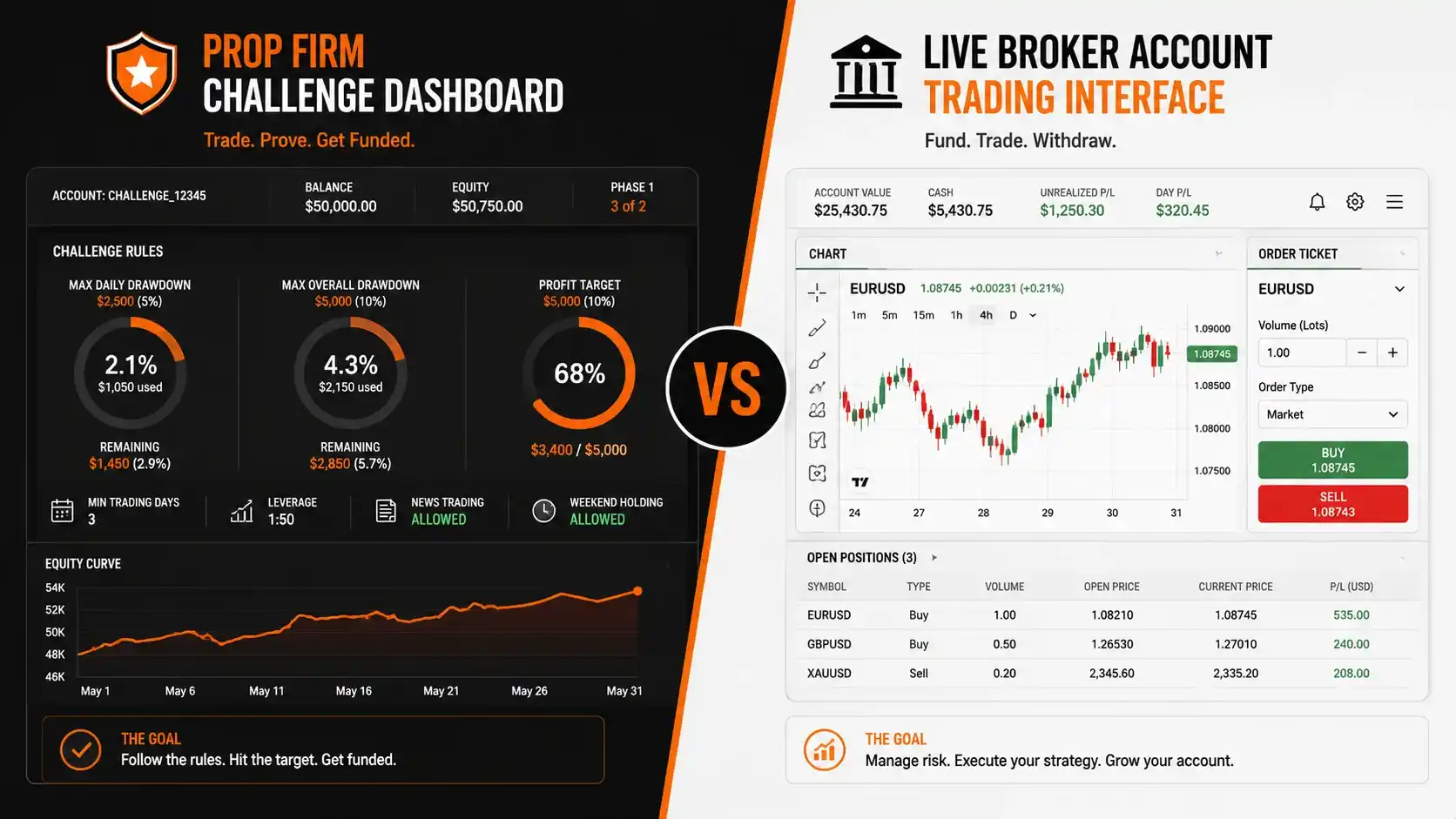
If you’re weighing a prop firm challenge against opening a live broker account, you’re comparing two structurally different models of trading. This guide breaks down exactly how they differ across capital, rules, psychology, costs, and growth so you can make a clear-eyed decision.
This article is for informational purposes only and does not constitute financial advice.
What You Are Actually Comparing
Before getting into the differences, it helps to be precise about what each model is. The phrase “prop firm vs live broker account” gets used loosely, and the confusion starts there.
How a Prop Firm Challenge Works
A prop firm challenge is an evaluation process. You pay a one-time fee to access a simulated (or occasionally live) trading environment and trade under a defined set of rules. Hit the profit target without breaching the drawdown limits or breaking any rules, and you pass. Pass, and the firm gives you access to a funded account: capital that belongs to them, not you, to trade on their behalf. Profits are split according to a pre-agreed ratio.
The challenge itself is not live trading in the traditional sense. You are proving you can manage risk inside a ruleset. The funded account that follows is where actual payouts come from.
How a Live Broker Account Works
A live broker account is straightforward: you deposit your own money, you trade, and whatever you make or lose is yours. There are no profit targets, no evaluation periods, no proprietary rules layered on top. The broker earns through spreads, commissions, or swap fees. Your account has no ceiling on how long you can hold a position, no restriction on the strategies you use (within standard regulatory limits), and no one reviewing your trade history for rule violations.
These are not the same kind of product. A prop firm challenge is an audition; a live broker account is where you trade with full autonomy and your own capital on the line.
Difference 1: Whose Capital Is at Risk
This is the most fundamental difference between the two models, and everything else flows from it.
With a live broker account, you are trading your own capital. A losing month comes directly out of your pocket. A blown account is your money, gone. That financial exposure is real and immediate.
With a prop firm challenge, the fee you pay upfront is your only direct financial exposure. Once you pass and receive a funded account, the capital you’re trading belongs to the firm. If you breach the drawdown rules and lose the funded account, the loss falls on them, not you. You lose access to the account, but you don’t lose $100,000 of personal savings.
This is the core attraction of the prop firm model for traders without significant personal capital. You get to deploy a large notional account size while your actual cash exposure stays limited to the challenge fee. The trade-off is that you’re operating under rules designed to protect the firm’s capital.
Difference 2: Drawdown Rules and How They Constrain You
Drawdown rules are the defining feature of prop firm trading. They don’t exist on live broker accounts in any enforced sense; you can draw your account down to zero if you choose. On a funded prop account, breaching a drawdown rule ends the account immediately.
Maximum Daily Drawdown
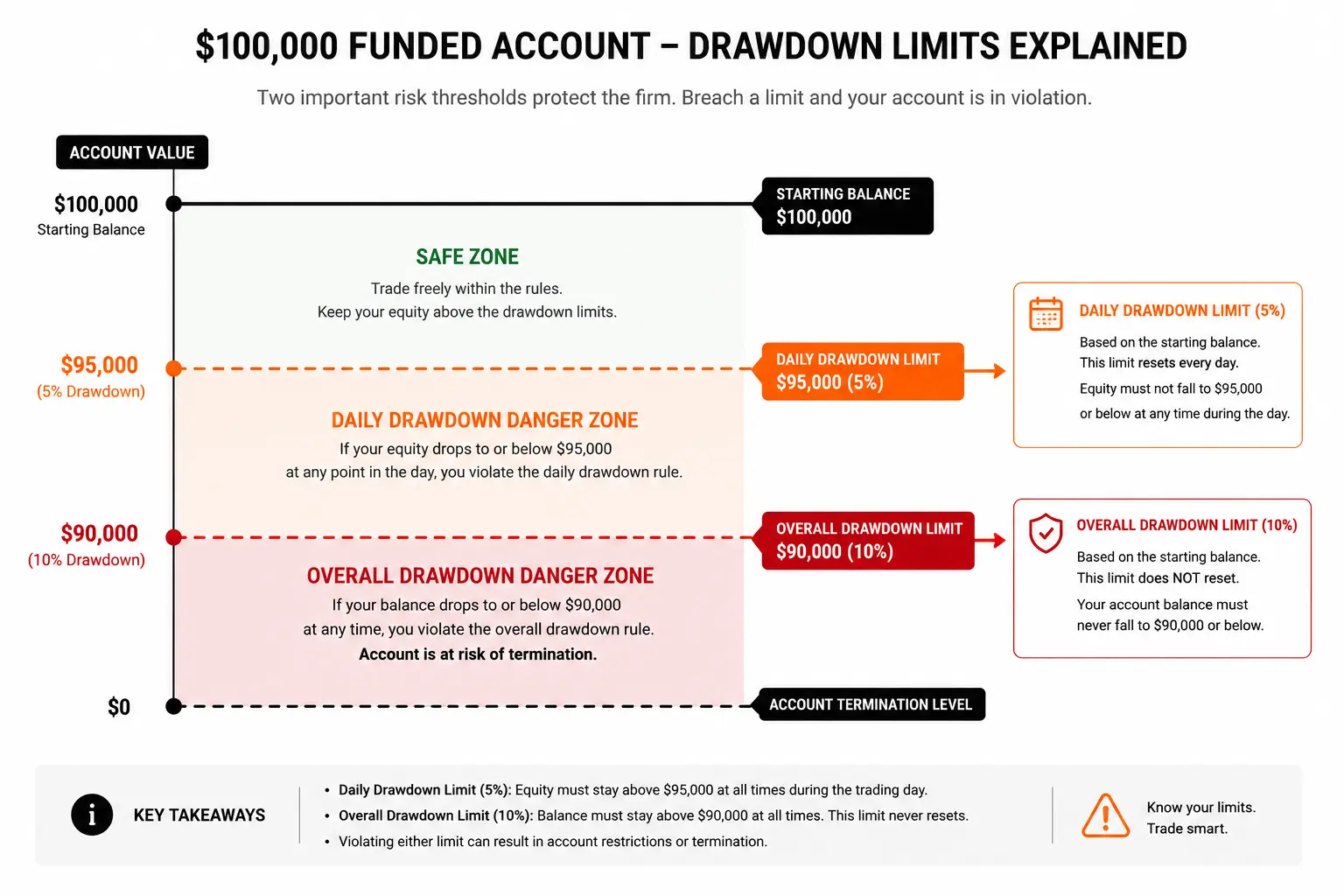
Most prop firms impose a maximum daily drawdown: a cap on how much you can lose in a single trading day before the account is closed. On a $100,000 account, a 5% daily drawdown limit means you cannot lose more than $5,000 in one day. Hit that number, and the account is terminated regardless of your overall balance or how close you are to a payout.
This is a hard stop. It doesn’t matter if you were up $4,000 earlier that morning.
Maximum Overall Drawdown
The overall (or maximum) drawdown is the total loss the firm will tolerate across the life of the account. A 10% overall drawdown on a $100,000 account means if your account ever falls to $90,000, whether in one day or across weeks, it’s over.
On a live broker account, you set your own risk tolerance. You can recover from a 20% drawdown, adjust your strategy, and keep trading. No external party is watching a threshold.
How Drawdown Is Calculated: Balance vs Equity-Based
This detail trips up more traders than any other rule, so pay close attention.
Balance-based drawdown calculates your limit from your starting or end-of-day balance, ignoring open positions. Equity-based drawdown counts your current balance including any open floating losses. If you have a $100,000 account with a 5% equity-based daily drawdown limit and you’re currently holding a trade that’s down $5,000, you’ve already hit your limit, even though none of that loss has been realised yet.
Equity-based drawdown rules are stricter. Some firms use balance-based rules during the challenge phase and equity-based rules on the funded account, or vice versa. Always read the specific firm’s rulebook.
Difference 3: Profit Targets and Performance Requirements
A prop firm challenge requires you to reach a specific profit target to pass. A common structure is an 8% profit target on Phase 1 and a 5% target on Phase 2, with both phases subject to drawdown limits throughout. You need to hit the number, stay within the rules, and do it within the time limit (covered in Difference 5).
On a live broker account, there are no profit targets. You trade as much or as little as you like. A month where you break even is perfectly fine. A conservative trader can run a low-volatility, low-frequency strategy for years without any external performance pressure.
Profit targets on challenges create a specific behavioural risk: the closer you get to the target, the more tempting it becomes to push harder. That pressure is artificial. It doesn’t exist in live trading, and experienced traders know to manage it consciously.
Difference 4: Trading Rules and Restrictions
This is where prop firm trading diverges most visibly from live broker trading in day-to-day practice.
Restricted Strategies: News Trading, Overnight Holds, and Hedging
Many prop firms restrict or ban specific trading approaches:
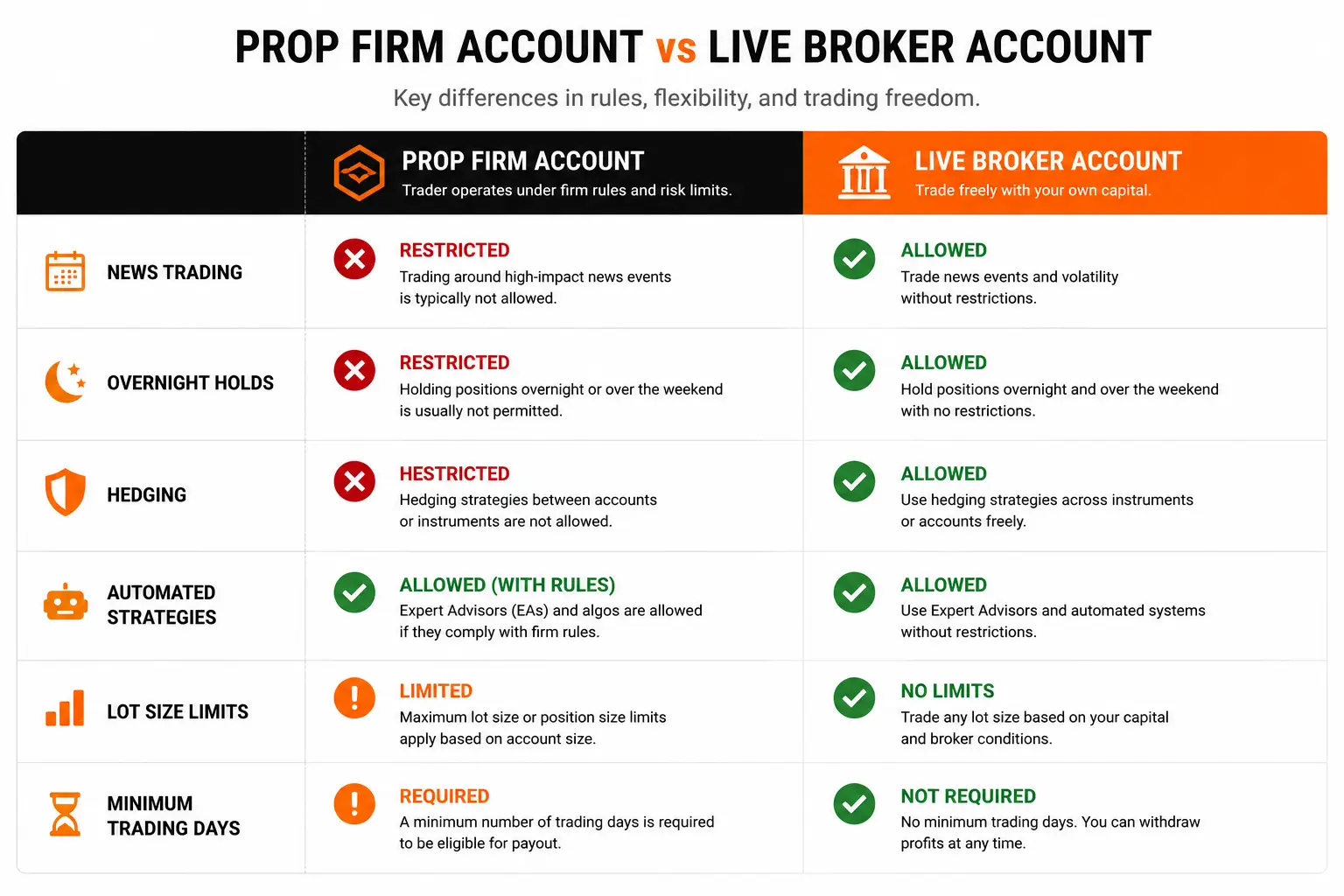
- News trading: Some firms prohibit opening or holding positions within a window around major economic releases, typically two minutes before and after. Live broker accounts have no such restriction.
- Overnight holds: Certain firms don’t allow positions to be held past the market close or over the weekend. This eliminates swing trading as a viable strategy on those accounts.
- Hedging: Some firms ban simultaneous long and short positions on the same instrument within the same account, or across multiple accounts with the same firm.
- Copying and EAs: Rules on automated strategies, signal copying, and expert advisors vary widely. Some firms permit EAs; others ban them outright or require prior approval.
On a live broker account, none of these restrictions exist in any standardised form. You can trade the Non-Farm Payrolls release, hold positions through the weekend, and run whatever automation you want.
Lot Size Limits and Position Restrictions
Prop firms typically set maximum lot sizes or position limits relative to account size. Stacking large positions to chase fast gains can breach these limits even if the trade itself is profitable. Live broker accounts limit your position size only by your available margin.
Minimum Trading Day Requirements
Some firms require you to trade on a minimum number of days during the evaluation period, commonly five to ten trading days. This prevents traders from getting lucky on one or two high-conviction trades and passing without demonstrating consistency. There is no equivalent requirement on a live broker account.
Difference 5: Time Pressure and Evaluation Deadlines
Most prop firm challenges come with a maximum time limit, often 30 days for each phase, though some firms offer unlimited-time models. You need to hit the profit target before the clock runs out, while staying within all the rules.
That time pressure changes how you trade. A naturally patient, selective trader may find themselves taking setups they wouldn’t otherwise take simply to make progress toward the target before the deadline.
Live broker accounts have no deadline. You can sit in cash for a week, reduce position sizes when conditions are poor, and increase activity when your edge is clear. That flexibility has real value, particularly for traders whose edge depends on selectivity.
Difference 6: Profit Ownership and Payout Structure
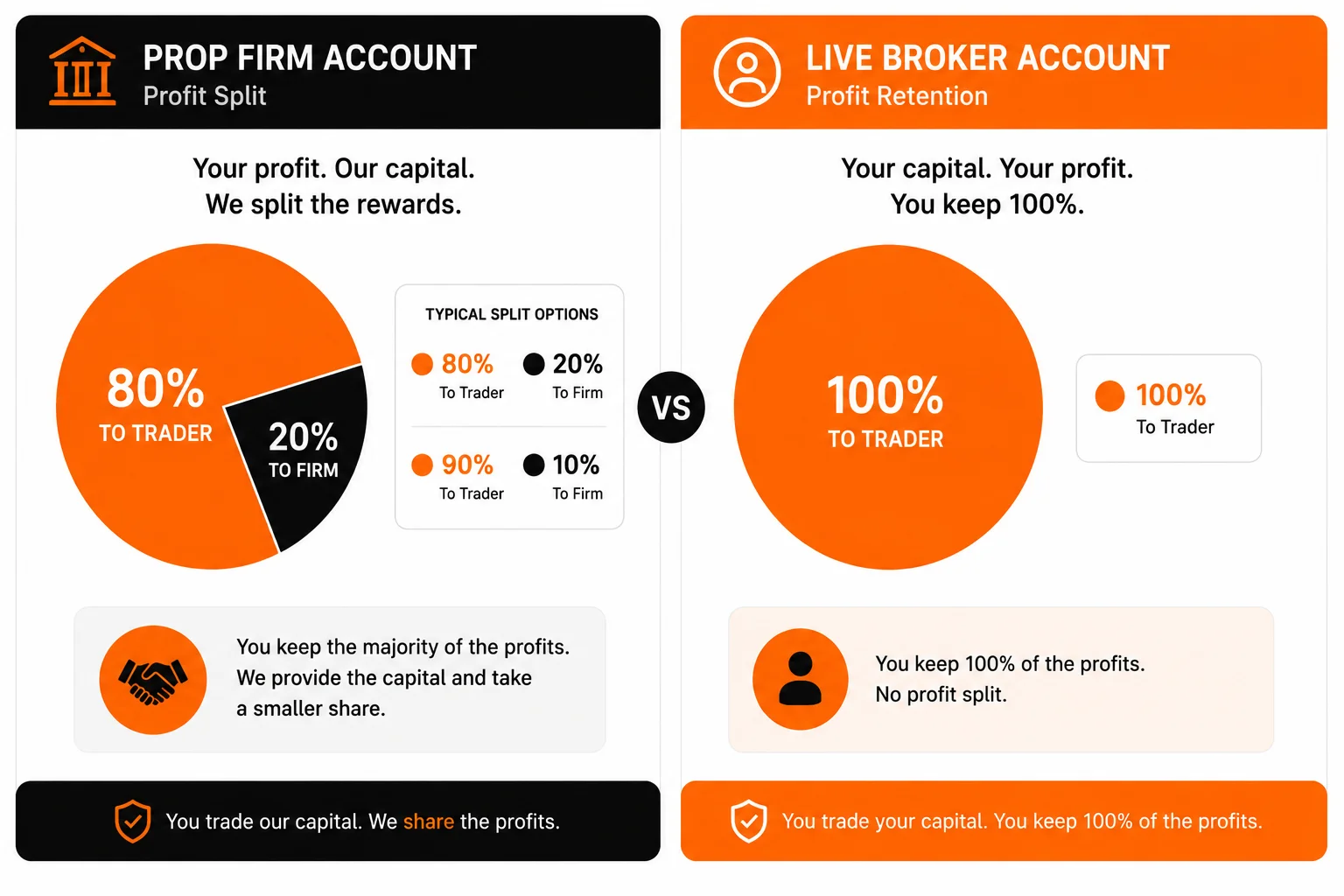
On a live broker account, every dollar of profit belongs to you.
On a funded prop account, profits are split. Most firms currently offer splits in the range of 80/20 to 90/10 in the trader’s favour, meaning you keep 80 or 90 percent of what you make. That is a meaningful share, but it is not the same as owning 100 percent.
Payouts are also subject to conditions. Firms typically require a minimum profit balance before a withdrawal is processed, and many pay on a monthly or bi-monthly cycle. Some firms impose a minimum number of trading days per cycle. On a live broker account, you withdraw when you want, subject only to the broker’s standard processing times.
The payout percentage is the cost of accessing the firm’s capital. Whether that trade-off works in your favour depends on your personal capital position and what you could realistically return trading your own money.
Difference 7: Psychological Environment
The rules on a prop firm account change how trading feels, and not always in the ways you might expect.
Trading under drawdown limits and profit targets with real consequences creates a distinctive form of performance pressure. For some traders, that structure is clarifying: the rules enforce discipline that might otherwise slip. For others, the monitoring and constraint create anxiety that degrades decision-making.
On a live broker account, the psychological pressure comes entirely from market outcomes and personal risk tolerance. There’s no external ruleset to violate, no account termination hanging over a drawdown day, and no profit target creating urgency. The discipline, or lack of it, is entirely self-imposed.
Neither environment is inherently easier. Plenty of traders who manage live accounts responsibly struggle under prop firm rules, and the reverse is equally true. Your psychology is part of the decision.
Difference 8: Cost to Participate vs Cost to Trade
These two models have completely different cost structures.
Prop firm challenge fees:
- One-time fee to enter the challenge, typically ranging from roughly $50 for small accounts to several hundred dollars for six-figure account sizes
- Fee is usually charged per attempt; fail and retake, and you pay again
- Some firms offer free retakes or discounts, but multiple failed attempts add up to real money
- Once funded, ongoing costs are typically minimal, as the firm earns through the profit split
Live broker account costs:
- No upfront entry fee
- Spreads and commissions on every trade
- Overnight swap fees on held positions
- These costs are continuous and scale with trading frequency and volume
The challenge fee is a defined, one-time cost. Broker costs are ongoing and variable. High-frequency traders on live accounts can pay significant sums in commissions over time. Low-frequency traders on prop firm challenges pay the challenge fee and relatively little thereafter.
Repeated challenge failures are the real cost trap in the prop firm model. If you’re consistently failing challenges and retaking them, the fees accumulate quickly, and those are real losses, not theoretical ones.
Difference 9: Scaling, Growth, and Account Ceilings
On a live broker account, your account grows as your profits accumulate.
Prop firms operate differently. Most have structured scaling plans: perform consistently over a set period, hit certain milestones, and the firm increases your account size. A trader might start at $25,000, scale to $50,000, then $100,000 as they demonstrate consistent risk management. Some firms cap funded accounts at a maximum, commonly between $200,000 and $400,000 per trader, though this varies.
The scaling plan is appealing if you’re working with limited personal capital. Access to larger capital faster than you could accumulate it independently is a genuine advantage.
Difference 10: Who Each Model Is Built For
These two structures suit different trader profiles. Neither is objectively superior; the better fit depends on where you are and what you need.

Prop firm challenges tend to suit traders who:
- Have a proven, rules-compatible strategy but limited personal capital
- Can operate comfortably within defined drawdown and rule constraints
- Are prepared to treat the challenge fee as a cost of doing business
- Want access to larger notional account sizes without depositing personal funds at scale
- Thrive with external structure and defined performance benchmarks
Live broker accounts tend to suit traders who:
- Have sufficient personal capital to trade at a meaningful size
- Use strategies that are restricted or incompatible with standard prop firm rules (news trading, overnight holds, automated systems)
- Prefer full profit ownership and withdrawal flexibility
- Need the freedom to adapt strategy without rule constraints
- Have a longer-term, lower-frequency approach that doesn’t fit evaluation timelines
Some traders run both simultaneously: a live account for strategies that don’t fit prop firm rules, and a funded account for strategies that do. That’s a legitimate approach, provided you’re clear about the separation and managing both responsibly.
Frequently Asked Questions


Comments