


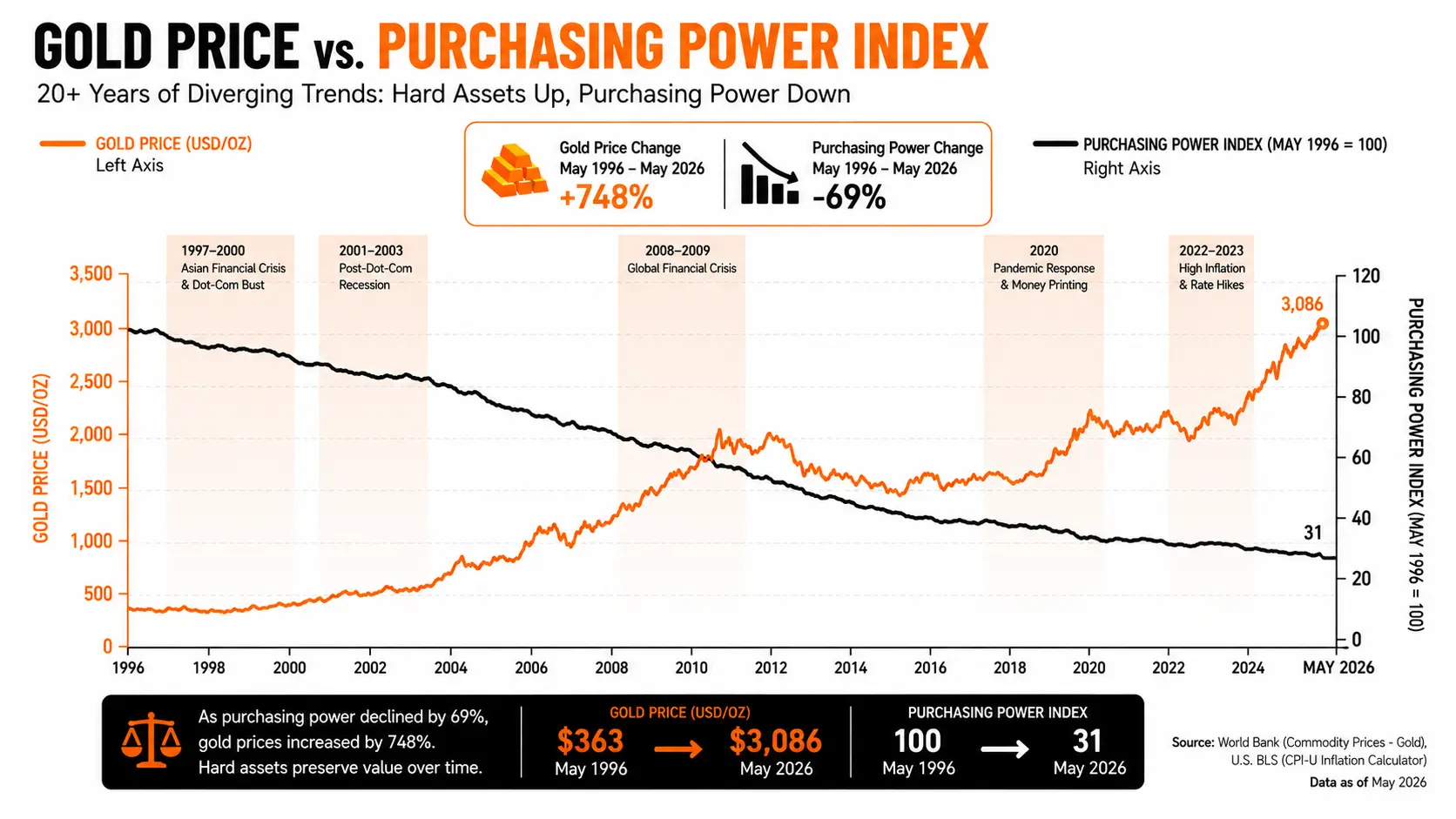
If you have ever watched gold move sharply and realised you were either too late or positioned wrong, this is the framework you need: a prioritised set of triggers with the reasoning behind each one, so you know when to buy gold based on evidence rather than instinct.
Understanding when to buy gold is genuinely harder than most people expect. Gold does not move the way equities do. You cannot check earnings or read a press release. The signals are macroeconomic, structural, and sometimes counterintuitive, which is exactly why getting them right gives you an edge over traders who are simply chasing price.
This article identifies the specific conditions that historically precede and sustain gold price rallies. For broader context on the asset class itself, see our gold and commodities overview.
Why Timing a Gold Buy Is Harder Than It Looks
Most traders know gold is a safe-haven asset. Far fewer know what that actually means when it comes to pulling the trigger on a trade.
The Difference Between Gold Being Valuable and Gold Being a Trade
Gold has intrinsic appeal. It is finite, globally recognised, and has a long history as a store of value. None of that tells you when to buy it.
The distinction that matters for traders is between gold being fundamentally valuable, which it usually is, and gold being positioned for a price move, which is only true under specific conditions.
The triggers below define those conditions. Each one represents a shift in the macro environment that historically increases demand for gold relative to the alternatives: dollar-denominated assets, equities, or cash.
The aim here is to move you from reacting to gold price moves to anticipating the conditions that produce them.
Moment 1: Real Interest Rates Turn Negative or Fall Sharply
If you only understand one trigger on this list, make it this one. Real interest rates are the single most reliable macro driver of gold price movements, and most traders either do not know they exist or confuse them with nominal rates.
What Real Rates Are and Why Gold Responds to Them
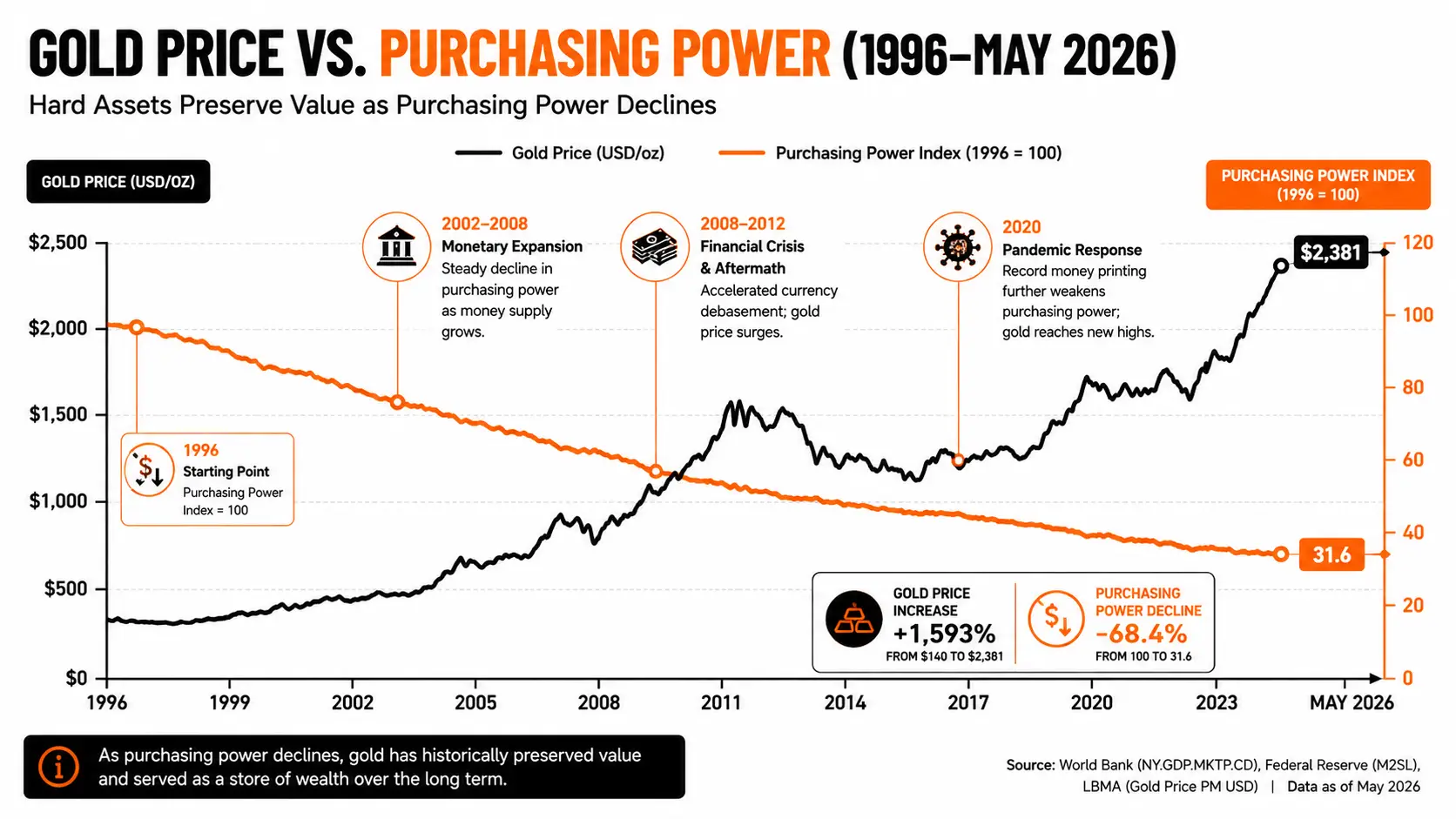
Real interest rates are nominal interest rates minus inflation expectations. In the US, they are typically tracked using TIPS (Treasury Inflation-Protected Securities) yields, which reflect what investors actually earn after adjusting for expected inflation.
When real rates are positive, holding cash or bonds pays you something in real terms. Gold, which pays no yield at all, becomes comparatively less attractive. When real rates fall, especially into negative territory, the opportunity cost of holding gold drops toward zero. At that point, gold competes on level terms with yielding assets, and often wins.
This is why gold often surges during periods when central banks cut rates aggressively or when inflation expectations run ahead of nominal yields. The XAU/USD chart has historically shown a tight inverse relationship with TIPS yields: when real yields fall, gold tends to rise, and vice versa.
Watch the 10-year TIPS yield as your primary indicator. A sustained move deeper into negative territory, or a sharp decline from a positive level, is one of the clearest early signals that gold price rally triggers are developing.
The dollar relationship compounds this dynamic, and it is the next trigger to understand.
Moment 2: The US Dollar Shows Sustained Weakness
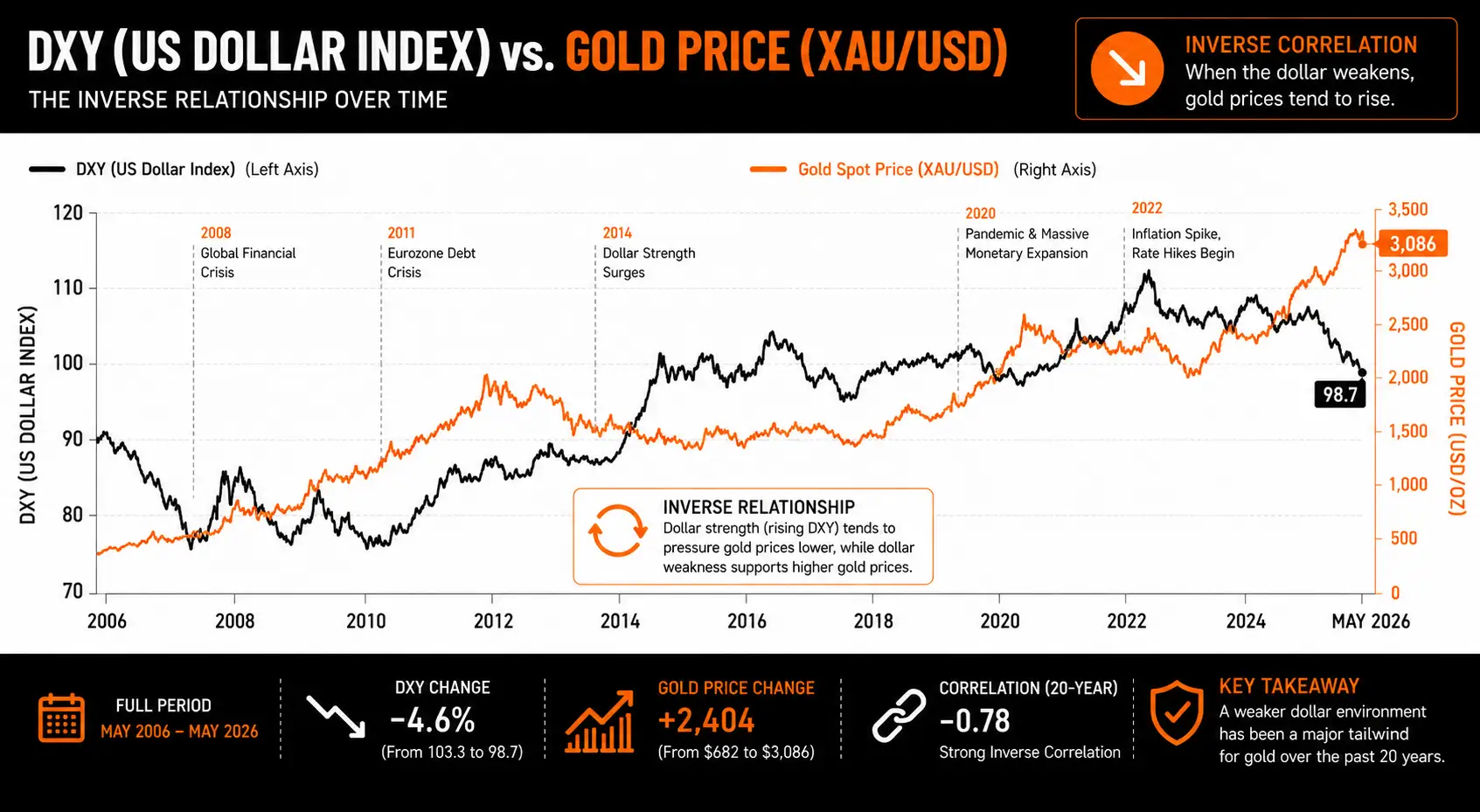
Gold is priced in US dollars globally. When the dollar weakens, gold becomes cheaper for buyers holding other currencies, which increases demand and pushes the price up. This is the mechanical foundation of the dollar weakness gold relationship, and it holds more consistently than almost any other correlation in commodities markets.
The Inverse Relationship and When It Holds
The DXY (US Dollar Index) measures the dollar against a basket of major currencies including the euro, yen, and pound. A falling DXY is a structural tailwind for gold. A rising DXY tends to suppress gold prices even when other bullish conditions exist.
The relationship holds most reliably when dollar weakness is driven by:
- Federal Reserve dovishness or rate cut cycles
- Declining US real yields (which connects back to Moment 1)
- Loss of confidence in US fiscal policy or growing debt concerns
- Capital flows rotating from US assets toward emerging markets
The relationship breaks down during acute risk-off events: moments of sudden global fear where the dollar and gold rally simultaneously because both are treated as safety assets. These periods exist but tend to be short-lived. For sustained bullish setups, you want dollar weakness that reflects structural conditions, not a single day’s panic.
When the DXY starts trending lower over weeks rather than bouncing intraday, and that weakness is driven by fundamentals rather than a one-off shock, treat it as confirmation that the macro environment is tilting toward gold.
Inflation expectations often accompany dollar weakness, and that is the next trigger worth watching closely.
Moment 3: Inflation Expectations Rise Ahead of Official Data
Reported CPI figures are backward-looking by nature. By the time official inflation data confirms what traders already suspected, the gold move has often already happened. The useful signal is what markets expect inflation to be in the future, not what it was last month.
Leading Indicators to Watch Before CPI Prints
The most widely used market-based measure is the breakeven inflation rate, derived from the spread between nominal Treasury yields and TIPS yields of the same maturity. When this spread widens, bond markets are pricing in higher future inflation. Gold, widely considered among inflation hedge assets, tends to respond to this expectation shift before the official data arrives.
Indicators to monitor ahead of CPI prints:
- 5-year and 10-year breakeven inflation rates: available via the Federal Reserve’s FRED database and most major financial data platforms
- University of Michigan Consumer Sentiment survey: includes 1-year and 5-year inflation expectations from households
- PPI (Producer Price Index): leads CPI by roughly one to two months, as input costs work their way through supply chains
- Commodity price indices: broad commodity strength often precedes consumer inflation
The trigger here is the expectation of rising inflation building in the market before official data confirms it. When breakeven rates are rising and PPI is already elevated, gold is often positioned to move before most traders are paying attention.
Moment 4: Geopolitical Risk Escalates Materially
Gold benefits from uncertainty, that much is well understood. The harder question is which geopolitical events actually move the market and which ones generate headlines but fizzle within 48 hours.
How to Distinguish Market-Moving Events from Noise
The geopolitical events that produce a sustained gold rally tend to share a few characteristics:
- They affect global energy or supply chains directly
- They involve major economies or nuclear powers
- They create genuine uncertainty about the policy response, rather than a predictable political statement
- They persist for weeks or months rather than resolving quickly
Localised conflicts that do not threaten global trade, diplomatic disputes that de-escalate within days, and political noise without economic consequence rarely produce durable gold price moves. The initial spike might look significant, but if the underlying risk resolves fast, the price typically retreats just as quickly.
What you are looking for is escalation that changes the probability distribution of future outcomes: events where the range of possible scenarios widens meaningfully. That is when capital moves defensively into gold and stays there.
The practical check: if the risk is still driving news coverage and policy debate after two weeks, it is likely material. If markets have already moved on, the safe-haven flow into gold was probably temporary.
Moment 5: Central Banks Increase Gold Reserve Purchases
This is the most overlooked trigger on this list. Central bank gold buying does not move the market overnight, but it represents a structural shift in demand that creates a sustained price floor, and it tends to accelerate in conditions where other bullish triggers are also present.
Why Institutional Accumulation Is a Structural Bullish Signal
Central banks hold gold as part of their foreign exchange reserves. When they increase those holdings, they are signalling where they see value relative to holding US dollars or other fiat currencies. In recent years, central banks, particularly from emerging markets, have been buying gold at a pace not seen in decades.
This matters for a few reasons:
- Central banks are large, price-insensitive buyers. They do not sell because the price dips.
- Accumulation over time reduces available supply in the market, which supports prices structurally.
- When multiple central banks buy simultaneously, it signals a shift in the global monetary system’s relationship with the dollar, which is itself a bullish condition for gold.
World Gold Council data tracks central bank demand on a quarterly basis and is publicly available. When official sector purchases are running well above historical averages, the underlying bid for gold is stronger than spot price action alone suggests. For retail traders, this is a signal to pay attention to the medium-term setup even when the immediate price is not moving dramatically.
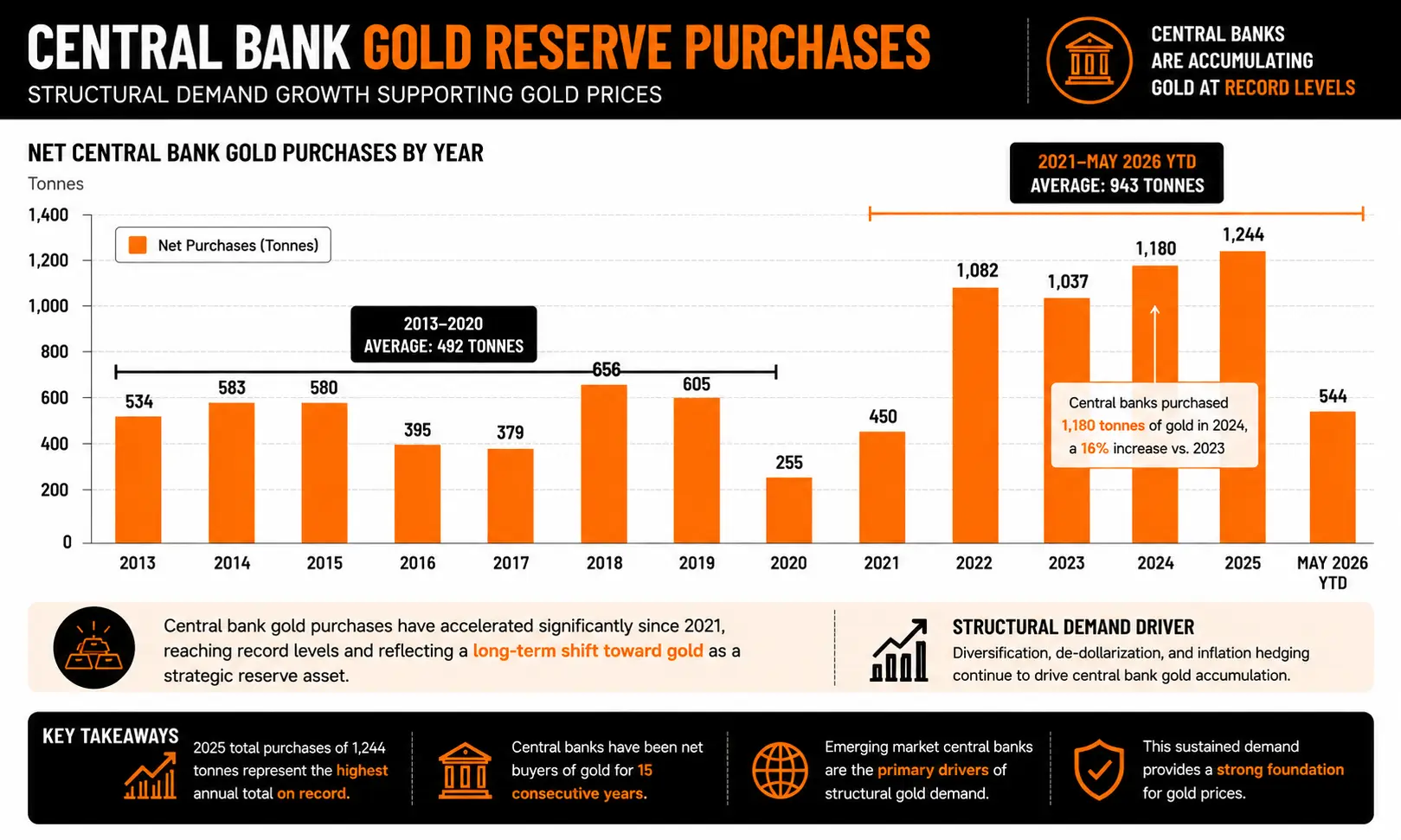
Central banks accumulating gold is a sign of structural repositioning. When equity markets start showing stress at the same time, the bullish case for gold becomes harder to ignore.
Moment 6: Equity Markets Show Stress or Correlation Breakdown
Gold has a complicated relationship with equities. In normal conditions, it tends to move independently. In stressed conditions, it often moves inversely. The most interesting setup, and one of the strongest signals for gold, occurs when the traditional relationship between stocks and bonds breaks down entirely.
Gold’s Role When the Stock-Bond Relationship Fails
In a standard portfolio, bonds are supposed to offset equity risk. When stocks fall, bond prices typically rise as investors seek safety and yields drop. This negative correlation is what makes a classic 60/40 portfolio function as a risk management tool.
When that relationship fails, when stocks and bonds fall together or correlations shift in ways that leave traditional hedges ineffective, investors need a different kind of protection. Gold historically fills that role. It is an asset with no counterparty risk, no earnings expectations to disappoint, and no central bank policy dependency in the way that bonds have.
Watch for:
- High-yield credit spreads widening sharply (signals credit stress)
- VIX sustained above 25 to 30 for multiple weeks, rather than a one-day spike
- Stocks and bonds declining in tandem (correlation breakdown)
- Bank sector stress or financial system concerns making sustained headlines
When equity market volatility is persistent rather than a single sharp correction, and when traditional portfolio diversifiers are not working, the demand for gold as a genuine uncorrelated asset tends to increase substantially.
Now that you understand the fundamental triggers, there is one more layer to apply before acting on any of them.
Moment 7: Technical Structure Confirms the Macro Case
Every macro trigger on this list can be present and gold can still fail to move if the technical structure does not support it. Technicals do not override fundamentals. They tell you whether the market has already priced in what you are seeing, or whether the setup is still developing.
Key Chart Levels, Breakouts, and Confirmation Signals to Use Alongside Fundamentals
Technical analysis in gold trading plays a confirmatory role, not a predictive one. Once your macro case is built, you use the chart to find the entry.
Key signals to watch on XAU/USD:
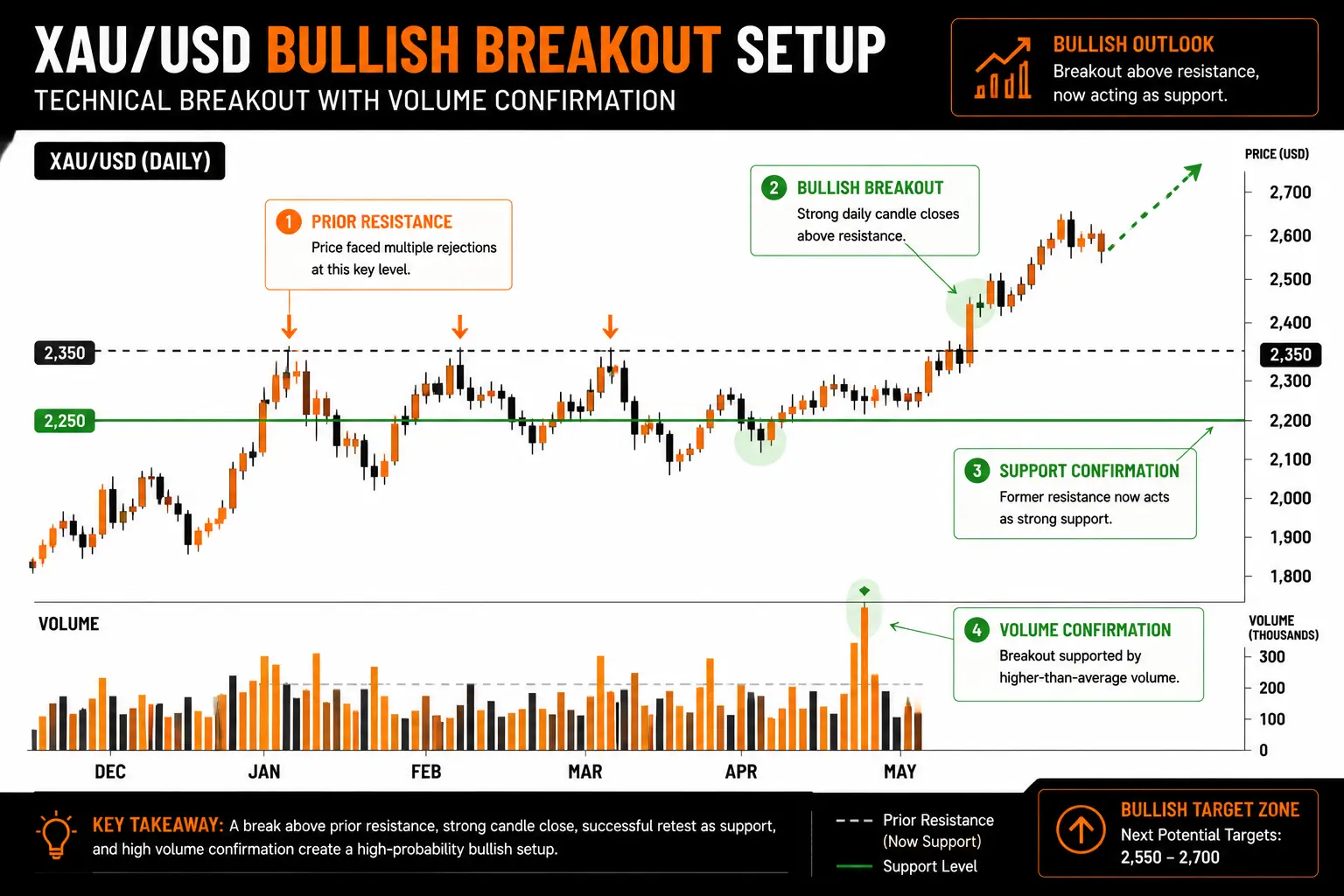
- Prior resistance becoming support: a level that capped the price multiple times becomes a floor after a breakout, indicating real buying pressure rather than speculation
- Clean breakout above a multi-week or multi-month consolidation range: the longer the consolidation, the more significant the eventual move
- Volume confirmation: in futures and ETF-tracked markets, a breakout accompanied by above-average volume is more credible than one on thin participation
- Moving average alignment: when short-term MAs cross above longer-term MAs (a golden cross on daily or weekly charts) in alignment with a macro setup, it confirms momentum is building
- Higher highs and higher lows: the simplest structure confirmation, with gold making a series of ascending peaks and troughs rather than just bouncing
What you want to avoid is entering a macro-justified gold position at the top of a short-term technical spike. A strong macro case that aligns with a technically sound entry, such as a breakout from consolidation with volume confirming and support holding, gives you both the rationale and the timing.
Seven triggers, each with its own logic. Acting on just one of them is rarely enough.
How to Use These Triggers Together
A single trigger is a reason to pay attention. Multiple triggers aligning is a reason to position.
This is arguably the most important section in the article, because the most common mistake in gold trading is acting on one signal while ignoring the broader context. Real yields dipping briefly while inflation expectations stay flat, the dollar holds steady, and equities show no stress is a thin basis for a position. A setup where real yields are falling alongside rising inflation expectations, a weakening DXY, and building equity market stress carries meaningfully more weight and deserves serious attention.
Think of the triggers as a checklist that builds a probability assessment. The more triggers that are active and moving in the same direction, the stronger the fundamental case for gold.
A useful practical approach:
- Start with real rates and dollar direction. These are the structural foundations.
- Add inflation expectations as confirmation of the macro environment.
- Check whether geopolitical or equity stress is creating demand flow.
- Consider whether central banks are quietly accumulating. This is a slow-moving but powerful signal.
- Apply technical structure last, to define your entry rather than your thesis.
One active trigger with no supporting evidence is a yellow light. Three or more converging is when the setup becomes compelling. What you do with that is where the practical side of trading takes over.
Practical Considerations for Trading Gold on These Signals
CFDs, Leverage, and Position Sizing in Volatile Conditions
For active traders, gold CFD trading is the most direct way to express a view on price direction without owning the underlying asset. CFDs allow you to go long or short on XAU/USD with leverage, which makes them useful in volatile, signal-driven conditions, and genuinely dangerous if position sizing is wrong.
For a detailed breakdown of how CFD mechanics work, see our article on CFDs.
A few practical realities to keep in mind:
- Leverage amplifies both gains and losses. A 10:1 leveraged position in gold does not just multiply your gains when you are right. It multiplies your losses at the same rate when you are wrong. This is not a caveat; it is a central feature of the product.
- Gold is volatile. Intraday ranges on XAU/USD can be wide, particularly around FOMC announcements, CPI prints, or geopolitical developments. Position sizing needs to account for the asset’s natural range, not just your directional conviction.
- Stop placement matters more in gold than in most assets. Because gold can gap through levels on news events, hard stops placed too close to entry are frequently triggered before the macro thesis plays out.
- ETFs and futures are alternatives. Gold ETFs offer exposure without CFD margin requirements. Futures carry rollover costs. The right instrument depends on your time horizon and capital structure.
For guidance on sizing positions relative to account risk in volatile markets, see our article on position trading.
Risk Disclaimer: CFDs are complex instruments and carry a high risk of losing money due to leverage. Trading gold and other commodities on margin may not be suitable for all investors. The triggers described in this article reflect observable market conditions, not forecasts. Past conditions that preceded gold price moves do not guarantee similar outcomes in the future. Ensure you understand the risks involved before trading.
Frequently Asked Questions


Comments