


Trailing Stop Loss: Definition and Usage
A trailing stop loss is one of the more practical tools available to traders who want to protect gains without watching their positions constantly. Unlike a standard stop loss that sits fixed at a single price, a trailing stop moves with the market, locking in profits as a trade moves in your favor while still providing downside protection.
This guide explains how trailing stops work mechanically, when they tend to be useful, and how to avoid the mistakes traders commonly make when configuring them.

What Is a Trailing Stop Loss?
A trailing stop loss is a dynamic order type that automatically adjusts its trigger price as the market moves favorably.
- For a long position, the trailing stop rises when the price increases but holds steady when the price falls.
- For a short position, the opposite applies: the stop moves downward as the price drops and remains fixed during upward movements.
The stop “trails” behind the price at a set distance. If the market reverses and reaches that trailing distance, the order triggers and closes the position. This mechanism lets traders capture more of a favorable move while maintaining a defined exit point.
How Trailing Stops Differ from Standard Stop Losses
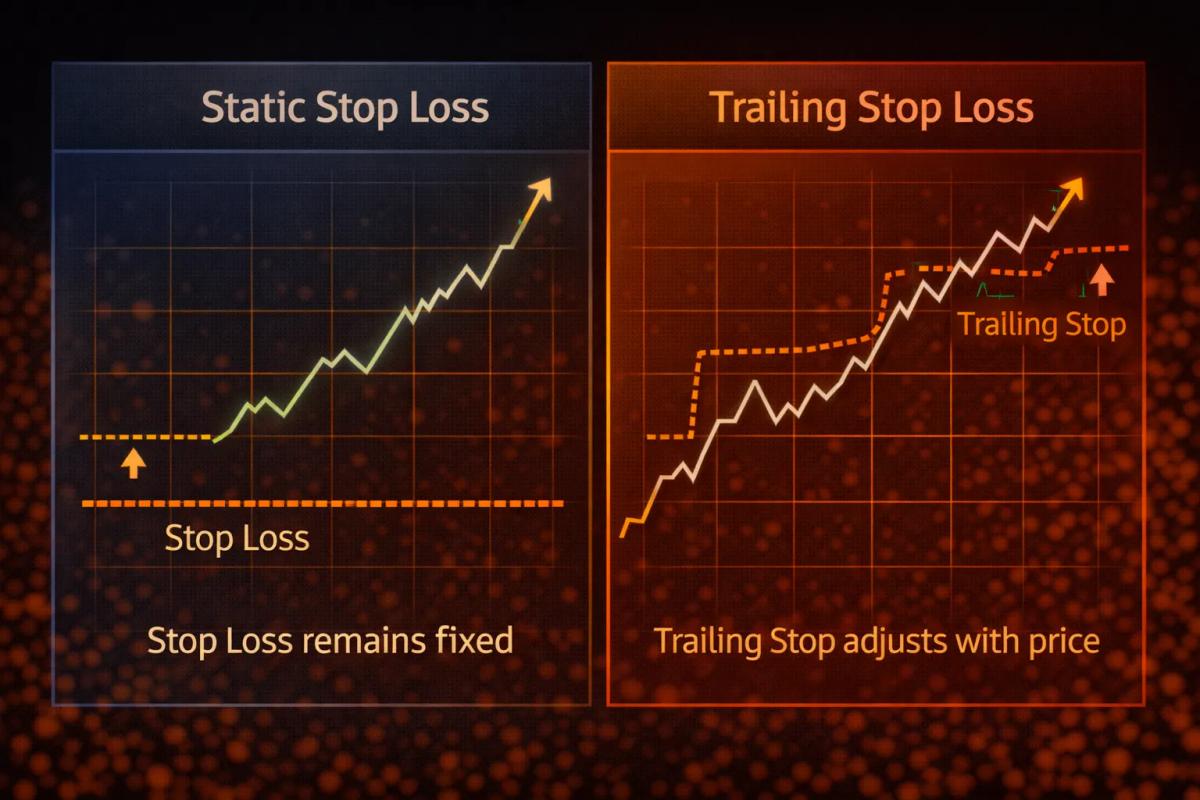
A standard stop loss sits at a fixed price and remains there until the order either triggers or gets manually changed. If you buy a stock at $50 and set a stop loss at $45, that stop stays at $45 regardless of what happens next, even if the stock climbs to $70.
A trailing stop, by contrast, follows the price upward. If you set a $5 trailing stop on that same position, your stop moves from $45 to $50 when the stock reaches $55, then to $65 when it hits $70. The stop only ever moves in the direction of your trade, never backward.
The key difference is that a fixed stop can leave significant profits unprotected during strong moves, while a trailing stop systematically locks in gains as they develop.
How Does a Trailing Stop Work?
The mechanics of a trailing stop depend on how the trail distance is defined. There are several common methods, each with different characteristics.
Fixed Distance Trailing Stops
A fixed distance trailing stop maintains a set number of points or price units behind the current market price.
If you set a 10-point trailing stop on a position and the price moves from 100 to 120, your stop adjusts from 90 to 110.
This approach is straightforward but doesn’t account for the volatility of the instrument being traded. A 10-point trail might be appropriate for one asset but far too tight or too wide for another.
Percentage-Based Trailing Stops
Percentage-based trailing stops define the trail distance as a percentage of the current price rather than a fixed number.
A 5% trailing stop on a $100 stock starts at $95. If the price rises to $120, the stop moves to $114 (5% below $120).
This method scales naturally with price changes, which can be useful for instruments that trade across wide price ranges. It still doesn’t directly account for volatility, but it provides more proportional protection than fixed-distance stops on higher-priced assets.
ATR-Based and Volatility-Adjusted Trailing Stops
Some traders prefer to set their trailing distance based on Average True Range (ATR) or other volatility measures. ATR reflects the typical price movement of an instrument over a given period, providing a data-driven basis for trail distance.
For example, a trader might set a trailing stop at 2x the 14-period ATR. If the ATR is 1.50, the trail distance becomes 3.00.
This approach attempts to give the position enough room to breathe during normal fluctuations while still providing meaningful protection.
Volatility-adjusted trailing stops require more calculation but can reduce the likelihood of being stopped out by routine price noise.
When to Use a Trailing Stop
Trailing stops tend to work best in specific market conditions and trading contexts.
Trending Markets
Trailing stops perform well in markets with clear directional trends. When price moves steadily in one direction with relatively shallow pullbacks, a trailing stop can capture most of the move while exiting when the trend shows signs of reversal.
In choppy or ranging markets, trailing stops often trigger prematurely. Prices that oscillate within a range will frequently hit a trailing stop only to resume moving in the original direction shortly afterward.
Momentum Trades
Trades based on momentum (where the goal is to ride a strong move for as long as it continues) are natural candidates for trailing stops. The trailing mechanism allows the position to stay open during the favorable move while providing an automatic exit when momentum fades.
Swing Trading Applications
Swing traders who hold positions for days or weeks sometimes use trailing stops to manage exits. Rather than picking a fixed take-profit target, they allow the trailing stop to determine when the trade ends. This approach can capture extended moves that might exceed initial profit targets.
Advantages of Trailing Stop Losses
Trailing stops offer several practical benefits:
- Automated profit protection: As a trade moves favorably, the stop adjusts automatically without requiring manual intervention.
- Reduced emotional decision-making: The mechanical nature of the exit removes the temptation to hold too long or exit too early based on fear or greed.
- Flexibility during favorable moves: Unlike fixed take-profit orders, trailing stops don’t cap upside potential. They stay in the trade as long as price continues moving favorably.
- Defined risk parameters: The trail distance establishes a clear maximum adverse excursion before the position closes.
Disadvantages and Limitations
Trailing stops also have meaningful drawbacks:
- Poor performance in choppy markets: Sideways or volatile price action frequently triggers trailing stops, often at unfavorable points.
- Slippage risk: In fast-moving markets, the actual exit price may differ from the stop trigger price, particularly with market orders.
- No guarantee of execution at the expected price: Gaps in price (common overnight or around major news events) can result in exits well beyond the intended stop level.
- Whipsaw vulnerability: Sharp but temporary pullbacks can trigger a trailing stop just before price resumes its favorable direction.
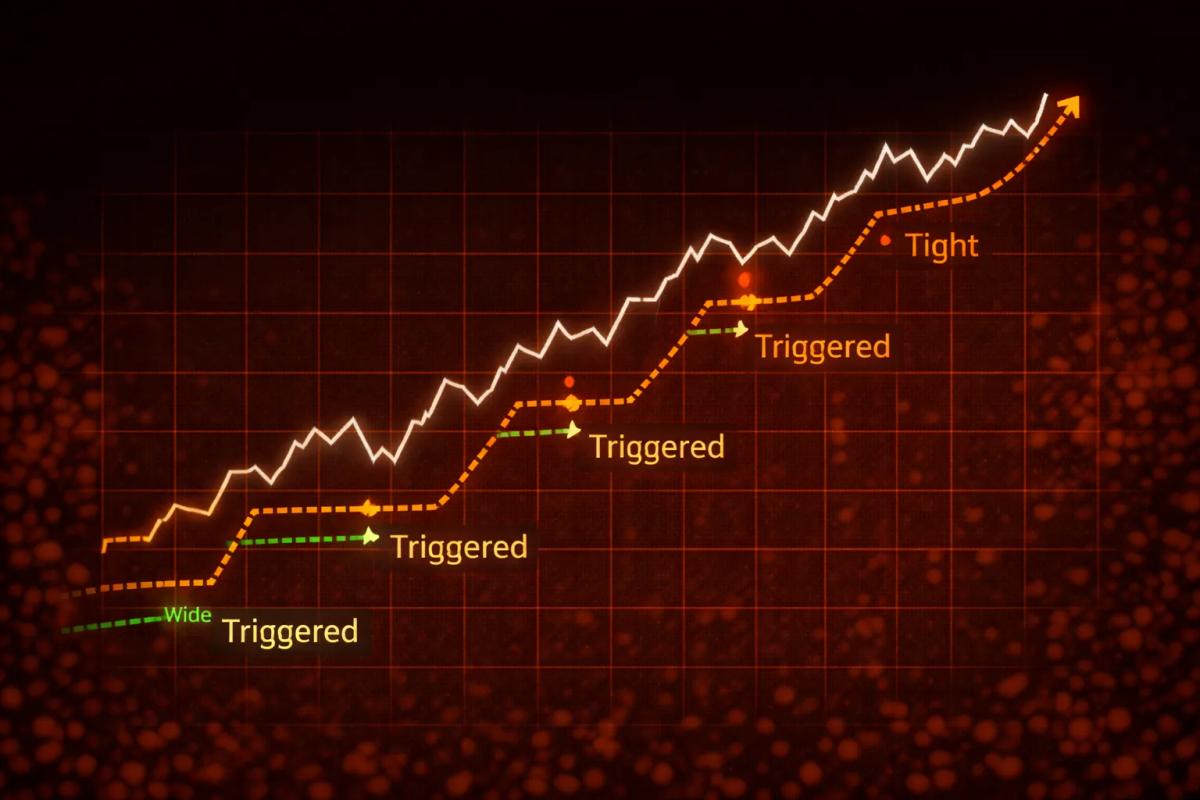
- Requires thoughtful calibration: Setting the trail distance too tight leads to premature exits; setting it too wide defeats the purpose of profit protection.
How to Set a Trailing Stop Distance
Choosing an appropriate trail distance is one of the more challenging aspects of using trailing stops effectively. The right distance depends on multiple factors.
Factors That Influence Trail Distance
Several considerations should inform your trail distance selection:
- Instrument volatility: Higher-volatility assets generally require wider trail distances to avoid being stopped out by normal price fluctuations.
- Timeframe: Shorter timeframes typically involve smaller price swings, which may warrant tighter trails. Longer-term positions usually need more room.
- Market conditions: Trending markets may allow tighter trails than ranging or uncertain environments.
- Recent price behavior: Looking at typical pullback depth during the current move can provide practical guidance.
- Personal risk management parameters: The trail distance should align with your overall position sizing and risk tolerance.
Some traders use technical reference points, such as recent swing lows or support levels, as informal guides for trail placement, though this moves toward discretionary rather than purely mechanical execution.
Common Trailing Stop Mistakes to Avoid
Several errors frequently undermine the effectiveness of trailing stops:
- Setting the trail too tight: A trail distance that doesn’t accommodate normal price fluctuations will trigger constantly, often at the worst possible times.
- Setting the trail too wide: An excessively wide trail provides little meaningful protection and may allow substantial profits to evaporate before triggering.
- Using trailing stops in unsuitable conditions: Applying trailing stops in ranging, choppy, or highly volatile markets often produces frustrating results.
- Ignoring instrument-specific characteristics: Different assets have different volatility profiles. A trail distance that works for one instrument may be inappropriate for another.
- Failing to account for gaps: Traders who expect precise exits at their stop level may be caught off guard by slippage during gaps or fast market conditions.
- Over-reliance on automation: While trailing stops reduce the need for constant monitoring, they don’t eliminate the need for sound trade selection and market awareness.
Trailing Stop vs. Manual Exit: When Each Makes Sense
The choice between a trailing stop and a manual exit depends on your trading style, availability, and psychological tendencies.
Trailing stops tend to work better when:
- You cannot monitor positions continuously
- You want to remove emotion from exit decisions
- You are trading trending conditions
- You prefer systematic, rule-based execution
Manual exits may be preferable when:
- Market conditions are complex or shifting rapidly
- You have strong discretionary skills and market intuition
- You want flexibility to respond to news or unexpected developments
- The position requires nuanced judgment that a mechanical stop can’t provide
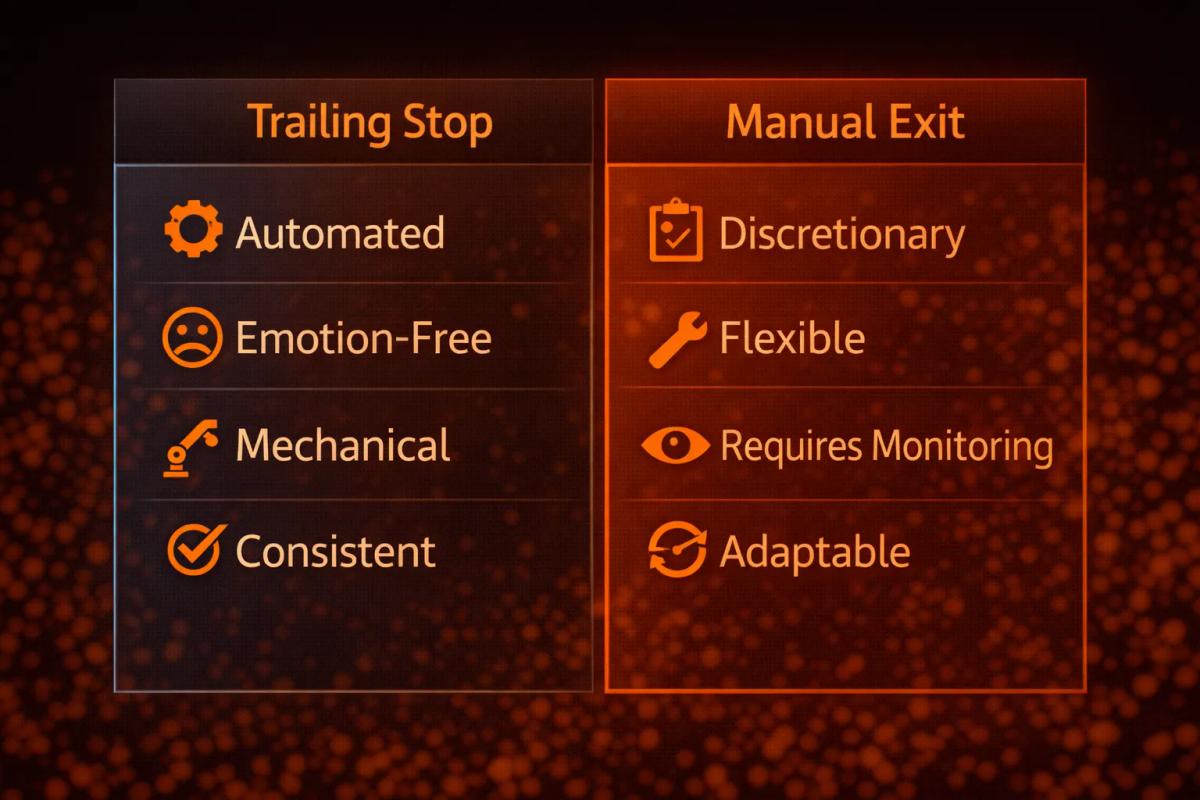
Neither approach is inherently superior. Some traders use trailing stops as a baseline protection while reserving the option to exit manually if circumstances warrant. Others prefer to rely entirely on one method or the other.
Frequently Asked Questions
Can a trailing stop guarantee that I lock in profits?
No. While trailing stops are designed to protect profits, they cannot guarantee execution at a specific price. Market gaps, slippage, and fast-moving conditions can result in exits at prices worse than the stop level.
What happens to a trailing stop if the market gaps overnight?
If the market opens beyond your trailing stop level, the order typically executes at the first available price after the open, which may be significantly different from your intended exit point.
Should I use trailing stops on every trade?
Not necessarily. Trailing stops work best in trending conditions. In choppy or ranging markets, they may trigger prematurely and produce suboptimal results. Consider market conditions before deciding whether a trailing stop is appropriate.
How do I know if my trail distance is too tight or too wide?
If your trailing stops are consistently triggering during minor pullbacks that don't end the broader move, the distance may be too tight. If you're frequently watching significant profits evaporate before the stop triggers, it may be too wide. Reviewing past trades can help calibrate future trail distances.
Do all brokers and platforms offer trailing stop orders?
Most major brokers and trading platforms support trailing stops, but implementation details vary. Some platforms offer only fixed-distance trailing stops, while others support percentage-based or more sophisticated methods. Check your platform's order types and execution policies before relying on trailing stops.
About the authors


Related articles

Cognitive Bias in Trading: How Mental Blind Spots Hurt Your Results
Learn how cognitive biases like confirmation bias and loss aversion affect your trading decisions. Discover practical techniques to recognize and overcome them.
Common Trading Mistakes and How to Avoid Them
Learn the most common trading mistakes that cost beginners money. Discover how to identify and avoid these errors to protect your capital and improve results.
Hedging Strategies in Trading: How to Protect Positions
Learn how hedging strategies help traders manage risk. Explore options, pairs trading, and diversification techniques with practical guidance.
0 comments