


Anxiety in Trading: Understanding and Managing Doubt
Anxiety in trading is one of the most universal experiences among people who put real money on the line. The uncertainty, the speed, and the stakes create a psychological pressure cooker that rattles even seasoned traders. That doubt you feel before, during, and after a trade means your brain is doing exactly what millions of years of evolution designed it to do.
This guide will help you understand where that anxiety originates, how it warps your decisions, and, most importantly, what you can do about it: practical techniques you can reach for the next time doubt tightens its grip.

Why Traders Experience Anxiety
Every trader, at some point, has felt that knot in the stomach before placing a trade. Understanding why your brain reacts this way is the first real step toward reclaiming control.
The Psychology Behind Trading Fear
Your brain can’t distinguish between a charging predator and a rapidly falling portfolio. Both trip the same ancient alarm: the fight-or-flight response. When you perceive a threat to your capital, your amygdala, the brain’s emotional command center, floods your body with cortisol and adrenaline. Rational analysis gets elbowed aside by raw survival instinct.
Think of it as a smoke detector that can’t tell a house fire from burnt toast. Your nervous system treats financial risk and physical danger with the same urgency. That’s why your hands might tremble before a large trade, or why dread rolls through you when a position moves against you.
There’s a deeper layer, too. Trading activates some of the brain’s oldest insecurities around loss. Psychologists have long observed that losses sting roughly twice as much as equivalent gains feel rewarding: a phenomenon known as loss aversion. So even when the probabilities favour you, your emotional brain is already mourning what you might lose.
Common Triggers That Fuel Trading Doubt
The biological machinery is universal, but the specific triggers that fire it up differ from person to person. Among the most common:
- Recent losses: A streak of losing trades can make every new setup feel like a trap. Your brain begins pattern-matching for danger, even when conditions have genuinely changed.
- Oversized positions: Trading bigger than you’re comfortable with turns every tick into a tremor. What would register as noise at normal size suddenly feels existential.
- Information overload: Scanning too many charts, absorbing too many opinions, reading conflicting analyses; none of it resolves uncertainty. It compounds it.
- Unfamiliar market conditions: Volatility spikes, surprise news events, or a market phase you haven’t navigated before can quietly strip your confidence.
- External pressure: Financial obligations, comparisons to other traders, or the creeping feeling that you need this trade to work out: these pile stress onto a decision that should rest on the setup alone.
Recognizing which triggers hit you hardest is half the battle. But what actually happens to your trading once anxiety takes the wheel?
How Anxiety Affects Your Trading Decisions
Anxiety actively corrodes the quality of your decisions. It distorts your perception of risk, warps your timing, and nudges you toward exactly the behaviour you know you should avoid.
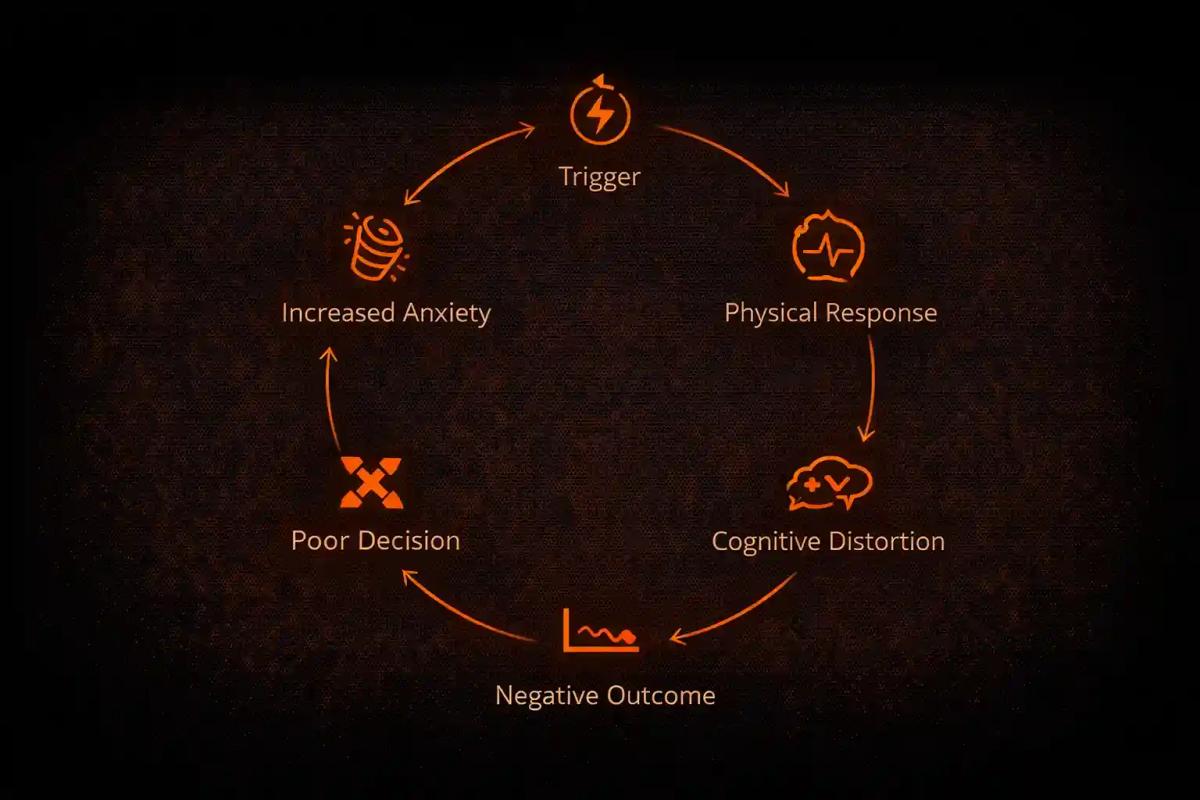
The Cost of Hesitation and Overthinking
When doubt floods in, your brain’s default response is to freeze, gather more data, wait for another confirmation, delay until certainty arrives. The problem is that in trading, certainty never arrives.
You’ve probably lived this: a clean setup appears, your plan says enter, but instead you pause. You wait for “one more candle.” You double-check the indicators. By the time you feel ready, the move has already played out without you. Then comes the frustration and self-criticism, which seed even deeper hesitation next time.
This overthinking loop is insidious because it disguises itself as diligence. You tell yourself you’re being careful, but what you’re really doing is letting anxiety override your system. The cost is a slow erosion of trust in your own judgment.
When Anxiety Leads to Impulsive Moves
The same anxiety that causes freezing can also trigger impulsivity. When emotional pressure climbs high enough, your brain flips from “don’t act” to “do something, anything, to make this feeling stop.”
That’s the moment you enter trades outside your plan, revenge-trade after a loss, widen your stop-loss to dodge being wrong, or cut winners early because watching unrealised profit fluctuate feels unbearable. The impulse is an attempt to escape the crushing tension of not knowing.
Hesitation and impulsivity look like opposites, but they share the same root. Both are efforts to manage an emotional state rather than follow a process. So how do you start breaking the cycle? It begins with seeing your own patterns clearly.
Recognizing Your Personal Anxiety Patterns
Most traders are so absorbed in the action that they don’t realise anxiety has seized control until after a decision they regret. Building awareness of your personal warning signs changes that equation entirely.
Physical and Emotional Warning Signs
Your body often registers anxiety before your conscious mind catches up. Learning to read those signals gives you a crucial early-warning system:
- Physical signs: Rapid heartbeat, shallow breathing, tightness in your chest or stomach, sweating palms, restlessness, jaw clenching, tension across your shoulders and neck.
- Cognitive signs: Racing thoughts, difficulty staying with your plan, fixation on worst-case outcomes, second-guessing decisions already made, or a mental “fog” that blunts your focus.
- Behavioural signs: Refreshing your P&L compulsively, flipping between charts without purpose, seeking reassurance in forums or chat groups, or avoiding your open positions altogether.
None of these signals mean you should quit trading. They mean you should pause and check in with yourself before your next move.
Situational Triggers to Monitor
Beyond the physical signals, pay attention to the situations that consistently crank up your anxiety. Keep a mental (or better yet, written) note of patterns like:
- Specific times of day (market opens, news releases, close of session)
- Certain asset classes or instruments that spike your nerves
- Days when personal stress is already elevated before you sit down
- Periods following a loss streak or an unusually large win
- Moments when you catch yourself deviating from your trading plan
Over time, this awareness sharpens into foresight. Instead of being ambushed by anxiety, you start anticipating it, and that’s precisely when the practical techniques become most powerful.
Practical Techniques to Manage Trading Anxiety
Understanding why you feel anxious is valuable. But when your pulse is hammering and your finger hovers over the order button, you need tools that work in the moment. These are concrete methods you can start applying now.
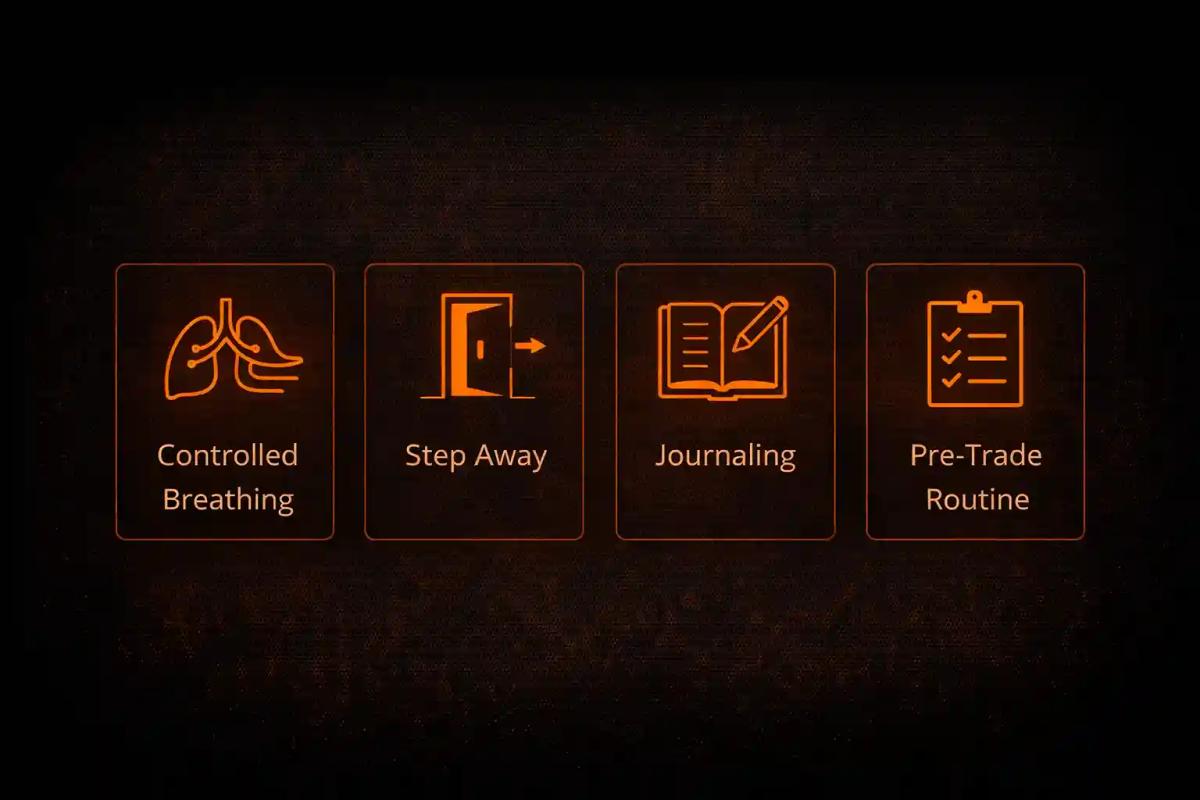
Pre-Trade Routines That Build Confidence
The best time to confront anxiety is before it arrives. A consistent pre-trade routine acts as an anchor: it grounds you in process and lifts the emotional weight off individual decisions.
Your routine doesn’t need to be complex. Consider building one around these elements:
- Review your trading plan first. Before opening a single chart, remind yourself of your rules. What setups qualify? What’s your risk per trade? What are your exit criteria? This shifts your brain from reactive mode into process mode.
- Set your risk before scanning for opportunities. Decide how much you’re willing to lose today before you see anything that tempts you. When risk is predefined, the anxiety around each individual trade drops considerably.
- Do a quick body scan. Spend 30 seconds noticing how you feel physically and emotionally. If you’re already tense, wired, or distracted, treat that as data: it may mean today calls for smaller position sizing or fewer trades.
- Limit your information inputs. Choose your sources before the session begins. Close the extra tabs. Mute the noise. Clarity comes from focus, not from consuming everything available.
Think of this routine as your warm-up. Athletes don’t walk onto the field cold, and you shouldn’t walk into the market without preparing your mind first.
In-the-Moment Calming Strategies
Even with solid preparation, anxiety will sometimes spike mid-trade. That’s normal. What matters is having a quick-access toolkit for those moments.
Controlled breathing is one of the most reliable tools available. It directly counteracts the fight-or-flight response by engaging your parasympathetic nervous system. Try this: inhale slowly for four counts, hold for four counts, exhale for six counts. Even two or three cycles can noticeably lower your heart rate and sharpen your thinking.
Stepping away from the screen, even for 60 seconds, can break the trance of anxiety-driven fixation. Stand up. Look out a window. Get water. The market will still be there when you return. What you’re really doing is giving your prefrontal cortex (the rational part of your brain) a chance to catch up with your emotional reaction.
Naming what you feel is another deceptively simple technique. Internally saying “I’m feeling anxious because this position is larger than usual” might sound trivial, but research on emotional labelling suggests it dampens the emotion’s intensity. You shift from being inside the feeling to observing it, and that small distance opens up room for clearer decisions.
Post-Trade Reflection Without Self-Criticism
What you do after a trade shapes your psychology just as much as what you do before and during. If every session ends with a harsh internal monologue about everything you got wrong, you’re conditioning your brain to associate trading with punishment, which only deepens future anxiety.
Instead, approach your review with curiosity rather than judgment. Ask yourself:
- Did I follow my process? (Not: Did I make money?)
- Where did I feel the most anxiety, and what set it off?
- Did I make any decisions driven by emotion rather than my plan?
- What would I repeat next time? What would I adjust?
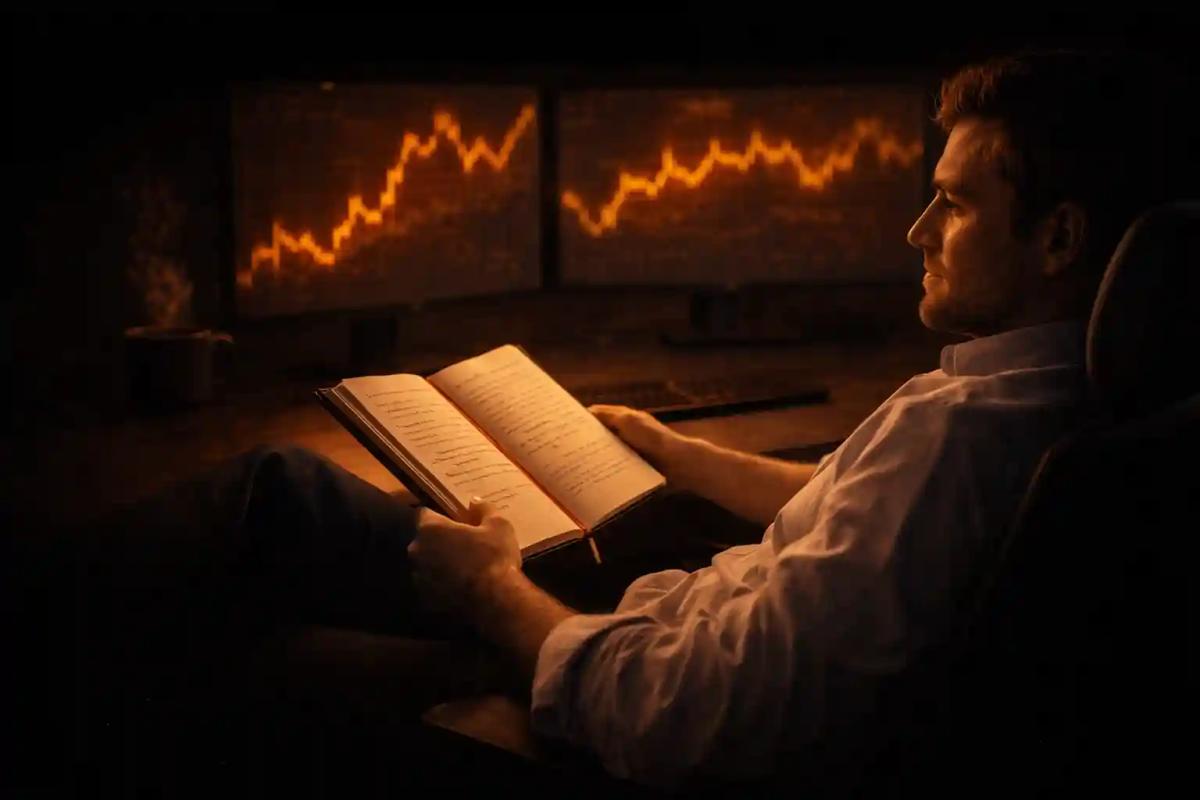
Writing these reflections in a trading journal (even just a few lines) builds genuine self-awareness over time and transforms emotional data into something you can learn from. It remains one of the most underrated tools for strengthening a trading mindset.
Techniques, though, will only carry you so far. What does lasting resilience actually look like?
Building Long-Term Emotional Resilience
Quick-fix strategies get you through difficult moments. Long-term resilience is what keeps you in the game month after month, year after year. It comes from fundamentally reshaping how you relate to uncertainty.
Developing a Healthy Relationship with Uncertainty
You will never have certainty in trading. Every trade is a probability. Much of trading anxiety flows from resisting that reality, from trying to know what simply can’t be known.
Traders who build real resilience aren’t the ones who stop feeling uncertain. They’re the ones who learn to act effectively within uncertainty. Consider a pilot flying through turbulence. The turbulence doesn’t vanish because the pilot is experienced, but the pilot’s response to it is fundamentally different. They trust their instruments, follow their procedures, and accept that rough air is part of the job.
You develop this relationship gradually, by consistently following your process regardless of outcomes. When you execute your plan and lose, that’s still a good trade. When you break your rules and win, that’s still a mistake. Anchoring your self-evaluation to process rather than results quietly loosens the anxiety that’s tangled up with the fear of losing.
When to Step Away from the Screen
One of the strongest moves you can make as a trader is knowing when not to trade. This is discipline in its purest form.
Step away when:
- Your anxiety is running high before you’ve even begun analysing
- You’ve taken several losses in a row and feel the pull to “make it back”
- Personal stress is bleeding into your trading decisions
- You notice yourself breaking your own rules more than once in a single session
- Market conditions don’t suit your strategy, but you’re forcing trades anyway
Taking a break (whether an hour, a day, or a week) protects both your capital and your psychological reserves. The market isn’t going anywhere. But your ability to trade well hinges on your mental state, and sometimes the highest-value decision you can make is to rest.
When Anxiety Becomes a Larger Problem
Everything in this guide is designed to help you manage the normal, expected anxiety that accompanies trading. But it’s worth being honest with yourself about when self-help techniques are no longer enough.
Signs You May Need Additional Support
There’s a meaningful gap between productive caution (the healthy alertness that helps you respect risk) and anxiety that genuinely interferes with your daily life. Consider reaching out to a mental health professional if:
- Trading anxiety is disrupting your sleep, appetite, or relationships outside the markets
- You experience persistent worry or dread that doesn’t ease even when you’re away from the screens
- You find yourself unable to execute trades at all, despite trusting your plan
- Anxiety comes paired with prolonged feelings of hopelessness or emotional numbness
- You’re using trading (or avoiding it) as a way to cope with deeper emotional issues
Many high-performing professionals work with therapists, coaches, or counsellors to sharpen their mental game. It’s one of the smartest investments you can make in sustained performance.
This article is educational in nature and is not a substitute for professional mental health guidance. If you’re experiencing persistent anxiety that impacts your well-being, please consider consulting a qualified professional.

About the authors

Related articles
Analysis Paralysis in Trading: Why You Freeze and How to Fix It
Learn to recognize analysis paralysis in trading, understand its psychological roots, and build a decision-making framework with confident execution.
Anchoring Bias in Trading: How Mental Price Traps Cost You Money
Learn how anchoring bias distorts your trading decisions. Spot mental price traps, break free from fixation on entry prices, and build systems to protect your returns.
Anger in Trading: Why It Happens and How to Control It
Learn why anger strikes during trading, how it destroys performance through revenge trades and broken rules, and proven techniques to control it.
0 comments