


Fear of Losing Money Trading: Why It Happens and How to Manage It

Fear of losing money is one of the most common (and least discussed) challenges in trading. It’s a deeply wired human response, and understanding it is the first step toward trading with more clarity.
This guide unpacks why your brain treats potential losses so differently from potential gains, how that fear infiltrates your trading behavior, and what you can actually do about it.
Trading involves substantial risk of loss. This content is educational and does not constitute financial advice.
What Is Fear of Losing Money in Trading?
Fear of losing money in trading goes beyond pre-trade nerves. It’s a psychological response where the possibility of loss hijacks your decision-making, often pushing you to act against your own analysis.
This fear shows up in obvious ways: refusing to enter trades, closing positions at the first hint of red. But it also operates in subtler patterns you might not recognize. The trader who keeps moving their stop-loss further away? That’s fear at work.
The difference between normal caution and problematic fear comes down to whether it sharpens your trading or undermines it. Healthy caution prompts you to double-check position size and confirm your analysis. Paralyzing fear makes you abandon your edge altogether.
How Loss Aversion Shapes Trading Behavior
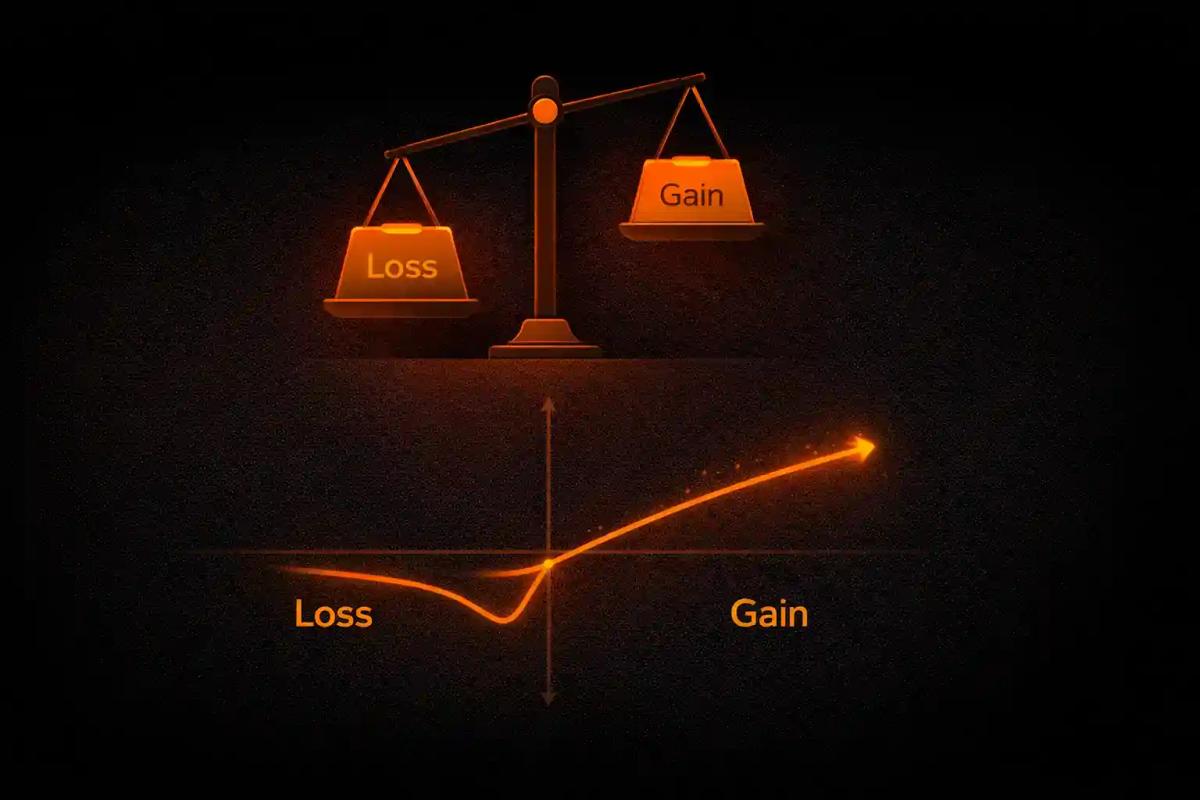
The reason fear of loss hits so hard traces back to something behavioral economists call loss aversion. Research pioneered by Daniel Kahneman and Amos Tversky revealed that humans don’t weigh gains and losses equally. Losing $100 stings roughly twice as much as gaining $100 feels good.
Picture a mental scale rigged against you from the start. The satisfaction side needs twice the weight just to balance the pain side. This is standard human wiring, shaped by millennia when avoiding threats mattered more than seizing opportunities.
In trading, this asymmetry generates constant pressure toward irrational choices. Your brain treats a $500 unrealized loss as an emergency requiring immediate escape, while a $500 unrealized gain feels precarious.
Understanding loss aversion matters. But it only becomes useful when you grasp why it activates so intensely in the first place.
Why Traders Experience Fear of Loss
Fear of losing money doesn’t emerge from thin air. Specific triggers set it off: some hardwired into your neurology, others shaped by your trading history and habits.
The Neuroscience Behind Loss Aversion
When you face a potential loss, your brain skips calm analysis entirely. The amygdala (the region that processes threats) fires in patterns strikingly similar to those triggered by physical danger. Stress hormones flood your system. Your heart rate climbs. Rational thinking gets shoved aside by survival instincts.
This explains why telling yourself to “stay calm” rarely works. The threat response fires faster than conscious thought can intervene. By the time you notice your fear, your brain has already begun preparing you to flee, which in trading means closing the position, skipping the trade, or making impulsive changes.
The intensity varies from person to person, but everyone experiences some version of this response. Your task is to build systems that account for it.
Past Losses and Conditioning
Every significant loss leaves a mark. Your brain constantly pattern-matches, scanning for ways to protect you from repeating painful experiences. If you took a substantial hit on a particular setup, currency pair, or market condition, your fear response intensifies whenever similar circumstances reappear.
This conditioning serves you when it’s accurate, helping you avoid genuinely dangerous situations you’ve encountered before. It becomes a liability when your brain overgeneralizes. One bad trade during a news event doesn’t mean every trade during news events will fail. But your fear response doesn’t make that distinction. It conflates valid lessons with false correlations.
The result: traders often develop blind spots and avoidances rooted in past pain rather than statistical reality.
Lack of a Defined Trading Plan
Without a clear plan, you’re essentially handing your emotional brain the controls and asking it to make trading decisions under pressure.
When you haven’t determined in advance what you’ll risk, where you’ll exit, or how large your position should be, every moment in a trade becomes a fresh decision point. And every decision point gives fear another opening to override logic.
A defined plan won’t eliminate fear. But it fundamentally changes your task. Rather than deciding what to do while under pressure, you’re executing decisions you made when calm. That’s a different challenge entirely, and far more manageable.
What does fear-driven trading actually look like when it takes hold?
How Fear of Losing Money Affects Your Trading
Fear of loss doesn’t announce itself with a warning label. It shows up in patterns you might rationalize as strategy tweaks or simple bad luck. Three behaviors serve as the clearest warning signs.
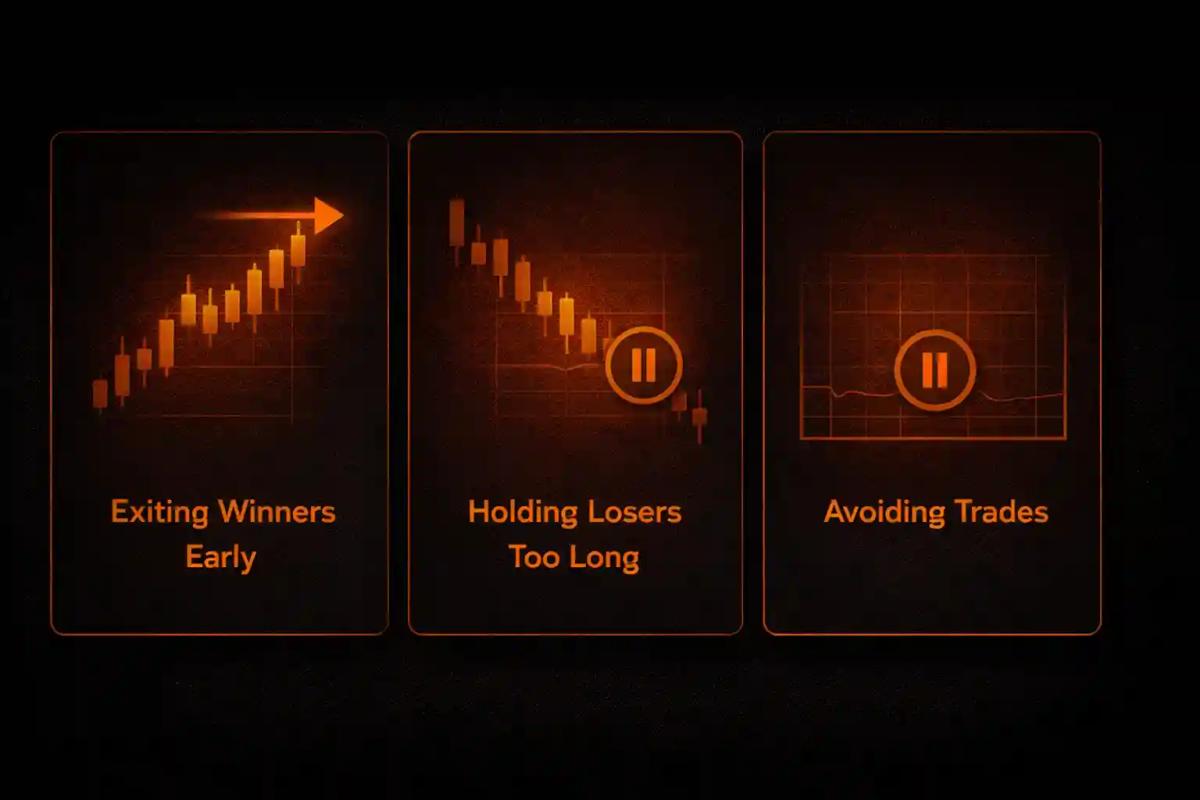
Exiting Winning Trades Too Early
You enter a trade with a clear target. Price moves your way, you’re up 1R, maybe 1.5R. The urge to take profit becomes almost unbearable. You tell yourself “profit is profit” and close out, then watch the trade run to your original target and beyond.
Loss aversion is the culprit, wearing a disguise. Your brain treats unrealized gains as something you already possess, and the prospect of those gains evaporating registers as loss. So you lock in the smaller win to dodge the pain of watching it disappear, even though your analysis pointed to more upside.
The cumulative damage is significant. Consistently cutting winners short while letting losers reach your stop destroys your risk-reward ratio. Even a strategy with a respectable win rate turns unprofitable when you’re capturing half your intended gains.
Holding Losing Trades Too Long
The counterpart to exiting winners early is refusing to exit losers. When a trade moves against you, closing the position means accepting that the loss is real. Your brain fights this. As long as the position stays open, hope remains. And hope feels better than the certainty of loss.
This leads to familiar behaviors: moving stop-losses further away, adding to losing positions to “average down,” or simply turning off the screen and hoping things improve. Each choice represents your brain’s attempt to sidestep the pain of making a loss permanent.
This behavior creates exactly what you’re trying to avoid: larger losses that erode both your account and your confidence.
Avoiding Trades Entirely
Sometimes fear doesn’t corrupt your trade management, it prevents you from trading at all. You watch setups form that meet your criteria, but you don’t pull the trigger. You tell yourself you’re being selective, that you need more confirmation. What’s really happening is paralysis.
This avoidance commonly follows a significant loss or a string of losing trades. Your brain has learned to associate trading with pain, so it manufactures resistance to keep you safe. The problem is that avoiding trades also means missing the wins that could rebuild your account and your confidence.
If you find yourself repeatedly “almost” taking trades but backing off at the last second, fear has likely shifted from influencing your decisions to blocking them entirely.
How do you work with these patterns instead of being ruled by them?
Practical Methods to Manage Fear of Losing Money Trading
Managing fear is about building structures that limit fear’s opportunities to seize control. These four methods tackle root causes,.
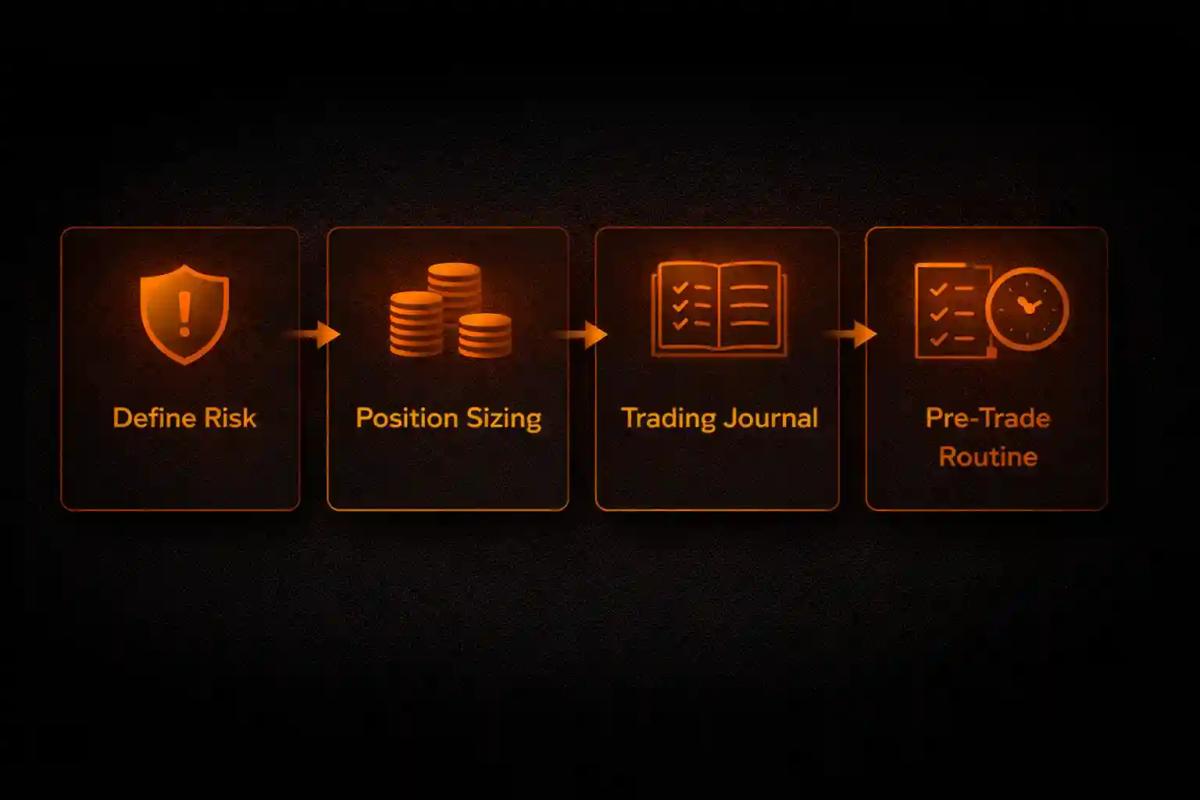
Define Risk Before Every Trade
Before entering any position, know exactly how much you’re prepared to lose. This means identifying your stop-loss level and calculating position size so that if the stop gets hit, you lose a predetermined amount.
Defining risk in advance reframes the fear question. Instead of “What if I lose money on this trade?” you’re asking “Am I willing to lose $X for this opportunity?” If the answer is yes, proceed with clarity. If the answer is no, skip the trade or reduce your size.
This single practice neutralizes more fear-based decisions than any other technique.
Use Position Sizing to Reduce Emotional Stakes
The emotional weight of a trade scales directly with what you stand to lose. Risking 5% of your account triggers far more fear than risking 0.5%, even when the setup is identical.
Effective position sizing means choosing a risk amount that lets you think clearly. For many traders, that’s 1% of account value or less per trade. The specific number matters less than this question: can you absorb the loss without it contaminating your next decision?
If you can’t follow your plan, your position size is probably too large for your current psychological capacity. Reducing size is acknowledging that your edge only exists when you can execute consistently.
Keep a Trading Journal Focused on Process
Most trading journals fixate on outcomes: win or loss, dollars gained or lost. A fear-reducing journal tracks something different: whether you honored your process.
After each trade, record whether you:
- Defined your risk before entry
- Sized the position according to your rules
- Entered based on your criteria (not impulse or FOMO)
- Managed the trade according to plan
- Exited at your predetermined level (stop or target)
Over time, this journal redirects your focus from results to execution. Success becomes about how faithfully you followed your system, not whether individual trades made money.
When your self-evaluation rests on factors within your control, fear of uncertain outcomes loses much of its grip.
Develop a Pre-Trade Routine
Fear responses hit hardest when they ambush you. A pre-trade routine inserts a buffer between impulse and action, buying your rational brain time to catch up with your emotional brain.
Your routine might include:
- Reviewing your trade criteria checklist
- Confirming position size and risk amount
- Taking three slow breaths
- Stating the trade thesis aloud
- Accepting, verbally or in writing, that you’re willing to lose the risked amount
The specific steps matter less than the consistency. Performing the same sequence before every trade creates a gateway from reactive mode to deliberate mode. Fear won’t disappear, but it won’t trigger automatic actions you’ll regret.
When Fear Is a Signal, Not a Problem
Not all trading fear is irrational. Sometimes it’s your brain delivering a message worth hearing.
If you feel fear because you’re risking too much, the right response is to cut your risk. If you feel fear because you don’t actually trust the setup, exploring that doubt serves you better than forcing yourself to trade anyway. If you feel fear because you’re trading money you can’t afford to lose, no psychological technique addresses that. The only remedy is trading with capital that won’t devastate you if it’s gone.
Fear becomes a problem when it stops you from executing a sound plan with appropriate risk. Fear is a valuable signal when it flags a genuine flaw in your plan or your risk management.
Learning to tell the difference takes practice and honest self-reflection. The aim is to become someone who heeds fear when it protects and manages fear when it doesn’t.
If fear around trading persists despite these methods and significantly affects your wellbeing, consider speaking with a professional who specializes in performance psychology or anxiety management.
Key Takeaways
- Fear of losing money in trading stems from loss aversion: a neurological bias where losses feel roughly twice as powerful as equivalent gains
- This fear shows up in three common patterns: exiting winners too early, holding losers too long, and avoiding trades entirely
- Past losses condition your brain to overreact to similar situations, often creating avoidances based on emotion rather than edge
- Trading without a defined plan forces your emotional brain to make real-time decisions, amplifying fear’s influence
- Four practical methods to manage fear: define risk before every trade, use position sizing that allows clear thinking, keep a process-focused trading journal, and develop a consistent pre-trade routine
- Some fear is protective and rational. The goal is distinguishing useful signals from irrational interference
- Managing fear means building structures that account for your psychology, not suppressing emotions or forcing yourself to act against instinct

About the authors

Related articles
Analysis Paralysis in Trading: Why You Freeze and How to Fix It
Learn to recognize analysis paralysis in trading, understand its psychological roots, and build a decision-making framework with confident execution.
Anchoring Bias in Trading: How Mental Price Traps Cost You Money
Learn how anchoring bias distorts your trading decisions. Spot mental price traps, break free from fixation on entry prices, and build systems to protect your returns.
Anger in Trading: Why It Happens and How to Control It
Learn why anger strikes during trading, how it destroys performance through revenge trades and broken rules, and proven techniques to control it.
0 comments