


Greed in Trading: How to Recognize It and Stop It From Destroying Your Profits
Greed in trading is a deeply wired impulse that strikes every person who watches a price tick in their favor. What separates traders who steadily grow their accounts from those who blow them up often comes down to a single skill: managing that impulse before it manages them.
This guide will help you do exactly that. You’ll learn to spot greed-driven behavior in your own trading, understand what it actually costs you, and walk away with a concrete framework to neutralize it before it devours your profits.
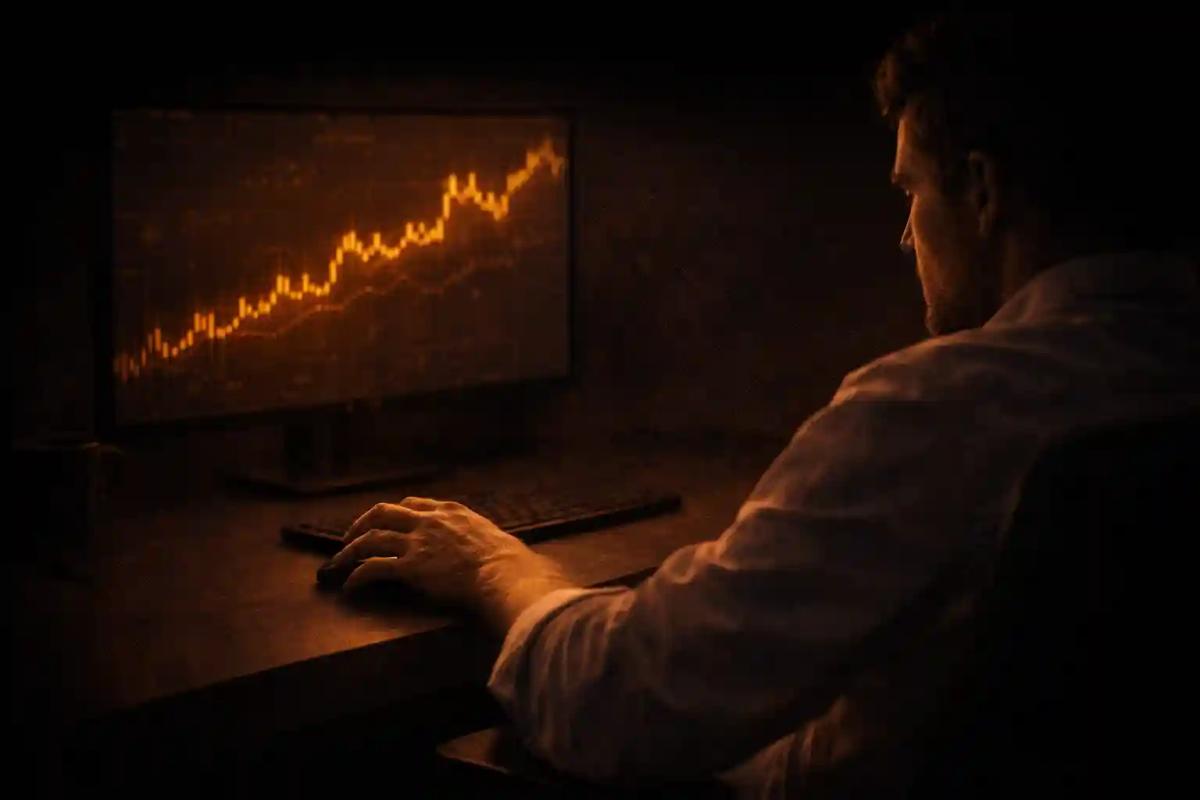
What Is Greed in Trading?
The Psychology Behind Trading Greed
Greed in trading has nothing to do with being a bad person or lacking character. It’s a cognitive bias: your brain’s reward circuitry hijacking your judgment at the worst possible moment.
Here’s what’s actually happening: when a trade moves in your favor, your brain releases dopamine. The same chemical that fires when you eat something delicious or hear your phone buzz with a notification. It feels good, so your brain chases more of it. The rational part of you knows the profit target is sitting right there. But the emotional part insists the reward could be bigger if you just wait a little longer.
Picture sitting at a blackjack table when you’re already up. Logic says pocket the chips and leave. The rush says play one more hand. In trading, that “one more hand” might mean holding a position well past your exit plan, doubling your size on the next trade, or tossing your rules entirely because you feel untouchable.
This is a wiring problem. Recognizing that distinction is the first real step toward managing it.
Why Every Trader Is Vulnerable
If you think greed only haunts undisciplined beginners, think again. Experienced traders, including professionals, stumble into greed traps regularly. The difference is that seasoned traders have typically built systems to catch themselves before the damage snowballs.
Your vulnerability to greed spikes under specific conditions:
- After a winning streak: success breeds overconfidence, and overconfidence loosens rules.
- During high-volatility markets: big swings create the illusion that massive profits are just there for the taking.
- When you’re close to a personal milestone: chasing a round-number account balance or clawing back from a drawdown pushes you harder than your plan permits.
- When you compare yourself to others: watching someone else post outsized gains can make your disciplined approach feel painfully small.
These scenarios can turn even professional traders into losing ones, sometimes in a single session.
So what does greed actually look like when it’s calling the shots?
How Greed Manifests in Your Trading
Greed dresses up as confidence, market intuition, or as “staying flexible.” That camouflage is exactly what makes it dangerous. Below are the four most common disguises.
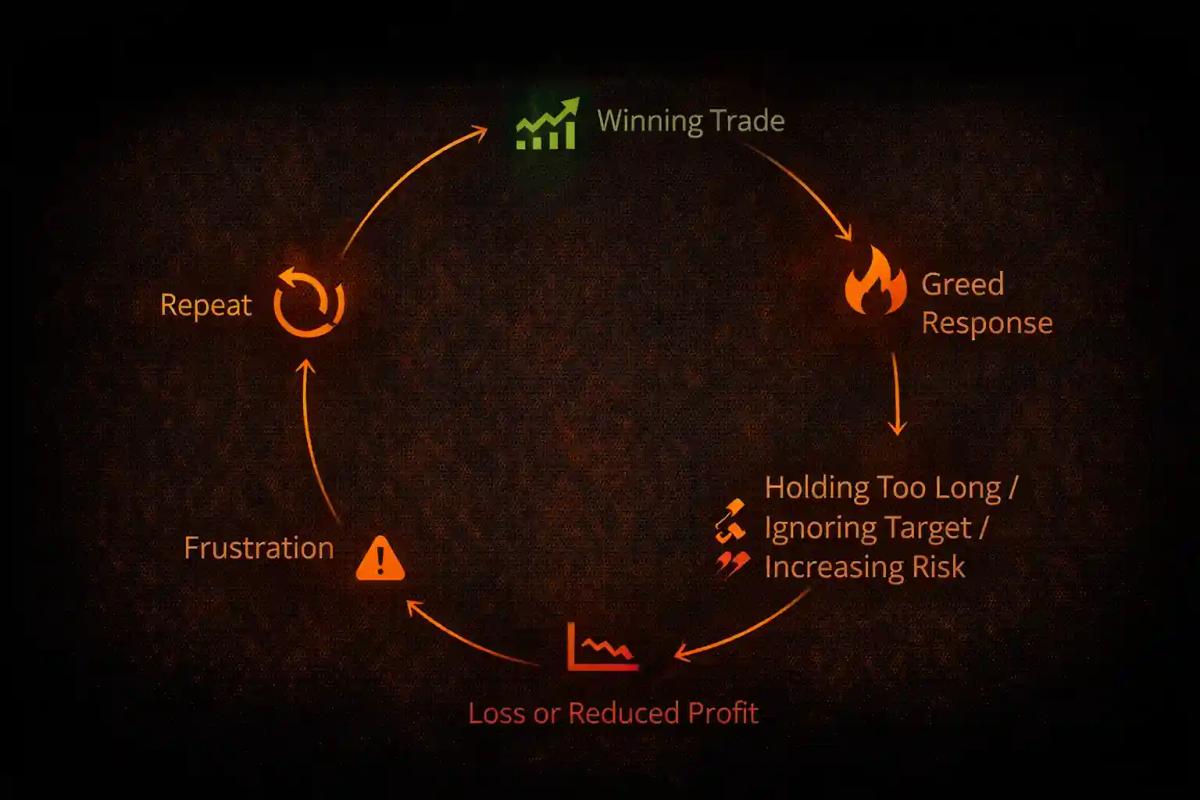
Holding Winning Trades Too Long
This is greed’s signature play. Your trade reaches the planned target, but instead of closing, you shift the goalposts. “The trend is strong,” you reason. “There’s more juice in this move.”
Sometimes there is. But here’s the pattern that repeats across thousands of trading accounts: you hold past target, the price stalls, you freeze because you’re now anchored to the higher unrealized number, and eventually you close at a fraction of what you could have banked, at breakeven, or at an outright loss.
Greed convinces you that you’re being clever. You tell yourself you’re “letting winners run.” But there’s a sharp line between a planned trailing strategy and simply refusing to take profit because you want more. If you can’t articulate which one you’re doing, it’s almost certainly the second.
Ignoring Profit Targets
This is closely related to holding too long, but more deliberate. You set profit targets during your planning phase, when you were calm, rational, clear-eyed. Then the trade goes live, adrenaline kicks in, and those targets suddenly feel conservative.
So you override them because the number on screen doesn’t feel like enough.
If you catch yourself repeatedly moving or scrapping targets mid-trade, that’s not market adaptation. That’s greed rewriting your plan in real time. And a plan that gets rewritten every time it’s supposed to execute is no plan at all.
Taking Excessive Risk After Wins
You just banked a big winner. You feel sharp, dialed in. You feel like you get this market right now. So your next trade is larger, maybe far larger than your normal position sizing rules allow.
This is greed wearing confidence as a mask. The logic seems airtight in the moment: “I’m reading the tape well, so I should press the advantage.” But your edge on the next trade is statistically independent from your last one. The market doesn’t know or care that you just won. Your inflated size only means that when the inevitable loss comes, it lands disproportionately hard.
A single outsized loss can erase several disciplined wins. That’s precisely how greed converts a strong week into a brutal month.
Overtrading to Chase More Gains
Some days, the market hands you one clean setup and you execute it well. Greed says that’s not enough. If one good trade worked, surely five more are hiding somewhere in the charts.
So you start forcing entries on setups you’d normally pass on. Quality drops. Frequency climbs. Commissions and spreads stack up. And because these trades were born from impulse rather than process, the win rate craters.
Overtrading is greed’s volume play: “Take enough shots and something big will land.” But trading isn’t a lottery. It’s a probability exercise where your edge only works on qualified setups. Every forced trade dilutes it.
If any of this sounds familiar, it’s worth understanding what these behaviors truly cost, beyond the individual trades themselves.
The Real Cost of Greed
Greed doesn’t just shave a few dollars off your P&L. It compounds quietly, creating damage that runs far deeper than any single position.
Financial Consequences
The math of greed works against you in ways that aren’t obvious at first glance.
When you hold past targets and surrender profits, you’re burning time and mental bandwidth on a position that already did its job. That’s opportunity cost: capital and focus that could have gone toward the next clean setup.
When you oversize after wins, you inject massive variance into your equity curve. A handful of bloated losses can carve drawdowns deep enough to push you into survival mode, where your risk management framework is about staying alive.
When you overtrade, commissions and slippage compound fast. Even modest per-trade friction becomes significant when you’re firing three times more trades than your plan prescribes.
The net result is an equity curve that looks like a rollercoaster instead of a staircase. Greed transforms a positive-expectancy system into an unpredictable mess by pulling you away from it.
Psychological Consequences
The financial toll is painful. The psychological toll is what makes traders walk away for good.
Every time greed drives you to break your own rules, you chip away at trust in yourself. You start second-guessing your plans because you know that you might not follow them. That doubt breeds hesitation, which causes you to miss valid setups and get you frustrated. And frustration makes you more vulnerable to greed the next time a winner appears. It’s a self-reinforcing loop, and it tightens with each cycle.
Over time, this pattern creates a painful state: you feel unable to trade well even though you know what good trading looks like. The gap between knowing and doing becomes a genuine source of distress: anxiety before trades, regret after them, and a persistent sense of battling yourself.
Here’s the encouraging part: this cycle breaks the moment you stop leaning on willpower and hope, and start leaning on structure. So let’s build that structure.
How to Control Greed in Trading
You can’t think your way out of greed. Not when dopamine is flooding your system and the price keeps ticking your way. What you can do is build mechanical guardrails that make disciplined execution the path of least resistance.
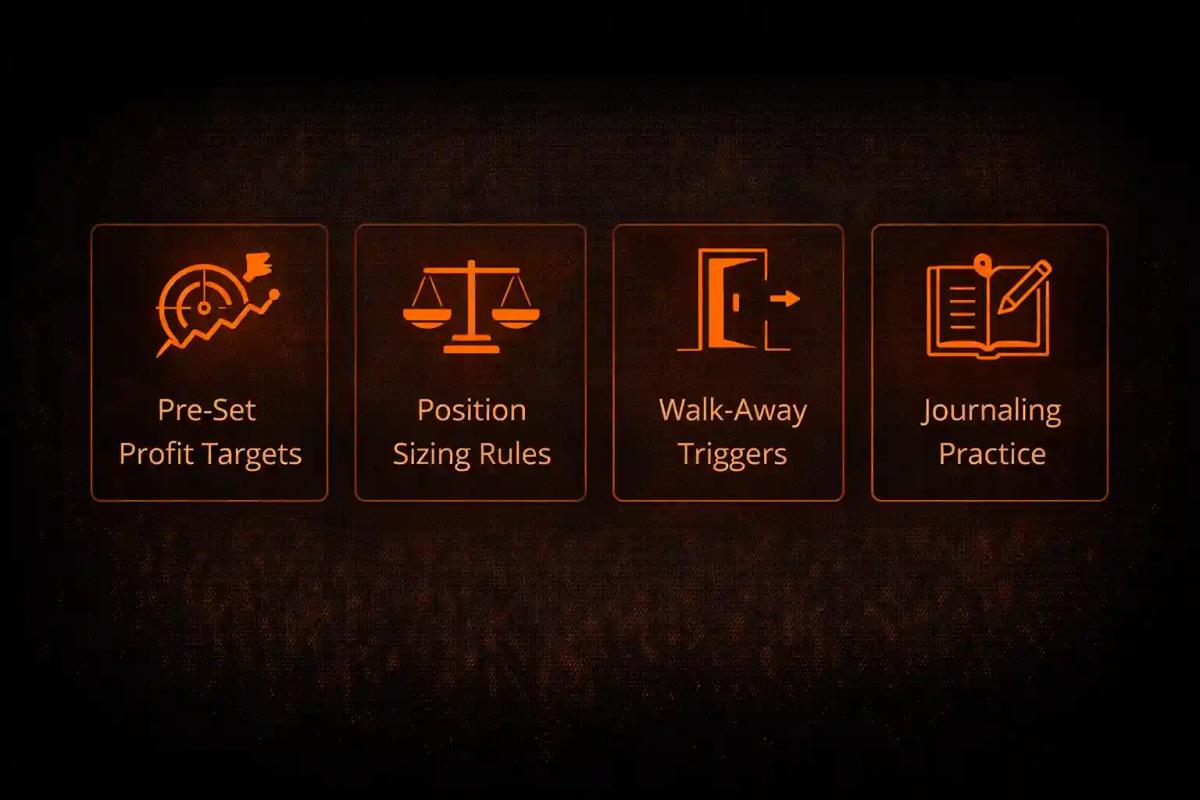
Pre-Defined Profit Targets and Exit Rules
The simplest greed countermeasure is removing the decision from the live moment entirely. Before you enter any trade, define exactly where you’ll take profit, and write it down.
A few approaches that make this stick:
- Hard limit orders: Place your take-profit at entry so the platform closes the position for you. No decision required when the price arrives.
- Scaled exits: Take partial profits at your first target and let a reduced position ride with a trailing stop. This satisfies both the “lock in gains” instinct and the “let it run” impulse without abandoning your plan.
- Time-based exits: If your target isn’t hit within a defined window, close the trade. This prevents open positions from becoming emotional anchors you can’t let go of.
The common thread: exit rules are defined before the trade, when you’re thinking clearly. Any rule change mid-trade demands a documented, and pre-approved reason.
Position Sizing Discipline
Your position size should be governed by your system’s rules. Confidence fluctuates with recent results. Your sizing formula shouldn’t.
A straightforward approach is to define a fixed percentage of your account to risk per trade, and never exceed it, regardless of how “certain” a setup looks. If your rule caps risk at a set amount, that cap applies after a five-trade winning streak exactly the same as it does after a loss.
This strips away one of greed’s most dangerous weapons: the ability to amplify a single bad decision into an account-threatening event. When your worst-case loss is controlled and consistent, greed simply can’t escalate beyond the boundaries you’ve set.
The Power of Walking Away
This one feels counterintuitive, but it may be the single most effective greed control available: stop trading when you’ve hit your daily or weekly profit goal.
Set a “done for the day” threshold. When you reach it, close the platform, because continuing after your goals are met is almost always greed.
Walking away while you’re ahead does two powerful things:
- It reinforces the habit of accepting what the market gives you instead of demanding more.
- It shields you from the post-win overconfidence that fuels oversizing and overtrading.
If stepping away from a green screen feels uncomfortable, sit with that discomfort for a moment. It’s revealing exactly how much greed has been steering your behavior.
Journaling to Expose Greed Patterns
Greed thrives in the dark. It operates best when you’re not scrutinizing your own behavior. A trading journal drags it into the open.
After every session, log both your trades but your decisions. Specifically:
- Did you follow your exit plan? If not, what override did you make and why?
- Did you adjust your position size? What prompted the change?
- Did you take trades that weren’t part of your plan?
- How did you feel during and after each trade?
Over weeks, patterns surface that are invisible in real time. You might discover that greed spikes on Mondays after you’ve spent the weekend building watchlists, or that you consistently override targets during the final hour of a session, or that one particular ticker reliably triggers your worst impulses.
Once you see the pattern, you can design a specific rule to neutralize it. That’s a personalized defense system, built from your own data.
With tools to control greed in the moment, the next question is: how do you make that control durable?
Building a Greed-Resistant Trading System
The thread running through every countermeasure above is a single principle: systems beat willpower. Every time. Traders who manage greed consistently aren’t gifted with superhuman discipline. They’ve designed their process so that discipline is largely automatic.
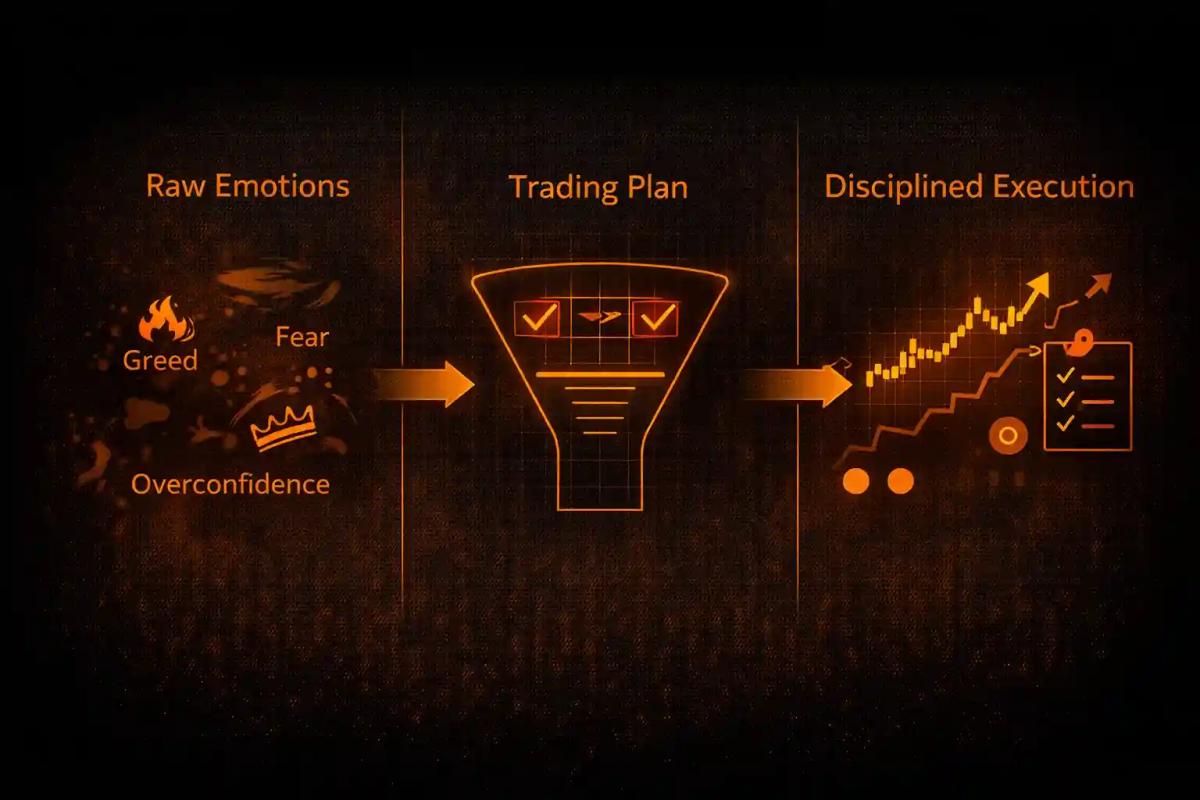
A greed-resistant trading system shares a few core features:
- Rules written in advance: Entry criteria, exit criteria, position size, and maximum daily trades are all locked in before the session begins.
- Mechanical execution where possible: Limit orders, stop-losses, and price alerts eliminate decision points where greed would otherwise step in.
- Post-session review as standard practice: Journaling is baked into the process, the same way clearing trades is part of settlement.
- Accountability checkpoints: Whether it’s a trading partner, a mentor, or a weekly self-review measured against your own rules, there’s a mechanism for catching slippage early.
Think of your trading plan as a filter sitting between your emotions and the market. Raw impulses enter one side. On the other side, only rule-qualified actions pass through. The tighter and more specific that filter, the less room greed has to operate.
You won’t build this overnight, and you won’t follow it flawlessly from day one. That’s expected. The goal is creating a structure that catches you most of the time, paired with a review process that catches the rest.
Final Thoughts
Greed is a signal you need to manage. Every trader feels the tug to hold longer, risk bigger, and push further than their plan allows. The ones who build durable accounts aren’t immune to that tug: they’ve simply built better systems around it.
Start with one change. Pick the behavior from this article that you recognized most clearly in yourself, and build a single rule to counter it. Test it for a week. Journal the results. Adjust. Then layer on the next rule. Over time, your system becomes your discipline, and greed fades from the voice running your trades to background noise you barely register.
This content is educational and informational in nature. It is not personalized financial advice. Trading involves risk, and the techniques discussed here are considerations, not prescriptions. Consult a qualified financial professional for guidance specific to your situation.

About the authors

Related articles
Analysis Paralysis in Trading: Why You Freeze and How to Fix It
Learn to recognize analysis paralysis in trading, understand its psychological roots, and build a decision-making framework with confident execution.
Anchoring Bias in Trading: How Mental Price Traps Cost You Money
Learn how anchoring bias distorts your trading decisions. Spot mental price traps, break free from fixation on entry prices, and build systems to protect your returns.
Anger in Trading: Why It Happens and How to Control It
Learn why anger strikes during trading, how it destroys performance through revenge trades and broken rules, and proven techniques to control it.
0 comments