


Happiness and Pride in Trading: How to Stay Grounded After Wins
Happiness and pride in trading are natural responses to doing something well, but they’re also where some of the most expensive mistakes quietly take root.
The emotional high after a win can be far more dangerous than the sting of a loss. Losses force caution. Wins breed a quiet recklessness: one that doesn’t announce itself until the damage is already done.
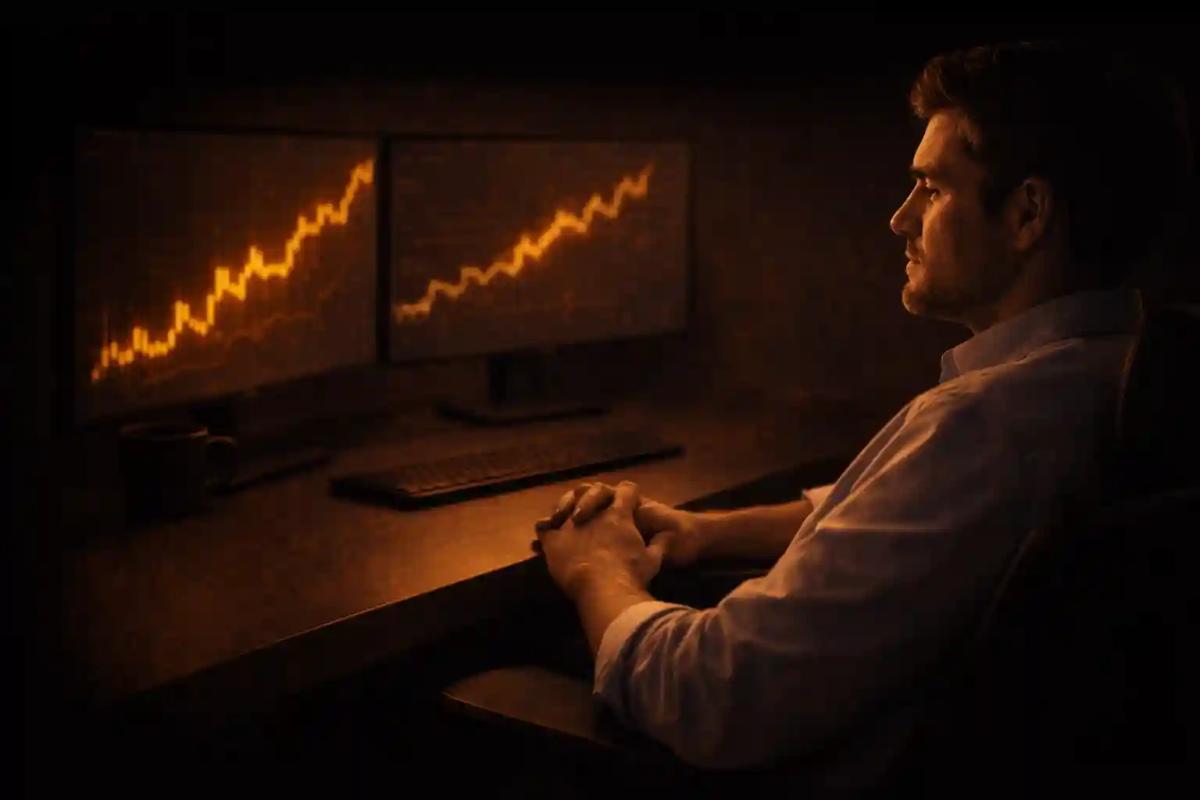
This guide is about understanding the mechanics of post-win psychology so you can enjoy your success without handing it back to the market in the very next session.
Why Winning Feels So Good, And Why That’s a Problem
That surge of satisfaction after a profitable trade is rooted in your neurochemistry. The same biological reward system that makes winning feel incredible is also wired to push you toward repeating the behavior, whether or not conditions still favor it.
The Dopamine Trap After Successful Trades
When you close a winning trade, your brain releases dopamine: the same neurotransmitter involved in nearly every pleasurable human experience. It’s your brain’s shorthand for “that worked, do it again.” In many areas of life, that feedback loop serves you well.
In trading, it becomes a trap.
The problem is that dopamine doesn’t discriminate. It fires whether your win came from rigorous analysis and disciplined execution or from sheer luck on a coin-flip position you had no business taking. Your brain treats both identically: reward, reinforce, repeat.
Think of it like a slot machine. The payout feels the same whether you pulled the lever with a strategy or at random. Your emotional brain can’t tell the difference. Only your rational brain can, and in that moment, it’s often drowned out by the feel-good chemicals flooding your system.
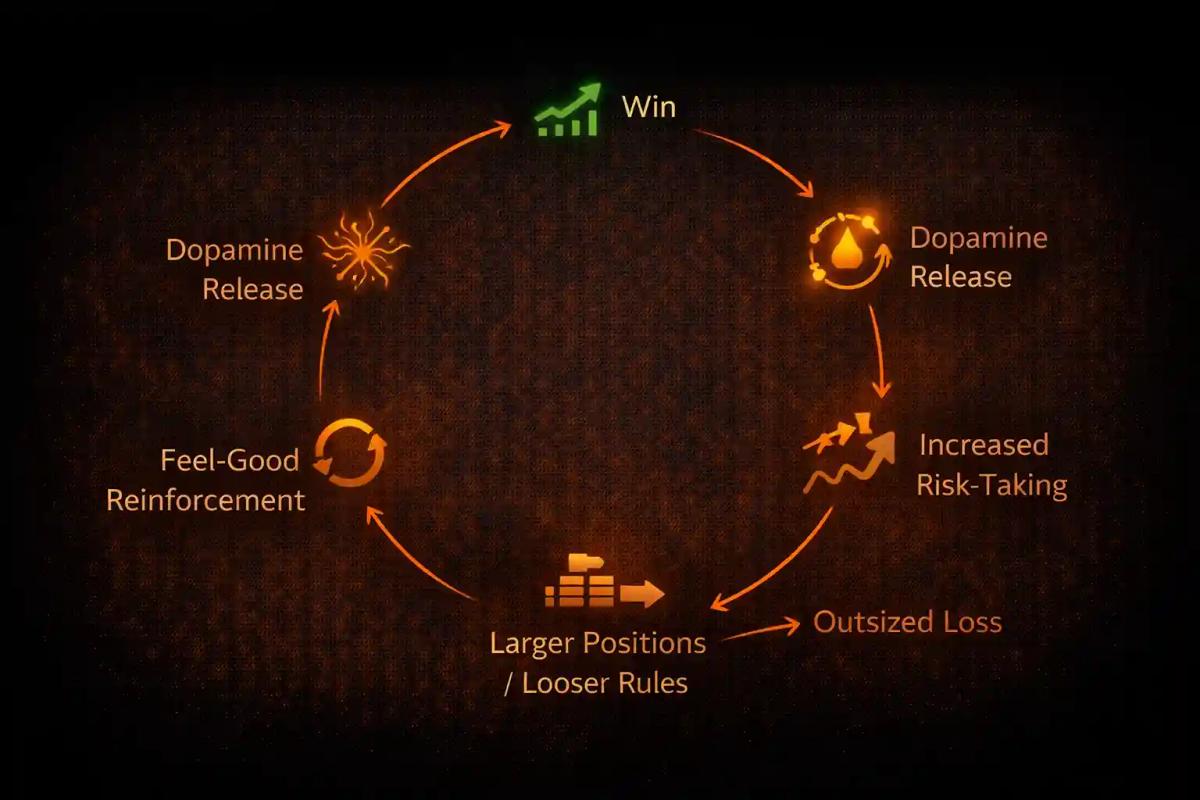
This creates a cycle that feeds on itself: win, feel great, trade more aggressively, chase that feeling. Sometimes you win again, which deepens the loop. Eventually, the market corrects your overreach, but by then, the pattern has already hardened.
When Happiness Crosses Into Overconfidence
There’s a moment where healthy happiness about a well-executed trade morphs into something else entirely. The shift sounds like this in your inner monologue:
- “That was a well-executed trade” becomes “I’m really good at this.”
- “My analysis was correct” becomes “I can see things others can’t.”
- “I followed my plan” becomes “I don’t need the plan anymore, I’ve got the feel for this.”
Each transition is subtle. None of them feel dangerous in the moment. But each one pulls you further from the disciplined process that produced the win and closer to impulsive decision-making dressed up as expertise.
Overconfidence feels like clarity, like you’ve finally cracked the code. That conviction is precisely what makes it so costly.
So when does natural happiness tip into liability? The answer lies in what happens next: in the trades you take after the win.
The Hidden Dangers of Pride in Trading
Pride is a strange beast. In measured doses, it fuels persistence and self-belief. Left unchecked, it becomes a blindfold you put on willingly: one that blocks your view of risk while convincing you that you can see everything perfectly.
How Pride Distorts Risk Assessment
After a winning streak, something shifts in how you evaluate risk. Behavioral finance researchers describe this as the “house money effect.” After gains, people tend to take larger risks because profits feel like the market’s money, not theirs. The wins create a psychological buffer that makes potential losses feel less real, less personal.
In practice, this shows up in specific, recognizable ways:
- Position sizing creep. You start risking 2% per trade instead of your planned 1%, telling yourself you’ve “earned” the room.
- Looser entry criteria. Setups that wouldn’t have met your standards last week suddenly look “close enough.”
- Ignoring stop losses. You give trades more room to breathe because you trust your gut more than your rules.
- Shorter analysis time. You spend less time reviewing charts and more time executing, mistaking speed for skill.
These feel like confidence. That’s what makes pride-driven risk distortion so insidious: it wears the disguise of competence.
The “I Can’t Lose” Mindset and Its Consequences
If you’ve ever had a stretch where trade after trade went your way, you know the feeling. There’s a point where you stop bracing for losses and start assuming wins. The question in your mind shifts from “will this trade work?” to “how much will I make on this one?”
This is the psychological setup for your worst drawdown.
The “I can’t lose” mindset typically ends in one of two ways. Either a single outsized loss snaps you back to reality, or worse, a slow bleed of undisciplined trades erodes your gains so gradually you don’t notice until you’re back to breakeven or below.
The cruelest part is that traders caught in this state often blame the market for “changing” rather than recognizing that their own behavior changed first.
Recognizing the problem in hindsight is easy enough. The real question is: how do you catch it while it’s happening?
Healthy Confidence vs. Destructive Overconfidence
Not all post-win emotions are enemies. Confidence built on genuine skill development and consistent process adherence is an asset. The challenge lies in distinguishing that earned confidence from the inflated, fragile kind that collapses at the first sign of adversity.
Recognizing the Warning Signs in Your Own Behavior
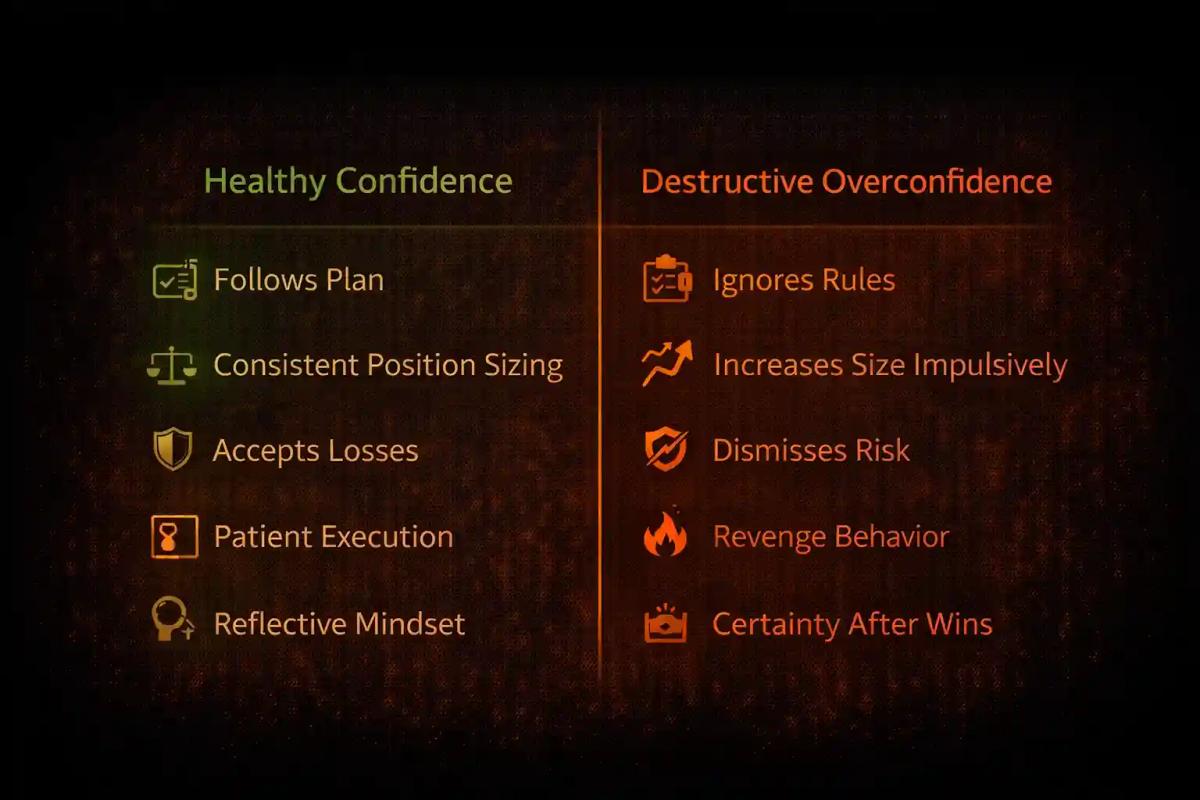
The difference between healthy confidence and destructive overconfidence is about what you do. These behavioral markers can signal you’ve crossed the line:
Signs of healthy confidence:
- You feel good about your process.
- You still review losing scenarios before entering trades.
- Your position sizes remain consistent with your plan.
- You can articulate why a trade worked beyond “I just knew.”
- You maintain the same preparation routine after wins as after losses.
Signs of destructive overconfidence:
- You increase position sizes without a systematic reason.
- You skip pre-trade analysis because you “feel” the market.
- You dismiss contradictory signals or information.
- You attribute all recent success to your own skill.
- You feel annoyed or impatient with your normal risk rules.
- You start offering unsolicited trading advice to others.
That last one might sound minor, but it’s a surprisingly reliable red flag. The urge to teach during a hot streak often signals a shift from quiet competence to ego-driven behavior.
The Role of Luck vs. Skill in Your Wins
Here’s something that’s genuinely uncomfortable to sit with: in any short-term sample of trades, luck plays a far larger role than most traders want to admit.
Picture flipping a coin 20 times. Getting 14 heads wouldn’t mean you’re skilled at flipping heads, it’s well within the range of normal variance. Trading outcomes over weeks or even months work similarly. You can do everything right and lose, or do several things wrong and still win. And the emotional weight of that win can trick you into believing the wrong things about your own ability.
This is about holding two truths at once: you may be genuinely improving as a trader, and your recent winning streak may have been partly aided by favorable market conditions that won’t last.
The traders who survive long-term are the ones who can enjoy a win while asking themselves honestly: “How much of that was me, and how much was the market handing me a gift?”
That kind of honest self-assessment is the foundation of sustainable confidence. And it requires specific tools and habits to maintain, especially when your brain is flooded with dopamine telling you you’re untouchable.
Practical Strategies for Staying Humble After Wins
To protect yourself from pride, you need systems: concrete, repeatable practices that act as guardrails when your judgment is compromised by success.
The Cooling-Off Period Between Trades
One of the simplest and most effective defenses against pride-driven trading is enforced time away from the screen after a significant win.
When you step away, even for a few hours or a single trading session, you give your rational brain time to catch up with your emotional brain.
During the cooling-off period, do something completely unrelated to trading. Go for a walk, exercise, spend time with people who don’t care about your P&L. The goal is to let the dopamine settle so that your next trade comes from analysis, not momentum.
Some traders build this directly into their rules: after any trade that exceeds a certain profit threshold, they sit out the next session. It feels counterintuitive: why stop when you’re winning? But that resistance is precisely the point. If stepping away feels difficult, that’s a signal the emotional pull is strong enough to distort your next decision.
Using a Trading Journal to Check Your Ego
A trading journal is the most honest mirror you’ll ever have as a trader. But only if you use it honestly.
Most traders journal the basics: entry, exit, profit or loss. That’s useful, but it’s not enough to catch pride-driven behavior. To use your journal as a genuine ego-management tool, you need to track the emotional and psychological dimensions of each trade.
Key fields to include alongside your standard trade data:
- Emotional state before entry: How were you feeling? Confident, cautious, euphoric, bored?
- Confidence level (1–10): Rate your conviction honestly. Track whether higher confidence correlates with better or worse outcomes over time.
- Luck vs. skill assessment: After the trade closes, honestly estimate what percentage of the outcome came from your analysis versus market conditions.
- Did I follow my rules? A simple yes or no, but be ruthlessly honest.
- Lessons or warnings: What would you tell yourself before taking this trade again?
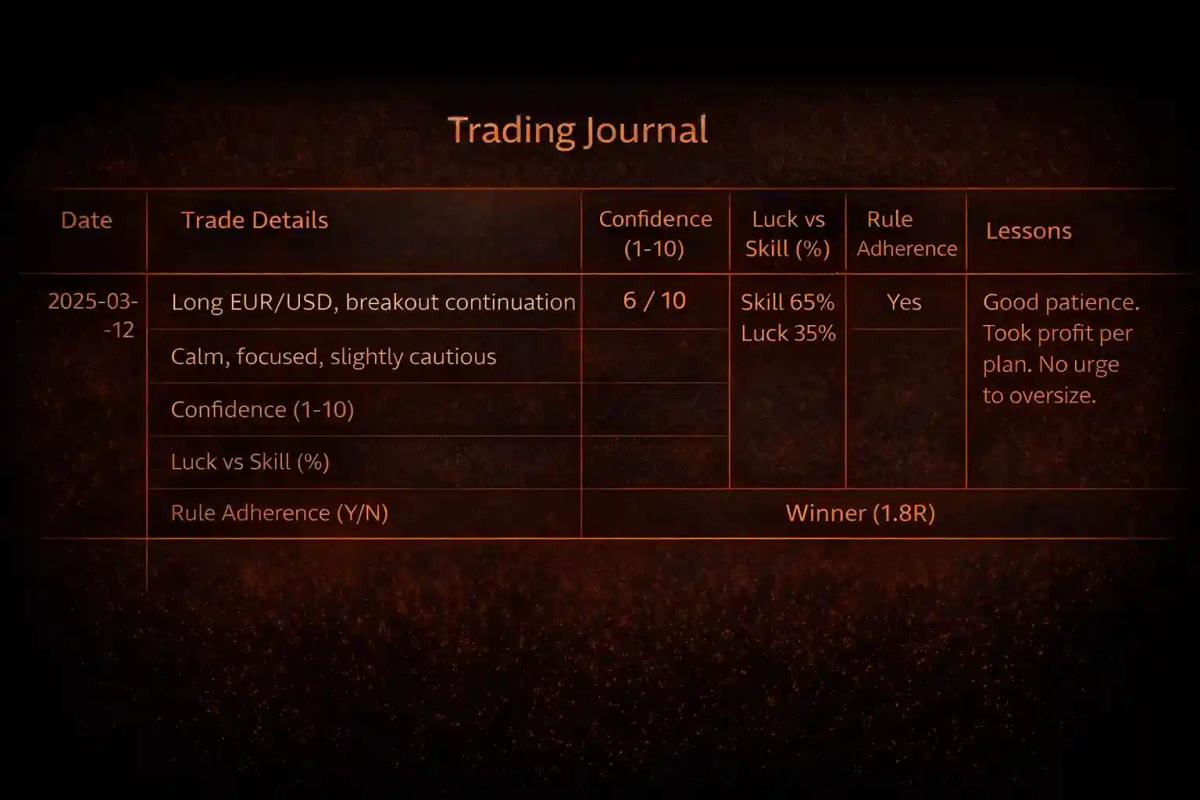
Over weeks and months, this data reveals patterns your memory alone will bury. You might discover that your worst losses consistently follow your highest-confidence entries. Or that you make the most money when your confidence sits at a moderate level.
The journal doesn’t lie. Your memory, filtered through pride, absolutely will.
Pre-Commitment Rules That Protect You From Yourself
Pre-commitment is exactly what it sounds like: making decisions about your behavior before you’re in the emotional state that compromises your judgment.
Think of it like setting a spending limit before walking into a store during a sale. You know your future self will be tempted, so your present self draws the boundary.
Effective pre-commitment rules for managing post-win pride:
- Fixed position sizing. Decide your risk percentage before each week or month and don’t adjust it upward based on recent results.
- Maximum consecutive trades. Set a cap on how many trades you take in a single session, regardless of how well things are going.
- Mandatory review triggers. If your account grows beyond a set percentage in a week, require a full strategy review before placing the next trade.
- Accountability check-ins. Share your rules with a trading partner or mentor and have them ask you directly whether you’re sticking to them after winning periods.
The power of pre-commitment is that it removes the decision from the moment when you’re least equipped to make it well. You don’t have to wrestle with your ego in real time, you just follow the rules you set when you were thinking clearly.
Building a Sustainable Relationship With Success
The goal of everything above is about building a relationship with success that actually lasts.
Redefining What “Good Trading” Actually Means
Most traders define good trading by the outcome: did I make money? But outcomes on individual trades are noisy. A terrible decision can produce a profit, and a textbook setup can result in a loss.
If your definition of “good trading” is tied to short-term results, your emotional state will ride a rollercoaster. And your pride will spike on every green day, setting you up for the exact pattern we’ve been discussing.
A more durable definition of good trading centers on process. A good trade is one where you identified a valid setup, sized appropriately, managed the position according to your plan, and reviewed the outcome honestly afterward, regardless of whether it made money.
This fundamentally changes what triggers your pride. Instead of being proud because you won, you’re proud because you executed well. One of those is within your control. The other isn’t.
Long-Term Mindset Over Short-Term Highs
The traders who last are the ones who maintain roughly the same emotional baseline whether they’re up 5% or down 2% on the week.
That might sound boring. It is. And that’s the point.
Sustainable trading success is built on consistency, routine, and the willingness to treat every single trade as one data point in a very long series. Your next hundred trades matter more than your last five. Your process over the next year matters more than your P&L this month.
Give yourself permission to feel good after a win. But when the satisfaction starts whispering that you’re special, that you’ve figured it all out, that the rules don’t quite apply to you anymore; that’s the moment to pause, open your journal, and remember that the market has a way of humbling everyone who stops paying attention.

About the authors

Related articles
Analysis Paralysis in Trading: Why You Freeze and How to Fix It
Learn to recognize analysis paralysis in trading, understand its psychological roots, and build a decision-making framework with confident execution.
Anchoring Bias in Trading: How Mental Price Traps Cost You Money
Learn how anchoring bias distorts your trading decisions. Spot mental price traps, break free from fixation on entry prices, and build systems to protect your returns.
Anger in Trading: Why It Happens and How to Control It
Learn why anger strikes during trading, how it destroys performance through revenge trades and broken rules, and proven techniques to control it.
0 comments