


Hindsight Bias in Trading: Why “I Knew It All Along” Is Holding You Back
Hindsight bias is one of the most deceptive mental traps in trading. It rewires how you remember your own decisions, distorts your trade reviews, and quietly prevents you from learning what actually went wrong or right.
This guide breaks down exactly how hindsight bias operates in your trading, why it’s so damaging, and what you can do to strip it out of your decision-making process so you can build real, lasting skill.
What Is Hindsight Bias?
The Psychology Behind “I Knew It All Along”
Hindsight bias is the tendency to look at past events and believe you predicted them, or at least could have predicted them, even when you had no real basis for that belief at the time. Researcher Baruch Fischhoff first documented this phenomenon in the 1970s, and decades of research since have confirmed it’s not a personality flaw or a sign of arrogance. It’s a deeply embedded feature of how human memory works.
Here’s what actually happens in your brain: once you know an outcome, your memory quietly reorganizes itself to make that outcome feel inevitable. Information that supported the result gets amplified. Information that pointed elsewhere gets downplayed or forgotten entirely. Your brain is doing it automatically, behind the scenes, without your permission.
In everyday life, this is mostly harmless. You watch a movie, guess the twist halfway through, and tell your friends you “called it.” But in trading, where your ability to honestly assess your own decisions determines whether you improve or stagnate, hindsight bias becomes a silent killer.
Hindsight Bias vs. Genuine Pattern Recognition
This is where things get tricky, because sometimes you really did see it coming. Experienced traders develop legitimate pattern recognition over time. So how do you tell the difference between a real skill and a retroactive illusion?
Genuine pattern recognition is something you can articulate before the outcome. You can write down your thesis, your entry criteria, your expected scenarios, and your invalidation points in advance. If the trade plays out as expected, you have documented evidence that your read was correct.
Hindsight bias only shows up after the fact. You couldn’t have explained the logic clearly before the move happened, but afterward, it all seems perfectly logical. If you catch yourself constructing the narrative after the chart has already moved, that’s your red flag.
So how does this actually play out when you’re sitting at your desk reviewing last week’s trades?
How Hindsight Bias Shows Up in Trading
Reviewing Trades After the Fact
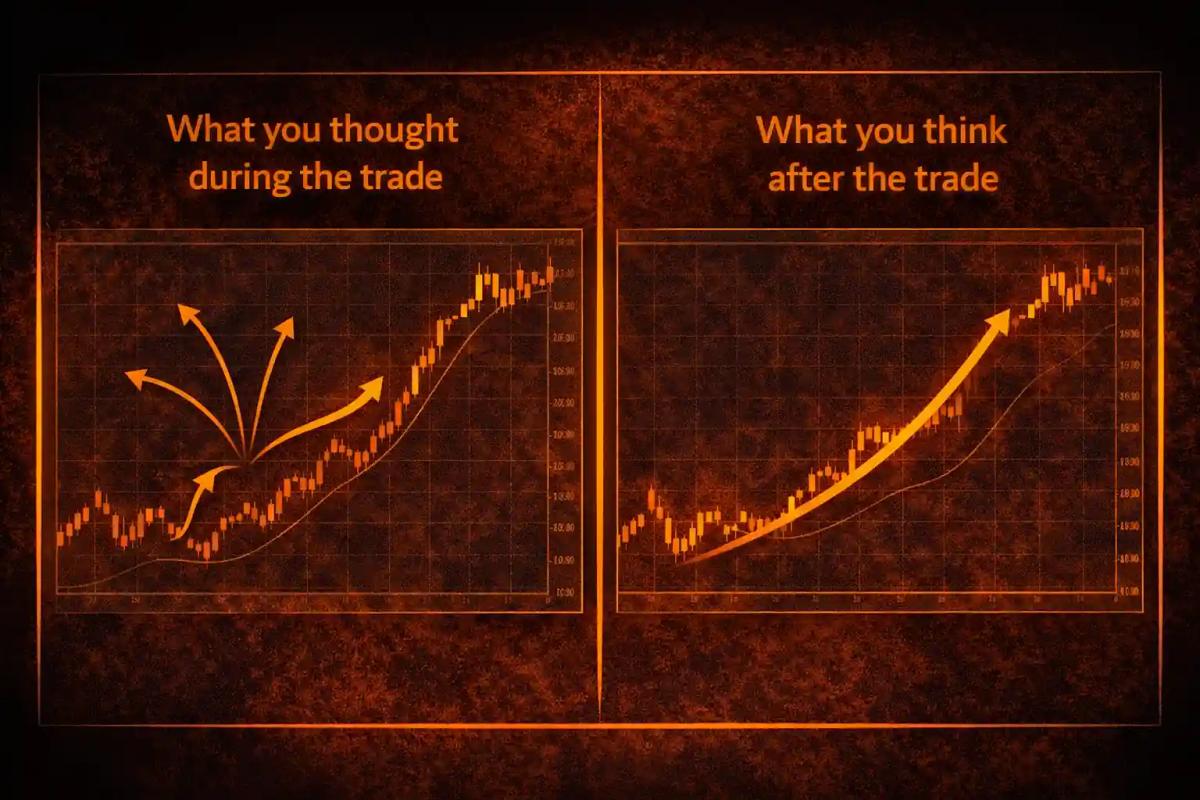
Every trader who takes improvement seriously reviews their trades. But the review process itself is where hindsight bias does its heaviest damage. You open a chart, already knowing exactly what happened, and your brain immediately starts constructing a story that makes the outcome look predictable.
You see the losing trade and think, “Why didn’t I just wait for that confirmation candle?” You look at the winner and think, “I read that perfectly.” But in the moment, that confirmation candle was just another candle in a sea of noise. The winner might have been a coin flip that happened to land your way. Your post-trade review isn’t giving you truth. It’s giving you a highlight reel edited by a biased narrator.
The Monday Morning Quarterback Trap
You know the type in sports. The guy on Monday who explains exactly why the coach should have called a different play on third down. He has all the answers, conveniently, after the game is over.
Traders fall into this constantly. After a Fed announcement tanks the market, it was “obvious” the statement would be hawkish. After a breakout fails, the resistance level was “clearly” too strong. This is the Monday morning quarterback trap: hindsight bias wearing a jersey.
The danger is that you start trusting your after-the-fact analysis as if it were real-time skill. You build confidence on a foundation of revisionist memory, and that foundation cracks the moment the market stops cooperating.
Overconfidence After Winning Streaks
A winning streak feels amazing. It also supercharges hindsight bias. After a string of winners, you look back and every trade seems like a perfectly executed read. Your strategy feels bulletproof. Your confidence swells.
But some of those wins were probably luck, or at least partially luck. Hindsight bias erases the uncertainty you felt during those trades and replaces it with a clean narrative of skill and foresight. As a result, you take setups you wouldn’t normally touch because you “feel” the market. And that’s usually when the streak ends, painfully.
Misreading Losses as “Obvious Mistakes”
On the flip side, hindsight bias also warps how you process losses. A trade that was perfectly reasonable given the information you had at entry suddenly looks like an “obvious mistake” once you see the outcome.
This is corrosive. If every loss looks like an obvious error in hindsight, you never learn to distinguish between a genuinely poor decision and a well-reasoned trade that simply didn’t work out. That distinction is everything in this game.
But recognizing the pattern is just the first step. Why does this bias matter so much for your growth as a trader?
Why Hindsight Bias Is Dangerous for Traders
It Prevents Objective Evaluation of Your Decisions
Your ability to improve depends entirely on your ability to evaluate your decisions honestly. Hindsight bias makes that nearly impossible. When every outcome looks predictable after the fact, you lose the ability to assess whether your process was sound, regardless of the result. You end up optimizing for outcomes instead of decision quality, which is a recipe for inconsistency.
If you’re interested in building a stronger foundation for protecting your capital, solid risk management starts with honest self-assessment. Hindsight bias is the biggest obstacle standing in the way.
It Creates False Confidence in Flawed Strategies
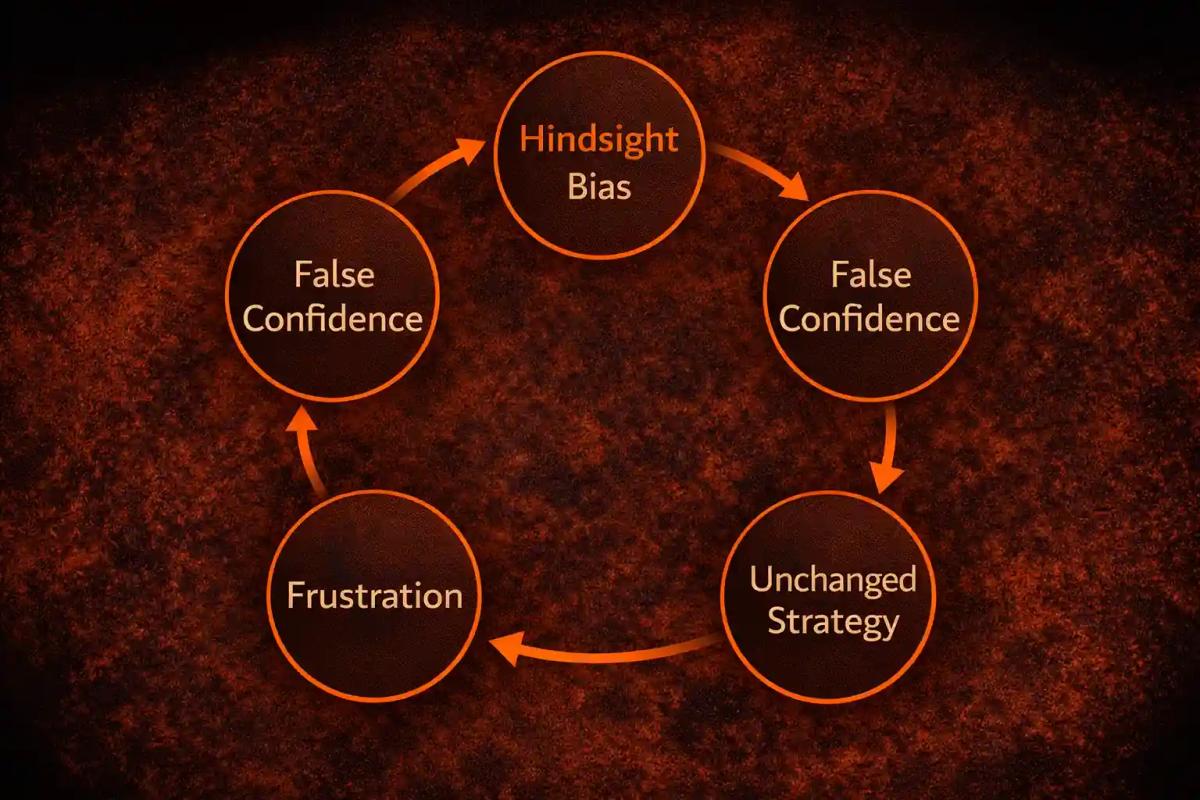
Think about what happens when hindsight bias goes unchecked over months. You develop a sense that your strategy “works” based on a curated, backward-looking narrative rather than objective data. You become resistant to changing things because, in your memory, your reads have been mostly right. The strategy doesn’t need fixing; you just need to “execute better.”
This is how traders get stuck on a plateau for years. They’re confident in an approach that their own biased memory has validated, and they never think to question the foundation beneath it.
It Blocks Real Learning and Skill Development
Real learning requires confronting uncertainty. It requires admitting that you didn’t know what was going to happen, that your edge is probabilistic, and that individual outcomes don’t prove or disprove your method. Hindsight bias short-circuits all of that by making everything feel knowable after the fact.
If you never sit with the discomfort of genuine uncertainty, you never develop the skills that actually matter: reading probability, managing risk dynamically, and sticking to your process when the outcome is still unknown. Understanding how trading psychology shapes your behavior is the first step toward breaking that cycle.
So how do you catch yourself in the act?
How to Identify Hindsight Bias in Your Own Trading
Warning Signs You Are Rationalizing, Not Analyzing
Spotting hindsight bias in yourself is difficult precisely because it feels like legitimate analysis. But there are telltale signs that you’ve crossed the line from analyzing into rationalizing:
- You frequently say “I knew it” or “that was obvious” when reviewing trades
- Your trade reviews almost always confirm your original thesis, win or lose
- You rarely identify trades where you were simply wrong about the setup
- You find yourself cherry-picking indicators or data points that support the outcome after the fact
- You feel more certain about past trades than you did while they were live
- Your review notes read like a clean narrative rather than a messy, honest assessment
If more than a couple of these sound familiar, hindsight bias is probably active in your process.
Questions to Ask Yourself During Trade Reviews
Before you review any trade, try running through these questions:
- What did I actually believe when I entered this trade, and can I prove it?
- What were the two or three most likely scenarios I considered before entry?
- What information did I not have at the time that I’m using now to evaluate the trade?
- If the outcome had been the opposite, would I still evaluate my decision the same way?
- Am I focusing on the process I followed, or just the result I got?
These questions force you to separate what you knew from what you know now. They’re uncomfortable. But that discomfort is a sign you’re doing it right.
What if you want to go beyond identifying the problem and start actively reducing it?
Practical Methods to Reduce Hindsight Bias
Pre-Trade Journaling and Decision Documentation
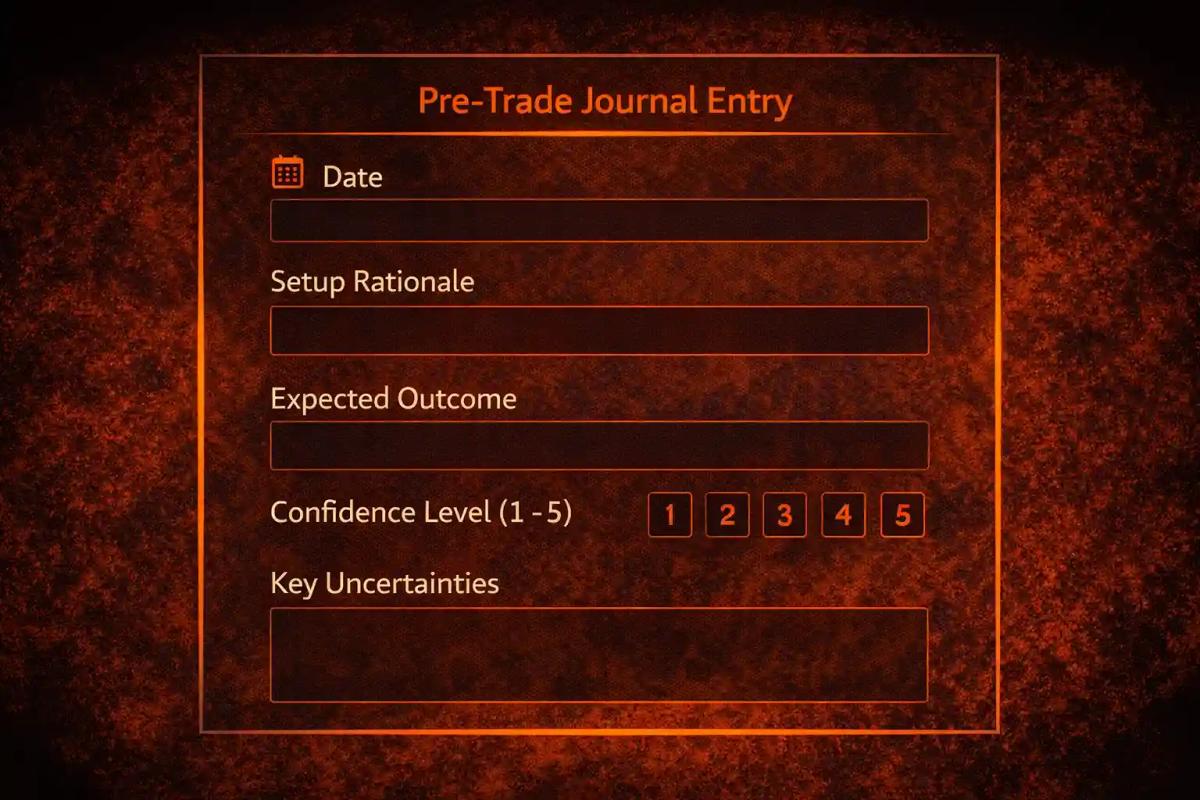
The single most effective countermeasure against hindsight bias is writing down your reasoning before you know the outcome. This means documenting, before entry:
- Your setup and why it qualifies
- Your expected outcome and invalidation point
- Your confidence level (on a simple 1-5 scale)
- The key uncertainties or risks you see
- Alternative scenarios that could play out
This creates a timestamped record of what you actually thought in real time. When you review the trade later, you can’t rewrite the narrative because the original story is already on paper. If you want to go deeper on building a solid review process, a structured trade journaling approach makes all the difference.
Process-Based Trade Reviews (Not Outcome-Based)
Most traders review trades by looking at whether they made or lost money. That’s outcome-based review, and it’s where hindsight bias thrives. Instead, shift to process-based review. Ask: did I follow my plan? Was my entry criteria met? Did I manage risk according to my rules?
A trade where you followed your process perfectly but lost money is a good trade. A trade where you broke every rule and got lucky is a bad trade. Until you internalize that distinction, hindsight bias will keep distorting your reviews.
Using Forward-Looking Analysis Instead of Backward Narratives
When you review a trade, resist the urge to start with the outcome and work backward. Instead, try covering the right side of the chart. Look at the setup as it appeared at entry, without seeing what happened next. Write your analysis of what you think should have happened. Then reveal the outcome.
This simple technique forces your brain to engage with the same uncertainty you faced in real time. It’s harder, slower, and much less satisfying than just scrolling through a completed chart. That’s exactly why it works.
Building Accountability Through External Feedback
Hindsight bias is an internal process, which means you’re often the last person to notice it in yourself. External accountability, whether from a trading partner, a mentor, or even a structured peer review group, introduces perspectives that aren’t contaminated by your own memory distortions.
When someone else reviews your trades and asks, “But what did you actually see at the time?”, it’s much harder to maintain a revisionist narrative. That kind of feedback can sting. It can also be the thing that finally breaks you out of a learning plateau.
Learning Properly from Wins and Losses
Separating Luck from Skill
Here’s a truth that most traders resist: you can make the right decision and lose, and you can make the wrong decision and win. In a probabilistic environment like trading, outcomes on individual trades tell you very little about decision quality.
Think of it like poker. A professional poker player can make the mathematically correct call and still lose the hand. That doesn’t make the decision wrong. Over hundreds of hands, good decisions produce good results. But on any single hand, luck plays a massive role.
Your job during trade review is to judge whether the decision was sound given the information available at the time. That’s a completely different question, and hindsight bias constantly tries to blur the line between the two.
Creating a Repeatable Evaluation Framework
To consistently learn from your trades without hindsight bias corrupting the process, you need a repeatable framework. A simple version might look like this:
- Pre-trade documentation – Record your thesis, criteria, and uncertainties before entry
- Blinded review – Assess the setup quality without looking at the outcome first
- Process scoring – Rate how well you followed your own rules (separate from P&L)
- Pattern tracking – Over 20-50 trades, look for recurring process errors, not just recurring outcomes
- Periodic comparison – Compare your pre-trade expectations with actual results to calibrate your confidence levels over time
This kind of structured approach turns trade review from a subjective storytelling exercise into an objective learning system. It takes more effort, yes. But it’s the difference between spinning your wheels and actually progressing.
Frequently Asked Questions
What's the difference between hindsight bias and learning from experience?
Learning from experience involves analyzing what information was available at the time of the decision and evaluating whether the process was sound. Hindsight bias, by contrast, uses knowledge of the outcome to rewrite your memory of the decision. The key test is whether your analysis would change if the outcome had been different. If it would, you're likely dealing with bias rather than genuine learning.
Does hindsight bias affect experienced or professional traders?
Yes. The research is somewhat mixed, but the general finding is that expertise can reduce hindsight bias without eliminating it entirely. Professional traders are still susceptible, and general research on overconfidence suggests that winning streaks or periods of high confidence may heighten the effect. The difference is that experienced professionals tend to have systems in place, like pre-trade documentation and structured reviews, that limit the bias's impact on their process.
How can I tell if I'm rationalizing a trade versus genuinely analyzing it?
The clearest indicator is whether your analysis could have been written before you knew the outcome. If you find yourself constructing explanations that only make sense with hindsight, or cherry-picking data points that support what already happened, you're rationalizing. Genuine analysis starts with what you knew at entry and evaluates process quality independent of results.
How do trading journals help combat hindsight bias?
Trading journals create a real-time record of your thinking before outcomes are known. When you document your thesis, confidence level, and key uncertainties before a trade plays out, you create evidence that your post-trade review can't override. Without that written record, your memory is free to reconstruct events in whatever way feels most comfortable, which is exactly what hindsight bias does.
Is hindsight bias related to overconfidence?
They're closely connected. Hindsight bias feeds overconfidence by making past decisions seem more prescient than they actually were. When you consistently remember yourself as "having known" what would happen, your confidence in future predictions inflates beyond what your actual track record justifies. This can lead to increased risk-taking, larger position sizes, and reduced discipline.
How often should I review past trades to avoid retrospective distortion?
Reviewing trades soon after they close, within a day or two, can reduce some memory distortion, but the timing matters less than the method. The most important factor is having pre-trade documentation to compare against. Whether you review daily or weekly, always start with what you wrote before the trade, not with the outcome. Batch reviews over 20-50 trades are also valuable for spotting patterns that single-trade reviews miss.
Can demo trading be affected by hindsight bias?
Absolutely. Hindsight bias operates on any situation where outcomes are known after decisions are made, regardless of whether real money is involved. In fact, demo trading can sometimes amplify the effect because the lack of financial consequences makes it easier to gloss over poor decisions and focus on the trades that "worked." The same documentation and review practices apply whether you're trading live or in a simulated environment. This article is for educational purposes only and does not constitute financial advice. Trading involves substantial risk, and no psychological technique guarantees profitability.
About the authors


Related articles
Analysis Paralysis in Trading: Why You Freeze and How to Fix It
Learn to recognize analysis paralysis in trading, understand its psychological roots, and build a decision-making framework with confident execution.
Anchoring Bias in Trading: How Mental Price Traps Cost You Money
Learn how anchoring bias distorts your trading decisions. Spot mental price traps, break free from fixation on entry prices, and build systems to protect your returns.
Anger in Trading: Why It Happens and How to Control It
Learn why anger strikes during trading, how it destroys performance through revenge trades and broken rules, and proven techniques to control it.
0 comments