


How to Manage a Losing Streak in Trading (and Come Back Stronger)
Every trader hits a losing streak. It’s not a matter of if, it’s a matter of when. And when it arrives, that stretch of red trades can feel like the market is personally out to get you. Before you know it, a manageable drawdown has spiraled into something that threatens your account and your mental health.
What most trading content glosses over is this: losing streaks are a statistical certainty. They’re baked into the math of every strategy, no matter how sharp your edge. The difference between traders who survive them and traders who blow up is having a clear, repeatable protocol for managing the streak, protecting capital, and coming back with clarity instead of desperation.
This guide gives you exactly that. You’ll walk away with a framework you can use during your next losing streak, and every one after that, to stay in control when everything feels like it’s falling apart.

What a Losing Streak Actually Is (and What It Is Not)
A losing streak can shake your belief in everything: your strategy, your skills, even your future as a trader. But before you start tearing apart your trading plan, it pays to understand what you’re actually dealing with.
Statistical Reality of Consecutive Losses
Let’s get something straight: consecutive losses are mathematically inevitable.
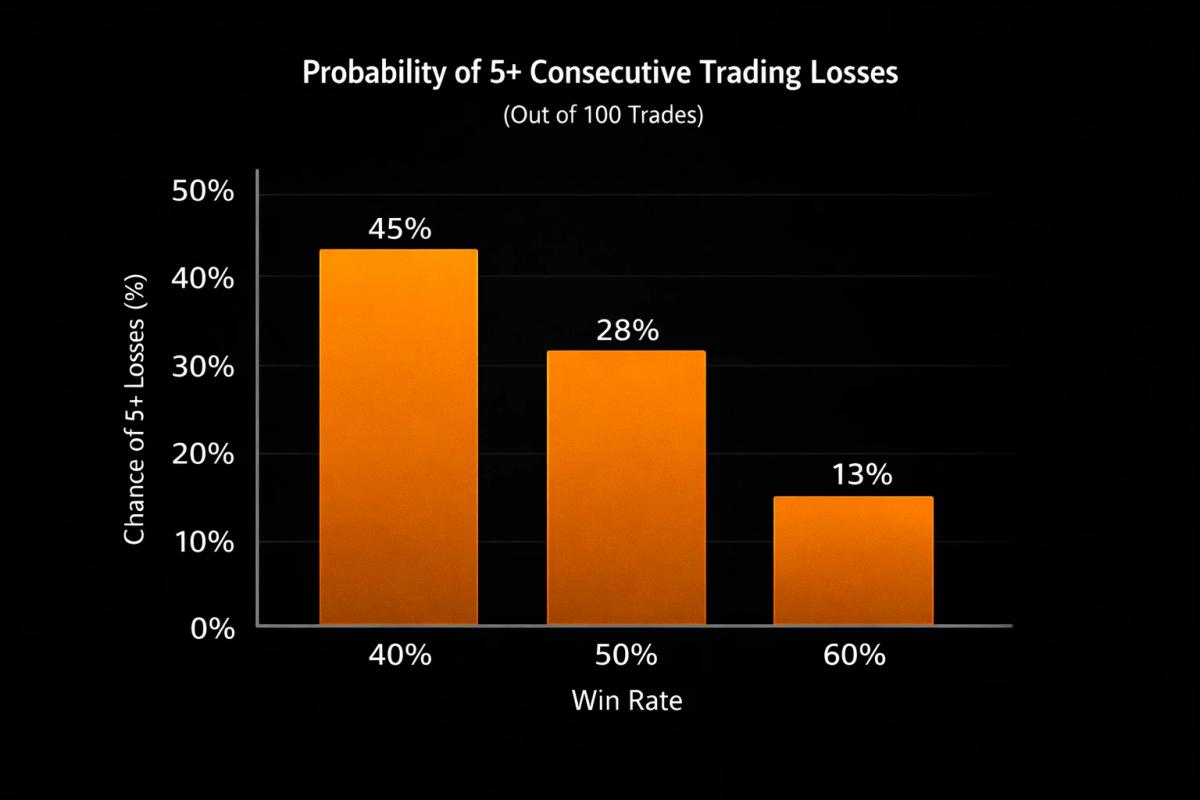
If your strategy has a 50% win rate (which is respectable for many styles of trading), the probability of hitting five losses in a row over a sample of 100 trades isn’t some rare, freak event. It’s expected. Stretch that sample to 200 or 500 trades, and streaks of six, seven, or even eight consecutive losses become increasingly likely.
Think of it like flipping a coin. You know it’s 50/50, but nobody bats an eye when heads comes up five times in a row during a long session. Your trading account works the same way. Wins and losses don’t distribute themselves neatly. They cluster.
Here’s a rough breakdown to ground this:
The point is that your strategy can be working perfectly and you’ll still hit stretches that feel terrible. Understanding this doesn’t make the losses sting less, but it does stop you from making a catastrophic decision based on a completely normal event.
Losing Streak vs. Broken Strategy: Knowing the Difference
This is where things get tricky, and where most traders make their costliest mistake during a drawdown. They assume the streak means the strategy is broken, tear it apart mid-drawdown, and replace it with something untested. That’s almost always worse than riding it out.
So how do you tell the difference?
A normal losing streak looks like this: your entries still align with your plan, your position sizing is consistent, and the losses fall within the range your backtesting or forward testing predicted. The market simply isn’t cooperating right now.
A broken strategy looks different. You notice that market conditions have fundamentally shifted (a trending market turned into a choppy range, or volatility collapsed), and your setup no longer triggers the way it used to. Or your backtesting sample was too small, and real-world performance is diverging from expectations consistently, not just in a cluster.
The key question to ask yourself: “Am I executing my plan correctly, or am I deviating?” If your execution is clean and the losses sit within your expected drawdown range, the strategy likely isn’t the problem. If your execution is clean but losses are exceeding anything your testing predicted, that warrants a deeper investigation, though not a panic overhaul.
Still, knowing the difference is only half the battle. The real danger of a losing streak is what happens inside your head while they’re piling up.
Why Losing Streaks Escalate
A string of losses triggers a predictable emotional chain reaction, and if you don’t catch it early, it will hijack your trading.
The Emotional Cascade: Fear, Frustration, Revenge
It almost always follows the same arc. The first couple of losses sting, but you handle them. By loss three or four, frustration creeps in. You start second-guessing your entries. By loss five or six, one of two things happens: you either freeze up and become afraid to take your next valid setup, or you swing the other way and start revenge trading, forcing trades to “win it back.”
Revenge trading is the account killer. It’s the moment your decisions stop being about your strategy and start being about your ego. You increase position size to recover faster. You take setups you’d normally skip. You move stop losses because you “just know” this one will turn around. Each of those choices compounds the problem, turning a normal drawdown into a serious one.
Fear is quieter but equally destructive. When you start skipping valid setups because the last few didn’t work, you’re no longer trading your strategy. You’re trading your emotions. And the cruel irony is that the trades you skip out of fear are often the ones that would have broken the streak.
How Cognitive Biases Fuel Poor Decisions Mid-Streak
Your brain is wired to make losing streaks worse. This isn’t a character flaw. It’s basic human psychology working against you in a trading context.
Recency bias makes your last few trades feel more significant than they are. Five losses in a row can feel like proof your edge is gone, even though they represent a tiny fraction of your overall sample.
Loss aversion means each loss lands harder emotionally than an equivalent win would. After several losses, the emotional weight becomes overwhelming, pushing you toward irrational risk-taking just to avoid feeling more pain.
Sunk cost thinking kicks in when you start justifying bad decisions because you’ve “already lost so much.” Holding a losing trade past your stop because you can’t stomach booking another loss? Classic sunk cost behavior.
Recognizing these patterns in yourself requires honesty. And once you see them, you can interrupt them, which brings us to what you should actually do when you’re in the thick of a streak.
The Immediate Response Protocol
When a losing streak hits, your instinct will be to trade harder, trade differently, or trade more. Every one of those instincts is wrong. What you need instead is a structured, predetermined response that removes emotion from the equation.
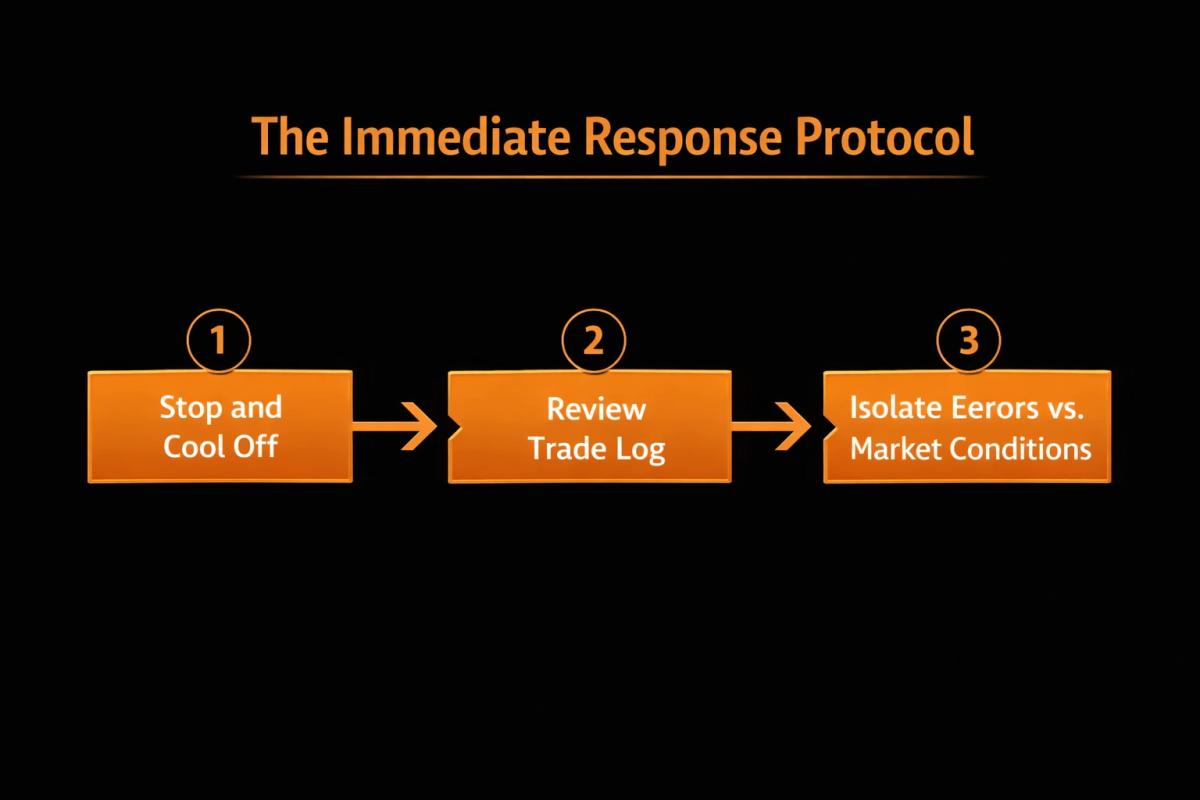
Step 1: Stop Trading and Set a Cooling-Off Rule
This is the hardest step and the most important. When you’re deep in a losing streak, stepping away is the single most effective thing you can do to stop the bleeding.
Set a concrete cooling-off rule before you ever need it. Some examples that many traders find effective:
- Three consecutive losses in a day: Stop trading for the rest of the session.
- Maximum daily loss hit: Walk away, no exceptions.
- Five consecutive losses across sessions: Take a full 24 to 48 hours off the screens.
The specific numbers are yours to define, but the principle is non-negotiable: your rule must be automatic, not discretionary. If you leave it to “I’ll stop when I feel like I should,” you won’t stop. Your frustrated brain will always justify one more trade.
During your cooling-off period, get away from the charts. Go outside, exercise, do something completely unrelated to markets. The goal is to break the emotional feedback loop so you return with a clear head.
Step 2: Review Your Trade Log Objectively
Once you’ve cooled off, open your trading journal. If you don’t have one, this is exactly why you need one, but we’ll get to that later.
Go through each losing trade and ask specific questions:
- Did I enter according to my plan’s criteria?
- Was my position size correct?
- Did I manage the trade (stops, targets) as planned?
- Was the setup objectively valid at the time of entry?
Were the losses a result of something you did wrong, or something the market did that was outside your control?
Step 3: Isolate Execution Errors from Market Conditions
This step is where your review becomes actionable. Separate your losing trades into two buckets:
- Execution errors: Trades where you deviated from your plan. Maybe you entered early, moved your stop, sized too large, or took a setup that didn’t meet all your criteria.
- Market condition losses: Trades where you followed your plan precisely, but the market simply didn’t cooperate. Your edge didn’t play out on those particular trades.
If most of your losses land in the first bucket, the fix is clear: tighten your execution discipline. If most sit in the second, your strategy may simply be moving through a normal drawdown period, and the best response is patience and continued execution.
This distinction changes everything. It transforms a losing streak from a vague, demoralizing experience into a diagnostic tool. Once you have that clarity, you can make informed decisions about what comes next.
Protecting Your Capital During a Streak
A losing streak you can recover from is just a rough patch. A losing streak that destroys your account is a career-ender. The gap between the two comes down to how aggressively you protect your capital when things go sideways.
Reducing Position Size Temporarily
One of the most practical things you can do during a drawdown is cut your position size. Many traders find that reducing to 50% or even 25% of their normal size accomplishes two things at once: it slows the rate of capital loss, and it reduces the emotional intensity of each trade.
Think of it this way: if you’re a boxer who just absorbed a series of hard shots, you don’t keep standing in the pocket trading blows. You clinch, you move, you buy yourself time to recover. Reducing position size is the trading equivalent. You’re still in the fight, but you’re managing your exposure while you find your footing.
The key is to have a predefined rule for when you scale down. For example: “If my account drops 5% from its peak, I reduce position size by half until I recover 50% of the drawdown.” This removes the guesswork and keeps you from making emotional sizing decisions.
Setting a Maximum Daily and Weekly Loss Limit
If you don’t have daily and weekly loss limits, you’re trading without a safety net. These limits act as circuit breakers that force you to stop before a bad day or bad week turns into a catastrophic one.
Consider setting limits like:
- Daily loss limit: 1-2% of account equity
- Weekly loss limit: 3-5% of account equity
When you hit the limit, you’re done. No exceptions, no “just one more trade.” This might feel restrictive, but it’s the kind of restriction that keeps you in the game long enough for your edge to play out over hundreds of trades.
When to Switch to a Demo Account
There’s no shame in switching to a demo account during a severe losing streak. In fact, it can be one of the smartest moves you make.
A demo account lets you keep trading your strategy, staying sharp and maintaining your routine, without risking real capital during a period where your confidence is shaken. It’s especially useful when you’re uncertain whether the issue is your strategy or your execution, because you can test in a risk-free environment while you work it out.
Consider switching to demo when:
- Your drawdown has exceeded your predefined maximum
- You notice you’re hesitating on valid setups due to fear
- You’ve made consecutive emotional (non-plan) trades
- You want to test strategy adjustments before risking real capital
The goal is to give yourself a safe space to rebuild your process and confidence before putting real money back on the line.
Protecting capital, though, is only half of the recovery equation. The other half is rebuilding the confidence to trust your process again.
Rebuilding Confidence After a Losing Streak
Confidence in trading is about trusting your process even when recent results have been painful. Rebuilding that trust after a streak takes patience and a structured approach, not a leap of faith.
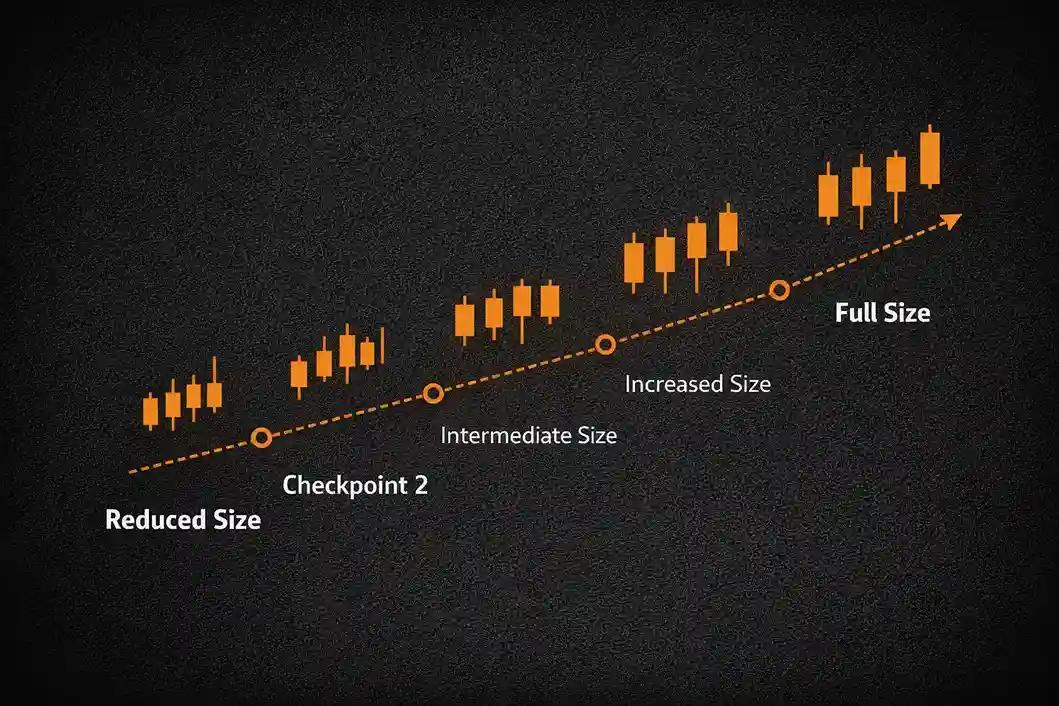
The Gradual Re-Entry Approach
Don’t go from a losing streak straight back to full-size positions. That’s like running a marathon the day after recovering from the flu. Instead, consider a staged re-entry:
- Start with reduced size (25-50% of normal) for your first 5-10 trades back.
- Set checkpoints: After a set number of executed-to-plan trades (not necessarily winners, just properly executed ones), increase size by one step.
- Return to full size only after you’ve demonstrated consistent execution and your confidence feels stable, not forced.
This approach does something powerful psychologically. It shifts your focus from “I need to make money to recover” to “I need to execute well.” And ironically, that shift in focus is usually what gets the money flowing again.
Reframing Losses as Data
Every losing trade contains information. The problem is that during a streak, your emotional brain treats each loss as evidence that you’re a bad trader, rather than treating it as a data point in a larger sample.
Try this reframe: after a loss, instead of thinking “I lost again,” ask yourself “What did this trade tell me?”
This helps to recognize that every trade, win or loss, is a piece of feedback that can sharpen your edge. But only if you’re willing to analyze it clearly.
Tracking Recovery Metrics That Matter
During recovery, most traders obsess over P&L. That’s the wrong metric to focus on right after a streak. Instead, consider tracking:
- Plan adherence rate: What percentage of your trades followed your plan exactly?
- Average risk-reward on executed trades: Are you taking setups with the right R:R profile?
- Emotional state log: Before each trade, note your emotional state on a simple 1-5 scale. Look for patterns between emotional state and execution quality.
- Consecutive plan-compliant trades: Track how many trades in a row you’ve executed according to your rules, regardless of outcome.
These metrics keep your attention on what you can control (your process) rather than what you can’t (individual trade outcomes). When your process metrics are strong, the P&L tends to follow.
So what keeps you from ending up in this same spiral six months from now? That’s where long-term systems come in.
Long-Term Systems That Prevent Streak Damage
Building systems that minimize their damage before they happen is what separates consistently profitable traders from those who keep riding the same emotional rollercoaster.
Pre-Defined Drawdown Rules in Your Trading Plan
Your trading plan should include specific, written drawdown rules that you commit to before you ever enter a trade. These rules are your emergency playbook, and they need to be detailed enough that you don’t have to think during a crisis.
At a minimum, your drawdown rules should cover:
- Position size reduction triggers: At what drawdown percentage do you cut size, and by how much?
- Cooling-off triggers: How many consecutive losses or what daily/weekly loss level triggers a mandatory break?
- Demo account switch: At what point do you move to simulated trading?
- Strategy review trigger: At what drawdown level do you conduct a formal strategy review (backtesting recent conditions, checking for market regime changes)?
- Full stop trigger: At what level do you stop trading entirely and seek outside perspective?
Write these down. Print them out. Tape them to your monitor if you have to. The whole point is that these decisions get made with a clear head, not in the heat of a drawdown.
It’s worth noting that prop firm traders often have these guardrails built in externally through drawdown rules and daily loss limits. Whether your limits are self-imposed or enforced by a firm, the principle is the same: predefined rules protect you from yourself.
Using a Trading Journal as an Early Warning System
A trading journal is an early warning system that can flag problems before they become full-blown streaks.
When you journal consistently, you start to notice patterns: maybe your losses cluster on certain days, during certain market conditions, or when you’re in a particular emotional state. These patterns are invisible without a journal, but once you spot them, they become actionable.
Your journal doesn’t need to be complicated. At a minimum, record:
- Entry and exit details
- Whether the trade followed your plan
- Your emotional state before and during the trade
- What the market conditions were
- What you’d do differently (if anything)
Review your journal weekly. The traders who catch problems early are the ones who review consistently, not reactively.
Accountability Structures (Mentors, Communities, Reviews)
Trading is isolating, and isolation makes losing streaks worse. When you’re alone with your P&L and your thoughts, it’s remarkably easy to spiral. Having an accountability structure creates a check on your worst impulses.
This could look like:
- A trading mentor or coach who reviews your trades and calls out pattern deviations
- A trading community or peer group where you discuss setups and share journal entries
- A weekly self-review where you formally assess your performance against your plan
The value is the knowledge that someone, or some process, is going to look at your decisions. That awareness alone can prevent the impulsive trades that turn a small streak into a large one.
Sometimes the simplest tool for managing a losing streak is not being alone in it. A brief mindful pause, even just a few deep breaths before opening your platform, can create enough space between impulse and action to make a real difference.
Frequently Asked Questions
How many consecutive losses are considered a "losing streak"?
There's no universal number, but most traders start feeling the psychological pressure after three to five consecutive losses. Statistically, what matters more than the count is whether the streak falls within the expected range for your strategy's win rate. A five-loss streak on a 50% win-rate system is completely normal over a reasonable sample size.
Should I change my strategy during a losing streak?
In most cases, no. Changing your strategy mid-streak is one of the most common and costly mistakes traders make. First, determine whether the losses stem from execution errors or normal market variance. If your execution is clean and the losses fall within your expected drawdown, the strategy likely isn't the problem. Only consider adjustments after a thorough, calm review, never in the heat of the moment.
How long should a cooling-off period last?
It depends on the severity of the streak and your emotional state. For a tough day with two or three losses, stepping away for the rest of the session is often enough. For a prolonged streak spanning multiple days, consider taking 24 to 48 hours completely away from the screens. The cooling-off period should last until you can look at a chart without feeling the urge to "win back" what you lost.
Does a losing streak mean trading isn't for me?
Absolutely not. Losing streaks happen to every trader, including consistently profitable ones. A streak is not a verdict on your potential. It's a normal feature of probabilistic outcomes. What matters is how you respond. If you can follow a structured protocol, protect your capital, and return with a clear head, you're already handling it better than most.
How do I tell the difference between a losing streak and a genuinely broken strategy?
Look at your execution first. If you've been following your plan precisely and the losses fall within the drawdown range your backtesting predicted, you're likely experiencing normal variance. If the losses exceed anything your testing showed, or if market conditions have fundamentally changed (for example, a trending market turned choppy), it may be time for a deeper strategy review. Backtesting your setup on recent market data can help confirm whether your edge is still present.
Should prop firm traders handle losing streaks differently because of drawdown rules?
The principles are the same, but the urgency is higher. Prop firm drawdown limits mean you have less room to ride out a streak, so your cooling-off rules and position size reductions may need to kick in earlier. Many prop firm traders find it helpful to set personal drawdown limits that are tighter than the firm's rules, giving themselves a buffer before hitting the firm's hard limits.
Can backtesting help confirm whether my strategy is still valid after a streak?
Yes, and it's one of the most useful things you can do during a cooling-off period. Run your strategy's rules against recent market data to see if the edge still shows up. If the backtest results are consistent with your historical expectations, that's strong evidence the streak is variance, not a broken strategy. If the results have degraded significantly, it may be time to adjust your approach or wait for market conditions to shift back in your favor. This article is for educational purposes only and does not constitute financial advice. Trading involves risk, and past performance does not guarantee future results. Consider your own financial situation and risk tolerance before making any trading decisions.
About the authors


Related articles
Analysis Paralysis in Trading: Why You Freeze and How to Fix It
Learn to recognize analysis paralysis in trading, understand its psychological roots, and build a decision-making framework with confident execution.
Anchoring Bias in Trading: How Mental Price Traps Cost You Money
Learn how anchoring bias distorts your trading decisions. Spot mental price traps, break free from fixation on entry prices, and build systems to protect your returns.
Anger in Trading: Why It Happens and How to Control It
Learn why anger strikes during trading, how it destroys performance through revenge trades and broken rules, and proven techniques to control it.
0 comments