


Overtrading: Causes, Warning Signs, and How to Stop
Overtrading is one of the most common and quietly destructive habits in retail trading. It bleeds you dry, trade by trade, commission by commission, until you are left wondering where your capital went.
The good news is that overtrading is diagnosable, understandable, and fixable once you know what you are dealing with.
This guide will help you identify whether you are overtrading, understand the specific psychological triggers behind it, and walk away with a concrete plan to trade with more intention and less noise.
Disclaimer: This article is for educational and informational purposes only. It does not constitute financial advice or psychological counseling. If you are struggling with compulsive behaviors, please seek support from a qualified professional.
What Is Overtrading?
Overtrading means executing more trades than your strategy, edge, or risk parameters justify. It is not about a specific number of trades per day. A scalper placing 30 trades in a session might be perfectly disciplined, while a swing trader placing five trades before lunch might be wildly off-plan.
The distinction is not frequency, but whether each trade has a legitimate reason to exist.
Overtrading happens when your trading activity outpaces your trading logic. You start clicking “buy” or “sell” not because your setup triggered, but because sitting still feels unbearable, or because the last trade went wrong and you need to “fix” it.
How Overtrading Differs from Active Trading
This is where many traders trip up. Active trading and overtrading can look identical from the outside, since both involve a high number of executions.
Active trading is systematic. Every trade aligns with a predefined setup, follows risk management rules, and fits within a planned session structure. The trader is busy but controlled.
Overtrading is reactive. Trades are driven by emotion, impulse, or a vague sense that “something is happening” in the market. There is no filter between the thought and the click. The trader is busy but chaotic.
Think of it like the difference between a chef working a packed dinner service with a menu and ticket system versus someone raiding the fridge at midnight, grabbing everything in sight. Same kitchen. Very different outcomes.
Types of Overtrading (Frequency-Based vs. Volume-Based)
Overtrading shows up in two distinct forms, and recognizing which type applies to you matters for finding the right fix.
- Frequency-based overtrading: You take too many trades. Your setup triggers once or twice a day, but you find yourself placing eight, ten, or fifteen trades because you are hunting for action. Each individual position might be appropriately sized, but the sheer quantity erodes your edge through commissions, spread costs, and low-quality entries.
- Volume-based overtrading: You take trades that are too large relative to your account. Instead of risking 1% per trade as your plan dictates, you start sizing up to 3% or 5% because you feel “confident” or want to recover losses faster. Fewer trades, but each one carries disproportionate risk.
Many traders struggle with both simultaneously, especially during losing streaks. Knowing which pattern dominates your behavior helps you target the right corrective measures.
So what is actually driving you to trade too much? The answer is rarely “I just like clicking buttons.” The roots run deeper than that.
Why Traders Overtrade
Overtrading almost never starts as a conscious decision. Nobody opens their platform thinking, “Today I will ignore my plan and take 20 random trades.”
It creeps in through emotional backdoors that feel rational in the moment. Here are the most common triggers, and if you are honest with yourself, you will probably recognize at least two or three.
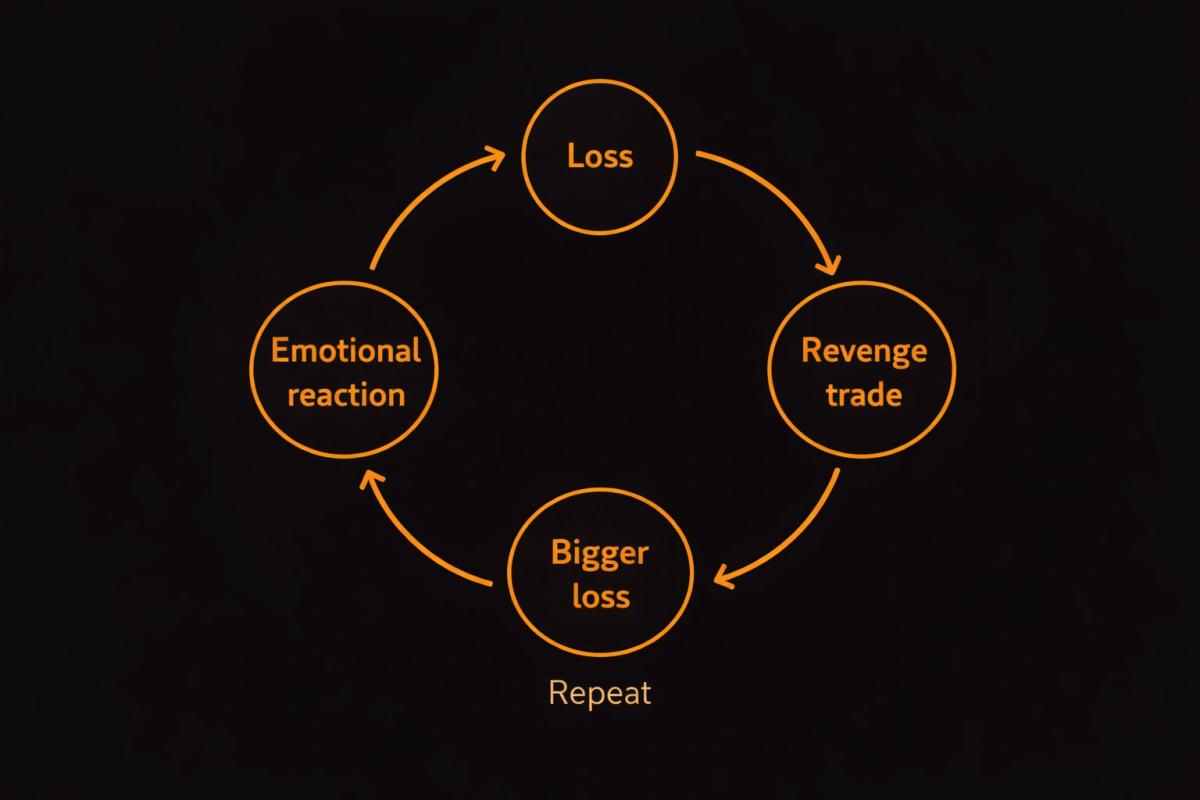
Revenge Trading After Losses
Revenge trading is overtrading with an emotional accelerator strapped to it. The underlying belief is that the market “owes” you something, and every new trade is an attempt to collect. The problem? Each revenge trade is typically lower quality than the last, because your decision-making grows increasingly clouded by frustration rather than sharpened by analysis.
Fear of Missing Out (FOMO)
FOMO-driven overtrading is rooted in the perception that opportunities are scarce, that missing this one move means missing your shot at profitability. In reality, markets generate setups constantly. The one you missed will be replaced by another within hours or days. But in the moment, it feels like the last bus leaving without you.
Boredom and Lack of a Trading Plan
Deceptively simple and incredibly common. You sit in front of your charts with no clear criteria for what constitutes a valid trade. The market is moving sideways. Nothing is setting up. And you start trading anyway, because you are there, the platform is open, and doing nothing feels like wasting time.
Without a trading plan that defines your setups, entry criteria, and session structure, every price movement looks like a potential trade. Your brain fills the vacuum of structure with activity.
Overconfidence After a Winning Streak
Overconfidence is one of the sneakier triggers because it feels positive. You are not trading from pain; you are trading from a sense of mastery. But the market does not care about your streak, and the trades you are adding outside your edge are statistically likely to be losers. This is where winning streaks go to die.
Addiction to Market Stimulation
For some traders, the issue goes beyond situational triggers. The act of placing a trade produces a dopamine response: anticipation, excitement, resolution. Over time, the brain begins to crave that cycle, independent of whether the trade makes money. You start trading for the feeling, not the result.
This is not the same as clinical gambling addiction, but the neurological mechanism is similar enough that if you find yourself unable to stop trading even when you recognize it is harmful, it is worth examining whether the stimulation itself has become the reward.
That moment of self-recognition is the first real step toward change. But how do you know if what you are experiencing is genuinely overtrading, or just an active week?
Warning Signs You Are Overtrading
Overtrading rarely announces itself. It disguises itself as productivity, hustle, or market engagement. The key is to look for patterns in both your behavior and your account metrics that tell a different story than the one you are telling yourself.
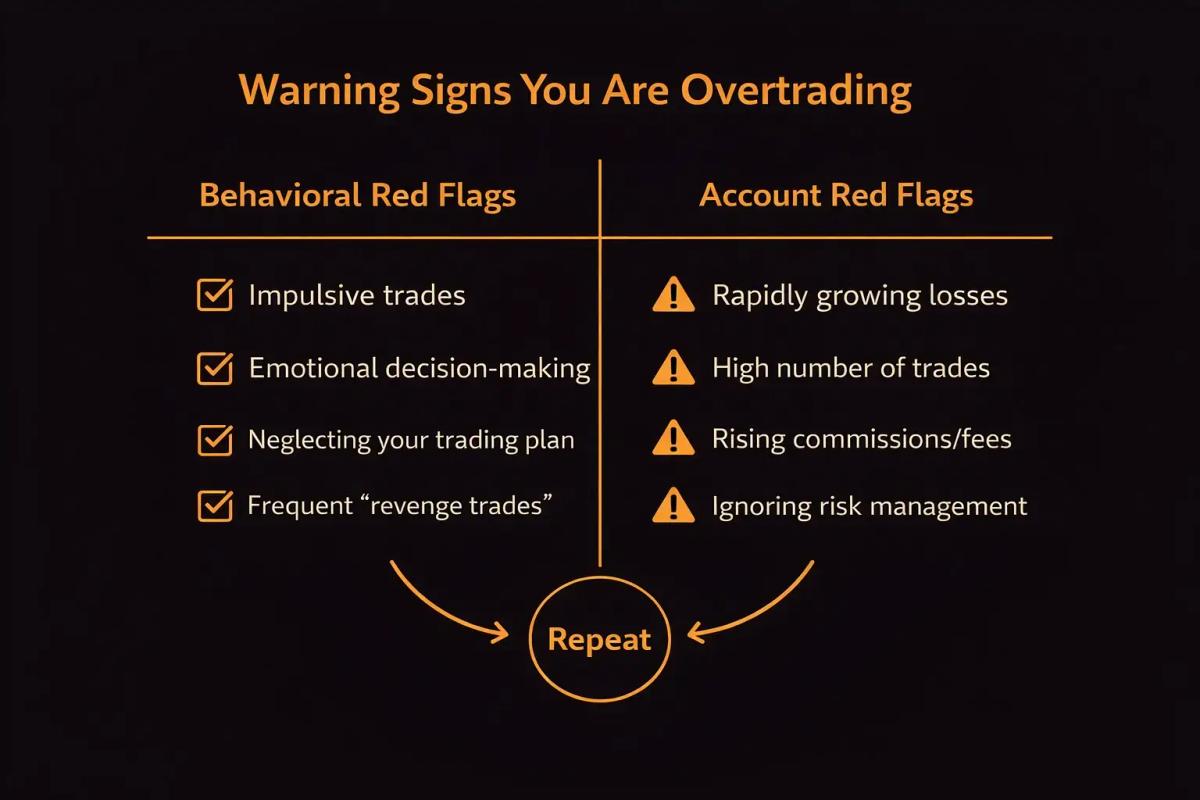
Behavioral Red Flags
Watch for these patterns in your daily trading routine:
- Trading without a setup: You enter positions based on gut feeling, a candle pattern you half-remember, or simply because the market “looks like it is going to move.”
- Inability to sit out: The thought of not trading during market hours produces anxiety or restlessness, even when no valid setup exists.
- Constant platform checking: You are refreshing charts on your phone during dinner, in meetings, or in the middle of the night.
- Immediate re-entry after stops: You get stopped out and enter a new trade within seconds or minutes, without re-analyzing the market.
- Trading outside your plan hours: Your plan says you trade the London or New York open, but you find yourself placing trades during the Asian session “just to see what happens.”
- Rationalizing bad trades after the fact: You know the trade was not in your plan, but you construct a post-hoc justification for why it was “technically” valid.
Account-Level Red Flags
Your account data does not lie. These numbers reveal overtrading even when your behavior feels justified:
- Rising commission and spread costs relative to your account size or gross profit
- Declining win rate compared to your historical average
- Increasing trade frequency week over week without a corresponding increase in quality setups
- Smaller average winner, larger average loser: A sign you are cutting winners short and holding losers longer under pressure
- Equity curve flattening or declining despite active trading
- More trades on red days than green days: A strong indicator of revenge and emotional trading
If you checked off three or more items from either list, it is worth taking a hard look at what this behavior is actually costing you.
The Real Cost of Overtrading
Overtrading is a financial leak with compounding consequences. Traders often underestimate the damage because it is distributed across dozens of small losses rather than one catastrophic blowup. But the math is unforgiving.
Financial Impact (Commissions, Spreads, Slippage)
Every trade carries a cost, win or lose. Spreads, commissions, and slippage are the toll you pay each time you enter and exit the market. When you trade within your edge, these costs are absorbed by your winning trades. When you overtrade, they stack into a significant drag on performance.
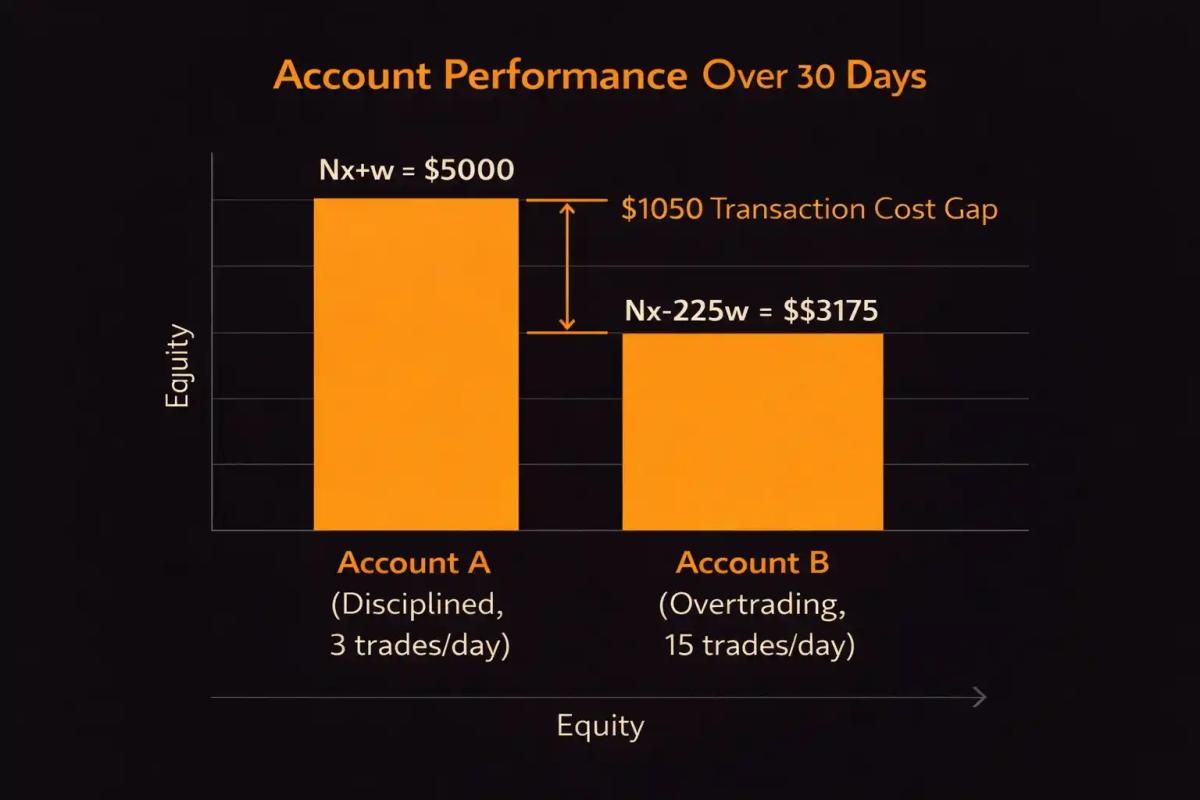
Consider a simple example. Suppose each round-trip trade costs you $5 in combined spread and commission on your instrument.
That is a $14,400 annual difference in pure friction costs, money leaving your account before your strategy even has a chance to perform. On a $25,000 account, the overtrader is giving away roughly 72% of their capital per year just in transaction costs. You would need a remarkably profitable strategy to overcome that kind of drag.
This does not even include slippage, which tends to worsen with trade frequency since you are more likely to chase entries and accept worse fills when trading impulsively.
Psychological and Emotional Toll
The financial damage is quantifiable. The psychological damage is harder to measure but equally real. Overtrading puts you in a constant state of heightened arousal: monitoring positions, reacting to ticks, managing multiple open trades. Over time, this produces:
- Decision fatigue: Your ability to evaluate setups deteriorates throughout the day as you burn through mental energy on low-quality trades.
- Emotional exhaustion: The cycle of hope, anxiety, disappointment, and relief across dozens of trades per day is draining. Many overtreaders report feeling physically tired after sessions, even though they have been sitting in a chair.
- Eroding self-trust: Every trade you take outside your plan chips away at your confidence in your own discipline. You start to see yourself as someone who “cannot follow rules,” which creates a self-fulfilling prophecy.
Long-Term Performance Erosion
Research from Barber and Odean, who studied retail trading accounts, found that the most active traders significantly underperformed less active traders, largely because transaction costs consumed a disproportionate share of their returns. The pattern is consistent: more trades, less profit.
This is because most additional trades beyond a trader’s core edge are noise trades, entries that dilute win rate, distort risk-reward, and introduce randomness into what should be a systematic process.
Over months and years, the gap between a disciplined trader and an overtrader widens dramatically. It is not the single bad trade that destroys accounts. It is the accumulation of hundreds of unnecessary ones.
The cost is clear. Now the question shifts: what are you going to do about it?
How to Stop Overtrading
Knowing you overtrade is the first step. Stopping requires structure. White-knuckling your way through a trading session and telling yourself “just trade less” rarely works, because it does not address the triggers or replace the behavior with something functional. Here is what does.
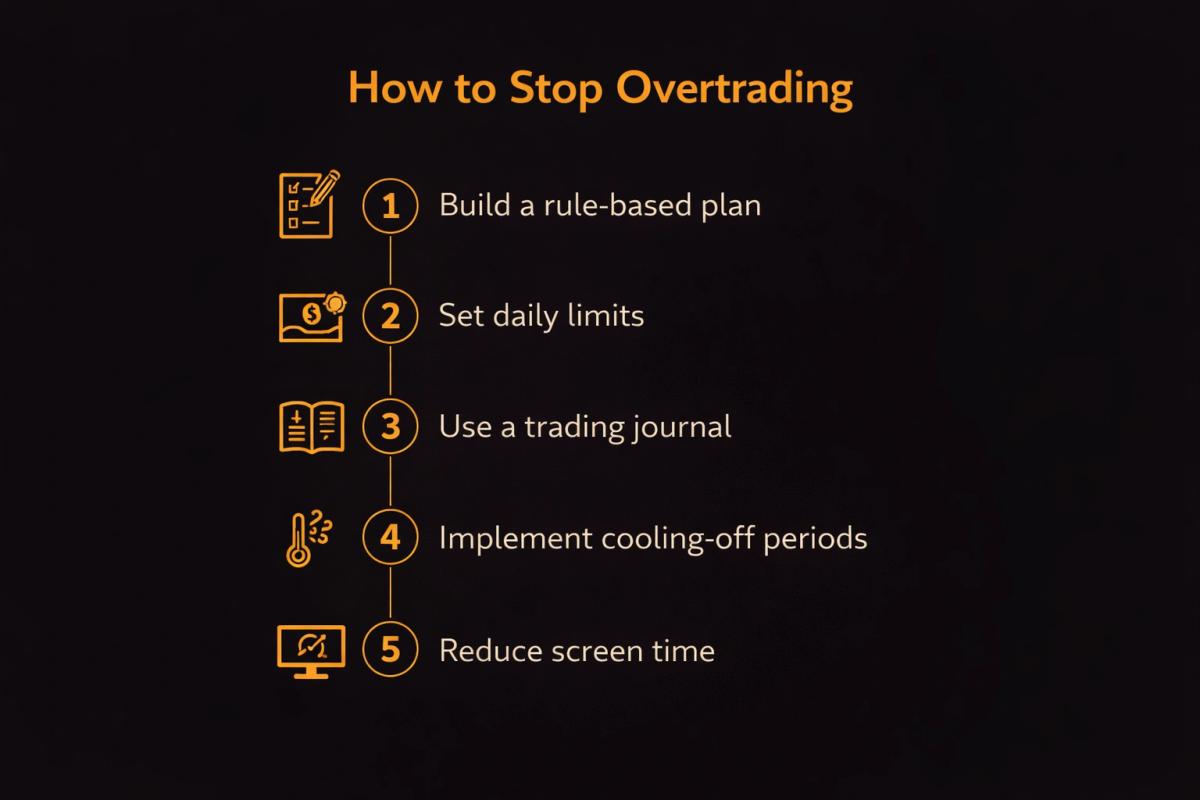
Build a Rule-Based Trading Plan
If you do not have a written trading plan with specific entry criteria, exit criteria, and position sizing rules, you are flying blind. And when you fly blind, you trade everything that catches your eye.
Your trading plan should answer these questions before you ever open your platform:
- What setups am I allowed to trade today?
- What market conditions invalidate my setups?
- What is my maximum position size per trade?
- What are my stop-loss and take-profit rules?
- What hours will I trade, and when will I stop?
The plan is your filter. Without it, every price movement is a potential trade. With it, most price movements become noise you can comfortably ignore.
Set Daily Trade Limits and Loss Caps
One of the most effective overtrading countermeasures is brutally simple: decide in advance the maximum number of trades you are allowed per session, and the maximum loss at which you will walk away.
For example:
- Maximum 3 trades per day (or whatever number aligns with your strategy’s typical setup frequency)
- Stop trading after 2 consecutive losses
- Stop trading if daily loss exceeds 2% of account equity
These are hard rules, not guidelines. When you hit the limit, you close your platform. No exceptions. The discomfort you feel in walking away is infinitely smaller than the damage of a revenge-fueled fifth or sixth trade.
Use a Trading Journal to Track Behavior
A trading journal does more than record entries and exits. When used properly, it exposes the behavioral patterns that fuel overtrading.
For each trade, log:
- The setup that triggered the entry (or note that there was no setup)
- Your emotional state before clicking the button
- Whether the trade was in your plan
- The outcome
After a week, review the data. You will likely find that your unplanned trades have a significantly lower win rate and worse risk-reward than your planned trades. Seeing this in your own numbers, not in someone else’s blog post, is what creates real behavioral change.
Implement Cooling-Off Periods
After a loss (or even after a win), build a mandatory pause into your routine. This can be as simple as a 15-minute break where you step away from your screen, or as structured as a rule that says you cannot enter a new trade within 30 minutes of closing the previous one.
The purpose is to break the emotional chain between one trade and the next. Impulsive trades happen in the seconds after a trigger: the loss that stings, the move you missed. A cooling-off period forces a gap between the trigger and your response, giving your rational brain time to catch up with your emotional one.
Reduce Screen Time and Remove Triggers
If you are staring at charts for eight hours a day but your strategy only produces one to three setups per session, you are creating the perfect conditions for overtrading. All that extra screen time is not “preparation.” It is exposure to temptation.
Consider these adjustments:
- Set price alerts for your key levels and step away until they trigger
- Close your trading platform between setup windows
- Remove trading apps from your phone’s home screen
- Limit your chart-watching to defined session blocks (e.g., 90 minutes during the New York open)
- Turn off social media feeds that broadcast other traders’ live positions
Even the best intentions sometimes need external reinforcement, though. What happens when self-discipline alone falls short?
Tools and Environments That Enforce Discipline
Sometimes the most effective guardrail is one you cannot remove on impulse. External constraints can serve as a safety net while you build internal discipline.
Platform Features That Limit Overtrading
Many modern trading platforms offer built-in tools that can help you enforce your rules:
- Maximum daily trade limits: Some platforms let you set a hard cap on the number of trades per session.
- Automatic session lockouts: Configure your platform to log you out after reaching a predefined loss threshold.
- Alert-based trading: Use price alert systems to notify you only when your specific setup conditions are met, rather than watching every tick.
- One-click trading disablement: Turning off one-click execution adds a small friction layer that can interrupt impulsive entries.
Check your current platform’s settings. These features often exist but go unused because traders never explore their configuration options.
How Prop Firm Rules Can Help
If you have considered trading with a proprietary trading firm, one underappreciated benefit is the built-in discipline framework most firms provide.
Many prop firms enforce:
- Daily loss limits that automatically freeze your account if breached
- Maximum drawdown thresholds that end your evaluation or funded phase
- Position size caps relative to account balance
- Trading hour restrictions in some cases
These rules exist to protect the firm’s capital, but they carry a secondary effect: they force you to trade within boundaries. For traders who struggle with self-imposed limits, having an external structure enforce them can serve as a bridge while you develop your own internal discipline.
If you are already considering prop trading, the built-in guardrails are a meaningful side benefit worth factoring into your decision.
Frequently Asked Questions
What is the difference between active trading and overtrading?
Active trading means executing a high number of trades that each align with a defined strategy and risk management framework. Overtrading means executing trades driven by emotion, impulse, or boredom rather than a systematic edge. The distinction is not about how many trades you take, but whether each trade has a legitimate, plan-based reason to exist.
How many trades per day is considered overtrading?
There is no universal number. Overtrading is relative to your strategy. A scalper might legitimately take 20 or more trades per day, while a swing trader taking 5 intraday trades might be massively overtrading. The benchmark is your own trading plan: if you are consistently exceeding the number of setups your strategy typically produces, you are likely overtrading.
Can overtrading become a genuine addiction?
Overtrading can develop compulsive characteristics similar to behavioral addictions. The dopamine cycle of anticipation, execution, and outcome can become self-reinforcing over time. While this article is not making clinical diagnoses, if you find yourself unable to stop trading despite recognizing consistent negative consequences, it may be worth speaking with a professional who understands behavioral compulsions.
What is the single most effective method to reduce overtrading?
Most experienced traders point to a written, rule-based trading plan with hard daily trade limits as the single highest-impact intervention. The plan removes ambiguity about what constitutes a valid trade, and the daily limit creates a non-negotiable stopping point. Combined, they eliminate most of the decision space where overtrading lives.
How does a trading journal help prevent overtrading?
A trading journal creates accountability by forcing you to document each trade's rationale and your emotional state at the time of entry. Over time, it reveals patterns you cannot see in real time, such as a significantly lower win rate on unplanned trades or a tendency to overtrade on specific days or after specific triggers. The data makes the cost of overtrading personal and undeniable.
Can demo accounts help break overtrading habits?
Demo accounts can be useful for practicing new discipline rules without financial risk. However, because there is no real money at stake, the emotional triggers that drive overtrading (fear of loss, revenge, FOMO) are significantly weaker. A demo account works best as a testing ground for your trading plan structure, but real behavioral change usually requires live market conditions, even if with reduced position sizes.
How do prop firm rules help control overtrading behavior?
Prop firms enforce external constraints like daily loss limits, maximum drawdown thresholds, and sometimes trade frequency caps. These rules create hard boundaries that you cannot override in the heat of the moment, unlike self-imposed limits you can rationalize past. For traders building discipline, these external guardrails can provide structure while you develop the internal habits to manage your own trading behavior independently.
About the authors


Related articles
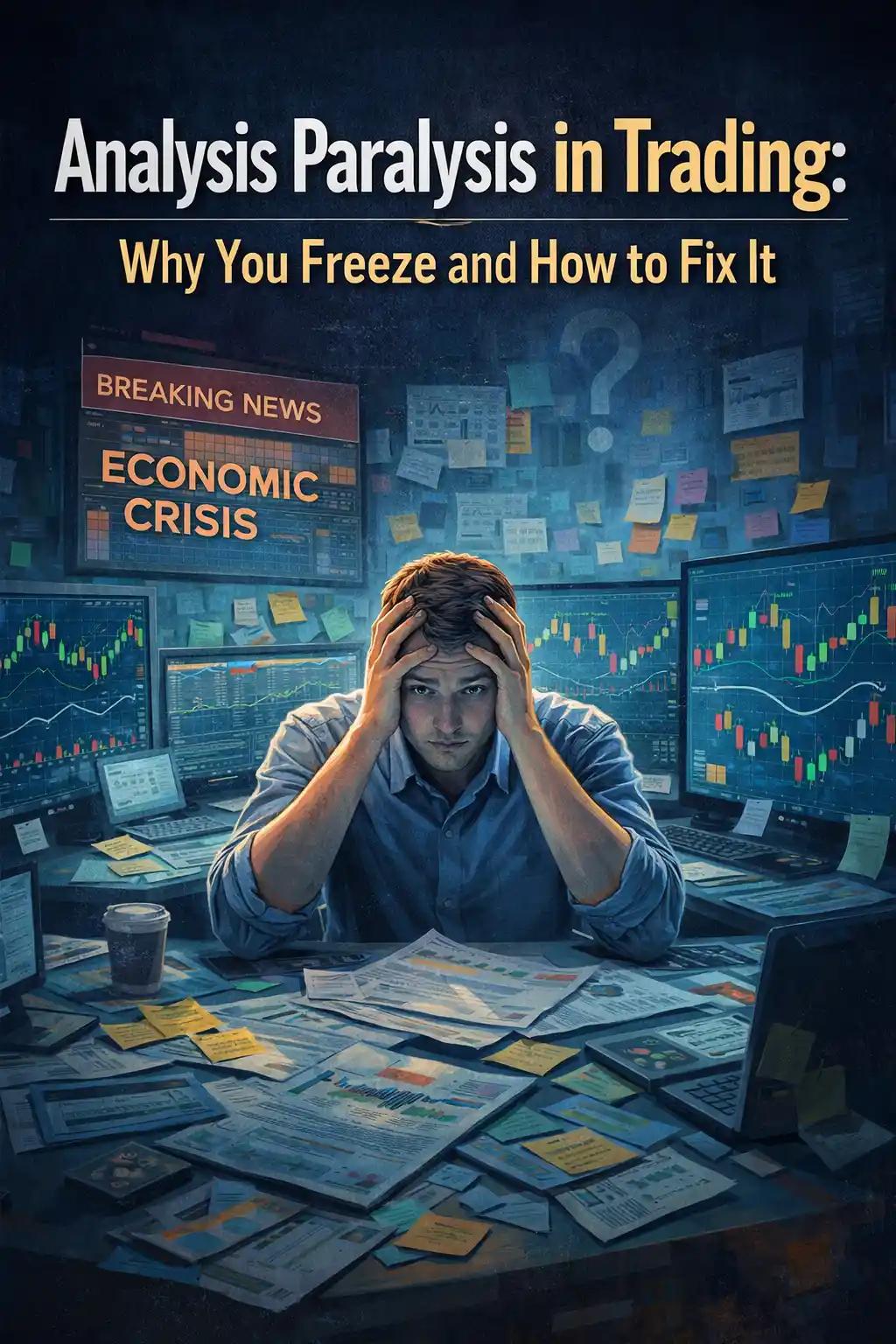
Analysis Paralysis in Trading: Why You Freeze and How to Fix It
Learn to recognize analysis paralysis in trading, understand its psychological roots, and build a decision-making framework with confident execution.
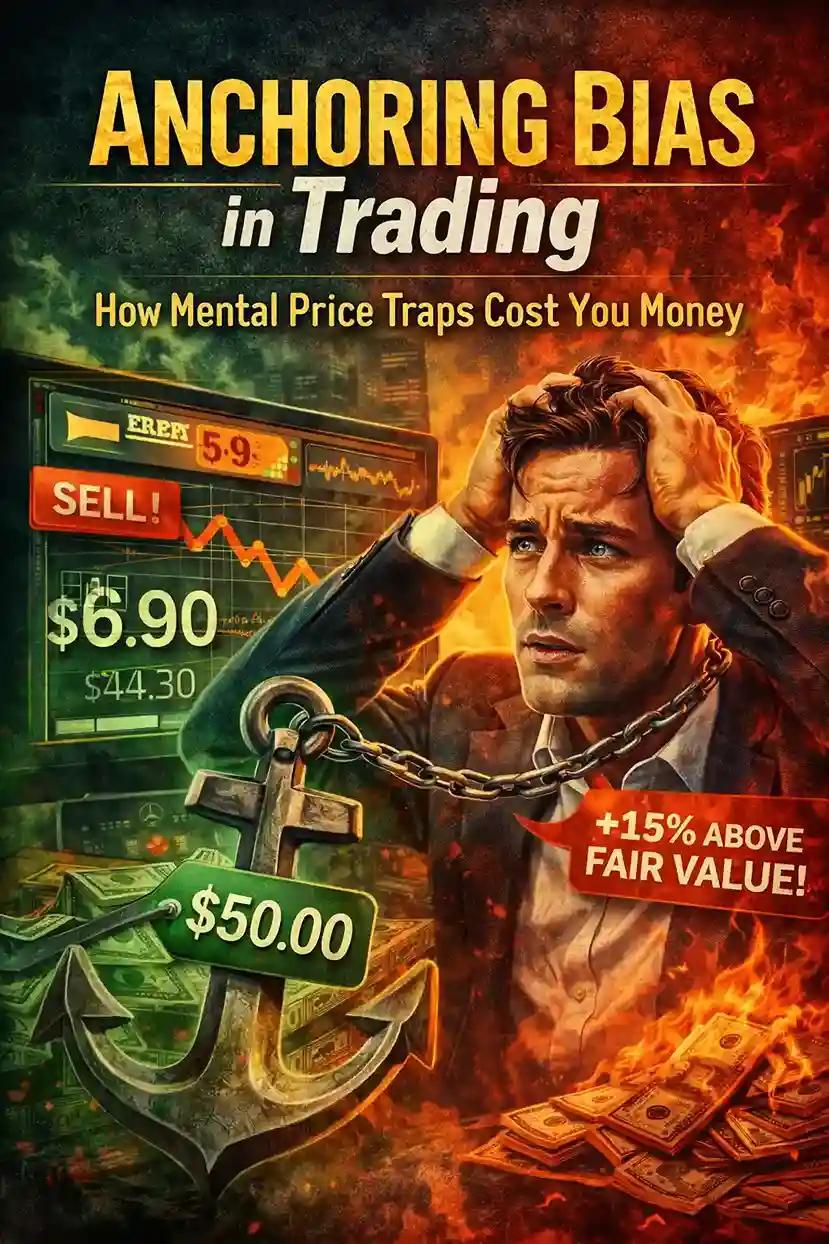
Anchoring Bias in Trading: How Mental Price Traps Cost You Money
Learn how anchoring bias distorts your trading decisions. Spot mental price traps, break free from fixation on entry prices, and build systems to protect your returns.
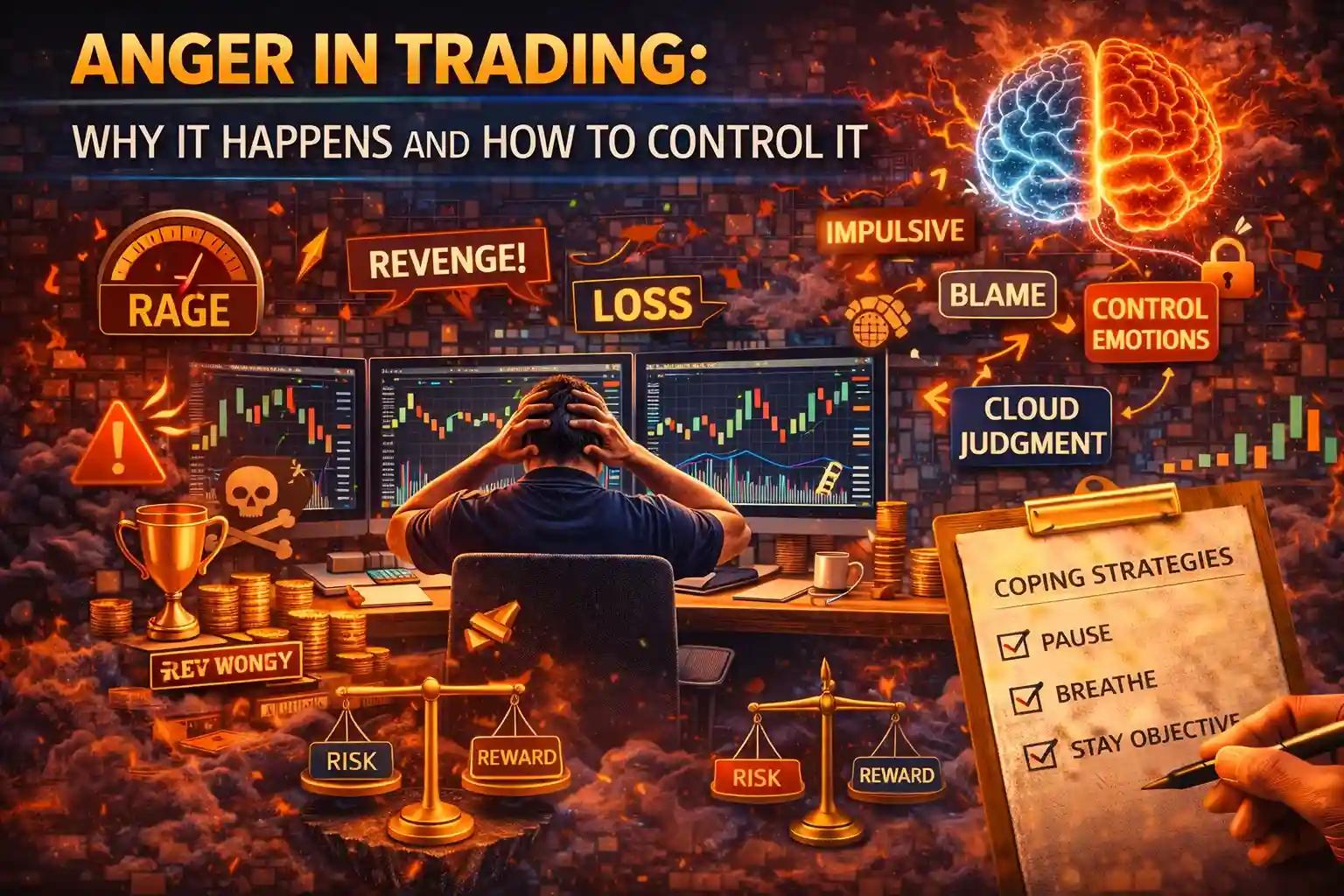
Anger in Trading: Why It Happens and How to Control It
Learn why anger strikes during trading, how it destroys performance through revenge trades and broken rules, and proven techniques to control it.
0 comments