


Pre-Market Checklist: Your Daily Trading Preparation Guide
Every experienced trader will tell you the same thing: the market doesn’t care how you feel at 9:30 AM. It won’t wait for you to find your levels, scan for news, or piece together what happened overnight. The traders who consistently perform aren’t smarter or luckier. They’re simply more prepared.
A solid pre-market checklist is the difference between sitting down at the open with a clear plan and scrambling to make sense of price action that’s already moving without you. Think of it like a pilot running through a pre-flight routine. No pilot skips that process because they “feel good about the flight.” And no serious trader should skip preparation because the action looks tempting.
This pre-market checklist gives you a structured, repeatable framework you can use every single trading day. It covers everything from reviewing overnight markets to checking your own mental state, and it’s built so you can start using it tomorrow morning.
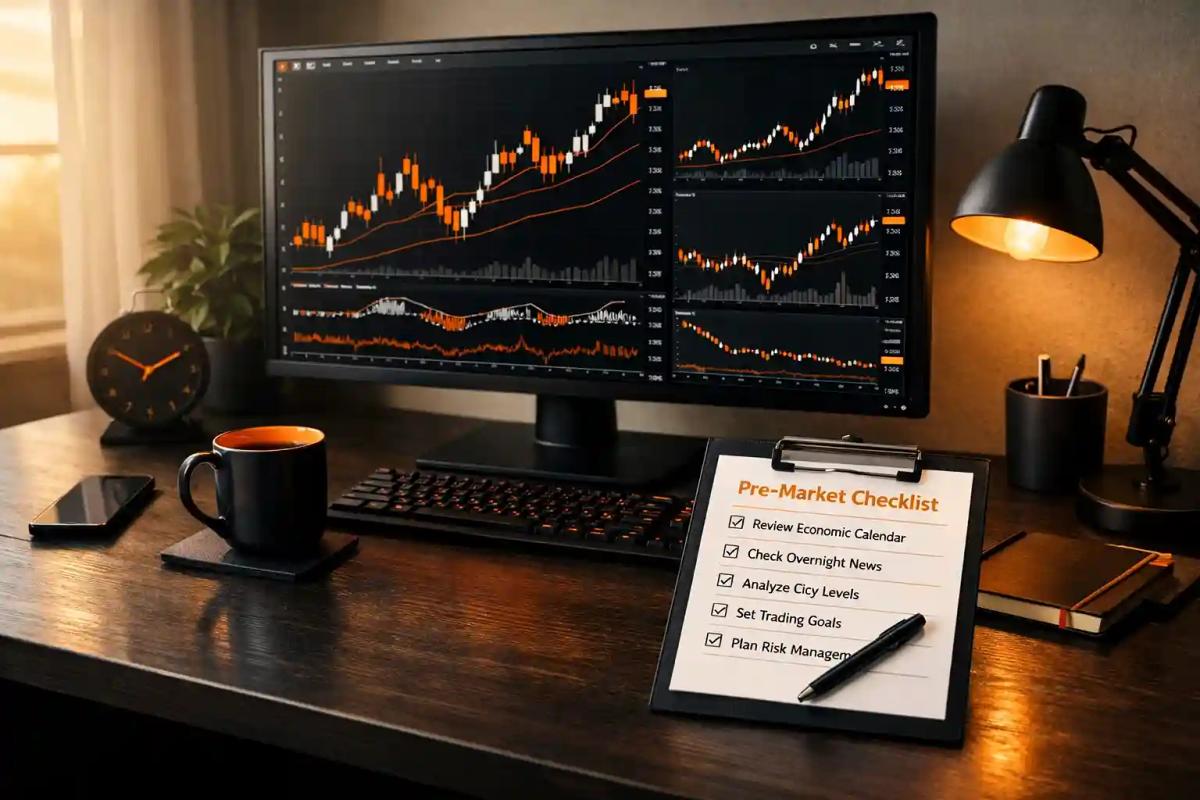
Why a Pre-Market Routine Changes Your Trading
A pre-market routine puts you in control before the market has a chance to pull you somewhere you didn’t choose to go.
What Happens When Traders Skip Preparation
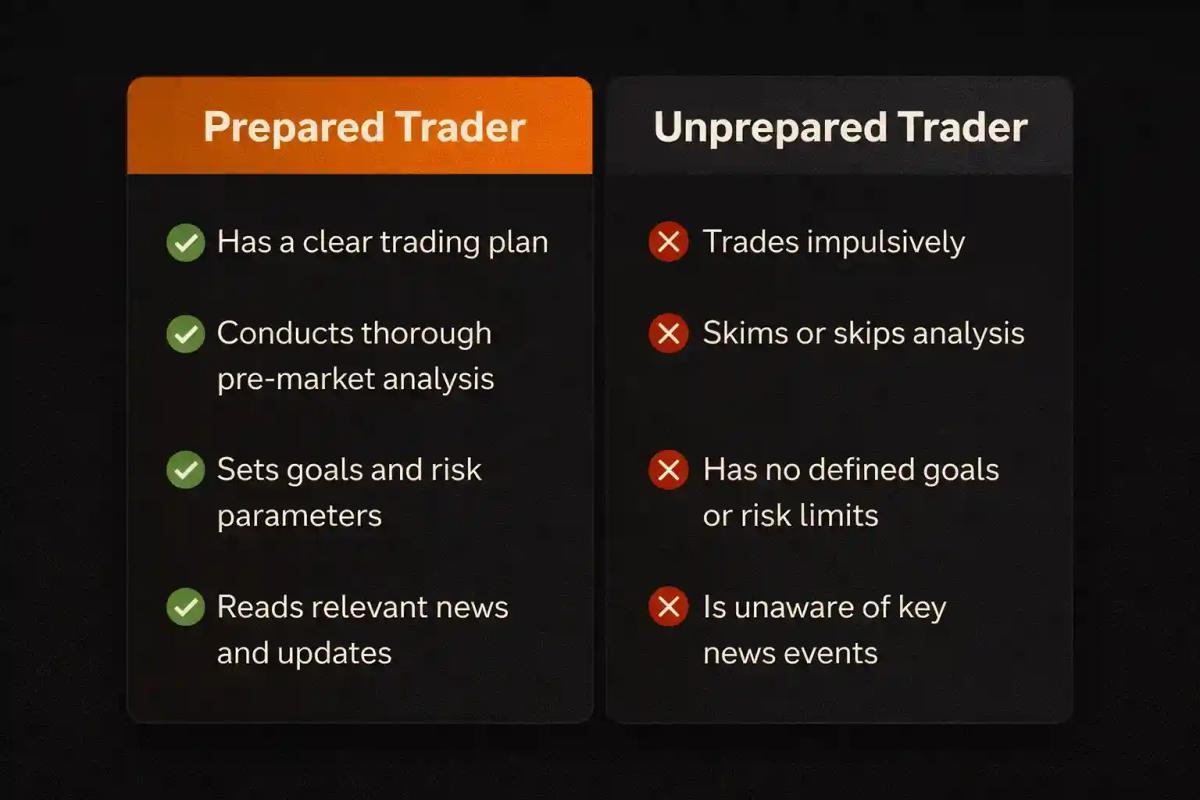
When you skip your prep, you hand the steering wheel to your emotions. You’re more likely to chase momentum, overtrade, or freeze when a fast move catches you flat-footed. Without pre-marked levels, you don’t know where to enter or exit. Without checking the economic calendar, a surprise data release can blow through your position before you even register what happened.
This results in impulsive decisions, inconsistent sizing, and that familiar sting of regret when you look back at trades you never should have taken. Skipping preparation costs you money and confidence.
How a Checklist Reduces Emotional Decision-Making
A checklist works because it forces you to make decisions when you’re calm, not when adrenaline is running the show. By the time the opening bell rings, you’ve already decided what you’re watching, where your levels are, what setups you’re looking for, and how much you’re willing to risk.
That’s emotional armor. When you’ve done the work beforehand, you’re far less likely to deviate from your plan because the plan already accounts for what might happen. You’ve pre-committed to your decisions, and that strips away the mental load when volatility kicks in.
So where does your morning routine actually begin? It starts the night before, with what happened while you were sleeping.
Step 1: Review the Overnight and Global Market Picture
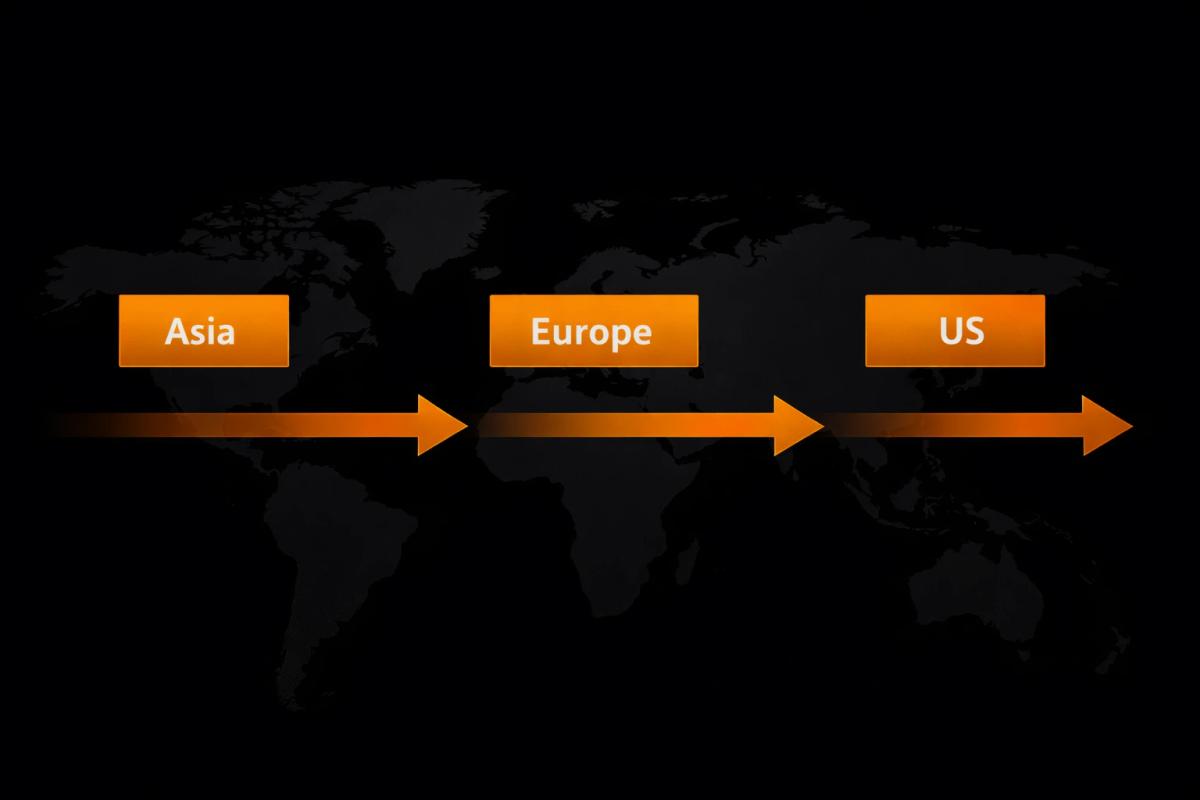
By the time you sit down in the morning, hours of global trading have already shaped the landscape you’re about to step into. Ignoring that context is like walking into a meeting halfway through and trying to lead the conversation.
Key Markets to Check (Futures, Asia, Europe)
Start with US index futures (S&P 500, Nasdaq, Dow). These give you the quickest read on overnight sentiment and where the US session might open relative to the prior close.
Then broaden your view:
- Asian markets (Nikkei, Hang Seng, Shanghai Composite) often react to US news released after hours and set the initial global tone.
- European markets (FTSE, DAX, Euro Stoxx 50) are mid-session by the time you’re doing your prep and can confirm or contradict the overnight move.
- Currency and commodity moves in the US Dollar Index (DXY), crude oil, and gold often ripple into equities and can signal whether the mood is risk-on or risk-off.
You’re looking for the big picture: is the overnight tone bullish, bearish, or somewhere in between?
Reading Overnight Price Action for Context
The goal here is to understand the context you’re inheriting. Run through a few quick questions:
- Did futures hold above or below yesterday’s close?
- Is a significant gap forming, and in which direction?
- Did any major asset class make an outsized move that could spill into your market?
This step should take five minutes. With that global picture sketched out, your next move is checking what scheduled events could disrupt your day.
Step 2: Check the Economic Calendar and News Catalysts
Nothing torpedoes a well-planned trade faster than a data release you didn’t know was coming. The economic calendar is your early warning system, and checking it should be non-negotiable every single morning.
High-Impact Events to Flag
Pull up a reliable economic calendar and filter for high-impact events. These are the releases that move markets:
- Interest rate decisions and central bank statements can shift entire market regimes in minutes.
- Employment data (Non-Farm Payrolls, jobless claims) tends to trigger sharp, fast moves.
- Inflation reports (CPI, PPI, PCE) directly influence rate expectations and broad sentiment.
- GDP releases land less frequently but carry real weight when they do.
- Earnings reports (if you trade equities) deserve attention before and after the bell.
Flag the exact release times. If a high-impact event falls during your planned trading window, decide in advance how you’ll handle it: sit out, reduce size, or widen stops.
How News Affects Your Trading Plan for the Day
On a quiet calendar day, your technical levels and setups carry more weight. On a heavy news day, those same levels can get steamrolled by a single headline.
Your job during this step is to calibrate expectations. A packed economic calendar might mean you trade lighter, wait for data to clear, or focus on post-release setups rather than pre-release positions. The point is knowing what’s ahead so the market can’t surprise you with something that was published on every economic calendar since last week.
With your macro and news context set, it’s time to get specific about price. Where are the levels that actually matter today?
Step 3: Identify Key Technical Levels
Walking into the market without knowing your key levels is like driving without a map. You might get somewhere, but you won’t know why, and you definitely won’t be able to repeat it. This is where your morning prep gets precise.
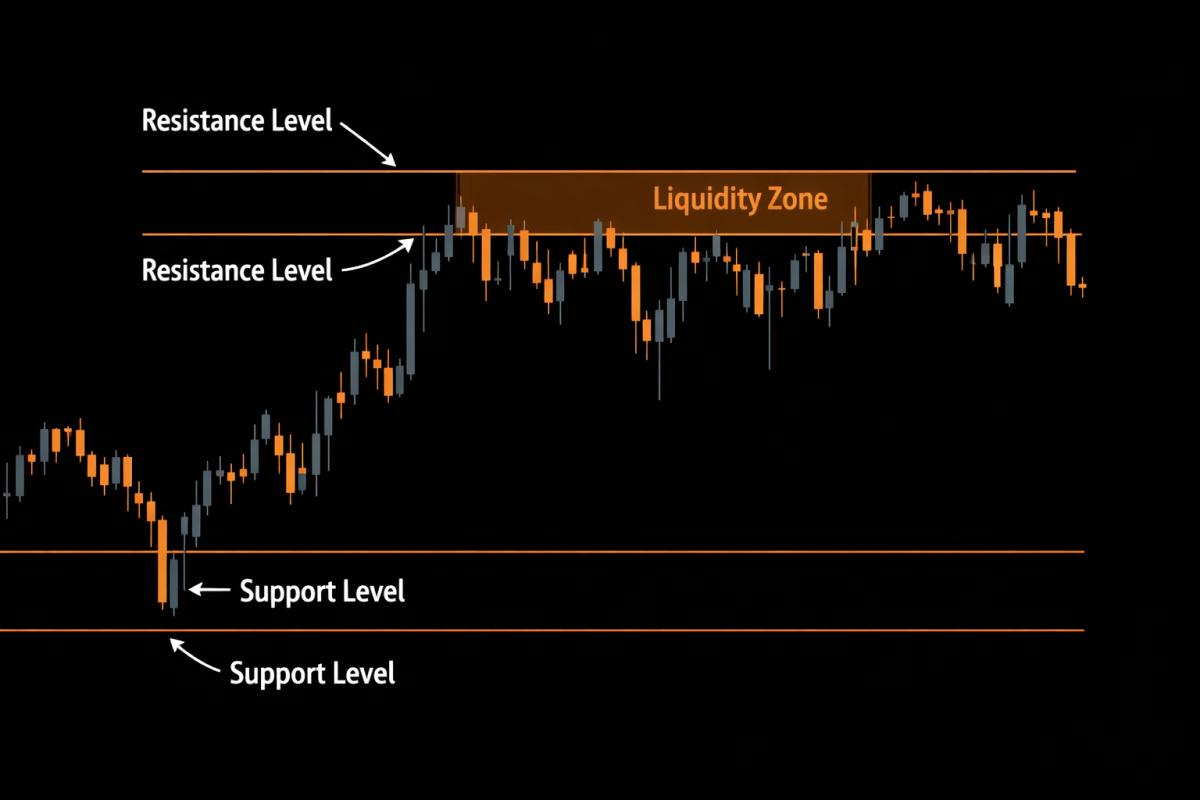
Support, Resistance, and Liquidity Zones
Focus on the levels most likely to produce a reaction:
- Prior day’s high and low serve as reference points that many traders and algorithms watch closely.
- Significant swing highs and swing lows on the daily or 4-hour chart anchor the broader structure.
- Volume-weighted levels like VWAP from the previous session, or a developing VWAP, add context around fair value.
- Round psychological numbers tend to attract clustered orders.
- Liquidity zones where you can spot clusters of wicks or consolidation, often suggesting resting orders beneath the surface.
Three to five relevant levels per instrument keeps things sharp. Clarity beats clutter every time.
Marking Levels on Your Charts
Open your charts and draw your levels before the session starts. Use horizontal lines, highlight zones, or whatever method keeps your charts clean and readable. The important thing is this: when price approaches one of these areas during the session, you already know it’s there and you already have a plan for how to respond.
Some traders prefer to do this work the evening before and simply review their levels in the morning. That works just as well. The goal is that by the time the market opens, your charts are marked and your eyes know exactly where to look.
Now that you know the landscape, which instruments actually deserve your attention today?
Step 4: Build Your Watchlist
Trying to watch everything is a guaranteed way to trade nothing well. Your watchlist is your filter. Building it with intention each morning keeps you focused on the strongest opportunities rather than chasing whatever ticker happens to be moving fastest.
Criteria for Selecting Instruments
Your specific criteria will depend on your strategy, but a solid starting framework includes:
- Proximity to key levels from Step 3. Is the instrument near a level you’ve already identified?
- Catalyst presence. Is there a news event, earnings report, or sector rotation that could drive this instrument today?
- Volume and liquidity. Is there enough participation to get clean entries and exits?
- Alignment with the broader picture. Does this instrument’s setup fit with the macro context from Step 1?
- Clean price structure. Is the chart readable, or is it choppy and unclear?
You’re looking for instruments where multiple factors converge. A stock sitting near key resistance on a day when its sector has a catalyst and overall sentiment supports the direction? That belongs on your watchlist.
Keeping Your Watchlist Focused
For most traders, three to five instruments is the sweet spot. Anything beyond that, and you’re likely spreading your attention too thin. Quality over quantity applies here just as much as it does to your actual trades.
Write your watchlist down or keep it in a dedicated section of your trading journal. Naming each instrument alongside the reason it made the list forces you to be intentional rather than reactive.
Your watchlist tells you what to watch, but watching isn’t trading. What exactly will you do if price reaches your levels?
Step 5: Define Your Trade Scenarios
This is where preparation becomes a trading plan. Levels and a watchlist mean nothing if you haven’t decided what you’ll actually do when price gets there. Scenario planning is what separates a prepared trader from someone who just glanced at some charts.
If/Then Planning for Entries and Exits
For each instrument on your watchlist, sketch out simple if/then scenarios:
- If price pulls back to [support level] and shows [confirmation signal], then you enter long with a stop at [level] and a target at [level].
- If price breaks above [resistance level] with volume, then you look for a retest entry with risk defined below the breakout zone.
- If the high-impact news release causes a gap through your level, then you stand aside and reassess after the initial volatility settles.
Two to three scenarios per instrument is plenty. The point is that when the moment arrives, you’re executing a pre-made decision, not scrambling to make one under pressure.
Setting Risk Parameters Before the Open
Before you take any trade, you need to know your risk. Define these numbers during your pre-market prep, not in the heat of the moment:
- Maximum risk per trade (as a percentage of your account or a fixed dollar amount)
- Maximum daily loss limit, the point where you stop trading for the day, no exceptions
- Position sizing based on your stop distance and per-trade risk
Writing these down makes them real. If your risk management framework is already established, this step is a quick confirmation. If it’s not, building one should be a priority before you even open a chart.
You’ve now covered the markets, the news, the levels, the instruments, and the plan. But there’s one more step that too many traders skip. It might be the most important one.
Step 6: Mental and Physical Readiness Check
Your mind is your primary trading tool. If it’s not functioning well, nothing else on this checklist matters. A perfect setup means nothing if you’re exhausted, distracted, angry, or anxious. This step is about being honest with yourself before you put real capital at risk.
Assessing Your Emotional State
Take thirty seconds and check in with yourself. Ask yourself:
- Did you sleep enough last night?
- Are you carrying stress from something outside of trading (an argument, financial pressure, personal issues)?
- Are you still emotionally affected by yesterday’s results, whether they were wins or losses?
- Do you feel focused and patient, or rushed and reactive?
There’s no passing grade here. This is a self-awareness exercise. The goal is to notice your state. But noticing gives you the power to adjust. Maybe you trade smaller today. Maybe you only take your highest-conviction setups. Maybe you sit out entirely.
Your trading psychology isn’t a soft skill. It’s the foundation everything else rests on.
Deciding Whether Today Is a Trading Day
This is the hardest part of the checklist for most people. Sometimes the right call is simply to not trade. If your mental check reveals that you’re off, or if the market conditions from your earlier steps are unclear or unusually risky, stepping aside is a legitimate, professional decision.
The market will be there tomorrow. Your capital needs to be there too.
Think of it this way: a surgeon who’s had two hours of sleep doesn’t go into the operating room. A trader who’s emotionally compromised shouldn’t go into the market. Knowing when to sit out is a skill, not a weakness.
With all six steps complete, let’s pull everything together into a format you can actually use every morning.
Putting It All Together: Your Printable Pre-Market Checklist
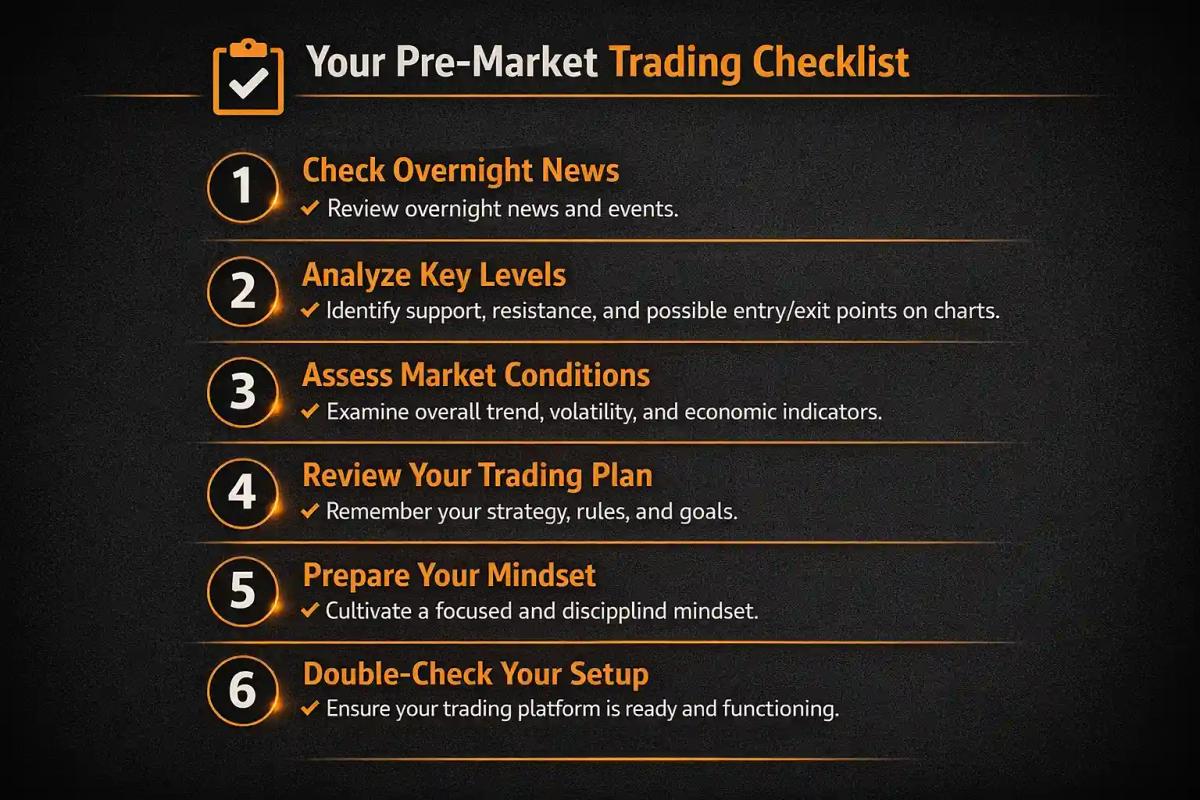
You’ve walked through each step in detail. Here’s the condensed version you can keep next to your desk, save on your phone, or pin to your trading station.
The Complete Checklist Summary
Step 1: Overnight and Global Markets
- Check US index futures (S&P 500, Nasdaq, Dow)
- Review Asian and European market performance
- Note significant moves in DXY, crude oil, gold
- Assess overall overnight sentiment (bullish, bearish, mixed)
Step 2: Economic Calendar and News
- Check economic calendar for high-impact releases
- Note exact release times
- Flag earnings reports if trading equities
- Decide how scheduled events affect your plan (sit out, reduce size, widen stops)
Step 3: Key Technical Levels
- Mark prior day high/low
- Identify 3-5 key support and resistance levels per instrument
- Note liquidity zones and psychological levels
- Ensure charts are clean and ready
Step 4: Watchlist
- Select 3-5 instruments based on confluence (levels, catalysts, volume, structure)
- Write down each instrument and your reason for watching it
Step 5: Trade Scenarios
- Write if/then scenarios for each watchlist instrument (2-3 per instrument)
- Define per-trade risk, position sizing, and daily loss limit
- Confirm risk parameters are set before the open
Step 6: Mental and Physical Readiness
- Assess sleep, stress, emotional state, and focus
- Decide whether to trade full size, reduced size, or sit out entirely
How to Customize the Checklist to Your Style
This checklist is a framework, not a rigid rulebook. Depending on your trading style, you might adjust certain steps:
- Swing traders might do a lighter version of Steps 1 and 2, since intraday catalysts matter less for multi-day holds, and spend more time on weekly or daily chart levels.
- Futures traders might expand Step 1 to include more detailed analysis of the overnight session and volume profile.
- Forex traders might reshape the global market review to focus on specific currency pair correlations and central bank calendars.
- Prop firm traders benefit especially from structured preparation, since consistency and discipline are exactly what evaluation programs are designed to measure.
If you keep a trading journal (and you should), consider adding a brief review of yesterday’s trades to the start of your morning routine. Five minutes spent reflecting on what worked and what didn’t can sharpen your focus for the day ahead. Reference your economic calendar and news trading approach to refine Step 2 over time.
The key is to make the checklist yours while keeping the core structure intact. Every step exists for a reason. Remove one, and you’ll eventually feel the gap.
Common Pre-Market Mistakes to Avoid
Even with a solid checklist, a few traps catch traders repeatedly. Knowing them in advance helps you sidestep them.
Spending too long on preparation. Your pre-market routine should take 20 to 45 minutes, not two hours. If you’re over-analyzing, you’re creating paralysis. Set a timer if you need to.
Anchoring to a bias. Checking overnight futures and news is meant to give you context. If you decide “today is a buy day” before the bell and refuse to adjust, you’ve turned preparation into stubbornness.
Overloading your watchlist. Ten instruments means you’re watching none of them properly. Be ruthless about filtering. If it doesn’t meet your criteria, it doesn’t make the list.
Skipping the mental check. This is the step that feels optional but isn’t. The days you skip it tend to be the days you most need it. Be honest with yourself, especially after a losing streak or an unusually big win.
Treating the checklist as a one-time exercise. Your checklist should evolve as you grow. Review it every few weeks and ask whether each step is still serving you. Add what’s missing, remove what’s become second nature, and adjust for changes in your strategy or the markets you trade.
Frequently Asked Questions
How long should my pre-market routine take?
Most traders find that 20 to 45 minutes is the right range. The first few times you use the checklist, it might take longer as you build the habit. Once the process becomes familiar, you'll move through it faster.
Does this pre-market checklist work for all markets, including forex, stocks, crypto, and futures?
The core framework applies across markets. The specific instruments you check in Step 1, the calendar events you flag in Step 2, and the technical tools you use in Step 3 will vary depending on your market. But the principle of reviewing context, identifying levels, building a watchlist, and planning scenarios is universal.
What should I do if a high-impact news event is scheduled during my trading session?
You have three main options: avoid trading around the release entirely, reduce your position size to account for increased volatility, or widen your stop losses to give trades room to breathe through the spike. The right choice depends on your risk tolerance and strategy, but the worst option is always being caught unaware.
How should swing traders adapt this checklist compared to day traders?
Swing traders can condense Steps 1 and 2, since intraday catalysts matter less for multi-day holds. The bigger focus shifts to daily and weekly chart levels in Step 3, and watchlist and scenario planning should reflect longer timeframes. The mental readiness check applies equally regardless of how long you hold your trades.
Should beginners use the same checklist as experienced traders?
Yes, with one adjustment: keep it simpler at first. Focus on mastering each step at a basic level before adding complexity. Start with fewer instruments on your watchlist, simpler if/then scenarios, and broader technical levels. The structure is the same. The depth scales with experience.
What if my mental readiness check tells me I'm not in the right state to trade?
Respect what it tells you. You can trade with reduced size, taking only your highest-conviction setups, or you can step away entirely. Both are valid, professional decisions. The worst choice is ignoring the signal and trading at full size when you know you're compromised. Protecting your capital includes protecting it from yourself on off days.
How often should I update or revise my personal checklist?
Review your checklist every two to four weeks, or any time you notice a consistent gap in your preparation. As your trading evolves, certain steps may need more depth while others become second nature.
About the authors


Related articles
Analysis Paralysis in Trading: Why You Freeze and How to Fix It
Learn to recognize analysis paralysis in trading, understand its psychological roots, and build a decision-making framework with confident execution.
Anchoring Bias in Trading: How Mental Price Traps Cost You Money
Learn how anchoring bias distorts your trading decisions. Spot mental price traps, break free from fixation on entry prices, and build systems to protect your returns.
Anger in Trading: Why It Happens and How to Control It
Learn why anger strikes during trading, how it destroys performance through revenge trades and broken rules, and proven techniques to control it.
0 comments